The journey to clean cooking:
Insights from Kenya and Zambia
Marie Jürisoo, Per Brolund and Sophie Andersson
SEI is an international non-profit organisation that
works with environment and development
issues from local to global policy levels.
The SEI Initiative on Behaviour and Choice
examines how to bring about change in decision-
making at the household level toward
sustainability.
Iterative process
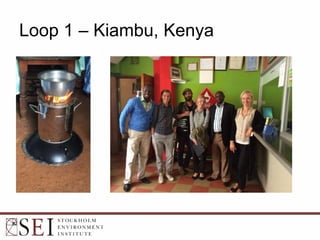
Loop 1 – Kiambu, Kenya
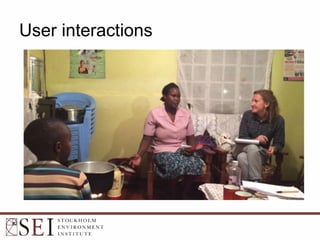
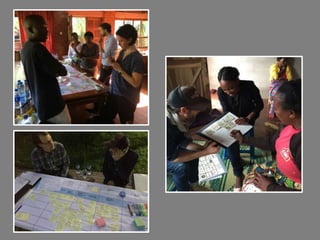
User interactions
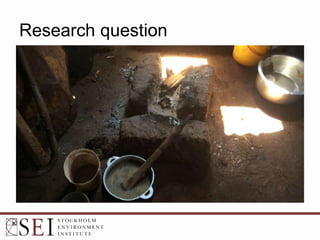
Research question
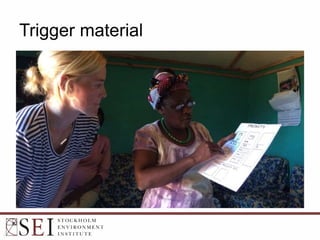
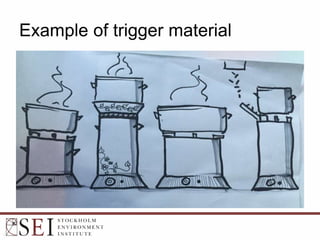
Trigger material
Example of trigger material
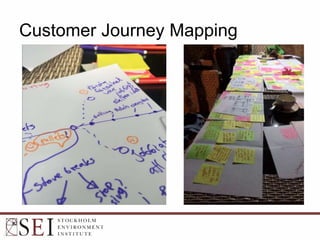
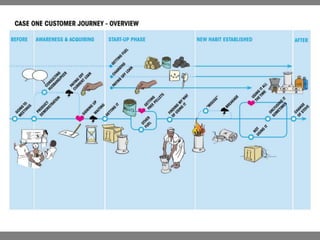
Customer Journey Mapping
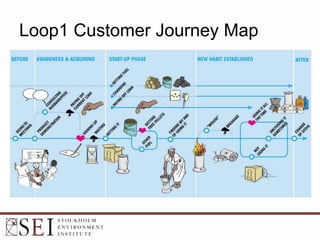
Loop1 Customer Journey Map
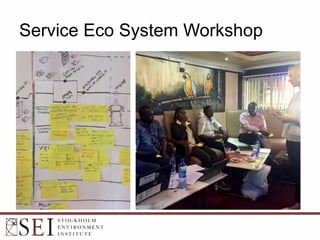
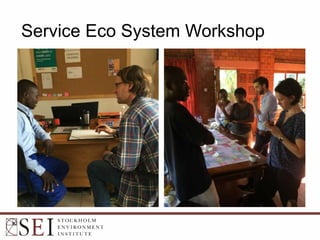
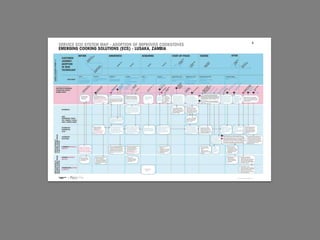
Service Eco System Workshop
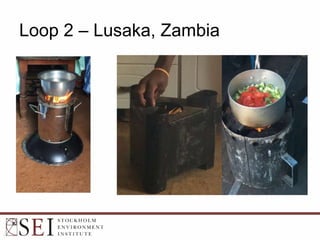
Loop 2 – Lusaka, Zambia
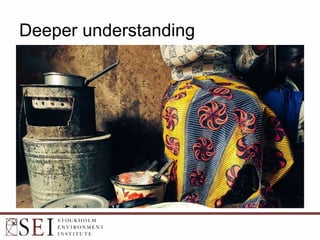
Deeper understanding
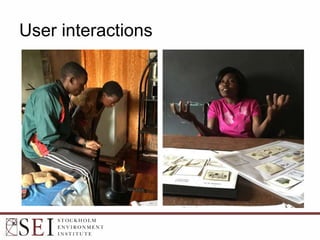
User interactions
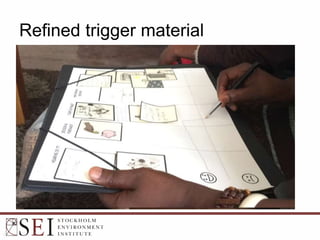
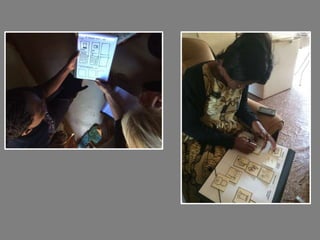
Refined trigger material
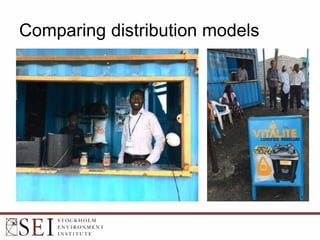
Comparing distribution models
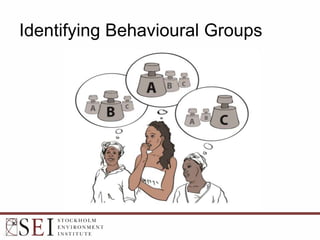
Identifying Behavioural Groups
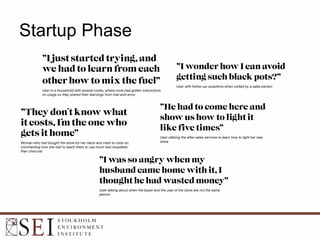
Startup Phase
Service Eco System Workshop
Make the methods more “research like”
Thank you!

Breakfast Seminar September 8 2016

Editor's Notes

  • #3 About SEI and the initiative Examine relationship between people and technologies and services
  • #4 WHY DO SO MANY TECHNOLOGICAL INTERVENTIONS FAIL?
  • #5 Even when stoves are given out for free, often not adopted Refugee camp in Somalia
  • #6 “standard research methods not enough” It is very difficult to understand why people who have access to advanced stoves don’t use them, can’t verbalise why they bought them, why the like them, or why the don’t use them.
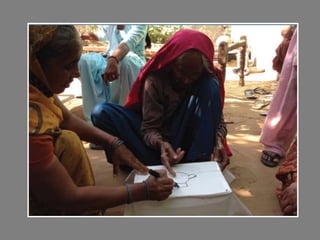
  • #7 Several of my colleagues started to dabble around with generative/design research methods. Here in Dehli, India, getting men and women to sketch their ideal stove. Realised that we wanted to more of this.
  • #8 Team up with Transformator
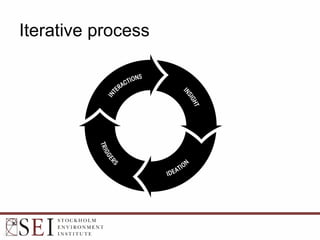
  • #9 8. In service design methodology we work with iterations to gain deeper understanding, usually in the same place but with new users/customer, but in this case the iterations took place in two different countries
  • #10 KENYA: – Loop 1 Context – Kiambu County Key stakeholders Philips is the Manufacturer of advanced cookstoves within this study and has a regional office in Nairobi. Our local partner (VEP) distributor of Philips stoves in Kenya & (set up womens group, savings programs and provide micro finance solutions),
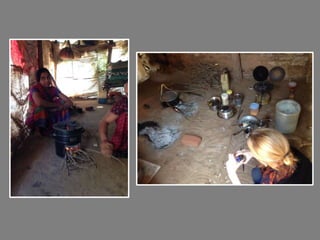
  • #11 INTERACTIONS: During a five days of fieldwork. Interacted with 19 households, as well as and local stakeholders , intractions between 1-3 hours, observations, while cooking or kitchen area
  • #12 Main focus was to understand what determined continuous usage of a stove, instead of going back to using the prior cooking solutions (In Kenya, often threestone fires). But it became clear, as so often, that you can not detach one phase of the customer journey, isolated in itself it can not be understood. We needed to understand the entire experience of the user in getting and using an improved cookstove.
  • #13 An important tool to getting the respondents to open up was visual material, sketches of objects and situations related to cooking, that were produced in between or even during the interviews. By over and over presenting the ideas from one respondent to the next, to react and reflect upon, they automatically refined relevant ideas and sorted out the irrelevant ones.
  • #14 In the first round of interviews, the users claimed to be happy with the usage and had no suggestions for improvements of the stove. But when showing images of stoves with different simple variations, such as hight, width and materials suddenly something happened. Users spontaneously started talking about pro´s and con´s with the different designs, giving clues on how they experienced using the current stove. E.g. “Oh I would love if it was higher, then it wouldn´t burn the food” Or “A wider one would definitely make less pellets go to waste at the bottom” They even started coming up with new suggestions for designs, services and solutions.)
  • #15 To structure the qualitative data collected we used what we call a CJM – a tool for sorting aggregated insights in phases: before, during and after, also a way to sort where the user experiences pain- and gainpoints – extremely useful way of understanding the entire process and breaking it into manageable pieces
  • #16 This is what a typical CJM looked like for a Kenyan consumer. Here are a few of the things we identified. Special context – The stove reseller helped organised women groups (often church-groups), and provided micro finance plans and continuously offered their products, this created trust and a natural distribution channel Main phases we found in Kenya are Before, Awareness & Acquiring, Start-up Phase, New Habit Established and After Phase (Evaluation in startup-phase is DEPENDENT on expectations set in awareness-phase) Main painpoints ((salesmen culture: mission accomplished = product sold, not when established continues use of new product), waiting for product, some times several month,
  • #17 In addition to the CJM we also held a workshop together with the key stakeholders to map out the eco system around the customers journey, their rolls and what impact they had.
  • #18 , two types of stoves (Philips, but also simplier, locally designed VL stove) 2 different resellors/distributors, i´ll come back to that
  • #19 Overall researchquestion
  • #20 17 households over 5 days Observations, interviews etc See trigger material in the bottom of the picture…
  • #21 Zambia Picture-library built on insights from loop one in Kenya as well as stakeholder interviews Emotional journey Used pre-prepared trigger material, [pics of cards ] in order to verify, but also refine the knowledge of the journey. We also asked people about their emotional journey Say something about what differs, what different kinds of responses? People would actively choose, or dismiss of presented cards, and draw their own.
  • #22 As allways as in our methodology, every loopbuild on the prior one, making some insights shine brighter and some fade away. Ill share some examples. The customer journey from Kenya started with a context being set, the women going to women groups. In Zambia we had opportunity to study customers to two different distributors with different business models. One would show up at workplaces and hold introductions and offer a instalment-plan, whilst the other had a strategy of local precence trough showrooms/shops in local neighbourhoods and more subsidiced stoves, possible for more to buy off the shelf. This gave much more insights on the before-phase, where we could refine the expectations Per mentioned.
  • #23 Bild på citat istället? Inte ha med rubrikerna på bilden! What expectations? Found tendences of three main drivers Savings: save money. Takes a while before the value is realised, seem aware of this (show chart) Bild på citat Convenience: individual definition, save time, black pots, monitor, travel. Relatively immediate improvement for value to be realised. Bild på citat Aesthetic appeal/”Newness”: social status or personal kick/stimulus. Newness decreased over time. Immediate rewards, does not necessarily motivate long-term use. The way tech delivers on this main driver also affects if the users stays motivated to learn to adopt the technology or not. Ideal customer: mix of all drivers, motivated to invest time in learning. Startup phase = make it or break it, but most stakeholders just drops out after selling it.
  • #25 We also got the value of thestart-up phase confirmed. In cases where the Zambian companies had after sales support, it was both used and apprechiated. Something that proved to be important was also the reliability in fuel supply, since distribution was not part of a continuous group, there were hesitations against how certain and long-term the companies and their production and supply would be… Bild på bränsle? A lot of confusion, old habits,
  • #27 Fantastic thing 1: CJM as a tool to untangle why adoption does and does not happen
  • #28 Trigger material
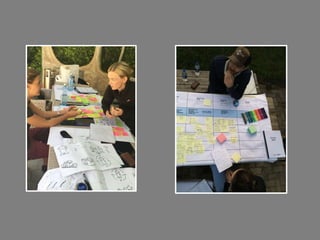
  • #29 Working together as a team, including with the “interviewee”. Collective brainstorming and top of mind.
  • #30 Trigger material