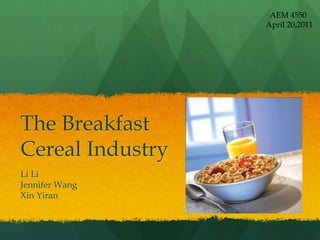
The Breakfast
Cereal Industry
Li Li
Jennifer Wang
Xin Yiran
AEM 4550
April 20,2011
Outline
 Introduction
 Industry Analysis
 Advertising Strategies
 Investment & Recommendation
Why the Breakfast Cereal
Industry?
• “Breakfast is the most important meal of the day” –
Metamorphosis, Franz Kafka, 1915
 Body fasts for 6-9 hours the night prior – “break-
fast”- breaks the fasting
• 93% of respondents reported household use of cold
cereal, 68% - hot cereal (Experian Simmons NCS data)
• “Americans buy 2.7 billion packages of breakfast cereal
each year. If laid end to end, the empty cereal boxes
from one year's consumption would stretch to the moon
and back. “ – Cerealizing America: The Unsweetened Story
of American Breakfast Cereal
Industry Analysis
Industry Definition
 US Cereal Production industry takes raw materials like corn,
wheat, flour, and sugar from different sources and turns
these ingredients into ready-to-eat cereals, hot cereals, and
cereal bars
 Main activities involve manufacturing:
- cold and hot breakfast cereal
- breakfast and snack bars
Industry Structure
Industry Structure
 HHI = 1822.86
 C4 = 76%
 Mergers will be challenged since HHI >1800
 Industry is an oligopoly with four main firms
Industry Structure
Kellogg
Company
34%
General Mills
Inc.
20%
Ralhorp
Holdings Inc.
14%
PepsiCo Inc.
8%
Other
24%
Major Companies
Industry Analysis
Life Cycle Stage Mature Barriers to Entry High
Capital Intensity High Technology Change High
Competition Level High Regulation Level Heavy
Key Success Factors
Product
Differentiation
EOS
Supply
Contract
Adaptability
Cost
Control
Industry Trend
 Expected Slower Growth
-High price of wheat
-Increasing price of coarse grains
 Attitude change towards health consciousness
e.g. Lower sugar and cholesterol, more fiber
 More convenient product to accommodate busy lifestyle
e.g. Breakfast bars
Employment
2006 2007 2008 2009 2010
Average Wage ($) 64183.4 60770.7 61061.9 62173.3 63730
Distribution
Imports & Exports
 Insignificant as major
companies own
facilities internationally
 Major trading
countries: Canada &
Mexico
 Imports are growing
while exports are
declining
Primary Advertising Methods
 Persuasive Advertising
 Informative Advertising
 Memory Jamming
 Celebrities
 Humor
 Emotional Appeal
 Promotions & Giveaways
 Segmentation
Persuasive Advertising
 Persuasive advertising is effective for experience
goods
 Honey Bunches of Oats – “There’s a box here with
your name on it!”
Honey Bunches of Oats
Commercial
Informative Advertising
 Direct Signaling
 Educational. Tells the consumer the health benefits
 Cheerios:
Informative Advertising
 Indirect Signaling
 Match product to buyers effect
 Saturday morning cartoons
 Measurable change in consumer preference and
market share of advertised products
 E.g. Kellogg’s high fiber cereal
Memory Jamming
 Repeated commercial plays
 Signaling efficiency effect
 Recognizable Mascots
 Catchy slogans and Jingles:
 “They’re Gr-r-r-eat!” –
Kellogg’s Frosted Flakes
 “Silly Rabbit, Trix are for
kids!” – Trix
Memory Jamming
Celebrity Endorsement
 Celebrities can increase brand
equity
 Wheaties: “The Breakfast of
Champions”
 Need to be careful of impact
on brand
 Michael Phelps
Humor
 Keeps audience attentive
 Difficult to appeal to everyone because people have
different preferences
 Cocoa Puffs:
Emotional
Appeal
• Form stronger
connection to consumer
• General Mills used
special promotion boxes
with retro designs
• Seeks to motivate
parents, by using
nostalgia
Cheerios Commercial
Promotions and
Giveaways
 Incentive for the
consumers to buy the
cereal
 Draws attention
 Include a toy or
opportunity to win
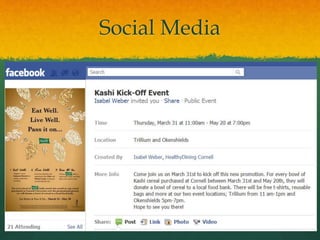
 Kashi Kick-Off Event at
Cornell
Segmentation
 Many commercials targeted children with highly
animated commercials
 Saturday morning cartoons is perfect time to target
the young audience
 Cap’n Crunch:
Segmentation
 After FTC’s warnings, cereal companies have
shifted toward targeting the adult audience
 More health-conscious
 Multi-Grain Cheerios:
Segmentation
 General Mills increased Hispanic-targeted media
spending in 2009 and 2010
 Cinnamon Toast Crunch particularly appeals to
Hispanics
 Baby Boomers- another key market
 Highest per capita cereal consumption by people over
55
 Seek to add fiber to diets (Fiber One, Multi-Grain
Cheerios)
Cheerios Targeted Toward
Both Children and Adults
Advertising Mediums
 TV
 Product Placement
 Print
 Online
Television Advertising
 Advertised mostly on Mon, Tues, Fri
 Mostly Advertised during 7-8 PM, 9 AM
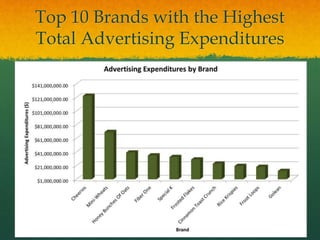
 Dollars spent most on Cheerios, Fiber One, Mini-
Wheats
 Largest Ads Spending during July, Aug
 Spent most on cold cereals especially the healthy
category such as Honey Nut Cheerios, Fiber One,
Multi-Grain Cheerios, but highest average dollar
spent per advertisement on hot cereals
Television Advertising
 Uses segmentation to target different audience
- More colorful, energetic, and animated commercials
for young children
- Use character mascots to connect to kids such as
Tony the Tiger, General Mill’s Trix Rabbit
- Focuses on nutritional content to target adults
Average Advertising Cost
per Day of Week
Top 10 Brands with the Highest
Total Advertising Expenditures
Top Program Types to
Advertise On
Healthy vs. Unhealthy
Cereal
Popular Program Types to Advertise Healthy Cereal
Popular Program Types to Advertise Unhealthy Cereal
Program Type Number of Ads
NEWSCAST (LOCAL ONLY) 138348
SITUATION COMEDY 93336
TALK 59858
SLICE-OF-LIFE 37354
Program Type Number of Ads
ANIMATION(LOCAL ONLY) 18347
CHILDRENS/FAMILY ENTERTAINMENT 4047
SITUATION COMEDY 3976
FEATURE FILM 2956
10 Most Popular Shows to
Advertise On
Most Expensive Ad Spots
for Cereal Ads
Show Ad Cost
AMERICAN IDOL $ 823,700
GREY'S ANATOMY $ 577,800
AMERICAN MUSIC AWARDS $ 361,100
NCAA Basketball Playoff Game 22 $ 281,100
NCAA Basketball Playoff Game 21 $ 281,100
Product Placement
 More common with the advent of Internet and TiVo
 Popular shows feature consumption of certain
cereal brands e.g. Frosted Flakes on “Friends”
 Audience are “forced” to watch the ads
 Careful not to ‘overdo’ it
 Effective if it is natural and integrated
Product Placement in Days
of Our Lives
Ad Spending of Top 4 Firms
Ad-to- Sales Ratio
Comparison
Ad-to-Sales Ratio
 1.2 times higher than the food sector
 3.5 times higher than the average value for all other
industries
 High profit margin
Kellogg Co
 Corn Flakes, Frosted Flakes, All-Bran, Apple Jacks,
Crispix, Rice Krispies, Froot Loops, Nutri-Grain
 Highest Advertising Expenditure
 Highest Ad-Sales Ratio
 Focuses on eight top sellers and Kashi cereal
 Kashi highlights healthy lifestyle, including
consuming natural foods and staying active
 Boston, Portland, LA
General Mills
 Brand Names: Cheerios, Fiber One, Kix, Wheaties,
Lucky Charms, Total
 Invested heavily in R&D and product innovation
 Target Large Cities e.g. New York, San Francisco,
Boston
Ralcorp Holdings, Inc.
 Brand Names: Honey Bunches of Oats, Pebbles,
Shredded Wheat, Post Raisin Bran, Grape-Nuts,
Honeycomb
 Acquired Post
 Both private label and branded cereals
 New Orleans, Cincinnati, Green Bay
PepsiCo Inc.
 Brand Names: Quaker Foods North America
(QFNA), Quaker Oatmeal, Life , Cap'n Crunch
 Richmond, Jacksonville, Norfolk
Perceptual Map
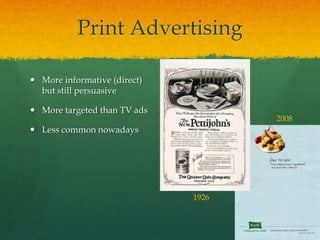
Print Advertising
 More informative (direct)
but still persuasive
 More targeted than TV ads
 Less common nowadays
1926
2008
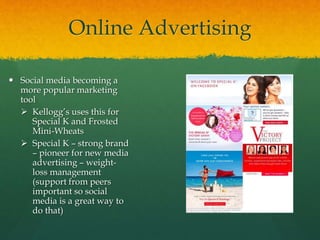
Online Advertising
 Social media becoming a
more popular marketing
tool
 Kellogg’s uses this for
Special K and Frosted
Mini-Wheats
 Special K – strong brand
– pioneer for new media
advertising – weight-
loss management
(support from peers
important so social
media is a great way to
do that)
Social Media
Brand Equity
 Crucial in order to stand out among hundreds of
brands
 Makes demand less elastic to price
 Emotional branding
Regulation
 Regulation level is high and increasing
 2007 – Self-regulation of marketing to youth
 Children's Food and Beverage Advertising Initiative
 Kellogg said would not promote foods in TV, radio, print or Web
site ads that reach audiences at least half of whom are under age 12
unless a serving of the product follows specific guidelines
 2008 – Federal Trade Commission published study on food
marketing to children and recommended that companies “adopt
and adhere to meaningful, nutrition-based standards for
marketing their products to children under 12”
False Health Claims
 Kellogg Co. came under scrutiny in 2009 and 2010
because of false health claims in advertisements
 Frosted Mini-Wheats: “clinically shown to improve kids’
attentiveness by nearly 20%”
 Rice Krispies: “now helps support your child’s immunity,”
with “25 percent Daily Value of Antioxidants and Nutrients
– Vitamins A, B, C, and E”
 FTC delivered strong message – won’t tolerate false
health claims
 Kellogg prohibited from making claims about any health
benefit unless backed by scientific evidence and not
misleading
Recommendation for
Management
 Local newscast is among the cheapest
 Sports events such as baseball and basketball are
expensive
 Talk show or soap opera as they target more
towards women and they control more than 80% of
spending
 Follow FTC regulation, otherwise would be heavily
penalized
Recommendation for
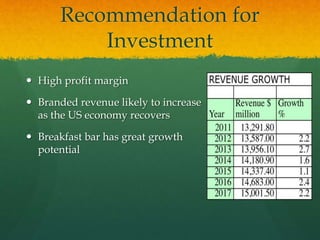
Investment
 High profit margin
 Branded revenue likely to increase
as the US economy recovers
 Breakfast bar has great growth
potential
Videos
 Honey Bunches of Oats:
http://www.youtube.com/watch?v=em9thvkiS7I
 Cocoa Puffs:
http://www.youtube.com/watch?v=xBGpRLjNnzM
 Cheerios 1:b. http://www.youtube.com/watch?v=pDNgbQ-
bQpA
 Cheerios 2: http://www.youtube.com/watch?v=aARf-XwDGFg
 Multigrain Cheerios: http://www.youtube.com/watch?v=-
IZ9CL4phPk
 Product placement:
http://www.youtube.com/watch?v=oGtig5DiTxc

Breakfast cereal industry final presentation

  • 1.
    The Breakfast Cereal Industry LiLi Jennifer Wang Xin Yiran AEM 4550 April 20,2011
  • 2.
    Outline  Introduction  IndustryAnalysis  Advertising Strategies  Investment & Recommendation
  • 3.
    Why the BreakfastCereal Industry? • “Breakfast is the most important meal of the day” – Metamorphosis, Franz Kafka, 1915  Body fasts for 6-9 hours the night prior – “break- fast”- breaks the fasting • 93% of respondents reported household use of cold cereal, 68% - hot cereal (Experian Simmons NCS data) • “Americans buy 2.7 billion packages of breakfast cereal each year. If laid end to end, the empty cereal boxes from one year's consumption would stretch to the moon and back. “ – Cerealizing America: The Unsweetened Story of American Breakfast Cereal
  • 4.
  • 5.
    Industry Definition  USCereal Production industry takes raw materials like corn, wheat, flour, and sugar from different sources and turns these ingredients into ready-to-eat cereals, hot cereals, and cereal bars  Main activities involve manufacturing: - cold and hot breakfast cereal - breakfast and snack bars
  • 6.
  • 7.
    Industry Structure  HHI= 1822.86  C4 = 76%  Mergers will be challenged since HHI >1800  Industry is an oligopoly with four main firms
  • 8.
  • 9.
    Industry Analysis Life CycleStage Mature Barriers to Entry High Capital Intensity High Technology Change High Competition Level High Regulation Level Heavy
  • 10.
  • 11.
    Industry Trend  ExpectedSlower Growth -High price of wheat -Increasing price of coarse grains  Attitude change towards health consciousness e.g. Lower sugar and cholesterol, more fiber  More convenient product to accommodate busy lifestyle e.g. Breakfast bars
  • 12.
    Employment 2006 2007 20082009 2010 Average Wage ($) 64183.4 60770.7 61061.9 62173.3 63730
  • 13.
  • 14.
    Imports & Exports Insignificant as major companies own facilities internationally  Major trading countries: Canada & Mexico  Imports are growing while exports are declining
  • 15.
    Primary Advertising Methods Persuasive Advertising  Informative Advertising  Memory Jamming  Celebrities  Humor  Emotional Appeal  Promotions & Giveaways  Segmentation
  • 16.
    Persuasive Advertising  Persuasiveadvertising is effective for experience goods  Honey Bunches of Oats – “There’s a box here with your name on it!”
  • 17.
    Honey Bunches ofOats Commercial
  • 18.
    Informative Advertising  DirectSignaling  Educational. Tells the consumer the health benefits  Cheerios:
  • 19.
    Informative Advertising  IndirectSignaling  Match product to buyers effect  Saturday morning cartoons  Measurable change in consumer preference and market share of advertised products  E.g. Kellogg’s high fiber cereal
  • 20.
    Memory Jamming  Repeatedcommercial plays  Signaling efficiency effect  Recognizable Mascots  Catchy slogans and Jingles:  “They’re Gr-r-r-eat!” – Kellogg’s Frosted Flakes  “Silly Rabbit, Trix are for kids!” – Trix
  • 21.
  • 22.
    Celebrity Endorsement  Celebritiescan increase brand equity  Wheaties: “The Breakfast of Champions”  Need to be careful of impact on brand  Michael Phelps
  • 23.
    Humor  Keeps audienceattentive  Difficult to appeal to everyone because people have different preferences  Cocoa Puffs:
  • 24.
    Emotional Appeal • Form stronger connectionto consumer • General Mills used special promotion boxes with retro designs • Seeks to motivate parents, by using nostalgia
  • 25.
  • 26.
    Promotions and Giveaways  Incentivefor the consumers to buy the cereal  Draws attention  Include a toy or opportunity to win  Kashi Kick-Off Event at Cornell
  • 27.
    Segmentation  Many commercialstargeted children with highly animated commercials  Saturday morning cartoons is perfect time to target the young audience  Cap’n Crunch:
  • 28.
    Segmentation  After FTC’swarnings, cereal companies have shifted toward targeting the adult audience  More health-conscious  Multi-Grain Cheerios:
  • 29.
    Segmentation  General Millsincreased Hispanic-targeted media spending in 2009 and 2010  Cinnamon Toast Crunch particularly appeals to Hispanics  Baby Boomers- another key market  Highest per capita cereal consumption by people over 55  Seek to add fiber to diets (Fiber One, Multi-Grain Cheerios)
  • 30.
    Cheerios Targeted Toward BothChildren and Adults
  • 31.
    Advertising Mediums  TV Product Placement  Print  Online
  • 32.
    Television Advertising  Advertisedmostly on Mon, Tues, Fri  Mostly Advertised during 7-8 PM, 9 AM  Dollars spent most on Cheerios, Fiber One, Mini- Wheats  Largest Ads Spending during July, Aug  Spent most on cold cereals especially the healthy category such as Honey Nut Cheerios, Fiber One, Multi-Grain Cheerios, but highest average dollar spent per advertisement on hot cereals
  • 33.
    Television Advertising  Usessegmentation to target different audience - More colorful, energetic, and animated commercials for young children - Use character mascots to connect to kids such as Tony the Tiger, General Mill’s Trix Rabbit - Focuses on nutritional content to target adults
  • 34.
  • 35.
    Top 10 Brandswith the Highest Total Advertising Expenditures
  • 36.
    Top Program Typesto Advertise On
  • 37.
    Healthy vs. Unhealthy Cereal PopularProgram Types to Advertise Healthy Cereal Popular Program Types to Advertise Unhealthy Cereal Program Type Number of Ads NEWSCAST (LOCAL ONLY) 138348 SITUATION COMEDY 93336 TALK 59858 SLICE-OF-LIFE 37354 Program Type Number of Ads ANIMATION(LOCAL ONLY) 18347 CHILDRENS/FAMILY ENTERTAINMENT 4047 SITUATION COMEDY 3976 FEATURE FILM 2956
  • 38.
    10 Most PopularShows to Advertise On
  • 39.
    Most Expensive AdSpots for Cereal Ads Show Ad Cost AMERICAN IDOL $ 823,700 GREY'S ANATOMY $ 577,800 AMERICAN MUSIC AWARDS $ 361,100 NCAA Basketball Playoff Game 22 $ 281,100 NCAA Basketball Playoff Game 21 $ 281,100
  • 40.
    Product Placement  Morecommon with the advent of Internet and TiVo  Popular shows feature consumption of certain cereal brands e.g. Frosted Flakes on “Friends”  Audience are “forced” to watch the ads  Careful not to ‘overdo’ it  Effective if it is natural and integrated
  • 41.
    Product Placement inDays of Our Lives
  • 42.
    Ad Spending ofTop 4 Firms
  • 43.
  • 44.
    Ad-to-Sales Ratio  1.2times higher than the food sector  3.5 times higher than the average value for all other industries  High profit margin
  • 45.
    Kellogg Co  CornFlakes, Frosted Flakes, All-Bran, Apple Jacks, Crispix, Rice Krispies, Froot Loops, Nutri-Grain  Highest Advertising Expenditure  Highest Ad-Sales Ratio  Focuses on eight top sellers and Kashi cereal  Kashi highlights healthy lifestyle, including consuming natural foods and staying active  Boston, Portland, LA
  • 46.
    General Mills  BrandNames: Cheerios, Fiber One, Kix, Wheaties, Lucky Charms, Total  Invested heavily in R&D and product innovation  Target Large Cities e.g. New York, San Francisco, Boston
  • 47.
    Ralcorp Holdings, Inc. Brand Names: Honey Bunches of Oats, Pebbles, Shredded Wheat, Post Raisin Bran, Grape-Nuts, Honeycomb  Acquired Post  Both private label and branded cereals  New Orleans, Cincinnati, Green Bay
  • 48.
    PepsiCo Inc.  BrandNames: Quaker Foods North America (QFNA), Quaker Oatmeal, Life , Cap'n Crunch  Richmond, Jacksonville, Norfolk
  • 49.
  • 50.
    Print Advertising  Moreinformative (direct) but still persuasive  More targeted than TV ads  Less common nowadays 1926 2008
  • 51.
    Online Advertising  Socialmedia becoming a more popular marketing tool  Kellogg’s uses this for Special K and Frosted Mini-Wheats  Special K – strong brand – pioneer for new media advertising – weight- loss management (support from peers important so social media is a great way to do that)
  • 52.
  • 53.
    Brand Equity  Crucialin order to stand out among hundreds of brands  Makes demand less elastic to price  Emotional branding
  • 54.
    Regulation  Regulation levelis high and increasing  2007 – Self-regulation of marketing to youth  Children's Food and Beverage Advertising Initiative  Kellogg said would not promote foods in TV, radio, print or Web site ads that reach audiences at least half of whom are under age 12 unless a serving of the product follows specific guidelines  2008 – Federal Trade Commission published study on food marketing to children and recommended that companies “adopt and adhere to meaningful, nutrition-based standards for marketing their products to children under 12”
  • 55.
    False Health Claims Kellogg Co. came under scrutiny in 2009 and 2010 because of false health claims in advertisements  Frosted Mini-Wheats: “clinically shown to improve kids’ attentiveness by nearly 20%”  Rice Krispies: “now helps support your child’s immunity,” with “25 percent Daily Value of Antioxidants and Nutrients – Vitamins A, B, C, and E”  FTC delivered strong message – won’t tolerate false health claims  Kellogg prohibited from making claims about any health benefit unless backed by scientific evidence and not misleading
  • 56.
    Recommendation for Management  Localnewscast is among the cheapest  Sports events such as baseball and basketball are expensive  Talk show or soap opera as they target more towards women and they control more than 80% of spending  Follow FTC regulation, otherwise would be heavily penalized
  • 57.
    Recommendation for Investment  Highprofit margin  Branded revenue likely to increase as the US economy recovers  Breakfast bar has great growth potential
  • 59.
    Videos  Honey Bunchesof Oats: http://www.youtube.com/watch?v=em9thvkiS7I  Cocoa Puffs: http://www.youtube.com/watch?v=xBGpRLjNnzM  Cheerios 1:b. http://www.youtube.com/watch?v=pDNgbQ- bQpA  Cheerios 2: http://www.youtube.com/watch?v=aARf-XwDGFg  Multigrain Cheerios: http://www.youtube.com/watch?v=- IZ9CL4phPk  Product placement: http://www.youtube.com/watch?v=oGtig5DiTxc