Brazil
History

   Portuguese explorers first made
    contact in the 1500s
   Brazil wood was the initial export,
    and lead to the rise of the
    sugarcane industry
   Gold and diamond deposits were
    mined by the African and
    Amerindian Slaves in the 1700s
   1808-1815 Brazil was the seat of
    the Portuguese court and Empire
History

   1835 Brazil had the largest slave
    rebellion in the Americas, the Malê
    Revolt
   Brazil was last to abolish slavery
    in 1888
   Getulio Vargas held dictatorial
    control after a coup in 1930 until
    1945
   Besides a military coup from 1964
    to 1989, Brazil has held
    Democratic
Geography

        Brazil is the 5th largest
         country after Russia,
         Canada, America, and
         China
        Brazil is split up
         Hydro-graphically
        The largest river in
         Brazil is the Amazon, it
         stretches some 4000
         miles
Geography
               Shares a border with
                every South American
                country but Ecuador and
                Chile
               1/3 of the territory is
                Pre-Cambrian – almost
                240 million years old
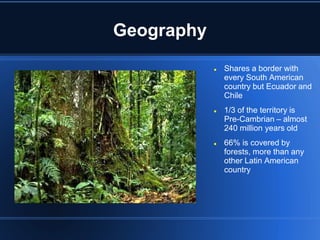
               66% is covered by
                forests, more than any
                other Latin American
                country
Brazilians

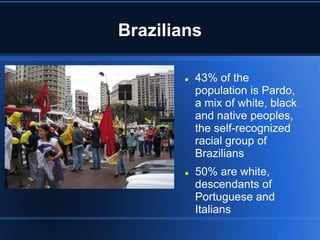
          43% of the
           population is Pardo,
           a mix of white, black
           and native peoples,
           the self-recognized
           racial group of
           Brazilians
          50% are white,
           descendants of
           Portuguese and
           Italians
Brazilians
   Brazil received 35% of the
    Africans brought to the
    Americas in the slave trade
   There are currently 184
    Million people living in Brazil,
    making it the 5th most
    populace in the world
   Brazil as well holds the 10th
    largest GDP at $1.99 Trillion
Culture

   Brazil has people from Japan, Portugal, Germany and Italy as
    well as the 3 million Slaves and Native people, who all bring
    their own culture
   Although extremely diverse, 70% of the population identifies as
    Roman Catholic
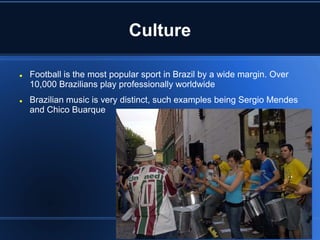
Culture

   Football is the most popular sport in Brazil by a wide margin. Over
    10,000 Brazilians play professionally worldwide
   Brazilian music is very distinct, such examples being Sergio Mendes
    and Chico Buarque
References

   https://www.cia.gov/library/publications/the-
    world-
    factbook/rankorder/2001rank.htmlhttp://en.wikip
    edia.org/wiki/Male_Revolt
   http://en.wikipedia.org/wiki/Male_Revolt
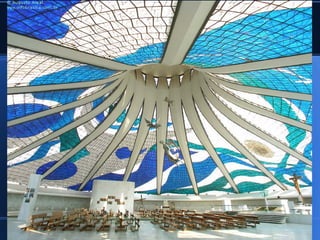
Architecture

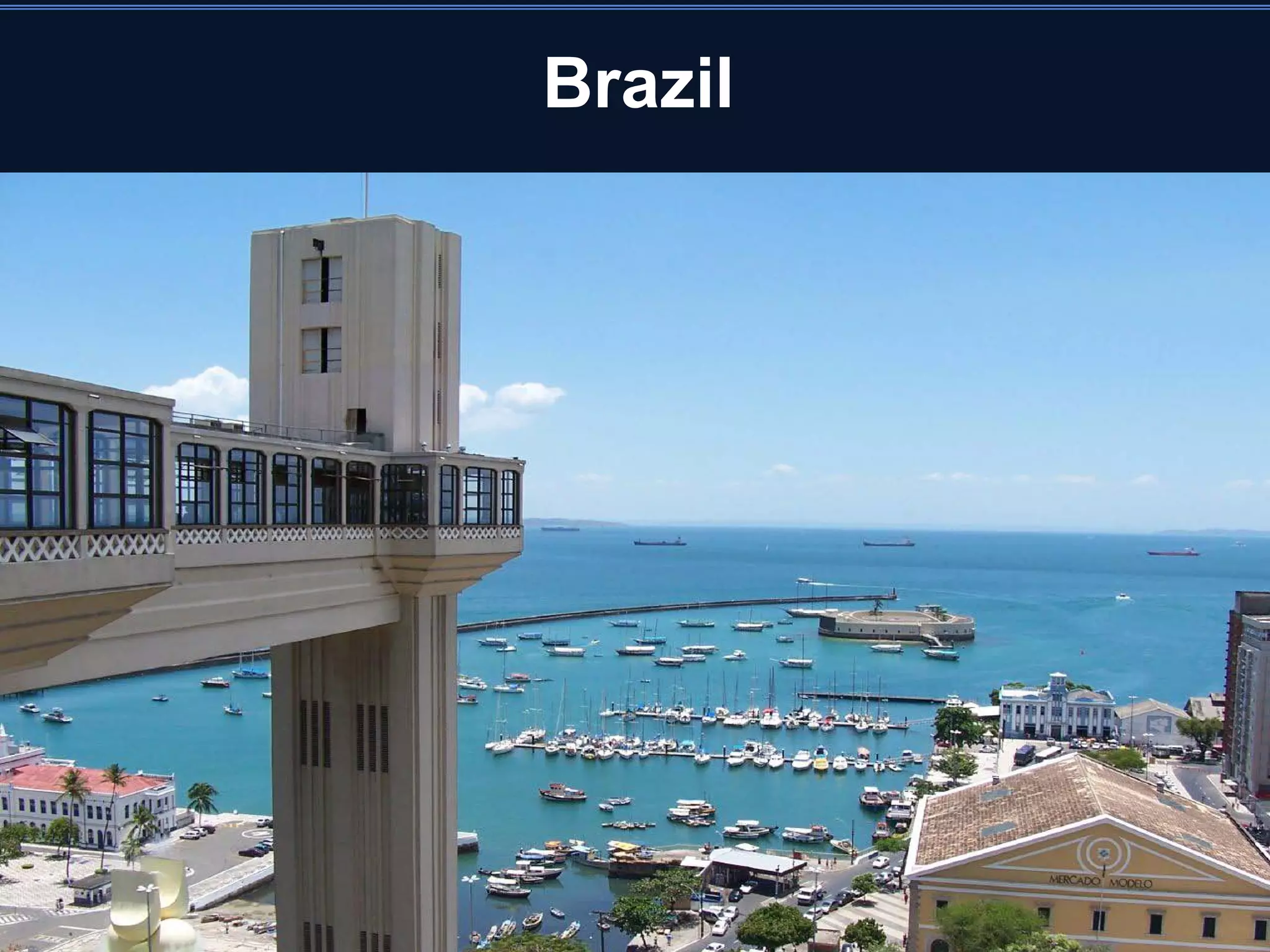
   As Brazil's economy explodes,
    new art rises as the buildings
   The developing regions of
    Salvador, Rio de Janeiro, and
    São Paulo have become richer,
    and are currently home to some
    of the most elaborate Architects
    in the world
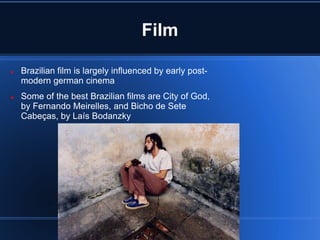
Film

   Brazilian film is largely influenced by early post-
    modern german cinema
   Some of the best Brazilian films are City of God,
    by Fernando Meirelles, and Bicho de Sete
    Cabeças, by Laís Bodanzky
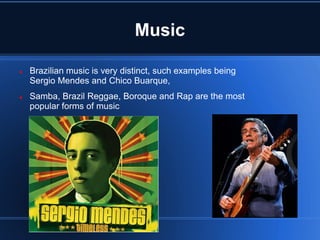
Music

   Brazilian music is very distinct, such examples being
    Sergio Mendes and Chico Buarque,
   Samba, Brazil Reggae, Boroque and Rap are the most
    popular forms of music
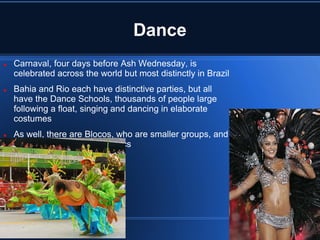
Dance
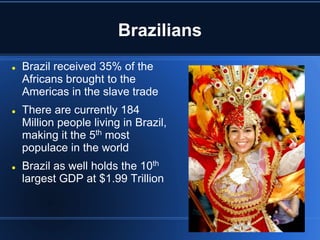
   Carnaval, four days before Ash Wednesday, is
    celebrated across the world but most distinctly in Brazil
   Bahia and Rio each have distinctive parties, but all
    have the Dance Schools, thousands of people large
    following a float, singing and dancing in elaborate
    costumes
   As well, there are Blocos, who are smaller groups, and
    tend to satirize current politics

Brazil All

  • 1.
  • 2.
    History  Portuguese explorers first made contact in the 1500s  Brazil wood was the initial export, and lead to the rise of the sugarcane industry  Gold and diamond deposits were mined by the African and Amerindian Slaves in the 1700s  1808-1815 Brazil was the seat of the Portuguese court and Empire
  • 3.
    History  1835 Brazil had the largest slave rebellion in the Americas, the Malê Revolt  Brazil was last to abolish slavery in 1888  Getulio Vargas held dictatorial control after a coup in 1930 until 1945  Besides a military coup from 1964 to 1989, Brazil has held Democratic
  • 4.
    Geography  Brazil is the 5th largest country after Russia, Canada, America, and China  Brazil is split up Hydro-graphically  The largest river in Brazil is the Amazon, it stretches some 4000 miles
  • 5.
    Geography  Shares a border with every South American country but Ecuador and Chile  1/3 of the territory is Pre-Cambrian – almost 240 million years old  66% is covered by forests, more than any other Latin American country
  • 6.
    Brazilians  43% of the population is Pardo, a mix of white, black and native peoples, the self-recognized racial group of Brazilians  50% are white, descendants of Portuguese and Italians
  • 7.
    Brazilians  Brazil received 35% of the Africans brought to the Americas in the slave trade  There are currently 184 Million people living in Brazil, making it the 5th most populace in the world  Brazil as well holds the 10th largest GDP at $1.99 Trillion
  • 8.
    Culture  Brazil has people from Japan, Portugal, Germany and Italy as well as the 3 million Slaves and Native people, who all bring their own culture  Although extremely diverse, 70% of the population identifies as Roman Catholic
  • 9.
    Culture  Football is the most popular sport in Brazil by a wide margin. Over 10,000 Brazilians play professionally worldwide  Brazilian music is very distinct, such examples being Sergio Mendes and Chico Buarque
  • 10.
    References  https://www.cia.gov/library/publications/the- world- factbook/rankorder/2001rank.htmlhttp://en.wikip edia.org/wiki/Male_Revolt  http://en.wikipedia.org/wiki/Male_Revolt
  • 11.
    Architecture  As Brazil's economy explodes, new art rises as the buildings  The developing regions of Salvador, Rio de Janeiro, and São Paulo have become richer, and are currently home to some of the most elaborate Architects in the world
  • 12.
    Film  Brazilian film is largely influenced by early post- modern german cinema  Some of the best Brazilian films are City of God, by Fernando Meirelles, and Bicho de Sete Cabeças, by Laís Bodanzky
  • 13.
    Music  Brazilian music is very distinct, such examples being Sergio Mendes and Chico Buarque,  Samba, Brazil Reggae, Boroque and Rap are the most popular forms of music
  • 14.
    Dance  Carnaval, four days before Ash Wednesday, is celebrated across the world but most distinctly in Brazil  Bahia and Rio each have distinctive parties, but all have the Dance Schools, thousands of people large following a float, singing and dancing in elaborate costumes  As well, there are Blocos, who are smaller groups, and tend to satirize current politics