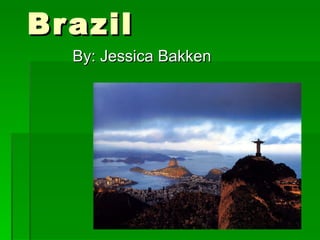
Brazil By: Jessica Bakken
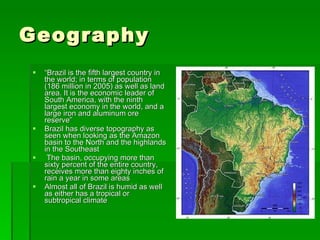
Geography “ Brazil is the fifth largest country in the world; in terms of population (186 million in 2005) as well as land area. It is the economic leader of South America, with the ninth largest economy in the world, and a large iron and aluminum ore reserve” Brazil has diverse topography as seen when looking as the Amazon basin to the North and the highlands in the Southeast The basin, occupying more than sixty percent of the entire country, receives more than eighty inches of rain a year in some areas  Almost all of Brazil is humid as well as either has a tropical or subtropical climate
Geography (cont.) Brazil encompasses so much of South America that it shares borders with all South American nations except Ecuador and Chile. Brazil is divided into 26 states and a Federal District  The state of Amazonas has the largest area and the most populous is Sao Paulo  Two of the world's fifteen largest cities are in Brazil: Sao Paulo and Rio de Janeiro, and are only about 250 miles (400 km) apart  Sao Paulo is growing at an incredible rate as shown when the population doubled since 1977, it was an 11 million people metropolis.  Both cities have a huge ever-expanding ring of shanty towns and squatter settlements on their periphery
People Brazilians are mostly descendants of colonial and post-colonial Portuguese settlers and immigrants, African  slaves and Brazil's indigenous peoples, along with several other groups of immigrants who arrived in Brazil mostly from the 1820s until the 1970s. Most of the immigrants were Italians and Portuguese, but also significant numbers of Germans, Spaniards, Japanese, and Lebanese and Syrians Whites constitute the majority of Brazil's population and the country has the second largest White population in the Americas, around 93 million, after only the United States, the largest in the Southern Hemisphere, and the third largest in the World, after the U.S. and Russia
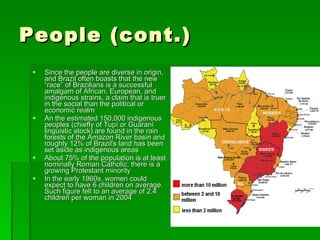
People (cont.) Since the people are diverse in origin, and Brazil often boasts that the new “race” of Brazilians is a successful   amalgam of African, European, and indigenous strains, a claim that is truer in the social than the political or economic realm An the estimated 150,000 indigenous peoples (chiefly of Tupí or Guaraní linguistic stock) are found in the rain forests of the Amazon River basin and roughly 12% of Brazil's land has been set aside as indigenous areas About 75% of the population is at least nominally Roman Catholic; there is a growing Protestant minority In the early 1960s, women could expect to have 6 children on average. Such figure fell to an average of 2.4 children per woman in 2004
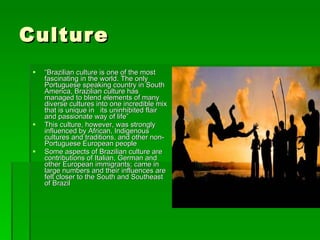
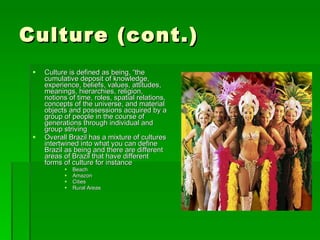
Culture “ Brazilian culture is one of the most fascinating in the world. The only Portuguese speaking country in South America, Brazilian culture has managed to blend elements of many diverse cultures into one incredible mix that is unique in  its uninhibited flair and passionate way of life”  This culture, however, was strongly influenced by African, Indigenous cultures and traditions, and other non-Portuguese European people Some aspects of Brazilian culture are contributions of Italian, German and other European immigrants; came in large numbers and their influences are felt closer to the South and Southeast of Brazil
Culture (cont.) Culture is defined as being, “the cumulative deposit of knowledge, experience, beliefs, values, attitudes, meanings, hierarchies, religion, notions of time, roles, spatial relations, concepts of the universe, and material objects and possessions acquired by a group of people in the course of generations through individual and group striving Overall Brazil has a mixture of cultures intertwined into what you can define Brazil as being and there are different areas of Brazil that have different forms of culture for instance Beach Amazon Cities Rural Areas
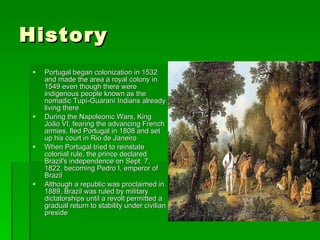
History Portugal began colonization in 1532 and made the area a royal colony in 1549 even though there were indigenous people known as the nomadic Tupí-Guaraní Indians already living there During the Napoleonic Wars, King João VI, fearing the advancing French armies, fled Portugal in 1808 and set up his court in Rio de Janeiro When Portugal tried to reinstate colonial rule, the prince declared Brazil's independence on Sept. 7, 1822, becoming Pedro I, emperor of Brazil Although a republic was proclaimed in 1889, Brazil was ruled by military dictatorships until a revolt permitted a gradual return to stability under civilian preside
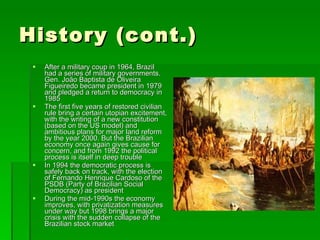
History (cont.) After a military coup in 1964, Brazil had a series of military governments. Gen. João Baptista de Oliveira Figueiredo became president in 1979 and pledged a return to democracy in 1985 The first five years of restored civilian rule bring a certain utopian excitement, with the writing of a new constitution (based on the US model) and ambitious plans for major land reform by the year 2000. But the Brazilian economy once again gives cause for concern, and from 1992 the political process is itself in deep trouble In 1994 the democratic process is safely back on track, with the election of Fernando Henrique Cardoso of the PSDB (Party of Brazilian Social Democracy) as president During the mid-1990s the economy improves, with privatization measures under way but 1998 brings a major crisis with the sudden collapse of the Brazilian stock market
Sources http://geography.about.com/od/specificplacesofinterest/a/geographyofbraz.htm http://en.wikipedia.org/wiki/Brazilian_people http://www.infoplease.com/ce6/world/A0857008.html   http://www.kidscornerbrazil.org/content/people.php   http://www.nexussurf.com/culture.html   http://www.geographia.com/brazil/brazihistory.htm   http://www.tamu.edu/classes/cosc/choudhury/culture.html   http://www.infoplease.com/ipa/A0107357.html   http://www.infoplease.com/ipa/A0107357.html   http://www.google.com/imghp?hl=en&tab=wi   http://www.historyworld.net/wrldhis/PlainTextHistories.asp?groupid=891&HistoryID=aa88&gtrack=pthc

Nation report

  • 1.
  • 2.
    Geography “ Brazilis the fifth largest country in the world; in terms of population (186 million in 2005) as well as land area. It is the economic leader of South America, with the ninth largest economy in the world, and a large iron and aluminum ore reserve” Brazil has diverse topography as seen when looking as the Amazon basin to the North and the highlands in the Southeast The basin, occupying more than sixty percent of the entire country, receives more than eighty inches of rain a year in some areas Almost all of Brazil is humid as well as either has a tropical or subtropical climate
  • 3.
    Geography (cont.) Brazilencompasses so much of South America that it shares borders with all South American nations except Ecuador and Chile. Brazil is divided into 26 states and a Federal District The state of Amazonas has the largest area and the most populous is Sao Paulo Two of the world's fifteen largest cities are in Brazil: Sao Paulo and Rio de Janeiro, and are only about 250 miles (400 km) apart Sao Paulo is growing at an incredible rate as shown when the population doubled since 1977, it was an 11 million people metropolis. Both cities have a huge ever-expanding ring of shanty towns and squatter settlements on their periphery
  • 4.
    People Brazilians aremostly descendants of colonial and post-colonial Portuguese settlers and immigrants, African slaves and Brazil's indigenous peoples, along with several other groups of immigrants who arrived in Brazil mostly from the 1820s until the 1970s. Most of the immigrants were Italians and Portuguese, but also significant numbers of Germans, Spaniards, Japanese, and Lebanese and Syrians Whites constitute the majority of Brazil's population and the country has the second largest White population in the Americas, around 93 million, after only the United States, the largest in the Southern Hemisphere, and the third largest in the World, after the U.S. and Russia
  • 5.
    People (cont.) Sincethe people are diverse in origin, and Brazil often boasts that the new “race” of Brazilians is a successful amalgam of African, European, and indigenous strains, a claim that is truer in the social than the political or economic realm An the estimated 150,000 indigenous peoples (chiefly of Tupí or Guaraní linguistic stock) are found in the rain forests of the Amazon River basin and roughly 12% of Brazil's land has been set aside as indigenous areas About 75% of the population is at least nominally Roman Catholic; there is a growing Protestant minority In the early 1960s, women could expect to have 6 children on average. Such figure fell to an average of 2.4 children per woman in 2004
  • 6.
    Culture “ Brazilianculture is one of the most fascinating in the world. The only Portuguese speaking country in South America, Brazilian culture has managed to blend elements of many diverse cultures into one incredible mix that is unique in its uninhibited flair and passionate way of life” This culture, however, was strongly influenced by African, Indigenous cultures and traditions, and other non-Portuguese European people Some aspects of Brazilian culture are contributions of Italian, German and other European immigrants; came in large numbers and their influences are felt closer to the South and Southeast of Brazil
  • 7.
    Culture (cont.) Cultureis defined as being, “the cumulative deposit of knowledge, experience, beliefs, values, attitudes, meanings, hierarchies, religion, notions of time, roles, spatial relations, concepts of the universe, and material objects and possessions acquired by a group of people in the course of generations through individual and group striving Overall Brazil has a mixture of cultures intertwined into what you can define Brazil as being and there are different areas of Brazil that have different forms of culture for instance Beach Amazon Cities Rural Areas
  • 8.
    History Portugal begancolonization in 1532 and made the area a royal colony in 1549 even though there were indigenous people known as the nomadic Tupí-Guaraní Indians already living there During the Napoleonic Wars, King João VI, fearing the advancing French armies, fled Portugal in 1808 and set up his court in Rio de Janeiro When Portugal tried to reinstate colonial rule, the prince declared Brazil's independence on Sept. 7, 1822, becoming Pedro I, emperor of Brazil Although a republic was proclaimed in 1889, Brazil was ruled by military dictatorships until a revolt permitted a gradual return to stability under civilian preside
  • 9.
    History (cont.) Aftera military coup in 1964, Brazil had a series of military governments. Gen. João Baptista de Oliveira Figueiredo became president in 1979 and pledged a return to democracy in 1985 The first five years of restored civilian rule bring a certain utopian excitement, with the writing of a new constitution (based on the US model) and ambitious plans for major land reform by the year 2000. But the Brazilian economy once again gives cause for concern, and from 1992 the political process is itself in deep trouble In 1994 the democratic process is safely back on track, with the election of Fernando Henrique Cardoso of the PSDB (Party of Brazilian Social Democracy) as president During the mid-1990s the economy improves, with privatization measures under way but 1998 brings a major crisis with the sudden collapse of the Brazilian stock market
  • 10.
    Sources http://geography.about.com/od/specificplacesofinterest/a/geographyofbraz.htm http://en.wikipedia.org/wiki/Brazilian_peoplehttp://www.infoplease.com/ce6/world/A0857008.html http://www.kidscornerbrazil.org/content/people.php http://www.nexussurf.com/culture.html http://www.geographia.com/brazil/brazihistory.htm http://www.tamu.edu/classes/cosc/choudhury/culture.html http://www.infoplease.com/ipa/A0107357.html http://www.infoplease.com/ipa/A0107357.html http://www.google.com/imghp?hl=en&tab=wi http://www.historyworld.net/wrldhis/PlainTextHistories.asp?groupid=891&HistoryID=aa88&gtrack=pthc