B R A N D N I R V A N A
C L O S I N G
T H E
H U M A N
E X P E R I E N C E
G A P
Karmarama, part of Accenture Interactive, is the
UK’s most progressive creative agency.
We combine creative excellence with technology-
inspired solutions to help brands better engage
with people.
We’re proud to be one of the most effective
agencies in the UK winning the DMA Grand Prix for
the last two successive years, and we’re the highest
ranked creative agency in The Sunday Times Best
100 Companies to Work For again this year.
The
c u s t o m e r
is
dead.
Long live the human being.
Have you noticed
that the world is
obsessed with the
customer?
The customer is always right. The customer
is king. Customer service. Customer journey.
Customer-centricity. And, of course, “the
customer experience”, any self-respecting
company’s number one priority.
It all comes from a good place. Every company’s
trying to do its best for the people who buy
its products, use its services and consume its
content. But perhaps everyone’s got it wrong.
Perhaps this relentless focus on the c-word has
lost sight of what’s behind it – a human.
There’s a famous saying that if a person talked
to you in the way advertising does, you’d punch
them in the face. Rather than smile and brush
this sentiment off, it’s worth considering what’s
behind it: people don’t necessarily want to be
spoken to like a “customer” – they want to be
engaged with as the living, breathing, well-
rounded human beings they are.
This is where things can start to go wrong in
the communication and marketing industries.
Reducing a target audience to the term
“customer” strongly influences the way brand
custodians behave. Nowadays, few relationships
with brands exist solely in the moment of
consumption. Only thinking, talking and
pursuing people as the transaction they might
make, as faceless figures with credit cards and
pound signs over their heads, means brands will
only ever be sellers and the audience will only
ever be buyers.
We’re missing a trick here. These people are
so much more than “buyers”. They have full
and active lives, of which they’re only spending
money for a small percentage of time. Yet this
is where brands choose to spend the majority of
their communication budgets.
The rest of the time the audience is participating
in culture and feeling human emotions, such as
love and excitement at best, and frustration and
anxiety at worst. If brands can speak directly to
these moments – with insight and empathy –
they can become more than sellers and start to
play a meaningful role in their audiences’ lives.
F
O
R
E
W
O
R
D
–
S
I
D
M
c
G
R
A
T
H
,
C
S
O
Imagine, then, if we all started seeing and
empathising with “customers” as human
beings and equipping brands with more human
characteristics? There’s a very simple way to do
this: upgrade “customer experience” to “human
experience”, switching out “CX” for “HX”. This
simple move can open up a completely new
way of communicating.
But it doesn’t stop there. Once you’ve reset
the way you refer to your target audience, you
can start to think about how this will affect the
way you behave. What does a “human-centric”
brand look like? What kinds of things does it do?
Where and how is it distributed and who does it
partner with?
We have long embraced this kind of thinking at
Karmarama. So we’ve decided to test it out to
find the true value of treating people as humans
rather than customers and distil tangible steps
to do so.
With a little help from our friends at Accenture
Research, we’ve made an interesting discovery:
brands that demonstrate more human-like
behaviours and treat their audience more like
humans than customers create such strong
emotional bonds with people that they become
irreplaceable. This is a highly preferred necessity
that people desire, often irrationally, and are
even willing to forgive when things go wrong.
However, our research also shows that many
brands and businesses still aren’t getting it right,
with a significant number of people still feeling
like they are being treated transactionally rather
than cared about as a person.
As we’ll see, it doesn’t have to be this way.
Through a variety of research techniques, we
have identified the eight steps necessary to
get to a more empathetic, near transcendental
state that we’ve called “Brand Nirvana”.
So if you’re ready to come with us, we’ll guide
you through these steps to enlightenment so
you can elevate your thinking, your brand and its
performance… because the customer is dead, so
long live the human being.
In a world dominated by technology, and with an abundance
of choice and diminishing trust in business, brands need to
work harder than ever to earn loyalty and create a valuable
bond with people.
It is no easy task, so our research set out to break down the
challenge for brands and offer a solution. At the heart of this
lies a mindset change – a change that can help brands create
deeper emotional connections, surpassing expectations and
eventually reaching a state we call Brand Nirvana.
Executive
summary
50% 50%
D R I V E R S F O R P U R C H A S I N G D E C I S I O N S
Emotional drivers Practical drivers
32%
1st
1st
2nd
2nd
78%
T H E N E X T G E N E R A T I O N W A N T S D E E P E R R E L A T I O N S H I P S W I T H B R A N D S :
T H E M O S T E F F E C T I V E B R A N D C U S T O D I A N S V A L U E A M O R E H U M A N E X P E R I E N C E :
T O P - R A N K E D E M O T I O N A L D R I V E R S
T O P - R A N K E D P R A C T I C A L D R I V E R S
of marketers who have successfully shown a return on
CX investment cited treating customers as humans as
the biggest opportunity for improving brand experience,
compared with 22% of all marketers.
of millennials actively engage with brands,
compared with 68% of Gen X and 54% of boomers.
Product / Service
quality
Positive experience
across channels
Value for
money
Being treated as a human,
not a customer
Engaging with people
as humans has clear
commercial benefits
Our analysis suggests that the average person
plans to increase spend with a brand they have
recently purchased by 9% over the next
12 months.
This rises to 56% for those who are the most
engaged and loyal.
Tellingly, these people are more likely to value
emotional drivers such as “being regularly
surprised in a good way” and “being proud to
be a customer”.
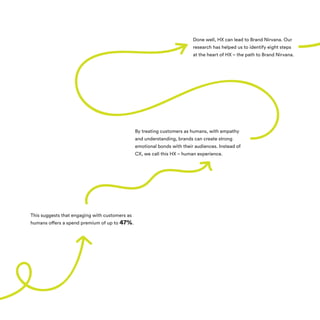
Done well, HX can lead to Brand Nirvana. Our
research has helped us to identify eight steps
at the heart of HX – the path to Brand Nirvana.
By treating customers as humans, with empathy
and understanding, brands can create strong
emotional bonds with their audiences. Instead of
CX, we call this HX – human experience.
This suggests that engaging with customers as
humans offers a spend premium of up to 47%.
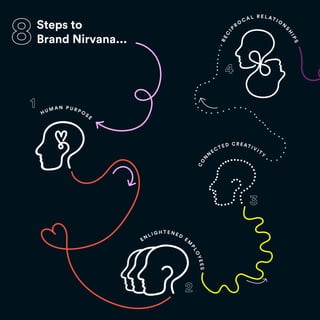
Steps to
Brand Nirvana...
H U M A N P U R P OSE
EN L I G H T E N E D
EM
P
L
O
Y
E
E
S
C
O
N
N
EC T E D C R E AT I VITY
R
E
C
I
P
R
O
CA L R E L AT I O
N
S
H
I
P
S
B R A N D NI R
V
A
N
A
C
O
N
T
I
N
U
O
U
S
IN N O VAT I ON
C
O
M
M
I
T
T
E
D
S E R V I C E
D I V E R S I F I E D
D
I
S
T
R
I
B
U
T
I
O
N
F
U
L
L
T
R
A
N
S
C
E N D E N C E
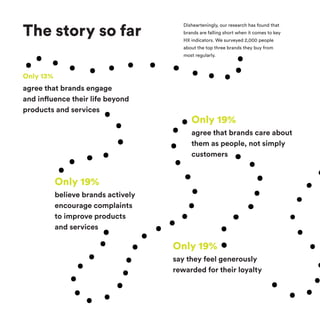
The story so far
Dishearteningly, our research has found that
brands are falling short when it comes to key
HX indicators. We surveyed 2,000 people
about the top three brands they buy from
most regularly.
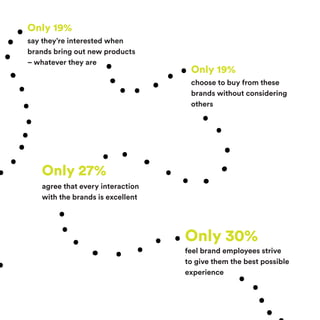
Only 19%
Only 19%
Only 19%
Only 13%
agree that brands engage
and influence their life beyond
products and services
agree that brands care about
them as people, not simply
customers
say they feel generously
rewarded for their loyalty
believe brands actively
encourage complaints
to improve products
and services
Only 19%
Only 19%
Only 27%
Only 30%
feel brand employees strive
to give them the best possible
experience
agree that every interaction
with the brands is excellent
choose to buy from these
brands without considering
others
say they’re interested when
brands bring out new products
– whatever they are
Chapter
T H E
H U M A N
E X P E R I E N C E
G A P
W H E R E
D I D
I T
A L L
G O
S O
W R O N G ?
Once upon a time…
…it all seemed so easy: create a product that
was better than the competition, brand it well,
sell it at a competitive price and watch the
money come in.
Now, the rules of business have changed.
At a time when 69 of the world’s 100 biggest
economies are corporations, the public is
scrutinising the behaviour of companies in a
way they haven’t before – expecting more and
punishing those deemed to be unsatisfactory.
Our research found that 71% of people care about
the impact a brand can have on them and on
society – above and beyond their products and
services. This rises to 78% and 79% for millennials
and post-millennials, suggesting that this trend is
set to grow in importance for future generations.
But it would seem that business is not doing too
well. Public trust in business is at an all-time
low. The latest results of Edelman’s annual trust
barometer show that in the UK, only 43% of the
population would say they trust business. For
the younger generation, this is even lower at
38% – a worrying stat considering the increased
importance this audience puts on brand behaviour.
Over the past decade, it has largely been
the behaviour of financial institutions in the
spotlight, getting a public battering in the fallout
from the financial crisis. But now all eyes have
turned towards Silicon Valley. Tech companies
have historically been seen as “the good guys”
– knights in shining armour, using innovation
to connect people, giving them the freedom to
share their stories and democratising the use
of technology.
But recent scandals around the misuse of
people’s data, combined with cybersecurity
concerns have had a wide-reaching domino
effect, toppling people’s confidence in the safety
of what they share online and in the honesty
at play when tech companies talk about their
altruistic intentions.
This matters because trust is important.
It’s the foundation of any strong brand.
It encourages the adoption of innovative
products and services.
It creates loyalty and it encourages people to
make purchases again and again.
The advertising industry has not escaped the
effects of this. Last year, Phil Smith, Director
General of advertising trade body ISBA,
commented that the public thinks less of
advertisers than it does bankers. Some of the
home truths buried in this statement centred
around the over-reliance on the techniques of
digital advertising. If you’d punch someone for
speaking to you in the way adverts do, you’d call
the police if someone stalked you the way ads
do online.
According to the latest report from Ipsos Global
Trends, 82% of people believe online ads get in
the way of what they’re doing. If you’re thinking
about success as clicks, then sure, relentless
online advertising is a win. But the truth is,
we should be thinking about the very human
emotion that these ads are evoking – annoyance.
That’s not success in anyone’s book.
One of the results of the sometimes blunt
targeting of online adverts has been the
meteoric rise of ad blockers. According to the
same study, 47% of Britons claim to use them.
In a bid to create efficiencies and extract value
from every interaction with people, we’ve
created a disconnect. We’re not offering people
rewarding interactions, but ones that strip
brands of humanity, empathy and authenticity.
This is the human experience gap in action.
In this new environment, brands need to
radically rethink the real-world relationships
they’re building with the public. A renewed
humanity is important, even if it involves
losing some of the efficiencies that technology
has enabled.
“Marketers have embraced technology that
identifies the stimuli to optimise transactions,”
says Alex Schlaubitz, VP Marketing, Lufthansa.
“The focus on customer data has diminished
the role of creative storytelling. However, as
marketers, we should prioritise building lasting,
trust-based relationships – even if this means
walking away from a concrete sale.”
It’s true that these are uncertain times in which
to be a brand, but there is a way to rise above
this groundswell of distrust.
By speaking people’s language, showing that we
understand their experiences – good and bad –
we can build up the trust we may have lost and
start to close the human experience gap.
Chapter
I T ’ S
N O T
H A R D
T O
B E
M O R E
H U M A N
People buy brands for all sorts of different reasons.
The ones that tend to come to mind are quite
practical, such as product performance or price.
After all, when you voice it aloud, it makes more
sense to buy something based on tangible benefits.
But there are also a range of emotional factors
at play in any decision. In fact, our research
found a perfect balance between the two – with
people ranking practical considerations as 50%
of the reason for buying a brand, with 50% owing
to emotional drivers, such as being “regularly
surprised in a good way” and “being proud to be
a customer”.
Emotions are important. This hasn’t escaped clients
– those we spoke to rate emotional reasons even
higher at 66%. The challenge is in activating this
knowledge and creating positive emotional bonds
with people.
It’s the successful combination of these rational
and emotional reasons to buy that can help brands
embed themselves into the unconscious mind,
becoming the preference.
“Brands exist as a series of memories – experiences
that build associations in people’s brains,” says
Charlie Hiscocks, former Global Director of Brand
Communications, SABMiller.
“The role of marketing is to create alignment
between what is in consumers’ brains with what you
would like to have in consumers’ brains. We want to
be front of mind with the right set of associations
because a lot of choice is subconscious.”
But finding the right way to balance these two
drivers can be a challenge, as is figuring out how
they interact with each other.
It’s not hard to be more human
Humans need to feel as well as
know that something is worth
buying or interacting with.
There are four things
to consider:
People’s brand experiences are
connected, so thinking and action
must be too
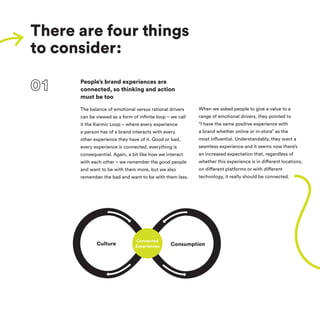
The balance of emotional versus rational drivers
can be viewed as a form of infinite loop – we call
it the Karmic Loop – where every experience
a person has of a brand interacts with every
other experience they have of it. Good or bad,
every experience is connected, everything is
consequential. Again, a bit like how we interact
with each other – we remember the good people
and want to be with them more, but we also
remember the bad and want to be with them less.
When we asked people to give a value to a
range of emotional drivers, they pointed to
“I have the same positive experience with
a brand whether online or in-store” as the
most influential. Understandably, they want a
seamless experience and it seems now there’s
an increased expectation that, regardless of
whether this experience is in different locations,
on different platforms or with different
technology, it really should be connected.
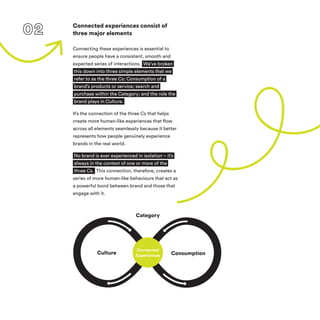
Connected
Experiences
Culture Consumption
Connected experiences consist of
three major elements
Connecting these experiences is essential to
ensure people have a consistent, smooth and
expected series of interactions. We’ve broken
this down into three simple elements that we
refer to as the three Cs: Consumption of a
brand’s products or service; search and
purchase within the Category; and the role the
brand plays in Culture.
It’s the connection of the three Cs that helps
create more human-like experiences that flow
across all elements seamlessly because it better
represents how people genuinely experience
brands in the real world.
No brand is ever experienced in isolation – it’s
always in the context of one or more of the
three Cs. This connection, therefore, creates a
series of more human-like behaviours that act as
a powerful bond between brand and those that
engage with it.
Connected
Experiences
Culture Consumption
Category
Brands must think and act like
humans too
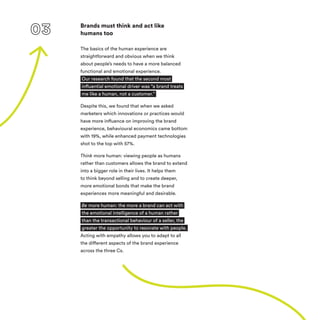
The basics of the human experience are
straightforward and obvious when we think
about people’s needs to have a more balanced
functional and emotional experience.
Our research found that the second most
influential emotional driver was “a brand treats
me like a human, not a customer.”
Despite this, we found that when we asked
marketers which innovations or practices would
have more influence on improving the brand
experience, behavioural economics came bottom
with 19%, while enhanced payment technologies
shot to the top with 57%.
Think more human: viewing people as humans
rather than customers allows the brand to extend
into a bigger role in their lives. It helps them
to think beyond selling and to create deeper,
more emotional bonds that make the brand
experiences more meaningful and desirable. 

Be more human: the more a brand can act with
the emotional intelligence of a human rather
than the transactional behaviour of a seller, the
greater the opportunity to resonate with people.
Acting with empathy allows you to adapt to all
the different aspects of the brand experience
across the three Cs.
When a truly human experience
is created, the brand has reached
nirvana
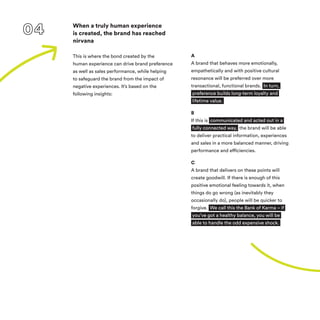
This is where the bond created by the
human experience can drive brand preference
as well as sales performance, while helping
to safeguard the brand from the impact of
negative experiences. It’s based on the
following insights:
A
A brand that behaves more emotionally,
empathetically and with positive cultural
resonance will be preferred over more
transactional, functional brands. In turn,
preference builds long-term loyalty and
lifetime value.
B
If this is communicated and acted out in a
fully connected way, the brand will be able
to deliver practical information, experiences
and sales in a more balanced manner, driving
performance and efficiencies.
C
A brand that delivers on these points will
create goodwill. If there is enough of this
positive emotional feeling towards it, when
things do go wrong (as inevitably they
occasionally do), people will be quicker to
forgive. We call this the Bank of Karma – if
you’ve got a healthy balance, you will be
able to handle the odd expensive shock.
This is clearly an enviable position for any brand
to be in – to become the preferred, the default,
the only one. Many brands may believe they
are already there, but our research suggests
differently. When we asked people whether
they choose to buy familiar brands without even
considering others, only 19% agreed.
Given the hyper-competitiveness of all markets,
it’s essential for brands to establish the type
of preference. Through our research we have
identified eight steps a brand can take to reach
this nirvana-like preference position, which will
ultimately help them build a healthy balance in
the Bank of Karma along the way. We’ll explore
these in the next chapter.
F E A T U R E D C O M M E N T
Mike Baxter, Product and Content Lead at Goal Atlas
The transcendental power
of surprise and delight
Marketers need to deconstruct how purchase
decisions are made. Consumers often find it very
hard to distinguish between brands. The trouble
is, marketers think everything can be solved by
an algorithm – but that’s superficial. Instead, they
need to tap into emotional cues if they are to
nudge consumers towards their brand.
We know quite a lot about the impact experiences
make in people’s minds. There’s something called
the peak-end rule, which states that we don’t
remember all brand experiences as a nice cross-
sectional average. Rather, we filter out the worst,
the best or the last and give them undue emphasis.
Many brands manipulate this bit of human
psychology to great effect. For example, one of
the top-rated hotels on TripAdvisor in Los Angeles
is not a brand you’d expect but an unremarkable
apartment block called the Magic Castle Hotel.
Rather than spending millions doing it up, they’ve
worked smarter: a red telephone next to the pool
is answered by someone saying,
	 “This is the popsicle hotline!”
and you get a delivery of ice lollies.
It’s an out-of-the-ordinary experience, delivered
at low cost but with high value. It dominates
people’s memories – overpowering the bland or
the disappointing ones.
Some brands do this very well and reach a
position of almost untouchable preference.
To benefit from this thinking, brands need to
consider what small things they could do that
won’t transform the bottom line in costs – but will
delight and surprise people. And this comes back
to considering the human experience of people
who come across a brand.
For example, if you’re an airline and you see
someone with stroppy children trying to get
through the airport quickly, give their kids a lolly,
and they don’t care that you fly planes, they love
you – whatever you do. You’re interacting with
them as a human being – taking a human problem
and solving it in a simple yet effective way.
This surprise and delight moment will be the
dominant memory and will encourage forgiveness
for any mistakes made in fulfilling other needs.
Shortcomings can be overridden by delighting
with some small pleasure.
Chapter
I N T R O D U C I N G
T H E
E I G H T
S T E P S
T O
B R A N D
N I R VA N A
We’ve explored the need for brands to take a more human, connected
approach, balancing practical and emotional benefits with equal measure.
By delivering joined-up experiences and engaging with people in a way
that empathises and speaks to their lives beyond “buying” mode, we can
create a special bond that builds preference and drives performance.
This allows brands to reach an almost altered state, whereby they come
to dominate their category and build long-term loyalty, so that even when
they make a mistake, they have built up enough goodwill with people that
they are easily forgiven. This is a state we call Brand Nirvana.
We know that this requires a change of mindset from the brand. Thinking
about its target audience not as customers, but as humans. But how does
it work beyond that? What are the steps a brand needs to consider to
reach this transcendental level?
Through research that asked people about their best and worst brand
experiences, and conversations with brand custodians about where
experience succeeds and where it fails, we’ve been able to identity eight
steps to help embrace human experience thinking and action, which
ultimately lead to Brand Nirvana.
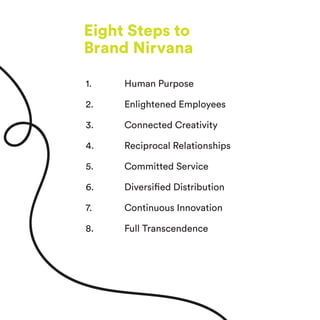
1. 	 	 Human Purpose
2. 	 	 Enlightened Employees
3. 	 	 Connected Creativity
4. 	 	 Reciprocal Relationships
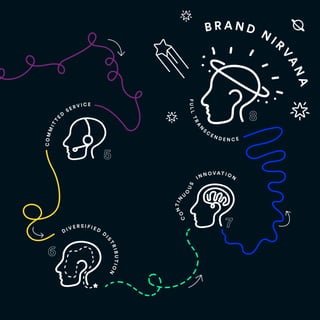
5. 	 	 Committed Service
6. 	 	 Diversified Distribution
7. 	 	 Continuous Innovation
8. 	 	 Full Transcendence
Eight Steps to
Brand Nirvana
S T E P O N E –
H U M
A
N
P
U
R
P
O
S
E
The new opportunity for brands
is to deliver a greater sense of
purpose within the heart of the
experience itself
Human Purpose
The concept of giving a brand a sense of
purpose is now commonplace. People are
increasingly looking to brands to have a
deeper meaning beyond positioning or selling,
as confirmed by our research, which found
that an average of 73% of people care about
the impact of brands above and beyond their
products. By blending profits with purpose,
it’s possible to give people another reason to
buy – aligning to what they believe in or giving
something back to society to create goodwill.
However, it’s easy for a brand to have a purpose
that is worthy and self-serving – too much about
client ego and too much of a leap of credibility
for what the brand genuinely is or does.
The new opportunity for brands is to deliver a
greater sense of purpose within the heart of the
experience itself.
This is the key distinction between brand
purpose – which is rapidly becoming a hygiene
factor in marketing circles – and human
purpose, where the brand seeks to involve,
share and encourage people to share in
their purpose. A human purpose is about the
heightened experience a person can have with
the brand, not the heightened experience the
brand wishes to play for its own gain.
A distinct human purpose provides a more
significant role for a brand to play in people’s
lives, where it can solve bigger, more profound
problems. It is the foundation upon which every
other aspect of the experience is formed and
allows the brand to be seen as genuinely helpful
and necessary.

While awareness of this important step is
increasing, our research found that only 19% of
people feel their favourite brands care about
them as humans, not simply as customers.
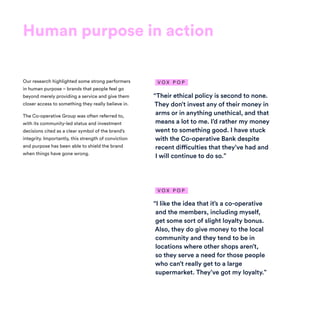
Human purpose in action
Our research highlighted some strong performers
in human purpose – brands that people feel go
beyond merely providing a service and give them
closer access to something they really believe in.
The Co-operative Group was often referred to,
with its community-led status and investment
decisions cited as a clear symbol of the brand’s
integrity. Importantly, this strength of conviction
and purpose has been able to shield the brand
when things have gone wrong.
“Their ethical policy is second to none.
They don’t invest any of their money in
arms or in anything unethical, and that
means a lot to me. I’d rather my money
went to something good. I have stuck
with the Co-operative Bank despite
recent difficulties that they’ve had and
I will continue to do so.”
“I like the idea that it’s a co-operative
and the members, including myself,
get some sort of slight loyalty bonus.
Also, they do give money to the local
community and they tend to be in
locations where other shops aren’t,
so they serve a need for those people
who can’t really get to a large
supermarket. They’ve got my loyalty.”
V O X P O P
V O X P O P
Case Study
first direct: the human face of banking
first direct always takes pride in its human
interaction, principally through its famously
responsive and empathetic staff. A recent
relaunch saw it commit to a purpose that offers a
younger generation of savers the opportunity to
“live a life less ordinary”.
By understanding its savers better and
recognising their need for unparalleled levels
of banking flexibility to assist them in their
unpredictable lives, first direct has created a
strong bond with a new generation.
Fundamental to this is seeing beyond the
customer, referring to this new generation as
“makers”, celebrating them, respecting them and
searching for every possible way to serve their
needs better.
S T E P T W O
–
E
N
L
I
G
H
T
E
N
E D
E M P L O Y E E S
A company must carry its values
and purpose internally as well as
externally. If a brand says one
thing in public but acts a very
different way in private, this can
create a disconnect that people
will pick up on
Enlightened Employees
It’s also missing an opportunity. Carrying brand
meaning “behind the line” can galvanise employees
and ensure they understand and are committed to
the bigger brand ambitions. This allows them to
form a partnership with the buyer where they can
proactively deliver the best experience possible.
They become a living embodiment of what the
brand stands for and are able to act quickly
and intuitively.
Disappointingly, our research found that only
30% of people feel employees of their favourite
brands constantly strive to give them the best
possible experience.
Part of this is also about carrying human purpose
from the top down. If the most senior managers
have not bought into the values and how to best
deliver these, or at the very least act as a sponsor
for them, it can be difficult to realise the potential
this has for the company.
Our research found that, while some companies
are achieving this, there are still some that
struggle. A quarter of respondents told us their
senior management buy into the broad concept of
“purpose”, but don’t communicate this to the rest
of the organisation. The same total again suggested
that their business prioritises profitability over
customer lifetime value, and 20% told us that
each department has its own agenda.
With no clear employee alignment, it’s difficult to
realise objectives.
Enlightened employees in action
Our research indicated that an aligned and
empowered workforce expresses itself in
two ways. Firstly, there’s the way employees
are treated as human beings rather than an
exploitable workforce. With employee working
conditions and rights such a newsworthy
topic, generosity or decency towards them
is recognised and appreciated.
Secondly, there’s the way that employees
really understand the purpose of the brand
they represent and its role in delivering a more
human service. Empowering employees to act
in moments of need, or simply to surprise and
delight, is the stuff of legendary service.
“I would sign up to Arthouse
cinemas again. It’s a true
independent cinema and it
pays the London minimum
wage – not something that’s
done throughout the cinema
chains in London. I think that’s
really something that’s worth
supporting.”
“I phoned up Tesco’s customer services to
complain about my Clubcards – the points
weren’t accruing on one card. When they
investigated, they actually discovered that
a large number of my points had expired.
As a goodwill gesture for their error, they
refunded those points and I was very
surprised by that. The lady that dealt with
me was very professional, very caring,
understood my concerns and resolved
my problem. Tesco is a great brand and
I thoroughly recommend them.”
V O X P O P
V O X P O P
“I’m quite loyal to John Lewis because
I feel you’re treated specially. There are
plenty of staff to talk to and if you’ve got
a problem, they’ll be able to find what
you’re looking for in store. But they also
offer a little bit more with really good
guarantees on their products. I think it’s
a case of good old-fashioned customer
service – that’s why I’m loyal to them.”
V O X P O P
Case Study
ao.com: more purpose through
more care
ao.com is a successful online business famed for its
service and efficiency. At the heart of this is a desire
to care more for the people that buy from it, as seen
in a desire to always deliver with “super-human
endeavour”.
At every point of contact with its audience, ao.com
searches for ways to empathise, solve problems and
deliver solutions. ao.com has incentivised staff to
go the extra mile and call centre staff have freedom
to do anything they think is “fair and reasonable” to
resolve issues when they arise. “Our rule is that you
treat every customer as if they were your gran and
fix how you would for her.”
Call centre staff are empowered with the freedom
to despatch a new product the same day a
customer calls up with a complaint and can send a
bunch of flowers without any barriers for approval.
The result of this committed workforce can be
seen in a five-star Trustpilot score with an 89%
“excellent” rating.
S T
E
P
T
H
R
E
E
–
C
O
N
N
E
C
T
E
D
C
R E A T I V I T Y
It’s essential for any brand to
have a fully connected experience,
where every action or reaction
is seamlessly integrated with the
next. This ensures that wherever
anyone experiences the brand,
it’s always consistent, matches
their expectations and can be
relied upon
Connected Creativity
There is clearly work to be done here, but
having a powerful, creative platform and an
organising thought at the centre of these
experiences ensures this consistency. It helps
to develop stronger emotional bonds, ensures
expectations are met and means experiences
and feedback loops are seamless rather
than disjointed.
Every touch point, whether that’s advertising
or the interactions people have with staff,
needs to be consistent. This helps the brand
to look strong, trustworthy and genuine.
And it’s possible to further reinforce these
emotional bonds through the creation of
behaviours or experiences that are designed
to be as distinct or as memorable as possible.
“For a brand like ours, product experience is key,”
explains Ben Carter, UK Marketing Director, Just Eat.
“It’s about building more empathy and personality
into the transaction.
“We take time to consider possible pain points across
the order process and address these as best we can.
For example, we understand that not knowing when
the food is going to arrive, or whether there has been
a hold-up, can cause anxiety – so we’ve created a way
to get regular updates and track where drivers are.”
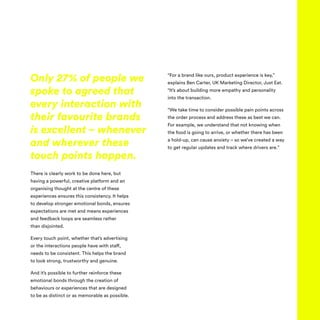
Only 27% of people we
spoke to agreed that
every interaction with
their favourite brands
is excellent – whenever
and wherever these
touch points happen.
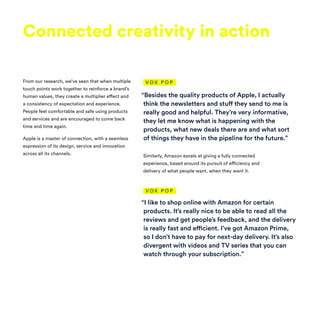
“Besides the quality products of Apple, I actually
think the newsletters and stuff they send to me is
really good and helpful. They’re very informative,
they let me know what is happening with the
products, what new deals there are and what sort
of things they have in the pipeline for the future.”
Connected creativity in action
From our research, we’ve seen that when multiple
touch points work together to reinforce a brand’s
human values, they create a multiplier effect and
a consistency of expectation and experience.
People feel comfortable and safe using products
and services and are encouraged to come back
time and time again.
Apple is a master of connection, with a seamless
expression of its design, service and innovation
across all its channels. Similarly, Amazon excels at giving a fully connected
experience, based around its pursuit of efficiency and
delivery of what people want, when they want it.
“I like to shop online with Amazon for certain
products. It’s really nice to be able to read all the
reviews and get people’s feedback, and the delivery
is really fast and efficient. I’ve got Amazon Prime,
so I don’t have to pay for next-day delivery. It’s also
divergent with videos and TV series that you can
watch through your subscription.”
V O X P O P
V O X P O P
Plusnet provides broadband, mobile and TV
services in a tough and competitive environment
where constant price-cutting and switching are
the norm. To ensure it stands out, is memorable
and distinctive, it employs a connected creative
idea that is “all around care”. It’s a connected idea
that has helped to bring consistency to all that the
brand does.
Using the charm and straightforwardness of its
Yorkshire location and personnel, it ensures every
touch point subscribes to one tone, one idea
and one purpose. With a commitment to “do you
proud”, this connectivity has delivered sales, loyalty
and numerous service awards.
Case Study
Plusnet: from Yorkshire with love
S
T
E P
F O U R – R E C I P R O C A L R E L A T I O N S H I P S
We’ve already explored the power in creating a
genuine and distinct brand with an aligned and
motivated workforce. Done well, this often helps
to create a different kind of relationship with
people, a mutually beneficial exchange based
on two-way interaction.
This comes from both the delivery of the brand
promise and some additional form of reciprocity,
where the brand rewards interaction in some way.
This reward can be emotional, in how the brand
delivers on a wider human purpose or how it
seeks to surprise and delight, often unexpectedly.
Alternatively, it can be more tangible through
improved understanding of needs or payback for
attention, engagement and loyalty.
In turn, people return this reward with greater
levels of engagement, advocacy and ultimately
preference and loyalty. Reciprocity can also play
an important role in overcoming post-purchase
dissonance, where people sometimes feel some
form of buyer’s remorse, especially with high-price
items or first purchases.
Despite the benefits, it seems brands that
achieve this are few and far between.
Extending the brand experience beyond
consumption, where a person enters into a
brand’s fuller experience ecosystem and
feels more involved, helps to create benefit
reinforcement and a sense of kinship.
Reciprocal Relationships
Only 19% of people
we spoke to feel their
favourite brands
generously reward
them for their loyalty.
Our research showed that when reciprocity
works well, at its heart is the creation of a two-
way relationship where brand and people interact,
often in a “we do, you do” manner. This quid pro
quo is often simply how we’d expect a relationship
or friendship to happen in the real world.
Reciprocity can also be expressed as an enhanced
service, where people feel like they are getting
more than they bargained for – an additional set
of benefits.
Reciprocal relationships in action
“I’ve been very loyal to a brand
called King of Shaves. I’ve always
enjoyed their products and I used
to do little things for the company.
For example, they asked if we could
take photographs of the displays in
certain stores and, after doing that,
we got some of their products for
free. Ever since then, I’ve really liked
the company.”
V O X P O P
“I’m very loyal to O2. It is brilliant and
has great customer service. I get lots
of perks, like O2 Rewards, which I’ve
used in the past and will continue to
use. I really like O2 and it’s different
to other brands and I probably
wouldn’t consider swapping for a
long time.”
V O X P O P
Spotify: rewarding regular
users with added extras
Case Study
Spotify is a regular on “most innovative companies” lists
and features highly on NetBase’s most-loved media brand
ranking. The Swedish company has become a leading name
in the music industry, making a variety of artists available
to audiences and legitimising music streaming. But beyond
offering almost unlimited access to a huge catalogue of music,
Spotify offers its users a range of additional services.
The Daily Mix and Discover Weekly services offer bespoke
playlists based on your previous listening habits. The more a
person listens, the smarter the algorithm gets – introducing
new music that suits his or her taste. Most recently, Spotify
has added Fresh Finds and Release Radar – putting new
artists and releases into people’s playlists. The added value
created by Spotify has helped it to gain some 70 million paying
subscribers by early 2018 – up from 30 million in 2016.
S
T
E
P
F
I
V
E
–
C O M M I T TE
D
S
E
R
V
I
C
E
Committed Service
Our research found that
only 19% of people feel
their favourite brands
actively encourage
complaints as a way to
improve their products
and services
A measure of how human-centric a brand is can be
found in its reaction to complaints. Social media
has given people a platform on which to broadcast
their grievances. This could, and should, be viewed
as an opportunity rather than an issue. A platform
for a complaint quickly becomes a platform for a
brand’s timely, human and understanding response.
If there’s an opportunity for humour, this can turn
a short conversation into a “surprise and delight”
moment.
However, our research found that only 19%
of people feel their favourite brands actively
encourage complaints as a way to improve
their products and services.
While all brand experiences have an ambition
to be positive, both brands and experiences are
fallible. Handled well, the seamless switch from
a negative to a positive experience can make
an even longer-lasting impression than an
unremarkable but problem-free brand interaction.
This often requires a move into more of a service
mindset, especially for product-centric businesses.
Key to this is employees reacting better and faster
to people’s needs.
Younger generations are more likely to be
influenced by a complaint resolution. Our research
has found that millennials and post-millennials are
almost twice as likely as older generations to make
complaints about brands they have bought from
(23% vs. 12%). However, these younger people are
also more likely to be satisfied with the response
they get (89% vs. 77%).
This is especially important when thinking about
data and the use of artificial intelligence to deal
with the unpredictability of human behaviour,
where there’s as much chance of getting it wrong
as there is of getting it right. If something goes
wrong, the more human, empathetic and
understanding a brand can be, the better – often
automated responses do more harm than good.
The speed of response, apology, atonement or
resolution is critical to ensure continued loyalty.
Committed service in action
“I have a really positive experience of using
Apple products and services and I’ve always
received excellent customer service. It has
great aftercare and that’s something that
makes me more inclined to feel loyalty to a
brand and to use it over and over again.
I just feel like a valued customer.”
“I was delayed for over three hours and
EasyJet’s representatives made me aware
that I was entitled to compensation for the
delay of my flight. They facilitated it, and
they paid out incredibly quickly. I was very,
very surprised that they were as efficient
as that.”
Stories of service, usually above and beyond what
was expected, were the most referred to reasons
for intense loyalty and bonding amongst our
interviewees. These fall into two clear dimensions:
when great service delivers against your expectations,
and when great service intervenes when something
goes wrong. With some brands, such is the loyalty
that, even when they fail or are the more expensive
option, people find ways to forgive.
V O X P O P
V O X P O P
When Sir Ralph Norris took the reins at Air New
Zealand in 2002, the airline was struggling. The
New Zealand government had been forced to take an
80% controlling stake along with providing a sizeable
rescue package. But Sir Ralph’s people-centric
leadership and strategy kick-started the airline’s
turnaround – it’s now one of the top-performing
airlines in the world and has been voted best airline
5 years running. Sir Ralph switched the airline’s
thinking from “we fly planes” to “we fly people”.
From the entertaining safety announcements
featuring The Lord of the Rings characters, to the
newly appointed chatbot Oscar, who answers 75%
of complaints and queries, often with a song and a
joke, the airline has examined each and every touch
point and added Kiwi humour and personality to
each – including customer service. The airline has
recently been voted Australia’s favourite brand (yes,
in Australia, not just New Zealand).
Case Study
Air New Zealand:
people-centric
transformation
S
T
E P
S I X
– D I V E R S I F I E D D I S T R I B
U
T
I
O
N
Diversified Distribution
When and where people experience
a brand can have a big impact on how
much they consider it a part of their
lives. Once the fundamentals of the
experience are being delivered
consistently, it’s possible to explore
ways to present the brand outside
of the category and the traditional
buying journey
By taking the brands and the experience deeper into
culture and people’s lives, it’s possible to find new and
sometimes unexpected entry points. These entry points
can then be used to help widen physical or mental
availability through partnerships – broadening the
experience and keeping the brand ever-present and
top of mind.
According to our research, this isn’t really happening.
Only 22% of marketers cite “partnerships that bring
customers new experiences” as an investment priority
– and it shows. A disheartening 13% of the people we
spoke to agreed that their favourite brands engage with
them and influence their lives beyond the products and
services they provide.
This isn’t impossible to achieve. Clever, strategic
partnerships can carry a brand name into completely
different fields, building on purpose and reaching
people in surprising ways.
Another way to achieve this is to create a new product
that builds on the brand and takes it into a different
category. A powerful way to do this is by moving from
a service to a product or vice versa.
Diversified distribution in action
Our research indicates that once someone has
bought into a particular product from a brand,
they’re more likely to buy more from its range,
often being pleasantly surprised to find new and
unexpected products. Loyalty can carry across
a line, creating multiple touch points.
“I think the brand I’m most loyal to is
Tesco because I go on a weekly basis.
There are large supermarkets, but also
the Tesco Express supermarkets that
you find next to a garage or just on the
high street. It also has an app, so I can
actually pay conveniently and quickly.
In addition to the own-brand products,
which are very reasonably priced,
it rewards me for my loyalty in many
ways and that’s why I stay.”
V O X P O P
Case Study
Just Eat:
connecting people
to food everywhere
Just Eat has always believed in making food discovery
as exciting as possible. A big part of that is constantly
searching for new ways for people to experience and
interact with the brand – whether that’s being among
the first to embrace new technology, or simply using
conspicuous and consistent advertising to make it clear
where and when people can enjoy the Just Eat service.
As Ben Carter, UK Marketing Director of Just Eat says,
“It’s important for us to be where our customers are.
That’s why we’ve made our services available on the likes
of Amazon Alexa and Google Home. We’re making the
customer journey as seamless as possible.”
Surrounding hungry people with more ways to
connect with and experience Just Eat has proved
successful – the business took its 400 millionth
order in the UK in April 2018.
S T E P S E V E N – C O N T I N UO
U
S
IN
N
O
V A T I O N
Continuous Innovation
A human-centric approach can help
a brand identify new ways to engage
with its audience and reinforce its
role in their lives through new ideas
and manifestations of its core benefit
How many ways can a product or service be improved to
make it more helpful, useful and enjoyable? As people’s
needs change, their relationship with a category changes;
as cultural shifts occur, brands need to be agile and open
to evolution.
By constantly improving its performance, or seeking out
new ways to offer solutions, the brand will create more
opportunities to bond with people, reinforcing their
understanding and appreciation of it. But we found that
only 23% of marketers identify “co-creation of products
or services with customers” as an opportunity to improve
the brand experience.
People like to see innovation. It helps to confirm that
they’ve chosen a dynamic brand with a dedication to
creating the best possible product. These brands use
innovation to create market leadership in their category,
with the innovations often becoming the new industry
standard over time.
Continuous innovation in action
Of all the brands mentioned in our research
investigation, when it came to innovation, Apple was
frequently referred to, often with huge admiration and
awe for the momentum around new ideas.
Apple keeps a large and loyal audience constantly
excited through the promise of improvements and
innovations that allow people to access new services
and technology in a reassuring and familiar way.
Giving people access to new features and technology
is a recurring theme for brand success.
Innovation that can appeal to new or wider audiences
is especially appreciated.
“I’ve been buying Apple for well over
10 years now. Apart from the quality
of the products, I think they have got
the ability to innovate, think outside
the box, challenge the status quo.
For example, fingerprint recognition
is a great innovation.”
“We just got the new Samsung washing
machine. It’s very expensive, but you can
control it from your smartphone –
it’s quite amazing. It even has a self-clean
function, so looks after itself.”
“I thought Nintendo Labo – a construction
kit for cardboard – was actually a great
idea, as it gets adults, as well as children,
looking at how to be creative. I think it’s
a really inventive and different thing for a
computer company to do and it definitely
made me more likely to consider them as
a brand and made me more likely to use
them in the future.”
V O X P O P
V O X P O P
V O X P O P
The Guardian has been a fearless innovator throughout
its near 200-year history. It was the first newspaper to
appoint a readers’ editor and, in 1995, was one of the
first to launch an online publication, which was the UK’s
most popular newspaper site by 2001.
In 2011, The Guardian announced plans to become a
digital-first organisation, placing open journalism on
the web at the heart of its strategy. Since then, it has
expanded its publishing across every major digital
platform. 2018 saw it reinvent itself yet again – moving
into a tabloid format, offering convenience without
compromising on its integrity.
Despite its main competitors constantly discounting,
The Guardian has always held its cover price, stayed true
to its principles and has recently launched a membership
model, allowing its readers to contribute whatever they
like to continue to support independent journalism.
Around 600,000 readers have taken this up, making
either one-off donations or recurring payments.
Case Study
The Guardian:
two centuries
of reinvention
S T E P E I G H T – F U L L T R A N S C E N D E N
C
E
B
R A N D N
I
R
V
A
N
A
Full Transcendence
A fully humanised experience
means that a brand has now
become far more empathetic,
attentive and responsive, moving
on from obsessing about itself to
obsessing about people...
It now thinks less about “me” or “I” and far more about
“we”, having invited the people inside its circle of
influence. These brands have transcended the fixedness
of their products or the conventions of their categories
and are freely able to offer new products, services and
experiences to their increasing audience of admirers.
When a brand is able to deliver a consistently
connected, more human experience, with a deep set of
positive experience credits, it elevates to a higher plane
where the bond people have with it has the potential to
transcend logic, price and sometimes even the delivery
of its promise.
This bond can be viewed as:
Irrational
– 
people will buy it as a default without
considering others
Irreplaceable
– 
people will choose to buy nothing else if their
preferred is unavailable
Irresistible
– 
people consume more, engage more or even pay more
than they need.
All of this adds up to a
form of nirvana, where
the brand is revered
and even forgiven for its
occasional fallibilities.
During the course of research, we discovered that
when brands really get it right and act with great
humanity, they were talked about and referred to in
markedly different ways.
Brands that reach the transcendent stage inspire
complete loyalty. Users don’t mind paying a little bit
extra, because they see the benefit in quality and
believe it’s money worth spending.
The most fascinating examples are where brands
have failed in some way and are forgiven. This can
often be because of great service, but sometimes
it’s an irrational affection for the brand that
maintains the loyalty.
But the most transcendent brand of all, and the
most consistently referred to in our study for
outstanding service, innovation and connectivity,
is Apple, which, even when something goes wrong,
still appears to be the preferred option.
Full transcendence
in action
“I’ve had a Mac computer for quite a few
years now, and I’ve always found that
the customer service offered by Apple
is excellent. I can go to the Apple store
either locally or anywhere in the world
and the staff are always very willing to
help. The products are well-designed
and very easy to use. They’re not the
cheapest, I have to say, but sometimes
you have to pay for the quality.”
V O X P O P
“Since getting my iPhone in 2009, I’ve
purchased various other Apple products
like iPods and laptops and I am always
going back to this brand because of the
quality of the service. When my Apple
laptop died, there was no question about
it that I would get another one from them.
So, I think it makes you feel a little bit
part of the club and it’s the brand I trust.
And sometimes it’s simply the positive
feeling that owning something from the
brand gives you.”
“One product I’m really loyal to is Apple
and it’s not just because of the quality
of the services. Nowadays, the likes of
Samsung are offering products that you
could say were even better. But there’s
just something about Apple that’s made
me remain loyal. When you have an
Apple product in your hand, there’s a sort
of feeling about it – you just feel good
using the product and being part of it.”
V O X P O P V O X P O P
IKEA is one of the world’s most successful retailers.
The 75-year-old Swedish flatpack pioneer has remained
true to its purpose “to create better everyday life for
the many people” by making great household design
affordable to almost any budget. IKEA’s brand attributes
are low price, sustainability, form, function and quality
– elements which perfectly balance practical and
emotional drivers.
The brand has clear sustainability targets, which
include increasing its use of renewable energy (most
shops have solar panels on roofs), sales of sustainable
life products and sustainable supply chains. As well
as embracing environmental issues, IKEA places huge
value on innovation, constantly creating new products
and services, and investing in innovation through its
SPACE10 lab in Copenhagen.
Case Study
IKEA: finding its
way into home
and hearts
When it comes to engagement, the “IKEA effect”
describes the impact of building the furniture at home
– because the brand requires such intense involvement
from the people who are buying it, it creates stronger
memories and affection towards the products.
Behind the line, the retailer is also renowned for its
non-bureaucratic company culture, inspired by founder
Ingvar Kamprad – enthusiasm, togetherness and
willpower are central to IKEA as a workplace.
The combination of these elements has worked well to
create a truly transcendent brand – IKEA is listed on a
huge number of global brand rankings. It has over 350
stores around the world and grew sales by 4% last year
– an impressive figure against a backdrop of declining
retail sales.
F E A T U R E D C O M M E N T
Sara Bennison, CMO, Nationwide Building Society
Understanding the DNA of our brand
creates our point of difference
By digging into our history, our values and the very
DNA of what makes Nationwide, it’s clear that the
sense of community and mutual support is very
much at the heart of what we do and what we are.
It runs through how others see us and how we
see ourselves too, underpinning the often-lively
conversations face-to-face in a branch, or a
seamless transaction on the mobile app while on
the move. The reason we were founded – to help
people help other people for everyone’s mutual
benefit – and our original purpose, shapes what
we do today.
It’s really important that we are not seen as a
bank, we are a building society. There’s a big
difference. We have members, not just customers,
who use our services. While our members are
interacting with us more digitally, they do still
value and need humanity, whether that is
delivered directly through the fabulous humans
who work in our front line or through the way in
which we design our digital services of the future.
You start by putting the human, the member,
first, then use new technology to work in pursuit
of providing better services. This is the way to
maintain trust and reputation rather than turning
us all into the slaves of technology.
The experience and enthusiasm of those who work
for us makes them the perfect ambassadors for the
brand. We support our people to feel empowered,
engaging with members on a personal level to
make a difference – one small example is providing
stamps so they can send handwritten letters to
members congratulating them on a new job.
If you know your customers as people, and
understand the human experiences that underpin
your brand, there are always ways to surprise
and delight them at different moments in their
lives. So, when one of our graduates had the idea
of sending freshers’ survival packs for university
starters, we took a bit of money from our social
media budget to pay for it. The result was pretty
impressive; we had fantastic organic tweets and
posts from the students, who really appreciated
an original, personal touch.
The key words customers use now are the same
as they have always been – trust, service, value.
However, the way that they define those words
has changed. They no longer simply trust us just
with their money; they need to trust us with their
data. They no longer expect great service just to
be defined by a smile in a branch during opening
hours – they demand speediness and the
certainty of 24/7 availability. And they certainly
no longer see value as just being about a rate or
an incentive. They need to see how we can make
their money work as hard for them as possible.
The important thing for any brand is to remain
constant in its values and focus on its customers,
maintaining what defines the company. Alongside
that, being open to change and innovation will
harness new possibilities, as customers look for
change that will help them, both now and into
the future.
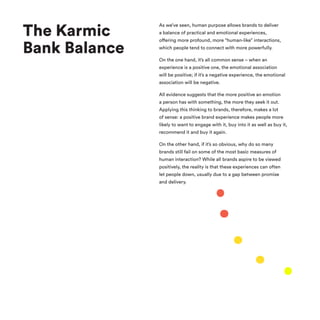
The Karmic
Bank Balance
As we’ve seen, human purpose allows brands to deliver
a balance of practical and emotional experiences,
offering more profound, more “human-like” interactions,
which people tend to connect with more powerfully.
On the one hand, it’s all common sense – when an
experience is a positive one, the emotional association
will be positive; if it’s a negative experience, the emotional
association will be negative.
All evidence suggests that the more positive an emotion
a person has with something, the more they seek it out.
Applying this thinking to brands, therefore, makes a lot
of sense: a positive brand experience makes people more
likely to want to engage with it, buy into it as well as buy it,
recommend it and buy it again.
On the other hand, if it’s so obvious, why do so many
brands still fail on some of the most basic measures of
human interaction? While all brands aspire to be viewed
positively, the reality is that these experiences can often
let people down, usually due to a gap between promise
and delivery.
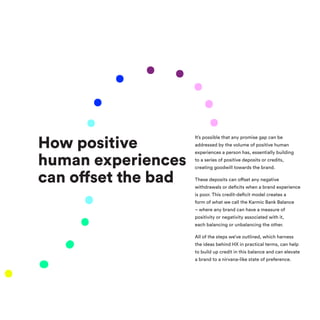
How positive
human experiences
can offset the bad
It’s possible that any promise gap can be
addressed by the volume of positive human
experiences a person has, essentially building
to a series of positive deposits or credits,
creating goodwill towards the brand.
These deposits can offset any negative
withdrawals or deficits when a brand experience
is poor. This credit-deficit model creates a
form of what we call the Karmic Bank Balance
– where any brand can have a measure of
positivity or negativity associated with it,
each balancing or unbalancing the other.
All of the steps we’ve outlined, which harness
the ideas behind HX in practical terms, can help
to build up credit in this balance and can elevate
a brand to a nirvana-like state of preference.
C
O
N
C
LU S I O
N
This is not an easy time to be a brand.
Or indeed a client for a brand. The complexity
of the world we’re operating in is increasing
at breakneck pace, expectations are growing
and unfortunately, public trust is at an all-time
low. But we believe there is a way to turn this
challenge into an opportunity.
The relationship between brands and people
is evolving, with more dialogue and touch
points opening up between the two. By viewing
customers more as humans and creating
connected experiences that speak to people’s
lives beyond buying, brands can interact with
them in a more meaningful way – creating
strong emotional bonds that transcend the
buying experience.
HX represents a simple change in mindset that
can have a transformative effect on a brand’s
performance – eventually leading to a kind of
Brand Nirvana. The eight individual steps we’ve
identified can help get brands to this altered
state of powerful preference.
As we’ve seen, in turn, this can help to create
a healthy Karmic Bank Balance – one that can
protect a brand when things go wrong, creating
a buffer of positive emotions that ensure people
forgive, not forget, their favourite brands.
The time to act is now. While technology brings
many benefits, it is also working against brands,
dehumanising their interactions and creating a
“human experience gap” that threatens to leave
people uninspired and unengaged. It’s not too
late to close this gap and harness HX thinking to
great effect – reaching Brand Nirvana and, with
it, a special place in people’s heart and minds.
If you want to hear more about HX,
and how you could apply human
experience thinking to your brand,
or if you’re interested in evaluating
your own Karmic Bank Balance –
please do get in touch with us at:
newbusiness@karmarama.com
Thank you
karmarama.com
Appendix
Research Methodology
Research and Discovery
Through our database of premium and
publicly available research, in-depth reviews
of all literature on the link between customer
experience and growth.
Industry Insights
In-depth interviews with academics and
marketing leads of major brands, including:
•	 Alex Schlaubitz, VP Marketing – Lufthansa
•	 David Wheldon, CMO – RBS
•	 Sara Bennison, CMO – Nationwide Building Society
•	 Geoff Seeley, Director, Global Marketing Connections
and Media Activation – Airbnb
•	 Ben Carter, UK Marketing Director – Just Eat
•	 Mike Baxter, Product and Content Lead, Goal Atlas
•	 Charlie Hiscocks, former Global Director of Brand
Comms – SABMiller
Online Quantitative / Vox pops
Consumer survey (n=1,000, April 2018)
•	 Each respondent had made a major purchase (pre-defined) across Retail;
leisure; hospitality; financial services in the last three months.
•	 Questions asked them to consider brand performance in the context of
this purchase.
•	 MaxDiff was used to build up a picture of the relative importance of each
purchase driver in the respondent’s mind.
Marketer survey (n=200, April 2018)
•	 Respondents spend between a third and all of their time on B2C marketing
activities at large UK companies.
•	 They were drawn primarily from financial services, retail and technology.
Consumer voxpops (n=114, May 2018)
•	 Respondents were asked to tell us about a brand they are loyal to and a
brand that recently surprised them.
Consumer omnibus (n=2,000, July 2018)
•	 Each was asked to respond to a series of eight questions relating to the
top three brands that they most regularly purchase products/services from.
Accenture
Research
Accenture Research shapes trends and creates
data-driven insights about the most pressing
issues global organisations face. Combining the
power of innovative research techniques with a
deep understanding of our clients’ industries,
our team of 250 researchers and analysts spans
23 countries and publishes hundreds of reports,
articles and points of view every year.
Our thought-provoking research – supported by
proprietary data and partnerships with leading
organisations, such as MIT and Singularity –
guides our innovations and allows us to transform
theories and fresh ideas into real-world solutions
for our clients.
For more information, visit:
www.accenture.com/research
or contact Jim Clark / Dominic King.
K
a
r
m
a
r
a
m
a
London
karmarama.com
E
C
1
M
3
H
E
20 Farringdon Road

BRAND NIRVANA - CLOSING THE HUMAN EXPERIENCE GAP

  • 1.
    B R AN D N I R V A N A C L O S I N G T H E H U M A N E X P E R I E N C E G A P
  • 2.
    Karmarama, part ofAccenture Interactive, is the UK’s most progressive creative agency. We combine creative excellence with technology- inspired solutions to help brands better engage with people. We’re proud to be one of the most effective agencies in the UK winning the DMA Grand Prix for the last two successive years, and we’re the highest ranked creative agency in The Sunday Times Best 100 Companies to Work For again this year.
  • 3.
    The c u st o m e r is dead. Long live the human being.
  • 4.
    Have you noticed thatthe world is obsessed with the customer? The customer is always right. The customer is king. Customer service. Customer journey. Customer-centricity. And, of course, “the customer experience”, any self-respecting company’s number one priority. It all comes from a good place. Every company’s trying to do its best for the people who buy its products, use its services and consume its content. But perhaps everyone’s got it wrong. Perhaps this relentless focus on the c-word has lost sight of what’s behind it – a human. There’s a famous saying that if a person talked to you in the way advertising does, you’d punch them in the face. Rather than smile and brush this sentiment off, it’s worth considering what’s behind it: people don’t necessarily want to be spoken to like a “customer” – they want to be engaged with as the living, breathing, well- rounded human beings they are. This is where things can start to go wrong in the communication and marketing industries. Reducing a target audience to the term “customer” strongly influences the way brand custodians behave. Nowadays, few relationships with brands exist solely in the moment of consumption. Only thinking, talking and pursuing people as the transaction they might make, as faceless figures with credit cards and pound signs over their heads, means brands will only ever be sellers and the audience will only ever be buyers. We’re missing a trick here. These people are so much more than “buyers”. They have full and active lives, of which they’re only spending money for a small percentage of time. Yet this is where brands choose to spend the majority of their communication budgets. The rest of the time the audience is participating in culture and feeling human emotions, such as love and excitement at best, and frustration and anxiety at worst. If brands can speak directly to these moments – with insight and empathy – they can become more than sellers and start to play a meaningful role in their audiences’ lives. F O R E W O R D – S I D M c G R A T H , C S O
  • 5.
    Imagine, then, ifwe all started seeing and empathising with “customers” as human beings and equipping brands with more human characteristics? There’s a very simple way to do this: upgrade “customer experience” to “human experience”, switching out “CX” for “HX”. This simple move can open up a completely new way of communicating. But it doesn’t stop there. Once you’ve reset the way you refer to your target audience, you can start to think about how this will affect the way you behave. What does a “human-centric” brand look like? What kinds of things does it do? Where and how is it distributed and who does it partner with? We have long embraced this kind of thinking at Karmarama. So we’ve decided to test it out to find the true value of treating people as humans rather than customers and distil tangible steps to do so. With a little help from our friends at Accenture Research, we’ve made an interesting discovery: brands that demonstrate more human-like behaviours and treat their audience more like humans than customers create such strong emotional bonds with people that they become irreplaceable. This is a highly preferred necessity that people desire, often irrationally, and are even willing to forgive when things go wrong. However, our research also shows that many brands and businesses still aren’t getting it right, with a significant number of people still feeling like they are being treated transactionally rather than cared about as a person. As we’ll see, it doesn’t have to be this way. Through a variety of research techniques, we have identified the eight steps necessary to get to a more empathetic, near transcendental state that we’ve called “Brand Nirvana”. So if you’re ready to come with us, we’ll guide you through these steps to enlightenment so you can elevate your thinking, your brand and its performance… because the customer is dead, so long live the human being.
  • 6.
    In a worlddominated by technology, and with an abundance of choice and diminishing trust in business, brands need to work harder than ever to earn loyalty and create a valuable bond with people. It is no easy task, so our research set out to break down the challenge for brands and offer a solution. At the heart of this lies a mindset change – a change that can help brands create deeper emotional connections, surpassing expectations and eventually reaching a state we call Brand Nirvana. Executive summary 50% 50% D R I V E R S F O R P U R C H A S I N G D E C I S I O N S Emotional drivers Practical drivers
  • 7.
    32% 1st 1st 2nd 2nd 78% T H EN E X T G E N E R A T I O N W A N T S D E E P E R R E L A T I O N S H I P S W I T H B R A N D S : T H E M O S T E F F E C T I V E B R A N D C U S T O D I A N S V A L U E A M O R E H U M A N E X P E R I E N C E : T O P - R A N K E D E M O T I O N A L D R I V E R S T O P - R A N K E D P R A C T I C A L D R I V E R S of marketers who have successfully shown a return on CX investment cited treating customers as humans as the biggest opportunity for improving brand experience, compared with 22% of all marketers. of millennials actively engage with brands, compared with 68% of Gen X and 54% of boomers. Product / Service quality Positive experience across channels Value for money Being treated as a human, not a customer
  • 8.
    Engaging with people ashumans has clear commercial benefits Our analysis suggests that the average person plans to increase spend with a brand they have recently purchased by 9% over the next 12 months. This rises to 56% for those who are the most engaged and loyal. Tellingly, these people are more likely to value emotional drivers such as “being regularly surprised in a good way” and “being proud to be a customer”.
  • 9.
    Done well, HXcan lead to Brand Nirvana. Our research has helped us to identify eight steps at the heart of HX – the path to Brand Nirvana. By treating customers as humans, with empathy and understanding, brands can create strong emotional bonds with their audiences. Instead of CX, we call this HX – human experience. This suggests that engaging with customers as humans offers a spend premium of up to 47%.
  • 10.
    Steps to Brand Nirvana... HU M A N P U R P OSE EN L I G H T E N E D EM P L O Y E E S C O N N EC T E D C R E AT I VITY R E C I P R O CA L R E L AT I O N S H I P S
  • 11.
    B R AN D NI R V A N A C O N T I N U O U S IN N O VAT I ON C O M M I T T E D S E R V I C E D I V E R S I F I E D D I S T R I B U T I O N F U L L T R A N S C E N D E N C E
  • 12.
    The story sofar Dishearteningly, our research has found that brands are falling short when it comes to key HX indicators. We surveyed 2,000 people about the top three brands they buy from most regularly. Only 19% Only 19% Only 19% Only 13% agree that brands engage and influence their life beyond products and services agree that brands care about them as people, not simply customers say they feel generously rewarded for their loyalty believe brands actively encourage complaints to improve products and services
  • 13.
    Only 19% Only 19% Only27% Only 30% feel brand employees strive to give them the best possible experience agree that every interaction with the brands is excellent choose to buy from these brands without considering others say they’re interested when brands bring out new products – whatever they are
  • 14.
  • 15.
    T H E HU M A N E X P E R I E N C E G A P W H E R E D I D I T A L L G O S O W R O N G ?
  • 16.
    Once upon atime… …it all seemed so easy: create a product that was better than the competition, brand it well, sell it at a competitive price and watch the money come in. Now, the rules of business have changed. At a time when 69 of the world’s 100 biggest economies are corporations, the public is scrutinising the behaviour of companies in a way they haven’t before – expecting more and punishing those deemed to be unsatisfactory. Our research found that 71% of people care about the impact a brand can have on them and on society – above and beyond their products and services. This rises to 78% and 79% for millennials and post-millennials, suggesting that this trend is set to grow in importance for future generations. But it would seem that business is not doing too well. Public trust in business is at an all-time low. The latest results of Edelman’s annual trust barometer show that in the UK, only 43% of the population would say they trust business. For the younger generation, this is even lower at 38% – a worrying stat considering the increased importance this audience puts on brand behaviour.
  • 17.
    Over the pastdecade, it has largely been the behaviour of financial institutions in the spotlight, getting a public battering in the fallout from the financial crisis. But now all eyes have turned towards Silicon Valley. Tech companies have historically been seen as “the good guys” – knights in shining armour, using innovation to connect people, giving them the freedom to share their stories and democratising the use of technology. But recent scandals around the misuse of people’s data, combined with cybersecurity concerns have had a wide-reaching domino effect, toppling people’s confidence in the safety of what they share online and in the honesty at play when tech companies talk about their altruistic intentions. This matters because trust is important. It’s the foundation of any strong brand. It encourages the adoption of innovative products and services. It creates loyalty and it encourages people to make purchases again and again. The advertising industry has not escaped the effects of this. Last year, Phil Smith, Director General of advertising trade body ISBA, commented that the public thinks less of advertisers than it does bankers. Some of the home truths buried in this statement centred around the over-reliance on the techniques of digital advertising. If you’d punch someone for speaking to you in the way adverts do, you’d call the police if someone stalked you the way ads do online.
  • 18.
    According to thelatest report from Ipsos Global Trends, 82% of people believe online ads get in the way of what they’re doing. If you’re thinking about success as clicks, then sure, relentless online advertising is a win. But the truth is, we should be thinking about the very human emotion that these ads are evoking – annoyance. That’s not success in anyone’s book. One of the results of the sometimes blunt targeting of online adverts has been the meteoric rise of ad blockers. According to the same study, 47% of Britons claim to use them. In a bid to create efficiencies and extract value from every interaction with people, we’ve created a disconnect. We’re not offering people rewarding interactions, but ones that strip brands of humanity, empathy and authenticity. This is the human experience gap in action.
  • 19.
    In this newenvironment, brands need to radically rethink the real-world relationships they’re building with the public. A renewed humanity is important, even if it involves losing some of the efficiencies that technology has enabled. “Marketers have embraced technology that identifies the stimuli to optimise transactions,” says Alex Schlaubitz, VP Marketing, Lufthansa. “The focus on customer data has diminished the role of creative storytelling. However, as marketers, we should prioritise building lasting, trust-based relationships – even if this means walking away from a concrete sale.” It’s true that these are uncertain times in which to be a brand, but there is a way to rise above this groundswell of distrust. By speaking people’s language, showing that we understand their experiences – good and bad – we can build up the trust we may have lost and start to close the human experience gap.
  • 20.
  • 21.
    I T ’S N O T H A R D T O B E M O R E H U M A N
  • 22.
    People buy brandsfor all sorts of different reasons. The ones that tend to come to mind are quite practical, such as product performance or price. After all, when you voice it aloud, it makes more sense to buy something based on tangible benefits. But there are also a range of emotional factors at play in any decision. In fact, our research found a perfect balance between the two – with people ranking practical considerations as 50% of the reason for buying a brand, with 50% owing to emotional drivers, such as being “regularly surprised in a good way” and “being proud to be a customer”. Emotions are important. This hasn’t escaped clients – those we spoke to rate emotional reasons even higher at 66%. The challenge is in activating this knowledge and creating positive emotional bonds with people. It’s the successful combination of these rational and emotional reasons to buy that can help brands embed themselves into the unconscious mind, becoming the preference. “Brands exist as a series of memories – experiences that build associations in people’s brains,” says Charlie Hiscocks, former Global Director of Brand Communications, SABMiller. “The role of marketing is to create alignment between what is in consumers’ brains with what you would like to have in consumers’ brains. We want to be front of mind with the right set of associations because a lot of choice is subconscious.” But finding the right way to balance these two drivers can be a challenge, as is figuring out how they interact with each other. It’s not hard to be more human Humans need to feel as well as know that something is worth buying or interacting with.
  • 23.
    There are fourthings to consider: People’s brand experiences are connected, so thinking and action must be too The balance of emotional versus rational drivers can be viewed as a form of infinite loop – we call it the Karmic Loop – where every experience a person has of a brand interacts with every other experience they have of it. Good or bad, every experience is connected, everything is consequential. Again, a bit like how we interact with each other – we remember the good people and want to be with them more, but we also remember the bad and want to be with them less. When we asked people to give a value to a range of emotional drivers, they pointed to “I have the same positive experience with a brand whether online or in-store” as the most influential. Understandably, they want a seamless experience and it seems now there’s an increased expectation that, regardless of whether this experience is in different locations, on different platforms or with different technology, it really should be connected. Connected Experiences Culture Consumption
  • 24.
    Connected experiences consistof three major elements Connecting these experiences is essential to ensure people have a consistent, smooth and expected series of interactions. We’ve broken this down into three simple elements that we refer to as the three Cs: Consumption of a brand’s products or service; search and purchase within the Category; and the role the brand plays in Culture. It’s the connection of the three Cs that helps create more human-like experiences that flow across all elements seamlessly because it better represents how people genuinely experience brands in the real world. No brand is ever experienced in isolation – it’s always in the context of one or more of the three Cs. This connection, therefore, creates a series of more human-like behaviours that act as a powerful bond between brand and those that engage with it. Connected Experiences Culture Consumption Category
  • 25.
    Brands must thinkand act like humans too The basics of the human experience are straightforward and obvious when we think about people’s needs to have a more balanced functional and emotional experience. Our research found that the second most influential emotional driver was “a brand treats me like a human, not a customer.” Despite this, we found that when we asked marketers which innovations or practices would have more influence on improving the brand experience, behavioural economics came bottom with 19%, while enhanced payment technologies shot to the top with 57%. Think more human: viewing people as humans rather than customers allows the brand to extend into a bigger role in their lives. It helps them to think beyond selling and to create deeper, more emotional bonds that make the brand experiences more meaningful and desirable. 
 Be more human: the more a brand can act with the emotional intelligence of a human rather than the transactional behaviour of a seller, the greater the opportunity to resonate with people. Acting with empathy allows you to adapt to all the different aspects of the brand experience across the three Cs.
  • 26.
    When a trulyhuman experience is created, the brand has reached nirvana This is where the bond created by the human experience can drive brand preference as well as sales performance, while helping to safeguard the brand from the impact of negative experiences. It’s based on the following insights: A A brand that behaves more emotionally, empathetically and with positive cultural resonance will be preferred over more transactional, functional brands. In turn, preference builds long-term loyalty and lifetime value. B If this is communicated and acted out in a fully connected way, the brand will be able to deliver practical information, experiences and sales in a more balanced manner, driving performance and efficiencies. C A brand that delivers on these points will create goodwill. If there is enough of this positive emotional feeling towards it, when things do go wrong (as inevitably they occasionally do), people will be quicker to forgive. We call this the Bank of Karma – if you’ve got a healthy balance, you will be able to handle the odd expensive shock.
  • 27.
    This is clearlyan enviable position for any brand to be in – to become the preferred, the default, the only one. Many brands may believe they are already there, but our research suggests differently. When we asked people whether they choose to buy familiar brands without even considering others, only 19% agreed. Given the hyper-competitiveness of all markets, it’s essential for brands to establish the type of preference. Through our research we have identified eight steps a brand can take to reach this nirvana-like preference position, which will ultimately help them build a healthy balance in the Bank of Karma along the way. We’ll explore these in the next chapter.
  • 28.
    F E AT U R E D C O M M E N T Mike Baxter, Product and Content Lead at Goal Atlas The transcendental power of surprise and delight
  • 29.
    Marketers need todeconstruct how purchase decisions are made. Consumers often find it very hard to distinguish between brands. The trouble is, marketers think everything can be solved by an algorithm – but that’s superficial. Instead, they need to tap into emotional cues if they are to nudge consumers towards their brand. We know quite a lot about the impact experiences make in people’s minds. There’s something called the peak-end rule, which states that we don’t remember all brand experiences as a nice cross- sectional average. Rather, we filter out the worst, the best or the last and give them undue emphasis. Many brands manipulate this bit of human psychology to great effect. For example, one of the top-rated hotels on TripAdvisor in Los Angeles is not a brand you’d expect but an unremarkable apartment block called the Magic Castle Hotel. Rather than spending millions doing it up, they’ve worked smarter: a red telephone next to the pool is answered by someone saying, “This is the popsicle hotline!” and you get a delivery of ice lollies. It’s an out-of-the-ordinary experience, delivered at low cost but with high value. It dominates people’s memories – overpowering the bland or the disappointing ones. Some brands do this very well and reach a position of almost untouchable preference. To benefit from this thinking, brands need to consider what small things they could do that won’t transform the bottom line in costs – but will delight and surprise people. And this comes back to considering the human experience of people who come across a brand. For example, if you’re an airline and you see someone with stroppy children trying to get through the airport quickly, give their kids a lolly, and they don’t care that you fly planes, they love you – whatever you do. You’re interacting with them as a human being – taking a human problem and solving it in a simple yet effective way. This surprise and delight moment will be the dominant memory and will encourage forgiveness for any mistakes made in fulfilling other needs. Shortcomings can be overridden by delighting with some small pleasure.
  • 30.
  • 31.
    I N TR O D U C I N G T H E E I G H T S T E P S T O B R A N D N I R VA N A
  • 32.
    We’ve explored theneed for brands to take a more human, connected approach, balancing practical and emotional benefits with equal measure. By delivering joined-up experiences and engaging with people in a way that empathises and speaks to their lives beyond “buying” mode, we can create a special bond that builds preference and drives performance. This allows brands to reach an almost altered state, whereby they come to dominate their category and build long-term loyalty, so that even when they make a mistake, they have built up enough goodwill with people that they are easily forgiven. This is a state we call Brand Nirvana. We know that this requires a change of mindset from the brand. Thinking about its target audience not as customers, but as humans. But how does it work beyond that? What are the steps a brand needs to consider to reach this transcendental level? Through research that asked people about their best and worst brand experiences, and conversations with brand custodians about where experience succeeds and where it fails, we’ve been able to identity eight steps to help embrace human experience thinking and action, which ultimately lead to Brand Nirvana.
  • 33.
    1. Human Purpose 2. Enlightened Employees 3. Connected Creativity 4. Reciprocal Relationships 5. Committed Service 6. Diversified Distribution 7. Continuous Innovation 8. Full Transcendence Eight Steps to Brand Nirvana
  • 35.
    S T EP O N E – H U M A N P U R P O S E
  • 36.
    The new opportunityfor brands is to deliver a greater sense of purpose within the heart of the experience itself
  • 37.
    Human Purpose The conceptof giving a brand a sense of purpose is now commonplace. People are increasingly looking to brands to have a deeper meaning beyond positioning or selling, as confirmed by our research, which found that an average of 73% of people care about the impact of brands above and beyond their products. By blending profits with purpose, it’s possible to give people another reason to buy – aligning to what they believe in or giving something back to society to create goodwill. However, it’s easy for a brand to have a purpose that is worthy and self-serving – too much about client ego and too much of a leap of credibility for what the brand genuinely is or does. The new opportunity for brands is to deliver a greater sense of purpose within the heart of the experience itself. This is the key distinction between brand purpose – which is rapidly becoming a hygiene factor in marketing circles – and human purpose, where the brand seeks to involve, share and encourage people to share in their purpose. A human purpose is about the heightened experience a person can have with the brand, not the heightened experience the brand wishes to play for its own gain. A distinct human purpose provides a more significant role for a brand to play in people’s lives, where it can solve bigger, more profound problems. It is the foundation upon which every other aspect of the experience is formed and allows the brand to be seen as genuinely helpful and necessary.
 While awareness of this important step is increasing, our research found that only 19% of people feel their favourite brands care about them as humans, not simply as customers.
  • 38.
    Human purpose inaction Our research highlighted some strong performers in human purpose – brands that people feel go beyond merely providing a service and give them closer access to something they really believe in. The Co-operative Group was often referred to, with its community-led status and investment decisions cited as a clear symbol of the brand’s integrity. Importantly, this strength of conviction and purpose has been able to shield the brand when things have gone wrong. “Their ethical policy is second to none. They don’t invest any of their money in arms or in anything unethical, and that means a lot to me. I’d rather my money went to something good. I have stuck with the Co-operative Bank despite recent difficulties that they’ve had and I will continue to do so.” “I like the idea that it’s a co-operative and the members, including myself, get some sort of slight loyalty bonus. Also, they do give money to the local community and they tend to be in locations where other shops aren’t, so they serve a need for those people who can’t really get to a large supermarket. They’ve got my loyalty.” V O X P O P V O X P O P
  • 39.
    Case Study first direct:the human face of banking first direct always takes pride in its human interaction, principally through its famously responsive and empathetic staff. A recent relaunch saw it commit to a purpose that offers a younger generation of savers the opportunity to “live a life less ordinary”. By understanding its savers better and recognising their need for unparalleled levels of banking flexibility to assist them in their unpredictable lives, first direct has created a strong bond with a new generation. Fundamental to this is seeing beyond the customer, referring to this new generation as “makers”, celebrating them, respecting them and searching for every possible way to serve their needs better.
  • 41.
    S T EP T W O – E N L I G H T E N E D E M P L O Y E E S
  • 42.
    A company mustcarry its values and purpose internally as well as externally. If a brand says one thing in public but acts a very different way in private, this can create a disconnect that people will pick up on Enlightened Employees
  • 43.
    It’s also missingan opportunity. Carrying brand meaning “behind the line” can galvanise employees and ensure they understand and are committed to the bigger brand ambitions. This allows them to form a partnership with the buyer where they can proactively deliver the best experience possible. They become a living embodiment of what the brand stands for and are able to act quickly and intuitively. Disappointingly, our research found that only 30% of people feel employees of their favourite brands constantly strive to give them the best possible experience. Part of this is also about carrying human purpose from the top down. If the most senior managers have not bought into the values and how to best deliver these, or at the very least act as a sponsor for them, it can be difficult to realise the potential this has for the company. Our research found that, while some companies are achieving this, there are still some that struggle. A quarter of respondents told us their senior management buy into the broad concept of “purpose”, but don’t communicate this to the rest of the organisation. The same total again suggested that their business prioritises profitability over customer lifetime value, and 20% told us that each department has its own agenda. With no clear employee alignment, it’s difficult to realise objectives.
  • 44.
    Enlightened employees inaction Our research indicated that an aligned and empowered workforce expresses itself in two ways. Firstly, there’s the way employees are treated as human beings rather than an exploitable workforce. With employee working conditions and rights such a newsworthy topic, generosity or decency towards them is recognised and appreciated. Secondly, there’s the way that employees really understand the purpose of the brand they represent and its role in delivering a more human service. Empowering employees to act in moments of need, or simply to surprise and delight, is the stuff of legendary service. “I would sign up to Arthouse cinemas again. It’s a true independent cinema and it pays the London minimum wage – not something that’s done throughout the cinema chains in London. I think that’s really something that’s worth supporting.” “I phoned up Tesco’s customer services to complain about my Clubcards – the points weren’t accruing on one card. When they investigated, they actually discovered that a large number of my points had expired. As a goodwill gesture for their error, they refunded those points and I was very surprised by that. The lady that dealt with me was very professional, very caring, understood my concerns and resolved my problem. Tesco is a great brand and I thoroughly recommend them.” V O X P O P V O X P O P “I’m quite loyal to John Lewis because I feel you’re treated specially. There are plenty of staff to talk to and if you’ve got a problem, they’ll be able to find what you’re looking for in store. But they also offer a little bit more with really good guarantees on their products. I think it’s a case of good old-fashioned customer service – that’s why I’m loyal to them.” V O X P O P
  • 45.
    Case Study ao.com: morepurpose through more care ao.com is a successful online business famed for its service and efficiency. At the heart of this is a desire to care more for the people that buy from it, as seen in a desire to always deliver with “super-human endeavour”. At every point of contact with its audience, ao.com searches for ways to empathise, solve problems and deliver solutions. ao.com has incentivised staff to go the extra mile and call centre staff have freedom to do anything they think is “fair and reasonable” to resolve issues when they arise. “Our rule is that you treat every customer as if they were your gran and fix how you would for her.” Call centre staff are empowered with the freedom to despatch a new product the same day a customer calls up with a complaint and can send a bunch of flowers without any barriers for approval. The result of this committed workforce can be seen in a five-star Trustpilot score with an 89% “excellent” rating.
  • 47.
  • 48.
    It’s essential forany brand to have a fully connected experience, where every action or reaction is seamlessly integrated with the next. This ensures that wherever anyone experiences the brand, it’s always consistent, matches their expectations and can be relied upon Connected Creativity
  • 49.
    There is clearlywork to be done here, but having a powerful, creative platform and an organising thought at the centre of these experiences ensures this consistency. It helps to develop stronger emotional bonds, ensures expectations are met and means experiences and feedback loops are seamless rather than disjointed. Every touch point, whether that’s advertising or the interactions people have with staff, needs to be consistent. This helps the brand to look strong, trustworthy and genuine. And it’s possible to further reinforce these emotional bonds through the creation of behaviours or experiences that are designed to be as distinct or as memorable as possible. “For a brand like ours, product experience is key,” explains Ben Carter, UK Marketing Director, Just Eat. “It’s about building more empathy and personality into the transaction. “We take time to consider possible pain points across the order process and address these as best we can. For example, we understand that not knowing when the food is going to arrive, or whether there has been a hold-up, can cause anxiety – so we’ve created a way to get regular updates and track where drivers are.” Only 27% of people we spoke to agreed that every interaction with their favourite brands is excellent – whenever and wherever these touch points happen.
  • 50.
    “Besides the qualityproducts of Apple, I actually think the newsletters and stuff they send to me is really good and helpful. They’re very informative, they let me know what is happening with the products, what new deals there are and what sort of things they have in the pipeline for the future.” Connected creativity in action From our research, we’ve seen that when multiple touch points work together to reinforce a brand’s human values, they create a multiplier effect and a consistency of expectation and experience. People feel comfortable and safe using products and services and are encouraged to come back time and time again. Apple is a master of connection, with a seamless expression of its design, service and innovation across all its channels. Similarly, Amazon excels at giving a fully connected experience, based around its pursuit of efficiency and delivery of what people want, when they want it. “I like to shop online with Amazon for certain products. It’s really nice to be able to read all the reviews and get people’s feedback, and the delivery is really fast and efficient. I’ve got Amazon Prime, so I don’t have to pay for next-day delivery. It’s also divergent with videos and TV series that you can watch through your subscription.” V O X P O P V O X P O P
  • 51.
    Plusnet provides broadband,mobile and TV services in a tough and competitive environment where constant price-cutting and switching are the norm. To ensure it stands out, is memorable and distinctive, it employs a connected creative idea that is “all around care”. It’s a connected idea that has helped to bring consistency to all that the brand does. Using the charm and straightforwardness of its Yorkshire location and personnel, it ensures every touch point subscribes to one tone, one idea and one purpose. With a commitment to “do you proud”, this connectivity has delivered sales, loyalty and numerous service awards. Case Study Plusnet: from Yorkshire with love
  • 53.
    S T E P F OU R – R E C I P R O C A L R E L A T I O N S H I P S
  • 54.
    We’ve already exploredthe power in creating a genuine and distinct brand with an aligned and motivated workforce. Done well, this often helps to create a different kind of relationship with people, a mutually beneficial exchange based on two-way interaction. This comes from both the delivery of the brand promise and some additional form of reciprocity, where the brand rewards interaction in some way. This reward can be emotional, in how the brand delivers on a wider human purpose or how it seeks to surprise and delight, often unexpectedly. Alternatively, it can be more tangible through improved understanding of needs or payback for attention, engagement and loyalty. In turn, people return this reward with greater levels of engagement, advocacy and ultimately preference and loyalty. Reciprocity can also play an important role in overcoming post-purchase dissonance, where people sometimes feel some form of buyer’s remorse, especially with high-price items or first purchases. Despite the benefits, it seems brands that achieve this are few and far between. Extending the brand experience beyond consumption, where a person enters into a brand’s fuller experience ecosystem and feels more involved, helps to create benefit reinforcement and a sense of kinship. Reciprocal Relationships Only 19% of people we spoke to feel their favourite brands generously reward them for their loyalty.
  • 55.
    Our research showedthat when reciprocity works well, at its heart is the creation of a two- way relationship where brand and people interact, often in a “we do, you do” manner. This quid pro quo is often simply how we’d expect a relationship or friendship to happen in the real world. Reciprocity can also be expressed as an enhanced service, where people feel like they are getting more than they bargained for – an additional set of benefits. Reciprocal relationships in action “I’ve been very loyal to a brand called King of Shaves. I’ve always enjoyed their products and I used to do little things for the company. For example, they asked if we could take photographs of the displays in certain stores and, after doing that, we got some of their products for free. Ever since then, I’ve really liked the company.” V O X P O P “I’m very loyal to O2. It is brilliant and has great customer service. I get lots of perks, like O2 Rewards, which I’ve used in the past and will continue to use. I really like O2 and it’s different to other brands and I probably wouldn’t consider swapping for a long time.” V O X P O P
  • 56.
    Spotify: rewarding regular userswith added extras Case Study
  • 57.
    Spotify is aregular on “most innovative companies” lists and features highly on NetBase’s most-loved media brand ranking. The Swedish company has become a leading name in the music industry, making a variety of artists available to audiences and legitimising music streaming. But beyond offering almost unlimited access to a huge catalogue of music, Spotify offers its users a range of additional services. The Daily Mix and Discover Weekly services offer bespoke playlists based on your previous listening habits. The more a person listens, the smarter the algorithm gets – introducing new music that suits his or her taste. Most recently, Spotify has added Fresh Finds and Release Radar – putting new artists and releases into people’s playlists. The added value created by Spotify has helped it to gain some 70 million paying subscribers by early 2018 – up from 30 million in 2016.
  • 59.
    S T E P F I V E – C O MM I T TE D S E R V I C E
  • 60.
    Committed Service Our researchfound that only 19% of people feel their favourite brands actively encourage complaints as a way to improve their products and services
  • 61.
    A measure ofhow human-centric a brand is can be found in its reaction to complaints. Social media has given people a platform on which to broadcast their grievances. This could, and should, be viewed as an opportunity rather than an issue. A platform for a complaint quickly becomes a platform for a brand’s timely, human and understanding response. If there’s an opportunity for humour, this can turn a short conversation into a “surprise and delight” moment. However, our research found that only 19% of people feel their favourite brands actively encourage complaints as a way to improve their products and services. While all brand experiences have an ambition to be positive, both brands and experiences are fallible. Handled well, the seamless switch from a negative to a positive experience can make an even longer-lasting impression than an unremarkable but problem-free brand interaction. This often requires a move into more of a service mindset, especially for product-centric businesses. Key to this is employees reacting better and faster to people’s needs. Younger generations are more likely to be influenced by a complaint resolution. Our research has found that millennials and post-millennials are almost twice as likely as older generations to make complaints about brands they have bought from (23% vs. 12%). However, these younger people are also more likely to be satisfied with the response they get (89% vs. 77%). This is especially important when thinking about data and the use of artificial intelligence to deal with the unpredictability of human behaviour, where there’s as much chance of getting it wrong as there is of getting it right. If something goes wrong, the more human, empathetic and understanding a brand can be, the better – often automated responses do more harm than good. The speed of response, apology, atonement or resolution is critical to ensure continued loyalty.
  • 62.
    Committed service inaction “I have a really positive experience of using Apple products and services and I’ve always received excellent customer service. It has great aftercare and that’s something that makes me more inclined to feel loyalty to a brand and to use it over and over again. I just feel like a valued customer.” “I was delayed for over three hours and EasyJet’s representatives made me aware that I was entitled to compensation for the delay of my flight. They facilitated it, and they paid out incredibly quickly. I was very, very surprised that they were as efficient as that.” Stories of service, usually above and beyond what was expected, were the most referred to reasons for intense loyalty and bonding amongst our interviewees. These fall into two clear dimensions: when great service delivers against your expectations, and when great service intervenes when something goes wrong. With some brands, such is the loyalty that, even when they fail or are the more expensive option, people find ways to forgive. V O X P O P V O X P O P
  • 63.
    When Sir RalphNorris took the reins at Air New Zealand in 2002, the airline was struggling. The New Zealand government had been forced to take an 80% controlling stake along with providing a sizeable rescue package. But Sir Ralph’s people-centric leadership and strategy kick-started the airline’s turnaround – it’s now one of the top-performing airlines in the world and has been voted best airline 5 years running. Sir Ralph switched the airline’s thinking from “we fly planes” to “we fly people”. From the entertaining safety announcements featuring The Lord of the Rings characters, to the newly appointed chatbot Oscar, who answers 75% of complaints and queries, often with a song and a joke, the airline has examined each and every touch point and added Kiwi humour and personality to each – including customer service. The airline has recently been voted Australia’s favourite brand (yes, in Australia, not just New Zealand). Case Study Air New Zealand: people-centric transformation
  • 65.
    S T E P S IX – D I V E R S I F I E D D I S T R I B U T I O N
  • 66.
    Diversified Distribution When andwhere people experience a brand can have a big impact on how much they consider it a part of their lives. Once the fundamentals of the experience are being delivered consistently, it’s possible to explore ways to present the brand outside of the category and the traditional buying journey
  • 67.
    By taking thebrands and the experience deeper into culture and people’s lives, it’s possible to find new and sometimes unexpected entry points. These entry points can then be used to help widen physical or mental availability through partnerships – broadening the experience and keeping the brand ever-present and top of mind. According to our research, this isn’t really happening. Only 22% of marketers cite “partnerships that bring customers new experiences” as an investment priority – and it shows. A disheartening 13% of the people we spoke to agreed that their favourite brands engage with them and influence their lives beyond the products and services they provide. This isn’t impossible to achieve. Clever, strategic partnerships can carry a brand name into completely different fields, building on purpose and reaching people in surprising ways. Another way to achieve this is to create a new product that builds on the brand and takes it into a different category. A powerful way to do this is by moving from a service to a product or vice versa.
  • 68.
    Diversified distribution inaction Our research indicates that once someone has bought into a particular product from a brand, they’re more likely to buy more from its range, often being pleasantly surprised to find new and unexpected products. Loyalty can carry across a line, creating multiple touch points. “I think the brand I’m most loyal to is Tesco because I go on a weekly basis. There are large supermarkets, but also the Tesco Express supermarkets that you find next to a garage or just on the high street. It also has an app, so I can actually pay conveniently and quickly. In addition to the own-brand products, which are very reasonably priced, it rewards me for my loyalty in many ways and that’s why I stay.” V O X P O P
  • 69.
    Case Study Just Eat: connectingpeople to food everywhere Just Eat has always believed in making food discovery as exciting as possible. A big part of that is constantly searching for new ways for people to experience and interact with the brand – whether that’s being among the first to embrace new technology, or simply using conspicuous and consistent advertising to make it clear where and when people can enjoy the Just Eat service. As Ben Carter, UK Marketing Director of Just Eat says, “It’s important for us to be where our customers are. That’s why we’ve made our services available on the likes of Amazon Alexa and Google Home. We’re making the customer journey as seamless as possible.” Surrounding hungry people with more ways to connect with and experience Just Eat has proved successful – the business took its 400 millionth order in the UK in April 2018.
  • 71.
    S T EP S E V E N – C O N T I N UO U S IN N O V A T I O N
  • 72.
    Continuous Innovation A human-centricapproach can help a brand identify new ways to engage with its audience and reinforce its role in their lives through new ideas and manifestations of its core benefit
  • 73.
    How many wayscan a product or service be improved to make it more helpful, useful and enjoyable? As people’s needs change, their relationship with a category changes; as cultural shifts occur, brands need to be agile and open to evolution. By constantly improving its performance, or seeking out new ways to offer solutions, the brand will create more opportunities to bond with people, reinforcing their understanding and appreciation of it. But we found that only 23% of marketers identify “co-creation of products or services with customers” as an opportunity to improve the brand experience. People like to see innovation. It helps to confirm that they’ve chosen a dynamic brand with a dedication to creating the best possible product. These brands use innovation to create market leadership in their category, with the innovations often becoming the new industry standard over time.
  • 74.
    Continuous innovation inaction Of all the brands mentioned in our research investigation, when it came to innovation, Apple was frequently referred to, often with huge admiration and awe for the momentum around new ideas. Apple keeps a large and loyal audience constantly excited through the promise of improvements and innovations that allow people to access new services and technology in a reassuring and familiar way. Giving people access to new features and technology is a recurring theme for brand success. Innovation that can appeal to new or wider audiences is especially appreciated. “I’ve been buying Apple for well over 10 years now. Apart from the quality of the products, I think they have got the ability to innovate, think outside the box, challenge the status quo. For example, fingerprint recognition is a great innovation.” “We just got the new Samsung washing machine. It’s very expensive, but you can control it from your smartphone – it’s quite amazing. It even has a self-clean function, so looks after itself.” “I thought Nintendo Labo – a construction kit for cardboard – was actually a great idea, as it gets adults, as well as children, looking at how to be creative. I think it’s a really inventive and different thing for a computer company to do and it definitely made me more likely to consider them as a brand and made me more likely to use them in the future.” V O X P O P V O X P O P V O X P O P
  • 75.
    The Guardian hasbeen a fearless innovator throughout its near 200-year history. It was the first newspaper to appoint a readers’ editor and, in 1995, was one of the first to launch an online publication, which was the UK’s most popular newspaper site by 2001. In 2011, The Guardian announced plans to become a digital-first organisation, placing open journalism on the web at the heart of its strategy. Since then, it has expanded its publishing across every major digital platform. 2018 saw it reinvent itself yet again – moving into a tabloid format, offering convenience without compromising on its integrity. Despite its main competitors constantly discounting, The Guardian has always held its cover price, stayed true to its principles and has recently launched a membership model, allowing its readers to contribute whatever they like to continue to support independent journalism. Around 600,000 readers have taken this up, making either one-off donations or recurring payments. Case Study The Guardian: two centuries of reinvention
  • 76.
    S T EP E I G H T – F U L L T R A N S C E N D E N C E
  • 77.
    B R A ND N I R V A N A
  • 78.
    Full Transcendence A fullyhumanised experience means that a brand has now become far more empathetic, attentive and responsive, moving on from obsessing about itself to obsessing about people...
  • 79.
    It now thinksless about “me” or “I” and far more about “we”, having invited the people inside its circle of influence. These brands have transcended the fixedness of their products or the conventions of their categories and are freely able to offer new products, services and experiences to their increasing audience of admirers. When a brand is able to deliver a consistently connected, more human experience, with a deep set of positive experience credits, it elevates to a higher plane where the bond people have with it has the potential to transcend logic, price and sometimes even the delivery of its promise. This bond can be viewed as: Irrational – people will buy it as a default without considering others Irreplaceable – people will choose to buy nothing else if their preferred is unavailable Irresistible – people consume more, engage more or even pay more than they need. All of this adds up to a form of nirvana, where the brand is revered and even forgiven for its occasional fallibilities.
  • 80.
    During the courseof research, we discovered that when brands really get it right and act with great humanity, they were talked about and referred to in markedly different ways. Brands that reach the transcendent stage inspire complete loyalty. Users don’t mind paying a little bit extra, because they see the benefit in quality and believe it’s money worth spending. The most fascinating examples are where brands have failed in some way and are forgiven. This can often be because of great service, but sometimes it’s an irrational affection for the brand that maintains the loyalty. But the most transcendent brand of all, and the most consistently referred to in our study for outstanding service, innovation and connectivity, is Apple, which, even when something goes wrong, still appears to be the preferred option. Full transcendence in action “I’ve had a Mac computer for quite a few years now, and I’ve always found that the customer service offered by Apple is excellent. I can go to the Apple store either locally or anywhere in the world and the staff are always very willing to help. The products are well-designed and very easy to use. They’re not the cheapest, I have to say, but sometimes you have to pay for the quality.” V O X P O P
  • 81.
    “Since getting myiPhone in 2009, I’ve purchased various other Apple products like iPods and laptops and I am always going back to this brand because of the quality of the service. When my Apple laptop died, there was no question about it that I would get another one from them. So, I think it makes you feel a little bit part of the club and it’s the brand I trust. And sometimes it’s simply the positive feeling that owning something from the brand gives you.” “One product I’m really loyal to is Apple and it’s not just because of the quality of the services. Nowadays, the likes of Samsung are offering products that you could say were even better. But there’s just something about Apple that’s made me remain loyal. When you have an Apple product in your hand, there’s a sort of feeling about it – you just feel good using the product and being part of it.” V O X P O P V O X P O P
  • 82.
    IKEA is oneof the world’s most successful retailers. The 75-year-old Swedish flatpack pioneer has remained true to its purpose “to create better everyday life for the many people” by making great household design affordable to almost any budget. IKEA’s brand attributes are low price, sustainability, form, function and quality – elements which perfectly balance practical and emotional drivers. The brand has clear sustainability targets, which include increasing its use of renewable energy (most shops have solar panels on roofs), sales of sustainable life products and sustainable supply chains. As well as embracing environmental issues, IKEA places huge value on innovation, constantly creating new products and services, and investing in innovation through its SPACE10 lab in Copenhagen. Case Study IKEA: finding its way into home and hearts
  • 83.
    When it comesto engagement, the “IKEA effect” describes the impact of building the furniture at home – because the brand requires such intense involvement from the people who are buying it, it creates stronger memories and affection towards the products. Behind the line, the retailer is also renowned for its non-bureaucratic company culture, inspired by founder Ingvar Kamprad – enthusiasm, togetherness and willpower are central to IKEA as a workplace. The combination of these elements has worked well to create a truly transcendent brand – IKEA is listed on a huge number of global brand rankings. It has over 350 stores around the world and grew sales by 4% last year – an impressive figure against a backdrop of declining retail sales.
  • 84.
    F E AT U R E D C O M M E N T Sara Bennison, CMO, Nationwide Building Society Understanding the DNA of our brand creates our point of difference
  • 85.
    By digging intoour history, our values and the very DNA of what makes Nationwide, it’s clear that the sense of community and mutual support is very much at the heart of what we do and what we are. It runs through how others see us and how we see ourselves too, underpinning the often-lively conversations face-to-face in a branch, or a seamless transaction on the mobile app while on the move. The reason we were founded – to help people help other people for everyone’s mutual benefit – and our original purpose, shapes what we do today. It’s really important that we are not seen as a bank, we are a building society. There’s a big difference. We have members, not just customers, who use our services. While our members are interacting with us more digitally, they do still value and need humanity, whether that is delivered directly through the fabulous humans who work in our front line or through the way in which we design our digital services of the future. You start by putting the human, the member, first, then use new technology to work in pursuit of providing better services. This is the way to maintain trust and reputation rather than turning us all into the slaves of technology. The experience and enthusiasm of those who work for us makes them the perfect ambassadors for the brand. We support our people to feel empowered, engaging with members on a personal level to make a difference – one small example is providing stamps so they can send handwritten letters to members congratulating them on a new job. If you know your customers as people, and understand the human experiences that underpin your brand, there are always ways to surprise and delight them at different moments in their lives. So, when one of our graduates had the idea of sending freshers’ survival packs for university starters, we took a bit of money from our social media budget to pay for it. The result was pretty impressive; we had fantastic organic tweets and posts from the students, who really appreciated an original, personal touch. The key words customers use now are the same as they have always been – trust, service, value. However, the way that they define those words has changed. They no longer simply trust us just with their money; they need to trust us with their data. They no longer expect great service just to be defined by a smile in a branch during opening hours – they demand speediness and the certainty of 24/7 availability. And they certainly no longer see value as just being about a rate or an incentive. They need to see how we can make their money work as hard for them as possible. The important thing for any brand is to remain constant in its values and focus on its customers, maintaining what defines the company. Alongside that, being open to change and innovation will harness new possibilities, as customers look for change that will help them, both now and into the future.
  • 86.
    The Karmic Bank Balance Aswe’ve seen, human purpose allows brands to deliver a balance of practical and emotional experiences, offering more profound, more “human-like” interactions, which people tend to connect with more powerfully. On the one hand, it’s all common sense – when an experience is a positive one, the emotional association will be positive; if it’s a negative experience, the emotional association will be negative. All evidence suggests that the more positive an emotion a person has with something, the more they seek it out. Applying this thinking to brands, therefore, makes a lot of sense: a positive brand experience makes people more likely to want to engage with it, buy into it as well as buy it, recommend it and buy it again. On the other hand, if it’s so obvious, why do so many brands still fail on some of the most basic measures of human interaction? While all brands aspire to be viewed positively, the reality is that these experiences can often let people down, usually due to a gap between promise and delivery.
  • 87.
    How positive human experiences canoffset the bad It’s possible that any promise gap can be addressed by the volume of positive human experiences a person has, essentially building to a series of positive deposits or credits, creating goodwill towards the brand. These deposits can offset any negative withdrawals or deficits when a brand experience is poor. This credit-deficit model creates a form of what we call the Karmic Bank Balance – where any brand can have a measure of positivity or negativity associated with it, each balancing or unbalancing the other. All of the steps we’ve outlined, which harness the ideas behind HX in practical terms, can help to build up credit in this balance and can elevate a brand to a nirvana-like state of preference.
  • 88.
    C O N C LU S IO N This is not an easy time to be a brand. Or indeed a client for a brand. The complexity of the world we’re operating in is increasing at breakneck pace, expectations are growing and unfortunately, public trust is at an all-time low. But we believe there is a way to turn this challenge into an opportunity. The relationship between brands and people is evolving, with more dialogue and touch points opening up between the two. By viewing customers more as humans and creating connected experiences that speak to people’s lives beyond buying, brands can interact with them in a more meaningful way – creating strong emotional bonds that transcend the buying experience. HX represents a simple change in mindset that can have a transformative effect on a brand’s performance – eventually leading to a kind of Brand Nirvana. The eight individual steps we’ve identified can help get brands to this altered state of powerful preference. As we’ve seen, in turn, this can help to create a healthy Karmic Bank Balance – one that can protect a brand when things go wrong, creating a buffer of positive emotions that ensure people forgive, not forget, their favourite brands. The time to act is now. While technology brings many benefits, it is also working against brands, dehumanising their interactions and creating a “human experience gap” that threatens to leave people uninspired and unengaged. It’s not too late to close this gap and harness HX thinking to great effect – reaching Brand Nirvana and, with it, a special place in people’s heart and minds.
  • 89.
    If you wantto hear more about HX, and how you could apply human experience thinking to your brand, or if you’re interested in evaluating your own Karmic Bank Balance – please do get in touch with us at: newbusiness@karmarama.com Thank you karmarama.com
  • 90.
    Appendix Research Methodology Research andDiscovery Through our database of premium and publicly available research, in-depth reviews of all literature on the link between customer experience and growth. Industry Insights In-depth interviews with academics and marketing leads of major brands, including: • Alex Schlaubitz, VP Marketing – Lufthansa • David Wheldon, CMO – RBS • Sara Bennison, CMO – Nationwide Building Society • Geoff Seeley, Director, Global Marketing Connections and Media Activation – Airbnb • Ben Carter, UK Marketing Director – Just Eat • Mike Baxter, Product and Content Lead, Goal Atlas • Charlie Hiscocks, former Global Director of Brand Comms – SABMiller Online Quantitative / Vox pops Consumer survey (n=1,000, April 2018) • Each respondent had made a major purchase (pre-defined) across Retail; leisure; hospitality; financial services in the last three months. • Questions asked them to consider brand performance in the context of this purchase. • MaxDiff was used to build up a picture of the relative importance of each purchase driver in the respondent’s mind. Marketer survey (n=200, April 2018) • Respondents spend between a third and all of their time on B2C marketing activities at large UK companies. • They were drawn primarily from financial services, retail and technology. Consumer voxpops (n=114, May 2018) • Respondents were asked to tell us about a brand they are loyal to and a brand that recently surprised them. Consumer omnibus (n=2,000, July 2018) • Each was asked to respond to a series of eight questions relating to the top three brands that they most regularly purchase products/services from.
  • 91.
    Accenture Research Accenture Research shapestrends and creates data-driven insights about the most pressing issues global organisations face. Combining the power of innovative research techniques with a deep understanding of our clients’ industries, our team of 250 researchers and analysts spans 23 countries and publishes hundreds of reports, articles and points of view every year. Our thought-provoking research – supported by proprietary data and partnerships with leading organisations, such as MIT and Singularity – guides our innovations and allows us to transform theories and fresh ideas into real-world solutions for our clients. For more information, visit: www.accenture.com/research or contact Jim Clark / Dominic King.
  • 92.