


BRAND DOSSIER
ON
DETTOL ANTISEPTIC LIQUID
ANKUSH ROY
KRISHNA BOLLOJULA
SHUBHAM SHARMA
SUDDHASHEEL BHATTACHARYA
AGENDA
 OVERVIEW OF BRAND DETTOL
 LITERATURE REVIEW
 RESEARCH DESIGN
 SAMPLING METHOD
 ANALYSIS OF RESULTS
 CONCLUSION
OVERVIEW OF BRAND DETTOL
 Reckit Benckiser India Ltd (RBIL) is a fully owned subsidiary of Reckit
Benckiser Plc.
 It is the world’s No.1 Company in household cleaning.
 The brand was launched in 1933 as antiseptic liquid
 For the first 50 years, Dettol was present only as an antiseptic liquid.
 It has extended to product categories like toilet soaps, liquid hand
wash, liquid body wash ,shaving cream and plaster strips.
Evolution, Positioning and Repositioning
of Dettol
 The brand Dettol was launched in India in 1933
 For the first 50 years, Dettol was present only as an antiseptic
liquid.
 It progressed from the ‘cuts and wounds’ brand to the ‘protector
from germs’
 All Dettol products have a sword on the pack, which is a symbol
for fighting germs and infection.
Evolution, Positioning and Repositioning
of Dettol
 The distinct associations of the brand:-
• its trademark smell
• its amber gold color
• the ‘clouding’ effect hat appears when it is added to water
 The brand’s tagline says - Be 100% sure
 In 2008, the brand’s launched its “Aapka Dettol Kya Kya Karta
Hai” campaign
 It showcased how brand users had formed their own special bond
with the brand
Segmentation Strategy
 Dettol initially targeted the urban and educated class who are well
aware of public health concerns
 Since then Dettol has successfully targeted the other segments
including the rural population of the country as well
 Dettol soap also targeted the urban middle class uneducated
consumers who wanted beauty soap with a property of
antiseptic’s.
Overall Strategy of Dettol
 Perceived as a very effective germ killer and cut/wound healer by its
consumers
 Huge market penetration of almost 83% in the country.
 Providing more SKU options at different price points
 Affordable to a larger segment particularly in the rural areas.
 Is now being endorsed by NIMA(National Integrated Medical Association)
which increases the trust factor of the consumer in brand.
Other players in the antiseptic liquid
market
Savlon:
 It is the key direct competitor in the antiseptic liquid market.
 It was launched with ‘no sting with Savlon’ campaign.
 It attempted to pull the consumer base towards its product with
the promise of non-sting.
Suthol
 G.D. Pharma launched Suthol antiseptic liquid in April 2006
 It was positioned on soothing sensation from irritation due to
prickly heat, mosquito bites, after-shave, etc.
RESEARCH DESIGN
 We used quantitative research to assess the aids and draw
conclusions statistically.
 In our research, we use single cross sectional study.
 In our questionnaire, we asked people different questions to
classify (Classification), understand their behavior (Behavior) and
get their opinion(Opinion).
 To filter the Target group people, we initiated the questionnaire
with recruitment question.
SAMPLING METHOD
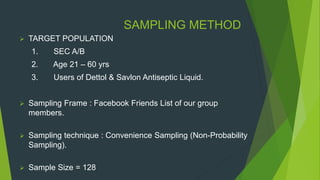
 TARGET POPULATION
1. SEC A/B
2. Age 21 – 60 yrs
3. Users of Dettol & Savlon Antiseptic Liquid.
 Sampling Frame : Facebook Friends List of our group
members.
 Sampling technique : Convenience Sampling (Non-Probability
Sampling).
 Sample Size = 128
HYPOTHESIS
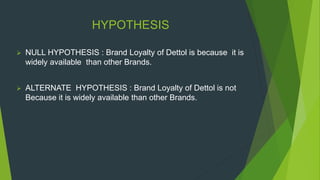
 NULL HYPOTHESIS : Brand Loyalty of Dettol is because it is
widely available than other Brands.
 ALTERNATE HYPOTHESIS : Brand Loyalty of Dettol is not
Because it is widely available than other Brands.
ANALYSIS OF RESULTS
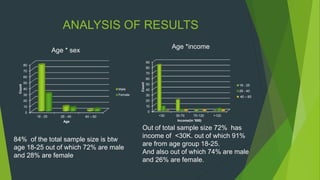
84% of the total sample size is btw
age 18-25 out of which 72% are male
and 28% are female
Out of total sample size 72% has
income of <30K. out of which 91%
are from age group 18-25.
And also out of which 74% are male
and 26% are female.
Age *income
Age * sex
0
10
20
30
40
50
60
70
80
18 - 25 26 - 40 40 – 60
Count
Age
Male
Female
0
10
20
30
40
50
60
70
80
90
<30 30-70 70-120 >120
Count
Income(in '000)
18 - 25
26 - 40
40 – 60
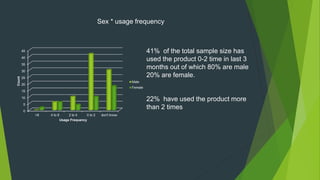
41% of the total sample size has
used the product 0-2 time in last 3
months out of which 80% are male
20% are female.
22% have used the product more
than 2 times
Sex * usage frequency
0
5
10
15
20
25
30
35
40
45
>8 4 to 8 2 to 4 0 to 2 don't know
Count
Usage Frequency
Male
Female
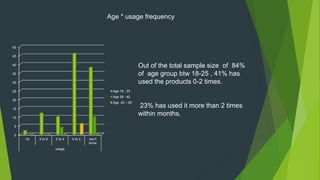
Out of the total sample size of 84%
of age group btw 18-25 , 41% has
used the products 0-2 times.
23% has used it more than 2 times
within months.
Age * usage frequency
0
5
10
15
20
25
30
35
40
45
50
>8 4 to 8 2 to 4 0 to 2 don't
know
usage
Age 18 - 25
Age 26 - 40
Age 40 – 60
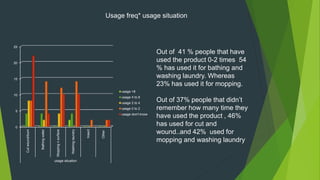
Out of 41 % people that have
used the product 0-2 times 54
% has used it for bathing and
washing laundry. Whereas
23% has used it for mopping.
Out of 37% people that didn’t
remember how many time they
have used the product , 46%
has used for cut and
wound..and 42% used for
mopping and washing laundry
Usage freq* usage situation
0
5
10
15
20
25
Cutwound/burn
Bathingwater
Moppingnsurface
Washinglaundry
Insect
Other
usage situation
usage >8
usage 4 to 8
usage 2 to 4
usage 0 to 2
usage don't know
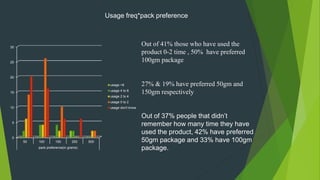
Out of 41% those who have used the
product 0-2 time , 50% have preferred
100gm package
27% & 19% have preferred 50gm and
150gm respectively
Out of 37% people that didn’t
remember how many time they have
used the product, 42% have preferred
50gm package and 33% have 100gm
package.
Usage freq*pack preference
0
5
10
15
20
25
30
50 100 150 250 500
pack preference(in grams)
usage >8
usage 4 to 8
usage 2 to 4
usage 0 to 2
usage don't know
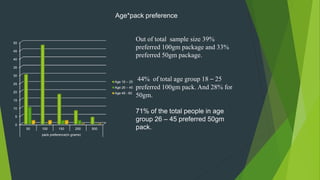
Out of total sample size 39%
preferred 100gm package and 33%
preferred 50gm package.
44% of total age group 18 – 25
preferred 100gm pack. And 28% for
50gm.
71% of the total people in age
group 26 – 45 preferred 50gm
pack.
Age*pack preference
0
5
10
15
20
25
30
35
40
45
50
50 100 150 250 500
pack preference(in grams)
Age 18 – 25
Age 26 – 45
Age 46 - 60
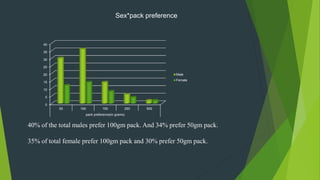
40% of the total males prefer 100gm pack. And 34% prefer 50gm pack.
35% of total female prefer 100gm pack and 30% prefer 50gm pack.
Sex*pack preference
0
5
10
15
20
25
30
35
40
50 100 150 250 500
pack preference(in grams)
Male
Female
Additional analysis
 Paired sample t- tests was carried out between Dettol and
Savlon on following parameters
Trust
Protection
Price
Availability
Need satisfaction
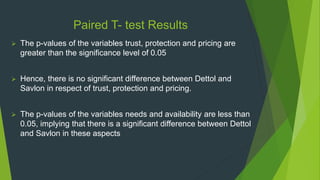
Paired T- test Results
 The p-values of the variables trust, protection and pricing are
greater than the significance level of 0.05
 Hence, there is no significant difference between Dettol and
Savlon in respect of trust, protection and pricing.
 The p-values of the variables needs and availability are less than
0.05, implying that there is a significant difference between Dettol
and Savlon in these aspects
 A new dummy brand “Ayurcare” was introduced to the survey
takers at the same price points with similar product
characteristics and survey takers were now asked to rate
following attributes between Dettol, Savlon and Ayurcare
 Which brand they would choose while shopping for an antiseptic?
 Was the price of the product fair?
 Did the product satisfied their needs?
 Overall perception of the brand?
Introduction of Dummy Brand
Analysis
 We did a paired sample t- test between the responses for two brands,
Savlon and Ayurcare, with respect to the main brand – Dettol
 There is a significant difference between the mean scores of the variable
‘brand chosen’ with most people preferring Dettol followed by Savlon.
 Dettol is also perceived to be the most fairly priced, since the mean scores
are significantly different.
 Overall preference is maximum for Dettol followed by Savlon. The p-values
of overall preference is less than 0.05, and hence, it is significantly different
from the mean scores of each other
CONCLUSION
 Dettol is available more widely than its competitor.
 Savlon and Dettol are perceived to be same on price points and
enjoy same trust factor
 Even after introducing AYURCARE Dettol remained most
preferred brand followed by Savlon
 We reject our null hypothesis that brand loyalty of Dettol is
only a function of its availability it scores highest on all tested
parameters- A mark of a truly cult brand.
Thank You

Brand dossier on dettol

  • 1.
    BRAND DOSSIER ON DETTOL ANTISEPTICLIQUID ANKUSH ROY KRISHNA BOLLOJULA SHUBHAM SHARMA SUDDHASHEEL BHATTACHARYA
  • 2.
    AGENDA  OVERVIEW OFBRAND DETTOL  LITERATURE REVIEW  RESEARCH DESIGN  SAMPLING METHOD  ANALYSIS OF RESULTS  CONCLUSION
  • 3.
    OVERVIEW OF BRANDDETTOL  Reckit Benckiser India Ltd (RBIL) is a fully owned subsidiary of Reckit Benckiser Plc.  It is the world’s No.1 Company in household cleaning.  The brand was launched in 1933 as antiseptic liquid  For the first 50 years, Dettol was present only as an antiseptic liquid.  It has extended to product categories like toilet soaps, liquid hand wash, liquid body wash ,shaving cream and plaster strips.
  • 4.
    Evolution, Positioning andRepositioning of Dettol  The brand Dettol was launched in India in 1933  For the first 50 years, Dettol was present only as an antiseptic liquid.  It progressed from the ‘cuts and wounds’ brand to the ‘protector from germs’  All Dettol products have a sword on the pack, which is a symbol for fighting germs and infection.
  • 5.
    Evolution, Positioning andRepositioning of Dettol  The distinct associations of the brand:- • its trademark smell • its amber gold color • the ‘clouding’ effect hat appears when it is added to water  The brand’s tagline says - Be 100% sure  In 2008, the brand’s launched its “Aapka Dettol Kya Kya Karta Hai” campaign  It showcased how brand users had formed their own special bond with the brand
  • 6.
    Segmentation Strategy  Dettolinitially targeted the urban and educated class who are well aware of public health concerns  Since then Dettol has successfully targeted the other segments including the rural population of the country as well  Dettol soap also targeted the urban middle class uneducated consumers who wanted beauty soap with a property of antiseptic’s.
  • 7.
    Overall Strategy ofDettol  Perceived as a very effective germ killer and cut/wound healer by its consumers  Huge market penetration of almost 83% in the country.  Providing more SKU options at different price points  Affordable to a larger segment particularly in the rural areas.  Is now being endorsed by NIMA(National Integrated Medical Association) which increases the trust factor of the consumer in brand.
  • 8.
    Other players inthe antiseptic liquid market Savlon:  It is the key direct competitor in the antiseptic liquid market.  It was launched with ‘no sting with Savlon’ campaign.  It attempted to pull the consumer base towards its product with the promise of non-sting. Suthol  G.D. Pharma launched Suthol antiseptic liquid in April 2006  It was positioned on soothing sensation from irritation due to prickly heat, mosquito bites, after-shave, etc.
  • 9.
    RESEARCH DESIGN  Weused quantitative research to assess the aids and draw conclusions statistically.  In our research, we use single cross sectional study.  In our questionnaire, we asked people different questions to classify (Classification), understand their behavior (Behavior) and get their opinion(Opinion).  To filter the Target group people, we initiated the questionnaire with recruitment question.
  • 10.
    SAMPLING METHOD  TARGETPOPULATION 1. SEC A/B 2. Age 21 – 60 yrs 3. Users of Dettol & Savlon Antiseptic Liquid.  Sampling Frame : Facebook Friends List of our group members.  Sampling technique : Convenience Sampling (Non-Probability Sampling).  Sample Size = 128
  • 11.
    HYPOTHESIS  NULL HYPOTHESIS: Brand Loyalty of Dettol is because it is widely available than other Brands.  ALTERNATE HYPOTHESIS : Brand Loyalty of Dettol is not Because it is widely available than other Brands.
  • 12.
    ANALYSIS OF RESULTS 84%of the total sample size is btw age 18-25 out of which 72% are male and 28% are female Out of total sample size 72% has income of <30K. out of which 91% are from age group 18-25. And also out of which 74% are male and 26% are female. Age *income Age * sex 0 10 20 30 40 50 60 70 80 18 - 25 26 - 40 40 – 60 Count Age Male Female 0 10 20 30 40 50 60 70 80 90 <30 30-70 70-120 >120 Count Income(in '000) 18 - 25 26 - 40 40 – 60
  • 13.
    41% of thetotal sample size has used the product 0-2 time in last 3 months out of which 80% are male 20% are female. 22% have used the product more than 2 times Sex * usage frequency 0 5 10 15 20 25 30 35 40 45 >8 4 to 8 2 to 4 0 to 2 don't know Count Usage Frequency Male Female
  • 14.
    Out of thetotal sample size of 84% of age group btw 18-25 , 41% has used the products 0-2 times. 23% has used it more than 2 times within months. Age * usage frequency 0 5 10 15 20 25 30 35 40 45 50 >8 4 to 8 2 to 4 0 to 2 don't know usage Age 18 - 25 Age 26 - 40 Age 40 – 60
  • 15.
    Out of 41% people that have used the product 0-2 times 54 % has used it for bathing and washing laundry. Whereas 23% has used it for mopping. Out of 37% people that didn’t remember how many time they have used the product , 46% has used for cut and wound..and 42% used for mopping and washing laundry Usage freq* usage situation 0 5 10 15 20 25 Cutwound/burn Bathingwater Moppingnsurface Washinglaundry Insect Other usage situation usage >8 usage 4 to 8 usage 2 to 4 usage 0 to 2 usage don't know
  • 16.
    Out of 41%those who have used the product 0-2 time , 50% have preferred 100gm package 27% & 19% have preferred 50gm and 150gm respectively Out of 37% people that didn’t remember how many time they have used the product, 42% have preferred 50gm package and 33% have 100gm package. Usage freq*pack preference 0 5 10 15 20 25 30 50 100 150 250 500 pack preference(in grams) usage >8 usage 4 to 8 usage 2 to 4 usage 0 to 2 usage don't know
  • 17.
    Out of totalsample size 39% preferred 100gm package and 33% preferred 50gm package. 44% of total age group 18 – 25 preferred 100gm pack. And 28% for 50gm. 71% of the total people in age group 26 – 45 preferred 50gm pack. Age*pack preference 0 5 10 15 20 25 30 35 40 45 50 50 100 150 250 500 pack preference(in grams) Age 18 – 25 Age 26 – 45 Age 46 - 60
  • 18.
    40% of thetotal males prefer 100gm pack. And 34% prefer 50gm pack. 35% of total female prefer 100gm pack and 30% prefer 50gm pack. Sex*pack preference 0 5 10 15 20 25 30 35 40 50 100 150 250 500 pack preference(in grams) Male Female
  • 19.
    Additional analysis  Pairedsample t- tests was carried out between Dettol and Savlon on following parameters Trust Protection Price Availability Need satisfaction
  • 20.
    Paired T- testResults  The p-values of the variables trust, protection and pricing are greater than the significance level of 0.05  Hence, there is no significant difference between Dettol and Savlon in respect of trust, protection and pricing.  The p-values of the variables needs and availability are less than 0.05, implying that there is a significant difference between Dettol and Savlon in these aspects
  • 21.
     A newdummy brand “Ayurcare” was introduced to the survey takers at the same price points with similar product characteristics and survey takers were now asked to rate following attributes between Dettol, Savlon and Ayurcare  Which brand they would choose while shopping for an antiseptic?  Was the price of the product fair?  Did the product satisfied their needs?  Overall perception of the brand? Introduction of Dummy Brand
  • 22.
    Analysis  We dida paired sample t- test between the responses for two brands, Savlon and Ayurcare, with respect to the main brand – Dettol  There is a significant difference between the mean scores of the variable ‘brand chosen’ with most people preferring Dettol followed by Savlon.  Dettol is also perceived to be the most fairly priced, since the mean scores are significantly different.  Overall preference is maximum for Dettol followed by Savlon. The p-values of overall preference is less than 0.05, and hence, it is significantly different from the mean scores of each other
  • 23.
    CONCLUSION  Dettol isavailable more widely than its competitor.  Savlon and Dettol are perceived to be same on price points and enjoy same trust factor  Even after introducing AYURCARE Dettol remained most preferred brand followed by Savlon  We reject our null hypothesis that brand loyalty of Dettol is only a function of its availability it scores highest on all tested parameters- A mark of a truly cult brand.
  • 24.