PRESENTATION
Name: Sultan Salahud Din
Roll No: 1464012
Topic: Branching
Submitted to: Mr Abdullah Khan
DEPARTMENT OF COMPUTER SCIENCE
GOVT AKL PG COLLEGE MATTA SWAT
Contents
• Comparison and Conditions
• Conditional Jumps
• Example 3.1
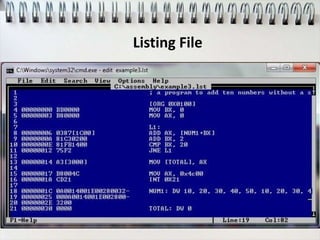
• Listing File
• Unconditional Jump
• Example 3.2
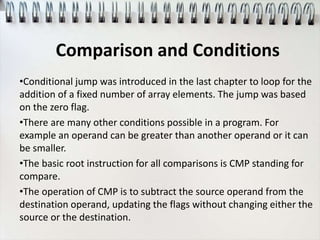
Comparison and Conditions
•Conditional jump was introduced in the last chapter to loop for the
addition of a fixed number of array elements. The jump was based
on the zero flag.
•There are many other conditions possible in a program. For
example an operand can be greater than another operand or it can
be smaller.
•The basic root instruction for all comparisons is CMP standing for
compare.
•The operation of CMP is to subtract the source operand from the
destination operand, updating the flags without changing either the
source or the destination.
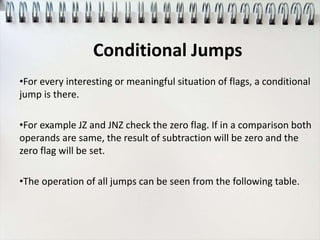
Conditional Jumps
•For every interesting or meaningful situation of flags, a conditional
jump is there.
•For example JZ and JNZ check the zero flag. If in a comparison both
operands are same, the result of subtraction will be zero and the
zero flag will be set.
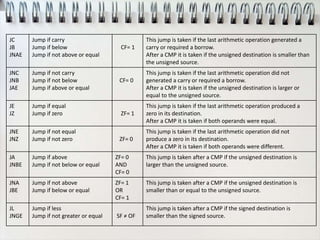
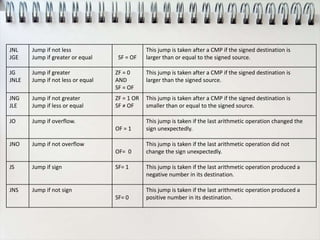
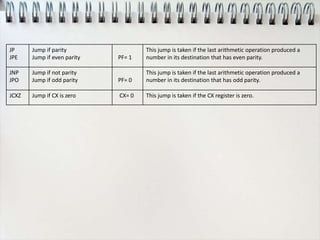
•The operation of all jumps can be seen from the following table.
JC
JB
JNAE
Jump if carry
Jump if below
Jump if not above or equal
CF= 1
This jump is taken if the last arithmetic operation generated a
carry or required a borrow.
After a CMP it is taken if the unsigned destination is smaller than
the unsigned source.
JNC
JNB
JAE
Jump if not carry
Jump if not below
Jump if above or equal
CF= 0
This jump is taken if the last arithmetic operation did not
generated a carry or required a borrow.
After a CMP it is taken if the unsigned destination is larger or
equal to the unsigned source.
JE
JZ
Jump if equal
Jump if zero ZF= 1
This jump is taken if the last arithmetic operation produced a
zero in its destination.
After a CMP it is taken if both operands were equal.
JNE
JNZ
Jump if not equal
Jump if not zero ZF= 0
This jump is taken if the last arithmetic operation did not
produce a zero in its destination.
After a CMP it is taken if both operands were different.
JA
JNBE
Jump if above
Jump if not below or equal
ZF= 0
AND
CF= 0
This jump is taken after a CMP if the unsigned destination is
larger than the unsigned source.
JNA
JBE
Jump if not above
Jump if below or equal
ZF= 1
OR
CF= 1
This jump is taken after a CMP if the unsigned destination is
smaller than or equal to the unsigned source.
JL
JNGE
Jump if less
Jump if not greater or equal SF ≠ OF
This jump is taken after a CMP if the signed destination is
smaller than the signed source.
JNL
JGE
Jump if not less
Jump if greater or equal SF = OF
This jump is taken after a CMP if the signed destination is
larger than or equal to the signed source.
JG
JNLE
Jump if greater
Jump if not less or equal
ZF = 0
AND
SF = OF
This jump is taken after a CMP if the signed destination is
larger than the signed source.
JNG
JLE
Jump if not greater
Jump if less or equal
ZF = 1 OR
SF ≠ OF
This jump is taken after a CMP if the signed destination is
smaller than or equal to the signed source.
JO Jump if overflow.
OF = 1
This jump is taken if the last arithmetic operation changed the
sign unexpectedly.
JNO Jump if not overflow
OF= 0
This jump is taken if the last arithmetic operation did not
change the sign unexpectedly.
JS Jump if sign SF= 1 This jump is taken if the last arithmetic operation produced a
negative number in its destination.
JNS Jump if not sign
SF= 0
This jump is taken if the last arithmetic operation produced a
positive number in its destination.
JP
JPE
Jump if parity
Jump if even parity PF= 1
This jump is taken if the last arithmetic operation produced a
number in its destination that has even parity.
JNP
JPO
Jump if not parity
Jump if odd parity PF= 0
This jump is taken if the last arithmetic operation produced a
number in its destination that has odd parity.
JCXZ Jump if CX is zero CX= 0 This jump is taken if the CX register is zero.
Example 3.1
; a program to add ten numbers without a separate counter
[ORG 0X0100]
MOV BX, 0
MOV AX, 0
L1:
ADD AX, [NUM1+BX]
ADD BX, 2
CMP BX, 20
JNE L1
MOV [TOTAL], AX
MOV AX, 0x4c00
INT 0X21
NUM1: DW 10, 20, 30, 40, 50, 10, 20, 30, 40, 50
TOTAL: DW 0
Listing File
Unconditional Jump
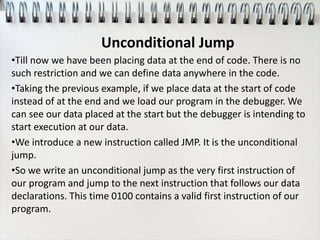
•Till now we have been placing data at the end of code. There is no
such restriction and we can define data anywhere in the code.
•Taking the previous example, if we place data at the start of code
instead of at the end and we load our program in the debugger. We
can see our data placed at the start but the debugger is intending to
start execution at our data.
•We introduce a new instruction called JMP. It is the unconditional
jump.
•So we write an unconditional jump as the very first instruction of
our program and jump to the next instruction that follows our data
declarations. This time 0100 contains a valid first instruction of our
program.
Example 3.2
; a program to add ten numbers without a separate counter
[ORG 0X0100]
JMP START
NUM1: DW 10, 20, 30, 40, 50, 10, 20, 30, 40, 50
TOTAL: DW 0
START:
MOV BX, 0
MOV AX, 0
L1:
ADD AX, [NUM1+BX]
ADD BX, 2
CMP BX, 20
JNE L1
MOV [TOTAL], AX
MOV AX, 0x4c00
INT 0X21
GOOD LUCK

Branching

  • 2.
    PRESENTATION Name: Sultan SalahudDin Roll No: 1464012 Topic: Branching Submitted to: Mr Abdullah Khan DEPARTMENT OF COMPUTER SCIENCE GOVT AKL PG COLLEGE MATTA SWAT
  • 3.
    Contents • Comparison andConditions • Conditional Jumps • Example 3.1 • Listing File • Unconditional Jump • Example 3.2
  • 4.
    Comparison and Conditions •Conditionaljump was introduced in the last chapter to loop for the addition of a fixed number of array elements. The jump was based on the zero flag. •There are many other conditions possible in a program. For example an operand can be greater than another operand or it can be smaller. •The basic root instruction for all comparisons is CMP standing for compare. •The operation of CMP is to subtract the source operand from the destination operand, updating the flags without changing either the source or the destination.
  • 5.
    Conditional Jumps •For everyinteresting or meaningful situation of flags, a conditional jump is there. •For example JZ and JNZ check the zero flag. If in a comparison both operands are same, the result of subtraction will be zero and the zero flag will be set. •The operation of all jumps can be seen from the following table.
  • 6.
    JC JB JNAE Jump if carry Jumpif below Jump if not above or equal CF= 1 This jump is taken if the last arithmetic operation generated a carry or required a borrow. After a CMP it is taken if the unsigned destination is smaller than the unsigned source. JNC JNB JAE Jump if not carry Jump if not below Jump if above or equal CF= 0 This jump is taken if the last arithmetic operation did not generated a carry or required a borrow. After a CMP it is taken if the unsigned destination is larger or equal to the unsigned source. JE JZ Jump if equal Jump if zero ZF= 1 This jump is taken if the last arithmetic operation produced a zero in its destination. After a CMP it is taken if both operands were equal. JNE JNZ Jump if not equal Jump if not zero ZF= 0 This jump is taken if the last arithmetic operation did not produce a zero in its destination. After a CMP it is taken if both operands were different. JA JNBE Jump if above Jump if not below or equal ZF= 0 AND CF= 0 This jump is taken after a CMP if the unsigned destination is larger than the unsigned source. JNA JBE Jump if not above Jump if below or equal ZF= 1 OR CF= 1 This jump is taken after a CMP if the unsigned destination is smaller than or equal to the unsigned source. JL JNGE Jump if less Jump if not greater or equal SF ≠ OF This jump is taken after a CMP if the signed destination is smaller than the signed source.
  • 7.
    JNL JGE Jump if notless Jump if greater or equal SF = OF This jump is taken after a CMP if the signed destination is larger than or equal to the signed source. JG JNLE Jump if greater Jump if not less or equal ZF = 0 AND SF = OF This jump is taken after a CMP if the signed destination is larger than the signed source. JNG JLE Jump if not greater Jump if less or equal ZF = 1 OR SF ≠ OF This jump is taken after a CMP if the signed destination is smaller than or equal to the signed source. JO Jump if overflow. OF = 1 This jump is taken if the last arithmetic operation changed the sign unexpectedly. JNO Jump if not overflow OF= 0 This jump is taken if the last arithmetic operation did not change the sign unexpectedly. JS Jump if sign SF= 1 This jump is taken if the last arithmetic operation produced a negative number in its destination. JNS Jump if not sign SF= 0 This jump is taken if the last arithmetic operation produced a positive number in its destination.
  • 8.
    JP JPE Jump if parity Jumpif even parity PF= 1 This jump is taken if the last arithmetic operation produced a number in its destination that has even parity. JNP JPO Jump if not parity Jump if odd parity PF= 0 This jump is taken if the last arithmetic operation produced a number in its destination that has odd parity. JCXZ Jump if CX is zero CX= 0 This jump is taken if the CX register is zero.
  • 9.
    Example 3.1 ; aprogram to add ten numbers without a separate counter [ORG 0X0100] MOV BX, 0 MOV AX, 0 L1: ADD AX, [NUM1+BX] ADD BX, 2 CMP BX, 20 JNE L1 MOV [TOTAL], AX MOV AX, 0x4c00 INT 0X21 NUM1: DW 10, 20, 30, 40, 50, 10, 20, 30, 40, 50 TOTAL: DW 0
  • 10.
  • 11.
    Unconditional Jump •Till nowwe have been placing data at the end of code. There is no such restriction and we can define data anywhere in the code. •Taking the previous example, if we place data at the start of code instead of at the end and we load our program in the debugger. We can see our data placed at the start but the debugger is intending to start execution at our data. •We introduce a new instruction called JMP. It is the unconditional jump. •So we write an unconditional jump as the very first instruction of our program and jump to the next instruction that follows our data declarations. This time 0100 contains a valid first instruction of our program.
  • 12.
    Example 3.2 ; aprogram to add ten numbers without a separate counter [ORG 0X0100] JMP START NUM1: DW 10, 20, 30, 40, 50, 10, 20, 30, 40, 50 TOTAL: DW 0 START: MOV BX, 0 MOV AX, 0 L1: ADD AX, [NUM1+BX] ADD BX, 2 CMP BX, 20 JNE L1 MOV [TOTAL], AX MOV AX, 0x4c00 INT 0X21
  • 13.