PRAYER
Dear Heavenly Father, As we gather here
today, we invite Your presence into this
classroom. Lord, bless each and every student
here, as well as our teacher, as we embark on
another day of learning. Please give us clear
minds and open hearts so we can grasp the
knowledge and lessons set before us.
AMEN.
Patient with
Gestational
Diabetes
Case Report
Here is where your presentation begins
Learning Objectives
Differentiate Health and
Wellness
Identify the 5 components of
wellness
Explain the importance of Health
Education
Analysis
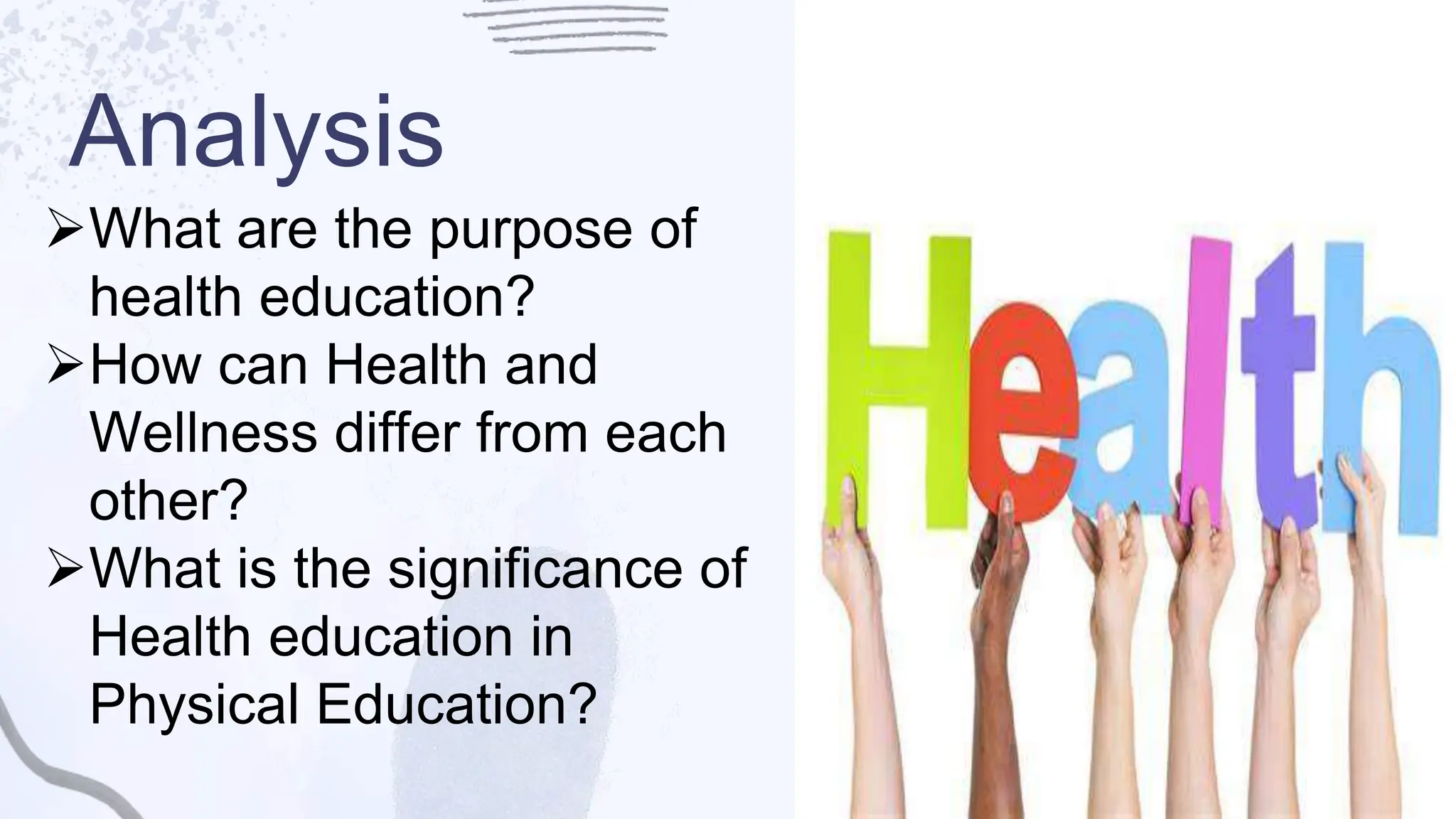
What are the purpose of
health education?
How can Health and
Wellness differ from each
other?
What is the significance of
Health education in
Physical Education?
World Health Organization (WHO) defines
health as “a state of complete physical,
mental, and social well-being and not merely
the absence of disease or infirmity (illness).”
What is Health?
What is Wellness?
WHO defines wellness as “the
optimal state of health of individuals
and groups,” and wellness is
expressed as “a positive approach to
living.”
HEALTH EDUCATION
Health education is defined as a continuous, dynamic,
complex and planned teaching-learning process
throughout the lifespan and in different settings that is
implemented through an equitable and negotiated client
and health professional ‘partnership’ to facilitate and
empower the person to promote/initiate lifestyle-related
behavioural changes that promote positive health status
outcomes.
6 COMPONENTS
OF WELLNESS
Component of Wellness
Physical Wellness:
Physical wellness
increases
physical fitness by being
physically fit, a person
would have an enhanced
ability to prevent illness
and diseases.
Component of Wellness
Environmental
Wellness: Awareness of
the role we play in
improving our natural
environment rather than
denigrating it and
maintaining and living in
a healthy physical
environment free of
hazards promotes
wellness.
Component of Wellness
Intellectual Wellness:
Mental exercise and
engagement through
learning, problem-
solving, and creativity
support intellectual
wellness and promote a
better attitude.
Component of Wellness
Emotional
Wellness: A person
with emotional
wellness can deal
with stressful
situations.
Component of Wellness
Social Wellness:
Social circles and
support networks
are invaluable to
the overall well-
being of a person.
Components of Wellness
Spiritual Wellness:
Spiritual wellness
does not imply
religion or faith of a
person, but the
search for meaning
and purpose of
human existence.
Health vs. Wellness
Wellness is an
active process
of growth and
change to
reach your
fullest health
and well-being.
Health comprises
the diagnosis of a
disease/illness,
predisposition to
a disease, and
any unexpected
injury.
QUIZ TIME!
PRAYER
Thank you for guiding us through this class and for the
opportunity to learn and grow. As we leave this space, may we
carry the knowledge gained with us and apply it in our lives.
Grant us wisdom and understanding as we continue on our
journey of learning.
Bless our teachers and classmates, and may we always strive
to support and uplift one another. Help us to be mindful of the
lessons learned today and to use them for the greater good.
Guide us in our studies and endeavors, and may we always
seek truth and knowledge in all that we do.
Amen.

BPE312HEALTH-WELLNESS 5 domains of health caring.pptx

  • 1.
    PRAYER Dear Heavenly Father,As we gather here today, we invite Your presence into this classroom. Lord, bless each and every student here, as well as our teacher, as we embark on another day of learning. Please give us clear minds and open hearts so we can grasp the knowledge and lessons set before us. AMEN.
  • 2.
    Patient with Gestational Diabetes Case Report Hereis where your presentation begins
  • 3.
    Learning Objectives Differentiate Healthand Wellness Identify the 5 components of wellness Explain the importance of Health Education
  • 4.
    Analysis What are thepurpose of health education? How can Health and Wellness differ from each other? What is the significance of Health education in Physical Education?
  • 5.
    World Health Organization(WHO) defines health as “a state of complete physical, mental, and social well-being and not merely the absence of disease or infirmity (illness).” What is Health?
  • 6.
    What is Wellness? WHOdefines wellness as “the optimal state of health of individuals and groups,” and wellness is expressed as “a positive approach to living.”
  • 7.
    HEALTH EDUCATION Health educationis defined as a continuous, dynamic, complex and planned teaching-learning process throughout the lifespan and in different settings that is implemented through an equitable and negotiated client and health professional ‘partnership’ to facilitate and empower the person to promote/initiate lifestyle-related behavioural changes that promote positive health status outcomes.
  • 8.
  • 9.
    Component of Wellness PhysicalWellness: Physical wellness increases physical fitness by being physically fit, a person would have an enhanced ability to prevent illness and diseases.
  • 10.
    Component of Wellness Environmental Wellness:Awareness of the role we play in improving our natural environment rather than denigrating it and maintaining and living in a healthy physical environment free of hazards promotes wellness.
  • 11.
    Component of Wellness IntellectualWellness: Mental exercise and engagement through learning, problem- solving, and creativity support intellectual wellness and promote a better attitude.
  • 12.
    Component of Wellness Emotional Wellness:A person with emotional wellness can deal with stressful situations.
  • 13.
    Component of Wellness SocialWellness: Social circles and support networks are invaluable to the overall well- being of a person.
  • 14.
    Components of Wellness SpiritualWellness: Spiritual wellness does not imply religion or faith of a person, but the search for meaning and purpose of human existence.
  • 15.
    Health vs. Wellness Wellnessis an active process of growth and change to reach your fullest health and well-being. Health comprises the diagnosis of a disease/illness, predisposition to a disease, and any unexpected injury.
  • 16.
  • 17.
    PRAYER Thank you forguiding us through this class and for the opportunity to learn and grow. As we leave this space, may we carry the knowledge gained with us and apply it in our lives. Grant us wisdom and understanding as we continue on our journey of learning. Bless our teachers and classmates, and may we always strive to support and uplift one another. Help us to be mindful of the lessons learned today and to use them for the greater good. Guide us in our studies and endeavors, and may we always seek truth and knowledge in all that we do. Amen.

Editor's Notes

  • #7 The primary difference between health and wellness is that health is the goal and wellness is the active process of achieving it. You truly cannot have health without first achieving wellness. Wellness has a direct influence on overall health, which is essential for living a robust, happy, and fulfilled life.
  • #16 It is associated with actively pursuing activities, making choices and lifestyle changes, controlling risk factors that can harm a person, focusing on nutrition, having a balanced diet, and following spiritual practices that lead to holistic health.