REASON & EMOTION
The aim of this tutorial is to help you learn to
understand the roles of reason and emotion in
critical thinking.
2
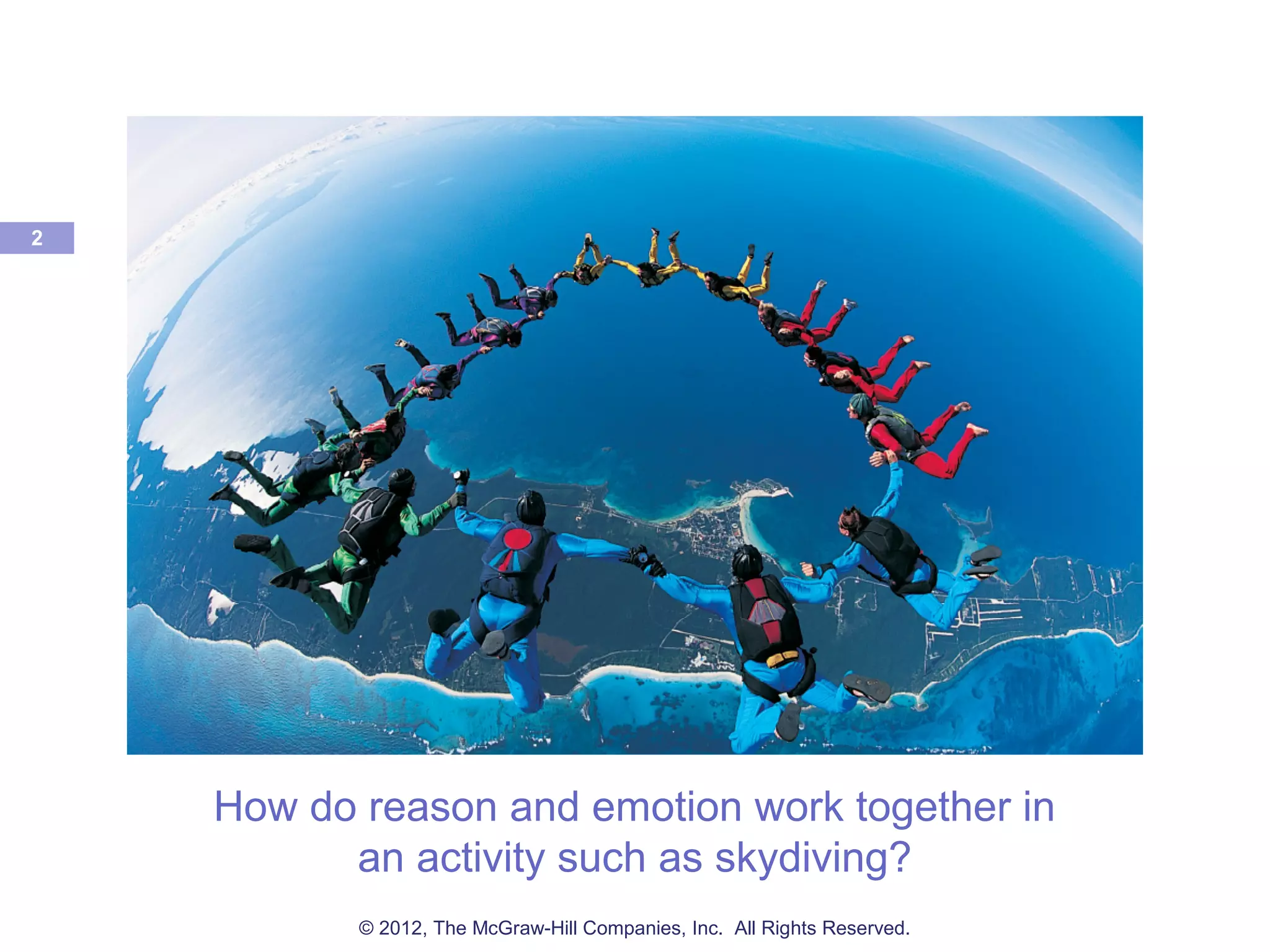
How do reason and emotion work together in
an activity such as skydiving?
© 2012, The McGraw-Hill Companies, Inc. All Rights Reserved.
Reason and emotion play important
roles in critical thinking
Understanding their roles as separate and combined
influences is a very important aspect of critical
thought.
Reason is the process of supporting a claim or
conclusion based on evidence. It involves both the
disciplined use of intelligence and the application of rules
for problem solving.
In logic, reasoning is presented in a structured form
supported by premises. However, everyday uses of reason
are broader, and require creative thought and emotional
discernment.
3
© 2012, The McGraw-Hill Companies, Inc. All Rights Reserved.
4
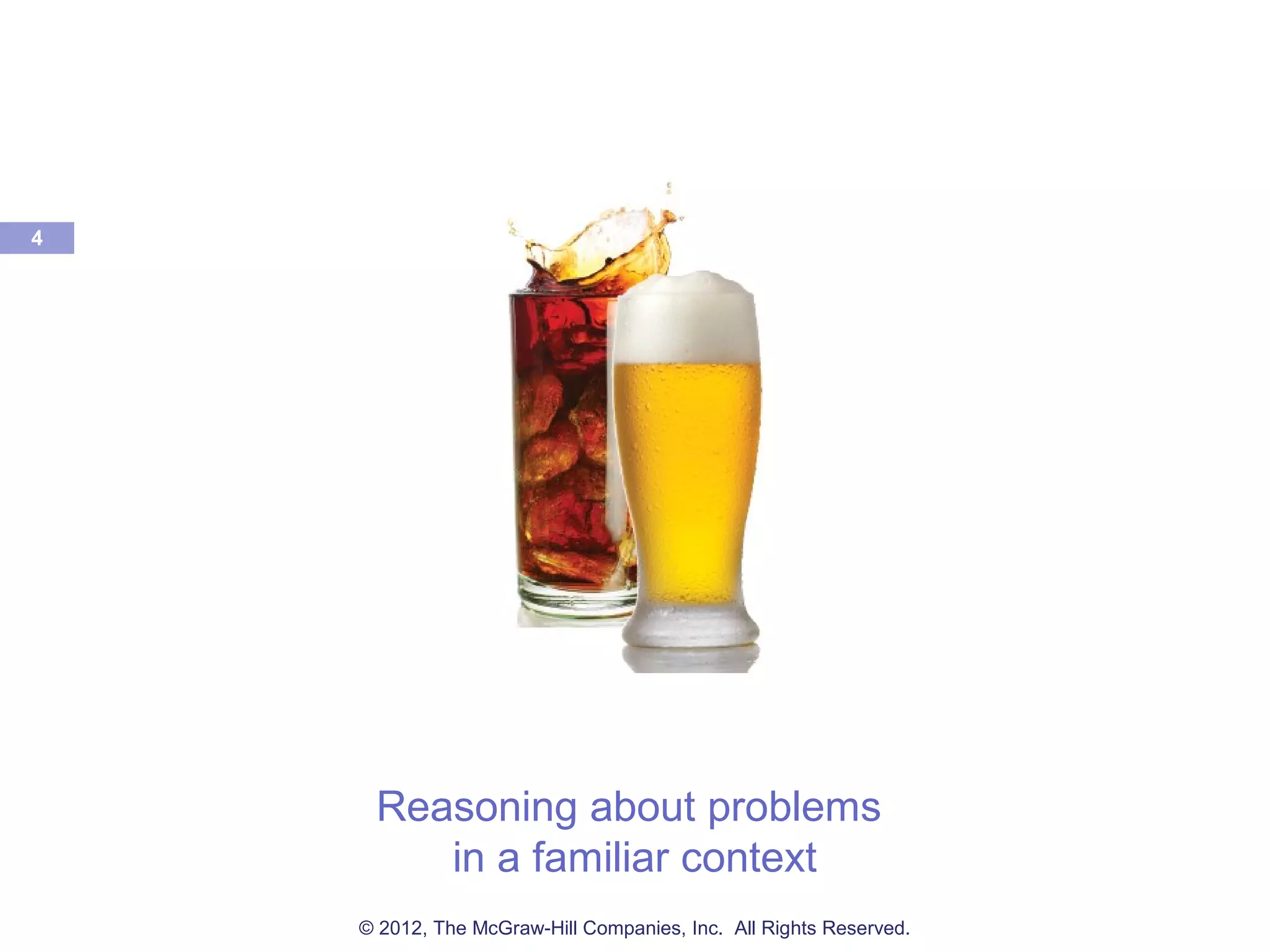
Reasoning about problems
in a familiar context
© 2012, The McGraw-Hill Companies, Inc. All Rights Reserved.
Reason contains a number of
important components and strategies
 These components include the ability to engage in
abstract thinking, logical argumentation, and behavioral
modification.
 Reason also involves the embrace of different cognitive
strategies such as deduction, generalization, and
imagination. It is also important in spatial-temporal
problem solving in fields such as mathematics,
engineering, and architecture.
5
© 2012, The McGraw-Hill Companies, Inc. All Rights Reserved.
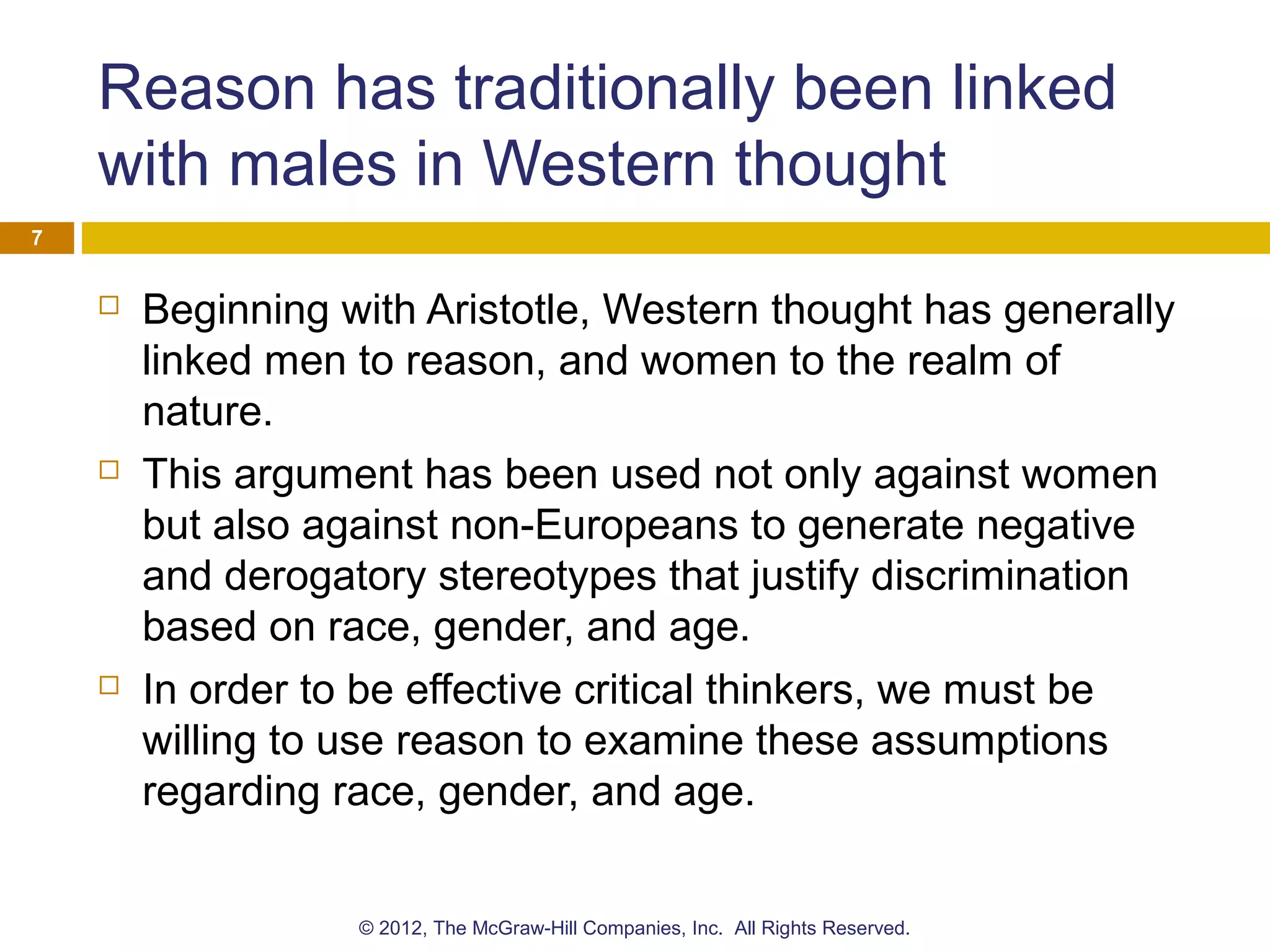
6
Great Chain of Being
© 2012, The McGraw-Hill Companies, Inc. All Rights Reserved.
Reason has traditionally been linked
with males in Western thought
 Beginning with Aristotle, Western thought has generally
linked men to reason, and women to the realm of
nature.
 This argument has been used not only against women
but also against non-Europeans to generate negative
and derogatory stereotypes that justify discrimination
based on race, gender, and age.
 In order to be effective critical thinkers, we must be
willing to use reason to examine these assumptions
regarding race, gender, and age.
7
© 2012, The McGraw-Hill Companies, Inc. All Rights Reserved.
Reason can operate at both the
conscious and unconscious levels
 Traditionally seen as a conscious activity, recent
cognitive research suggests much of reasoning is in fact
unconscious and automatic.
 Studies of brain function indicate that dreams involve
cerebral activity related to reason and problem solving.
 Many important knowledge breakthroughs, such as the
creation of the periodic table by Russian chemist Dmitri
Mendeleyev, occurred through dream-inspired guidance.
8
© 2012, The McGraw-Hill Companies, Inc. All Rights Reserved.
9
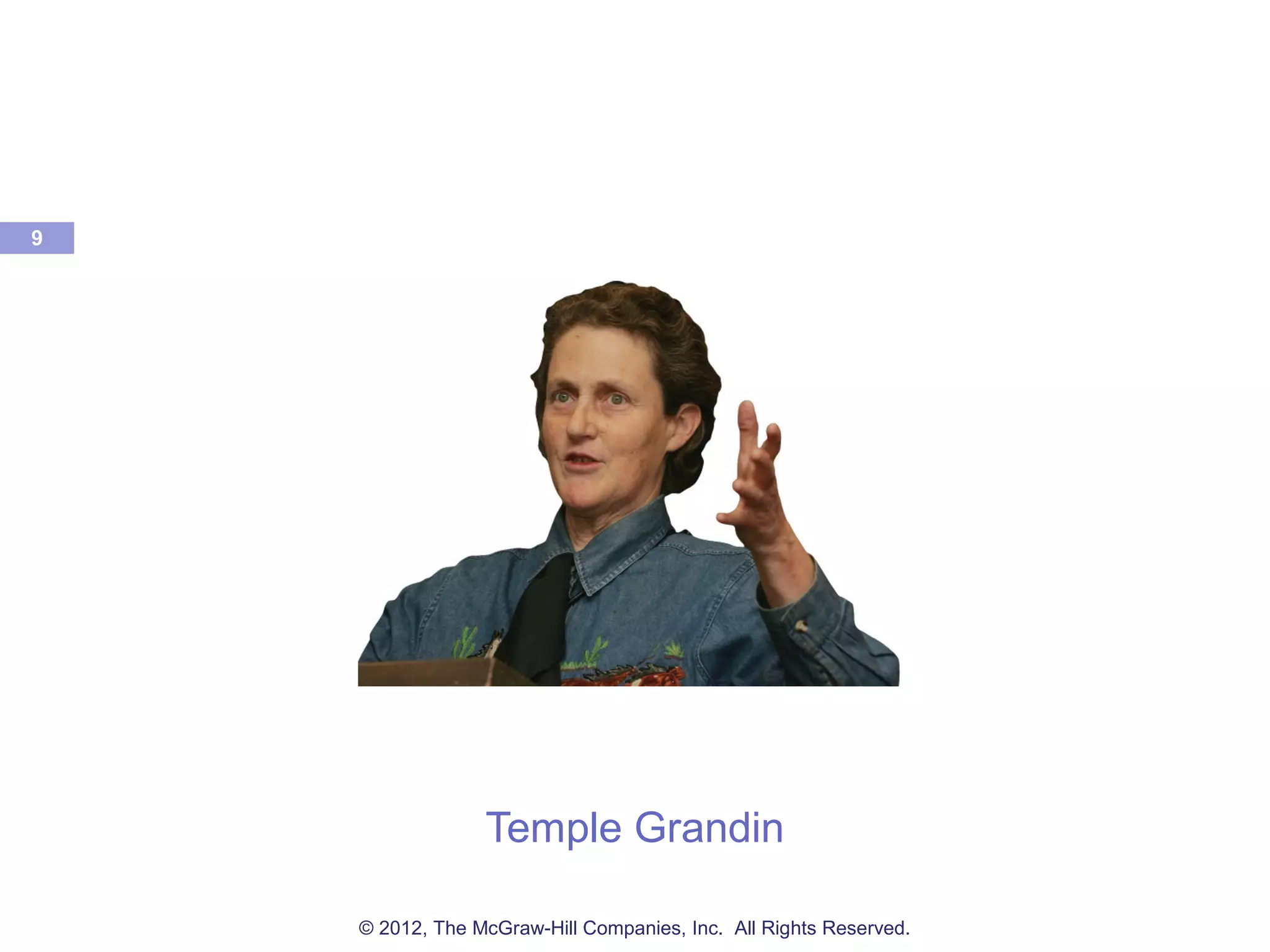
Temple Grandin
© 2012, The McGraw-Hill Companies, Inc. All Rights Reserved.
10
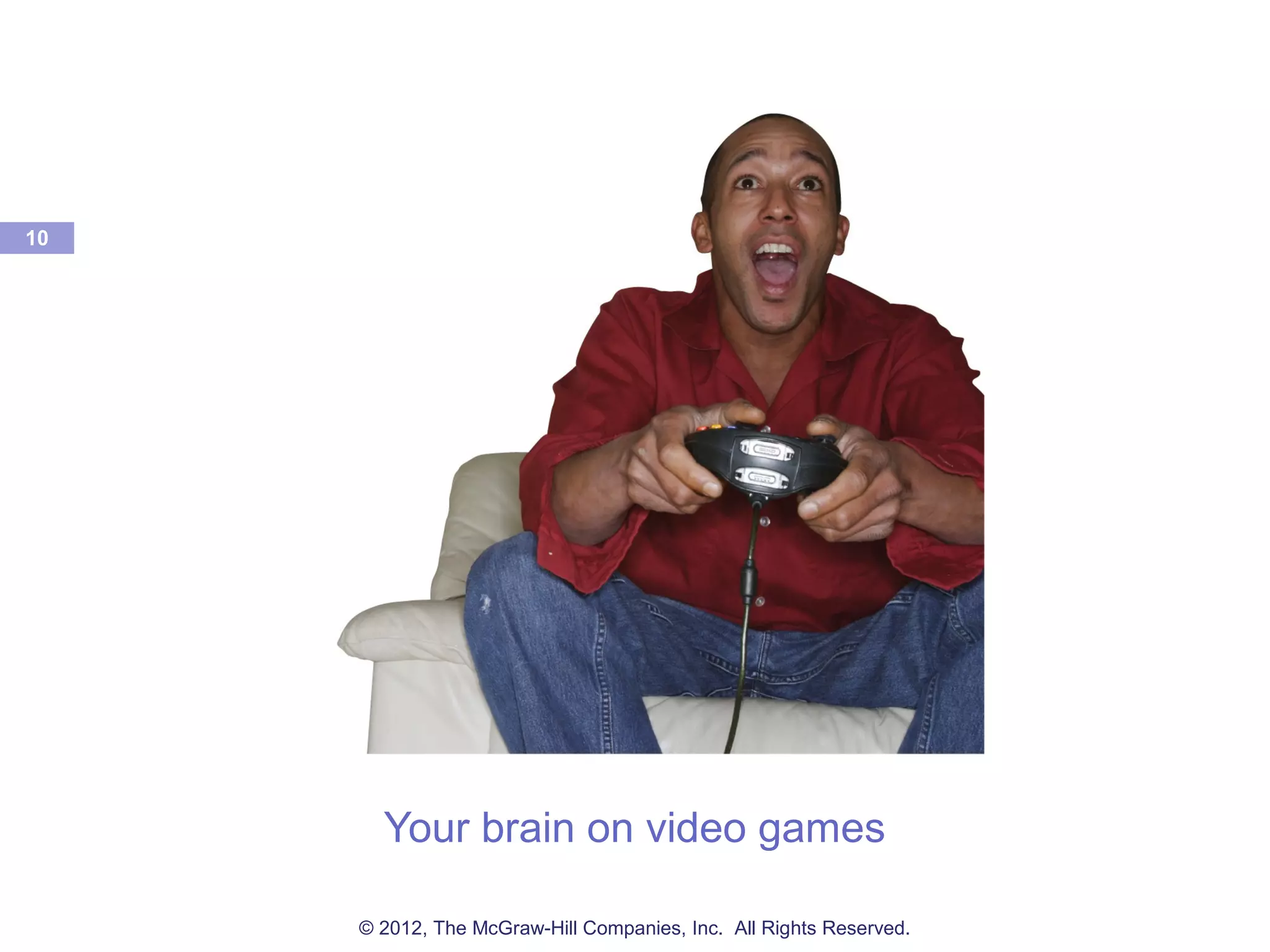
Your brain on video games
© 2012, The McGraw-Hill Companies, Inc. All Rights Reserved.
Reason is an essential component of
critical thinking
 Reason helps us analyze beliefs and evidence, to make
good life choice decisions, to cope with adversity, and to
resolve problems. In critical thinking, reason does not
operate alone, but works together with other faculties,
such as emotion.
 Understanding the role emotion plays in critical thinking
is essential for the development of strong critical thinking
skills.
11
© 2012, The McGraw-Hill Companies, Inc. All Rights Reserved.
The role of emotion in critical thinking
 According to Random House Webster’s College
Dictionary, emotion is a “state of consciousness in
which joy, sorrow, fear, etc., is experienced, as
distinguished from cognitive and volitional
consciousness.”
 In Western culture, emotion has been traditionally
viewed as the opposite of reason. In contrast, other
cultures have emphasized the importance of positive
emotions in the development of critical thinking skills.
12
© 2012, The McGraw-Hill Companies, Inc. All Rights Reserved.
13
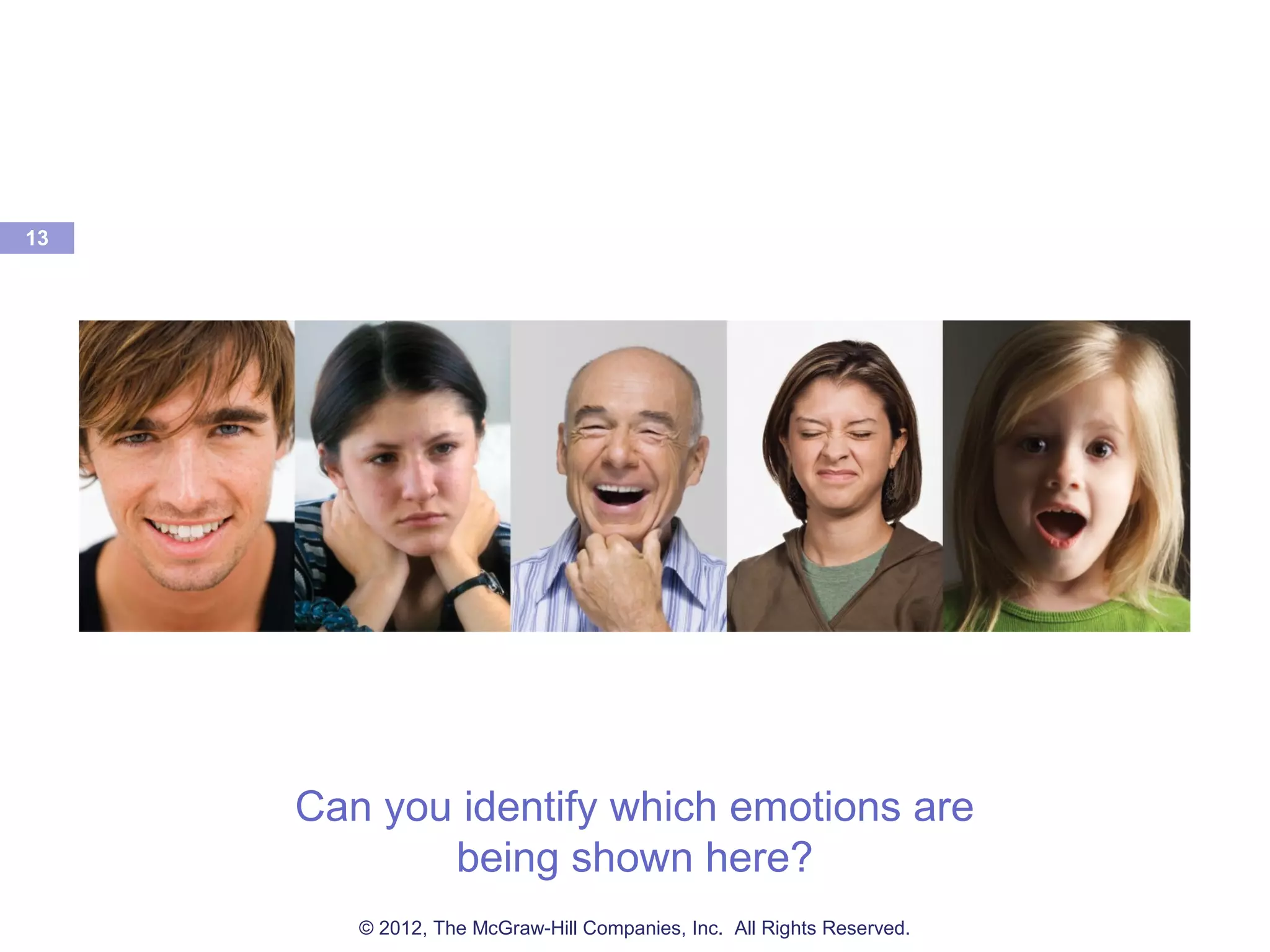
Can you identify which emotions are
being shown here?
© 2012, The McGraw-Hill Companies, Inc. All Rights Reserved.
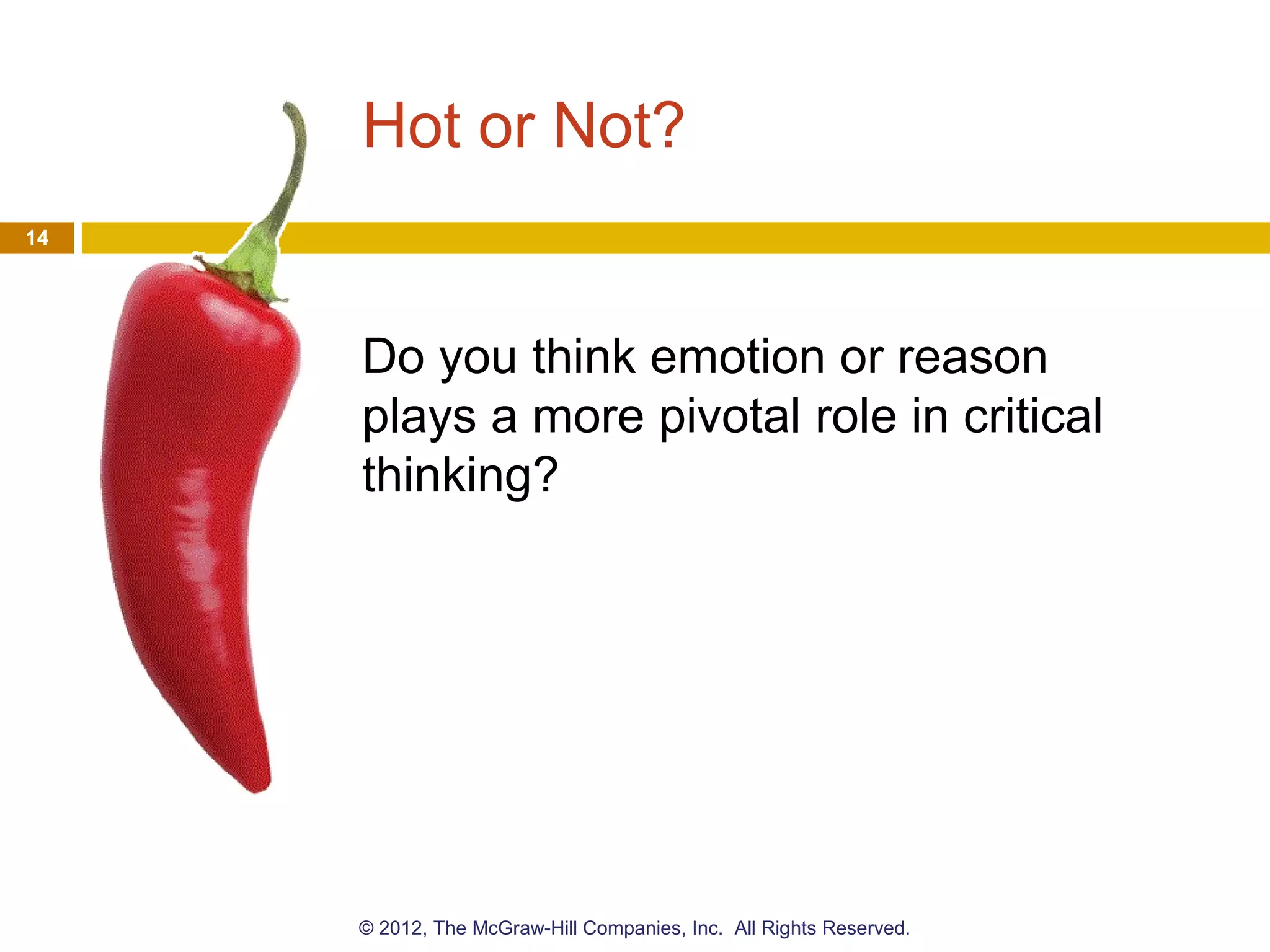
Hot or Not?
Do you think emotion or reason
plays a more pivotal role in critical
thinking?
14
© 2012, The McGraw-Hill Companies, Inc. All Rights Reserved.
The role of emotion in critical thinking
 As critical thinkers, we need to be aware of the dangers
of emotions such as anger and fear as barriers to
critical thought, and also of the benefits of using
emotions such as empathy and compassion to
enhance our critical thinking abilities.
15
© 2012, The McGraw-Hill Companies, Inc. All Rights Reserved.
16
Rosa Parks
© 2012, The McGraw-Hill Companies, Inc. All Rights Reserved.
The importance of emotional
intelligence
 Emotional intelligence—the ability to perceive,
appraise, express, and regulate emotion—is positively
related to abstract reasoning ability.
 Emotions such as empathy, moral indignation, love,
happiness, and even guilt can have a positive effect on
our reasoning by influencing us to make better
decisions.
 An empathetic person is more flexible and open to other
perspectives. This openness motivates critical analysis
of problems and situations and helps formulate
appropriate action plans and responses.
17
© 2012, The McGraw-Hill Companies, Inc. All Rights Reserved.
Emotions can also work against critical
thinking
 Although emotions can motivate better decision-making,
they can also hinder it. Examples of the negative role
emotions can play include the presence of fear and
anger in action plans.
 Additionally, we are vulnerable to emotional appeals
such as those in advertising and political campaigns.
These appeals, often devoid of evidence and good
reasoning, can distract us from more important issues or
encourage regrettable actions.
18
© 2012, The McGraw-Hill Companies, Inc. All Rights Reserved.
Integrating reason and emotion…
…provides a double-pronged tool for critical thinking.
 Emotion alerts us to problems and other people’s
perspectives. Emotion also motivates action and
problem resolution.
 Using our emotions in conjunction with reason allows us
to make better-informed decisions.
19
© 2012, The McGraw-Hill Companies, Inc. All Rights Reserved.
Artificial Intelligence (AI), reasoning,
and emotion
 Artificial intelligence is defined as “the study of
computations that make it possible to perceive, reason,
and act.” Its goals include the enhancement of human
reasoning, the creation of intelligent machines, and the
development of sociable, intelligent machines that can
cooperate with people.
 Given recent advances in these endeavors, as critical
thinkers we need to move beyond questioning whether
AI is capable of reasoning and emotion, and not hold AI
to higher standards of proof than we apply to humanity.
AI possesses enormous potential to enhance our critical
thinking abilities.
20
© 2012, The McGraw-Hill Companies, Inc. All Rights Reserved.
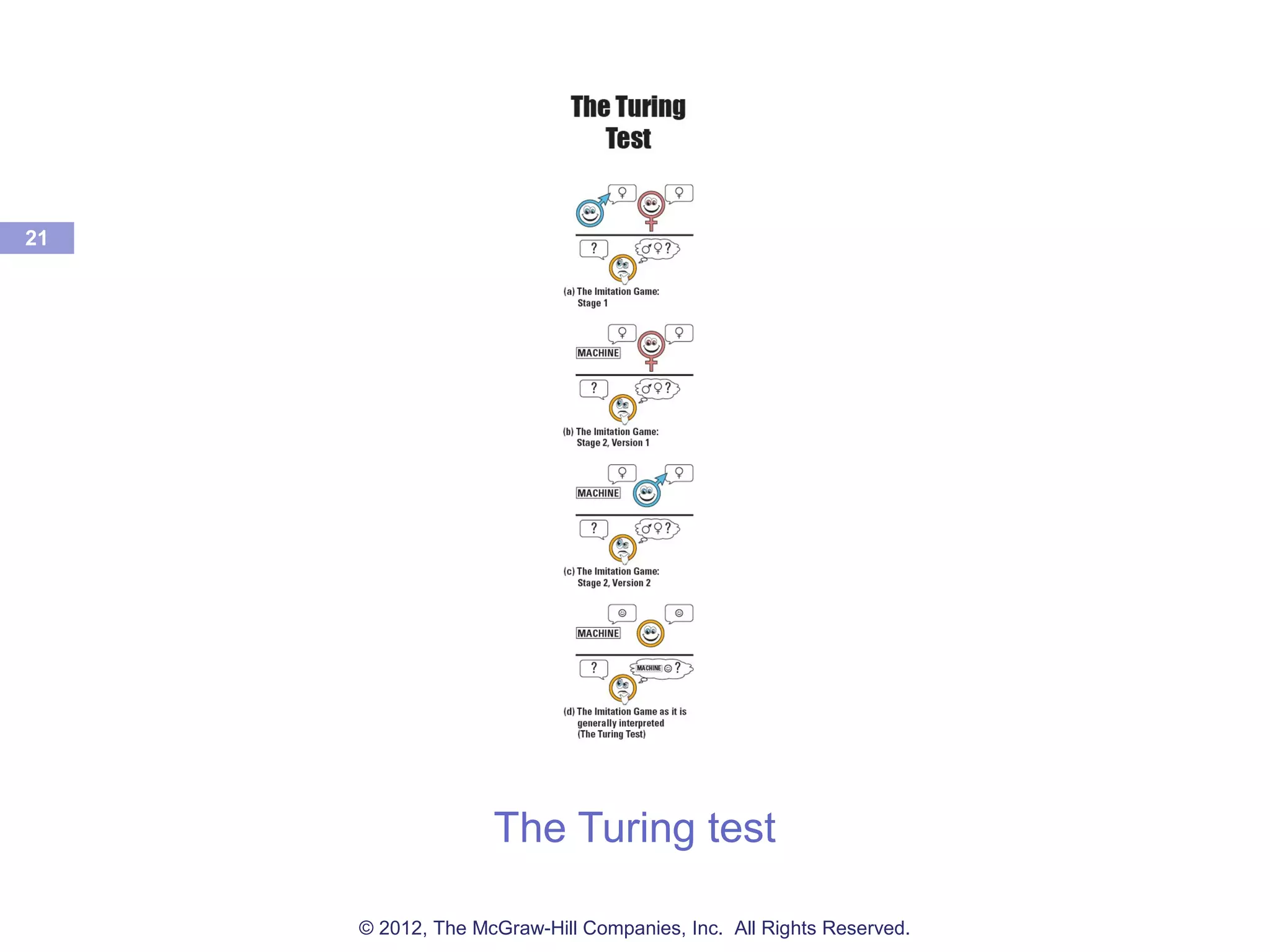
21
The Turing test
© 2012, The McGraw-Hill Companies, Inc. All Rights Reserved.
Hot or Not?
Do some computers have the
ability for rational thought?
22
© 2012, The McGraw-Hill Companies, Inc. All Rights Reserved.
Faith and reason
 Faith involves not only belief in God, but also an act of
trust in and obedience to God. Traditionally, faith and
reason have been seen as uneasy co-inhabitants of the
human mind. Whatever one’s personal beliefs, it is
important for us as critical thinkers to connect faith with
reason, to balance belief and doubt.
 Integrating reason into faith allows us to evaluate the
competing claims of faith and revelation, and to question
faith-based claims that are inconsistent with evidence or
reason.
23
© 2012, The McGraw-Hill Companies, Inc. All Rights Reserved.
Three approaches to faith and reason
 Fideism argues that faith transcends reason, and that
the divine is revealed through faith and revelation, not
reason or empirical evidence.
 Rationalism argues that religious beliefs should be
consistent with reason and evidence.
 Critical rationalism argues that divine knowledge can
derive from both faith and reason, but that both sources
should be compatible with one another.
24
© 2012, The McGraw-Hill Companies, Inc. All Rights Reserved.
25
Abraham making preparations to sacrifice
his son Isaac at God’s command
© 2012, The McGraw-Hill Companies, Inc. All Rights Reserved.
26
Mother Teresa
© 2012, The McGraw-Hill Companies, Inc. All Rights Reserved.
27
Albert Schweitzer
© 2012, The McGraw-Hill Companies, Inc. All Rights Reserved.
Conclusions
As the previous slides have shown, effective critical
thinking requires exercise of both reason and emotion in
order to be most effective.
Also, reason and faith are compatible. Indeed, applying
reason to faith is important, for it protects us from faith-
based knowledge and arguments not supported by
evidence.
28
© 2012, The McGraw-Hill Companies, Inc. All Rights Reserved.
29
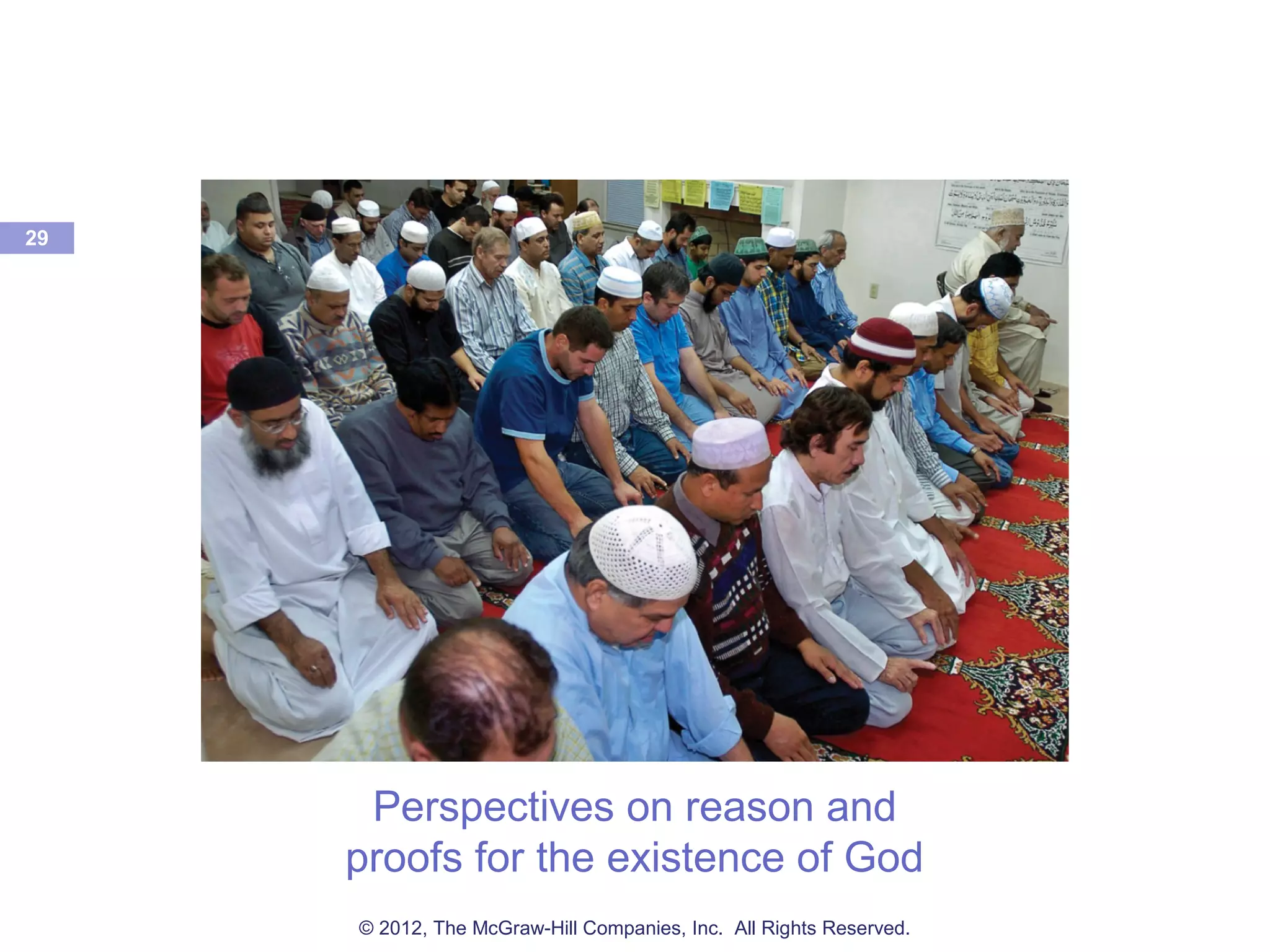
Perspectives on reason and
proofs for the existence of God
© 2012, The McGraw-Hill Companies, Inc. All Rights Reserved.

Boss2 ppt ch02

  • 1.
    REASON & EMOTION Theaim of this tutorial is to help you learn to understand the roles of reason and emotion in critical thinking.
  • 2.
    2 How do reasonand emotion work together in an activity such as skydiving? © 2012, The McGraw-Hill Companies, Inc. All Rights Reserved.
  • 3.
    Reason and emotionplay important roles in critical thinking Understanding their roles as separate and combined influences is a very important aspect of critical thought. Reason is the process of supporting a claim or conclusion based on evidence. It involves both the disciplined use of intelligence and the application of rules for problem solving. In logic, reasoning is presented in a structured form supported by premises. However, everyday uses of reason are broader, and require creative thought and emotional discernment. 3 © 2012, The McGraw-Hill Companies, Inc. All Rights Reserved.
  • 4.
    4 Reasoning about problems ina familiar context © 2012, The McGraw-Hill Companies, Inc. All Rights Reserved.
  • 5.
    Reason contains anumber of important components and strategies  These components include the ability to engage in abstract thinking, logical argumentation, and behavioral modification.  Reason also involves the embrace of different cognitive strategies such as deduction, generalization, and imagination. It is also important in spatial-temporal problem solving in fields such as mathematics, engineering, and architecture. 5 © 2012, The McGraw-Hill Companies, Inc. All Rights Reserved.
  • 6.
    6 Great Chain ofBeing © 2012, The McGraw-Hill Companies, Inc. All Rights Reserved.
  • 7.
    Reason has traditionallybeen linked with males in Western thought  Beginning with Aristotle, Western thought has generally linked men to reason, and women to the realm of nature.  This argument has been used not only against women but also against non-Europeans to generate negative and derogatory stereotypes that justify discrimination based on race, gender, and age.  In order to be effective critical thinkers, we must be willing to use reason to examine these assumptions regarding race, gender, and age. 7 © 2012, The McGraw-Hill Companies, Inc. All Rights Reserved.
  • 8.
    Reason can operateat both the conscious and unconscious levels  Traditionally seen as a conscious activity, recent cognitive research suggests much of reasoning is in fact unconscious and automatic.  Studies of brain function indicate that dreams involve cerebral activity related to reason and problem solving.  Many important knowledge breakthroughs, such as the creation of the periodic table by Russian chemist Dmitri Mendeleyev, occurred through dream-inspired guidance. 8 © 2012, The McGraw-Hill Companies, Inc. All Rights Reserved.
  • 9.
    9 Temple Grandin © 2012,The McGraw-Hill Companies, Inc. All Rights Reserved.
  • 10.
    10 Your brain onvideo games © 2012, The McGraw-Hill Companies, Inc. All Rights Reserved.
  • 11.
    Reason is anessential component of critical thinking  Reason helps us analyze beliefs and evidence, to make good life choice decisions, to cope with adversity, and to resolve problems. In critical thinking, reason does not operate alone, but works together with other faculties, such as emotion.  Understanding the role emotion plays in critical thinking is essential for the development of strong critical thinking skills. 11 © 2012, The McGraw-Hill Companies, Inc. All Rights Reserved.
  • 12.
    The role ofemotion in critical thinking  According to Random House Webster’s College Dictionary, emotion is a “state of consciousness in which joy, sorrow, fear, etc., is experienced, as distinguished from cognitive and volitional consciousness.”  In Western culture, emotion has been traditionally viewed as the opposite of reason. In contrast, other cultures have emphasized the importance of positive emotions in the development of critical thinking skills. 12 © 2012, The McGraw-Hill Companies, Inc. All Rights Reserved.
  • 13.
    13 Can you identifywhich emotions are being shown here? © 2012, The McGraw-Hill Companies, Inc. All Rights Reserved.
  • 14.
    Hot or Not? Doyou think emotion or reason plays a more pivotal role in critical thinking? 14 © 2012, The McGraw-Hill Companies, Inc. All Rights Reserved.
  • 15.
    The role ofemotion in critical thinking  As critical thinkers, we need to be aware of the dangers of emotions such as anger and fear as barriers to critical thought, and also of the benefits of using emotions such as empathy and compassion to enhance our critical thinking abilities. 15 © 2012, The McGraw-Hill Companies, Inc. All Rights Reserved.
  • 16.
    16 Rosa Parks © 2012,The McGraw-Hill Companies, Inc. All Rights Reserved.
  • 17.
    The importance ofemotional intelligence  Emotional intelligence—the ability to perceive, appraise, express, and regulate emotion—is positively related to abstract reasoning ability.  Emotions such as empathy, moral indignation, love, happiness, and even guilt can have a positive effect on our reasoning by influencing us to make better decisions.  An empathetic person is more flexible and open to other perspectives. This openness motivates critical analysis of problems and situations and helps formulate appropriate action plans and responses. 17 © 2012, The McGraw-Hill Companies, Inc. All Rights Reserved.
  • 18.
    Emotions can alsowork against critical thinking  Although emotions can motivate better decision-making, they can also hinder it. Examples of the negative role emotions can play include the presence of fear and anger in action plans.  Additionally, we are vulnerable to emotional appeals such as those in advertising and political campaigns. These appeals, often devoid of evidence and good reasoning, can distract us from more important issues or encourage regrettable actions. 18 © 2012, The McGraw-Hill Companies, Inc. All Rights Reserved.
  • 19.
    Integrating reason andemotion… …provides a double-pronged tool for critical thinking.  Emotion alerts us to problems and other people’s perspectives. Emotion also motivates action and problem resolution.  Using our emotions in conjunction with reason allows us to make better-informed decisions. 19 © 2012, The McGraw-Hill Companies, Inc. All Rights Reserved.
  • 20.
    Artificial Intelligence (AI),reasoning, and emotion  Artificial intelligence is defined as “the study of computations that make it possible to perceive, reason, and act.” Its goals include the enhancement of human reasoning, the creation of intelligent machines, and the development of sociable, intelligent machines that can cooperate with people.  Given recent advances in these endeavors, as critical thinkers we need to move beyond questioning whether AI is capable of reasoning and emotion, and not hold AI to higher standards of proof than we apply to humanity. AI possesses enormous potential to enhance our critical thinking abilities. 20 © 2012, The McGraw-Hill Companies, Inc. All Rights Reserved.
  • 21.
    21 The Turing test ©2012, The McGraw-Hill Companies, Inc. All Rights Reserved.
  • 22.
    Hot or Not? Dosome computers have the ability for rational thought? 22 © 2012, The McGraw-Hill Companies, Inc. All Rights Reserved.
  • 23.
    Faith and reason Faith involves not only belief in God, but also an act of trust in and obedience to God. Traditionally, faith and reason have been seen as uneasy co-inhabitants of the human mind. Whatever one’s personal beliefs, it is important for us as critical thinkers to connect faith with reason, to balance belief and doubt.  Integrating reason into faith allows us to evaluate the competing claims of faith and revelation, and to question faith-based claims that are inconsistent with evidence or reason. 23 © 2012, The McGraw-Hill Companies, Inc. All Rights Reserved.
  • 24.
    Three approaches tofaith and reason  Fideism argues that faith transcends reason, and that the divine is revealed through faith and revelation, not reason or empirical evidence.  Rationalism argues that religious beliefs should be consistent with reason and evidence.  Critical rationalism argues that divine knowledge can derive from both faith and reason, but that both sources should be compatible with one another. 24 © 2012, The McGraw-Hill Companies, Inc. All Rights Reserved.
  • 25.
    25 Abraham making preparationsto sacrifice his son Isaac at God’s command © 2012, The McGraw-Hill Companies, Inc. All Rights Reserved.
  • 26.
    26 Mother Teresa © 2012,The McGraw-Hill Companies, Inc. All Rights Reserved.
  • 27.
    27 Albert Schweitzer © 2012,The McGraw-Hill Companies, Inc. All Rights Reserved.
  • 28.
    Conclusions As the previousslides have shown, effective critical thinking requires exercise of both reason and emotion in order to be most effective. Also, reason and faith are compatible. Indeed, applying reason to faith is important, for it protects us from faith- based knowledge and arguments not supported by evidence. 28 © 2012, The McGraw-Hill Companies, Inc. All Rights Reserved.
  • 29.
    29 Perspectives on reasonand proofs for the existence of God © 2012, The McGraw-Hill Companies, Inc. All Rights Reserved.