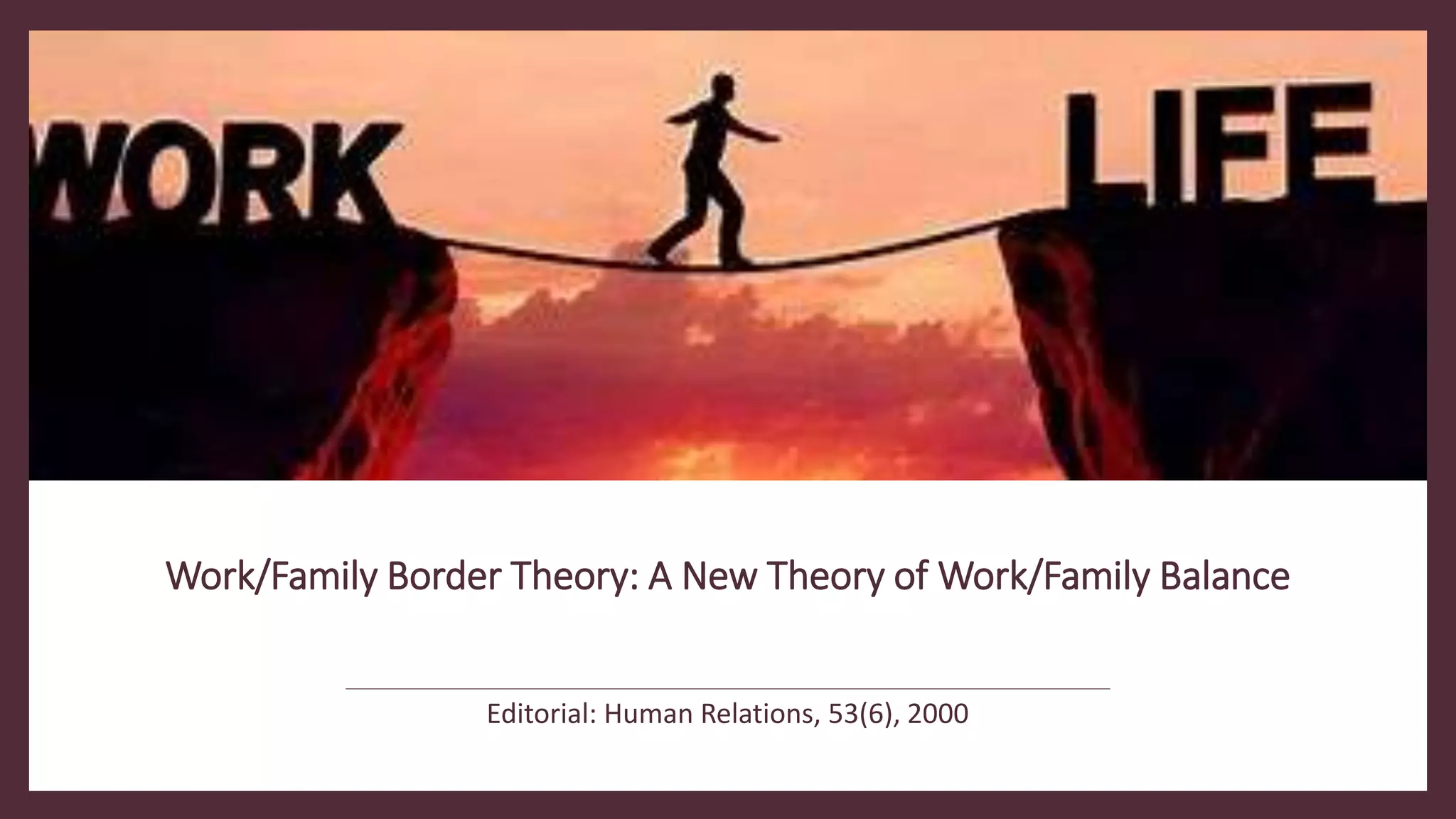
Work/Family Border Theory: A New Theory of Work/Family Balance
Editorial: Human Relations, 53(6), 2000
Background
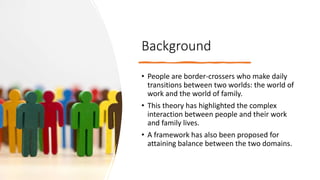
• People are border-crossers who make daily
transitions between two worlds: the world of
work and the world of family.
• This theory has highlighted the complex
interaction between people and their work
and family lives.
• A framework has also been proposed for
attaining balance between the two domains.
Previous Work
• Spillover Theory:
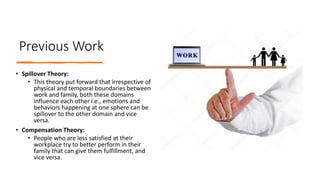
• This theory put forward that irrespective of
physical and temporal boundaries between
work and family, both these domains
influence each other i.e., emotions and
behaviors happening at one sphere can be
spillover to the other domain and vice
versa.
• Compensation Theory:
• People who are less satisfied at their
workplace try to better perform in their
family that can give them fulfillment, and
vice versa.
Limitations of
Spillover and
Compensation
Theory:
• These theories put forward the mainstream of
ideas relating to workplace and family life.
However, they are inadequate:
• To fully explain the two domains from different
perspectives.
• To predict when and how the imbalance
between the two domains took place.
• To give the remedies and solutions if the
imbalance occurs between workplace and
family life.
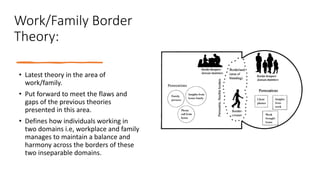
Work/Family Border
Theory:
• Latest theory in the area of
work/family.
• Put forward to meet the flaws and
gaps of the previous theories
presented in this area.
• Defines how individuals working in
two domains i.e, workplace and family
manages to maintain a balance and
harmony across the borders of these
two inseparable domains.
Postulates of Work/Family Border Theory:
a) Borders and domains must work together for balance to occur.
b) Central participants in a domain will have more control over
the borders than peripheral participants.
c) Central participants in both domains will have greater
work/family balance.
d) Border-crossers with domain members having high other
domain awareness will have higher work/family balance.
e) Border-crossers with domain members having high
commitment will have higher work/family balance.
f) When work and family domains are different, border-crossers
will engage in less across-the-border communication.
g) Supportive communication between border-keepers and
border-crossers helps in maintaining work/family balance.

Border Theory.pptx

  • 1.
    Work/Family Border Theory:A New Theory of Work/Family Balance Editorial: Human Relations, 53(6), 2000
  • 2.
    Background • People areborder-crossers who make daily transitions between two worlds: the world of work and the world of family. • This theory has highlighted the complex interaction between people and their work and family lives. • A framework has also been proposed for attaining balance between the two domains.
  • 3.
    Previous Work • SpilloverTheory: • This theory put forward that irrespective of physical and temporal boundaries between work and family, both these domains influence each other i.e., emotions and behaviors happening at one sphere can be spillover to the other domain and vice versa. • Compensation Theory: • People who are less satisfied at their workplace try to better perform in their family that can give them fulfillment, and vice versa.
  • 4.
    Limitations of Spillover and Compensation Theory: •These theories put forward the mainstream of ideas relating to workplace and family life. However, they are inadequate: • To fully explain the two domains from different perspectives. • To predict when and how the imbalance between the two domains took place. • To give the remedies and solutions if the imbalance occurs between workplace and family life.
  • 5.
    Work/Family Border Theory: • Latesttheory in the area of work/family. • Put forward to meet the flaws and gaps of the previous theories presented in this area. • Defines how individuals working in two domains i.e, workplace and family manages to maintain a balance and harmony across the borders of these two inseparable domains.
  • 6.
    Postulates of Work/FamilyBorder Theory: a) Borders and domains must work together for balance to occur. b) Central participants in a domain will have more control over the borders than peripheral participants. c) Central participants in both domains will have greater work/family balance. d) Border-crossers with domain members having high other domain awareness will have higher work/family balance. e) Border-crossers with domain members having high commitment will have higher work/family balance. f) When work and family domains are different, border-crossers will engage in less across-the-border communication. g) Supportive communication between border-keepers and border-crossers helps in maintaining work/family balance.