PLANCK 2021
June 2021
Daniel Baumann
University of Amsterdam &
National Taiwan University
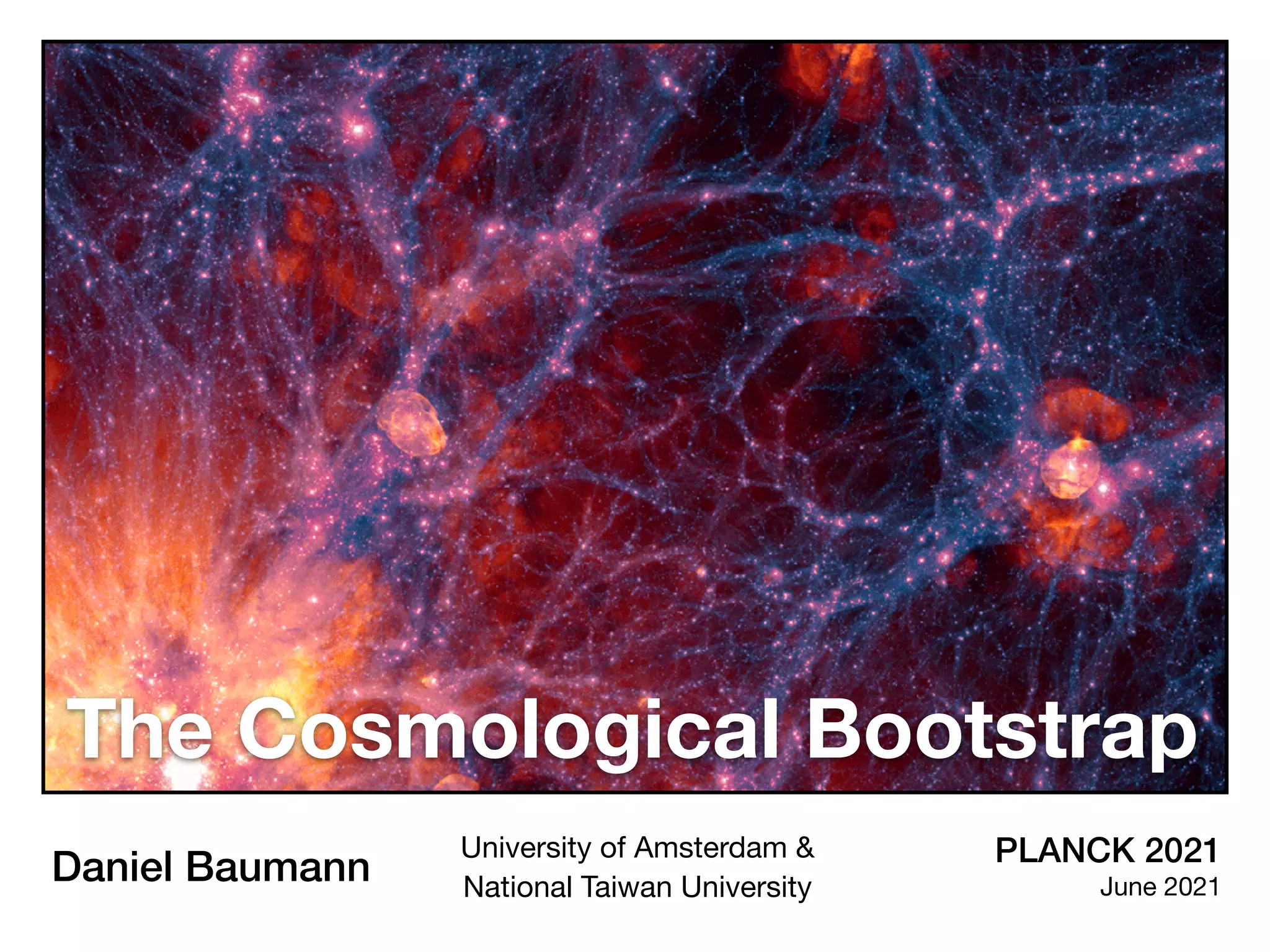
The Cosmological Bootstrap
Nima Arkani-Hamed, Wei Ming Chen, Hayden Lee, Manuel Loparco,
Guilherme Pimentel, Carlos Duaso Pueyo and Austin Joyce
Interesting related work by
Enrico Pajer, Sadra Jazayeri, David Stefanyszyn, Scott Melville, Harry Goodhew,
Paolo Benincasa, Charlotte Sleight, Massimo Taronna
Soner Albayrak, Adam Bzowski, Sebastian Cespedes, Xingang Chen, Claudio
Coriano, Anne-Christine Davis, Lorenz Eberhardt, Joseph Farrow, Garrett Goon,
Tanguy Grall, Daniel Green, Aaron Hillman, Kurt Hinterbichler, Hiroshi Isono, Alex
Kehagias, Savan Kharel, Shota Komatsu, Soubhik Kumar, Arthur Lipstein, Matteo
Maglio, Juan Maldacena, Paul McFadden, David Meltzer, Sebastian Mizera,
Toshifumi Noumi, Rafael Porto, Suvrat Raju, Antonio Riotto, Gary Shiu, Allic
Sivaramakrishnan, Kostas Skenderis, Raman Sundrum, Jakub Supel, Sandip
Trivedi, Mark Trodden, Yi Wang, …
Based on work with
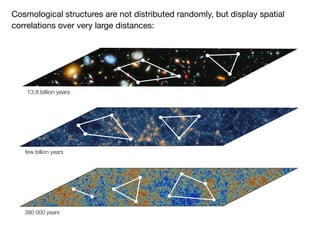
Cosmological structures are not distributed randomly, but display spatial
correlations over very large distances:
380 000 years
few billion years
13.8 billion years
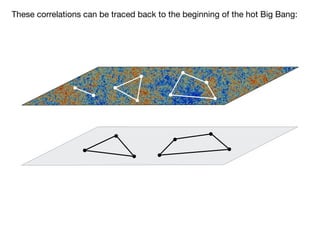
These correlations can be traced back to the beginning of the hot Big Bang:
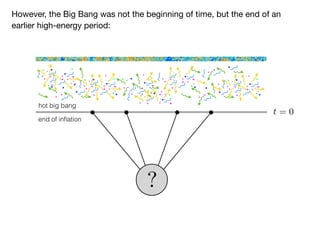
However, the Big Bang was not the beginning of time, but the end of an
earlier high-energy period:
?
t = 0
end of inflation
hot big bang
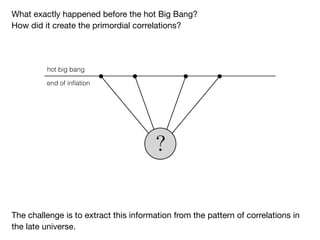
What exactly happened before the hot Big Bang?

How did it create the primordial correlations?
The challenge is to extract this information from the pattern of correlations in
the late universe.
?
end of inflation
hot big bang
?
end of inflation
hot big bang
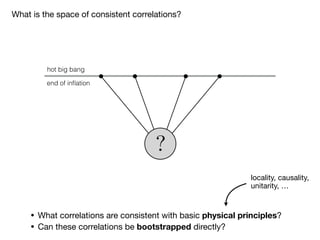
• What correlations are consistent with basic physical principles?

• Can these correlations be bootstrapped directly?
locality, causality, 

unitarity, …
What is the space of consistent correlations?
?
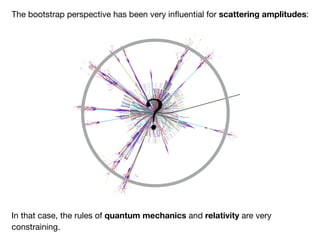
In that case, the rules of quantum mechanics and relativity are very
constraining.
The bootstrap perspective has been very influential for scattering amplitudes:
?
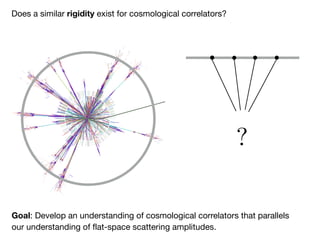
Does a similar rigidity exist for cosmological correlators?
Goal: Develop an understanding of cosmological correlators that parallels
our understanding of flat-space scattering amplitudes.
The connection to scattering amplitudes is also relevant because the early
universe was like a giant cosmological collider:
Chen and Wang [2009]
DB and Green [2011]
Noumi, Yamaguchi and Yokoyama [2013]
Arkani-Hamed and Maldacena [2015]
Arkani-Hamed, DB, Lee and Pimentel [2018]
particle
creation
particle
decay
time
space
During inflation, the rapid expansion can produce very massive particles
(~1014 GeV) whose decays lead to nontrivial correlations.
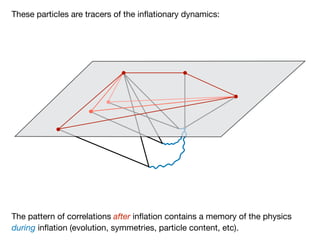
These particles are tracers of the inflationary dynamics:
The pattern of correlations after inflation contains a memory of the physics
during inflation (evolution, symmetries, particle content, etc).
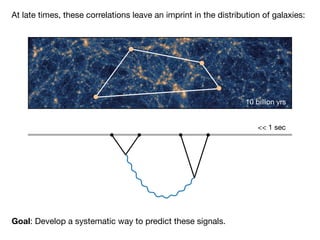
10 billion yrs
<< 1 sec
Goal: Develop a systematic way to predict these signals.
At late times, these correlations leave an imprint in the distribution of galaxies:
Outline
Basics of the
Bootstrap II.
I. Recent
Progress
III. Future
Directions
I. Basics of the
Bootstrap
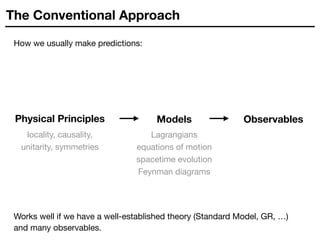
The Conventional Approach
How we usually make predictions:
Lagrangians

equations of motion

spacetime evolution 

Feynman diagrams
Physical Principles Observables
locality, causality, 

unitarity, symmetries
Models
Works well if we have a well-established theory (Standard Model, GR, …)
and many observables.
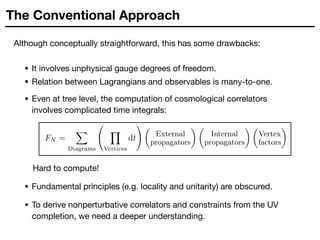
The Conventional Approach
Although conceptually straightforward, this has some drawbacks:
• It involves unphysical gauge degrees of freedom.

• Relation between Lagrangians and observables is many-to-one.
• Even at tree level, the computation of cosmological correlators
involves complicated time integrals:
FN =
X
Diagrams
Y
Vertices
dt
! ✓
External
propagators
◆ ✓
Internal
propagators
◆ ✓
Vertex
factors
◆
Hard to compute!
• Fundamental principles (e.g. locality and unitarity) are obscured.
• To derive nonperturbative correlators and constraints from the UV
completion, we need a deeper understanding.
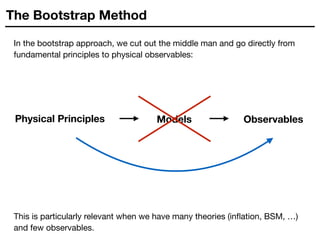
The Bootstrap Method
In the bootstrap approach, we cut out the middle man and go directly from
fundamental principles to physical observables:
This is particularly relevant when we have many theories (inflation, BSM, …)
and few observables.
Physical Principles Observables
Models
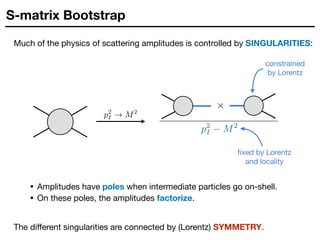
S-matrix Bootstrap
fixed by Lorentz

and locality
Much of the physics of scattering amplitudes is controlled by SINGULARITIES:
constrained
by Lorentz
• Amplitudes have poles when intermediate particles go on-shell.

• On these poles, the amplitudes factorize.
The different singularities are connected by (Lorentz) SYMMETRY.
S-matrix Bootstrap
Consistent factorization is very constraining for massless particles:
µ1...µS
S = { 0 , 1
2 , 1 , 3
2 , 2 }
Only consistent for spins
YM
GR
SUSY
Benincasa and Cachazo [2007]

McGady and Rodina [2013]
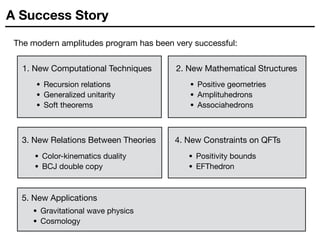
A Success Story
The modern amplitudes program has been very successful:
1. New Computational Techniques 2. New Mathematical Structures
3. New Relations Between Theories
• Recursion relations

• Generalized unitarity

• Soft theorems
• Positive geometries

• Amplituhedrons

• Associahedrons
• Color-kinematics duality

• BCJ double copy
4. New Constraints on QFTs
• Positivity bounds

• EFThedron
5. New Applications
• Gravitational wave physics

• Cosmology
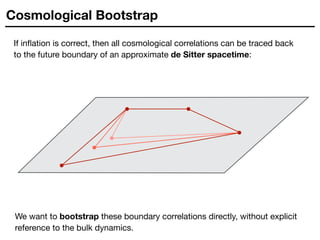
Cosmological Bootstrap
If inflation is correct, then all cosmological correlations can be traced back
to the future boundary of an approximate de Sitter spacetime:
We want to bootstrap these boundary correlations directly, without explicit
reference to the bulk dynamics.
Cosmological Bootstrap
The logic for bootstrapping these correlators is similar to that for amplitudes:
• SINGULARITIES: 

Correlators have characteristic singularities as a function of the external
energies. Analog of resonance singularities for amplitudes.
• SYMMETRIES: 

These singularities are connected by causal time evolution, which is
constrained by the symmetries of the bulk spacetime.
Analog of Lorentz symmetry for amplitudes.
Arkani-Hamed, DB, Lee and Pimentel [2018]
DB, Duaso Pueyo, Joyce, Lee and Pimentel [2020]
DB, Chen, Duaso Pueyo, Joyce, Lee and Pimentel [2021]
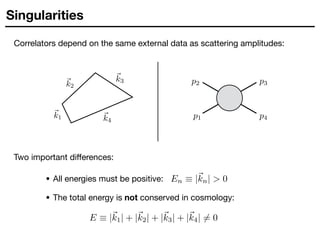
Singularities
• The total energy is not conserved in cosmology:
Correlators depend on the same external data as scattering amplitudes:
Two important differences:
• All energies must be positive:
Singularities
Something interesting happens in the limit of would-be energy conservation:
Raju [2012]

Maldacena and Pimentel [2011]
Amplitudes live inside correlators.
En
=
AMPLITUDE
TOTAL ENERGY POLE
Singularities
Additional singularities arise when the energy of a subgraph is conserved:
=
Arkani-Hamed, Benincasa and Postnikov [2017]

Arkani-Hamed, DB, Lee and Pimentel [2018]
DB, Duaso Pueyo, Joyce, Lee and Pimentel [2020]
PARTIAL ENERGY POLE
Singularities
=
Additional singularities arise when the energy of a subgraph is conserved:
Arkani-Hamed, Benincasa and Postnikov [2017]

Arkani-Hamed, DB, Lee and Pimentel [2018]
DB, Duaso Pueyo, Joyce, Lee and Pimentel [2020]
Amplitudes are the building blocks of correlators.
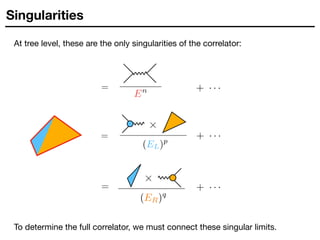
Singularities
At tree level, these are the only singularities of the correlator:
To determine the full correlator, we must connect these singular limits.
=
En
=
=
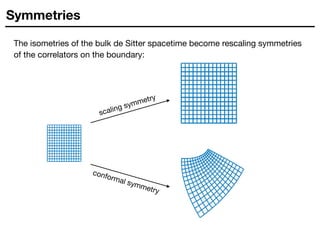
conformal symmetry
Symmetries
The isometries of the bulk de Sitter spacetime become rescaling symmetries
of the correlators on the boundary:
scaling symmetry
Symmetries
These symmetries lead to a set of differential equations that control the
amplitude of the correlations as we deform the quadrilateral
The boundary conditions of this equation are the energy singularities.
Arkani-Hamed, DB, Lee and Pimentel [2018]
DB, Duaso Pueyo, Joyce, Lee and Pimentel [2020]
Symmetries
Symmetry relates the singularities in the unphysical region to the form of the
correlator in the physical region:
En
Analytic continuation Physical regime
Arkani-Hamed, DB, Lee and Pimentel [2018]
DB, Duaso Pueyo, Joyce, Lee and Pimentel [2020]
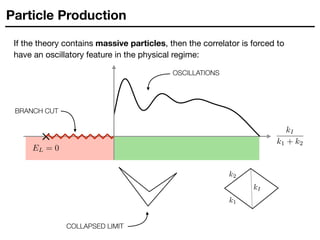
If the theory contains massive particles, then the correlator is forced to
have an oscillatory feature in the physical regime:
Particle Production
BRANCH CUT
OSCILLATIONS
COLLAPSED LIMIT
Time Without Time
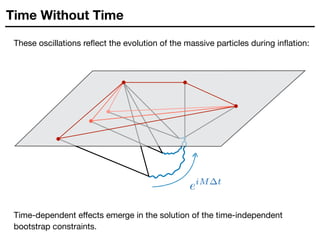
These oscillations reflect the evolution of the massive particles during inflation:
Time-dependent effects emerge in the solution of the time-independent
bootstrap constraints.
Cosmological Collider Physics
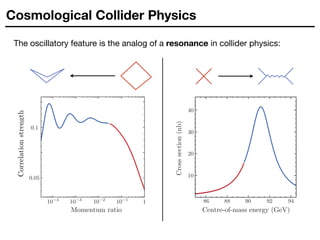
Centre-of-mass energy (GeV)
Cross
section
(nb)
Four-point
function
Four-point
function
Momentum ratio
Correlation
strength
The oscillatory feature is the analog of a resonance in collider physics:
A =
g2
s M2
PS(cos ✓)
The angular dependence of the signal depends on the spin of the particles.
This is very similar to what
we do in collider physics:
Particle Spectroscopy
✓
kI / sin[M log kI ] PS(cos ✓)
The frequency of the oscillations depends on the mass of the particles:
Observational Prospects
SphereX
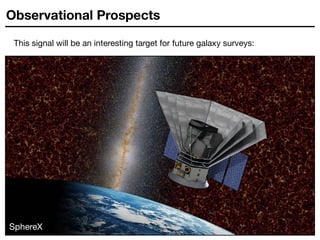
This signal will be an interesting target for future galaxy surveys:
II. Recent
Progress
Recently, there has been significant progress in understanding the role
of unitarity and transmutation in the cosmological bootstrap.
Goodhew, Jazayeri and Pajer [2020]
Cespedes, Davis and Melville [2020]
Meltzer and Sivaramakrishnan [2020]
Jazayeri, Pajer and Stefanyszyn [2021]
Melville and Pajer [2021]
Goodhew, Jazayeri, Lee and Pajer [2021]
DB, Chen, Duaso Pueyo, Joyce, Lee and Pimentel [2021]
Unitarity
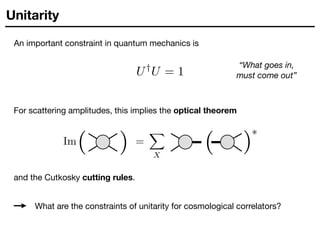
An important constraint in quantum mechanics is
“What goes in,
must come out”
U†
U = 1
For scattering amplitudes, this implies the optical theorem
Im( ( =
X
X
( (
⇤
and the Cutkosky cutting rules.
What are the constraints of unitarity for cosmological correlators?
Unitarity
Goodhew, Jazayeri and Pajer derived the cosmological optical theorem
• Unitarity enforces consistent factorization away from the energy poles.

• In some cases, this fixes the correlator without using de Sitter symmetry.
Goodhew, Jazayeri and Pajer [2020]
Jazayeri, Pajer and Stefanyszyn [2021]
DB, Chen, Duaso Pueyo, Joyce, Lee and Pimentel [2021]
k12 −k34
kI
kI
and associated cutting rules:
F4(kn) + F⇤
4 ( kn) = F̃L
3 ⌦ F̃R
3
FN (kn) + F⇤
N ( kn) =
X
cuts
FN
Transmutation
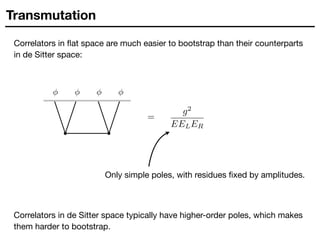
Correlators in flat space are much easier to bootstrap than their counterparts
in de Sitter space:
Only simple poles, with residues fixed by amplitudes.
=
g2
EELER
Correlators in de Sitter space typically have higher-order poles, which makes
them harder to bootstrap.
Transmutation
Recently, we showed that complicated dS correlators can be obtained by
acting with transmutation operators on simple flat-space seeds:
• Transmutation can also change the spin of the fields.

• It can also account for symmetry breaking interactions.
F
(dS)
N = D F
(flat)
N
DB, Chen, Duaso Pueyo, Joyce, Lee and Pimentel [2021]
Charting the Space of dS Correlators
This has allowed us to bootstrap a large number of de Sitter correlators (using
scattering amplitudes and flat-space correlators as input):
Scattering
amplitudes
Flat-space

correlators
De Sitter

correlators
DB, Chen, Duaso Pueyo, Joyce, Lee and Pimentel [2021]
III. Future
Directions
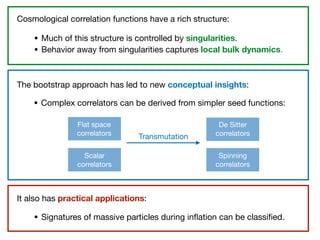
• Much of this structure is controlled by singularities.

• Behavior away from singularities captures local bulk dynamics.
Cosmological correlation functions have a rich structure:
The bootstrap approach has led to new conceptual insights:
• Complex correlators can be derived from simpler seed functions:
Flat space 

correlators Transmutation
De Sitter

correlators
Scalar

correlators
Spinning

correlators
It also has practical applications:
• Signatures of massive particles during inflation can be classified.
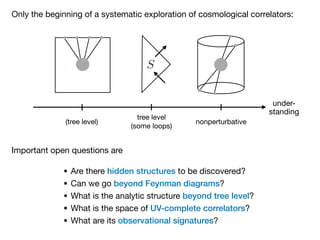
Only the beginning of a systematic exploration of cosmological correlators:
• Are there hidden structures to be discovered?

• Can we go beyond Feynman diagrams?

• What is the analytic structure beyond tree level?

• What is the space of UV-complete correlators?

• What are its observational signatures?
under-

standing
nonperturbative
tree level

(some loops)
(tree level)
Important open questions are
Thank you for your attention!
NTU, Taiwan

Bootstrapping Cosmological Correlations

  • 1.
    PLANCK 2021 June 2021 DanielBaumann University of Amsterdam & National Taiwan University The Cosmological Bootstrap
  • 2.
    Nima Arkani-Hamed, WeiMing Chen, Hayden Lee, Manuel Loparco, Guilherme Pimentel, Carlos Duaso Pueyo and Austin Joyce Interesting related work by Enrico Pajer, Sadra Jazayeri, David Stefanyszyn, Scott Melville, Harry Goodhew, Paolo Benincasa, Charlotte Sleight, Massimo Taronna Soner Albayrak, Adam Bzowski, Sebastian Cespedes, Xingang Chen, Claudio Coriano, Anne-Christine Davis, Lorenz Eberhardt, Joseph Farrow, Garrett Goon, Tanguy Grall, Daniel Green, Aaron Hillman, Kurt Hinterbichler, Hiroshi Isono, Alex Kehagias, Savan Kharel, Shota Komatsu, Soubhik Kumar, Arthur Lipstein, Matteo Maglio, Juan Maldacena, Paul McFadden, David Meltzer, Sebastian Mizera, Toshifumi Noumi, Rafael Porto, Suvrat Raju, Antonio Riotto, Gary Shiu, Allic Sivaramakrishnan, Kostas Skenderis, Raman Sundrum, Jakub Supel, Sandip Trivedi, Mark Trodden, Yi Wang, … Based on work with
  • 3.
    Cosmological structures arenot distributed randomly, but display spatial correlations over very large distances: 380 000 years few billion years 13.8 billion years
  • 4.
    These correlations canbe traced back to the beginning of the hot Big Bang:
  • 5.
    However, the BigBang was not the beginning of time, but the end of an earlier high-energy period: ? t = 0 end of inflation hot big bang
  • 6.
    What exactly happenedbefore the hot Big Bang? How did it create the primordial correlations? The challenge is to extract this information from the pattern of correlations in the late universe. ? end of inflation hot big bang
  • 7.
    ? end of inflation hotbig bang • What correlations are consistent with basic physical principles? • Can these correlations be bootstrapped directly? locality, causality, 
 unitarity, … What is the space of consistent correlations?
  • 8.
    ? In that case,the rules of quantum mechanics and relativity are very constraining. The bootstrap perspective has been very influential for scattering amplitudes:
  • 9.
    ? Does a similarrigidity exist for cosmological correlators? Goal: Develop an understanding of cosmological correlators that parallels our understanding of flat-space scattering amplitudes.
  • 10.
    The connection toscattering amplitudes is also relevant because the early universe was like a giant cosmological collider: Chen and Wang [2009] DB and Green [2011] Noumi, Yamaguchi and Yokoyama [2013] Arkani-Hamed and Maldacena [2015] Arkani-Hamed, DB, Lee and Pimentel [2018] particle creation particle decay time space During inflation, the rapid expansion can produce very massive particles (~1014 GeV) whose decays lead to nontrivial correlations.
  • 11.
    These particles aretracers of the inflationary dynamics: The pattern of correlations after inflation contains a memory of the physics during inflation (evolution, symmetries, particle content, etc).
  • 12.
    10 billion yrs <<1 sec Goal: Develop a systematic way to predict these signals. At late times, these correlations leave an imprint in the distribution of galaxies:
  • 13.
    Outline Basics of the BootstrapII. I. Recent Progress III. Future Directions
  • 14.
    I. Basics ofthe Bootstrap
  • 15.
    The Conventional Approach Howwe usually make predictions: Lagrangians equations of motion spacetime evolution Feynman diagrams Physical Principles Observables locality, causality, 
 unitarity, symmetries Models Works well if we have a well-established theory (Standard Model, GR, …) and many observables.
  • 16.
    The Conventional Approach Althoughconceptually straightforward, this has some drawbacks: • It involves unphysical gauge degrees of freedom. • Relation between Lagrangians and observables is many-to-one. • Even at tree level, the computation of cosmological correlators involves complicated time integrals: FN = X Diagrams Y Vertices dt ! ✓ External propagators ◆ ✓ Internal propagators ◆ ✓ Vertex factors ◆ Hard to compute! • Fundamental principles (e.g. locality and unitarity) are obscured. • To derive nonperturbative correlators and constraints from the UV completion, we need a deeper understanding.
  • 17.
    The Bootstrap Method Inthe bootstrap approach, we cut out the middle man and go directly from fundamental principles to physical observables: This is particularly relevant when we have many theories (inflation, BSM, …) and few observables. Physical Principles Observables Models
  • 18.
    S-matrix Bootstrap fixed byLorentz and locality Much of the physics of scattering amplitudes is controlled by SINGULARITIES: constrained by Lorentz • Amplitudes have poles when intermediate particles go on-shell. • On these poles, the amplitudes factorize. The different singularities are connected by (Lorentz) SYMMETRY.
  • 19.
    S-matrix Bootstrap Consistent factorizationis very constraining for massless particles: µ1...µS S = { 0 , 1 2 , 1 , 3 2 , 2 } Only consistent for spins YM GR SUSY Benincasa and Cachazo [2007] McGady and Rodina [2013]
  • 20.
    A Success Story Themodern amplitudes program has been very successful: 1. New Computational Techniques 2. New Mathematical Structures 3. New Relations Between Theories • Recursion relations • Generalized unitarity • Soft theorems • Positive geometries • Amplituhedrons • Associahedrons • Color-kinematics duality • BCJ double copy 4. New Constraints on QFTs • Positivity bounds • EFThedron 5. New Applications • Gravitational wave physics • Cosmology
  • 21.
    Cosmological Bootstrap If inflationis correct, then all cosmological correlations can be traced back to the future boundary of an approximate de Sitter spacetime: We want to bootstrap these boundary correlations directly, without explicit reference to the bulk dynamics.
  • 22.
    Cosmological Bootstrap The logicfor bootstrapping these correlators is similar to that for amplitudes: • SINGULARITIES: 
 Correlators have characteristic singularities as a function of the external energies. Analog of resonance singularities for amplitudes. • SYMMETRIES: 
 These singularities are connected by causal time evolution, which is constrained by the symmetries of the bulk spacetime. Analog of Lorentz symmetry for amplitudes. Arkani-Hamed, DB, Lee and Pimentel [2018] DB, Duaso Pueyo, Joyce, Lee and Pimentel [2020] DB, Chen, Duaso Pueyo, Joyce, Lee and Pimentel [2021]
  • 23.
    Singularities • The totalenergy is not conserved in cosmology: Correlators depend on the same external data as scattering amplitudes: Two important differences: • All energies must be positive:
  • 24.
    Singularities Something interesting happensin the limit of would-be energy conservation: Raju [2012] Maldacena and Pimentel [2011] Amplitudes live inside correlators. En = AMPLITUDE TOTAL ENERGY POLE
  • 25.
    Singularities Additional singularities arisewhen the energy of a subgraph is conserved: = Arkani-Hamed, Benincasa and Postnikov [2017] Arkani-Hamed, DB, Lee and Pimentel [2018] DB, Duaso Pueyo, Joyce, Lee and Pimentel [2020] PARTIAL ENERGY POLE
  • 26.
    Singularities = Additional singularities arisewhen the energy of a subgraph is conserved: Arkani-Hamed, Benincasa and Postnikov [2017] Arkani-Hamed, DB, Lee and Pimentel [2018] DB, Duaso Pueyo, Joyce, Lee and Pimentel [2020] Amplitudes are the building blocks of correlators.
  • 27.
    Singularities At tree level,these are the only singularities of the correlator: To determine the full correlator, we must connect these singular limits. = En = =
  • 28.
    conformal symmetry Symmetries The isometriesof the bulk de Sitter spacetime become rescaling symmetries of the correlators on the boundary: scaling symmetry
  • 29.
    Symmetries These symmetries leadto a set of differential equations that control the amplitude of the correlations as we deform the quadrilateral The boundary conditions of this equation are the energy singularities. Arkani-Hamed, DB, Lee and Pimentel [2018] DB, Duaso Pueyo, Joyce, Lee and Pimentel [2020]
  • 30.
    Symmetries Symmetry relates thesingularities in the unphysical region to the form of the correlator in the physical region: En Analytic continuation Physical regime Arkani-Hamed, DB, Lee and Pimentel [2018] DB, Duaso Pueyo, Joyce, Lee and Pimentel [2020]
  • 31.
    If the theorycontains massive particles, then the correlator is forced to have an oscillatory feature in the physical regime: Particle Production BRANCH CUT OSCILLATIONS COLLAPSED LIMIT
  • 32.
    Time Without Time Theseoscillations reflect the evolution of the massive particles during inflation: Time-dependent effects emerge in the solution of the time-independent bootstrap constraints.
  • 33.
    Cosmological Collider Physics Centre-of-massenergy (GeV) Cross section (nb) Four-point function Four-point function Momentum ratio Correlation strength The oscillatory feature is the analog of a resonance in collider physics:
  • 34.
    A = g2 s M2 PS(cos✓) The angular dependence of the signal depends on the spin of the particles. This is very similar to what we do in collider physics: Particle Spectroscopy ✓ kI / sin[M log kI ] PS(cos ✓) The frequency of the oscillations depends on the mass of the particles:
  • 35.
    Observational Prospects SphereX This signalwill be an interesting target for future galaxy surveys:
  • 36.
  • 37.
    Recently, there hasbeen significant progress in understanding the role of unitarity and transmutation in the cosmological bootstrap. Goodhew, Jazayeri and Pajer [2020] Cespedes, Davis and Melville [2020] Meltzer and Sivaramakrishnan [2020] Jazayeri, Pajer and Stefanyszyn [2021] Melville and Pajer [2021] Goodhew, Jazayeri, Lee and Pajer [2021] DB, Chen, Duaso Pueyo, Joyce, Lee and Pimentel [2021]
  • 38.
    Unitarity An important constraintin quantum mechanics is “What goes in, must come out” U† U = 1 For scattering amplitudes, this implies the optical theorem Im( ( = X X ( ( ⇤ and the Cutkosky cutting rules. What are the constraints of unitarity for cosmological correlators?
  • 39.
    Unitarity Goodhew, Jazayeri andPajer derived the cosmological optical theorem • Unitarity enforces consistent factorization away from the energy poles. • In some cases, this fixes the correlator without using de Sitter symmetry. Goodhew, Jazayeri and Pajer [2020] Jazayeri, Pajer and Stefanyszyn [2021] DB, Chen, Duaso Pueyo, Joyce, Lee and Pimentel [2021] k12 −k34 kI kI and associated cutting rules: F4(kn) + F⇤ 4 ( kn) = F̃L 3 ⌦ F̃R 3 FN (kn) + F⇤ N ( kn) = X cuts FN
  • 40.
    Transmutation Correlators in flatspace are much easier to bootstrap than their counterparts in de Sitter space: Only simple poles, with residues fixed by amplitudes. = g2 EELER Correlators in de Sitter space typically have higher-order poles, which makes them harder to bootstrap.
  • 41.
    Transmutation Recently, we showedthat complicated dS correlators can be obtained by acting with transmutation operators on simple flat-space seeds: • Transmutation can also change the spin of the fields. • It can also account for symmetry breaking interactions. F (dS) N = D F (flat) N DB, Chen, Duaso Pueyo, Joyce, Lee and Pimentel [2021]
  • 42.
    Charting the Spaceof dS Correlators This has allowed us to bootstrap a large number of de Sitter correlators (using scattering amplitudes and flat-space correlators as input): Scattering amplitudes Flat-space correlators De Sitter correlators DB, Chen, Duaso Pueyo, Joyce, Lee and Pimentel [2021]
  • 43.
  • 44.
    • Much ofthis structure is controlled by singularities. • Behavior away from singularities captures local bulk dynamics. Cosmological correlation functions have a rich structure: The bootstrap approach has led to new conceptual insights: • Complex correlators can be derived from simpler seed functions: Flat space correlators Transmutation De Sitter correlators Scalar correlators Spinning correlators It also has practical applications: • Signatures of massive particles during inflation can be classified.
  • 45.
    Only the beginningof a systematic exploration of cosmological correlators: • Are there hidden structures to be discovered? • Can we go beyond Feynman diagrams? • What is the analytic structure beyond tree level? • What is the space of UV-complete correlators? • What are its observational signatures? under- standing nonperturbative tree level (some loops) (tree level) Important open questions are
  • 46.
    Thank you foryour attention! NTU, Taiwan