THE TEAL EDITION


                 LIZ RUTLEDGE
                 rutle173@newschool.edu
DAY 4            esrutledge@gmail.com
August 4, 2011   cell phone: 415.828.4865
agenda.

        Review:                                     Do:
        Homework                                    PsuedoCode
        +,-,*,%                                     Logic for Ball Bounce
        Data Types - String, int, float
        Variables - assigning and good labelling
        practices


        Learn:
        Drawing Curves
        Operators - &&, ||, !=, ==, >
        Conditionals - if, and, or, random, noise
        Displaying text in the sketch window -
        PFont, Create/Load Font, text()
        PImage


DAY 4
Tuesday, 4 Aug 2011
                                                                            CODE
                                                                            bootcamp 2011
review.
                                                             now wasn’t that fun?


        homework:
        questions?
        let’s put that bad boy together


        topics we covered yesterday:
        +,-,*,%
        Data Types - String, int, float
        Variables - assigning and good labelling practices


DAY 4
Tuesday, 4 Aug 2011
                                                                         CODE
                                                                         bootcamp 2011
curves.
                                     like using the Illustrator pen tool...wearing a blindfold.


          Curves Example:
          http://www.openprocessing.org/visuals/?visualID=2124


DAY 4
Tuesday, 4 Aug 2011
                                                                                      CODE
                                                                                      bootcamp 2011
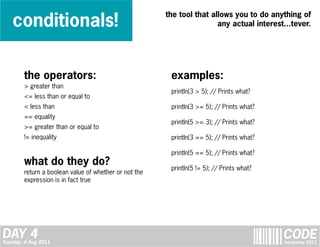
conditionals!
                                                       the tool that allows you to do anything of
                                                                       any actual interest...tever.


        the operators:                                  examples:
        > greater than
                                                        println(3 > 5); // Prints what?
        <= less than or equal to
        < less than                                     println(3 >= 5); // Prints what?
        == equality
                                                        println(5 >= 3); // Prints what?
        >= greater than or equal to
        != inequality                                   println(3 == 5); // Prints what?

                                                        println(5 == 5); // Prints what?
        what do they do?                                println(5 != 5); // Prints what?
        return a boolean value of whether or not the
        expression is in fact true


DAY 4
Tuesday, 4 Aug 2011
                                                                                           CODE
                                                                                           bootcamp 2011
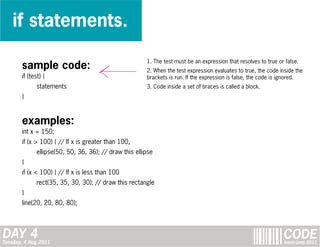
if statements.

                                                        1. The test must be an expression that resolves to true or false.
       sample code:                                     2. When the test expression evaluates to true, the code inside the
       if (test) {                                      brackets is run. If the expression is false, the code is ignored.
              statements                                3. Code inside a set of braces is called a block.
       }


       examples:
       int x = 150;
       if (x > 100) { // If x is greater than 100,
              ellipse(50, 50, 36, 36); // draw this ellipse
       }
       if (x < 100) { // If x is less than 100
              rect(35, 35, 30, 30); // draw this rectangle
       }
       line(20, 20, 80, 80);


DAY 4
Tuesday, 4 Aug 2011
                                                                                                                  CODE
                                                                                                                  bootcamp 2011
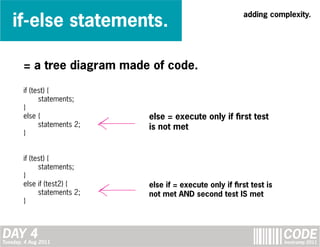
if-else statements.
                                                           adding complexity.


        = a tree diagram made of code.

        if (test) {
              statements;
        }
        else {                else = execute only if first test
              statements 2;   is not met
        }


        if (test) {
              statements;
        }
        else if (test2) {     else if = execute only if first test is
              statements 2;   not met AND second test IS met
        }


DAY 4
Tuesday, 4 Aug 2011
                                                                        CODE
                                                                        bootcamp 2011
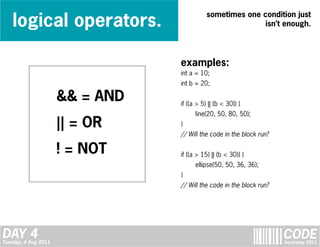
logical operators.
                                            sometimes one condition just
                                                           isn’t enough.


                                 examples:
                                 int a = 10;
                                 int b = 20;

                      && = AND   if ((a > 5) || (b < 30)) {
                                       line(20, 50, 80, 50);
                      || = OR    }
                                 // Will the code in the block run?

                      ! = NOT    if ((a > 15) || (b < 30)) {
                                       ellipse(50, 50, 36, 36);
                                 }
                                 // Will the code in the block run?


DAY 4
Tuesday, 4 Aug 2011
                                                                      CODE
                                                                      bootcamp 2011
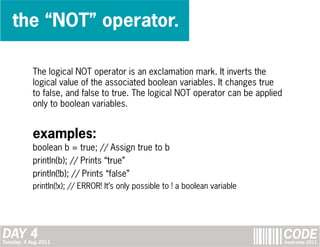
the “NOT” operator.

            The logical NOT operator is an exclamation mark. It inverts the
            logical value of the associated boolean variables. It changes true
            to false, and false to true. The logical NOT operator can be applied
            only to boolean variables.


            examples:
            boolean b = true; // Assign true to b
            println(b); // Prints “true”
            println(!b); // Prints “false”
            println(!x); // ERROR! It’s only possible to ! a boolean variable


DAY 4
Tuesday, 4 Aug 2011
                                                                                   CODE
                                                                                   bootcamp 2011
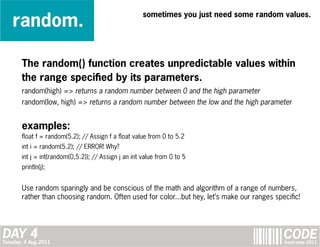
random.
                                                      sometimes you just need some random values.


       The random() function creates unpredictable values within
       the range specified by its parameters.
       random(high) => returns a random number between 0 and the high parameter
       random(low, high) => returns a random number between the low and the high parameter


       examples:
       float f = random(5.2); // Assign f a float value from 0 to 5.2
       int i = random(5.2); // ERROR! Why?
       int j = int(random(0,5.2)); // Assign j an int value from 0 to 5
       println(j);


       Use random sparingly and be conscious of the math and algorithm of a range of numbers,
       rather than choosing random. Often used for color...but hey, let’s make our ranges specific!


DAY 4
Tuesday, 4 Aug 2011
                                                                                             CODE
                                                                                             bootcamp 2011
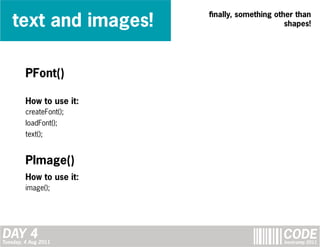
text and images!
                          finally, something other than
                                                shapes!


         PFont()

         How to use it:
         createFont();
         loadFont();
         text();


         PImage()
         How to use it:
         image();


DAY 4
Tuesday, 4 Aug 2011
                                               CODE
                                               bootcamp 2011
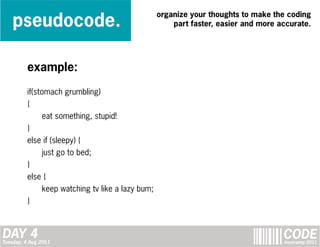
pseudocode.
                                                   organize your thoughts to make the coding
                                                       part faster, easier and more accurate.


         example:

         if(stomach grumbling)
         {
               eat something, stupid!
         }
         else if (sleepy) {
               just go to bed;
         }
         else {
               keep watching tv like a lazy bum;
         }


DAY 4
Tuesday, 4 Aug 2011
                                                                                     CODE
                                                                                     bootcamp 2011
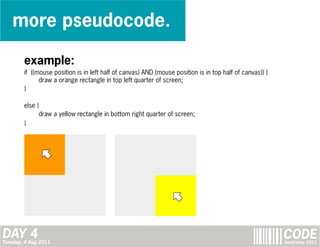
more pseudocode.

        example:
        if ((mouse position is in left half of canvas) AND (mouse position is in top half of canvas)) {
              draw a orange rectangle in top left quarter of screen;
        }

        else {
              draw a yellow rectangle in bottom right quarter of screen;
        }


DAY 4
Tuesday, 4 Aug 2011
                                                                                                          CODE
                                                                                                          bootcamp 2011
a bouncing ball.
                                                        let’s try out our sweet new
                                                                 pseudocode skillz.


         in-class activity:
         go over logic of a bouncing ball as a class.


DAY 4
Tuesday, 4 Aug 2011
                                                                          CODE
                                                                           bootcamp 2011
homework.
                                                                    optional subheading goes here.


       do:
       1) Write pseudocode for bouncing balls
       2) Add label/text to drawing from the green painting tiles in an interesting way (i.e. not just
       a line of text in the middle of the screen)


       extra credit:
       3) Write pseudocode for bouncing balls that respond realistically. Think the physics of a
       billards table.


DAY 4
Tuesday, 4 Aug 2011
                                                                                                 CODE
                                                                                                 bootcamp 2011

Bootcamp - Team TEAL - Day 4

  • 1.
    THE TEAL EDITION LIZ RUTLEDGE rutle173@newschool.edu DAY 4 esrutledge@gmail.com August 4, 2011 cell phone: 415.828.4865
  • 2.
    agenda. Review: Do: Homework PsuedoCode +,-,*,% Logic for Ball Bounce Data Types - String, int, float Variables - assigning and good labelling practices Learn: Drawing Curves Operators - &&, ||, !=, ==, > Conditionals - if, and, or, random, noise Displaying text in the sketch window - PFont, Create/Load Font, text() PImage DAY 4 Tuesday, 4 Aug 2011 CODE bootcamp 2011
  • 3.
    review. now wasn’t that fun? homework: questions? let’s put that bad boy together topics we covered yesterday: +,-,*,% Data Types - String, int, float Variables - assigning and good labelling practices DAY 4 Tuesday, 4 Aug 2011 CODE bootcamp 2011
  • 4.
    curves. like using the Illustrator pen tool...wearing a blindfold. Curves Example: http://www.openprocessing.org/visuals/?visualID=2124 DAY 4 Tuesday, 4 Aug 2011 CODE bootcamp 2011
  • 5.
    conditionals! the tool that allows you to do anything of any actual interest...tever. the operators: examples: > greater than println(3 > 5); // Prints what? <= less than or equal to < less than println(3 >= 5); // Prints what? == equality println(5 >= 3); // Prints what? >= greater than or equal to != inequality println(3 == 5); // Prints what? println(5 == 5); // Prints what? what do they do? println(5 != 5); // Prints what? return a boolean value of whether or not the expression is in fact true DAY 4 Tuesday, 4 Aug 2011 CODE bootcamp 2011
  • 6.
    if statements. 1. The test must be an expression that resolves to true or false. sample code: 2. When the test expression evaluates to true, the code inside the if (test) { brackets is run. If the expression is false, the code is ignored. statements 3. Code inside a set of braces is called a block. } examples: int x = 150; if (x > 100) { // If x is greater than 100, ellipse(50, 50, 36, 36); // draw this ellipse } if (x < 100) { // If x is less than 100 rect(35, 35, 30, 30); // draw this rectangle } line(20, 20, 80, 80); DAY 4 Tuesday, 4 Aug 2011 CODE bootcamp 2011
  • 7.
    if-else statements. adding complexity. = a tree diagram made of code. if (test) { statements; } else { else = execute only if first test statements 2; is not met } if (test) { statements; } else if (test2) { else if = execute only if first test is statements 2; not met AND second test IS met } DAY 4 Tuesday, 4 Aug 2011 CODE bootcamp 2011
  • 8.
    logical operators. sometimes one condition just isn’t enough. examples: int a = 10; int b = 20; && = AND if ((a > 5) || (b < 30)) { line(20, 50, 80, 50); || = OR } // Will the code in the block run? ! = NOT if ((a > 15) || (b < 30)) { ellipse(50, 50, 36, 36); } // Will the code in the block run? DAY 4 Tuesday, 4 Aug 2011 CODE bootcamp 2011
  • 9.
    the “NOT” operator. The logical NOT operator is an exclamation mark. It inverts the logical value of the associated boolean variables. It changes true to false, and false to true. The logical NOT operator can be applied only to boolean variables. examples: boolean b = true; // Assign true to b println(b); // Prints “true” println(!b); // Prints “false” println(!x); // ERROR! It’s only possible to ! a boolean variable DAY 4 Tuesday, 4 Aug 2011 CODE bootcamp 2011
  • 10.
    random. sometimes you just need some random values. The random() function creates unpredictable values within the range specified by its parameters. random(high) => returns a random number between 0 and the high parameter random(low, high) => returns a random number between the low and the high parameter examples: float f = random(5.2); // Assign f a float value from 0 to 5.2 int i = random(5.2); // ERROR! Why? int j = int(random(0,5.2)); // Assign j an int value from 0 to 5 println(j); Use random sparingly and be conscious of the math and algorithm of a range of numbers, rather than choosing random. Often used for color...but hey, let’s make our ranges specific! DAY 4 Tuesday, 4 Aug 2011 CODE bootcamp 2011
  • 11.
    text and images! finally, something other than shapes! PFont() How to use it: createFont(); loadFont(); text(); PImage() How to use it: image(); DAY 4 Tuesday, 4 Aug 2011 CODE bootcamp 2011
  • 12.
    pseudocode. organize your thoughts to make the coding part faster, easier and more accurate. example: if(stomach grumbling) { eat something, stupid! } else if (sleepy) { just go to bed; } else { keep watching tv like a lazy bum; } DAY 4 Tuesday, 4 Aug 2011 CODE bootcamp 2011
  • 13.
    more pseudocode. example: if ((mouse position is in left half of canvas) AND (mouse position is in top half of canvas)) { draw a orange rectangle in top left quarter of screen; } else { draw a yellow rectangle in bottom right quarter of screen; } DAY 4 Tuesday, 4 Aug 2011 CODE bootcamp 2011
  • 14.
    a bouncing ball. let’s try out our sweet new pseudocode skillz. in-class activity: go over logic of a bouncing ball as a class. DAY 4 Tuesday, 4 Aug 2011 CODE bootcamp 2011
  • 15.
    homework. optional subheading goes here. do: 1) Write pseudocode for bouncing balls 2) Add label/text to drawing from the green painting tiles in an interesting way (i.e. not just a line of text in the middle of the screen) extra credit: 3) Write pseudocode for bouncing balls that respond realistically. Think the physics of a billards table. DAY 4 Tuesday, 4 Aug 2011 CODE bootcamp 2011