1


                Advanced
C Foundation


               Techniques
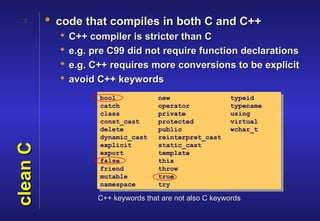
2       • code that compiles in both C and C++
               C++ compiler is stricter than C
               e.g. pre C99 did not require function declarations
               e.g. C++ requires more conversions to be explicit
               avoid C++ keywords
                      bool             new                 typeid
                      catch            operator            typename
                      class            private             using
                      const_cast       protected           virtual
                      delete           public              wchar_t
                      dynamic_cast     reinterpret_cast
                      explicit         static_cast
clean C


                      export           template
                      false            this
                      friend           throw
                      mutable          true
                      namespace        try

                      C++ keywords that are not also C keywords
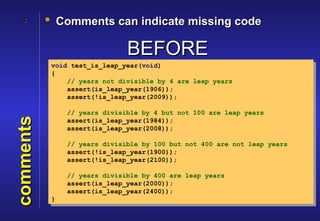
3       • Comments can indicate missing code

                               BEFORE
            void test_is_leap_year(void)
            {
                // years not divisible by 4 are leap years
                assert(is_leap_year(1906));
                assert(!is_leap_year(2009));

                // years divisible by 4 but not 100 are leap years
comments


                assert(is_leap_year(1984));
                assert(is_leap_year(2008));

                // years divisible by 100 but not 400 are not leap years
                assert(!is_leap_year(1900));
                assert(!is_leap_year(2100));

                // years divisible by 400 are leap years
                assert(is_leap_year(2000));
                assert(is_leap_year(2400));
            }
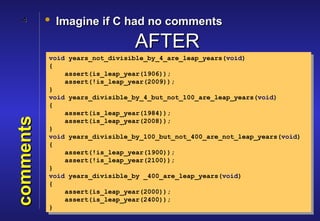
4       • Imagine if C had no comments

                                AFTER
           void years_not_divisible_by_4_are_leap_years(void)
           {
               assert(is_leap_year(1906));
               assert(!is_leap_year(2009));
           }
           void years_divisible_by_4_but_not_100_are_leap_years(void)
           {
               assert(is_leap_year(1984));
comments


               assert(is_leap_year(2008));
           }
           void years_divisible_by_100_but_not_400_are_not_leap_years(void)
           {
               assert(!is_leap_year(1900));
               assert(!is_leap_year(2100));
           }
           void years_divisible_by _400_are_leap_years(void)
           {
               assert(is_leap_year(2000));
               assert(is_leap_year(2400));
           }
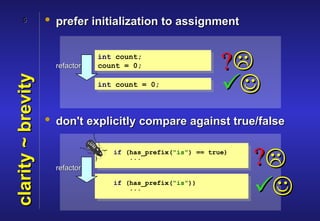
5             • prefer initialization to assignment


                      refactor
                                 int count;
                                 count = 0;                    ?
                                                               
clarity ~ brevity


                                 int count = 0;


                    • don't explicitly compare against true/false


                      refactor
                                    if (has_prefix("is") == true)
                                        ...
                                                                    ?
                                    if (has_prefix("is"))
                                        ...
                                                                    
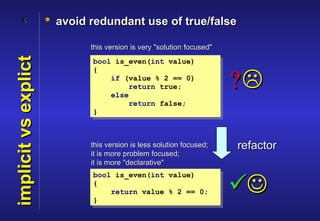
6              • avoid redundant use of true/false

                              this version is very "solution focused"
implicit vs explict
                              bool is_even(int value)
                              {
                                  if (value % 2 == 0)

                                  else
                                       return true;                     ?
                                       return false;
                              }


                              this version is less solution focused;    refactor
                              it is more problem focused;
                              it is more "declarative"
                              bool is_even(int value)
                              {

                              }
                                  return value % 2 == 0;                
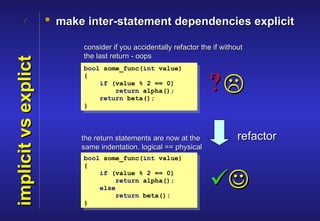
7              • make inter-statement dependencies explicit

                            consider if you accidentally refactor the if without
                            the last return - oops
implicit vs explict

                            bool some_func(int value)
                            {
                                if (value % 2 == 0)
                                    return alpha();
                                return beta();
                                                                     ?
                            }


                            the return statements are now at the              refactor
                            same indentation. logical == physical
                            bool some_func(int value)
                            {


                                                                     
                                if (value % 2 == 0)
                                    return alpha();
                                else
                                    return beta();
                            }
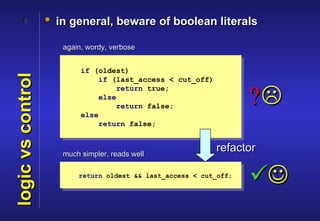
8            • in general, beware of boolean literals

                      again, wordy, verbose


                           if (oldest)
logic vs control

                               if (last_access < cut_off)


                                                                    ?
                                    return true;
                               else
                                    return false;
                           else
                               return false;


                      much simpler, reads well
                                                            refactor

                          return oldest && last_access < cut_off;
                                                                    
9           • iteration is a common bug hotspot
                    looping is easy, knowing when to stop is tricky!
                 • follow the fundamental rule of design
                    always design a thing by considering it in its next
                     largest context
                    what do you want to be true after the iteration?
how to iterate


                    this forms the termination condition
                      ... search(size_t end, int values[], int find)
                      {
                          size_t at = 0;
                              // values[at==0  at==end] iteration
                              at == end         ||     values[at] == find
                              ...
                      }


                          we didn't find it............ or ....................we found it
                                               (short-circuiting)
10           • the negation of the termination condition is
                   the iteration's continuation condition
                    !(at == end || values[at] == find)
                                                                equivalent
                    at != end && values[at] != find            (DeMorgan's Law)


                     ... search(size_t end, int values[], int find)
how to iterate


                     {
                         size_t at = 0;
                         while (at != end && values[at] != find)
                         {
                             ...
                         }
                         ...
                     }


                             at++;             short-circuiting protects values[at]


                 • then simply fill in the loop body
                                                               
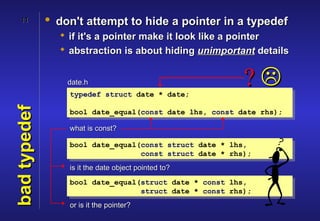
11         • don't attempt to hide a pointer in a typedef
                 if it's a pointer make it look like a pointer
                 abstraction is about hiding unimportant details


                  date.h
                  typedef struct date * date;
                                                         ?
bad typedef


                  bool date_equal(const date lhs, const date rhs);

                  what is const?

                  bool date_equal(const struct date * lhs,
                                  const struct date * rhs);
                  is it the date object pointed to?
                  bool date_equal(struct date * const lhs,
                                  struct date * const rhs);
                  or is it the pointer?
12


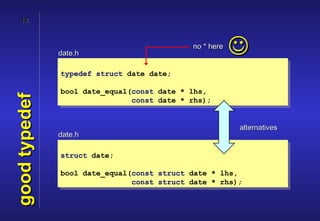
               date.h
                                            no * here
                                                        
               typedef struct date date;

               bool date_equal(const date * lhs,
good typedef


                               const date * rhs);


                                                        alternatives
               date.h

               struct date;

               bool date_equal(const struct date * lhs,
                               const struct date * rhs);
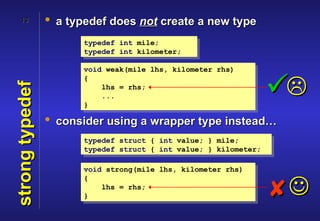
13           • a typedef does not create a new type
                       typedef int mile;
                       typedef int kilometer;

                       void weak(mile lhs, kilometer rhs)


                                                                  
                       {
strong typedef


                           lhs = rhs;
                           ...
                       }

                 • consider using a wrapper type instead…
                       typedef struct { int value; } mile;
                       typedef struct { int value; } kilometer;

                       void strong(mile lhs, kilometer rhs)
                       {

                       }
                           lhs = rhs;
                                                                  
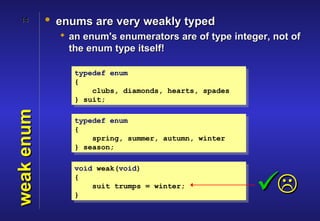
14        • enums are very weakly typed
               an enum's enumerators are of type integer, not of
                the enum type itself!

                 typedef enum
                 {
                     clubs, diamonds, hearts, spades
                 } suit;
weak enum


                 typedef enum
                 {
                     spring, summer, autumn, winter
                 } season;

                 void weak(void)
                 {

                 }
                     suit trumps = winter;
                                                       
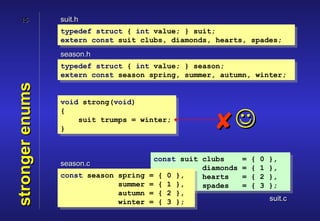
15           suit.h
                 typedef struct { int value; } suit;
                 extern const suit clubs, diamonds, hearts, spades;
                 season.h
                 typedef struct { int value; } season;
                 extern const season spring, summer, autumn, winter;
stronger enums


                 void strong(void)
                 {

                 }
                     suit trumps = winter;
                                                     
                                        const suit clubs      =   {   0   },
                 season.c
                                                   diamonds   =   {   1   },
                 const season spring   = { 0 },    hearts     =   {   2   },
                              summer   = { 1 },    spades     =   {   3   };
                              autumn   = { 2 },
                              winter   = { 3 };                           suit.c
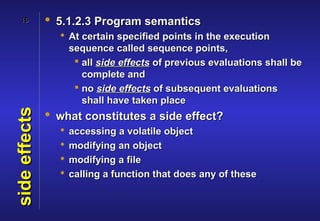
16          • 5.1.2.3 Program semantics
                  At certain specified points in the execution
                   sequence called sequence points,
                     all side effects of previous evaluations shall be
                      complete and
                     no side effects of subsequent evaluations
                      shall have taken place
               • what constitutes a side effect?
side effects


                    accessing a volatile object
                    modifying an object
                    modifying a file
                    calling a function that does any of these
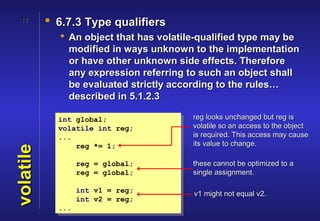
17       • 6.7.3 Type qualifiers
              An object that has volatile-qualified type may be
               modified in ways unknown to the implementation
               or have other unknown side effects. Therefore
               any expression referring to such an object shall
               be evaluated strictly according to the rules…
               described in 5.1.2.3

             int global;                 reg looks unchanged but reg is
             volatile int reg;           volatile so an access to the object
             ...                         is required. This access may cause
                 reg *= 1;               its value to change.
volatile


                   reg = global;         these cannot be optimized to a
                   reg = global;         single assignment.

                   int v1 = reg;         v1 might not equal v2.
                   int v2 = reg;
             ...
18
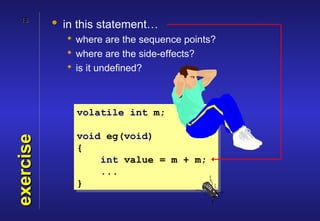
           • in this statement…
              where are the sequence points?
              where are the side-effects?
              is it undefined?


               volatile int m;

               void eg(void)
exercise


               {
                   int value = m + m;
                   ...
               }
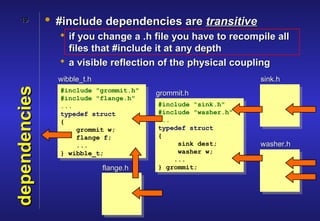
19          • #include dependencies are transitive
                  if you change a .h file you have to recompile all
                   files that #include it at any depth
                  a visible reflection of the physical coupling
                 wibble_t.h                                    sink.h
dependencies


                 #include "grommit.h"    grommit.h
                 #include "flange.h"
                 ...                     #include "sink.h"
                 typedef struct          #include "washer.h"
                 {                       ...
                     grommit w;          typedef struct
                     flange f;           {
                     ...                      sink dest;       washer.h
                 } wibble_t;                  washer w;
                                             ...
                              flange.h   } grommit;
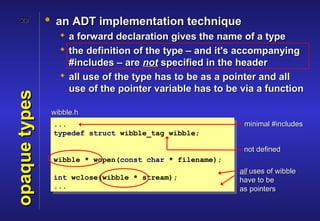
20          • an ADT implementation technique
                   a forward declaration gives the name of a type
                   the definition of the type – and it's accompanying
                    #includes – are not specified in the header
                   all use of the type has to be as a pointer and all
                    use of the pointer variable has to be via a function
opaque types


                wibble.h
                ...                                       minimal #includes
                typedef struct wibble_tag wibble;

                                                          not defined
                wibble * wopen(const char * filename);
                                                         all uses of wibble
                int wclose(wibble * stream);             have to be
                ...                                      as pointers
21          • in most APIs the idea that a set of functions
                 are closely related is quite weakly expressed
                     int main(int argc, char * argv[])
                     {
                         wibble * w = wopen(argv[1]);
                         ...
                         wclose(w);
                     }
module : use


               • a struct containing function pointers can
                 express the idea more strongly
                     int main(int argc, char * argv[])
                     {
                         wibble * w = wibbles.open(argv[1]);
                         ...
                         wibbles.close(w);
                     }
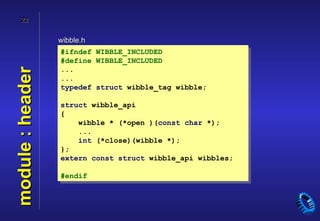
22


                  wibble.h
                  #ifndef WIBBLE_INCLUDED
                  #define WIBBLE_INCLUDED
                  ...
module : header

                  ...
                  typedef struct wibble_tag wibble;

                  struct wibble_api
                  {
                      wibble * (*open )(const char *);
                      ...
                      int (*close)(wibble *);
                  };
                  extern const struct wibble_api wibbles;

                  #endif
23

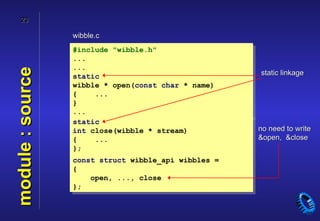
                  wibble.c
                  #include "wibble.h"
                  ...
                  ...
module : source

                  static                              static linkage
                  wibble * open(const char * name)
                  {    ...
                  }
                  ...
                  static
                  int close(wibble * stream)          no need to write
                  {    ...                            &open, &close
                  };
                  const struct wibble_api wibbles =
                  {
                      open, ..., close
                  };
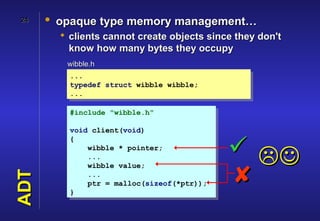
24    • opaque type memory management…
         clients cannot create objects since they don't
          know how many bytes they occupy
         wibble.h
          ...
          typedef struct wibble wibble;
          ...

          #include "wibble.h"

          void client(void)
          {
              wibble * pointer;
              ...
                                             
                                             
              wibble value;
ADT


              ...
              ptr = malloc(sizeof(*ptr));
          }
25            • an ADT can declare its size!
                      clients can now allocate the memory
                      true representation remains abstract
                                                               
shadow data type

                        wibble.h
                         typedef struct wibble
                         {
                             unsigned char size[16];
                         } wibble;

                         bool wopen(wibble *, const char *);
                         void wclose(wibble *);

                         #include "wibble.h"
                         void client(const char * name)
                         {
                            wibble w;
                            if (wopen(&w, name))


                         }
                               ...
                            wclose(&w);                        
26          • implementation needs to…
                   define the true representation type
                                                       wibble.c

                             the analogy is that the   #include "grommit.h"
                             true type casts           #include "flange.h"
shadowed type


                             a shadow which
                             reveals only its size     typedef struct
                                                       {
                                                           grommit g;
                                                           flange f;
                                                           ...
                                                       } wibble_rep;


                  wibble.h
                  typedef struct wibble
                  {
                      unsigned char size[16];
                                                                             
                  } wibble;                                       Still some problems
                                                                  though…
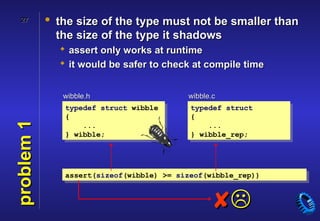
27        • the size of the type must not be smaller than
              the size of the type it shadows
               assert only works at runtime
               it would be safer to check at compile time


               wibble.h                   wibble.c
               typedef struct wibble       typedef struct
               {                           {
problem 1


                   ...                         ...
               } wibble;                   } wibble_rep;


               assert(sizeof(wibble) >= sizeof(wibble_rep))


                                                
28        • use a compile time assertion
                you cannot declare an array with negative size

                compile_time_assert.h
                #define COMPILE_TIME_ASSERT(desc,exp) ¬
                              extern char desc [ (exp) ? 1 : -1 ]


                                                      
                #include "compile_time_assert.h"
                COMPILE_TIME_ASSERT(ok, 1 == 1);
deep magic


                #include "compile_time_assert.h"
                COMPILE_TIME_ASSERT(
                    your_message,
                    1 == 0);
                                                      
                    gcc
                      error: size of array 'your_message' is negative
29
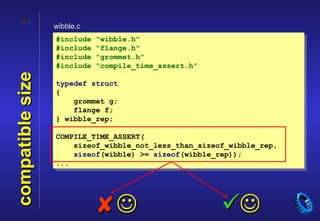
                  wibble.c
                  #include   "wibble.h"
                  #include   "flange.h"
                  #include   "grommet.h"
                  #include   "compile_time_assert.h"
compatible size


                  typedef struct
                  {
                      grommet g;
                      flange f;
                  } wibble_rep;

                  COMPILE_TIME_ASSERT(
                      sizeof_wibble_not_less_than_sizeof_wibble_rep,
                      sizeof(wibble) >= sizeof(wibble_rep));
                  ...


                                                     
30        • the two types must be alignment compatible
               this means the first member of both types must be
                alignment compatible
                  wibble.h
                  typedef struct wibble
                  {
                      unsigned char size[16];
                  } wibble;
problem 2


                 wibble.c
                 typedef struct
                 {
                     grommit g;
                                                  
                     flange f;
                     ...
                 } wibble_rep;
31              • use a union to force alignment
                      alignment.h
                      typedef union
alignment solution
                      {
                          char c,*cp; int i,*ip; long l,*lp; long long ll,*llp;
                          float f,*fp; double d,*dp; long double ld,*ldp;
                          void *vp;
                          void (*fv)(void); void (*fo)(); void (*fe)(int,...);
                      } alignment;

                     wibble.h
                                                      List all the primitive types in here.
                      #include "alignment.h"
                                                      One must have the strictest alignment
                      ...
                      typedef union wibble
                      {
                          alignment universal;
                          unsigned char size[16];
                      } wibble;
                                                           
                      ...
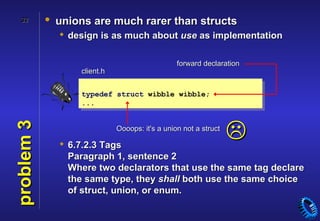
32        • unions are much rarer than structs
               design is as much about use as implementation

                                                forward declaration
                  client.h


                  typedef struct wibble wibble;
                  ...


                                                                 
problem 3


                             Oooops: it's a union not a struct

               6.7.2.3 Tags
                Paragraph 1, sentence 2
                Where two declarators that use the same tag declare
                the same type, they shall both use the same choice
                of struct, union, or enum.
33           • put a union object inside a struct!
                    drop the union tag name
                   wibble.h
                    ...
                    typedef struct wibble
                                                       
                    {
wrapper struct


                        union
                        {
                            alignment universal;
                            unsigned char size[16];
                        } shadow;                      one object
                    } wibble;
                    ...

                    6.7.2.3 Tags
                     Paragraph 4, sentence 2
                     Each declaration of a structure, union, or
                     enumerated type which does not include a tag
                     declares a distinct type
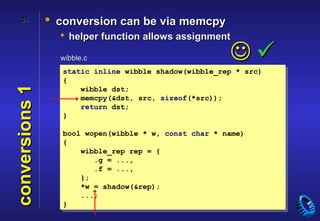
34          • conversion can be via memcpy
                   helper function allows assignment

                  wibble.c                               
                  wibble.c inline wibble shadow(wibble_rep * src)
                  static
                  {
conversions 1


                        wibble dst;
                        memcpy(&dst, src, sizeof(*src));
                        return dst;
                  }

                  bool wopen(wibble * w, const char * name)
                  {
                      wibble_rep rep = {
                         .g = ...,
                         .f = ...,
                      };
                      *w = shadow(&rep);
                      ...;
                  }
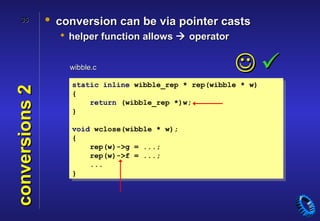
35          • conversion can be via pointer casts
                   helper function allows  operator


                    wibble.c                            
                    static inline wibble_rep * rep(wibble * w)
conversions 2


                    {
                        return (wibble_rep *)w;
                    }

                    void wclose(wibble * w);
                    {
                        rep(w)->g = ...;
                        rep(w)->f = ...;
                        ...
                    }
36     • This course was written by


               Expertise: Agility, Process, OO, Patterns
               Training+Designing+Consulting+Mentoring
                                                           { JSL }

                         Jon Jagger
                                    jon@ jaggersoft.com
Contact


                                     www.jaggersoft.com

08 advanced techniques

  • 1.
    1 Advanced C Foundation Techniques
  • 2.
    2 • code that compiles in both C and C++  C++ compiler is stricter than C  e.g. pre C99 did not require function declarations  e.g. C++ requires more conversions to be explicit  avoid C++ keywords bool new typeid catch operator typename class private using const_cast protected virtual delete public wchar_t dynamic_cast reinterpret_cast explicit static_cast clean C export template false this friend throw mutable true namespace try C++ keywords that are not also C keywords
  • 3.
    3 • Comments can indicate missing code BEFORE void test_is_leap_year(void) { // years not divisible by 4 are leap years assert(is_leap_year(1906)); assert(!is_leap_year(2009)); // years divisible by 4 but not 100 are leap years comments assert(is_leap_year(1984)); assert(is_leap_year(2008)); // years divisible by 100 but not 400 are not leap years assert(!is_leap_year(1900)); assert(!is_leap_year(2100)); // years divisible by 400 are leap years assert(is_leap_year(2000)); assert(is_leap_year(2400)); }
  • 4.
    4 • Imagine if C had no comments AFTER void years_not_divisible_by_4_are_leap_years(void) { assert(is_leap_year(1906)); assert(!is_leap_year(2009)); } void years_divisible_by_4_but_not_100_are_leap_years(void) { assert(is_leap_year(1984)); comments assert(is_leap_year(2008)); } void years_divisible_by_100_but_not_400_are_not_leap_years(void) { assert(!is_leap_year(1900)); assert(!is_leap_year(2100)); } void years_divisible_by _400_are_leap_years(void) { assert(is_leap_year(2000)); assert(is_leap_year(2400)); }
  • 5.
    5 • prefer initialization to assignment refactor int count; count = 0; ?  clarity ~ brevity int count = 0; • don't explicitly compare against true/false refactor if (has_prefix("is") == true) ... ? if (has_prefix("is")) ... 
  • 6.
    6 • avoid redundant use of true/false this version is very "solution focused" implicit vs explict bool is_even(int value) { if (value % 2 == 0) else return true; ? return false; } this version is less solution focused; refactor it is more problem focused; it is more "declarative" bool is_even(int value) { } return value % 2 == 0; 
  • 7.
    7 • make inter-statement dependencies explicit consider if you accidentally refactor the if without the last return - oops implicit vs explict bool some_func(int value) { if (value % 2 == 0) return alpha(); return beta(); ? } the return statements are now at the refactor same indentation. logical == physical bool some_func(int value) {  if (value % 2 == 0) return alpha(); else return beta(); }
  • 8.
    8 • in general, beware of boolean literals again, wordy, verbose if (oldest) logic vs control if (last_access < cut_off) ? return true; else return false; else return false; much simpler, reads well refactor return oldest && last_access < cut_off; 
  • 9.
    9 • iteration is a common bug hotspot  looping is easy, knowing when to stop is tricky! • follow the fundamental rule of design  always design a thing by considering it in its next largest context  what do you want to be true after the iteration? how to iterate  this forms the termination condition ... search(size_t end, int values[], int find) { size_t at = 0; // values[at==0  at==end] iteration at == end || values[at] == find ... } we didn't find it............ or ....................we found it (short-circuiting)
  • 10.
    10 • the negation of the termination condition is the iteration's continuation condition  !(at == end || values[at] == find) equivalent  at != end && values[at] != find (DeMorgan's Law) ... search(size_t end, int values[], int find) how to iterate { size_t at = 0; while (at != end && values[at] != find) { ... } ... } at++; short-circuiting protects values[at] • then simply fill in the loop body 
  • 11.
    11 • don't attempt to hide a pointer in a typedef  if it's a pointer make it look like a pointer  abstraction is about hiding unimportant details date.h typedef struct date * date; ? bad typedef bool date_equal(const date lhs, const date rhs); what is const? bool date_equal(const struct date * lhs, const struct date * rhs); is it the date object pointed to? bool date_equal(struct date * const lhs, struct date * const rhs); or is it the pointer?
  • 12.
    12 date.h no * here  typedef struct date date; bool date_equal(const date * lhs, good typedef const date * rhs); alternatives date.h struct date; bool date_equal(const struct date * lhs, const struct date * rhs);
  • 13.
    13 • a typedef does not create a new type typedef int mile; typedef int kilometer; void weak(mile lhs, kilometer rhs)  { strong typedef lhs = rhs; ... } • consider using a wrapper type instead… typedef struct { int value; } mile; typedef struct { int value; } kilometer; void strong(mile lhs, kilometer rhs) { } lhs = rhs; 
  • 14.
    14 • enums are very weakly typed  an enum's enumerators are of type integer, not of the enum type itself! typedef enum { clubs, diamonds, hearts, spades } suit; weak enum typedef enum { spring, summer, autumn, winter } season; void weak(void) { } suit trumps = winter; 
  • 15.
    15 suit.h typedef struct { int value; } suit; extern const suit clubs, diamonds, hearts, spades; season.h typedef struct { int value; } season; extern const season spring, summer, autumn, winter; stronger enums void strong(void) { } suit trumps = winter;  const suit clubs = { 0 }, season.c diamonds = { 1 }, const season spring = { 0 }, hearts = { 2 }, summer = { 1 }, spades = { 3 }; autumn = { 2 }, winter = { 3 }; suit.c
  • 16.
    16 • 5.1.2.3 Program semantics  At certain specified points in the execution sequence called sequence points,  all side effects of previous evaluations shall be complete and  no side effects of subsequent evaluations shall have taken place • what constitutes a side effect? side effects  accessing a volatile object  modifying an object  modifying a file  calling a function that does any of these
  • 17.
    17 • 6.7.3 Type qualifiers  An object that has volatile-qualified type may be modified in ways unknown to the implementation or have other unknown side effects. Therefore any expression referring to such an object shall be evaluated strictly according to the rules… described in 5.1.2.3 int global; reg looks unchanged but reg is volatile int reg; volatile so an access to the object ... is required. This access may cause reg *= 1; its value to change. volatile reg = global; these cannot be optimized to a reg = global; single assignment. int v1 = reg; v1 might not equal v2. int v2 = reg; ...
  • 18.
    18 • in this statement…  where are the sequence points?  where are the side-effects?  is it undefined? volatile int m; void eg(void) exercise { int value = m + m; ... }
  • 19.
    19 • #include dependencies are transitive  if you change a .h file you have to recompile all files that #include it at any depth  a visible reflection of the physical coupling wibble_t.h sink.h dependencies #include "grommit.h" grommit.h #include "flange.h" ... #include "sink.h" typedef struct #include "washer.h" { ... grommit w; typedef struct flange f; { ... sink dest; washer.h } wibble_t; washer w; ... flange.h } grommit;
  • 20.
    20 • an ADT implementation technique  a forward declaration gives the name of a type  the definition of the type – and it's accompanying #includes – are not specified in the header  all use of the type has to be as a pointer and all use of the pointer variable has to be via a function opaque types wibble.h ... minimal #includes typedef struct wibble_tag wibble; not defined wibble * wopen(const char * filename); all uses of wibble int wclose(wibble * stream); have to be ... as pointers
  • 21.
    21 • in most APIs the idea that a set of functions are closely related is quite weakly expressed int main(int argc, char * argv[]) { wibble * w = wopen(argv[1]); ... wclose(w); } module : use • a struct containing function pointers can express the idea more strongly int main(int argc, char * argv[]) { wibble * w = wibbles.open(argv[1]); ... wibbles.close(w); }
  • 22.
    22 wibble.h #ifndef WIBBLE_INCLUDED #define WIBBLE_INCLUDED ... module : header ... typedef struct wibble_tag wibble; struct wibble_api { wibble * (*open )(const char *); ... int (*close)(wibble *); }; extern const struct wibble_api wibbles; #endif
  • 23.
    23 wibble.c #include "wibble.h" ... ... module : source static static linkage wibble * open(const char * name) { ... } ... static int close(wibble * stream) no need to write { ... &open, &close }; const struct wibble_api wibbles = { open, ..., close };
  • 24.
    24 • opaque type memory management…  clients cannot create objects since they don't know how many bytes they occupy wibble.h ... typedef struct wibble wibble; ... #include "wibble.h" void client(void) { wibble * pointer; ...    wibble value; ADT ... ptr = malloc(sizeof(*ptr)); }
  • 25.
    25 • an ADT can declare its size!  clients can now allocate the memory  true representation remains abstract  shadow data type wibble.h typedef struct wibble { unsigned char size[16]; } wibble; bool wopen(wibble *, const char *); void wclose(wibble *); #include "wibble.h" void client(const char * name) { wibble w; if (wopen(&w, name)) } ... wclose(&w); 
  • 26.
    26 • implementation needs to…  define the true representation type wibble.c the analogy is that the #include "grommit.h" true type casts #include "flange.h" shadowed type a shadow which reveals only its size typedef struct { grommit g; flange f; ... } wibble_rep; wibble.h typedef struct wibble { unsigned char size[16];  } wibble; Still some problems though…
  • 27.
    27 • the size of the type must not be smaller than the size of the type it shadows  assert only works at runtime  it would be safer to check at compile time wibble.h wibble.c typedef struct wibble typedef struct { { problem 1 ... ... } wibble; } wibble_rep; assert(sizeof(wibble) >= sizeof(wibble_rep)) 
  • 28.
    28 • use a compile time assertion  you cannot declare an array with negative size compile_time_assert.h #define COMPILE_TIME_ASSERT(desc,exp) ¬ extern char desc [ (exp) ? 1 : -1 ]  #include "compile_time_assert.h" COMPILE_TIME_ASSERT(ok, 1 == 1); deep magic #include "compile_time_assert.h" COMPILE_TIME_ASSERT( your_message, 1 == 0);  gcc error: size of array 'your_message' is negative
  • 29.
    29 wibble.c #include "wibble.h" #include "flange.h" #include "grommet.h" #include "compile_time_assert.h" compatible size typedef struct { grommet g; flange f; } wibble_rep; COMPILE_TIME_ASSERT( sizeof_wibble_not_less_than_sizeof_wibble_rep, sizeof(wibble) >= sizeof(wibble_rep)); ...  
  • 30.
    30 • the two types must be alignment compatible  this means the first member of both types must be alignment compatible wibble.h typedef struct wibble { unsigned char size[16]; } wibble; problem 2 wibble.c typedef struct { grommit g;  flange f; ... } wibble_rep;
  • 31.
    31 • use a union to force alignment alignment.h typedef union alignment solution { char c,*cp; int i,*ip; long l,*lp; long long ll,*llp; float f,*fp; double d,*dp; long double ld,*ldp; void *vp; void (*fv)(void); void (*fo)(); void (*fe)(int,...); } alignment; wibble.h List all the primitive types in here. #include "alignment.h" One must have the strictest alignment ... typedef union wibble { alignment universal; unsigned char size[16]; } wibble;  ...
  • 32.
    32 • unions are much rarer than structs  design is as much about use as implementation forward declaration client.h typedef struct wibble wibble; ...  problem 3 Oooops: it's a union not a struct  6.7.2.3 Tags Paragraph 1, sentence 2 Where two declarators that use the same tag declare the same type, they shall both use the same choice of struct, union, or enum.
  • 33.
    33 • put a union object inside a struct!  drop the union tag name wibble.h ... typedef struct wibble  { wrapper struct union { alignment universal; unsigned char size[16]; } shadow; one object } wibble; ...  6.7.2.3 Tags Paragraph 4, sentence 2 Each declaration of a structure, union, or enumerated type which does not include a tag declares a distinct type
  • 34.
    34 • conversion can be via memcpy  helper function allows assignment wibble.c  wibble.c inline wibble shadow(wibble_rep * src) static { conversions 1 wibble dst; memcpy(&dst, src, sizeof(*src)); return dst; } bool wopen(wibble * w, const char * name) { wibble_rep rep = { .g = ..., .f = ..., }; *w = shadow(&rep); ...; }
  • 35.
    35 • conversion can be via pointer casts  helper function allows  operator wibble.c  static inline wibble_rep * rep(wibble * w) conversions 2 { return (wibble_rep *)w; } void wclose(wibble * w); { rep(w)->g = ...; rep(w)->f = ...; ... }
  • 36.
    36 • This course was written by Expertise: Agility, Process, OO, Patterns Training+Designing+Consulting+Mentoring { JSL } Jon Jagger jon@ jaggersoft.com Contact www.jaggersoft.com