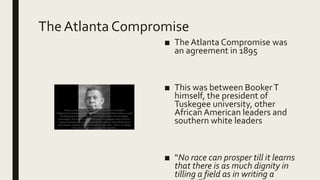
Booker T. Washington, born into slavery in 1859, became a notable civil rights leader and the first leader of the Tuskegee Normal and Industrial Institute, where he focused on education and economic progress for African Americans. Despite his achievements and the Atlanta Compromise in 1895, he faced criticism from contemporaries for his acceptance of discrimination and emphasis on economic advancement over direct political action. Washington's legacy is significant, as he raised substantial funds for African American education and authored 14 books, impacting civil rights discourse even today.