Machine Learning
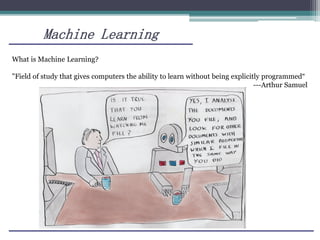
What isMachine Learning?
"Field of study that gives computers the ability to learn without being explicitly programmed“
---Arthur Samuel
Deep Learning
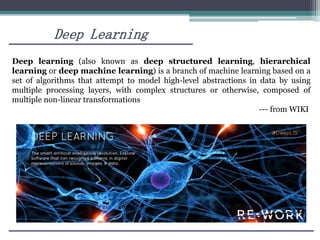
Deep learning(also known as deep structured learning, hierarchical
learning or deep machine learning) is a branch of machine learning based on a
set of algorithms that attempt to model high-level abstractions in data by using
multiple processing layers, with complex structures or otherwise, composed of
multiple non-linear transformations
--- from WIKI
Deep Learning
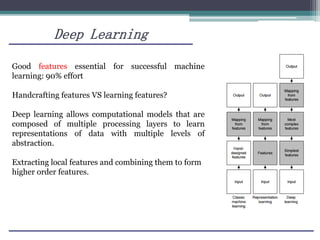
Good featuresessential for successful machine
learning: 90% effort
Handcrafting features VS learning features?
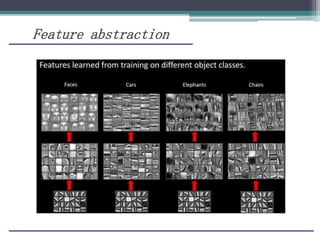
Deep learning allows computational models that are
composed of multiple processing layers to learn
representations of data with multiple levels of
abstraction.
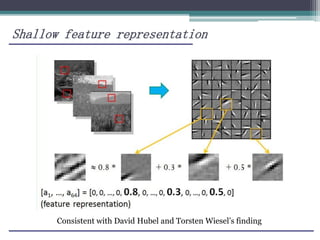
Extracting local features and combining them to form
higher order features.
8.
Why going deep?
Data are often high-dimensional.
There is a huge amount of structure in the data, but the structure is too
complicated to be represented by a simple model.
Insufficient depth can require more computational elements than
architectures whose depth matches the task.
Deep nets provide simpler but more descriptive models of many problems.
9.
Layered Visual System
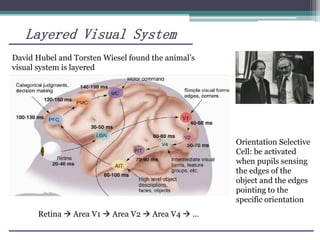
DavidHubel and Torsten Wiesel found the animal’s
visual system is layered
Retina Area V1 Area V2 Area V4 …
Orientation Selective
Cell: be activated
when pupils sensing
the edges of the
object and the edges
pointing to the
specific orientation
10.
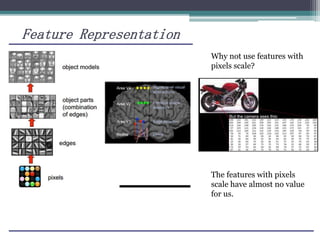
Feature Representation
Why notuse features with
pixels scale?
The features with pixels
scale have almost no value
for us.
Deep Learning
Conventional machine-learningtechniques were limited in their ability to
process natural data in their raw form.
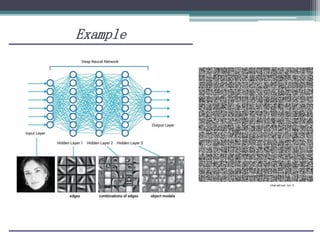
Deep-learning methods are representation-learning methods with multiple
levels of representation, obtained by computing simple but non-linear modules
that each transform the representation at one level(staring with the raw input)
into a representation at a higher, slightly more abstract level.
Deep learning discovers intricate structure in large data sets by using the
backpropagation algorithm to indicate how a machine should change its
internal parameters that are used to compute the representation in each layer
from the representation in the previous layer.
15.
Deep Learning
Various deeplearning architectures such as:
deep neural networks
convolutional deep neural networks
deep belief networks
recurrent neural networks
have been applied to fields like computer vision, automatic speech
recognition, natural language processing, audio recognition
and bioinformatics where they have been shown to produce state-of-the-art
results on various tasks.
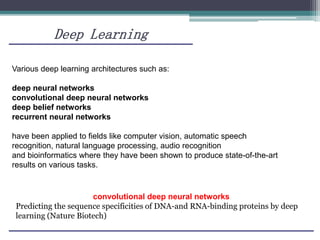
convolutional deep neural networks
Predicting the sequence specificities of DNA-and RNA-binding proteins by deep
learning (Nature Biotech)
16.
Convolutional Neural Networks
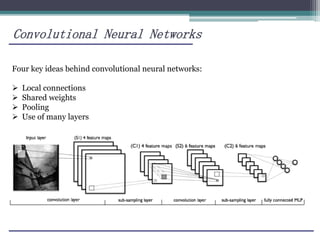
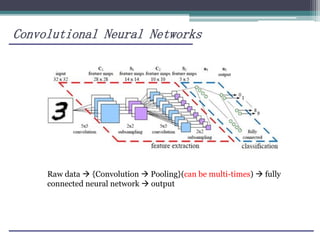
Fourkey ideas behind convolutional neural networks:
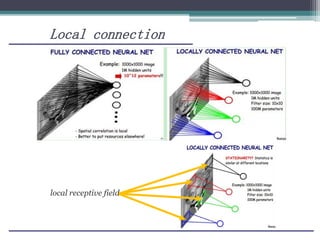
Local connections
Shared weights
Pooling
Use of many layers
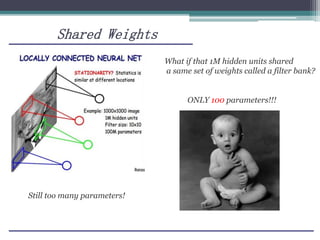
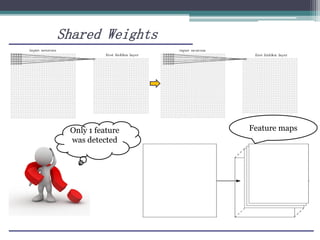
Shared Weights
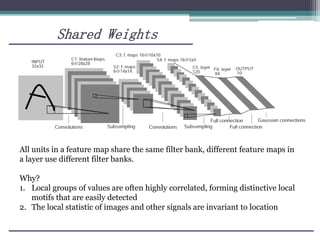
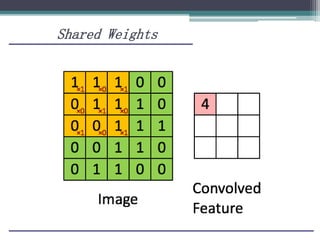
All unitsin a feature map share the same filter bank, different feature maps in
a layer use different filter banks.
Why?
1. Local groups of values are often highly correlated, forming distinctive local
motifs that are easily detected
2. The local statistic of images and other signals are invariant to location
21.
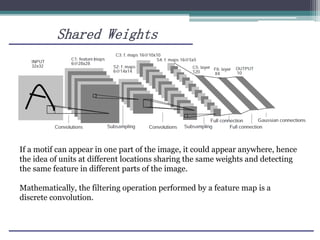
Shared Weights
If amotif can appear in one part of the image, it could appear anywhere, hence
the idea of units at different locations sharing the same weights and detecting
the same feature in different parts of the image.
Mathematically, the filtering operation performed by a feature map is a
discrete convolution.
Pooling
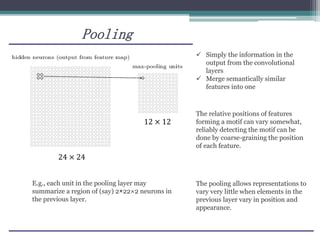
E.g., each unitin the pooling layer may
summarize a region of (say) 2×22×2 neurons in
the previous layer.
24 × 24
12 × 12
Simply the information in the
output from the convolutional
layers
Merge semantically similar
features into one
The pooling allows representations to
vary very little when elements in the
previous layer vary in position and
appearance.
The relative positions of features
forming a motif can vary somewhat,
reliably detecting the motif can be
done by coarse-graining the position
of each feature.