Input •READING
Output •WRITING
SOURCE
SCRIPT
SUPPORT
BOOK
REVIEW
BOOK
REVIEW
Heading
Introduction
Background
information
Summary
Evaluation
Ending
HEADING
•Title. Author. Place of
publication: publisher,
date of publication.
Number of pages.
Introduction
•BRIEF OVERVIEW
•PURPOSE OR AUDIENCE FOR
THE BOOK
•GENERAL REACTION AND
EVALUATION
BACKGROUND INFORMATION
•Places the book in
CONTEXT
•Discusses the criteria of
judging the book
SUMMARY
•Main points of the book
•Quotes and paraphrases
key phrases from the
author
Evaluation
• how well the book has achieved its goal •
what possibilities are suggested by the
book • what the book has left out • how
the book compares to others on the
subject • what specific points are not
convincing • what personal experiences
you’ve had related to the subject.
DIRECT COMMENT
• ties together issues
raised in the review
in a conclusion
general rule of thumb
•the first one-half to two-thirds
of the review should
summarize the author’s main
ideas and at least one-third
should evaluate the book.
QUESTIONS TO BE ANSWERED
• What are the author’s viewpoint and
purpose?
• What are the author’s main points?
• What kind of evidence does the author
use to prove his or her points?
• How does this book relate to other books
on the same topic?
QUESTIONS TO BE ANSWERED
• Does the author have the necessary
expertise to write the book?
• What are the most appropriate criteria
by which to judge the book? How
successful do you think the author
was in carrying out the overall
purposes of the book?
LITERATURE
REVIEW
Literary merit
BOOKS
POETRY
DRAMA
NON
FICTION
MOVIES and
other genres
RESEARCH REPORT
Not a full paper
I. PARTS OF THE PAPER
Title: maximum 20 words (both content and function words)
Author’s Name
Official Email: (preferably webmail of university/office or professional
email)
Affiliation: University Name / Agency
Place of Origin (Town/City/Province/Country with coordinates)
Telephone Number
Abstract : 150 words containing 5 parts:
(situating the topic, chief purpose / objectives, methods, results,
conclusions)
Keywords : 5-8 words
I. PARTS OF THE PAPER
Introduction
Framework (with framework if social science, no framework If
experimental)
Objectives: limit to 2 or 3
Methodology: (Materials and Methods for technical/scientific studies)
Results and Discussion: (Maybe separated for technical/scientific
studies)
Conclusions
Recommendations (optional; needed if it has international application)
Literature Cited: 50% of sources shall be traceable online from
reputable journals; APA format
Supporting papers of a
RESEARCH
UNDERTAKING would be
INSTITUTIONAL.
Project Proposal
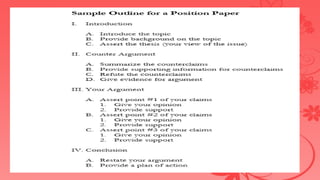
POSITION PAPER
• Is it a real issue, with genuine
controversy and uncertainty?
• Can you distinctly identify two
positions?
• Are you personally interested in
advocating one of these positions?
• Is the issue narrow enough to be
manageable?
Issue Criteria
• AUDIENCE
• VIEWPOINT
Analyzing an Issue
and Developing an
Argument
In considering the audience, ask yourself
the following questions
•Who is your audience? What do
they believe? Where do they
stand on the issue? How are
their interests involved? What
evidence is likely to be effective
with them?
In determining your viewpoint, ask yourself
the following:
• Is your topic interesting? Can you
manage the material within the
specifications set by the instructor?
Does your topic assert something
specific and propose a plan of action?
Do you have enough material to
support your opinion?
In SUMMARY
•Introduction
•Body
•Closing
•Situation
• Role in the
Solution/
Request/Call for
Action
•Closing
All subjects are hard to TEACH. Hard, but
not impossible.

BOOK REVIEW.pdf,.,.,.,.,.,.,.,/,/,.,.,.,.

  • 1.
  • 2.
  • 3.
  • 4.
  • 5.
    HEADING •Title. Author. Placeof publication: publisher, date of publication. Number of pages.
  • 6.
    Introduction •BRIEF OVERVIEW •PURPOSE ORAUDIENCE FOR THE BOOK •GENERAL REACTION AND EVALUATION
  • 7.
    BACKGROUND INFORMATION •Places thebook in CONTEXT •Discusses the criteria of judging the book
  • 8.
    SUMMARY •Main points ofthe book •Quotes and paraphrases key phrases from the author
  • 9.
    Evaluation • how wellthe book has achieved its goal • what possibilities are suggested by the book • what the book has left out • how the book compares to others on the subject • what specific points are not convincing • what personal experiences you’ve had related to the subject.
  • 10.
    DIRECT COMMENT • tiestogether issues raised in the review in a conclusion
  • 11.
    general rule ofthumb •the first one-half to two-thirds of the review should summarize the author’s main ideas and at least one-third should evaluate the book.
  • 12.
    QUESTIONS TO BEANSWERED • What are the author’s viewpoint and purpose? • What are the author’s main points? • What kind of evidence does the author use to prove his or her points? • How does this book relate to other books on the same topic?
  • 13.
    QUESTIONS TO BEANSWERED • Does the author have the necessary expertise to write the book? • What are the most appropriate criteria by which to judge the book? How successful do you think the author was in carrying out the overall purposes of the book?
  • 14.
  • 15.
  • 16.
  • 17.
    I. PARTS OFTHE PAPER Title: maximum 20 words (both content and function words) Author’s Name Official Email: (preferably webmail of university/office or professional email) Affiliation: University Name / Agency Place of Origin (Town/City/Province/Country with coordinates) Telephone Number Abstract : 150 words containing 5 parts: (situating the topic, chief purpose / objectives, methods, results, conclusions) Keywords : 5-8 words
  • 18.
    I. PARTS OFTHE PAPER Introduction Framework (with framework if social science, no framework If experimental) Objectives: limit to 2 or 3 Methodology: (Materials and Methods for technical/scientific studies) Results and Discussion: (Maybe separated for technical/scientific studies) Conclusions Recommendations (optional; needed if it has international application) Literature Cited: 50% of sources shall be traceable online from reputable journals; APA format
  • 19.
    Supporting papers ofa RESEARCH UNDERTAKING would be INSTITUTIONAL.
  • 20.
  • 21.
  • 22.
    • Is ita real issue, with genuine controversy and uncertainty? • Can you distinctly identify two positions? • Are you personally interested in advocating one of these positions? • Is the issue narrow enough to be manageable? Issue Criteria • AUDIENCE • VIEWPOINT Analyzing an Issue and Developing an Argument
  • 23.
    In considering theaudience, ask yourself the following questions •Who is your audience? What do they believe? Where do they stand on the issue? How are their interests involved? What evidence is likely to be effective with them?
  • 24.
    In determining yourviewpoint, ask yourself the following: • Is your topic interesting? Can you manage the material within the specifications set by the instructor? Does your topic assert something specific and propose a plan of action? Do you have enough material to support your opinion?
  • 26.
    In SUMMARY •Introduction •Body •Closing •Situation • Rolein the Solution/ Request/Call for Action •Closing
  • 27.
    All subjects arehard to TEACH. Hard, but not impossible.