Bokeh
Upon researchinglighttechniques for filming, I came across a very simple but effective technique:
bokeh. From the Japanese word ‘boke’ meaning ‘blur’ or ‘haze’, the technique improves the
aesthetic quality of lighting which is out of focus. With this, you can change its size and shape.
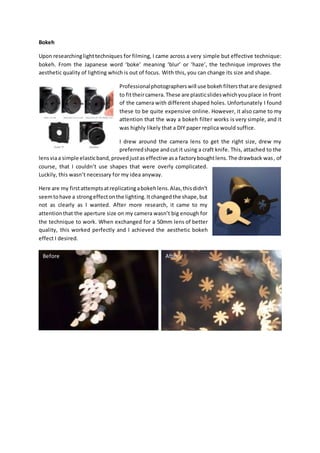
Professionalphotographerswill use bokehfiltersthatare designed
to fittheircamera.These are plasticslideswhichyouplace in front
of the camera with different shaped holes. Unfortunately I found
these to be quite expensive online. However, it also came to my
attention that the way a bokeh filter works is very simple, and it
was highly likely that a DIY paper replica would suffice.
I drew around the camera lens to get the right size, drew my
preferredshape andcut it using a craft knife. This, attached to the
lensviaa simple elasticband,provedjustaseffective asa factoryboughtlens.The drawback was, of
course, that I couldn’t use shapes that were overly complicated.
Luckily, this wasn’t necessary for my idea anyway.
Here are my firstattemptsatreplicatingabokehlens.Alas,thisdidn’t
seemtohave a strongeffectonthe lighting.Itchangedthe shape,but
not as clearly as I wanted. After more research, it came to my
attentionthat the aperture size on my camera wasn’t big enough for
the technique to work. When exchanged for a 50mm lens of better
quality, this worked perfectly and I achieved the aesthetic bokeh
effect I desired.
Before After

Bokeh

  • 1.
    Bokeh Upon researchinglighttechniques forfilming, I came across a very simple but effective technique: bokeh. From the Japanese word ‘boke’ meaning ‘blur’ or ‘haze’, the technique improves the aesthetic quality of lighting which is out of focus. With this, you can change its size and shape. Professionalphotographerswill use bokehfiltersthatare designed to fittheircamera.These are plasticslideswhichyouplace in front of the camera with different shaped holes. Unfortunately I found these to be quite expensive online. However, it also came to my attention that the way a bokeh filter works is very simple, and it was highly likely that a DIY paper replica would suffice. I drew around the camera lens to get the right size, drew my preferredshape andcut it using a craft knife. This, attached to the lensviaa simple elasticband,provedjustaseffective asa factoryboughtlens.The drawback was, of course, that I couldn’t use shapes that were overly complicated. Luckily, this wasn’t necessary for my idea anyway. Here are my firstattemptsatreplicatingabokehlens.Alas,thisdidn’t seemtohave a strongeffectonthe lighting.Itchangedthe shape,but not as clearly as I wanted. After more research, it came to my attentionthat the aperture size on my camera wasn’t big enough for the technique to work. When exchanged for a 50mm lens of better quality, this worked perfectly and I achieved the aesthetic bokeh effect I desired. Before After