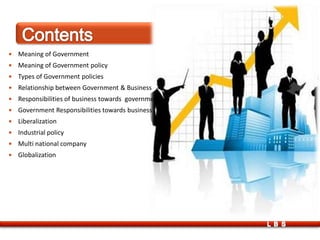
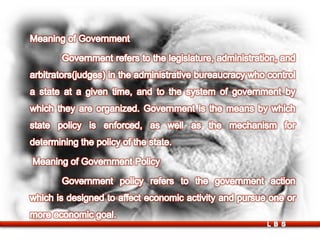
 Meaning of Government
 Meaning of Government policy
 Types of Government policies
 Relationship between Government & Business
 Responsibilities of business towards government
 Government Responsibilities towards business
 Liberalization
 Industrial policy
 Multi national company
 Globalization
LBS
LBS
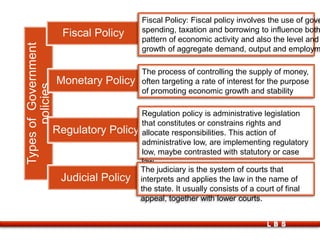
TypesofGovernment
policies
Fiscal Policy
Monetary Policy
Regulatory Policy
Judicial Policy
Fiscal Policy: Fiscal policy involves the use of gove
spending, taxation and borrowing to influence both
pattern of economic activity and also the level and
growth of aggregate demand, output and employm
The process of controlling the supply of money,
often targeting a rate of interest for the purpose
of promoting economic growth and stability
Regulation policy is administrative legislation
that constitutes or constrains rights and
allocate responsibilities. This action of
administrative low, are implementing regulatory
low, maybe contrasted with statutory or case
law.
The judiciary is the system of courts that
interprets and applies the law in the name of
the state. It usually consists of a court of final
appeal, together with lower courts.
LBS
LBS
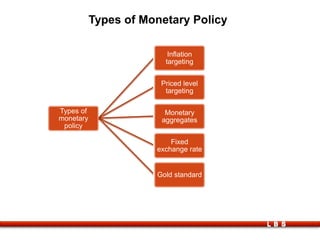
Types of Monetary Policy
Types of
monetary
policy
Inflation
targeting
Priced level
targeting
Monetary
aggregates
Fixed
exchange rate
Gold standard
LBS
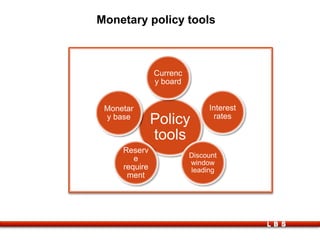
Monetary policy tools
Policy
tools
Currenc
y board
Interest
rates
Discount
window
leading
Reserv
e
require
ment
Monetar
y base
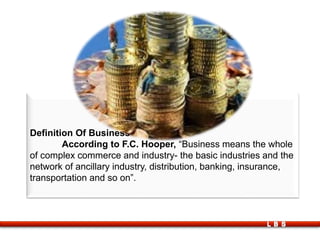
Definition Of Business
According to F.C. Hooper, “Business means the whole
of complex commerce and industry- the basic industries and the
network of ancillary industry, distribution, banking, insurance,
transportation and so on”.
LBS
The free market: This system proposes that there be little or no formal
relationship between busi & govt.
Socialism: This system proposes action to ensure economic equality for
the entire population.
The Depression: This system proposes the measure to be taken by govt
in order to stabilize the economic & promote new growth and systematic
issue could not be resolved by the free market alone.
LBS
The relationship between Govt & business is
complex, with both positive and negative aspects.
Thus an accurate and complete understanding of
this relationship necessities to examine the three
main theories of political, i.e., the free market,
socialism, the depression.
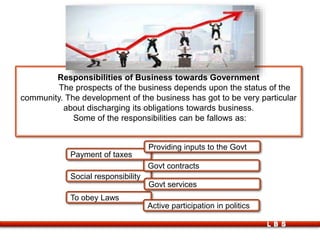
Responsibilities of Business towards Government
The prospects of the business depends upon the status of the
community. The development of the business has got to be very particular
about discharging its obligations towards business.
Some of the responsibilities can be fallows as:
LBS
Payment of taxes
Providing inputs to the Govt
Social responsibility
To obey Laws
Govt contracts
Govt services
Active participation in politics
LBS
Government Responsibilities towards Business
The Govt has to discharge several responsibilities towards the
business. Govt is the most powerful and sovereign authority in the
country. It can use its power to regulate and to stimulate business.
Some of the responsibilities can be fallowed as,
 maintenance of law and order
 Building Infrastructure
 Providing Money & Credit
 To Pass and Execute proper laws
 Basic Research
a) Basic Research
b) Commercial Research
 Providing information
 Controlling the growth of monopolies & preserving competition
 Reservation of fields of production
 Awarding patents Rights & copy Rights
 Protections
LBS
The Impact of Govt Policy on Business and Industry
Developing innovative ideas and taking them to market
successfully is an important determine for growth and sustainability. “in
the age of globalization and the knowledge economy, production of
knowledge, particularly localized tacit knowledge, is viewed as a valuable
regional asset”. How the relevant governing authorities support or hinder
the chances of success in these areas will there fore be of interest to
each nation concerned.
Moreover, by considering the development of policies supporting
innovation and entrepreneurship within these nations, some lesson may
be learned from real world experience. Although a strict, perspective
framework may not be possible or appropriate to put forward for all
nations as a result, nevertheless there may be common findings that will
serve as an initial guide for policy makers.
LBS
Liberalization
Liberalization refers to realization of previous government
restrictions, usually in areas of social or economic policy. It includes
dismantling of tariff (such as duties, surcharges, and export subsidies.
Economic liberalization
Economic liberalization is a very broad term that usually refers to
the fewer Govt regulations and restrictions in the economy in exchange for
greater participation of private entities.
Sum of the important economic liberalization policies.
1. The licensing system was cancelled for the most of the industries in
India. In India licensing was maintain only for 18 industries.
2. In 1994 the system of NSE was maintained to expand the market for
India.
3. Many acts that restricted the free flow of goods were liberalized then
such as the controller of capital issues, acts for tariffs and quantitative
control.
4. Foreign direct investment was also encouraged the limit for shares
was also increased.
LBS
Benefits of liberalization in India
One of the most significant effect of liberalization era has been
the emergence of a strong, effluent(waste) and buoyant(floating) middle
class with significant purchasing powers and this has been the engine that
has driven the economy since.
Another major benefit of liberalization era has been the shift in the
pattern of export of full traditional items like clothes, tea and spices to
automobiles, steel, IT etc.
LBS
Industrial policy
A major shift in the industrial policy was made by the Congress (I)
Government led by Mr. P.B. Narasimha Rao on July 24, 1991.
The main aim of this policy was to unshackle the country's indus-
trial economy from the cobwebs of unnecessary bureaucratic control,
introduce liberalization with a view to integrate the Indian economy with the
world economy, to remove restrictions on direct foreign investment and
also to free the domestic entrepreneur from the restrictions of MRTP Act.
Besides, the policy aims to shed the load of the public enterprises which
have shown a very low rate of return or are incurring losses over the years.
Some salient features of this policy are as follows:
1. Except some specified industries (security and strategic concerns, social
reasons, environmental issues, hazardous projects and articles of elitist
consumption) industrial licensing would be abolished.
2. Foreign investment would be encouraged in high priority areas up to a
limit of 51 per cent equity.
3. Government will encourage foreign trading companies to assist Indian
exporters in export activities
4. Disinvestment of Public Sector Units' shares.
5. Closing of such public sector units which are incurring heavy losses.
6. Abolition of C.C.I, and wealth tax on shares.
7. General reduction in customs duties.
LBS
Multi national company
As the name suggests, any company is referred to as a multinational
company or corporation (M. N. C.) when that company manages its operation
or production or service delivery from more than a single country.
Such a company is even known as international company or
corporation. As defined by I. L. O. or the International Labor Organization, a M.
N. C. is one, which has its operational headquarters based in one country with
several other operating branches in different other countries. The country
where the head quarter is located is called the home country whereas, the
other countries with operational branches are called the host countries. Apart
from playing an important role in globalization and international relations, these
multinational companies even have notable influence in a country's economy
as well as the world economy. The budget of some of the M. N. C.s are so high
that at times they even exceed the G. D. P. (Gross Domestic Product) of a
nation.
LBS
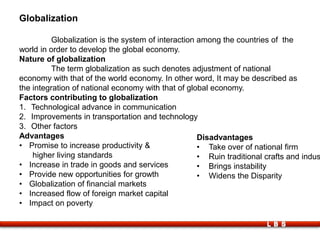
Globalization
Globalization is the system of interaction among the countries of the
world in order to develop the global economy.
Nature of globalization
The term globalization as such denotes adjustment of national
economy with that of the world economy. In other word, It may be described as
the integration of national economy with that of global economy.
Factors contributing to globalization
1. Technological advance in communication
2. Improvements in transportation and technology
3. Other factors
Advantages
• Promise to increase productivity &
higher living standards
• Increase in trade in goods and services
• Provide new opportunities for growth
• Globalization of financial markets
• Increased flow of foreign market capital
• Impact on poverty
Disadvantages
• Take over of national firm
• Ruin traditional crafts and indus
• Brings instability
• Widens the Disparity
• Thanks

Boe 2

  • 2.
     Meaning ofGovernment  Meaning of Government policy  Types of Government policies  Relationship between Government & Business  Responsibilities of business towards government  Government Responsibilities towards business  Liberalization  Industrial policy  Multi national company  Globalization LBS
  • 3.
  • 4.
    TypesofGovernment policies Fiscal Policy Monetary Policy RegulatoryPolicy Judicial Policy Fiscal Policy: Fiscal policy involves the use of gove spending, taxation and borrowing to influence both pattern of economic activity and also the level and growth of aggregate demand, output and employm The process of controlling the supply of money, often targeting a rate of interest for the purpose of promoting economic growth and stability Regulation policy is administrative legislation that constitutes or constrains rights and allocate responsibilities. This action of administrative low, are implementing regulatory low, maybe contrasted with statutory or case law. The judiciary is the system of courts that interprets and applies the law in the name of the state. It usually consists of a court of final appeal, together with lower courts. LBS
  • 5.
    LBS Types of MonetaryPolicy Types of monetary policy Inflation targeting Priced level targeting Monetary aggregates Fixed exchange rate Gold standard
  • 6.
    LBS Monetary policy tools Policy tools Currenc yboard Interest rates Discount window leading Reserv e require ment Monetar y base
  • 7.
    Definition Of Business Accordingto F.C. Hooper, “Business means the whole of complex commerce and industry- the basic industries and the network of ancillary industry, distribution, banking, insurance, transportation and so on”. LBS
  • 8.
    The free market:This system proposes that there be little or no formal relationship between busi & govt. Socialism: This system proposes action to ensure economic equality for the entire population. The Depression: This system proposes the measure to be taken by govt in order to stabilize the economic & promote new growth and systematic issue could not be resolved by the free market alone. LBS The relationship between Govt & business is complex, with both positive and negative aspects. Thus an accurate and complete understanding of this relationship necessities to examine the three main theories of political, i.e., the free market, socialism, the depression.
  • 9.
    Responsibilities of Businesstowards Government The prospects of the business depends upon the status of the community. The development of the business has got to be very particular about discharging its obligations towards business. Some of the responsibilities can be fallows as: LBS Payment of taxes Providing inputs to the Govt Social responsibility To obey Laws Govt contracts Govt services Active participation in politics
  • 10.
    LBS Government Responsibilities towardsBusiness The Govt has to discharge several responsibilities towards the business. Govt is the most powerful and sovereign authority in the country. It can use its power to regulate and to stimulate business. Some of the responsibilities can be fallowed as,  maintenance of law and order  Building Infrastructure  Providing Money & Credit  To Pass and Execute proper laws  Basic Research a) Basic Research b) Commercial Research  Providing information  Controlling the growth of monopolies & preserving competition  Reservation of fields of production  Awarding patents Rights & copy Rights  Protections
  • 11.
    LBS The Impact ofGovt Policy on Business and Industry Developing innovative ideas and taking them to market successfully is an important determine for growth and sustainability. “in the age of globalization and the knowledge economy, production of knowledge, particularly localized tacit knowledge, is viewed as a valuable regional asset”. How the relevant governing authorities support or hinder the chances of success in these areas will there fore be of interest to each nation concerned. Moreover, by considering the development of policies supporting innovation and entrepreneurship within these nations, some lesson may be learned from real world experience. Although a strict, perspective framework may not be possible or appropriate to put forward for all nations as a result, nevertheless there may be common findings that will serve as an initial guide for policy makers.
  • 12.
    LBS Liberalization Liberalization refers torealization of previous government restrictions, usually in areas of social or economic policy. It includes dismantling of tariff (such as duties, surcharges, and export subsidies. Economic liberalization Economic liberalization is a very broad term that usually refers to the fewer Govt regulations and restrictions in the economy in exchange for greater participation of private entities. Sum of the important economic liberalization policies. 1. The licensing system was cancelled for the most of the industries in India. In India licensing was maintain only for 18 industries. 2. In 1994 the system of NSE was maintained to expand the market for India. 3. Many acts that restricted the free flow of goods were liberalized then such as the controller of capital issues, acts for tariffs and quantitative control. 4. Foreign direct investment was also encouraged the limit for shares was also increased.
  • 13.
    LBS Benefits of liberalizationin India One of the most significant effect of liberalization era has been the emergence of a strong, effluent(waste) and buoyant(floating) middle class with significant purchasing powers and this has been the engine that has driven the economy since. Another major benefit of liberalization era has been the shift in the pattern of export of full traditional items like clothes, tea and spices to automobiles, steel, IT etc.
  • 14.
    LBS Industrial policy A majorshift in the industrial policy was made by the Congress (I) Government led by Mr. P.B. Narasimha Rao on July 24, 1991. The main aim of this policy was to unshackle the country's indus- trial economy from the cobwebs of unnecessary bureaucratic control, introduce liberalization with a view to integrate the Indian economy with the world economy, to remove restrictions on direct foreign investment and also to free the domestic entrepreneur from the restrictions of MRTP Act. Besides, the policy aims to shed the load of the public enterprises which have shown a very low rate of return or are incurring losses over the years. Some salient features of this policy are as follows: 1. Except some specified industries (security and strategic concerns, social reasons, environmental issues, hazardous projects and articles of elitist consumption) industrial licensing would be abolished. 2. Foreign investment would be encouraged in high priority areas up to a limit of 51 per cent equity. 3. Government will encourage foreign trading companies to assist Indian exporters in export activities 4. Disinvestment of Public Sector Units' shares. 5. Closing of such public sector units which are incurring heavy losses. 6. Abolition of C.C.I, and wealth tax on shares. 7. General reduction in customs duties.
  • 15.
    LBS Multi national company Asthe name suggests, any company is referred to as a multinational company or corporation (M. N. C.) when that company manages its operation or production or service delivery from more than a single country. Such a company is even known as international company or corporation. As defined by I. L. O. or the International Labor Organization, a M. N. C. is one, which has its operational headquarters based in one country with several other operating branches in different other countries. The country where the head quarter is located is called the home country whereas, the other countries with operational branches are called the host countries. Apart from playing an important role in globalization and international relations, these multinational companies even have notable influence in a country's economy as well as the world economy. The budget of some of the M. N. C.s are so high that at times they even exceed the G. D. P. (Gross Domestic Product) of a nation.
  • 16.
    LBS Globalization Globalization is thesystem of interaction among the countries of the world in order to develop the global economy. Nature of globalization The term globalization as such denotes adjustment of national economy with that of the world economy. In other word, It may be described as the integration of national economy with that of global economy. Factors contributing to globalization 1. Technological advance in communication 2. Improvements in transportation and technology 3. Other factors Advantages • Promise to increase productivity & higher living standards • Increase in trade in goods and services • Provide new opportunities for growth • Globalization of financial markets • Increased flow of foreign market capital • Impact on poverty Disadvantages • Take over of national firm • Ruin traditional crafts and indus • Brings instability • Widens the Disparity
  • 17.