Webinar on
Board Responsibilities
  will begin soon!
BOARD RESPONSIBILITIES:
WHAT IS A BOARD TO DO?
Lisa Presley,
District Executive, Heartland District, MidAmerica
Region
BROUGHT TO YOU BY
MIDAMERICA REGION
Central MidWest, Heartland and Prairie Star
Districts
WELCOME!
 Welcome
 Introductions
 Technical   Issues
THIS WEBINAR IS BEING
RECORDED
BOARD RESPONSIBILITIES:
WHAT IS A BOARD TO DO?
Lisa Presley,
District Executive, Heartland District, MidAmerica
Region
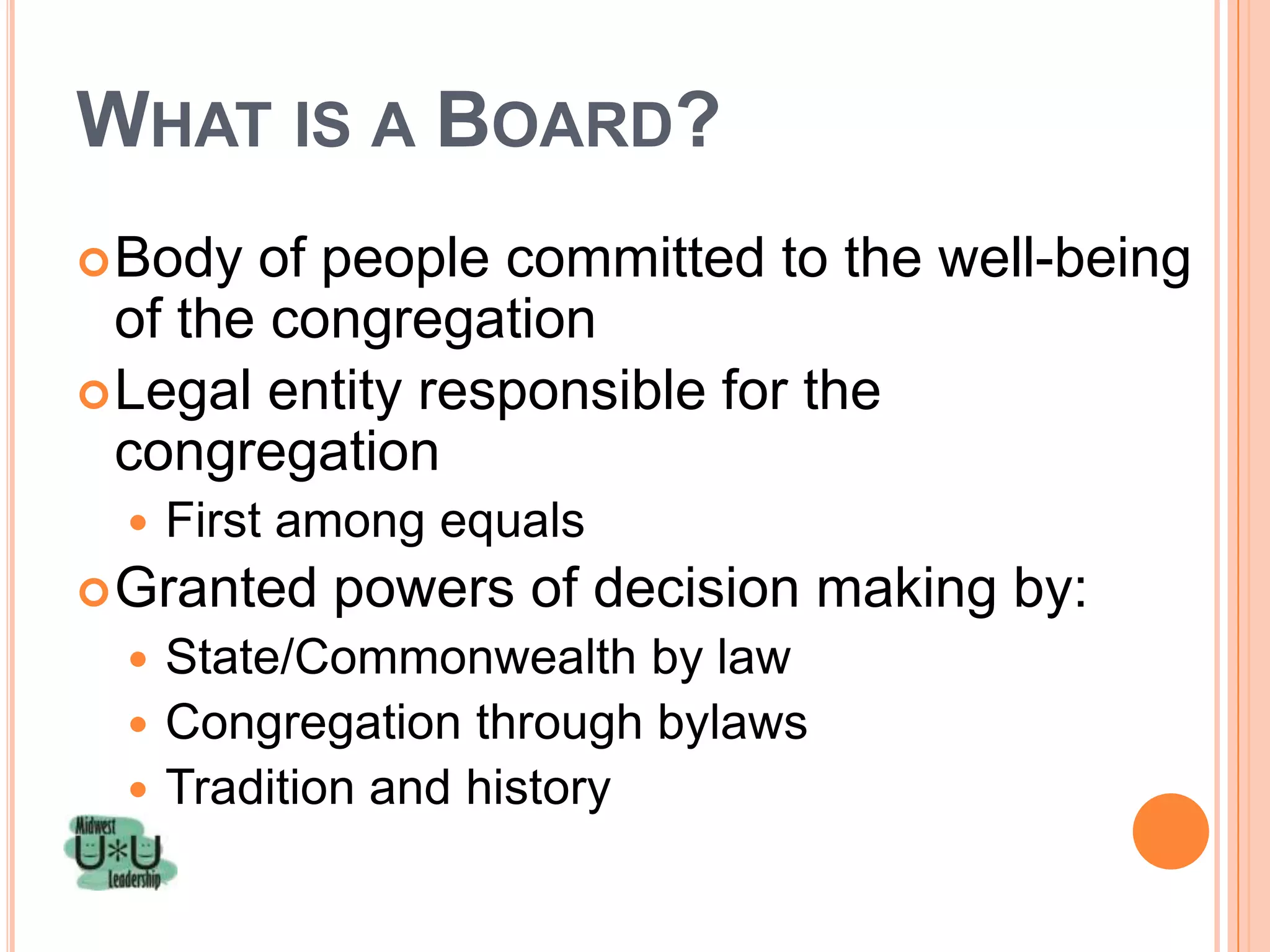
WHAT IS A BOARD?
 Body  of people committed to the well-being
  of the congregation
 Legal entity responsible for the
  congregation
     First among equals
 Granted    powers of decision making by:
   State/Commonwealth by law
   Congregation through bylaws
   Tradition and history
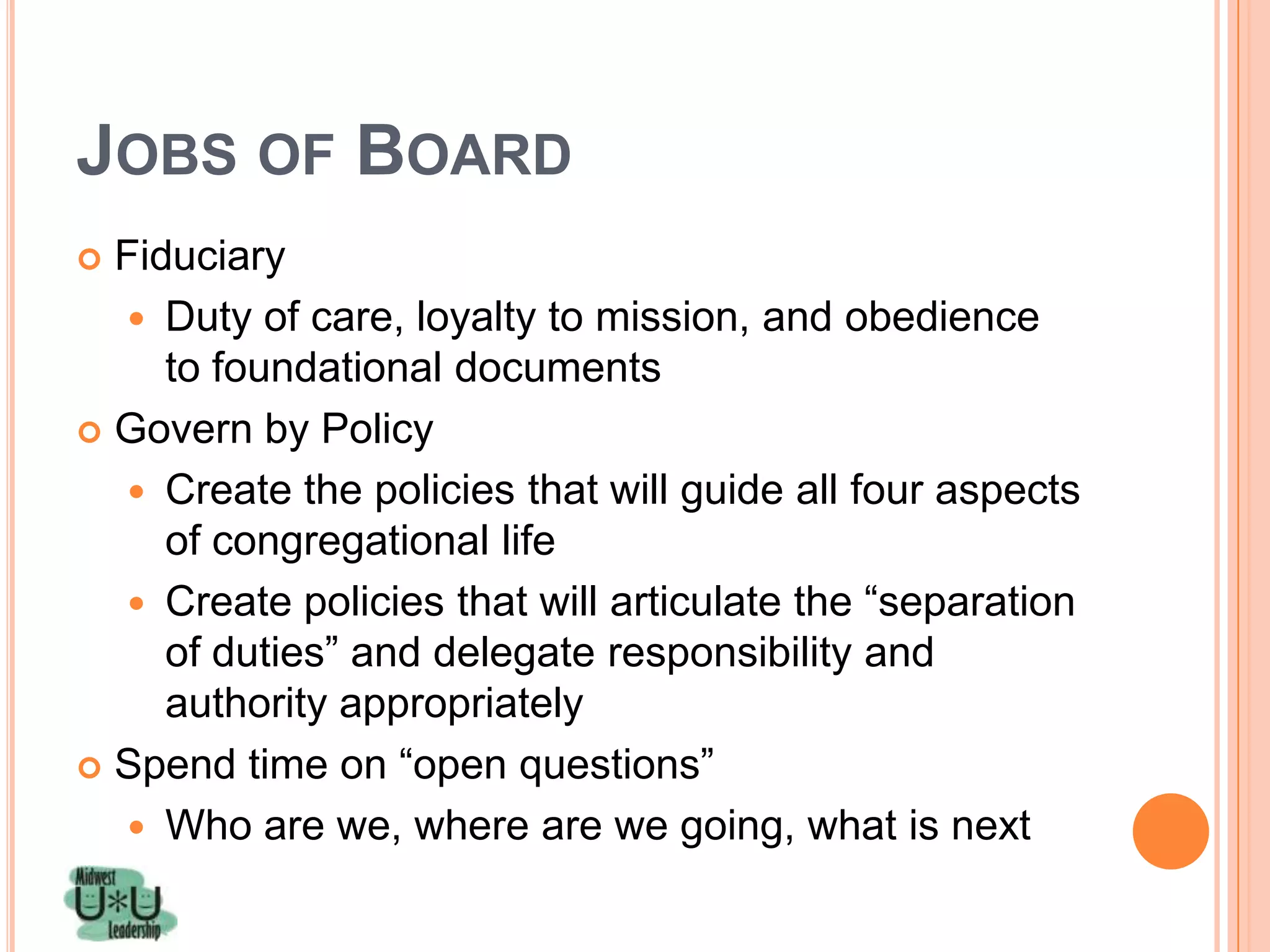
JOBS OF BOARD
 Fiduciary
   Duty of care, loyalty to mission, and obedience
     to foundational documents
 Govern by Policy

   Create the policies that will guide all four aspects
     of congregational life
   Create policies that will articulate the ―separation
     of duties‖ and delegate responsibility and
     authority appropriately
 Spend time on ―open questions‖

   Who are we, where are we going, what is next
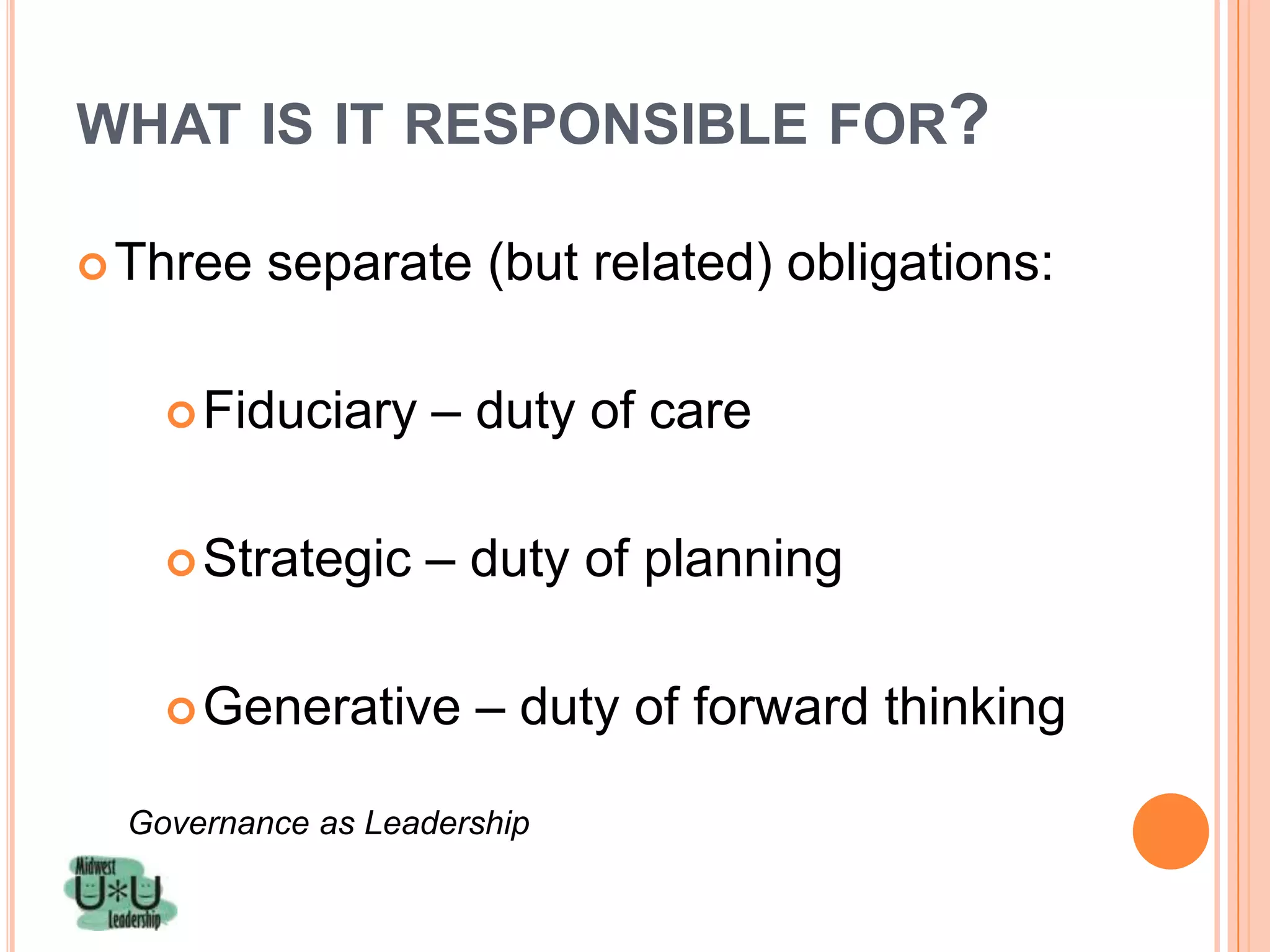
WHAT IS IT RESPONSIBLE FOR?

 Three   separate (but related) obligations:

     Fiduciary     – duty of care

     Strategic    – duty of planning

     Generative      – duty of forward thinking

  Governance as Leadership
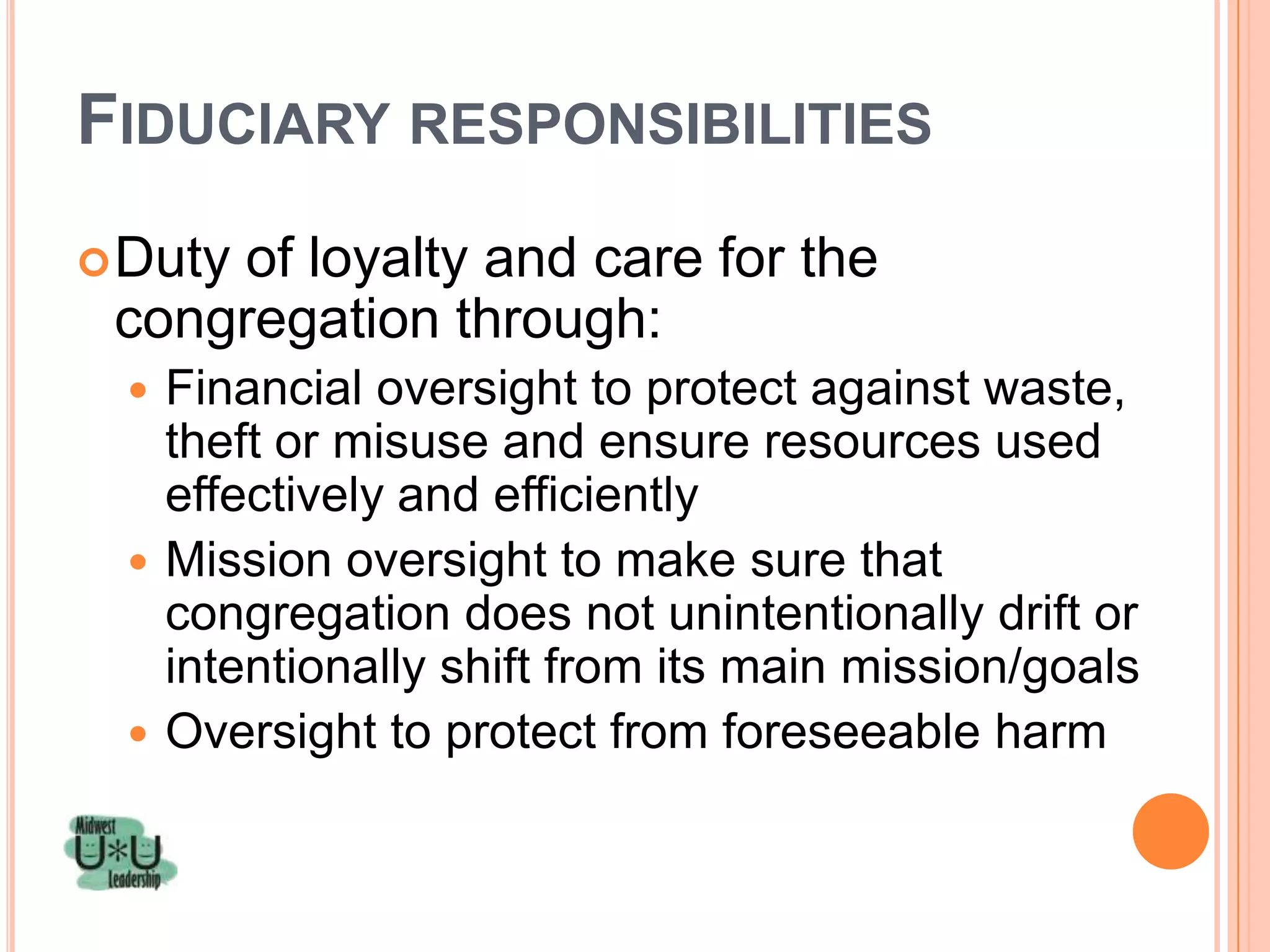
FIDUCIARY RESPONSIBILITIES
 Duty
     of loyalty and care for the
 congregation through:
  Financial oversight to protect against waste,
   theft or misuse and ensure resources used
   effectively and efficiently
  Mission oversight to make sure that
   congregation does not unintentionally drift or
   intentionally shift from its main mission/goals
  Oversight to protect from foreseeable harm
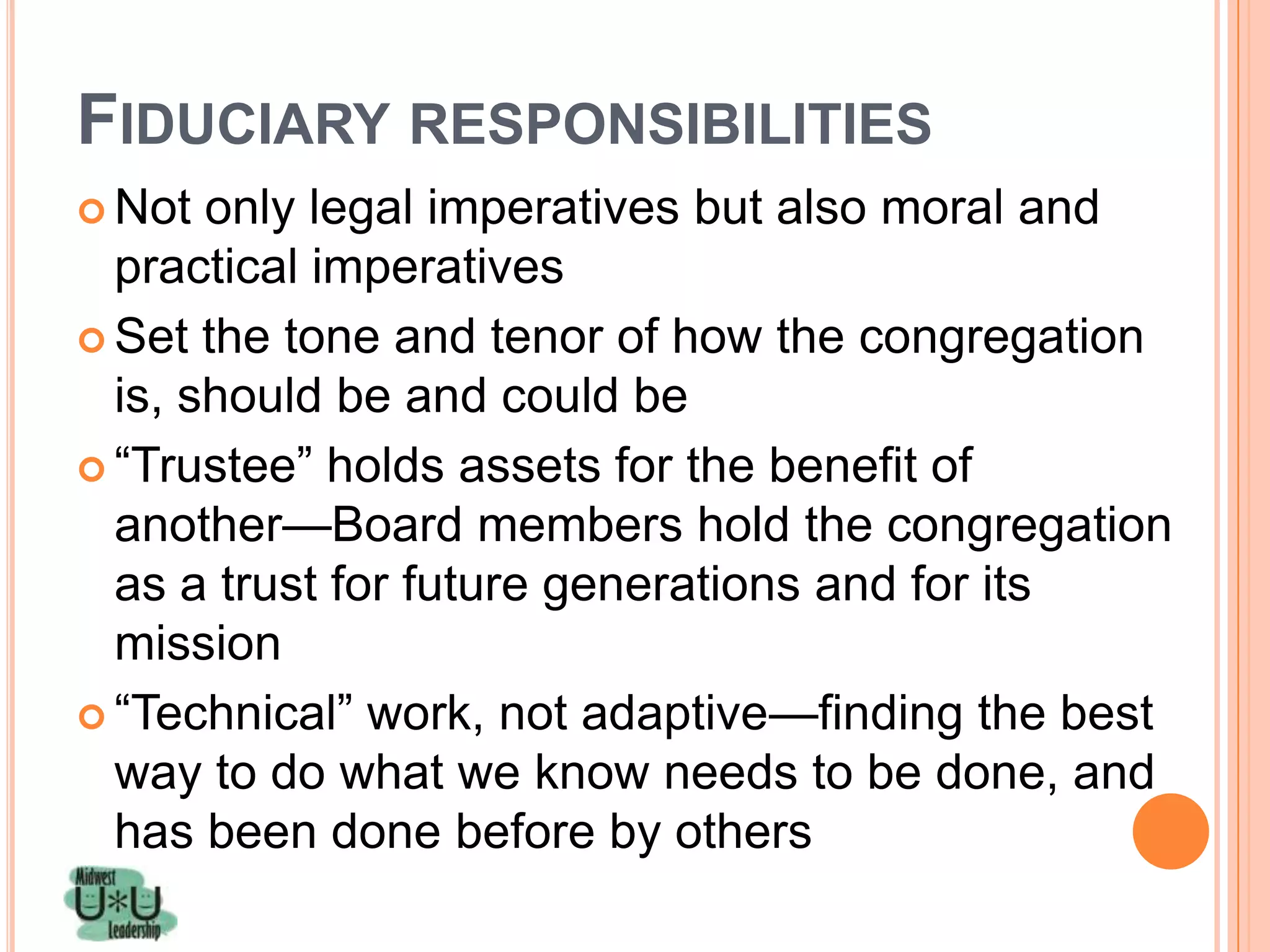
FIDUCIARY RESPONSIBILITIES
 Not  only legal imperatives but also moral and
  practical imperatives
 Set the tone and tenor of how the congregation
  is, should be and could be
 ―Trustee‖ holds assets for the benefit of
  another—Board members hold the congregation
  as a trust for future generations and for its
  mission
 ―Technical‖ work, not adaptive—finding the best
  way to do what we know needs to be done, and
  has been done before by others
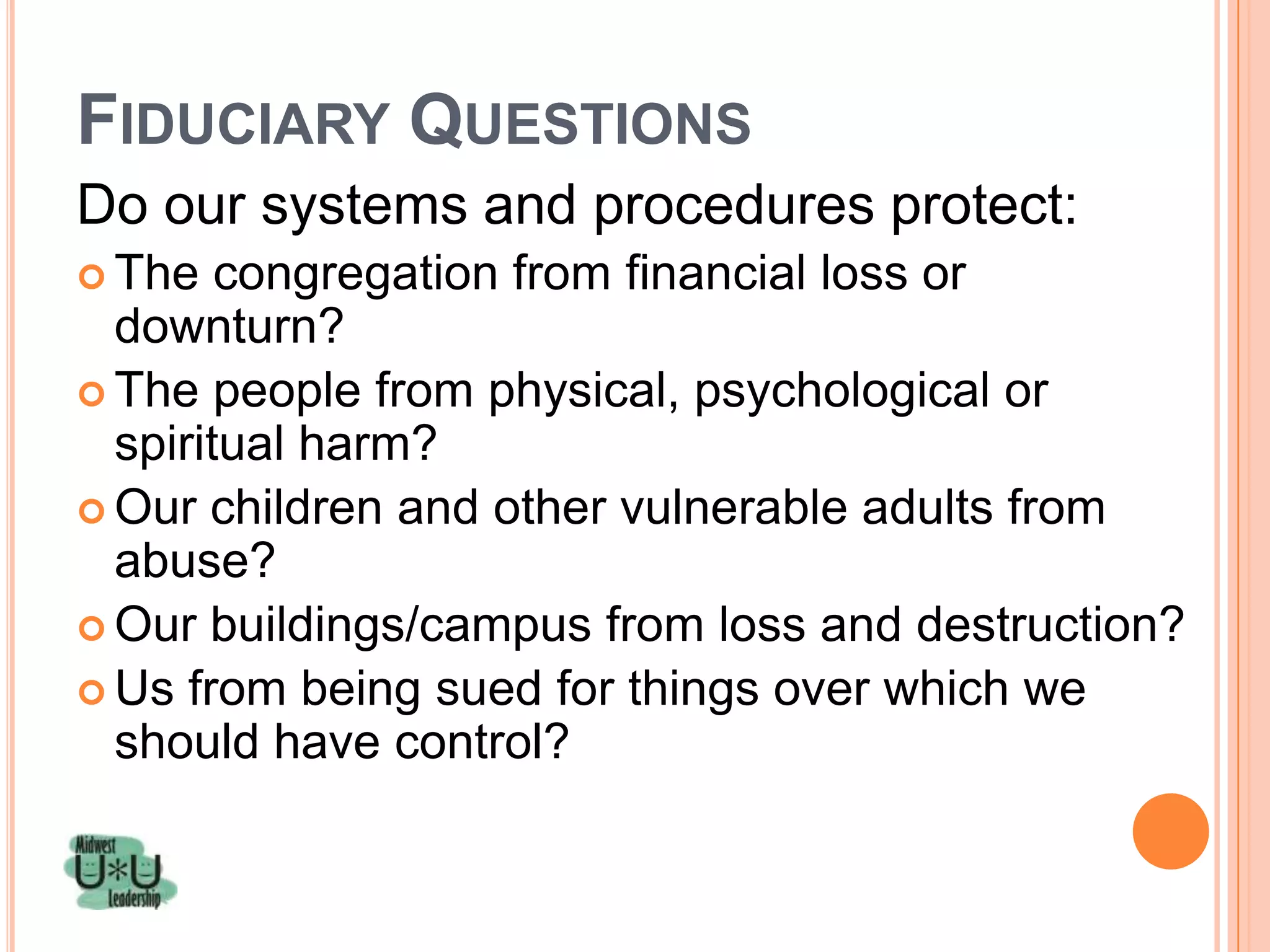
FIDUCIARY QUESTIONS
Do our systems and procedures protect:
 The   congregation from financial loss or
  downturn?
 The people from physical, psychological or
  spiritual harm?
 Our children and other vulnerable adults from
  abuse?
 Our buildings/campus from loss and destruction?
 Us from being sued for things over which we
  should have control?
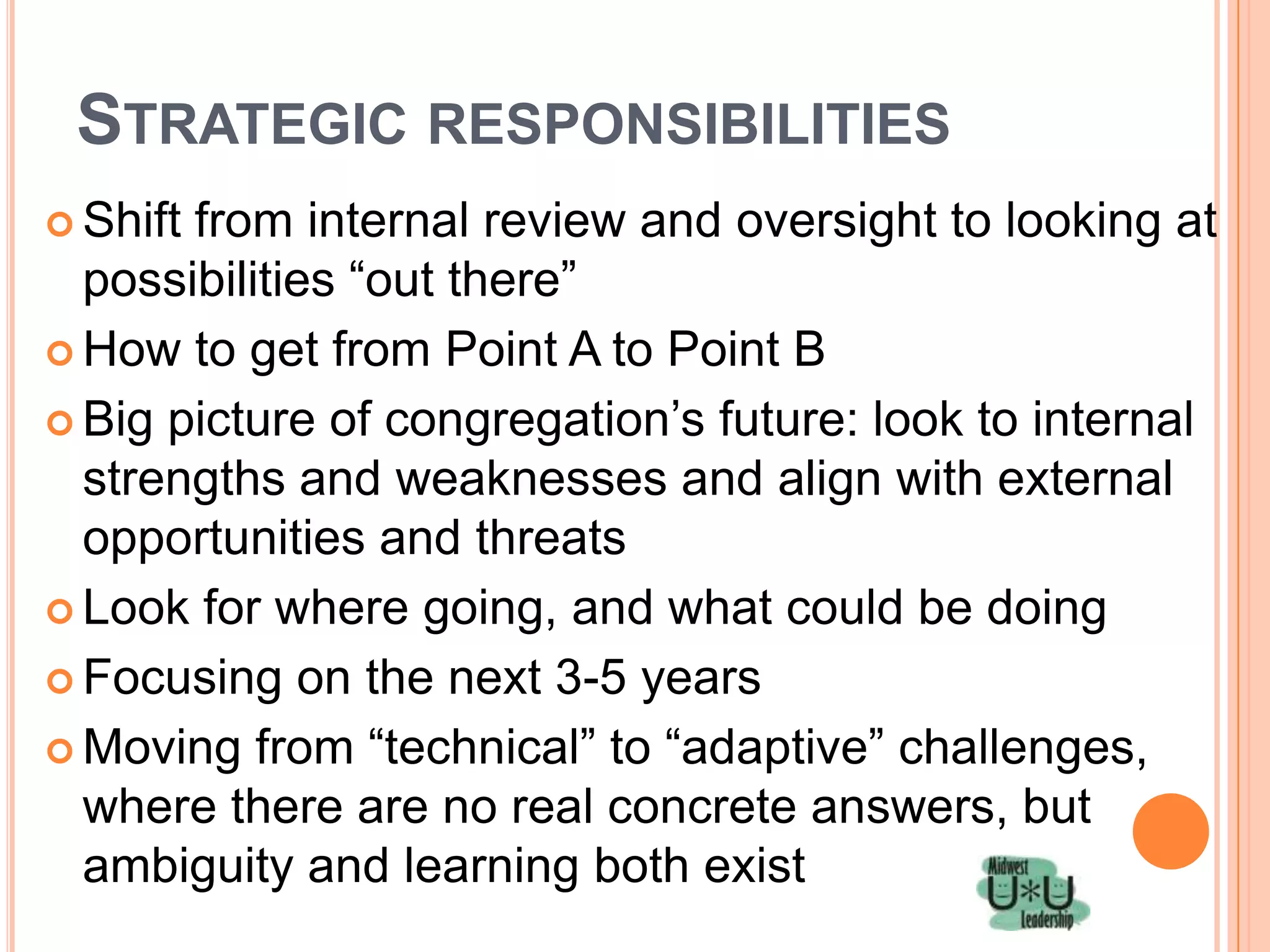
STRATEGIC RESPONSIBILITIES
 Shiftfrom internal review and oversight to looking at
  possibilities ―out there‖
 How to get from Point A to Point B

 Big picture of congregation’s future: look to internal
  strengths and weaknesses and align with external
  opportunities and threats
 Look for where going, and what could be doing

 Focusing on the next 3-5 years

 Moving from ―technical‖ to ―adaptive‖ challenges,
  where there are no real concrete answers, but
  ambiguity and learning both exist
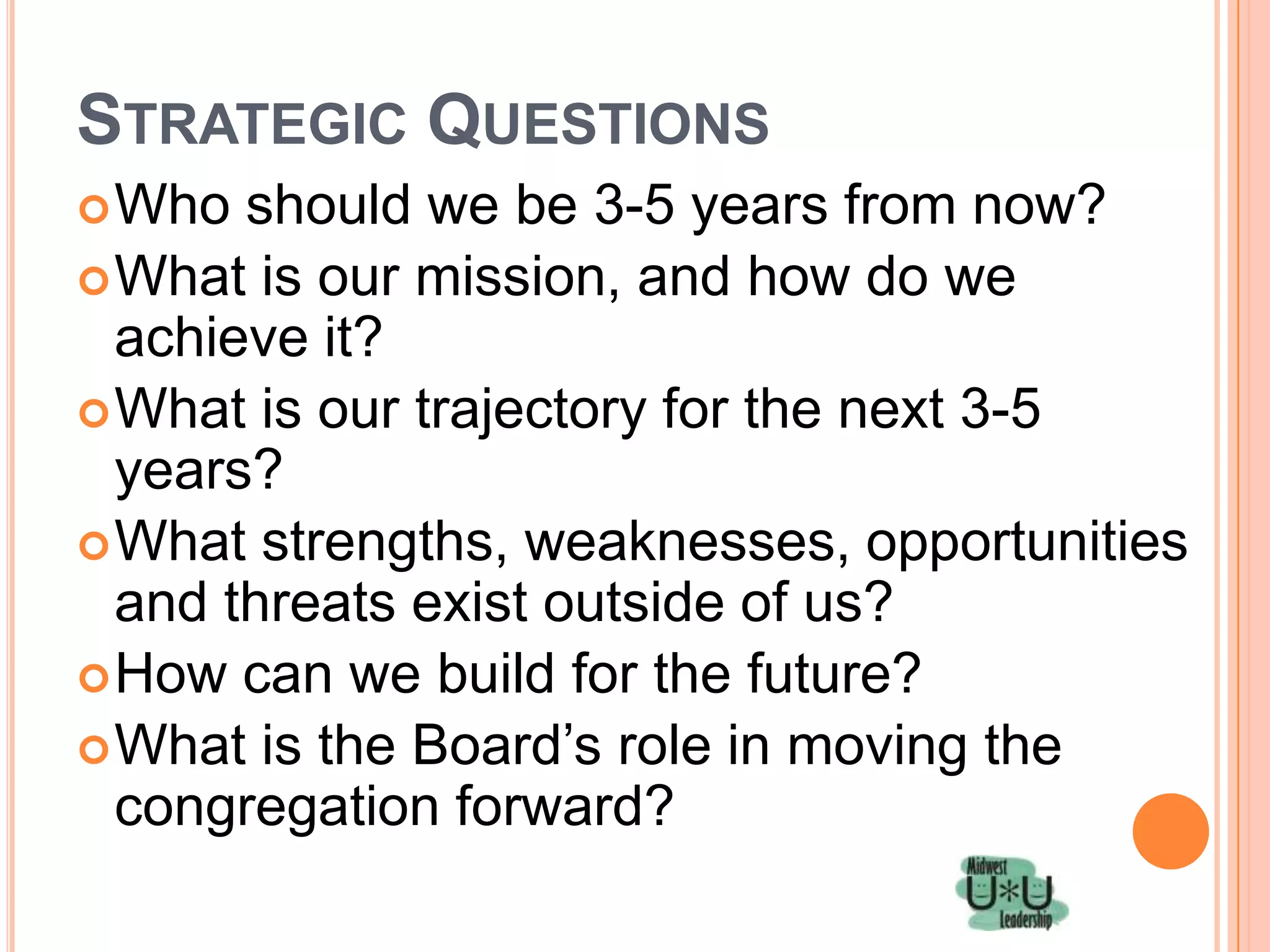
STRATEGIC QUESTIONS
 Who  should we be 3-5 years from now?
 What is our mission, and how do we
  achieve it?
 What is our trajectory for the next 3-5
  years?
 What strengths, weaknesses, opportunities
  and threats exist outside of us?
 How can we build for the future?
 What is the Board’s role in moving the
  congregation forward?
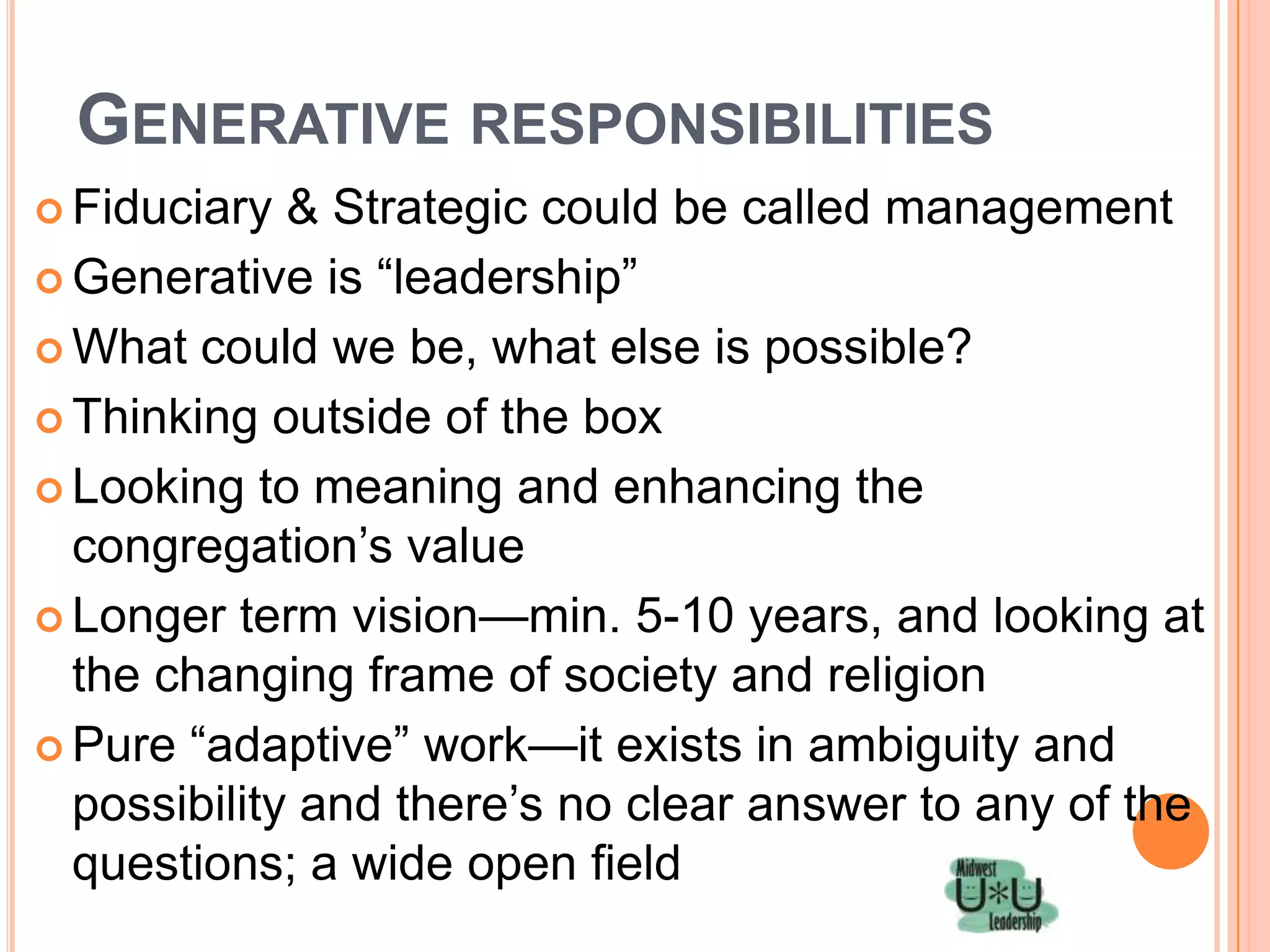
GENERATIVE RESPONSIBILITIES
 Fiduciary  & Strategic could be called management
 Generative is ―leadership‖

 What could we be, what else is possible?

 Thinking outside of the box

 Looking to meaning and enhancing the
  congregation’s value
 Longer term vision—min. 5-10 years, and looking at
  the changing frame of society and religion
 Pure ―adaptive‖ work—it exists in ambiguity and
  possibility and there’s no clear answer to any of the
  questions; a wide open field
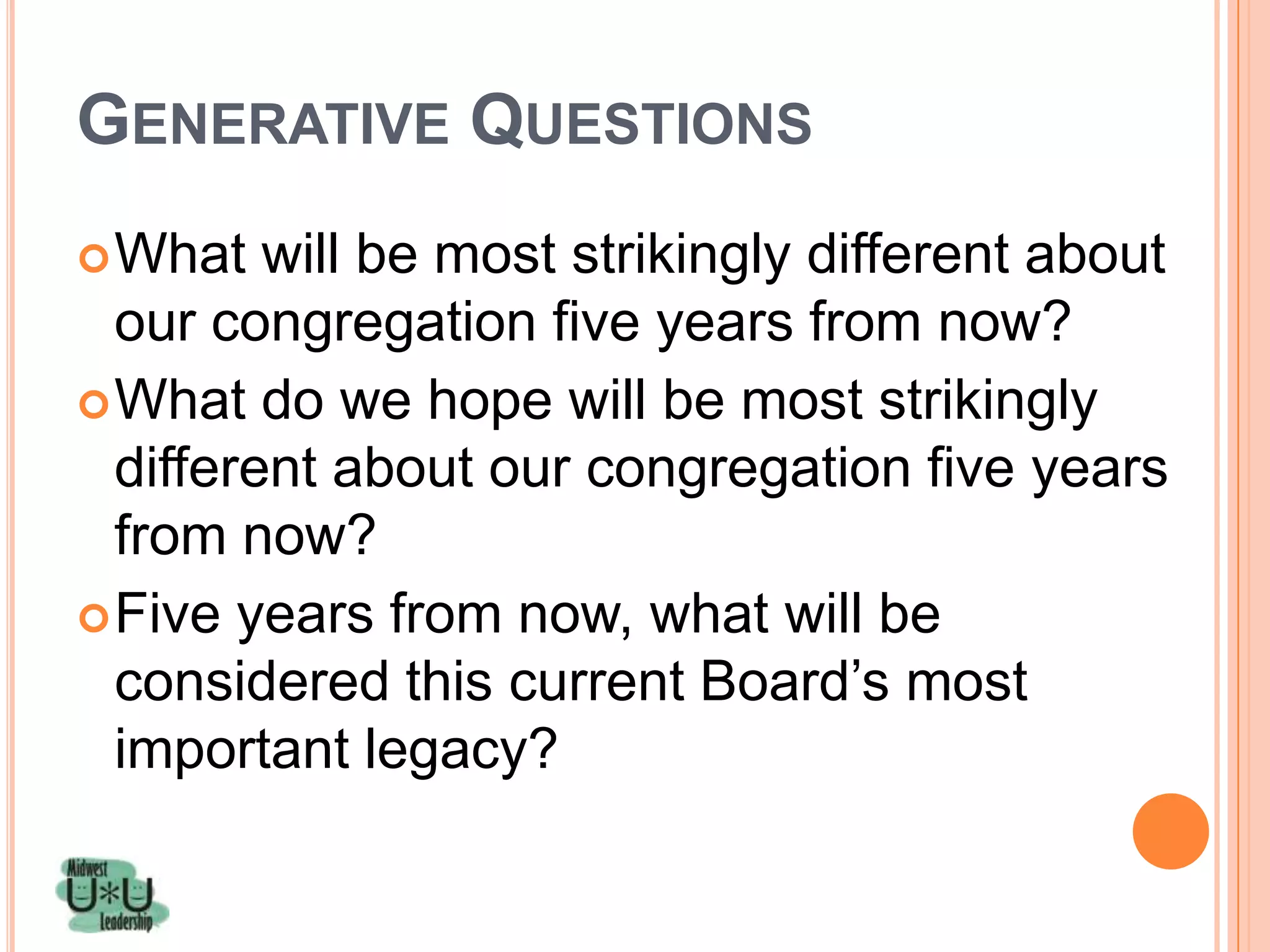
GENERATIVE QUESTIONS
 What   will be most strikingly different about
  our congregation five years from now?
 What do we hope will be most strikingly
  different about our congregation five years
  from now?
 Five years from now, what will be
  considered this current Board’s most
  important legacy?
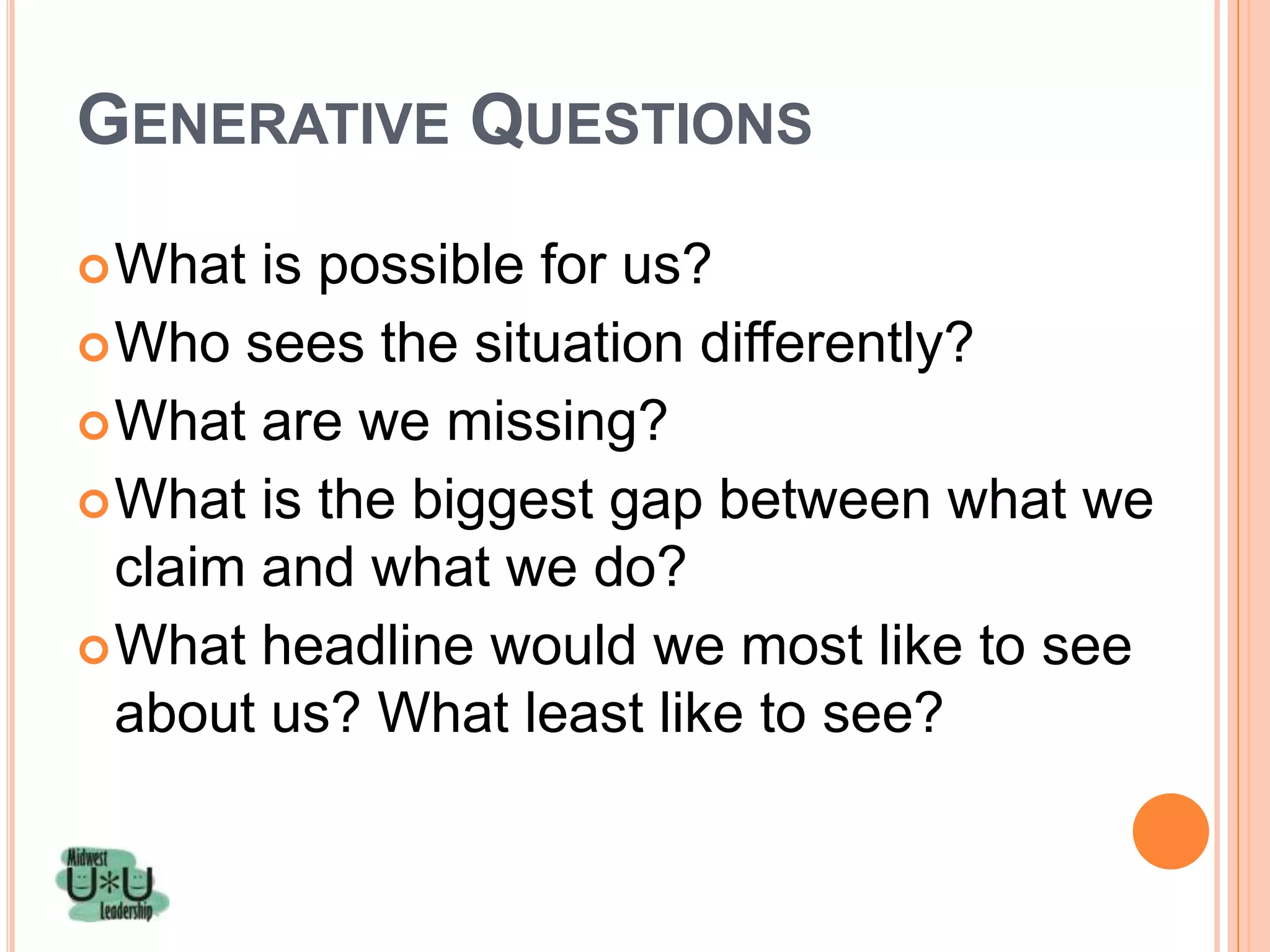
GENERATIVE QUESTIONS
 What  is possible for us?
 Who sees the situation differently?
 What are we missing?
 What is the biggest gap between what we
  claim and what we do?
 What headline would we most like to see
  about us? What least like to see?
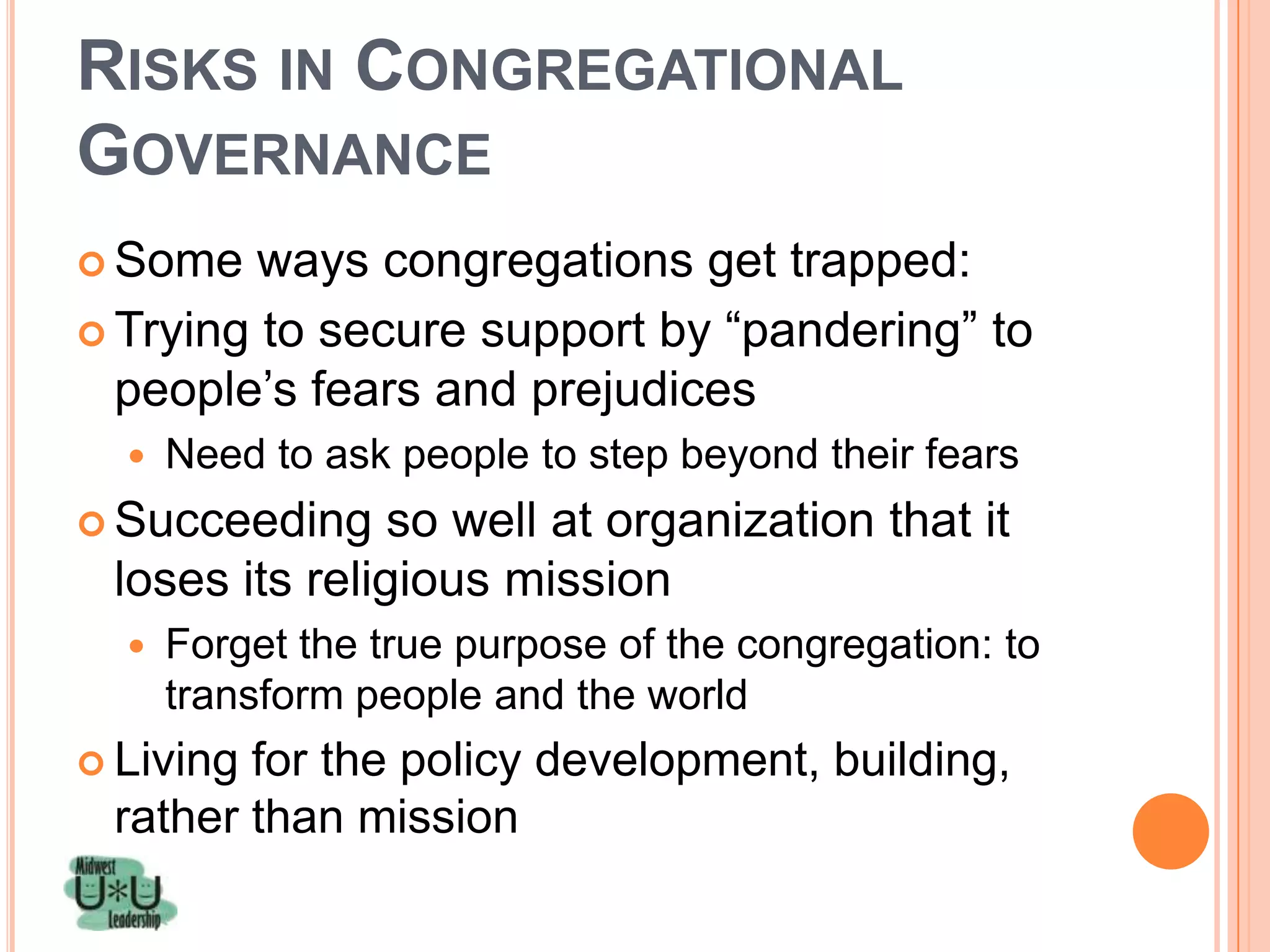
RISKS IN CONGREGATIONAL
GOVERNANCE
 Some   ways congregations get trapped:
 Trying to secure support by ―pandering‖ to
  people’s fears and prejudices
     Need to ask people to step beyond their fears
 Succeeding    so well at organization that it
 loses its religious mission
     Forget the true purpose of the congregation: to
      transform people and the world
 Livingfor the policy development, building,
 rather than mission
WHAT MAKES GOVERNANCE
WORK?
 No one right way for carrying out
 You are looking for:
     Unified structure for making governance
      decisions
          Mission, Vision, Evaluation
     Unified structure for making operational
      decisions
          Program, Staff, Volunteer Accountability
     Creative, open atmosphere for ministry and
      governance
          Transformation of people, the world
WHAT MAKES GOVERNANCE
WORK?
 Clarityabout job and job description
 Recruitment part of ongoing leadership
  development program
 Orientation of new members
   To the life of church, including physical plant
   To the Board and its operations (including
    history, policy, covenant, expectations)
 Regular evaluation of Board’s performance,
 including Board Member’s self-evaluation
ORIENTATION
 Orientation    to the position
     What are the expectations?
     What are the existing documents?
     What scope or limitations?
     Confidentiality conversation
 Orientation    to the congregation
     History, including relevant secrets
     Mission
     Tour of premises
EVALUATION
 Evaluation    of:
     Programs, practices, policies: are they
      the right ones for us now?
     Board performance: Are we doing our jobs,
      or someone else’s? Are we following our
      covenant of how we are working?
     Board members: How am I contributing? Am
      I showing up? Doing my part? Remaining
      open to the whole? Holding on to the past?
BECAUSE YOU ASK: WHAT KINDS OF
GOVERNANCE POLICIES?
There are four kinds of policy that Boards need:
 Discernment: all about mission, and how that’s
  determined
 Strategy: all about what things at what time; what
  are the major projects and when will they happen
 Management: ensuring that things run, and they run
  right, by delegating power and authority
  appropriately
 Oversight: ensuring that the resources of the
  congregation are properly safeguarded, managed,
  handled
RESOURCES


 Governance as Leadership: Reframing the Work of
  Nonprofit Boards, Richard P. Chait, William P. Ryan and
  Barbara E. Taylor; Wiley
 Governance and Ministry: Rethinking Board Leadership,
  Dan Hotchkiss; Alban Institute
 Congregational Leadership in Anxious Times: Being
  Calm and Courageous No Matter What, Peter L. Steinke,
  Alban Institute
 Leadership Without Easy Answers, Ronald A. Heifetz,
  Belknap Press of Harvard University Press

Board Responsibilities: Webinar January 2012

  • 1.
  • 2.
    BOARD RESPONSIBILITIES: WHAT ISA BOARD TO DO? Lisa Presley, District Executive, Heartland District, MidAmerica Region
  • 3.
    BROUGHT TO YOUBY MIDAMERICA REGION Central MidWest, Heartland and Prairie Star Districts
  • 4.
  • 5.
    THIS WEBINAR ISBEING RECORDED
  • 6.
    BOARD RESPONSIBILITIES: WHAT ISA BOARD TO DO? Lisa Presley, District Executive, Heartland District, MidAmerica Region
  • 7.
    WHAT IS ABOARD?  Body of people committed to the well-being of the congregation  Legal entity responsible for the congregation  First among equals  Granted powers of decision making by:  State/Commonwealth by law  Congregation through bylaws  Tradition and history
  • 8.
    JOBS OF BOARD Fiduciary  Duty of care, loyalty to mission, and obedience to foundational documents  Govern by Policy  Create the policies that will guide all four aspects of congregational life  Create policies that will articulate the ―separation of duties‖ and delegate responsibility and authority appropriately  Spend time on ―open questions‖  Who are we, where are we going, what is next
  • 9.
    WHAT IS ITRESPONSIBLE FOR?  Three separate (but related) obligations:  Fiduciary – duty of care  Strategic – duty of planning  Generative – duty of forward thinking Governance as Leadership
  • 10.
    FIDUCIARY RESPONSIBILITIES  Duty of loyalty and care for the congregation through:  Financial oversight to protect against waste, theft or misuse and ensure resources used effectively and efficiently  Mission oversight to make sure that congregation does not unintentionally drift or intentionally shift from its main mission/goals  Oversight to protect from foreseeable harm
  • 11.
    FIDUCIARY RESPONSIBILITIES  Not only legal imperatives but also moral and practical imperatives  Set the tone and tenor of how the congregation is, should be and could be  ―Trustee‖ holds assets for the benefit of another—Board members hold the congregation as a trust for future generations and for its mission  ―Technical‖ work, not adaptive—finding the best way to do what we know needs to be done, and has been done before by others
  • 12.
    FIDUCIARY QUESTIONS Do oursystems and procedures protect:  The congregation from financial loss or downturn?  The people from physical, psychological or spiritual harm?  Our children and other vulnerable adults from abuse?  Our buildings/campus from loss and destruction?  Us from being sued for things over which we should have control?
  • 13.
    STRATEGIC RESPONSIBILITIES  Shiftfrominternal review and oversight to looking at possibilities ―out there‖  How to get from Point A to Point B  Big picture of congregation’s future: look to internal strengths and weaknesses and align with external opportunities and threats  Look for where going, and what could be doing  Focusing on the next 3-5 years  Moving from ―technical‖ to ―adaptive‖ challenges, where there are no real concrete answers, but ambiguity and learning both exist
  • 14.
    STRATEGIC QUESTIONS  Who should we be 3-5 years from now?  What is our mission, and how do we achieve it?  What is our trajectory for the next 3-5 years?  What strengths, weaknesses, opportunities and threats exist outside of us?  How can we build for the future?  What is the Board’s role in moving the congregation forward?
  • 15.
    GENERATIVE RESPONSIBILITIES  Fiduciary & Strategic could be called management  Generative is ―leadership‖  What could we be, what else is possible?  Thinking outside of the box  Looking to meaning and enhancing the congregation’s value  Longer term vision—min. 5-10 years, and looking at the changing frame of society and religion  Pure ―adaptive‖ work—it exists in ambiguity and possibility and there’s no clear answer to any of the questions; a wide open field
  • 16.
    GENERATIVE QUESTIONS  What will be most strikingly different about our congregation five years from now?  What do we hope will be most strikingly different about our congregation five years from now?  Five years from now, what will be considered this current Board’s most important legacy?
  • 17.
    GENERATIVE QUESTIONS  What is possible for us?  Who sees the situation differently?  What are we missing?  What is the biggest gap between what we claim and what we do?  What headline would we most like to see about us? What least like to see?
  • 18.
    RISKS IN CONGREGATIONAL GOVERNANCE Some ways congregations get trapped:  Trying to secure support by ―pandering‖ to people’s fears and prejudices  Need to ask people to step beyond their fears  Succeeding so well at organization that it loses its religious mission  Forget the true purpose of the congregation: to transform people and the world  Livingfor the policy development, building, rather than mission
  • 19.
    WHAT MAKES GOVERNANCE WORK? No one right way for carrying out  You are looking for:  Unified structure for making governance decisions  Mission, Vision, Evaluation  Unified structure for making operational decisions  Program, Staff, Volunteer Accountability  Creative, open atmosphere for ministry and governance  Transformation of people, the world
  • 20.
    WHAT MAKES GOVERNANCE WORK? Clarityabout job and job description  Recruitment part of ongoing leadership development program  Orientation of new members  To the life of church, including physical plant  To the Board and its operations (including history, policy, covenant, expectations)  Regular evaluation of Board’s performance, including Board Member’s self-evaluation
  • 21.
    ORIENTATION  Orientation to the position  What are the expectations?  What are the existing documents?  What scope or limitations?  Confidentiality conversation  Orientation to the congregation  History, including relevant secrets  Mission  Tour of premises
  • 22.
    EVALUATION  Evaluation of:  Programs, practices, policies: are they the right ones for us now?  Board performance: Are we doing our jobs, or someone else’s? Are we following our covenant of how we are working?  Board members: How am I contributing? Am I showing up? Doing my part? Remaining open to the whole? Holding on to the past?
  • 23.
    BECAUSE YOU ASK:WHAT KINDS OF GOVERNANCE POLICIES? There are four kinds of policy that Boards need:  Discernment: all about mission, and how that’s determined  Strategy: all about what things at what time; what are the major projects and when will they happen  Management: ensuring that things run, and they run right, by delegating power and authority appropriately  Oversight: ensuring that the resources of the congregation are properly safeguarded, managed, handled
  • 24.
    RESOURCES  Governance asLeadership: Reframing the Work of Nonprofit Boards, Richard P. Chait, William P. Ryan and Barbara E. Taylor; Wiley  Governance and Ministry: Rethinking Board Leadership, Dan Hotchkiss; Alban Institute  Congregational Leadership in Anxious Times: Being Calm and Courageous No Matter What, Peter L. Steinke, Alban Institute  Leadership Without Easy Answers, Ronald A. Heifetz, Belknap Press of Harvard University Press