O
S
T
N
I
R
T
A
I
N
TO MALAYSIA
Kuala Lumpur exists as a National & Inter-
national Node. Formally a mining state, it
is now the very heart of Malaysia’s rapid
development.
TO KUALA LUMPUR
Located within the Kuala
Centre, Chow Kit is home
prostitutes and street chil
market in the heart of the
intersection of the different
M O R P H O L O G Y
1889 A.D
Tin mining sites were set up at the
confluence of Gombak River and
Klang River. The rivers are the neces-
sity for transportation & the tin min-
ing activity.
Urban pattern corresponds to the tin
mining site, scattered blocks were
built to accommodate the tin min-
ing workers. The activities transition
from tin mining to residential & com-
mercial with the increasing radius
from the tin mining site.
Unplanned development of the
town occurs according to necessity,
water.
1895 A.D.
As the mining activity advances,
the railway system was established
causing a transition of dependence
on river as a transportation system
to railway.
Road and rail systems took over the
functional importance of the rivers,
enabling urbanism to spread away
from the river. The river, instead, was
a recreational path in the city.
With the strong economic status, the
scattered worker quarters were re-
placed with bigger blocks. The city
started to transition into a business
and administrative centre accom-
modating the British Officials from a
tin mining zone.
1920 A.D.
As the city develops, big blocks
were cut apart to allow physical
permeability and visual connection
between streets.
As the price of land by the river in-
creases, higher plot ratios were al-
lowed, thus causing high rise build-
ings to emerge along the river,
changing the cityscape.
F I G U R E G R O U N D
U R B A N G R A I N
2017 A.D.
Currently, the city is densely filled
with mid to high rise buildings. Only
small portions of the heritage was
preserved, creating a diversity of
building scales as people transverse
into different zones.
Jalan TAR became one of the main
arterial road that links the different
district.
The rivers are also experiencing a
transition stage where authorities
are taking actions to bring back the
glory of the Klang river.
COURSE GRAIN
Lower physical permeability and higher hierachy
formed by large building footprints.
This grain cater only certain targeted user groups with
less public activities happening.
FINE GRAIN
Consist of smaller building foot prints which increases
negative spaces.
Negative spaces promotes more alternative routes
which lowers the hierachy which increase physical per-
meability.
Promotes more public activities and intimate spaces
The walkability contributes to high pedestrian flow.
COURSE GRAIN
Linear forms are a series of long building blocks along a
path, preferbly used for commercial purposes as they
are accessible from front and back. This built form also
act as connectivity from one place to another.
ENCLOSURE FORM
An enclosure form portrays strength and status back in
the colonial era as they provide a sense of guardance,
protecting the inner form which are usually open space
of plazas.
POINT FORM
High-rise buildings are built for private funcitions, target-
ting only certain groups of user. Thus, point form rep-
resents a single building configuration embodying the
status and power of the company.
T Y P O L O G Y
S I T E
1. Different spatial experience from one point to another.
group indi
a Lumpur City
to immigrants,
dren. The wet
e district is the
t communities.
TO CHOW KIT
The foundation in which the city was built,
Jalan TAR area is presently a major dis-
trict where local and corporate business-
es mix. The transition on different streets
parallel to Jalan TAR creates a diverse
experience from every direction.
TO JALAN TAR
The site sits alongside the street’s most val-
ued local landmark, The Coliseum Cafe.
Located at the transition of a shopping
street and the national heritage zone, it
welcomes different communities in the
area.
H I S T O R I C A L T I M E L I N E
L E G I B I L I T YE I N C O N T E X T
MORPHOLOGICAL
The serial vision shows the morphological transition of build-
ings scale. As the time goes by the urban sprawl expand
from the micro site toward to the macro site, which causes
the concentration of high rises and development in Jalan
TAR is lower.
MORPHOLOGICAL
SOCIAL
FUNCTIONAL
FUNCTIONAL
Movement is fundamental to understanding how places
function. Pedestrian flows through public space where peo-
ple will stop by and linger around. The openness of a space
would affect the interaction varies among individuals which
are related to the life and activity within the space.
SOCIAL
Due to the urban development that causes a fall out of in-
ner ciy crisis which is the homeless people transitioning of
healthy eco level of locals, immigrant workers, and tourists
cause by the heritage interface.
D I S T R I C T S
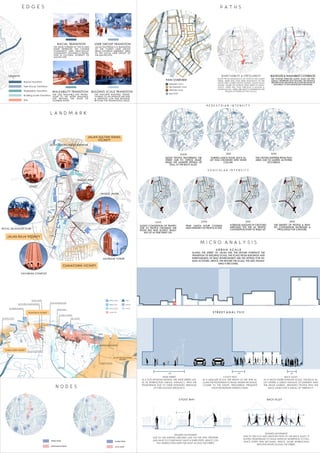
E D G E S
L A N D M A R K
N O D E S
P A T H S
P E D E S T R I A N I N T E N S I T Y
V E H I C U L A R I N T E N S I T Y
9AM 12PM 3PM 5PM
SEARCHABILITY & STROLLABILITY
ROUTE FROM BANDARAYA LRT STATION HAS LESSER
TURNS. USERS WILL PASS WIDE WALKWAYS OF THE
SHOPS WITH LOWER PEOPLE DENSITY. ROUTE FROM
MASJID JAMEK LRT STATION TAKE USERS TO SMALL
ALLEYS. USERS WILL PASS THROUGH A BAZAAR &
PASAR MALAM, USERS ARE ABLE TO EXPERIENCE THE
HUMAN ACTIVITIES OF THE LOCALS.
BUS STATIONS STRETCHES ALONG JALAN TAR WITH
EQUALLY DISTRIBUTED STOP SPACING. THE DISTANCE
BETWEEN STOPS ARE WITHIN THE COMFORT RANGE OF
WALKABILITY TO ENCOURAGE BUS PATRONAGE.
BUS ROUTE & WALKABILITY COVERAGE
PATH OVERVIEW
SLIGHT CONGESTION OF TRAFFIC
DUE TO PEOPLE CROSSING THE
ROAD BUT WAS SLOWLY BUILD-
ING UP AS TIME WENT ON.
10AM 3PM 9PM
SLIGHT PEOPLE TRAVERSING THE
STREET DUE TO OFFICE HOUR,
WHILE THE HAWKER SETTING UP
STALL AT THE BACK ALLEY.
DURING LUNCH HOUR, BACK AL-
LEY WAS CROWDED WITH WHITE
COLLAR.
THE CROWD DISPERSE FROM THAT
AREA DUE TO LIMITED ACTIVITIES
OCCURING.
PEAK LUNCH HOUR CAUSING
HIGH INTENSITY OF PEOPLE AT SITE.
AVERAGE AMOUNT OF CROOWD
ARROUND THE SITE AS TRAFFIC
CONGESTION START TO BUILD UP.
THE DENSITY OF PEOPLE & TRAF-
FIC CONGESTION INCREASES &
PROLONGS FOR 2.5HOURS.
M I C R O A N A L Y S I S
U R B A N S C A L E
ALONG THE STREET OF JALAN TAR, THE SKYLINE PORTRAYS THE
TRANSITION OF BUILDING SCALE. THE SCALE FROM BUILDINGS AND
SURROUNDING OF BUILT ENVIRONMENT ARE THE SETTING FOR HU-
MAN ACTIVITIES. HENCE, THE BIGGER THE SCALE, THE LESS HUMAN-
ISING IT BECOMES.
S T R E E T A N A L Y S I S
WIDE STREET
IN A TOO SPATIOUS SETTING, THE WIDE STREET LOS-
ES ITS INTERACTION HENCE, INTIMACY, WITH THE
PEDESTRIANS DUE TO THEIR EXTENDED FREEDOM
OF CIRCULATION AROUND IT.
SEAMED MOVEMENT
DUE TO THE UNEVEN GROUND LAID ON THE 5FW, PEDESTRI-
ANS HAVE TO CONSTANTLY WATCH THEIR STEPS. HENCE, LOS-
ING INTERACTION WITH THE SHOP ALONG THE STREET.
SEAMED MOVEMENT
DUE TO THE FLAT AND SMOOTH PATH OF THE BACK ALLEY, IT
INVITES PEDESTRIANS TO WALK WITHOUT WORRYING TO FALL
ONCE EVERY FEW SECONDS. HENCE, MORE INTERACTION
WITH THE SHOPS ALONG THE STREET.
5 FOOT WAY
IN A SMALLER SCALE, THE WIDTH OF THE 5FW AL-
LOWS THE PEDESTRIAN TO WALK UNDER THE SHADE,
CLOSER TO THE SHOPS, TRIGGERING FREQUENT
SHOP-PEDESTRIAN INTERACTIONS.
BACK ALLEY
AT A MUCH MORE INTIMATE SCALE, THE BACK AL-
LEY OFFERS A GREAT AMOUNT OF DIVERSITY WITH
THE NIGHT MARKET, DRAWING PEOPLE INTO THE
BACK LANES FOR A STROLL OF VIBRANCY.
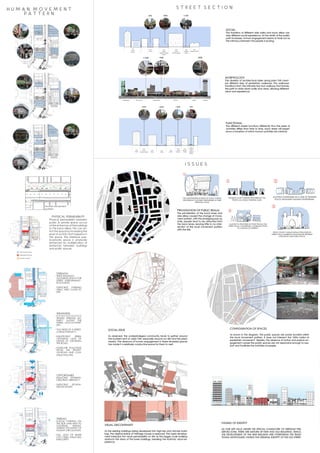
PHYSICAL PERMEABILITY
Physical permeability between
public & private space occurs
at the entrances of the buildings
to the back alleys. This can en-
rich the space by increasing the
level of activity that happens in
the space. The interface pub-
lic/private space is physically
enhanced by multiplication of
entrances between buildings
and public spaces.
H U M A N M O V E M E N T
P A T T E R N
S T R E E T S E C T I O N
I S S U E S
SOCIAL
The transition of different side walks and back alleys cre-
ates different social experience. As the width of the public
path increases, human engagement seems to fade out as
the intimacy between the people is lacking.
MORPHOLOGY
The diversity of architectural styles along jalan TAR creat-
ed different sizes of pedestrian walkways. the walkways
transitions from the intimate five foot walkway that frames
the path to wide urban walks vice versa, allowing different
views and experience.
FUNCTIONAL
The different streets functions differently thus the peak of
activities differs from time to time. each street will experi-
ence a transition of which human activities are minimal.
Human movement
pattern
STRENGH
WIDE WALKWAY,
ALLOWING SPACE FOR
STREET PERFORMANC-
ES & EVENTS.
SUFFICIENT PARKING
AREA, VERY CLOSE TO
SITE.
-
-
WEAKNESS
H O M O G E N E O U S
TRADES SPREADS LIN-
EARLY ALONG THE
STREET, LACK IN DIVER-
SITY.
TOO WIDE OF A STREET,
LOSING INTIMACY.
INSUFFICIENT ZEBRA
CROSSING, LACK OF
MEANS IN CROSSING
THE ROAD.
NOISE/AIR POLLUTION
FROM THE TRAFFIC
ON-ROAD AND CON-
STRUCTION SITE.
-
-
-
-
OPPORTUNIES
INDUCING DIVERSITY,
CREATING VIBRANCY.
SUFFICIENT SPONTA-
NEOUS NODES
-
-
THREAD
ILLEGAL PARKING ON
THE SIDE LANE NEXT TO
COLISEUM, ENDAN-
GERING THE SAFETY OF
HUMAN CIRCULATION.
FALL OUTS OF INNER
CITY CRISIS, INDUCING
INSECURITY.
-
-
PRIVATIZATION OF PUBLIC REALM
The privatization of the back lanes and
side alleys caused the change of move-
ment pattern. with the emeriging pop up
stolls, people tend to be attracted intot
the back lanes, leaving little to no inter-
section of the local movement pattern
with the site.
VISUAL DISCONTINUITY
As the existing buildings being developed into high-rise and mid-rise build-
ings, the original skyline of heritage houses is replaced. The rapid develop-
ment interrupts the visual permeability on site as the bigger scale building
obstructs the views of the lower buildings, breaking the rhythmic visual ex-
perience.
FADING OF IDENTITY
AS OUR SITE FALLS UNDER THE SPECIAL CHARACTER OF HERITAGE PRE-
SERVED ZONE, THERE ARE MIXTURE OF NEW AND OLD BUILDINGS. HENCE,
THE DEVELOPMENT OF THE NEW BUILDING ARE OVERTAKING THE TRADI-
TIONAL SHOPHOUSES, FADING THE ORIGINAL IDENTITY OF THE OLD STREET.
SOCIAL ISSUE
As observed, the underprivileged community tends to gather around
the southern end of Jalan TAR, especially around our site and the plaza
nearby. The absence of human engagement in these recessed spaces
has made it a relatively conductive space for them to nest.
CONFIGURATION OF SPACES
As shown in the diagram, the public spaces are poorly located within
the local movement pattern, it does not intersect the 100m radius of
pedestrain mavement. Besides, the absence of active and passive en-
gagement causes the public spaces are not responsive enough to sup-
port and facilitate the activities of people.
C O N C L U S I O N
WIDE STREET
- SPATIOUS, UNACTRACTIVE, NOISY
VEHICLE
Conclusion
The width of the street lower the densi-
ty of interaction between the pedestrian
and the shop as there is enough space for
the pedestrian to keep at least 12 feet with
other peoples.
FIVE FOOT WALKWAY
- NARROW BUT COMFY, DIFFERENT
IN LEVELS
Conclusion
Humanizing scale of the 5 foot way is wel-
coming and serve as a shelter space for
circulation. It functions as a void between the
street and the shops where different forms
of interaction and communication take place
BACK ALLEY
- NARROW AND INTIMATE, SLOW
MOVEMENT, SOUND OF HUMAN
VOICES. SMELLS OF FOOD.
Conclusion
Back alleys considered as friendly urban
space as it portrays the true daily life of
the neighborhood where constant interac-
tion and intimate contact often occurs within
the gap
People cross the
road despite no
zebra line was
drawn on the floor
due to little or slow
traffic movement.
P R O P O S A L

Board

  • 1.
    O S T N I R T A I N TO MALAYSIA Kuala Lumpurexists as a National & Inter- national Node. Formally a mining state, it is now the very heart of Malaysia’s rapid development. TO KUALA LUMPUR Located within the Kuala Centre, Chow Kit is home prostitutes and street chil market in the heart of the intersection of the different M O R P H O L O G Y 1889 A.D Tin mining sites were set up at the confluence of Gombak River and Klang River. The rivers are the neces- sity for transportation & the tin min- ing activity. Urban pattern corresponds to the tin mining site, scattered blocks were built to accommodate the tin min- ing workers. The activities transition from tin mining to residential & com- mercial with the increasing radius from the tin mining site. Unplanned development of the town occurs according to necessity, water. 1895 A.D. As the mining activity advances, the railway system was established causing a transition of dependence on river as a transportation system to railway. Road and rail systems took over the functional importance of the rivers, enabling urbanism to spread away from the river. The river, instead, was a recreational path in the city. With the strong economic status, the scattered worker quarters were re- placed with bigger blocks. The city started to transition into a business and administrative centre accom- modating the British Officials from a tin mining zone. 1920 A.D. As the city develops, big blocks were cut apart to allow physical permeability and visual connection between streets. As the price of land by the river in- creases, higher plot ratios were al- lowed, thus causing high rise build- ings to emerge along the river, changing the cityscape. F I G U R E G R O U N D U R B A N G R A I N 2017 A.D. Currently, the city is densely filled with mid to high rise buildings. Only small portions of the heritage was preserved, creating a diversity of building scales as people transverse into different zones. Jalan TAR became one of the main arterial road that links the different district. The rivers are also experiencing a transition stage where authorities are taking actions to bring back the glory of the Klang river. COURSE GRAIN Lower physical permeability and higher hierachy formed by large building footprints. This grain cater only certain targeted user groups with less public activities happening. FINE GRAIN Consist of smaller building foot prints which increases negative spaces. Negative spaces promotes more alternative routes which lowers the hierachy which increase physical per- meability. Promotes more public activities and intimate spaces The walkability contributes to high pedestrian flow. COURSE GRAIN Linear forms are a series of long building blocks along a path, preferbly used for commercial purposes as they are accessible from front and back. This built form also act as connectivity from one place to another. ENCLOSURE FORM An enclosure form portrays strength and status back in the colonial era as they provide a sense of guardance, protecting the inner form which are usually open space of plazas. POINT FORM High-rise buildings are built for private funcitions, target- ting only certain groups of user. Thus, point form rep- resents a single building configuration embodying the status and power of the company. T Y P O L O G Y S I T E 1. Different spatial experience from one point to another. group indi
  • 2.
    a Lumpur City toimmigrants, dren. The wet e district is the t communities. TO CHOW KIT The foundation in which the city was built, Jalan TAR area is presently a major dis- trict where local and corporate business- es mix. The transition on different streets parallel to Jalan TAR creates a diverse experience from every direction. TO JALAN TAR The site sits alongside the street’s most val- ued local landmark, The Coliseum Cafe. Located at the transition of a shopping street and the national heritage zone, it welcomes different communities in the area. H I S T O R I C A L T I M E L I N E L E G I B I L I T YE I N C O N T E X T MORPHOLOGICAL The serial vision shows the morphological transition of build- ings scale. As the time goes by the urban sprawl expand from the micro site toward to the macro site, which causes the concentration of high rises and development in Jalan TAR is lower. MORPHOLOGICAL SOCIAL FUNCTIONAL FUNCTIONAL Movement is fundamental to understanding how places function. Pedestrian flows through public space where peo- ple will stop by and linger around. The openness of a space would affect the interaction varies among individuals which are related to the life and activity within the space. SOCIAL Due to the urban development that causes a fall out of in- ner ciy crisis which is the homeless people transitioning of healthy eco level of locals, immigrant workers, and tourists cause by the heritage interface. D I S T R I C T S
  • 3.
    E D GE S L A N D M A R K N O D E S P A T H S P E D E S T R I A N I N T E N S I T Y V E H I C U L A R I N T E N S I T Y 9AM 12PM 3PM 5PM SEARCHABILITY & STROLLABILITY ROUTE FROM BANDARAYA LRT STATION HAS LESSER TURNS. USERS WILL PASS WIDE WALKWAYS OF THE SHOPS WITH LOWER PEOPLE DENSITY. ROUTE FROM MASJID JAMEK LRT STATION TAKE USERS TO SMALL ALLEYS. USERS WILL PASS THROUGH A BAZAAR & PASAR MALAM, USERS ARE ABLE TO EXPERIENCE THE HUMAN ACTIVITIES OF THE LOCALS. BUS STATIONS STRETCHES ALONG JALAN TAR WITH EQUALLY DISTRIBUTED STOP SPACING. THE DISTANCE BETWEEN STOPS ARE WITHIN THE COMFORT RANGE OF WALKABILITY TO ENCOURAGE BUS PATRONAGE. BUS ROUTE & WALKABILITY COVERAGE PATH OVERVIEW SLIGHT CONGESTION OF TRAFFIC DUE TO PEOPLE CROSSING THE ROAD BUT WAS SLOWLY BUILD- ING UP AS TIME WENT ON. 10AM 3PM 9PM SLIGHT PEOPLE TRAVERSING THE STREET DUE TO OFFICE HOUR, WHILE THE HAWKER SETTING UP STALL AT THE BACK ALLEY. DURING LUNCH HOUR, BACK AL- LEY WAS CROWDED WITH WHITE COLLAR. THE CROWD DISPERSE FROM THAT AREA DUE TO LIMITED ACTIVITIES OCCURING. PEAK LUNCH HOUR CAUSING HIGH INTENSITY OF PEOPLE AT SITE. AVERAGE AMOUNT OF CROOWD ARROUND THE SITE AS TRAFFIC CONGESTION START TO BUILD UP. THE DENSITY OF PEOPLE & TRAF- FIC CONGESTION INCREASES & PROLONGS FOR 2.5HOURS. M I C R O A N A L Y S I S U R B A N S C A L E ALONG THE STREET OF JALAN TAR, THE SKYLINE PORTRAYS THE TRANSITION OF BUILDING SCALE. THE SCALE FROM BUILDINGS AND SURROUNDING OF BUILT ENVIRONMENT ARE THE SETTING FOR HU- MAN ACTIVITIES. HENCE, THE BIGGER THE SCALE, THE LESS HUMAN- ISING IT BECOMES. S T R E E T A N A L Y S I S WIDE STREET IN A TOO SPATIOUS SETTING, THE WIDE STREET LOS- ES ITS INTERACTION HENCE, INTIMACY, WITH THE PEDESTRIANS DUE TO THEIR EXTENDED FREEDOM OF CIRCULATION AROUND IT. SEAMED MOVEMENT DUE TO THE UNEVEN GROUND LAID ON THE 5FW, PEDESTRI- ANS HAVE TO CONSTANTLY WATCH THEIR STEPS. HENCE, LOS- ING INTERACTION WITH THE SHOP ALONG THE STREET. SEAMED MOVEMENT DUE TO THE FLAT AND SMOOTH PATH OF THE BACK ALLEY, IT INVITES PEDESTRIANS TO WALK WITHOUT WORRYING TO FALL ONCE EVERY FEW SECONDS. HENCE, MORE INTERACTION WITH THE SHOPS ALONG THE STREET. 5 FOOT WAY IN A SMALLER SCALE, THE WIDTH OF THE 5FW AL- LOWS THE PEDESTRIAN TO WALK UNDER THE SHADE, CLOSER TO THE SHOPS, TRIGGERING FREQUENT SHOP-PEDESTRIAN INTERACTIONS. BACK ALLEY AT A MUCH MORE INTIMATE SCALE, THE BACK AL- LEY OFFERS A GREAT AMOUNT OF DIVERSITY WITH THE NIGHT MARKET, DRAWING PEOPLE INTO THE BACK LANES FOR A STROLL OF VIBRANCY.
  • 4.
    PHYSICAL PERMEABILITY Physical permeabilitybetween public & private space occurs at the entrances of the buildings to the back alleys. This can en- rich the space by increasing the level of activity that happens in the space. The interface pub- lic/private space is physically enhanced by multiplication of entrances between buildings and public spaces. H U M A N M O V E M E N T P A T T E R N S T R E E T S E C T I O N I S S U E S SOCIAL The transition of different side walks and back alleys cre- ates different social experience. As the width of the public path increases, human engagement seems to fade out as the intimacy between the people is lacking. MORPHOLOGY The diversity of architectural styles along jalan TAR creat- ed different sizes of pedestrian walkways. the walkways transitions from the intimate five foot walkway that frames the path to wide urban walks vice versa, allowing different views and experience. FUNCTIONAL The different streets functions differently thus the peak of activities differs from time to time. each street will experi- ence a transition of which human activities are minimal. Human movement pattern STRENGH WIDE WALKWAY, ALLOWING SPACE FOR STREET PERFORMANC- ES & EVENTS. SUFFICIENT PARKING AREA, VERY CLOSE TO SITE. - - WEAKNESS H O M O G E N E O U S TRADES SPREADS LIN- EARLY ALONG THE STREET, LACK IN DIVER- SITY. TOO WIDE OF A STREET, LOSING INTIMACY. INSUFFICIENT ZEBRA CROSSING, LACK OF MEANS IN CROSSING THE ROAD. NOISE/AIR POLLUTION FROM THE TRAFFIC ON-ROAD AND CON- STRUCTION SITE. - - - - OPPORTUNIES INDUCING DIVERSITY, CREATING VIBRANCY. SUFFICIENT SPONTA- NEOUS NODES - - THREAD ILLEGAL PARKING ON THE SIDE LANE NEXT TO COLISEUM, ENDAN- GERING THE SAFETY OF HUMAN CIRCULATION. FALL OUTS OF INNER CITY CRISIS, INDUCING INSECURITY. - - PRIVATIZATION OF PUBLIC REALM The privatization of the back lanes and side alleys caused the change of move- ment pattern. with the emeriging pop up stolls, people tend to be attracted intot the back lanes, leaving little to no inter- section of the local movement pattern with the site. VISUAL DISCONTINUITY As the existing buildings being developed into high-rise and mid-rise build- ings, the original skyline of heritage houses is replaced. The rapid develop- ment interrupts the visual permeability on site as the bigger scale building obstructs the views of the lower buildings, breaking the rhythmic visual ex- perience. FADING OF IDENTITY AS OUR SITE FALLS UNDER THE SPECIAL CHARACTER OF HERITAGE PRE- SERVED ZONE, THERE ARE MIXTURE OF NEW AND OLD BUILDINGS. HENCE, THE DEVELOPMENT OF THE NEW BUILDING ARE OVERTAKING THE TRADI- TIONAL SHOPHOUSES, FADING THE ORIGINAL IDENTITY OF THE OLD STREET. SOCIAL ISSUE As observed, the underprivileged community tends to gather around the southern end of Jalan TAR, especially around our site and the plaza nearby. The absence of human engagement in these recessed spaces has made it a relatively conductive space for them to nest. CONFIGURATION OF SPACES As shown in the diagram, the public spaces are poorly located within the local movement pattern, it does not intersect the 100m radius of pedestrain mavement. Besides, the absence of active and passive en- gagement causes the public spaces are not responsive enough to sup- port and facilitate the activities of people.
  • 5.
    C O NC L U S I O N WIDE STREET - SPATIOUS, UNACTRACTIVE, NOISY VEHICLE Conclusion The width of the street lower the densi- ty of interaction between the pedestrian and the shop as there is enough space for the pedestrian to keep at least 12 feet with other peoples. FIVE FOOT WALKWAY - NARROW BUT COMFY, DIFFERENT IN LEVELS Conclusion Humanizing scale of the 5 foot way is wel- coming and serve as a shelter space for circulation. It functions as a void between the street and the shops where different forms of interaction and communication take place BACK ALLEY - NARROW AND INTIMATE, SLOW MOVEMENT, SOUND OF HUMAN VOICES. SMELLS OF FOOD. Conclusion Back alleys considered as friendly urban space as it portrays the true daily life of the neighborhood where constant interac- tion and intimate contact often occurs within the gap People cross the road despite no zebra line was drawn on the floor due to little or slow traffic movement. P R O P O S A L