BMW factory in China
Efficiency & Ability to React Quickly
“The ability to react quickly and increase or decrease production for various markets was a major factor for BMW
North America in turning the recession year 2008 into the highest production volume year ever in its history.”
In the past five years, the plant had lowered energy
consumption by 48%, halved water consumption, reduced CO2
emissions by 44%, and waste output by 65%.16
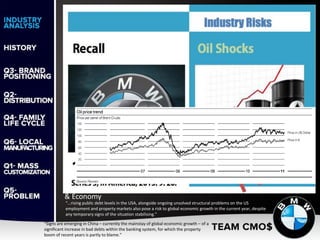
& Economy
“…rising public debt levels in the USA, alongside ongoing unsolved structural problems on the US
employment and property markets also pose a risk to global economic growth in the current year, despite
any temporary signs of the situation stabilising.”
“Signs are emerging in China – currently the mainstay of global economic growth – of a
significant increase in bad debts within the banking system, for which the property
boom of recent years is partly to blame.”
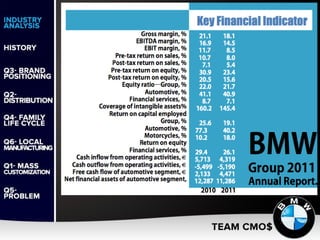
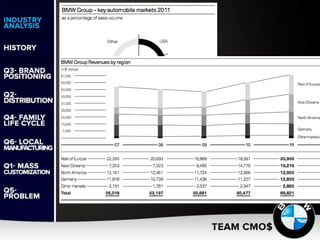
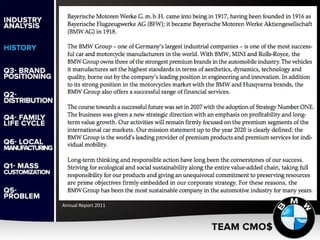
Annual Report 2011
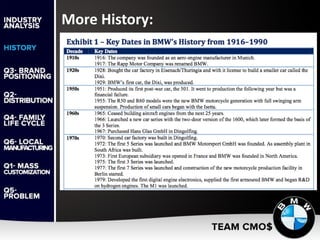
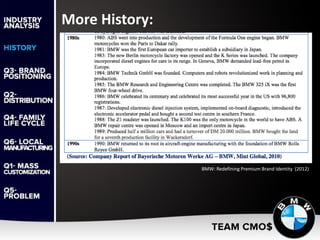
More History:
More History:
BMW: Redefining Premium Brand Identity (2012)
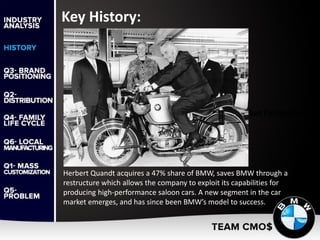
Key History:
Herbert Quandt acquires a 47% share of BMW, saves BMW through a
restructure which allows the company to exploit its capabilities for
producing high-performance saloon cars. A new segment in the car
market emerges, and has since been BMW’s model to success.
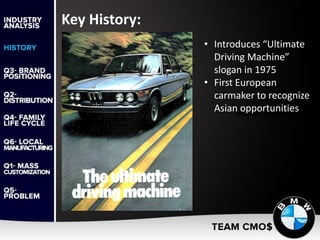
Key History:
• Introduces “Ultimate
Driving Machine”
slogan in 1975
• First European
carmaker to recognize
Asian opportunities
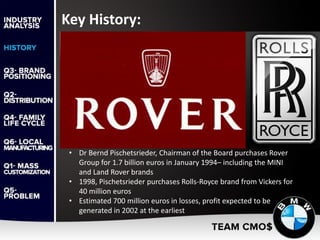
Key History:
• Dr Bernd Pischetsrieder, Chairman of the Board purchases Rover
Group for 1.7 billion euros in January 1994– including the MINI
and Land Rover brands
• 1998, Pischetsrieder purchases Rolls-Royce brand from Vickers for
40 million euros
• Estimated 700 million euros in losses, profit expected to be
generated in 2002 at the earliest
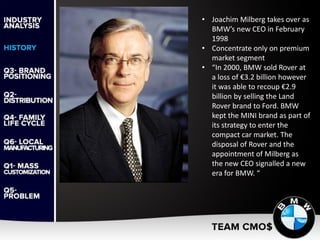
• Joachim Milberg takes over as
BMW’s new CEO in February
1998
• Concentrate only on premium
market segment
• “In 2000, BMW sold Rover at
a loss of €3.2 billion however
it was able to recoup €2.9
billion by selling the Land
Rover brand to Ford. BMW
kept the MINI brand as part of
its strategy to enter the
compact car market. The
disposal of Rover and the
appointment of Milberg as
the new CEO signalled a new
era for BMW. “
Milberg’s strategy:
Concentrating only on the premium segments of the automobile
market.
Creating a demanding product and market offensive in the premium
segments, ensuring
that the brand is represented in all relevant parts of the market.
The appropriate expansion of the production and sales network.
The agility of the overall company with quick reactions and
innovations.
Cooperation and networks using external resources through strategic
partnerships rather
than mergers.
A new style of leadership and guidance oriented.
Profitable growth.
“The sale of Rover and Milberg’s premium brand strategy brought about
an increase in profits of more than 400% in 2002 compared to 1999,
despite the economic downturn in both Germany and the US”
BMW: Redefining Premium Brand Identity (2012)
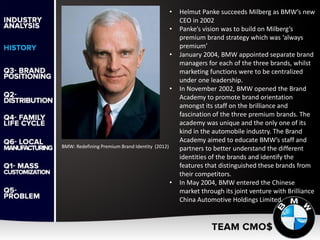
• Helmut Panke succeeds Milberg as BMW’s new
CEO in 2002
• Panke’s vision was to build on Milberg’s
premium brand strategy which was ‘always
premium’
• January 2004, BMW appointed separate brand
managers for each of the three brands, whilst
marketing functions were to be centralized
under one leadership.
• In November 2002, BMW opened the Brand
Academy to promote brand orientation
amongst its staff on the brilliance and
fascination of the three premium brands. The
academy was unique and the only one of its
kind in the automobile industry. The Brand
Academy aimed to educate BMW’s staff and
partners to better understand the different
identities of the brands and identify the
features that distinguished these brands from
their competitors.
• In May 2004, BMW entered the Chinese
market through its joint venture with Brilliance
China Automotive Holdings Limited.
BMW: Redefining Premium Brand Identity (2012)
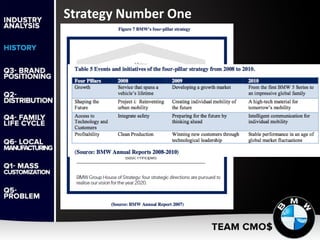
Strategy Number One
3. What are the different brand positioning strategies of BMW's main competitors? [You may
analyze slogans, advertisements, company homepage, etc.] In particular, carry out a detailed
comparison between BMW and Audi.
3. What are the different brand positioning strategies of BMW's main competitors? [You may
analyze slogans, advertisements, company homepage, etc.] In particular, carry out a detailed
comparison between BMW and Audi.
3. What are the different brand positioning strategies of BMW's main competitors? [You may
analyze slogans, advertisements, company homepage, etc.] In particular, carry out a detailed
comparison between BMW and Audi.
3. What are the different brand positioning strategies of BMW's main competitors? [You may
analyze slogans, advertisements, company homepage, etc.] In particular, carry out a detailed
comparison between BMW and Audi.
http://www.interbrand.com/en/best-global-brands/2012/BMW
3. What are the different brand positioning strategies of BMW's main competitors? [You may
analyze slogans, advertisements, company homepage, etc.] In particular, carry out a detailed
comparison between BMW and Audi.
Film Product Placement BMW Brand Academy
BMW Performance Driving
School
3. What are the different brand positioning strategies of BMW's main competitors? [You may
analyze slogans, advertisements, company homepage, etc.] In particular, carry out a detailed
comparison between BMW and Audi.
Competitors
BMW Audi
3. What are the different brand positioning strategies of BMW's main competitors? [You may
analyze slogans, advertisements, company homepage, etc.] In particular, carry out a detailed
comparison between BMW and Audi.
3. What are the different brand positioning strategies of BMW's main competitors? [You may
analyze slogans, advertisements, company homepage, etc.] In particular, carry out a detailed
comparison between BMW and Audi.
Audi.com
3. What are the different brand positioning strategies of BMW's main competitors? [You may
analyze slogans, advertisements, company homepage, etc.] In particular, carry out a detailed
comparison between BMW and Audi.
Audi - brand management driven success Michael Renz, Head of Central Marketing AUDI AG
3. What are the different brand positioning strategies of BMW's main competitors? [You may
analyze slogans, advertisements, company homepage, etc.] In particular, carry out a detailed
comparison between BMW and Audi.
Audi - brand management driven success Michael Renz, Head of Central Marketing AUDI AG
3. What are the different brand positioning strategies of BMW's main competitors? [You may
analyze slogans, advertisements, company homepage, etc.] In particular, carry out a detailed
comparison between BMW and Audi.
Audi - brand management driven success Michael Renz, Head of Central Marketing AUDI AG
3. What are the different brand positioning strategies of BMW's main competitors? [You may
analyze slogans, advertisements, company homepage, etc.] In particular, carry out a detailed
comparison between BMW and Audi.
Fair Competition: BMW vs Audi, WIPO-US
BMW AUDI
“Sheer driving pleasure Advantage through Technology
Joy of driving Truth in Engineering
The Ultimate Driving Machine Truth in Motion
Cultural insight Green Police
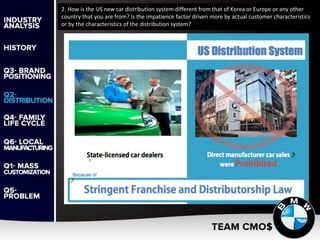
2. How is the US new car distribution system different from that of Korea or Europe or any other
country that you are from? Is the impatience factor driven more by actual customer characteristics
or by the characteristics of the distribution system?
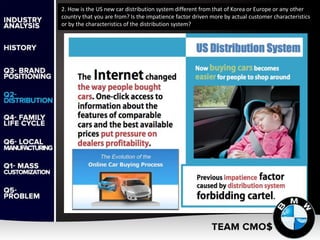
2. How is the US new car distribution system different from that of Korea or Europe or any other
country that you are from? Is the impatience factor driven more by actual customer characteristics
or by the characteristics of the distribution system?
4. How is the purchase for a specific model type (e.g., compact car, minivan etc.) affected by the
family life cycle (single, married w/ young children, married w/ teenage children, empty nest,
retired seniors)? Towards which segment is the X3 targeted to?
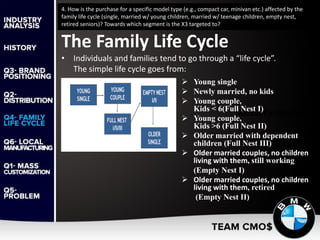
The Family Life Cycle
• Individuals and families tend to go through a “life cycle”.
The simple life cycle goes from:
 Young single
 Newly married, no kids
 Young couple,
Kids < 6(Full Nest I)
 Young couple,
Kids >6 (Full Nest II)
 Older married with dependent
children (Full Nest III)
 Older married couples, no children
living with them, still working
(Empty Nest I)
 Older married couples, no children
living with them, retired
(Empty Nest II)
4. How is the purchase for a specific model type (e.g., compact car, minivan etc.) affected by the
family life cycle (single, married w/ young children, married w/ teenage children, empty nest,
retired seniors)? Towards which segment is the X3 targeted to?
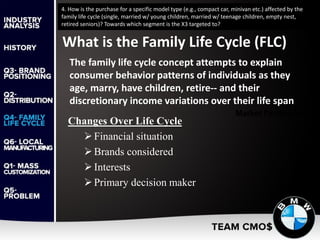
What is the Family Life Cycle (FLC)
Changes Over Life Cycle
Financial situation
Brands considered
Interests
Primary decision maker
The family life cycle concept attempts to explain
consumer behavior patterns of individuals as they
age, marry, have children, retire-- and their
discretionary income variations over their life span
4. How is the purchase for a specific model type (e.g., compact car, minivan etc.) affected by the
family life cycle (single, married w/ young children, married w/ teenage children, empty nest,
retired seniors)? Towards which segment is the X3 targeted to?
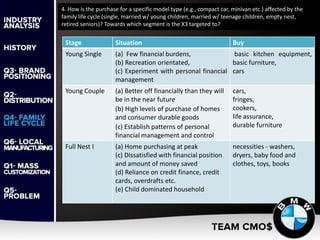
Stage Situation Buy
Young Single (a) Few financial burdens,
(b) Recreation orientated,
(c) Experiment with personal financial
management
basic kitchen equipment,
basic furniture,
cars
Young Couple (a) Better off financially than they will
be in the near future
(b) High levels of purchase of homes
and consumer durable goods
(c) Establish patterns of personal
financial management and control
cars,
fringes,
cookers,
life assurance,
durable furniture
Full Nest I (a) Home purchasing at peak
(c) Dissatisfied with financial position
and amount of money saved
(d) Reliance on credit finance, credit
cards, overdrafts etc.
(e) Child dominated household
necessities - washers,
dryers, baby food and
clothes, toys, books
4. How is the purchase for a specific model type (e.g., compact car, minivan etc.) affected by the
family life cycle (single, married w/ young children, married w/ teenage children, empty nest,
retired seniors)? Towards which segment is the X3 targeted to?
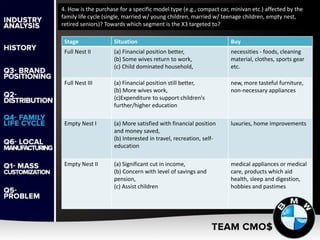
Stage Situation Buy
Full Nest II (a) Financial position better,
(b) Some wives return to work,
(c) Child dominated household,
necessities - foods, cleaning
material, clothes, sports gear
etc.
Full Nest III (a) Financial position still better,
(b) More wives work,
(c)Expenditure to support children's
further/higher education
new, more tasteful furniture,
non-necessary appliances
Empty Nest I (a) More satisfied with financial position
and money saved,
(b) Interested in travel, recreation, self-
education
luxuries, home improvements
Empty Nest II (a) Significant cut in income,
(b) Concern with level of savings and
pension,
(c) Assist children
medical appliances or medical
care, products which aid
health, sleep and digestion,
hobbies and pastimes
4. How is the purchase for a specific model type (e.g., compact car, minivan etc.) affected by the
family life cycle (single, married w/ young children, married w/ teenage children, empty nest,
retired seniors)? Towards which segment is the X3 targeted to?
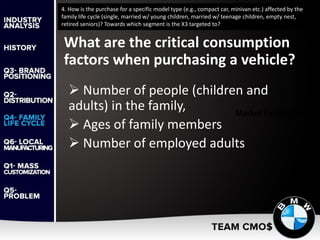
 Number of people (children and
adults) in the family,
 Ages of family members
 Number of employed adults
What are the critical consumption
factors when purchasing a vehicle?
4. How is the purchase for a specific model type (e.g., compact car, minivan etc.) affected by the
family life cycle (single, married w/ young children, married w/ teenage children, empty nest,
retired seniors)? Towards which segment is the X3 targeted to?
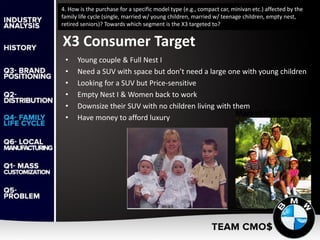
X3 Consumer Target
• Young couple & Full Nest I
• Need a SUV with space but don’t need a large one with young children
• Looking for a SUV but Price-sensitive
• Empty Nest I & Women back to work
• Downsize their SUV with no children living with them
• Have money to afford luxury
6. Why is local manufacturing a source of differential advantage for an automaker? [Almost all the
major import brands in the US have local manufacturing facilities. For example, Hyundai and Kia
have their plants in Alabama and Georgia, USA, respectively, and Toyota's plant is in Kentucky, USA]
Advantage for Local Manufacturing
• Assembly line was completely integrated to shorten the
delivery time of car
Improvement in delivery time
• With local production, the car price of imported brand may be
as low as the local brand
Exempt from customs duty
• Logistics cost advantage
• government incentives, regional interest rates, wages and
trade agreements
Cost advantage
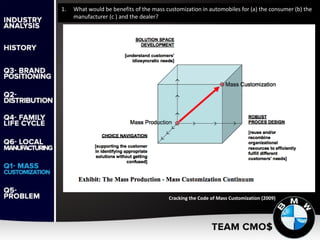
1. What would be benefits of the mass customization in automobiles for (a) the consumer (b) the
manufacturer (c ) and the dealer?
• Mass customization was commonly known as
“using flexible processes and organizational
structures to produce varied and individually
customized products and services at the price
of standardized mass-produced alternatives.”
1. What would be benefits of the mass customization in automobiles for (a) the consumer (b) the
manufacturer (c ) and the dealer?
1. What would be benefits of the mass customization in automobiles for (a) the consumer (b) the
manufacturer (c ) and the dealer?
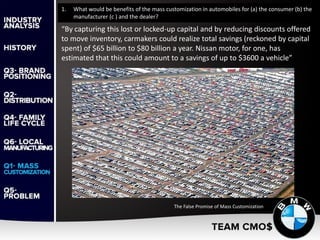
“By capturing this lost or locked-up capital and by reducing discounts offered
to move inventory, carmakers could realize total savings (reckoned by capital
spent) of $65 billion to $80 billion a year. Nissan motor, for one, has
estimated that this could amount to a savings of up to $3600 a vehicle”
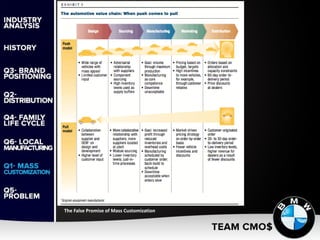
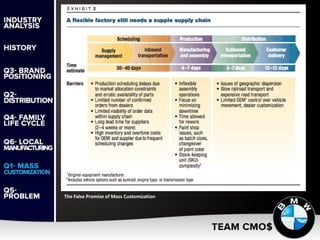
The False Promise of Mass Customization
1. What would be benefits of the mass customization in automobiles for (a) the consumer (b) the
manufacturer (c ) and the dealer?
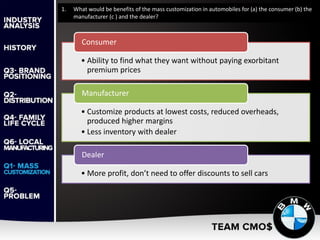
• Ability to find what they want without paying exorbitant
premium prices
Consumer
• Customize products at lowest costs, reduced overheads,
produced higher margins
• Less inventory with dealer
Manufacturer
• More profit, don’t need to offer discounts to sell cars
Dealer
1. What would be benefits of the mass customization in automobiles for (a) the consumer (b) the
manufacturer (c ) and the dealer?
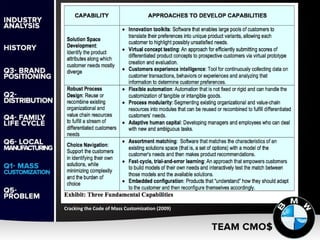
Cracking the Code of Mass Customization (2009)
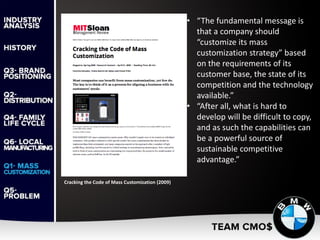
• “The fundamental message is
that a company should
“customize its mass
customization strategy” based
on the requirements of its
customer base, the state of its
competition and the technology
available.”
• “After all, what is hard to
develop will be difficult to copy,
and as such the capabilities can
be a powerful source of
sustainable competitive
advantage.”
Cracking the Code of Mass Customization (2009)
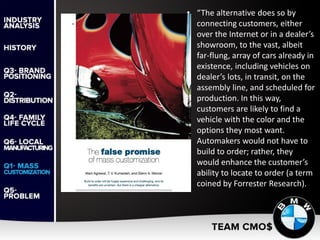
• “The alternative does so by
connecting customers, either
over the Internet or in a dealer’s
showroom, to the vast, albeit
far-flung, array of cars already in
existence, including vehicles on
dealer’s lots, in transit, on the
assembly line, and scheduled for
production. In this way,
customers are likely to find a
vehicle with the color and the
options they most want.
Automakers would not have to
build to order; rather, they
would enhance the customer’s
ability to locate to order (a term
coined by Forrester Research).
The False Promise of Mass Customization
5. Would you recommend that mass customization program be expanded to other BMW models?
[Back up your answer]
Failure cases in Mass Customization:
BMW, Ford Motor, GM
Limited forward integration:
Prohibition of direct car selling
Interest conflicts between car dealers and
manufacturers
Weak connection between
carmakers and customers:
No active platform to communicate with
customers
Many required
operational changes:
Achieve Strategic manufacturing flexibility
(from batch to module system,
redundancy involved, more floor space)
High cost of mass customization:
Customer price sensitivity
Labor union opposition to the external
assembly of modules
Not successful!
5. Would you recommend that mass customization program be expanded to other BMW models?
[Back up your answer]
Success Case of MC: BMW X3 Model
5. Would you recommend that mass customization program be expanded to other BMW models?
[Back up your answer]
5. Would you recommend that mass customization program be expanded to other BMW models?
[Back up your answer]
5. Would you recommend that mass customization program be expanded to other BMW models?
[Back up your answer]
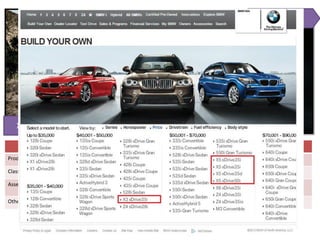
“Your X3 on the Assembly Line”
X5 Full-size SUVs
2014 X4
X5 Full-size SUVs 2014 X4
Production 1999~ 2014~
Class Mid-size CUV Compact crossover SUV(like BMW X3)
Assembly • Spartanburg, South Carolina, USA
• Mexico at the BMW de México Toluca plant.
Spartanburg, South Carolina, USA
Others Online customization available The latest addition to BMW’s X Series
5. Would you recommend that mass customization program be expanded to other BMW models?
[Back up your answer]
5. Would you recommend that mass customization program be expanded to other BMW models?
[Back up your answer]

BMW Final

  • 3.
    BMW factory inChina Efficiency & Ability to React Quickly “The ability to react quickly and increase or decrease production for various markets was a major factor for BMW North America in turning the recession year 2008 into the highest production volume year ever in its history.” In the past five years, the plant had lowered energy consumption by 48%, halved water consumption, reduced CO2 emissions by 44%, and waste output by 65%.16
  • 4.
    & Economy “…rising publicdebt levels in the USA, alongside ongoing unsolved structural problems on the US employment and property markets also pose a risk to global economic growth in the current year, despite any temporary signs of the situation stabilising.” “Signs are emerging in China – currently the mainstay of global economic growth – of a significant increase in bad debts within the banking system, for which the property boom of recent years is partly to blame.”
  • 9.
  • 10.
  • 11.
    More History: BMW: RedefiningPremium Brand Identity (2012)
  • 12.
    Key History: Herbert Quandtacquires a 47% share of BMW, saves BMW through a restructure which allows the company to exploit its capabilities for producing high-performance saloon cars. A new segment in the car market emerges, and has since been BMW’s model to success.
  • 13.
    Key History: • Introduces“Ultimate Driving Machine” slogan in 1975 • First European carmaker to recognize Asian opportunities
  • 14.
    Key History: • DrBernd Pischetsrieder, Chairman of the Board purchases Rover Group for 1.7 billion euros in January 1994– including the MINI and Land Rover brands • 1998, Pischetsrieder purchases Rolls-Royce brand from Vickers for 40 million euros • Estimated 700 million euros in losses, profit expected to be generated in 2002 at the earliest
  • 15.
    • Joachim Milbergtakes over as BMW’s new CEO in February 1998 • Concentrate only on premium market segment • “In 2000, BMW sold Rover at a loss of €3.2 billion however it was able to recoup €2.9 billion by selling the Land Rover brand to Ford. BMW kept the MINI brand as part of its strategy to enter the compact car market. The disposal of Rover and the appointment of Milberg as the new CEO signalled a new era for BMW. “
  • 16.
    Milberg’s strategy: Concentrating onlyon the premium segments of the automobile market. Creating a demanding product and market offensive in the premium segments, ensuring that the brand is represented in all relevant parts of the market. The appropriate expansion of the production and sales network. The agility of the overall company with quick reactions and innovations. Cooperation and networks using external resources through strategic partnerships rather than mergers. A new style of leadership and guidance oriented. Profitable growth. “The sale of Rover and Milberg’s premium brand strategy brought about an increase in profits of more than 400% in 2002 compared to 1999, despite the economic downturn in both Germany and the US” BMW: Redefining Premium Brand Identity (2012)
  • 17.
    • Helmut Pankesucceeds Milberg as BMW’s new CEO in 2002 • Panke’s vision was to build on Milberg’s premium brand strategy which was ‘always premium’ • January 2004, BMW appointed separate brand managers for each of the three brands, whilst marketing functions were to be centralized under one leadership. • In November 2002, BMW opened the Brand Academy to promote brand orientation amongst its staff on the brilliance and fascination of the three premium brands. The academy was unique and the only one of its kind in the automobile industry. The Brand Academy aimed to educate BMW’s staff and partners to better understand the different identities of the brands and identify the features that distinguished these brands from their competitors. • In May 2004, BMW entered the Chinese market through its joint venture with Brilliance China Automotive Holdings Limited. BMW: Redefining Premium Brand Identity (2012)
  • 18.
  • 19.
    3. What arethe different brand positioning strategies of BMW's main competitors? [You may analyze slogans, advertisements, company homepage, etc.] In particular, carry out a detailed comparison between BMW and Audi.
  • 20.
    3. What arethe different brand positioning strategies of BMW's main competitors? [You may analyze slogans, advertisements, company homepage, etc.] In particular, carry out a detailed comparison between BMW and Audi.
  • 21.
    3. What arethe different brand positioning strategies of BMW's main competitors? [You may analyze slogans, advertisements, company homepage, etc.] In particular, carry out a detailed comparison between BMW and Audi.
  • 22.
    3. What arethe different brand positioning strategies of BMW's main competitors? [You may analyze slogans, advertisements, company homepage, etc.] In particular, carry out a detailed comparison between BMW and Audi. http://www.interbrand.com/en/best-global-brands/2012/BMW
  • 23.
    3. What arethe different brand positioning strategies of BMW's main competitors? [You may analyze slogans, advertisements, company homepage, etc.] In particular, carry out a detailed comparison between BMW and Audi. Film Product Placement BMW Brand Academy BMW Performance Driving School
  • 24.
    3. What arethe different brand positioning strategies of BMW's main competitors? [You may analyze slogans, advertisements, company homepage, etc.] In particular, carry out a detailed comparison between BMW and Audi. Competitors BMW Audi
  • 25.
    3. What arethe different brand positioning strategies of BMW's main competitors? [You may analyze slogans, advertisements, company homepage, etc.] In particular, carry out a detailed comparison between BMW and Audi.
  • 26.
    3. What arethe different brand positioning strategies of BMW's main competitors? [You may analyze slogans, advertisements, company homepage, etc.] In particular, carry out a detailed comparison between BMW and Audi. Audi.com
  • 27.
    3. What arethe different brand positioning strategies of BMW's main competitors? [You may analyze slogans, advertisements, company homepage, etc.] In particular, carry out a detailed comparison between BMW and Audi. Audi - brand management driven success Michael Renz, Head of Central Marketing AUDI AG
  • 28.
    3. What arethe different brand positioning strategies of BMW's main competitors? [You may analyze slogans, advertisements, company homepage, etc.] In particular, carry out a detailed comparison between BMW and Audi. Audi - brand management driven success Michael Renz, Head of Central Marketing AUDI AG
  • 29.
    3. What arethe different brand positioning strategies of BMW's main competitors? [You may analyze slogans, advertisements, company homepage, etc.] In particular, carry out a detailed comparison between BMW and Audi. Audi - brand management driven success Michael Renz, Head of Central Marketing AUDI AG
  • 30.
    3. What arethe different brand positioning strategies of BMW's main competitors? [You may analyze slogans, advertisements, company homepage, etc.] In particular, carry out a detailed comparison between BMW and Audi. Fair Competition: BMW vs Audi, WIPO-US BMW AUDI “Sheer driving pleasure Advantage through Technology Joy of driving Truth in Engineering The Ultimate Driving Machine Truth in Motion Cultural insight Green Police
  • 31.
    2. How isthe US new car distribution system different from that of Korea or Europe or any other country that you are from? Is the impatience factor driven more by actual customer characteristics or by the characteristics of the distribution system?
  • 32.
    2. How isthe US new car distribution system different from that of Korea or Europe or any other country that you are from? Is the impatience factor driven more by actual customer characteristics or by the characteristics of the distribution system?
  • 33.
    4. How isthe purchase for a specific model type (e.g., compact car, minivan etc.) affected by the family life cycle (single, married w/ young children, married w/ teenage children, empty nest, retired seniors)? Towards which segment is the X3 targeted to? The Family Life Cycle • Individuals and families tend to go through a “life cycle”. The simple life cycle goes from:  Young single  Newly married, no kids  Young couple, Kids < 6(Full Nest I)  Young couple, Kids >6 (Full Nest II)  Older married with dependent children (Full Nest III)  Older married couples, no children living with them, still working (Empty Nest I)  Older married couples, no children living with them, retired (Empty Nest II)
  • 34.
    4. How isthe purchase for a specific model type (e.g., compact car, minivan etc.) affected by the family life cycle (single, married w/ young children, married w/ teenage children, empty nest, retired seniors)? Towards which segment is the X3 targeted to? What is the Family Life Cycle (FLC) Changes Over Life Cycle Financial situation Brands considered Interests Primary decision maker The family life cycle concept attempts to explain consumer behavior patterns of individuals as they age, marry, have children, retire-- and their discretionary income variations over their life span
  • 35.
    4. How isthe purchase for a specific model type (e.g., compact car, minivan etc.) affected by the family life cycle (single, married w/ young children, married w/ teenage children, empty nest, retired seniors)? Towards which segment is the X3 targeted to? Stage Situation Buy Young Single (a) Few financial burdens, (b) Recreation orientated, (c) Experiment with personal financial management basic kitchen equipment, basic furniture, cars Young Couple (a) Better off financially than they will be in the near future (b) High levels of purchase of homes and consumer durable goods (c) Establish patterns of personal financial management and control cars, fringes, cookers, life assurance, durable furniture Full Nest I (a) Home purchasing at peak (c) Dissatisfied with financial position and amount of money saved (d) Reliance on credit finance, credit cards, overdrafts etc. (e) Child dominated household necessities - washers, dryers, baby food and clothes, toys, books
  • 36.
    4. How isthe purchase for a specific model type (e.g., compact car, minivan etc.) affected by the family life cycle (single, married w/ young children, married w/ teenage children, empty nest, retired seniors)? Towards which segment is the X3 targeted to? Stage Situation Buy Full Nest II (a) Financial position better, (b) Some wives return to work, (c) Child dominated household, necessities - foods, cleaning material, clothes, sports gear etc. Full Nest III (a) Financial position still better, (b) More wives work, (c)Expenditure to support children's further/higher education new, more tasteful furniture, non-necessary appliances Empty Nest I (a) More satisfied with financial position and money saved, (b) Interested in travel, recreation, self- education luxuries, home improvements Empty Nest II (a) Significant cut in income, (b) Concern with level of savings and pension, (c) Assist children medical appliances or medical care, products which aid health, sleep and digestion, hobbies and pastimes
  • 37.
    4. How isthe purchase for a specific model type (e.g., compact car, minivan etc.) affected by the family life cycle (single, married w/ young children, married w/ teenage children, empty nest, retired seniors)? Towards which segment is the X3 targeted to?  Number of people (children and adults) in the family,  Ages of family members  Number of employed adults What are the critical consumption factors when purchasing a vehicle?
  • 38.
    4. How isthe purchase for a specific model type (e.g., compact car, minivan etc.) affected by the family life cycle (single, married w/ young children, married w/ teenage children, empty nest, retired seniors)? Towards which segment is the X3 targeted to? X3 Consumer Target • Young couple & Full Nest I • Need a SUV with space but don’t need a large one with young children • Looking for a SUV but Price-sensitive • Empty Nest I & Women back to work • Downsize their SUV with no children living with them • Have money to afford luxury
  • 39.
    6. Why islocal manufacturing a source of differential advantage for an automaker? [Almost all the major import brands in the US have local manufacturing facilities. For example, Hyundai and Kia have their plants in Alabama and Georgia, USA, respectively, and Toyota's plant is in Kentucky, USA] Advantage for Local Manufacturing • Assembly line was completely integrated to shorten the delivery time of car Improvement in delivery time • With local production, the car price of imported brand may be as low as the local brand Exempt from customs duty • Logistics cost advantage • government incentives, regional interest rates, wages and trade agreements Cost advantage
  • 40.
    1. What wouldbe benefits of the mass customization in automobiles for (a) the consumer (b) the manufacturer (c ) and the dealer? • Mass customization was commonly known as “using flexible processes and organizational structures to produce varied and individually customized products and services at the price of standardized mass-produced alternatives.”
  • 41.
    1. What wouldbe benefits of the mass customization in automobiles for (a) the consumer (b) the manufacturer (c ) and the dealer?
  • 42.
    1. What wouldbe benefits of the mass customization in automobiles for (a) the consumer (b) the manufacturer (c ) and the dealer? “By capturing this lost or locked-up capital and by reducing discounts offered to move inventory, carmakers could realize total savings (reckoned by capital spent) of $65 billion to $80 billion a year. Nissan motor, for one, has estimated that this could amount to a savings of up to $3600 a vehicle” The False Promise of Mass Customization
  • 43.
    1. What wouldbe benefits of the mass customization in automobiles for (a) the consumer (b) the manufacturer (c ) and the dealer? • Ability to find what they want without paying exorbitant premium prices Consumer • Customize products at lowest costs, reduced overheads, produced higher margins • Less inventory with dealer Manufacturer • More profit, don’t need to offer discounts to sell cars Dealer
  • 44.
    1. What wouldbe benefits of the mass customization in automobiles for (a) the consumer (b) the manufacturer (c ) and the dealer? Cracking the Code of Mass Customization (2009)
  • 45.
    Cracking the Codeof Mass Customization (2009) Cracking the Code of Mass Customization (2009)
  • 46.
    Cracking the Codeof Mass Customization (2009) • “The fundamental message is that a company should “customize its mass customization strategy” based on the requirements of its customer base, the state of its competition and the technology available.” • “After all, what is hard to develop will be difficult to copy, and as such the capabilities can be a powerful source of sustainable competitive advantage.”
  • 47.
    Cracking the Codeof Mass Customization (2009) • “The alternative does so by connecting customers, either over the Internet or in a dealer’s showroom, to the vast, albeit far-flung, array of cars already in existence, including vehicles on dealer’s lots, in transit, on the assembly line, and scheduled for production. In this way, customers are likely to find a vehicle with the color and the options they most want. Automakers would not have to build to order; rather, they would enhance the customer’s ability to locate to order (a term coined by Forrester Research).
  • 48.
    The False Promiseof Mass Customization
  • 49.
    The False Promiseof Mass Customization
  • 50.
    5. Would yourecommend that mass customization program be expanded to other BMW models? [Back up your answer] Failure cases in Mass Customization: BMW, Ford Motor, GM Limited forward integration: Prohibition of direct car selling Interest conflicts between car dealers and manufacturers Weak connection between carmakers and customers: No active platform to communicate with customers Many required operational changes: Achieve Strategic manufacturing flexibility (from batch to module system, redundancy involved, more floor space) High cost of mass customization: Customer price sensitivity Labor union opposition to the external assembly of modules Not successful!
  • 51.
    5. Would yourecommend that mass customization program be expanded to other BMW models? [Back up your answer] Success Case of MC: BMW X3 Model
  • 52.
    5. Would yourecommend that mass customization program be expanded to other BMW models? [Back up your answer]
  • 53.
    5. Would yourecommend that mass customization program be expanded to other BMW models? [Back up your answer]
  • 54.
    5. Would yourecommend that mass customization program be expanded to other BMW models? [Back up your answer] “Your X3 on the Assembly Line”
  • 55.
    X5 Full-size SUVs 2014X4 X5 Full-size SUVs 2014 X4 Production 1999~ 2014~ Class Mid-size CUV Compact crossover SUV(like BMW X3) Assembly • Spartanburg, South Carolina, USA • Mexico at the BMW de México Toluca plant. Spartanburg, South Carolina, USA Others Online customization available The latest addition to BMW’s X Series
  • 56.
    5. Would yourecommend that mass customization program be expanded to other BMW models? [Back up your answer]
  • 57.
    5. Would yourecommend that mass customization program be expanded to other BMW models? [Back up your answer]