ASSIGNMENT PRESENTED TO
MR. SHOEL AKHTAR
ASST. PROFESSOR
PRESENTED BY
MULAYAM SINGH
DOCTOR OF PHARMACY
(2nd YEAR)
HOSPITAL TRAINING
INTEGRAL UNIVERSITY , LUCKNOW
FACULTY OF PHARMACY
M.sin
gh
M.sin
gh
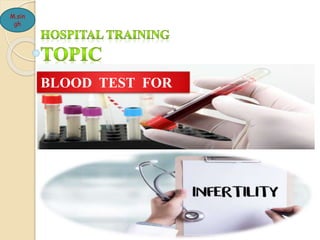
BLOOD TEST FOR
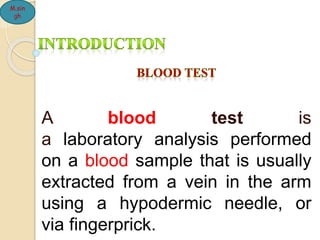
A blood test is
a laboratory analysis performed
on a blood sample that is usually
extracted from a vein in the arm
using a hypodermic needle, or
via fingerprick.
M.sin
gh
M.sin
gh
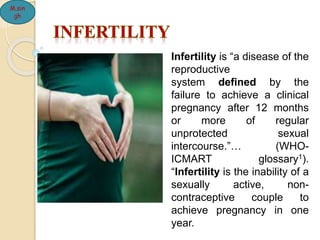
Infertility is “a disease of the
reproductive
system defined by the
failure to achieve a clinical
pregnancy after 12 months
or more of regular
unprotected sexual
intercourse.”… (WHO-
ICMART glossary1).
“Infertility is the inability of a
sexually active, non-
contraceptive couple to
achieve pregnancy in one
year.
M.sin
gh
M.sin
gh
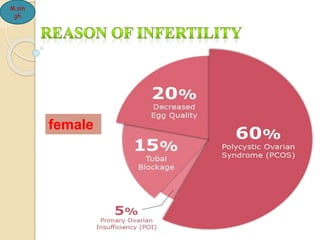
female
Blood tests can be used to evaluate
hormone levels such as:
Free and total testosterone.
Luteinizing hormone (LH)
Follicle-stimulating hormone (FSH)
Prolactin (PRL)
Sex hormone binding globulin (SHBG)
M.sin
gh
I. Free and total
testosterone
It checks the level of testosterone in your blood.
Your doctor uses it to diagnose conditions caused
by too much or too little testosterone. That’s
a hormone produced in a man’s testes.
During puberty, testosterone builds a man's
muscles, deepens his voice, puts hair on his chest,
and makes his penis grow. Throughout a man's
life, the hormone also helps produce sperm and
keep up his sex drive.
Women make testosterone too, but in smaller
amounts. They produce it in their ovaries. It helps
maintain hormone balance and regulates other
M.sin
gh
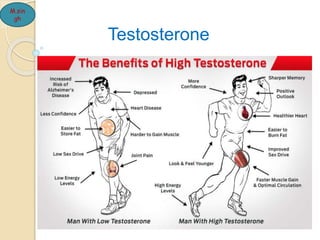
Testosterone
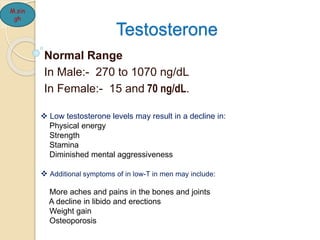
Normal Range
In Male:- 270 to 1070 ng/dL
In Female:- 15 and 70 ng/dL.
M.sin
gh
 Low testosterone levels may result in a decline in:
Physical energy
Strength
Stamina
Diminished mental aggressiveness
 Additional symptoms of in low-T in men may include:
More aches and pains in the bones and joints
A decline in libido and erections
Weight gain
Osteoporosis
M.sin
gh
Testosterone
2. Luteinizing harmone (LH)
Normal Range
In Male:- 1 – 10 IU/mL
In Female:- 8.7 to 76.3 IU/L
high levels of LH
during nonovulatory times in your menstrual cycle
may mean you are in menopause. It may
also mean that you have a pituitary disorder or
polycystic ovary syndrome.
Low levels of LH
may mean you have a pituitary disorder, anorexia,
malnutrition, or are under stress.
M.sin
gh
3. Follicle-stimulating
hormone(FSH)
Normal Range
In Male:- 2-7 mIU/mL.
In Female:- 30 mIU/mL
High levels of LH
If you're a woman with high FSH levels, this may
indicate: a loss of ovarian function, or ovarian failure. ...
polycystic ovarian syndrome, which is a condition in
which a woman's hormones are out of
balance,causing ovarian cysts.
Low levels of LH
LH are consistent with secondary ovarian failure due to a
pituitary disorder or hypothalamic problem. Low
FSH serum levels have been associated with increased risk
of ovarian cancer.
M.sin
gh
4. Prolactin (PRL)
Normal Range
In Male:- Males: 2 to 18 (ng/mL
In Female:- ) Nonpregnant : 2 to 29 ng/mL.
Pregnant : 10 to 209 ng/mL.
High levels of (PRL)
One common cause of hyperprolactinemia is a
growth or tumor on the pituitary gland called a
prolactinoma. The tumor produces high
levels of prolactin. ... Large tumors can
also cause headaches, vision problems, or both.
Prolactinomas are more common in women than
in men and rarely occur in children.
M.sin
gh
4. Prolactin (PRL)
Low levels of (PRL)
In some cases, low levels of prolactin may
be a sign of a pituitary disorder, for example,
hypopituitarism. This is a rare condition that can
delay growth and puberty in children, and cause
premature aging in adults.
M.sin
gh
5. Sex hormone binding
globulin (SHBG)
Normal Range
In Male:- 10 to 57 nanomoles per liter (nmol/L)
In Female:- (nonpregnant): 18 to 144 nmol/L.
high levels of (SHBG)
A high SHBG level means that it is likely that less
free testosterone is available to the tissues than is
indicated by the total testosterone test.
Increased SHBG levels may be seen in: Liver
disease.
Low levels of (SHBG)
. A low SHBG level means that more of the total
testosterone is bioavailable and not bound
M.sin
gh
M.sin
gh
Women
Women with prolactinoma symptoms may need the test.
Prolactinoma is a noncancerous tumor on the pituitary gland that
produces high levels of prolactin.
Symptoms of prolactinoma in women include:
 unexplained headaches
 visual impairment
 galactorrhea, or lactation outside of childbirth or nursing
 pain or discomfort during sex
 abnormal growth of body and facial hair
 abnormal acne
The test is usually performed on people with prolactinoma to keep
track of the tumor’s response to treatment.
In addition, the prolactin test may be needed if you’re having fertility
problems or irregular periods. The test can also rule out other
pituitary gland or hypothalamus problems.
Prolactin
Men
Men may need the test if they display symptoms
of prolactinoma. Symptoms of prolactinoma in
men include:
unexplained headaches
visual impairment
reduced sex drive or fertility problems
erectile dysfunction abnormal lack of body and
facial hair
The test may also be used to:
investigate testicular dysfunction or erectile
dysfunction
rule out problems with the pituitary gland or
hypothalamus
M.sin
gh
M.sin
gh
REFERENCES

https://www.healthline.com/health/prolactin#purpose-
of-the-test
 https://www.google.com/search?
 www.slideshare.net
 https://en.wikipedia.org/wiki/Follicle-
stimulating_hormone
M.sin
gh
M.sin
gh

BLOOD TEST FOR INFERTILITY

  • 1.
    ASSIGNMENT PRESENTED TO MR.SHOEL AKHTAR ASST. PROFESSOR PRESENTED BY MULAYAM SINGH DOCTOR OF PHARMACY (2nd YEAR) HOSPITAL TRAINING INTEGRAL UNIVERSITY , LUCKNOW FACULTY OF PHARMACY M.sin gh
  • 2.
  • 3.
    A blood testis a laboratory analysis performed on a blood sample that is usually extracted from a vein in the arm using a hypodermic needle, or via fingerprick. M.sin gh
  • 4.
    M.sin gh Infertility is “adisease of the reproductive system defined by the failure to achieve a clinical pregnancy after 12 months or more of regular unprotected sexual intercourse.”… (WHO- ICMART glossary1). “Infertility is the inability of a sexually active, non- contraceptive couple to achieve pregnancy in one year.
  • 5.
  • 6.
  • 7.
    Blood tests canbe used to evaluate hormone levels such as: Free and total testosterone. Luteinizing hormone (LH) Follicle-stimulating hormone (FSH) Prolactin (PRL) Sex hormone binding globulin (SHBG) M.sin gh
  • 8.
    I. Free andtotal testosterone It checks the level of testosterone in your blood. Your doctor uses it to diagnose conditions caused by too much or too little testosterone. That’s a hormone produced in a man’s testes. During puberty, testosterone builds a man's muscles, deepens his voice, puts hair on his chest, and makes his penis grow. Throughout a man's life, the hormone also helps produce sperm and keep up his sex drive. Women make testosterone too, but in smaller amounts. They produce it in their ovaries. It helps maintain hormone balance and regulates other M.sin gh
  • 9.
    Testosterone Normal Range In Male:-270 to 1070 ng/dL In Female:- 15 and 70 ng/dL. M.sin gh  Low testosterone levels may result in a decline in: Physical energy Strength Stamina Diminished mental aggressiveness  Additional symptoms of in low-T in men may include: More aches and pains in the bones and joints A decline in libido and erections Weight gain Osteoporosis
  • 10.
  • 11.
    2. Luteinizing harmone(LH) Normal Range In Male:- 1 – 10 IU/mL In Female:- 8.7 to 76.3 IU/L high levels of LH during nonovulatory times in your menstrual cycle may mean you are in menopause. It may also mean that you have a pituitary disorder or polycystic ovary syndrome. Low levels of LH may mean you have a pituitary disorder, anorexia, malnutrition, or are under stress. M.sin gh
  • 12.
    3. Follicle-stimulating hormone(FSH) Normal Range InMale:- 2-7 mIU/mL. In Female:- 30 mIU/mL High levels of LH If you're a woman with high FSH levels, this may indicate: a loss of ovarian function, or ovarian failure. ... polycystic ovarian syndrome, which is a condition in which a woman's hormones are out of balance,causing ovarian cysts. Low levels of LH LH are consistent with secondary ovarian failure due to a pituitary disorder or hypothalamic problem. Low FSH serum levels have been associated with increased risk of ovarian cancer. M.sin gh
  • 13.
    4. Prolactin (PRL) NormalRange In Male:- Males: 2 to 18 (ng/mL In Female:- ) Nonpregnant : 2 to 29 ng/mL. Pregnant : 10 to 209 ng/mL. High levels of (PRL) One common cause of hyperprolactinemia is a growth or tumor on the pituitary gland called a prolactinoma. The tumor produces high levels of prolactin. ... Large tumors can also cause headaches, vision problems, or both. Prolactinomas are more common in women than in men and rarely occur in children. M.sin gh
  • 14.
    4. Prolactin (PRL) Lowlevels of (PRL) In some cases, low levels of prolactin may be a sign of a pituitary disorder, for example, hypopituitarism. This is a rare condition that can delay growth and puberty in children, and cause premature aging in adults. M.sin gh
  • 15.
    5. Sex hormonebinding globulin (SHBG) Normal Range In Male:- 10 to 57 nanomoles per liter (nmol/L) In Female:- (nonpregnant): 18 to 144 nmol/L. high levels of (SHBG) A high SHBG level means that it is likely that less free testosterone is available to the tissues than is indicated by the total testosterone test. Increased SHBG levels may be seen in: Liver disease. Low levels of (SHBG) . A low SHBG level means that more of the total testosterone is bioavailable and not bound M.sin gh
  • 16.
    M.sin gh Women Women with prolactinomasymptoms may need the test. Prolactinoma is a noncancerous tumor on the pituitary gland that produces high levels of prolactin. Symptoms of prolactinoma in women include:  unexplained headaches  visual impairment  galactorrhea, or lactation outside of childbirth or nursing  pain or discomfort during sex  abnormal growth of body and facial hair  abnormal acne The test is usually performed on people with prolactinoma to keep track of the tumor’s response to treatment. In addition, the prolactin test may be needed if you’re having fertility problems or irregular periods. The test can also rule out other pituitary gland or hypothalamus problems. Prolactin
  • 17.
    Men Men may needthe test if they display symptoms of prolactinoma. Symptoms of prolactinoma in men include: unexplained headaches visual impairment reduced sex drive or fertility problems erectile dysfunction abnormal lack of body and facial hair The test may also be used to: investigate testicular dysfunction or erectile dysfunction rule out problems with the pituitary gland or hypothalamus M.sin gh
  • 18.
  • 19.
  • 20.