Copyright © 2016 Peter Robinson
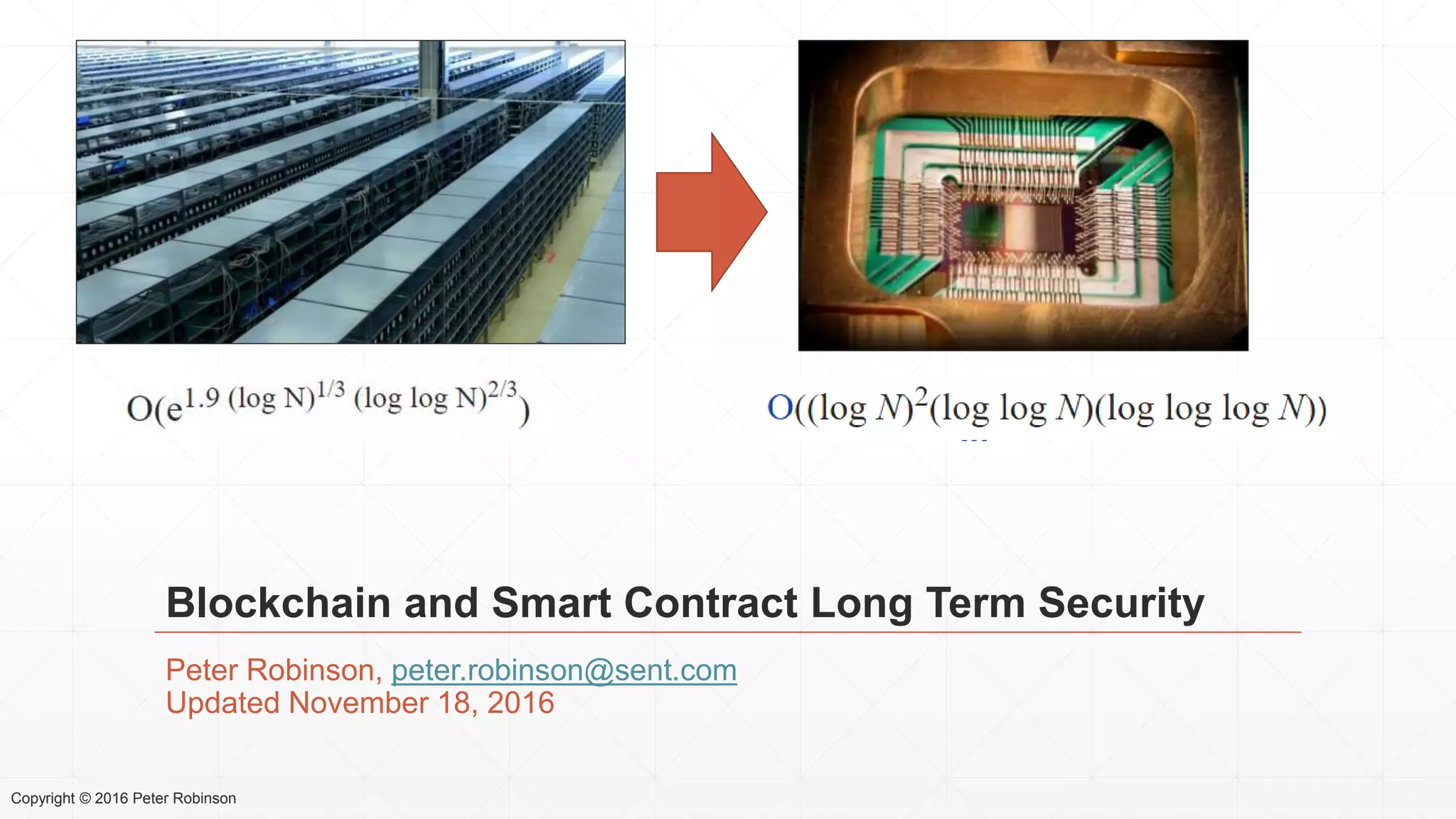
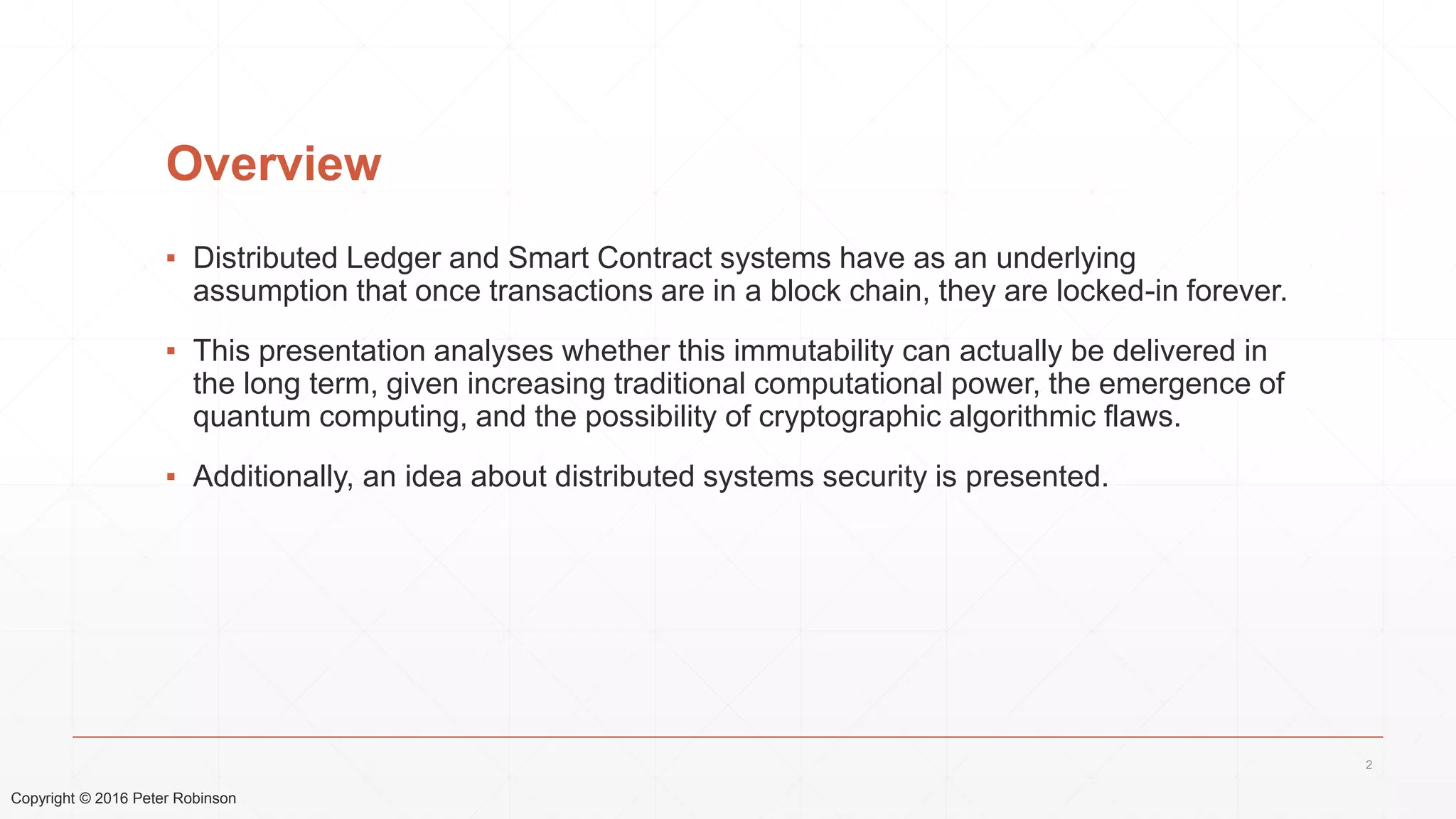
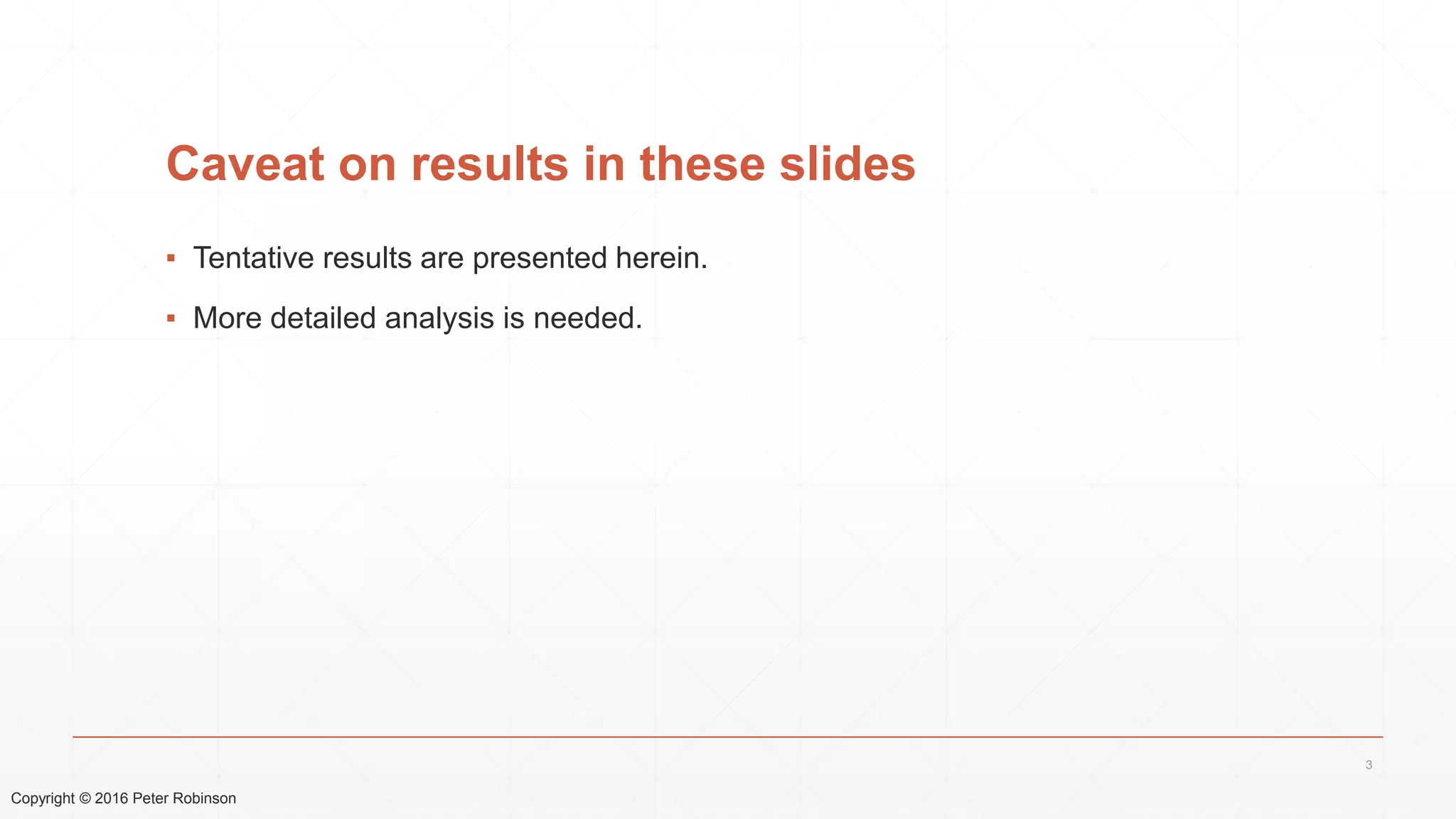
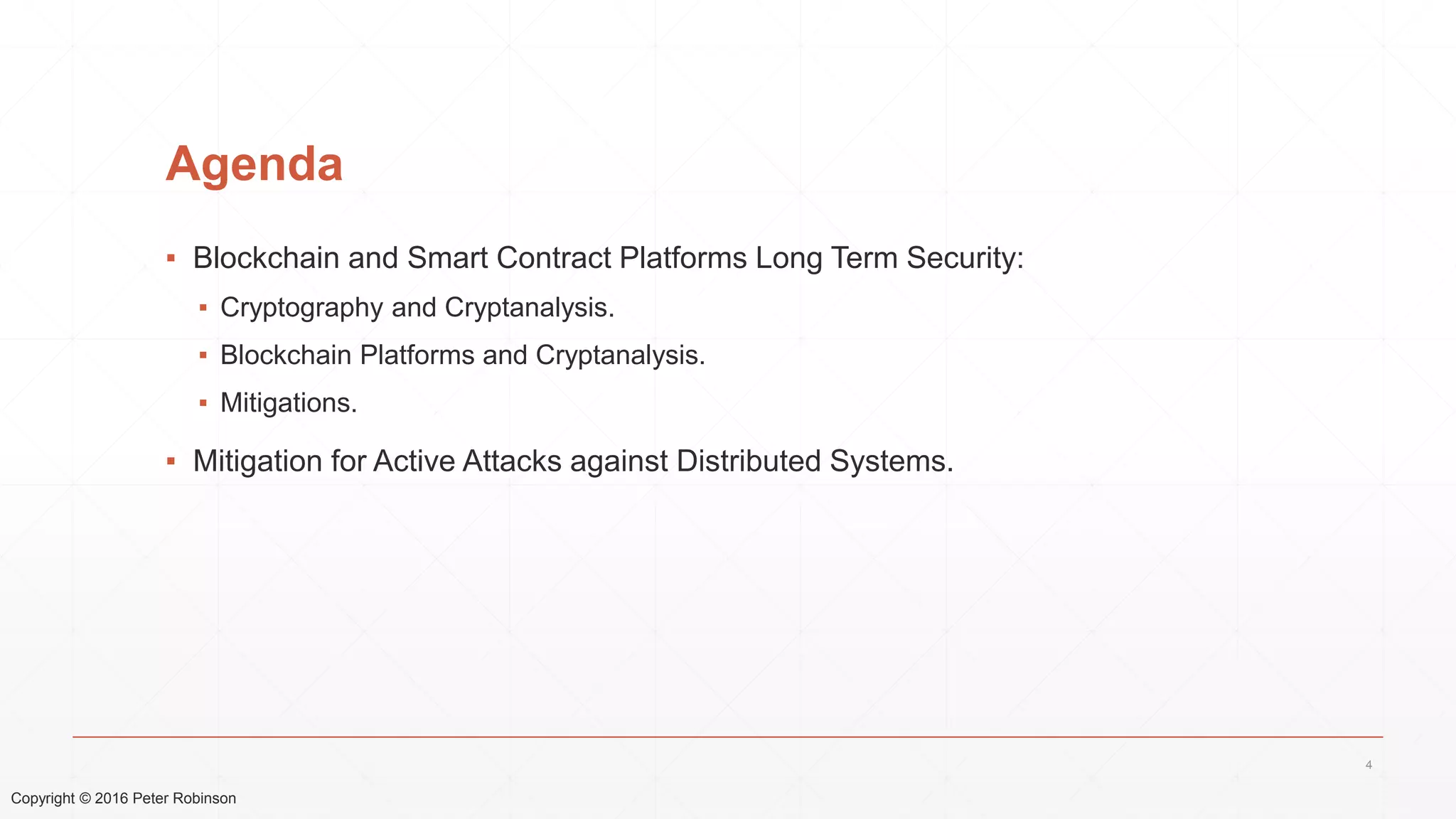
Blockchain and Smart Contract Long Term Security
Peter Robinson, peter.robinson@sent.com
Updated November 18, 2016
Copyright © 2016 Peter Robinson
Overview
▪ Distributed Ledger and Smart Contract systems have as an underlying
assumption that once transactions are in a block chain, they are locked-in forever.
▪ This presentation analyses whether this immutability can actually be delivered in
the long term, given increasing traditional computational power, the emergence of
quantum computing, and the possibility of cryptographic algorithmic flaws.
▪ Additionally, an idea about distributed systems security is presented.
2
Copyright © 2016 Peter Robinson
Caveat on results in these slides
▪ Tentative results are presented herein.
▪ More detailed analysis is needed.
3
Copyright © 2016 Peter Robinson
Agenda
▪ Blockchain and Smart Contract Platforms Long Term Security:
▪ Cryptography and Cryptanalysis.
▪ Blockchain Platforms and Cryptanalysis.
▪ Mitigations.
▪ Mitigation for Active Attacks against Distributed Systems.
4
Copyright © 2016 Peter Robinson
Cryptography &
Cryptanalysis
Copyright © 2016 Peter Robinson
Cryptography: Algorithms
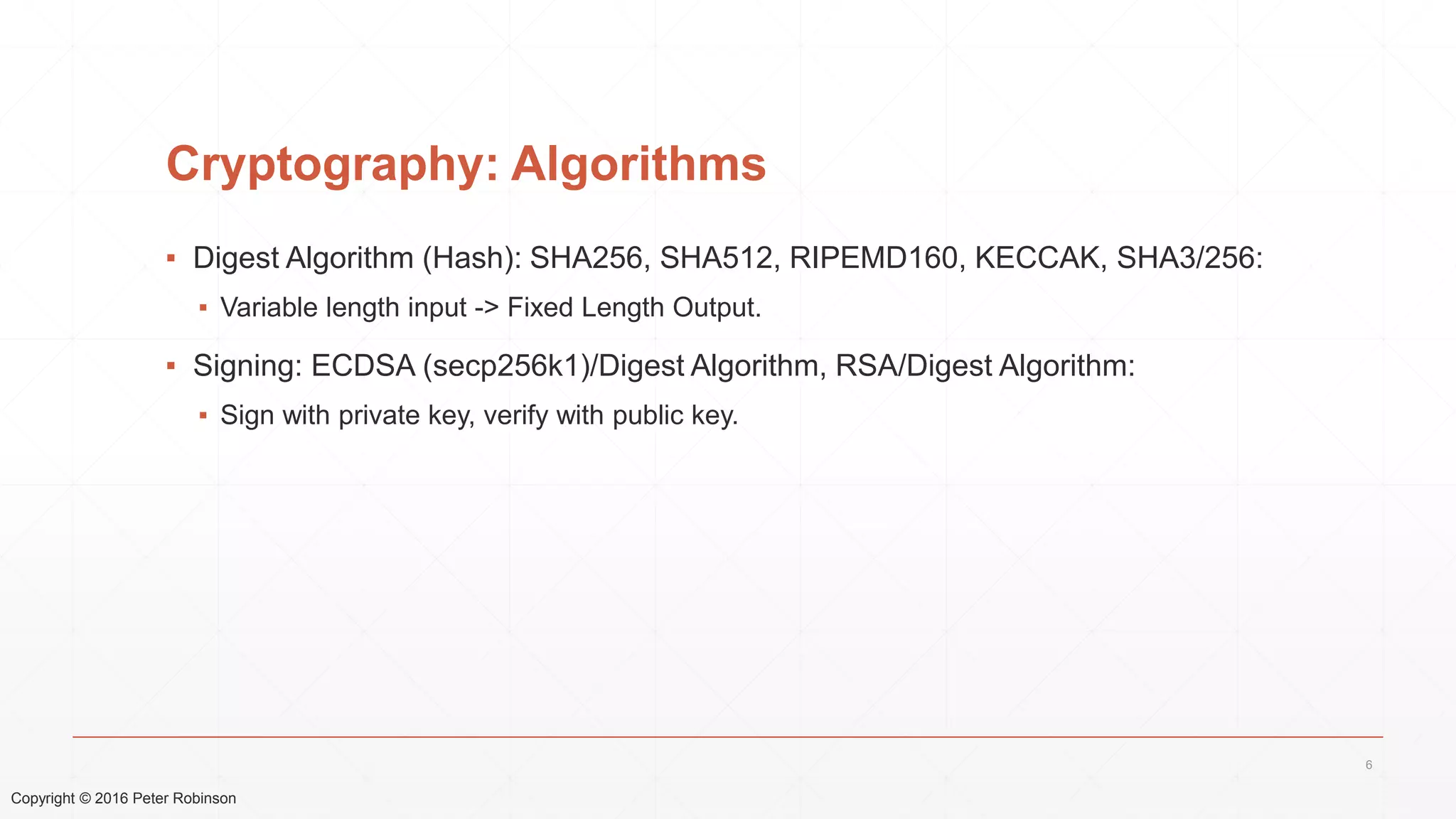
▪ Digest Algorithm (Hash): SHA256, SHA512, RIPEMD160, KECCAK, SHA3/256:
▪ Variable length input -> Fixed Length Output.
▪ Signing: ECDSA (secp256k1)/Digest Algorithm, RSA/Digest Algorithm:
▪ Sign with private key, verify with public key.
6
Copyright © 2016 Peter Robinson
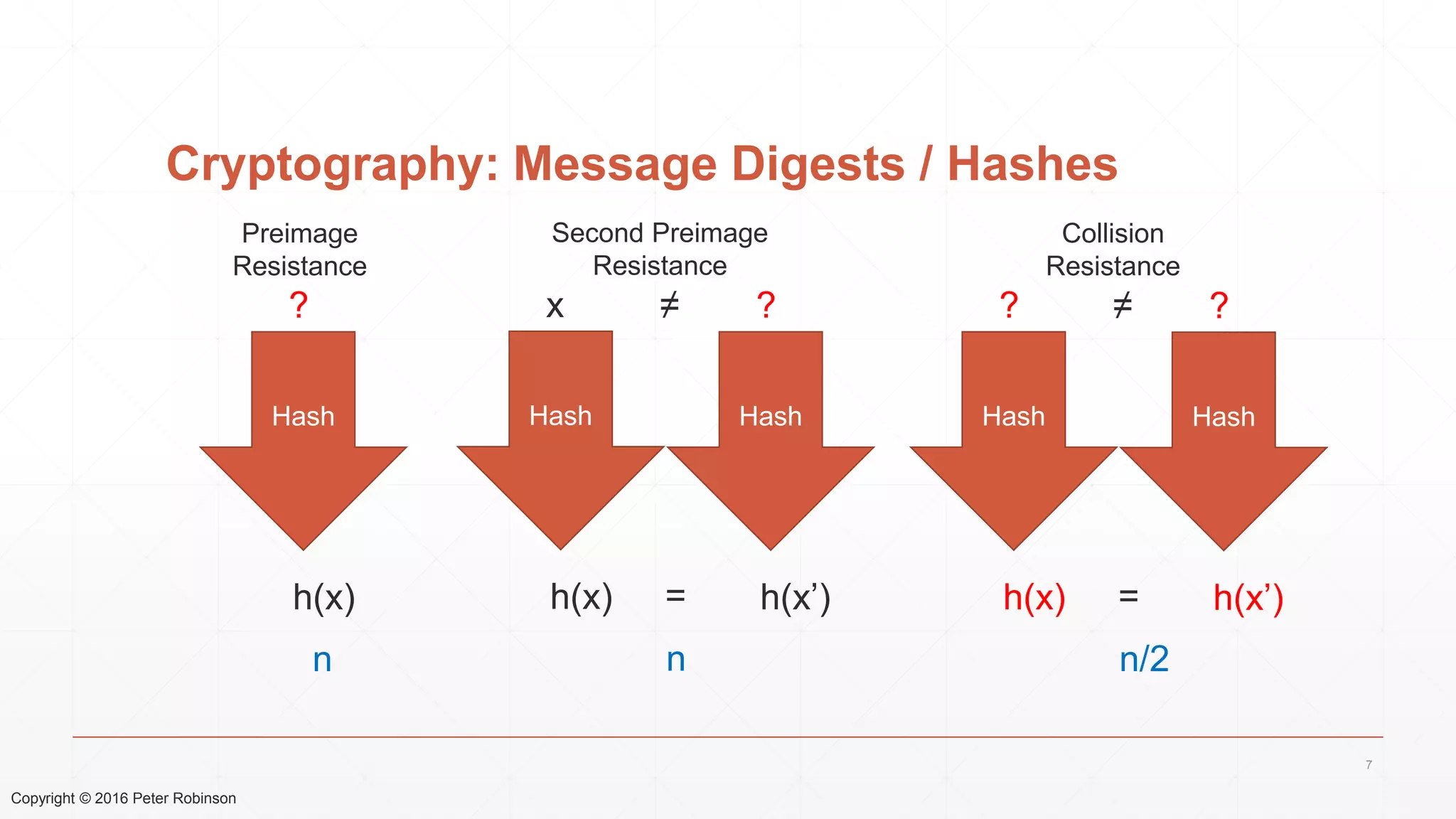
Cryptography: Message Digests / Hashes
7
?
Preimage
Resistance
Hash
n
h(x)
x
Second Preimage
Resistance
Hash
n
h(x)
?
Hash
h(x’)
≠
=
?
Collision
Resistance
Hash
n/2
h(x)
?
Hash
h(x’)
≠
=
Copyright © 2016 Peter Robinson
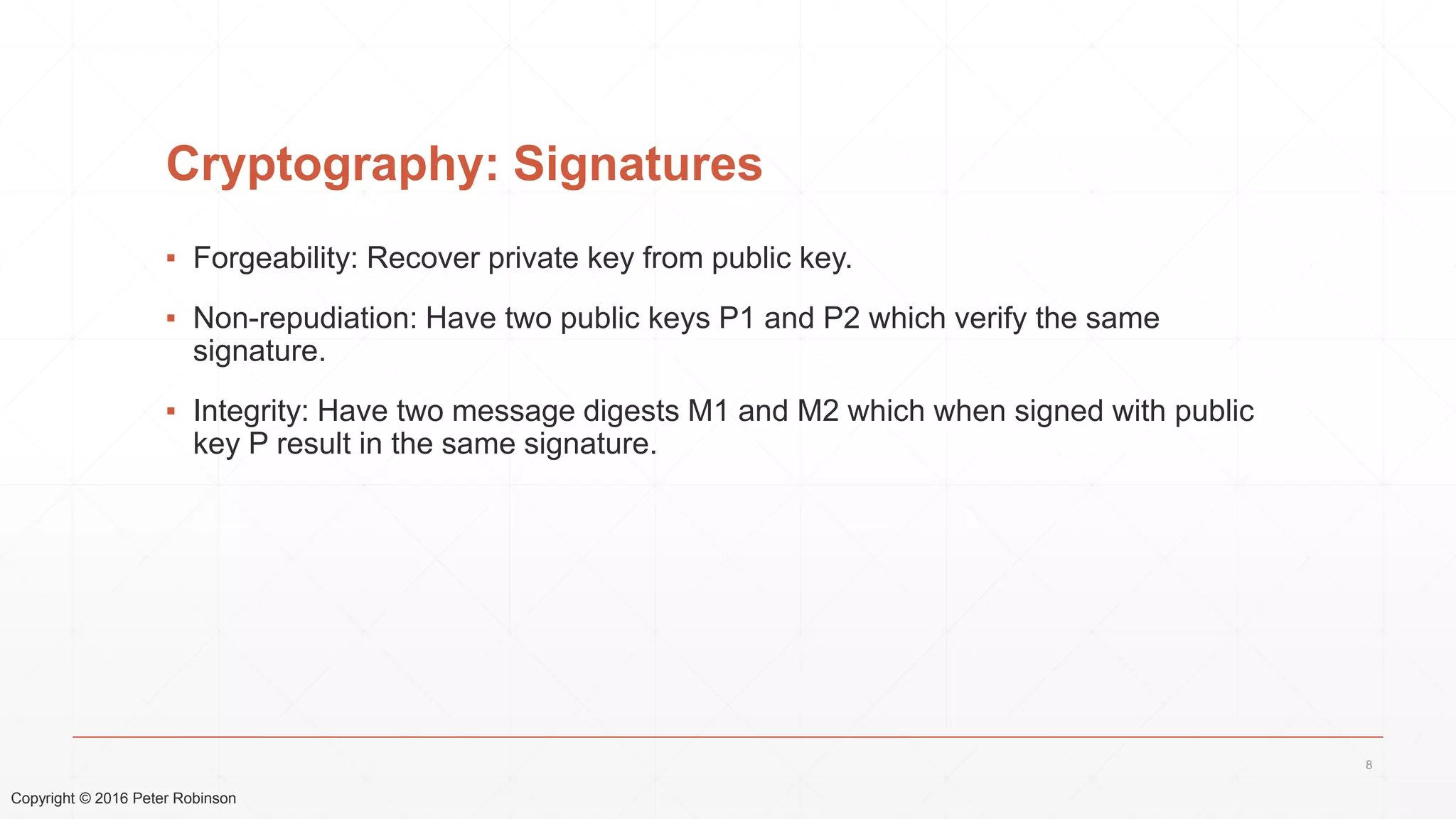
Cryptography: Signatures
▪ Forgeability: Recover private key from public key.
▪ Non-repudiation: Have two public keys P1 and P2 which verify the same
signature.
▪ Integrity: Have two message digests M1 and M2 which when signed with public
key P result in the same signature.
8
Copyright © 2016 Peter Robinson
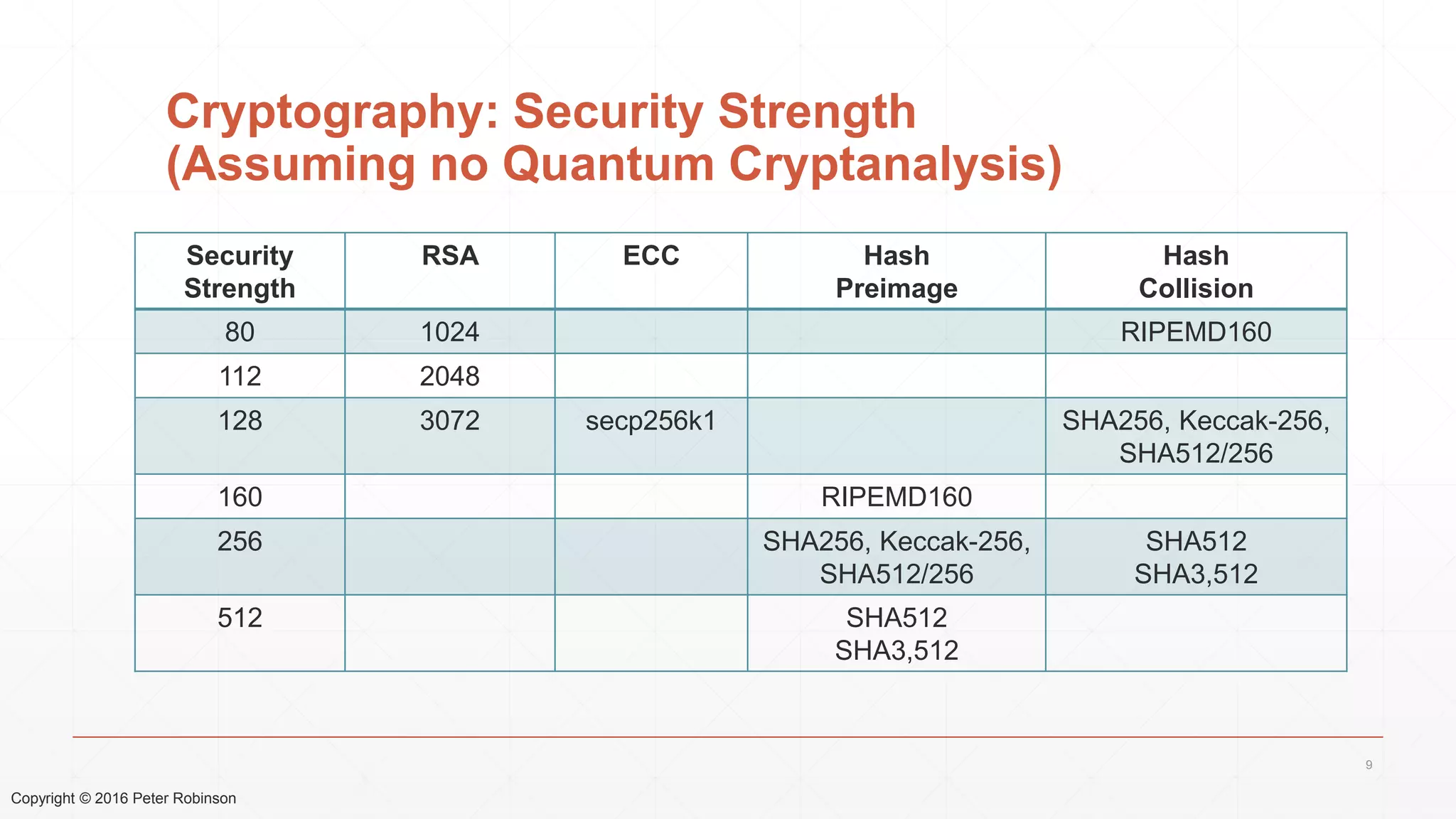
Cryptography: Security Strength
(Assuming no Quantum Cryptanalysis)
9
Security
Strength
RSA ECC Hash
Preimage
Hash
Collision
80 1024 RIPEMD160
112 2048
128 3072 secp256k1 SHA256, Keccak-256,
SHA512/256
160 RIPEMD160
256 SHA256, Keccak-256,
SHA512/256
SHA512
SHA3,512
512 SHA512
SHA3,512
Copyright © 2016 Peter Robinson
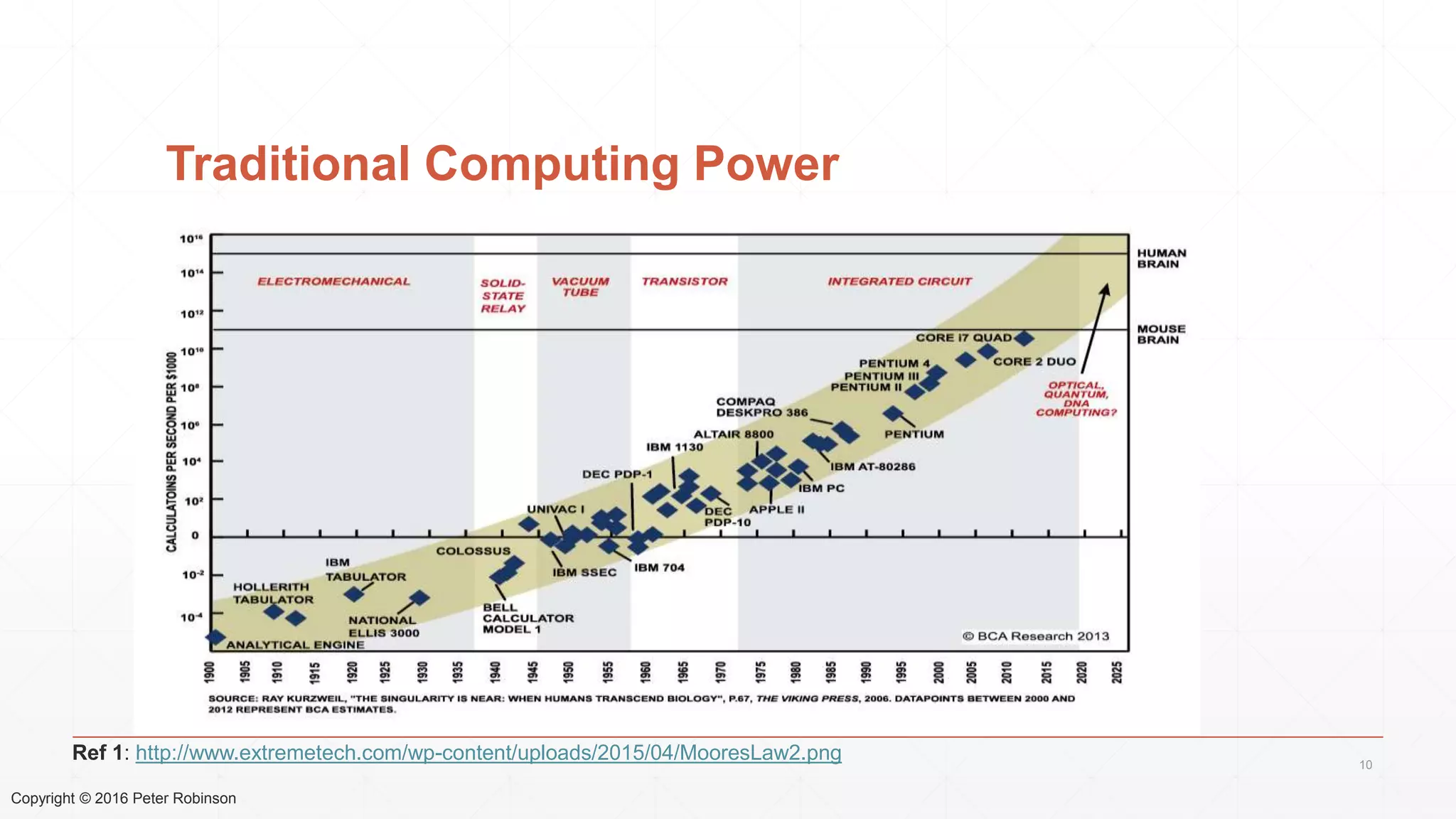
Traditional Computing Power
10
Ref 1: http://www.extremetech.com/wp-content/uploads/2015/04/MooresLaw2.png
Copyright © 2016 Peter Robinson
Security
Strength
RSA ECC Hash
Preimage
Hash
Collision
80 1024 RIPEMD160
112 2048
128 3072 secp256k1 SHA256, Keccak-256,
SHA512/256
160 RIPEMD160
256 SHA256, Keccak-256,
SHA512/256
SHA512, SHA3,512
512 SHA512, SHA3,512
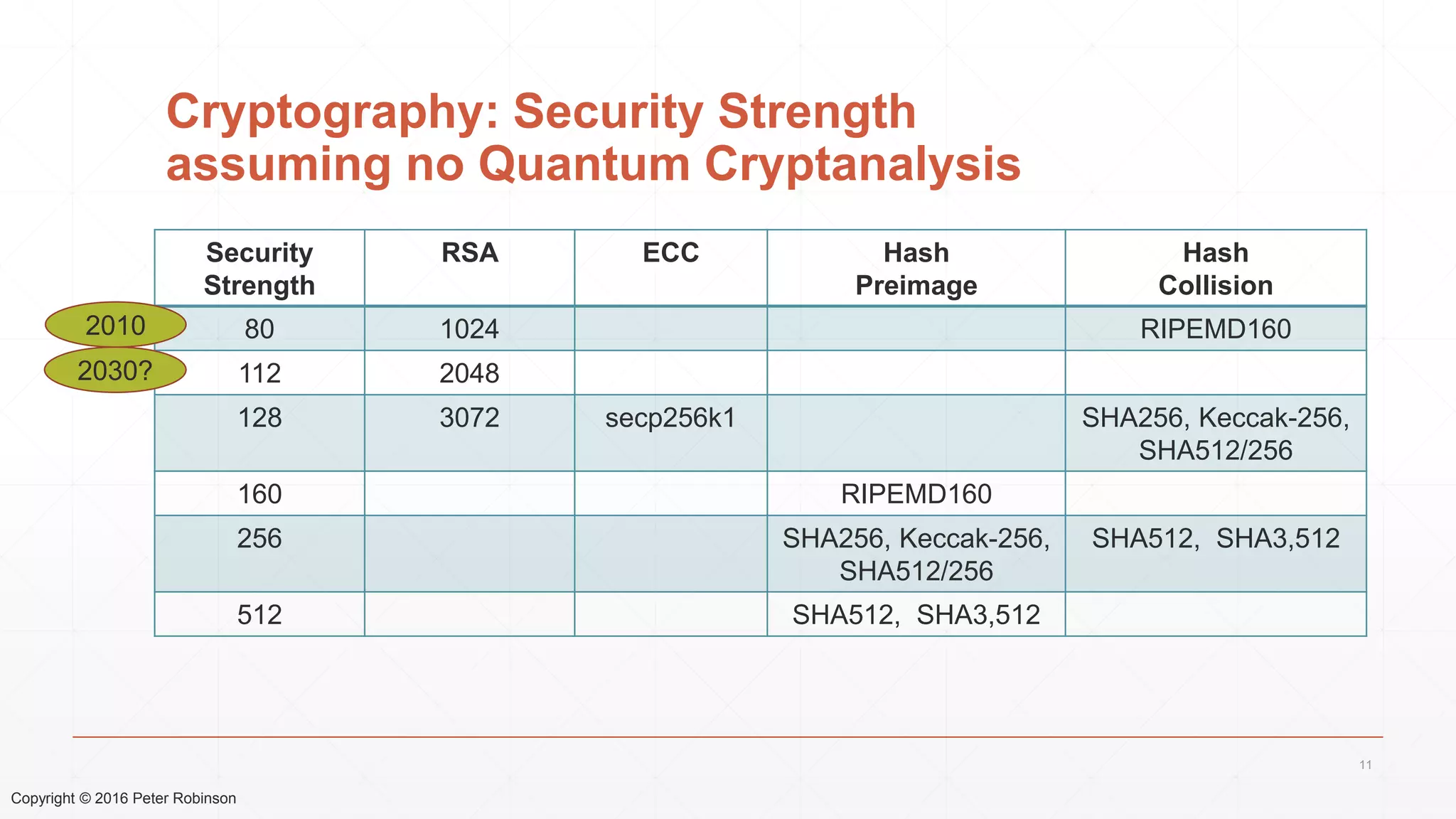
Cryptography: Security Strength
assuming no Quantum Cryptanalysis
11
2010
2030?
Copyright © 2016 Peter Robinson
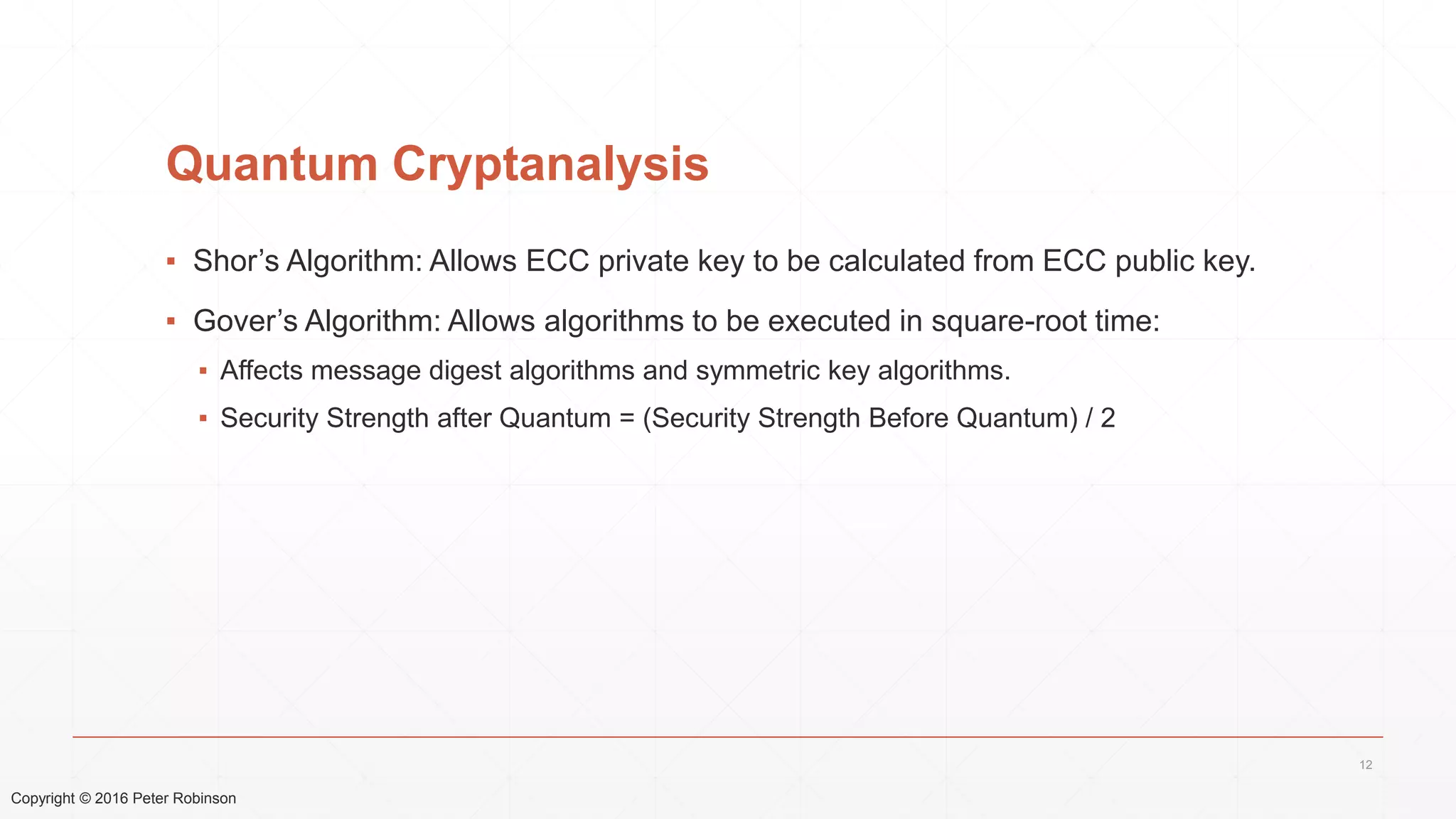
Quantum Cryptanalysis
▪ Shor’s Algorithm: Allows ECC private key to be calculated from ECC public key.
▪ Gover’s Algorithm: Allows algorithms to be executed in square-root time:
▪ Affects message digest algorithms and symmetric key algorithms.
▪ Security Strength after Quantum = (Security Strength Before Quantum) / 2
12
Copyright © 2016 Peter Robinson
Quantum Cryptanalysis
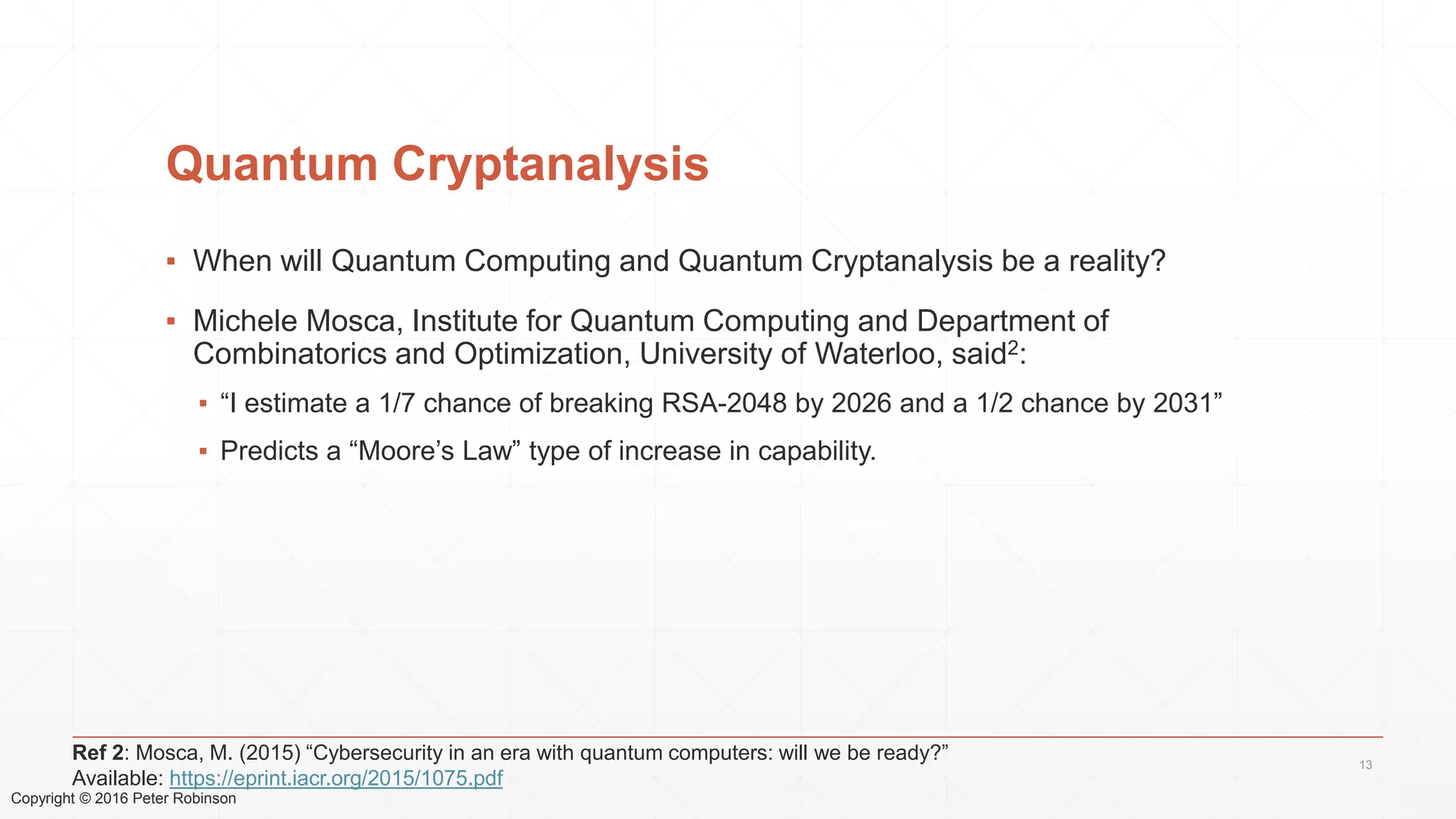
▪ When will Quantum Computing and Quantum Cryptanalysis be a reality?
▪ Michele Mosca, Institute for Quantum Computing and Department of
Combinatorics and Optimization, University of Waterloo, said2:
▪ “I estimate a 1/7 chance of breaking RSA-2048 by 2026 and a 1/2 chance by 2031”
▪ Predicts a “Moore’s Law” type of increase in capability.
13
Ref 2: Mosca, M. (2015) “Cybersecurity in an era with quantum computers: will we be ready?”
Available: https://eprint.iacr.org/2015/1075.pdf
Copyright © 2016 Peter Robinson
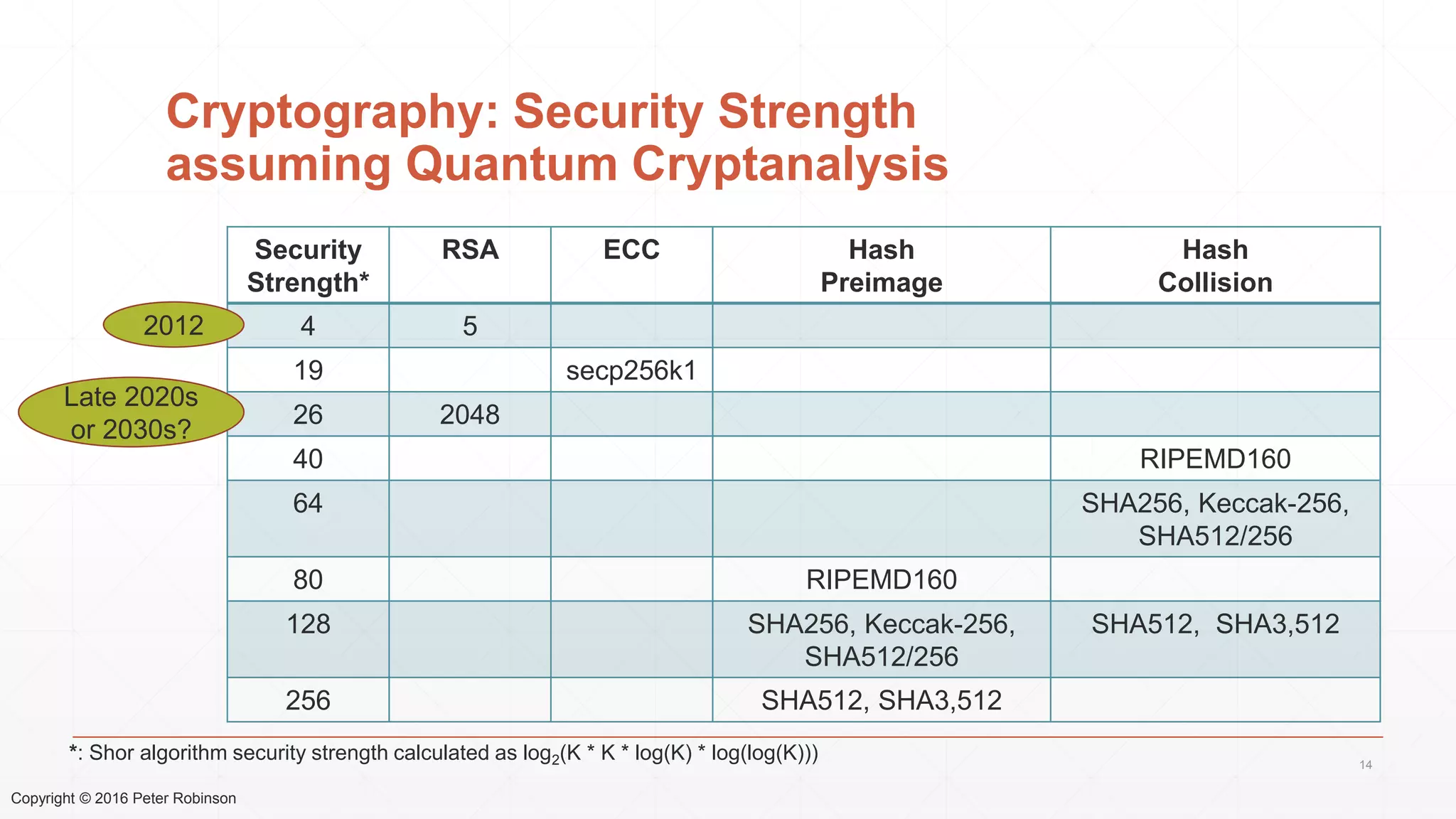
Cryptography: Security Strength
assuming Quantum Cryptanalysis
14
Security
Strength*
RSA ECC Hash
Preimage
Hash
Collision
4 5
19 secp256k1
26 2048
40 RIPEMD160
64 SHA256, Keccak-256,
SHA512/256
80 RIPEMD160
128 SHA256, Keccak-256,
SHA512/256
SHA512, SHA3,512
256 SHA512, SHA3,512
2012
*: Shor algorithm security strength calculated as log2(K * K * log(K) * log(log(K)))
Late 2020s
or 2030s?
Copyright © 2016 Peter Robinson
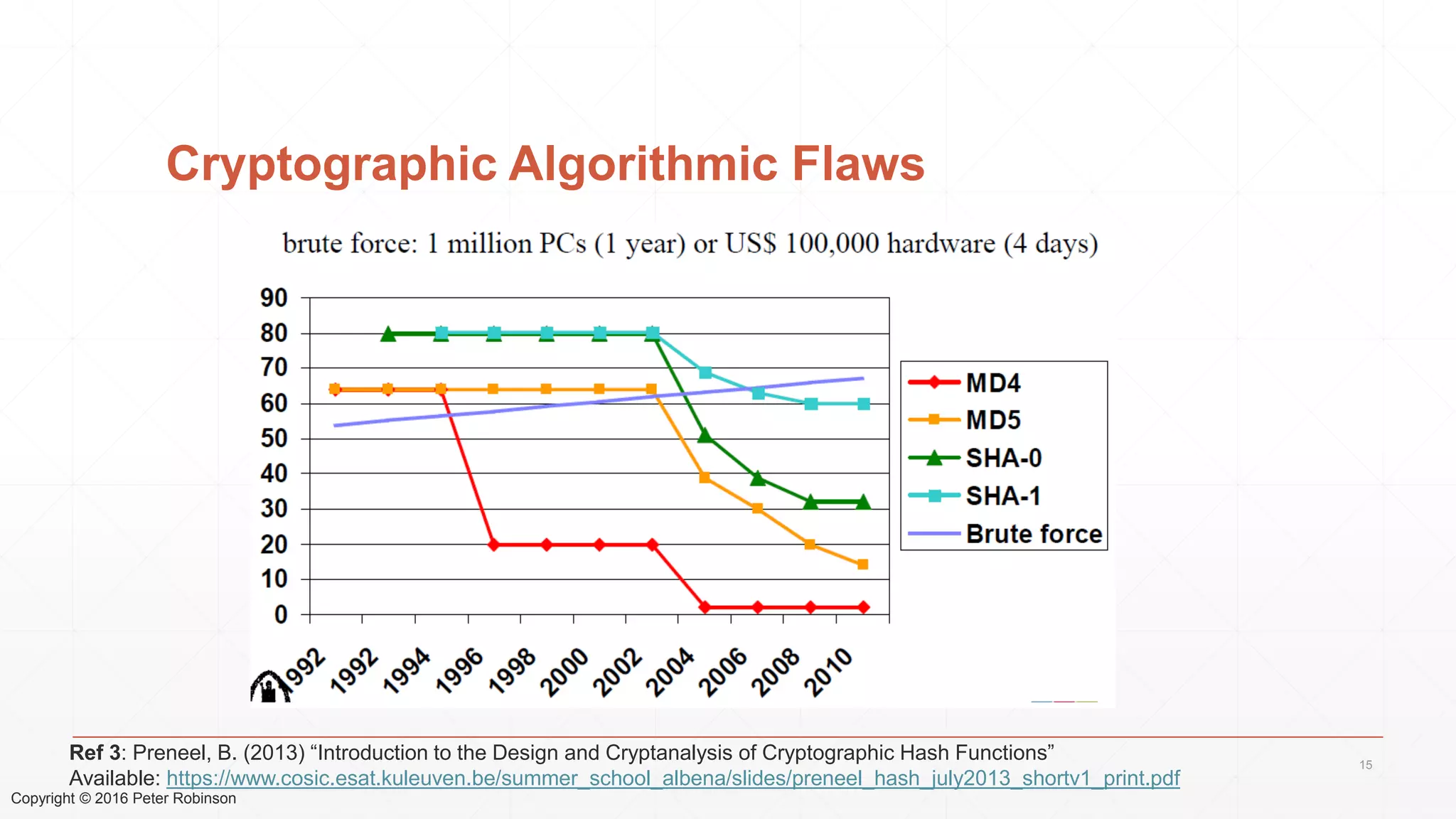
Cryptographic Algorithmic Flaws
15
Ref 3: Preneel, B. (2013) “Introduction to the Design and Cryptanalysis of Cryptographic Hash Functions”
Available: https://www.cosic.esat.kuleuven.be/summer_school_albena/slides/preneel_hash_july2013_shortv1_print.pdf
Copyright © 2016 Peter Robinson
Blockchain Platforms and
Cryptanalysis
Copyright © 2016 Peter Robinson
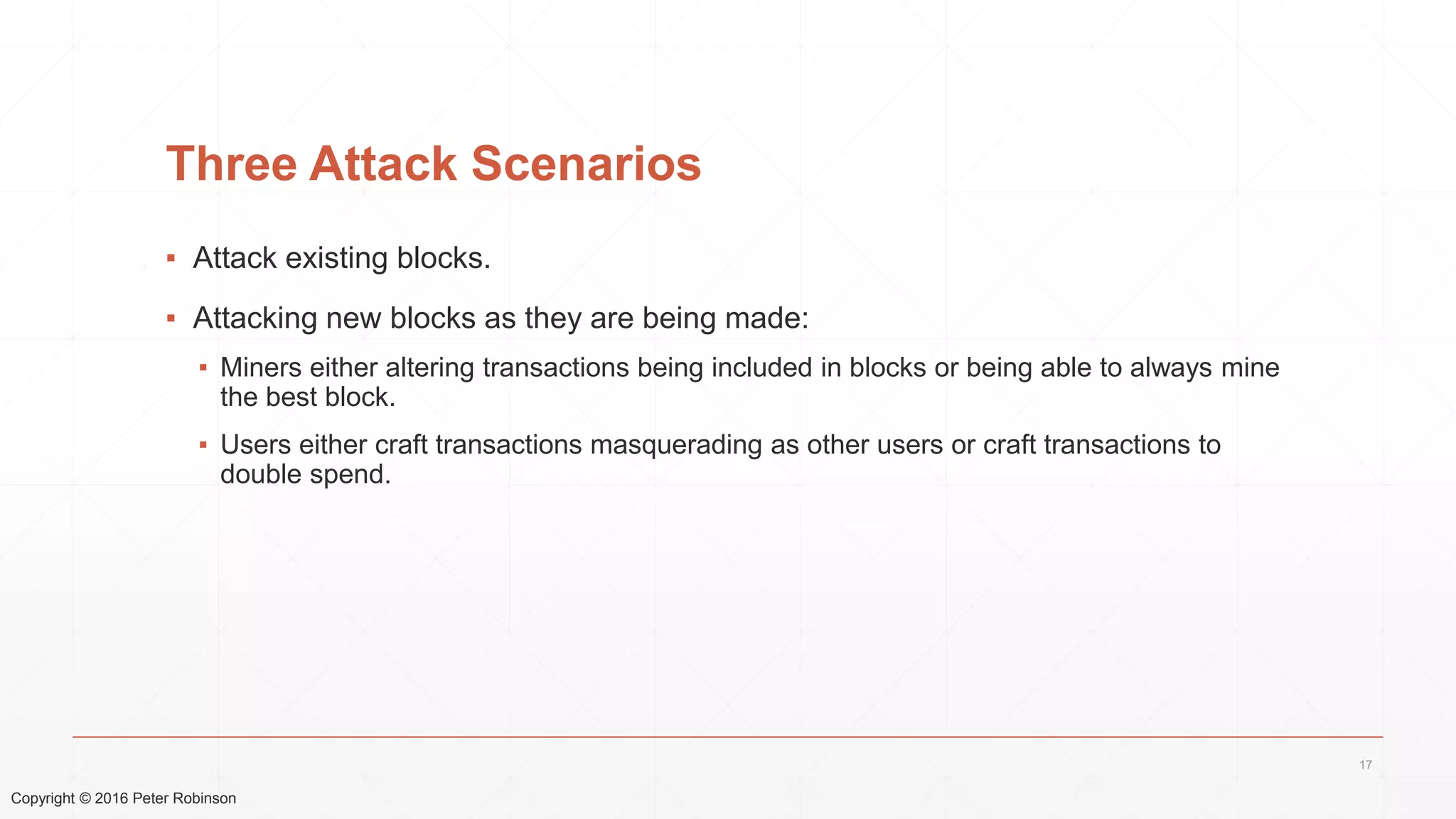
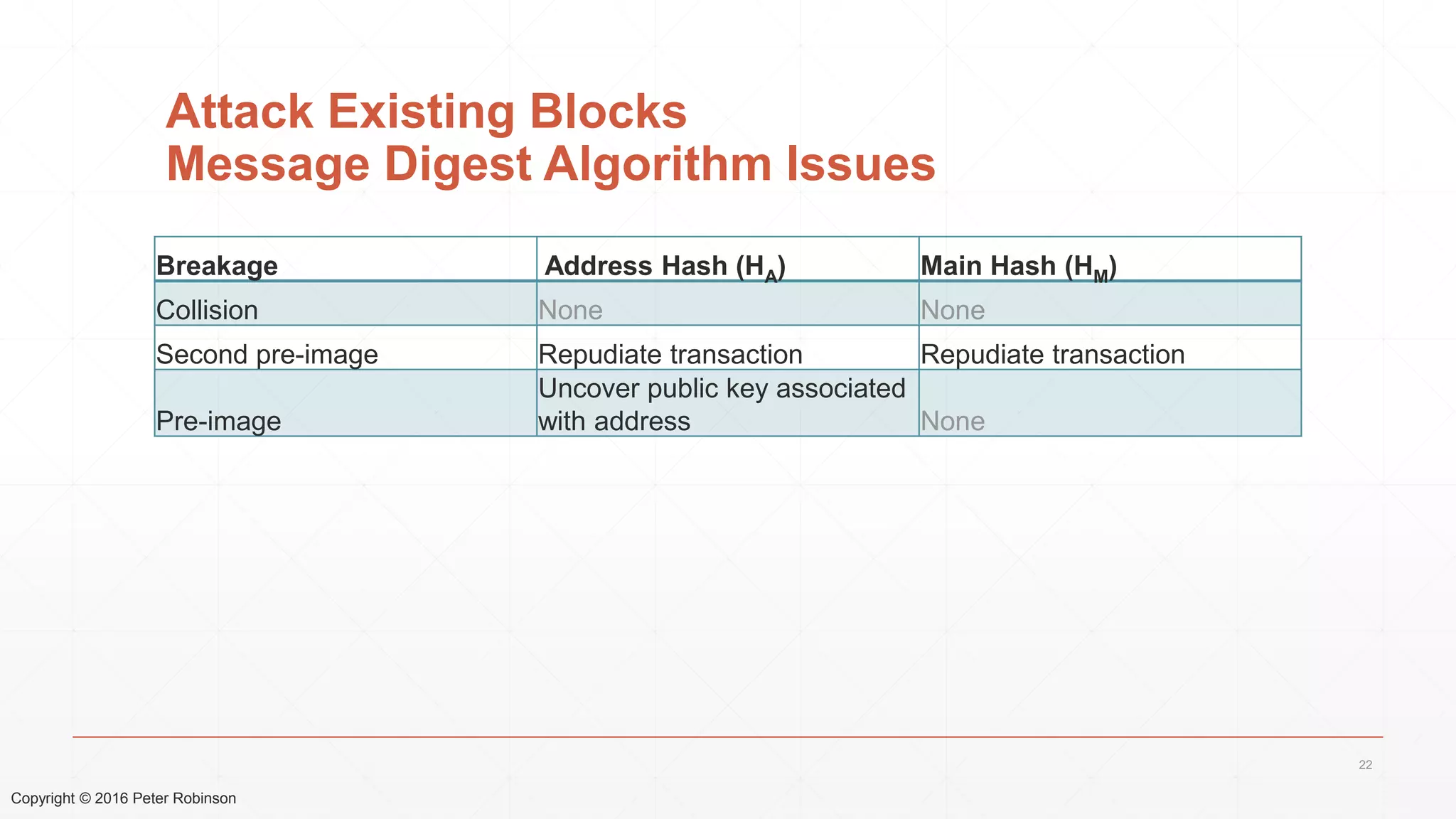
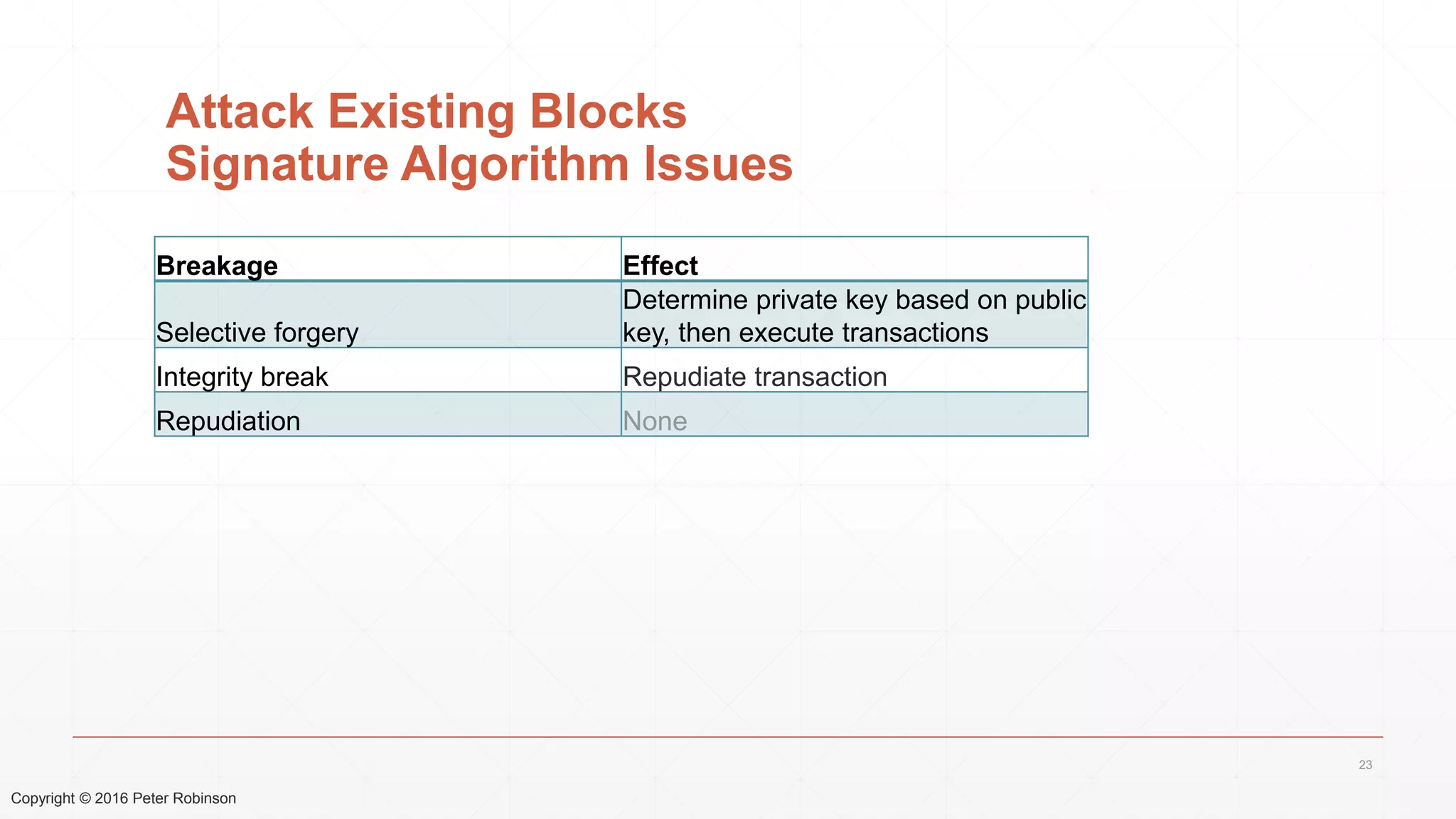
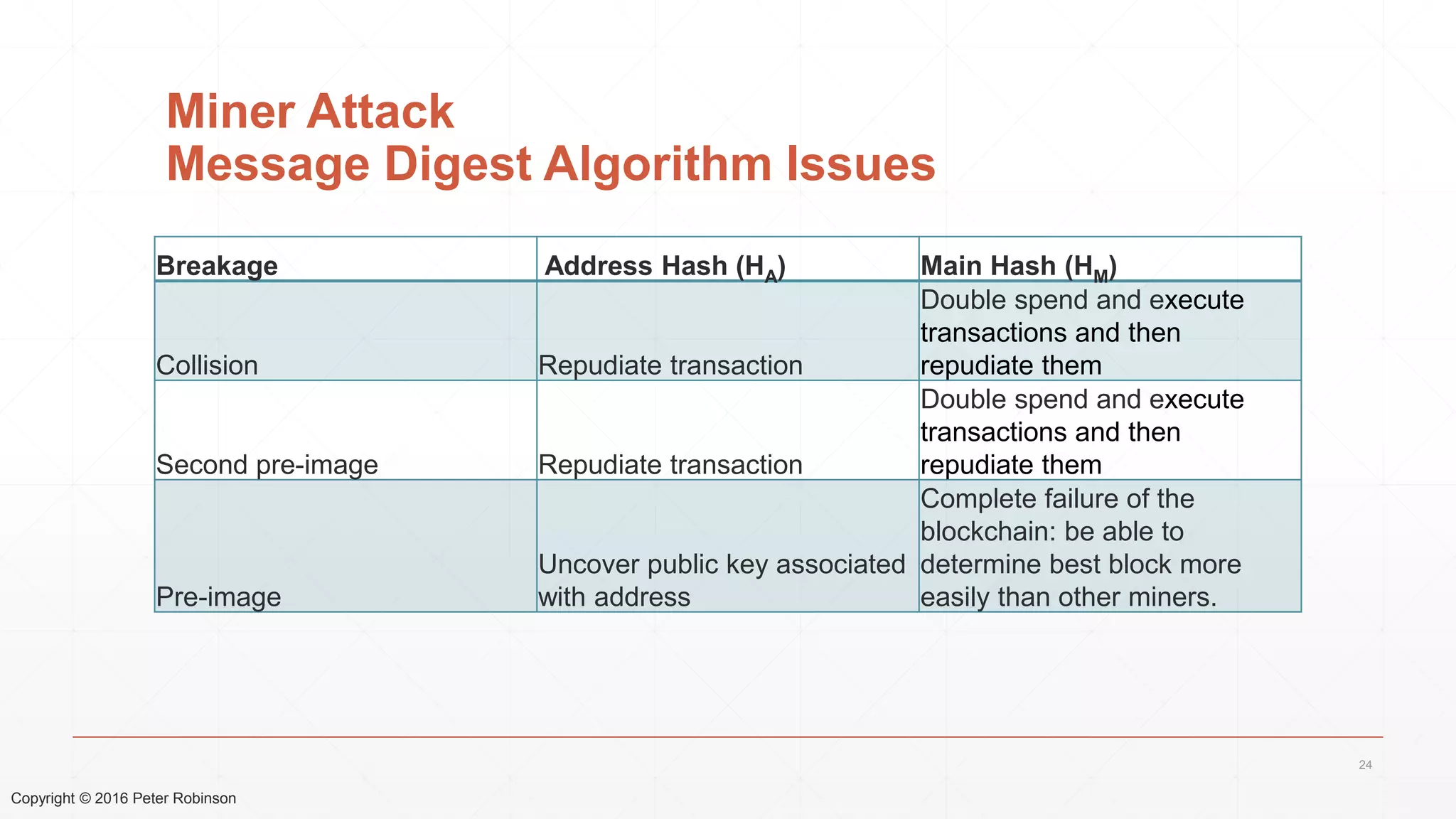
Three Attack Scenarios
▪ Attack existing blocks.
▪ Attacking new blocks as they are being made:
▪ Miners either altering transactions being included in blocks or being able to always mine
the best block.
▪ Users either craft transactions masquerading as other users or craft transactions to
double spend.
17
Copyright © 2016 Peter Robinson
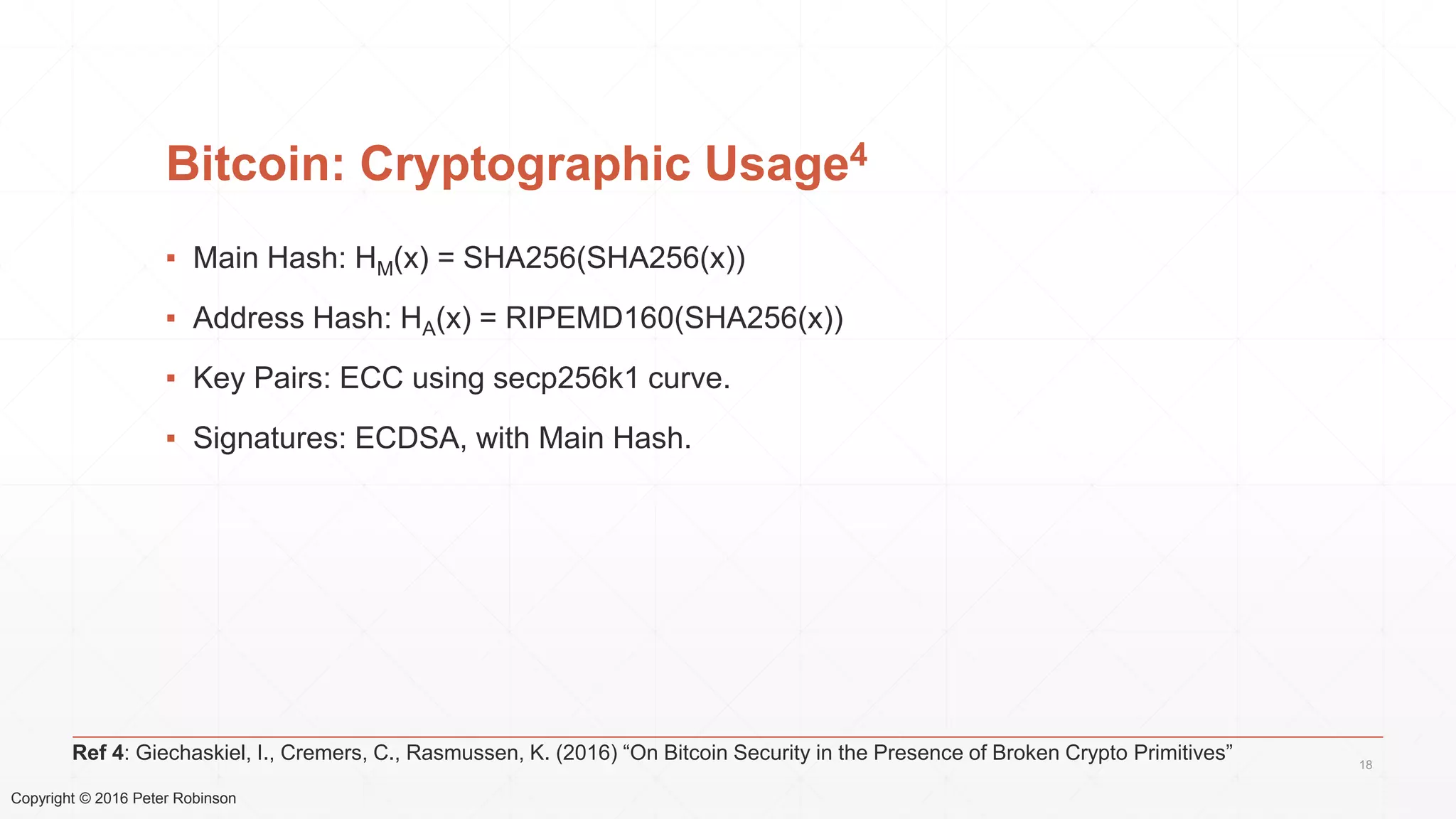
Bitcoin: Cryptographic Usage4
▪ Main Hash: HM(x) = SHA256(SHA256(x))
▪ Address Hash: HA(x) = RIPEMD160(SHA256(x))
▪ Key Pairs: ECC using secp256k1 curve.
▪ Signatures: ECDSA, with Main Hash.
18
Ref 4: Giechaskiel, I., Cremers, C., Rasmussen, K. (2016) “On Bitcoin Security in the Presence of Broken Crypto Primitives”
Copyright © 2016 Peter Robinson
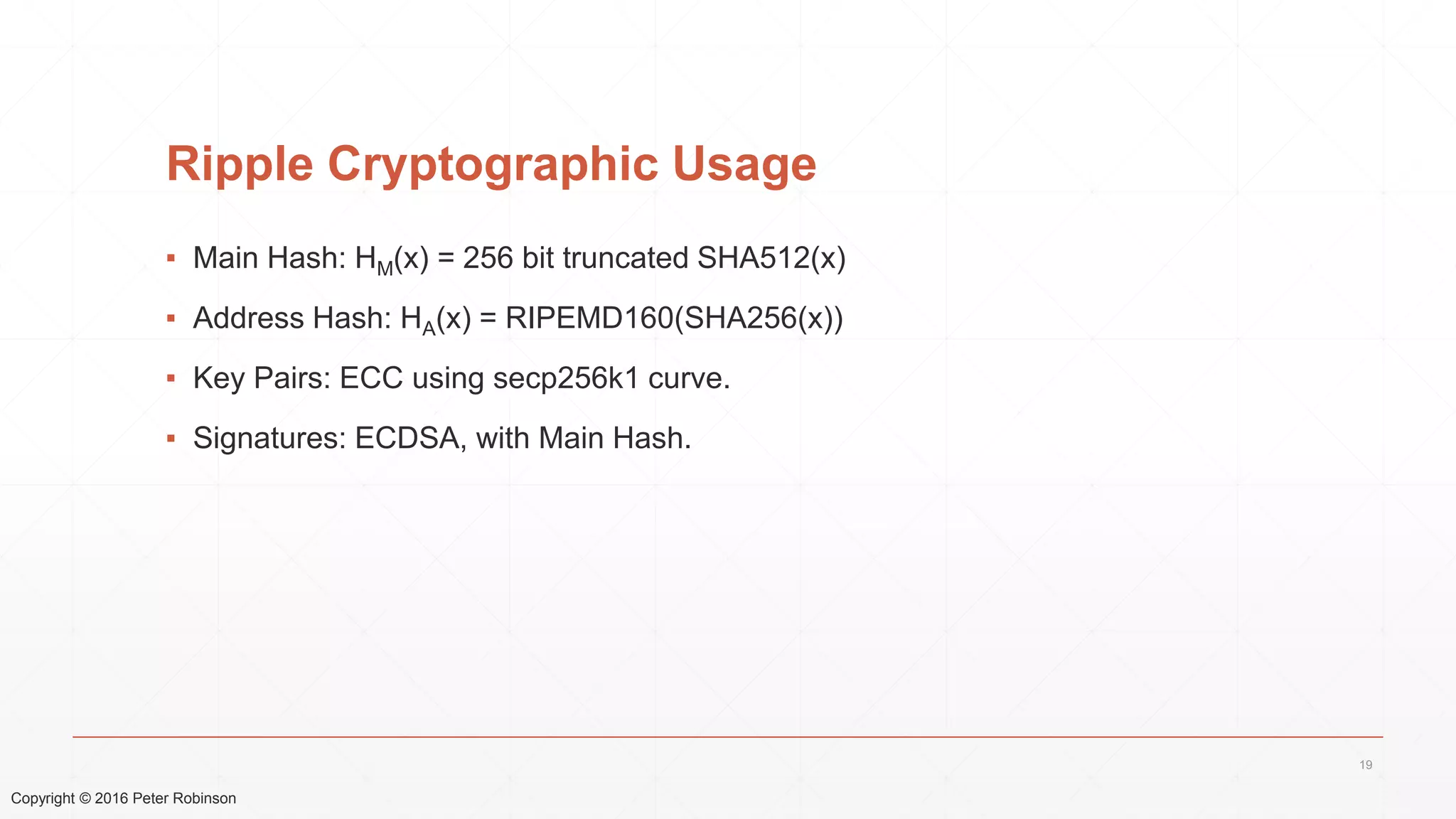
Ripple Cryptographic Usage
▪ Main Hash: HM(x) = 256 bit truncated SHA512(x)
▪ Address Hash: HA(x) = RIPEMD160(SHA256(x))
▪ Key Pairs: ECC using secp256k1 curve.
▪ Signatures: ECDSA, with Main Hash.
19
Copyright © 2016 Peter Robinson
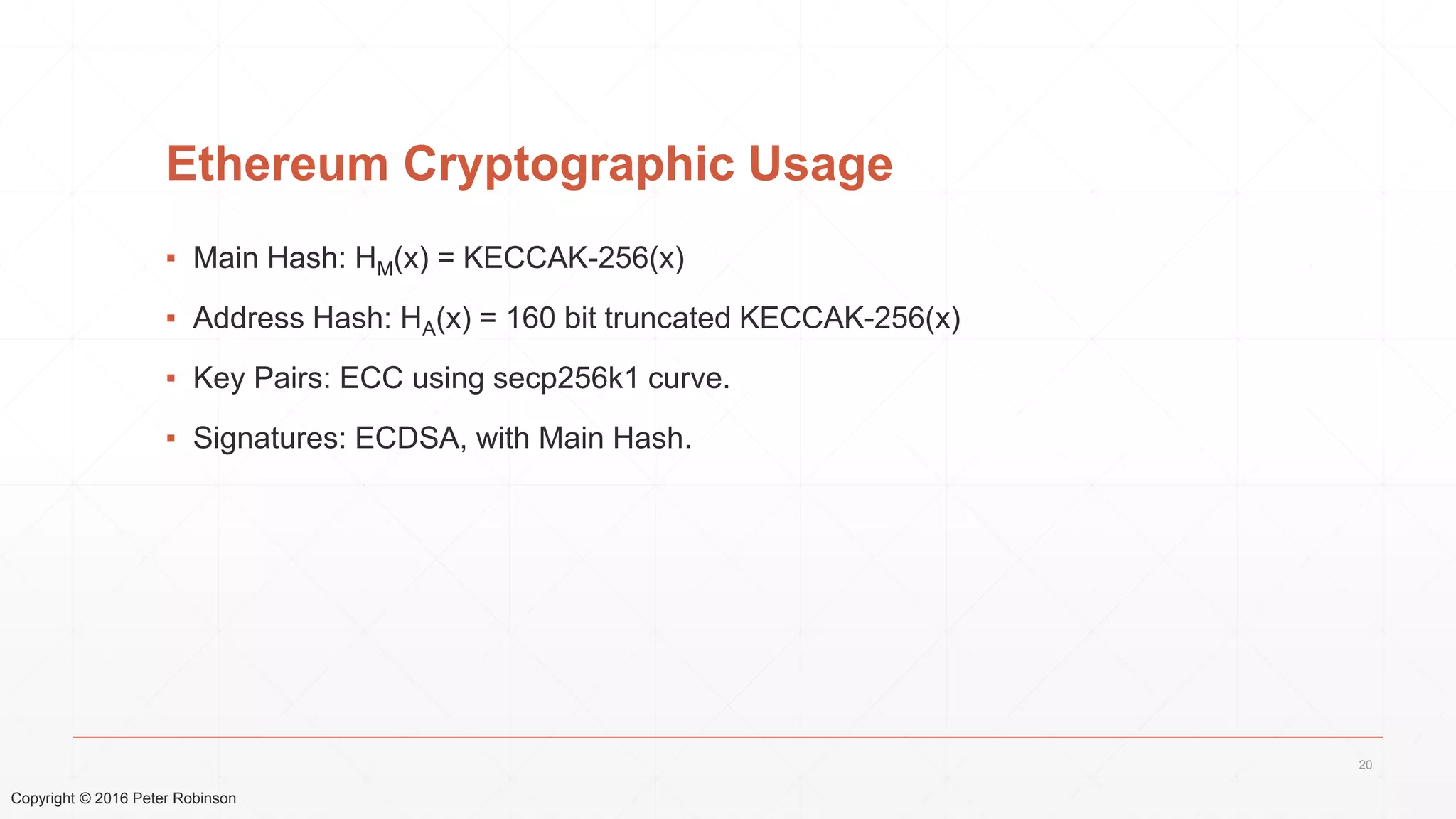
Ethereum Cryptographic Usage
▪ Main Hash: HM(x) = KECCAK-256(x)
▪ Address Hash: HA(x) = 160 bit truncated KECCAK-256(x)
▪ Key Pairs: ECC using secp256k1 curve.
▪ Signatures: ECDSA, with Main Hash.
20
Copyright © 2016 Peter Robinson
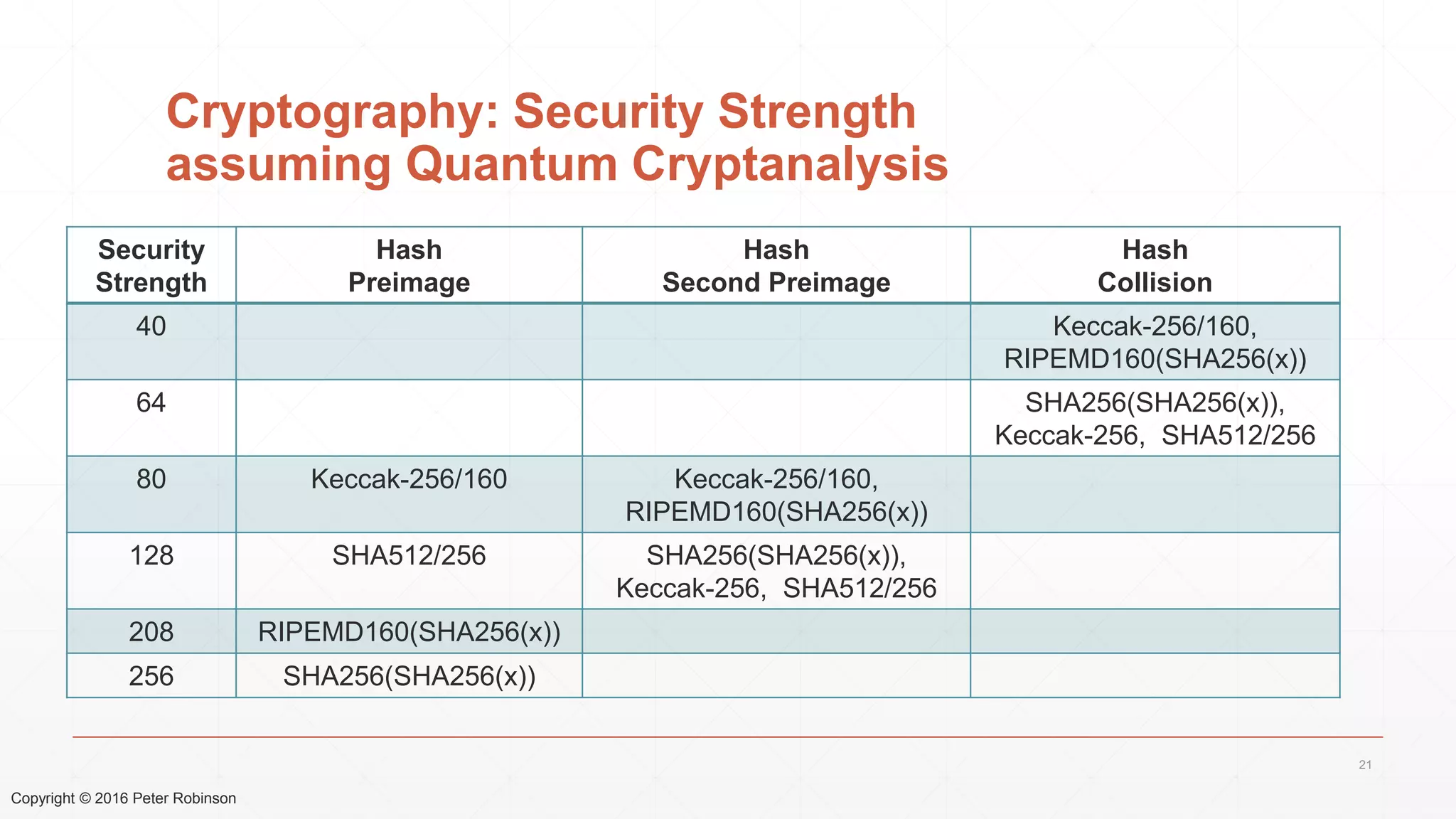
Cryptography: Security Strength
assuming Quantum Cryptanalysis
21
Security
Strength
Hash
Preimage
Hash
Second Preimage
Hash
Collision
40 Keccak-256/160,
RIPEMD160(SHA256(x))
64 SHA256(SHA256(x)),
Keccak-256, SHA512/256
80 Keccak-256/160 Keccak-256/160,
RIPEMD160(SHA256(x))
128 SHA512/256 SHA256(SHA256(x)),
Keccak-256, SHA512/256
208 RIPEMD160(SHA256(x))
256 SHA256(SHA256(x))
Copyright © 2016 Peter Robinson
Attack Existing Blocks
Message Digest Algorithm Issues
Breakage Address Hash (HA) Main Hash (HM)
Collision None None
Second pre-image Repudiate transaction Repudiate transaction
Pre-image
Uncover public key associated
with address None
22
Copyright © 2016 Peter Robinson
Attack Existing Blocks
Signature Algorithm Issues
Breakage Effect
Selective forgery
Determine private key based on public
key, then execute transactions
Integrity break Repudiate transaction
Repudiation None
23
Copyright © 2016 Peter Robinson
Miner Attack
Message Digest Algorithm Issues
Breakage Address Hash (HA) Main Hash (HM)
Collision Repudiate transaction
Double spend and execute
transactions and then
repudiate them
Second pre-image Repudiate transaction
Double spend and execute
transactions and then
repudiate them
Pre-image
Uncover public key associated
with address
Complete failure of the
blockchain: be able to
determine best block more
easily than other miners.

24
Copyright © 2016 Peter Robinson
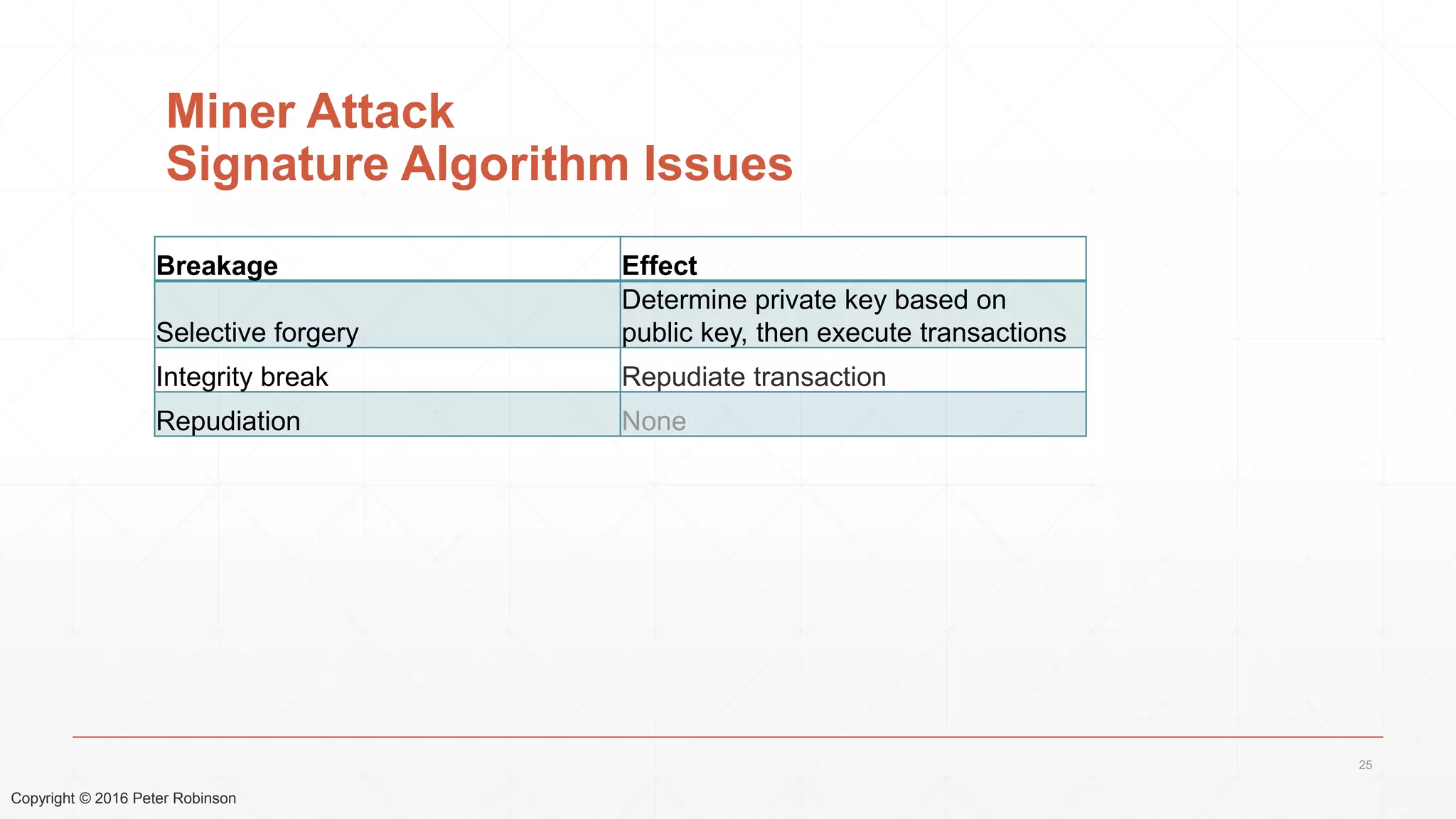
Miner Attack
Signature Algorithm Issues
Breakage Effect
Selective forgery
Determine private key based on
public key, then execute transactions
Integrity break Repudiate transaction
Repudiation None
25
Copyright © 2016 Peter Robinson
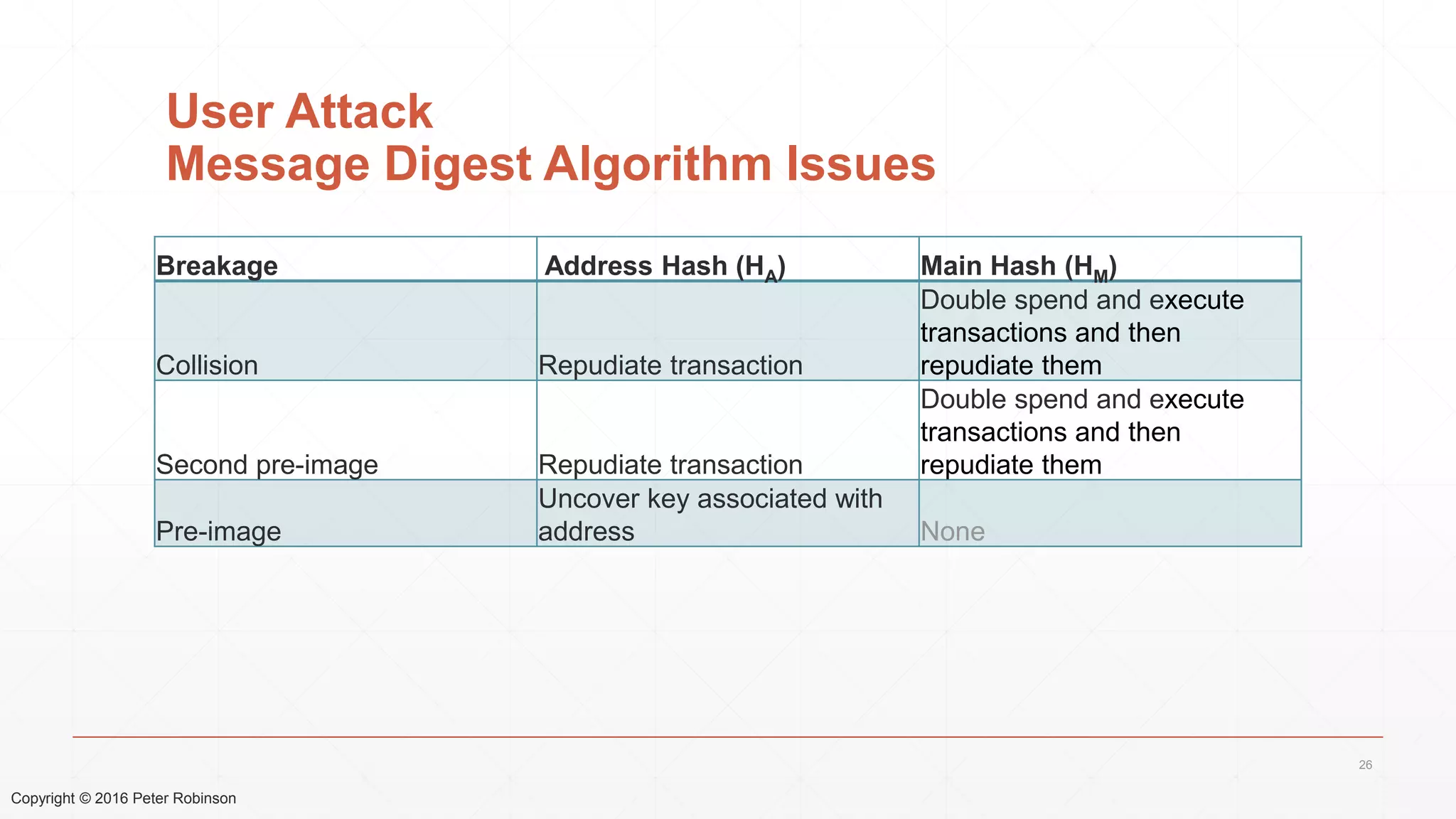
User Attack
Message Digest Algorithm Issues
Breakage Address Hash (HA) Main Hash (HM)
Collision Repudiate transaction
Double spend and execute
transactions and then
repudiate them
Second pre-image Repudiate transaction
Double spend and execute
transactions and then
repudiate them
Pre-image
Uncover key associated with
address None
26
Copyright © 2016 Peter Robinson
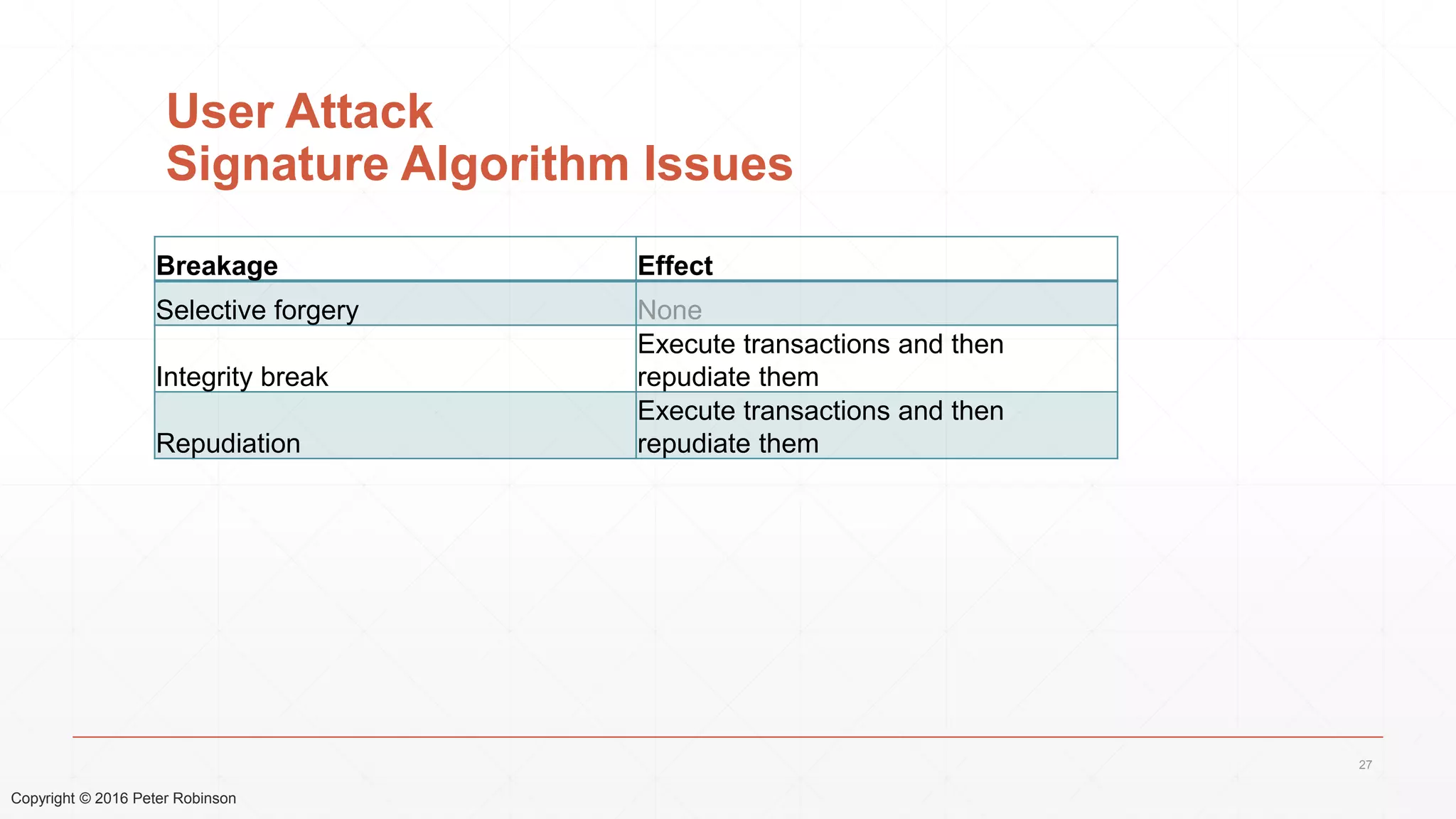
User Attack
Signature Algorithm Issues
Breakage Effect
Selective forgery None
Integrity break
Execute transactions and then
repudiate them
Repudiation
Execute transactions and then
repudiate them
27
Copyright © 2016 Peter Robinson
Mitigations
Copyright © 2016 Peter Robinson
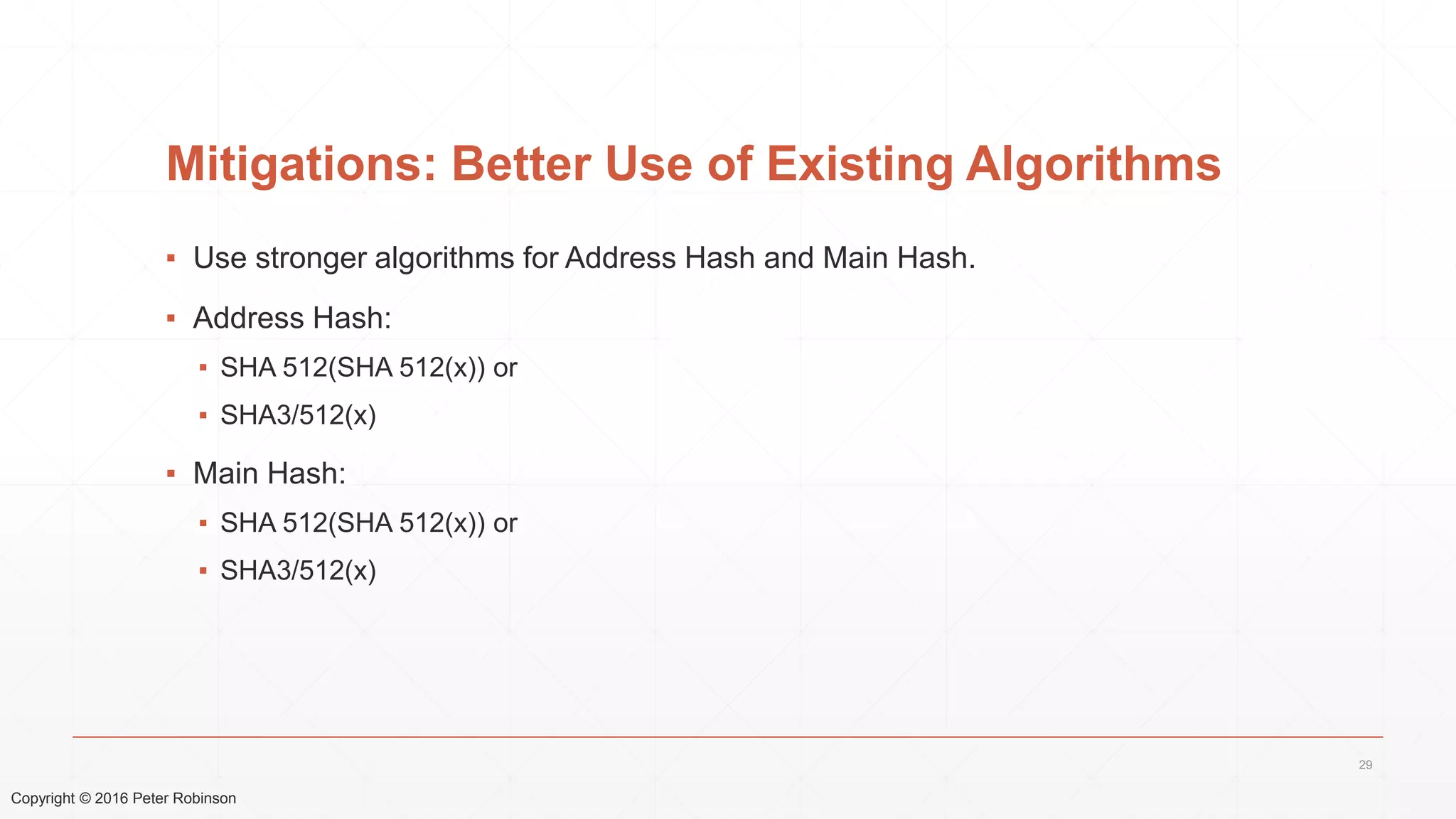
Mitigations: Better Use of Existing Algorithms
▪ Use stronger algorithms for Address Hash and Main Hash.
▪ Address Hash:
▪ SHA 512(SHA 512(x)) or
▪ SHA3/512(x)
▪ Main Hash:
▪ SHA 512(SHA 512(x)) or
▪ SHA3/512(x)
29
Copyright © 2016 Peter Robinson
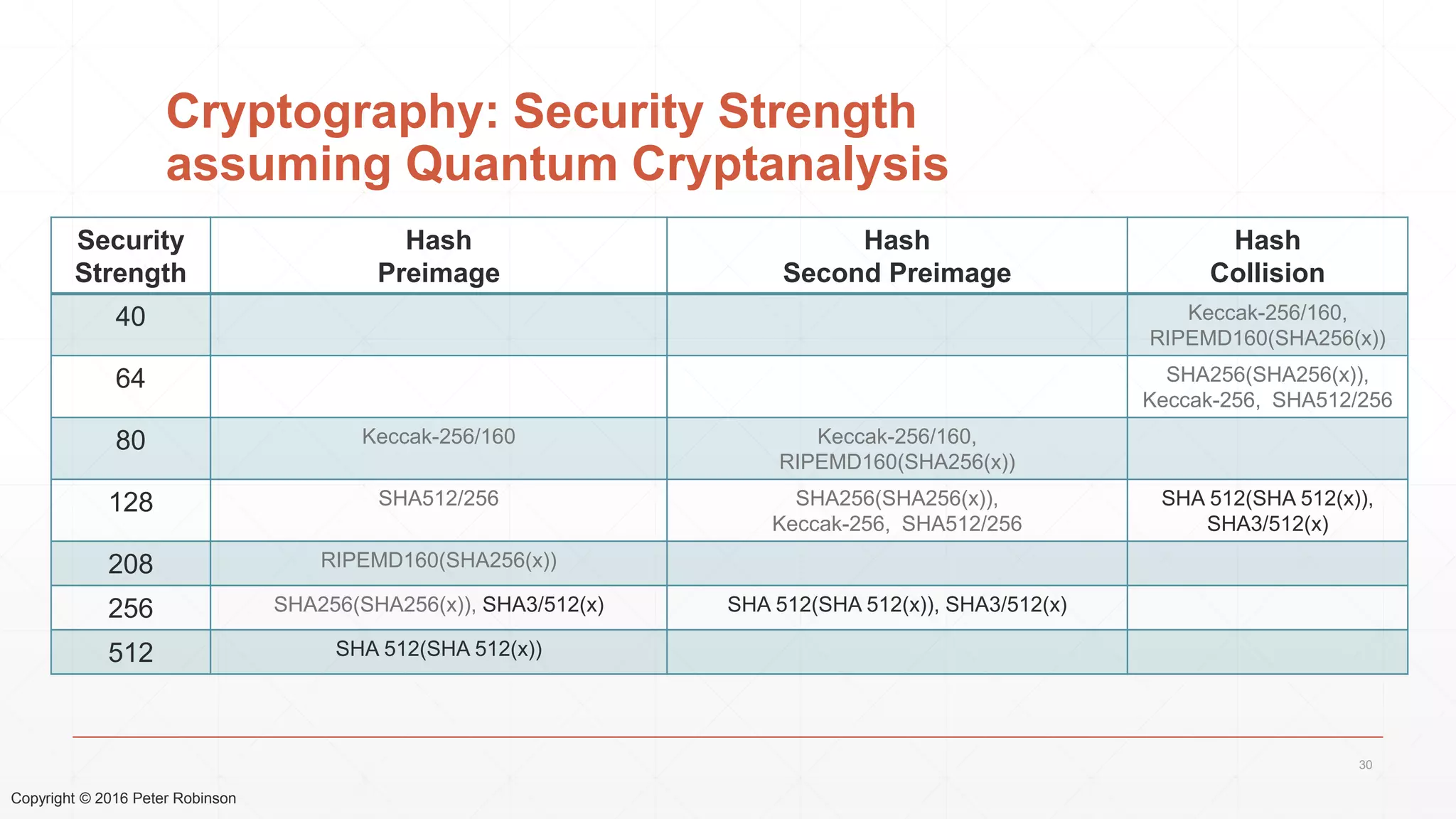
Cryptography: Security Strength
assuming Quantum Cryptanalysis
30
Security
Strength
Hash
Preimage
Hash
Second Preimage
Hash
Collision
40 Keccak-256/160,
RIPEMD160(SHA256(x))
64 SHA256(SHA256(x)),
Keccak-256, SHA512/256
80 Keccak-256/160 Keccak-256/160,
RIPEMD160(SHA256(x))
128 SHA512/256 SHA256(SHA256(x)),
Keccak-256, SHA512/256
SHA 512(SHA 512(x)),
SHA3/512(x)
208 RIPEMD160(SHA256(x))
256 SHA256(SHA256(x)), SHA3/512(x) SHA 512(SHA 512(x)), SHA3/512(x)
512 SHA 512(SHA 512(x))
Copyright © 2016 Peter Robinson
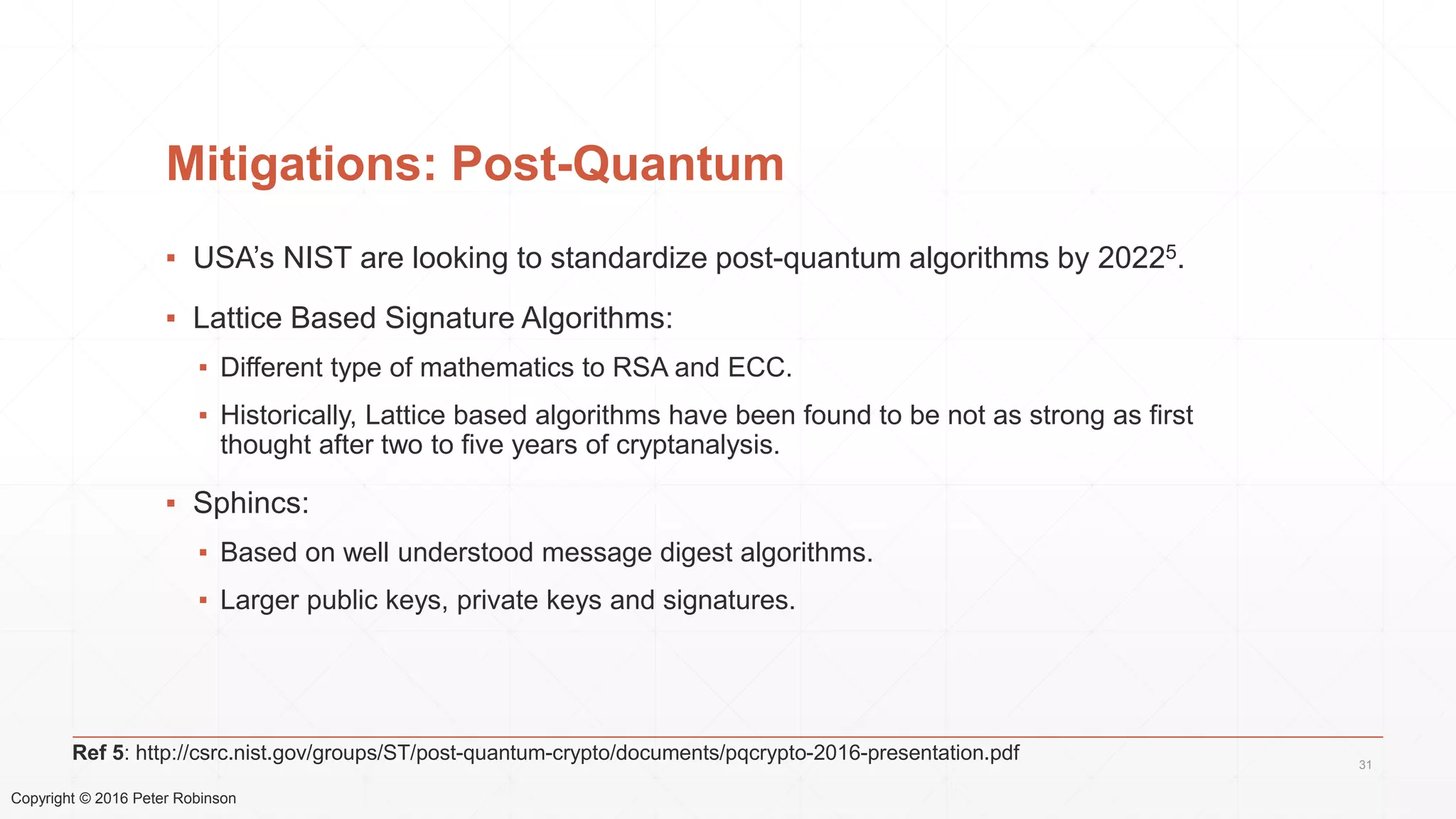
Mitigations: Post-Quantum
▪ USA’s NIST are looking to standardize post-quantum algorithms by 20225.
▪ Lattice Based Signature Algorithms:
▪ Different type of mathematics to RSA and ECC.
▪ Historically, Lattice based algorithms have been found to be not as strong as first
thought after two to five years of cryptanalysis.
▪ Sphincs:
▪ Based on well understood message digest algorithms.
▪ Larger public keys, private keys and signatures.
31
Ref 5: http://csrc.nist.gov/groups/ST/post-quantum-crypto/documents/pqcrypto-2016-presentation.pdf
Copyright © 2016 Peter Robinson
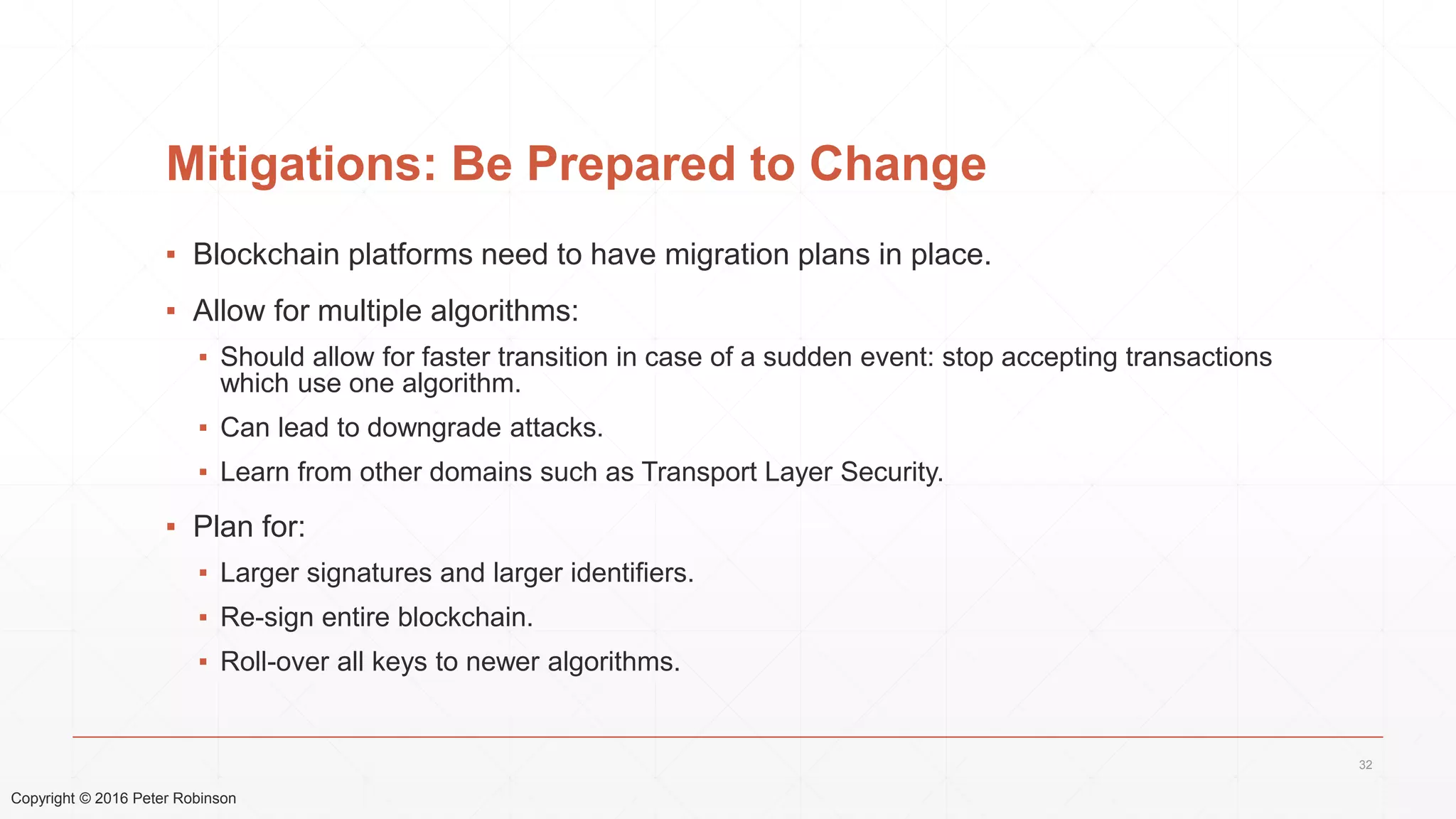
Mitigations: Be Prepared to Change
▪ Blockchain platforms need to have migration plans in place.
▪ Allow for multiple algorithms:
▪ Should allow for faster transition in case of a sudden event: stop accepting transactions
which use one algorithm.
▪ Can lead to downgrade attacks.
▪ Learn from other domains such as Transport Layer Security.
▪ Plan for:
▪ Larger signatures and larger identifiers.
▪ Re-sign entire blockchain.
▪ Roll-over all keys to newer algorithms.
32
Copyright © 2016 Peter Robinson
Mitigation for
Active Attacks against
Distributed Systems
Copyright © 2016 Peter Robinson
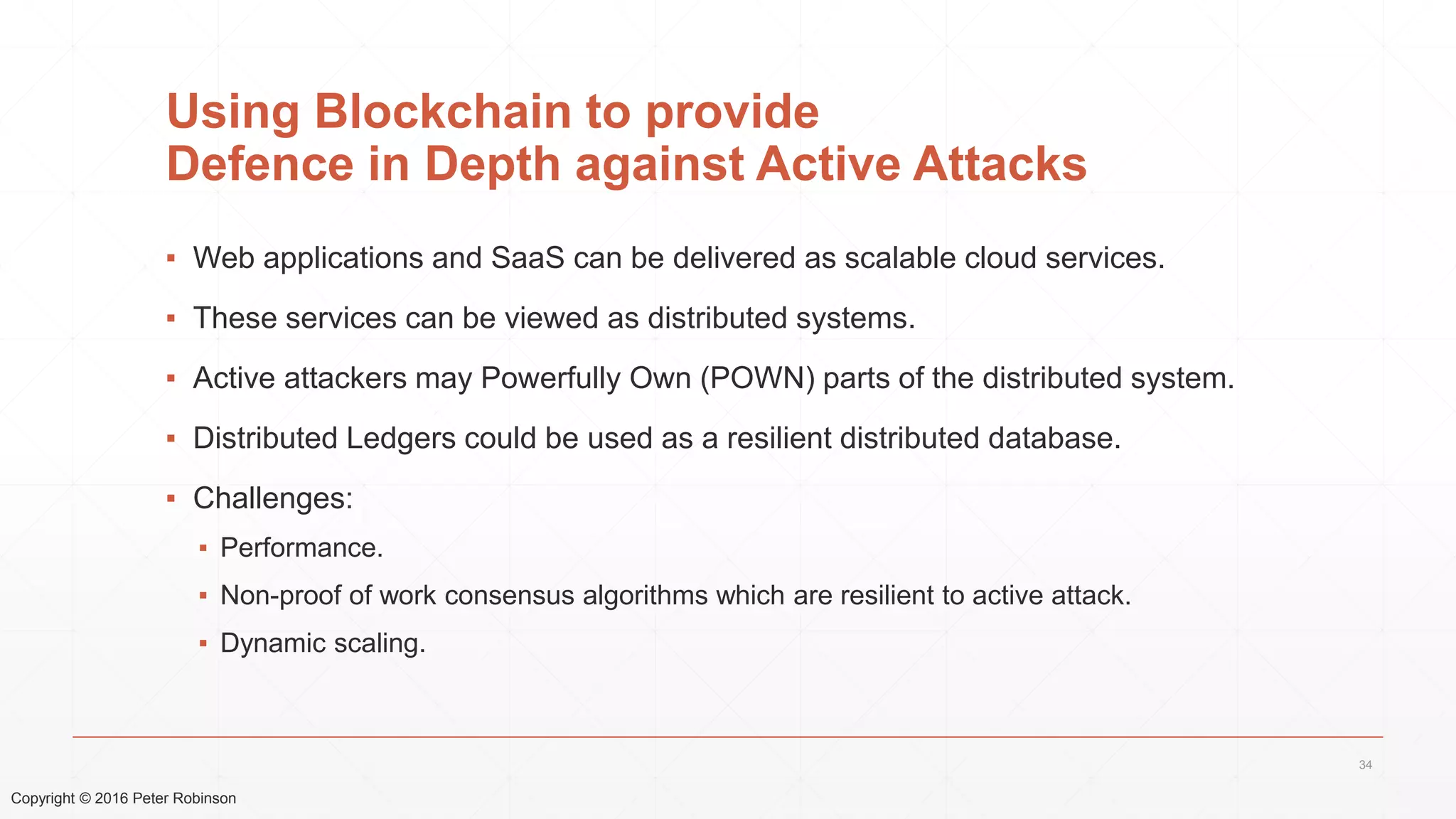
Using Blockchain to provide
Defence in Depth against Active Attacks
▪ Web applications and SaaS can be delivered as scalable cloud services.
▪ These services can be viewed as distributed systems.
▪ Active attackers may Powerfully Own (POWN) parts of the distributed system.
▪ Distributed Ledgers could be used as a resilient distributed database.
▪ Challenges:
▪ Performance.
▪ Non-proof of work consensus algorithms which are resilient to active attack.
▪ Dynamic scaling.
34
Copyright © 2016 Peter Robinson
Closing
Copyright © 2016 Peter Robinson
Future Work
▪ More detailed analysis to verify the results presented herein.
▪ Hyper Ledger needs to be reviewed.
▪ Proof of Stake protocols need to be considered.
36
Copyright © 2016 Peter Robinson
Summary
▪ Cryptography is a dynamic field. Things change:
▪ Quantum Cryptanalysis may become a reality.
▪ Processing power is still ever increasing despite declarations, “Moore’s Law is dead”.
▪ Breaks in cryptographic algorithms happen from time to time.
▪ Plan for change:
▪ Do mitigation planning and determine migration paths.
▪ Start executing changes now which can be done now.
37
Copyright © 2016 Peter Robinson
Questions
38

Blockchain and Smart Contract Long Term Security (updated)

  • 1.
    Copyright © 2016Peter Robinson Blockchain and Smart Contract Long Term Security Peter Robinson, peter.robinson@sent.com Updated November 18, 2016
  • 2.
    Copyright © 2016Peter Robinson Overview ▪ Distributed Ledger and Smart Contract systems have as an underlying assumption that once transactions are in a block chain, they are locked-in forever. ▪ This presentation analyses whether this immutability can actually be delivered in the long term, given increasing traditional computational power, the emergence of quantum computing, and the possibility of cryptographic algorithmic flaws. ▪ Additionally, an idea about distributed systems security is presented. 2
  • 3.
    Copyright © 2016Peter Robinson Caveat on results in these slides ▪ Tentative results are presented herein. ▪ More detailed analysis is needed. 3
  • 4.
    Copyright © 2016Peter Robinson Agenda ▪ Blockchain and Smart Contract Platforms Long Term Security: ▪ Cryptography and Cryptanalysis. ▪ Blockchain Platforms and Cryptanalysis. ▪ Mitigations. ▪ Mitigation for Active Attacks against Distributed Systems. 4
  • 5.
    Copyright © 2016Peter Robinson Cryptography & Cryptanalysis
  • 6.
    Copyright © 2016Peter Robinson Cryptography: Algorithms ▪ Digest Algorithm (Hash): SHA256, SHA512, RIPEMD160, KECCAK, SHA3/256: ▪ Variable length input -> Fixed Length Output. ▪ Signing: ECDSA (secp256k1)/Digest Algorithm, RSA/Digest Algorithm: ▪ Sign with private key, verify with public key. 6
  • 7.
    Copyright © 2016Peter Robinson Cryptography: Message Digests / Hashes 7 ? Preimage Resistance Hash n h(x) x Second Preimage Resistance Hash n h(x) ? Hash h(x’) ≠ = ? Collision Resistance Hash n/2 h(x) ? Hash h(x’) ≠ =
  • 8.
    Copyright © 2016Peter Robinson Cryptography: Signatures ▪ Forgeability: Recover private key from public key. ▪ Non-repudiation: Have two public keys P1 and P2 which verify the same signature. ▪ Integrity: Have two message digests M1 and M2 which when signed with public key P result in the same signature. 8
  • 9.
    Copyright © 2016Peter Robinson Cryptography: Security Strength (Assuming no Quantum Cryptanalysis) 9 Security Strength RSA ECC Hash Preimage Hash Collision 80 1024 RIPEMD160 112 2048 128 3072 secp256k1 SHA256, Keccak-256, SHA512/256 160 RIPEMD160 256 SHA256, Keccak-256, SHA512/256 SHA512 SHA3,512 512 SHA512 SHA3,512
  • 10.
    Copyright © 2016Peter Robinson Traditional Computing Power 10 Ref 1: http://www.extremetech.com/wp-content/uploads/2015/04/MooresLaw2.png
  • 11.
    Copyright © 2016Peter Robinson Security Strength RSA ECC Hash Preimage Hash Collision 80 1024 RIPEMD160 112 2048 128 3072 secp256k1 SHA256, Keccak-256, SHA512/256 160 RIPEMD160 256 SHA256, Keccak-256, SHA512/256 SHA512, SHA3,512 512 SHA512, SHA3,512 Cryptography: Security Strength assuming no Quantum Cryptanalysis 11 2010 2030?
  • 12.
    Copyright © 2016Peter Robinson Quantum Cryptanalysis ▪ Shor’s Algorithm: Allows ECC private key to be calculated from ECC public key. ▪ Gover’s Algorithm: Allows algorithms to be executed in square-root time: ▪ Affects message digest algorithms and symmetric key algorithms. ▪ Security Strength after Quantum = (Security Strength Before Quantum) / 2 12
  • 13.
    Copyright © 2016Peter Robinson Quantum Cryptanalysis ▪ When will Quantum Computing and Quantum Cryptanalysis be a reality? ▪ Michele Mosca, Institute for Quantum Computing and Department of Combinatorics and Optimization, University of Waterloo, said2: ▪ “I estimate a 1/7 chance of breaking RSA-2048 by 2026 and a 1/2 chance by 2031” ▪ Predicts a “Moore’s Law” type of increase in capability. 13 Ref 2: Mosca, M. (2015) “Cybersecurity in an era with quantum computers: will we be ready?” Available: https://eprint.iacr.org/2015/1075.pdf
  • 14.
    Copyright © 2016Peter Robinson Cryptography: Security Strength assuming Quantum Cryptanalysis 14 Security Strength* RSA ECC Hash Preimage Hash Collision 4 5 19 secp256k1 26 2048 40 RIPEMD160 64 SHA256, Keccak-256, SHA512/256 80 RIPEMD160 128 SHA256, Keccak-256, SHA512/256 SHA512, SHA3,512 256 SHA512, SHA3,512 2012 *: Shor algorithm security strength calculated as log2(K * K * log(K) * log(log(K))) Late 2020s or 2030s?
  • 15.
    Copyright © 2016Peter Robinson Cryptographic Algorithmic Flaws 15 Ref 3: Preneel, B. (2013) “Introduction to the Design and Cryptanalysis of Cryptographic Hash Functions” Available: https://www.cosic.esat.kuleuven.be/summer_school_albena/slides/preneel_hash_july2013_shortv1_print.pdf
  • 16.
    Copyright © 2016Peter Robinson Blockchain Platforms and Cryptanalysis
  • 17.
    Copyright © 2016Peter Robinson Three Attack Scenarios ▪ Attack existing blocks. ▪ Attacking new blocks as they are being made: ▪ Miners either altering transactions being included in blocks or being able to always mine the best block. ▪ Users either craft transactions masquerading as other users or craft transactions to double spend. 17
  • 18.
    Copyright © 2016Peter Robinson Bitcoin: Cryptographic Usage4 ▪ Main Hash: HM(x) = SHA256(SHA256(x)) ▪ Address Hash: HA(x) = RIPEMD160(SHA256(x)) ▪ Key Pairs: ECC using secp256k1 curve. ▪ Signatures: ECDSA, with Main Hash. 18 Ref 4: Giechaskiel, I., Cremers, C., Rasmussen, K. (2016) “On Bitcoin Security in the Presence of Broken Crypto Primitives”
  • 19.
    Copyright © 2016Peter Robinson Ripple Cryptographic Usage ▪ Main Hash: HM(x) = 256 bit truncated SHA512(x) ▪ Address Hash: HA(x) = RIPEMD160(SHA256(x)) ▪ Key Pairs: ECC using secp256k1 curve. ▪ Signatures: ECDSA, with Main Hash. 19
  • 20.
    Copyright © 2016Peter Robinson Ethereum Cryptographic Usage ▪ Main Hash: HM(x) = KECCAK-256(x) ▪ Address Hash: HA(x) = 160 bit truncated KECCAK-256(x) ▪ Key Pairs: ECC using secp256k1 curve. ▪ Signatures: ECDSA, with Main Hash. 20
  • 21.
    Copyright © 2016Peter Robinson Cryptography: Security Strength assuming Quantum Cryptanalysis 21 Security Strength Hash Preimage Hash Second Preimage Hash Collision 40 Keccak-256/160, RIPEMD160(SHA256(x)) 64 SHA256(SHA256(x)), Keccak-256, SHA512/256 80 Keccak-256/160 Keccak-256/160, RIPEMD160(SHA256(x)) 128 SHA512/256 SHA256(SHA256(x)), Keccak-256, SHA512/256 208 RIPEMD160(SHA256(x)) 256 SHA256(SHA256(x))
  • 22.
    Copyright © 2016Peter Robinson Attack Existing Blocks Message Digest Algorithm Issues Breakage Address Hash (HA) Main Hash (HM) Collision None None Second pre-image Repudiate transaction Repudiate transaction Pre-image Uncover public key associated with address None 22
  • 23.
    Copyright © 2016Peter Robinson Attack Existing Blocks Signature Algorithm Issues Breakage Effect Selective forgery Determine private key based on public key, then execute transactions Integrity break Repudiate transaction Repudiation None 23
  • 24.
    Copyright © 2016Peter Robinson Miner Attack Message Digest Algorithm Issues Breakage Address Hash (HA) Main Hash (HM) Collision Repudiate transaction Double spend and execute transactions and then repudiate them Second pre-image Repudiate transaction Double spend and execute transactions and then repudiate them Pre-image Uncover public key associated with address Complete failure of the blockchain: be able to determine best block more easily than other miners. 24
  • 25.
    Copyright © 2016Peter Robinson Miner Attack Signature Algorithm Issues Breakage Effect Selective forgery Determine private key based on public key, then execute transactions Integrity break Repudiate transaction Repudiation None 25
  • 26.
    Copyright © 2016Peter Robinson User Attack Message Digest Algorithm Issues Breakage Address Hash (HA) Main Hash (HM) Collision Repudiate transaction Double spend and execute transactions and then repudiate them Second pre-image Repudiate transaction Double spend and execute transactions and then repudiate them Pre-image Uncover key associated with address None 26
  • 27.
    Copyright © 2016Peter Robinson User Attack Signature Algorithm Issues Breakage Effect Selective forgery None Integrity break Execute transactions and then repudiate them Repudiation Execute transactions and then repudiate them 27
  • 28.
    Copyright © 2016Peter Robinson Mitigations
  • 29.
    Copyright © 2016Peter Robinson Mitigations: Better Use of Existing Algorithms ▪ Use stronger algorithms for Address Hash and Main Hash. ▪ Address Hash: ▪ SHA 512(SHA 512(x)) or ▪ SHA3/512(x) ▪ Main Hash: ▪ SHA 512(SHA 512(x)) or ▪ SHA3/512(x) 29
  • 30.
    Copyright © 2016Peter Robinson Cryptography: Security Strength assuming Quantum Cryptanalysis 30 Security Strength Hash Preimage Hash Second Preimage Hash Collision 40 Keccak-256/160, RIPEMD160(SHA256(x)) 64 SHA256(SHA256(x)), Keccak-256, SHA512/256 80 Keccak-256/160 Keccak-256/160, RIPEMD160(SHA256(x)) 128 SHA512/256 SHA256(SHA256(x)), Keccak-256, SHA512/256 SHA 512(SHA 512(x)), SHA3/512(x) 208 RIPEMD160(SHA256(x)) 256 SHA256(SHA256(x)), SHA3/512(x) SHA 512(SHA 512(x)), SHA3/512(x) 512 SHA 512(SHA 512(x))
  • 31.
    Copyright © 2016Peter Robinson Mitigations: Post-Quantum ▪ USA’s NIST are looking to standardize post-quantum algorithms by 20225. ▪ Lattice Based Signature Algorithms: ▪ Different type of mathematics to RSA and ECC. ▪ Historically, Lattice based algorithms have been found to be not as strong as first thought after two to five years of cryptanalysis. ▪ Sphincs: ▪ Based on well understood message digest algorithms. ▪ Larger public keys, private keys and signatures. 31 Ref 5: http://csrc.nist.gov/groups/ST/post-quantum-crypto/documents/pqcrypto-2016-presentation.pdf
  • 32.
    Copyright © 2016Peter Robinson Mitigations: Be Prepared to Change ▪ Blockchain platforms need to have migration plans in place. ▪ Allow for multiple algorithms: ▪ Should allow for faster transition in case of a sudden event: stop accepting transactions which use one algorithm. ▪ Can lead to downgrade attacks. ▪ Learn from other domains such as Transport Layer Security. ▪ Plan for: ▪ Larger signatures and larger identifiers. ▪ Re-sign entire blockchain. ▪ Roll-over all keys to newer algorithms. 32
  • 33.
    Copyright © 2016Peter Robinson Mitigation for Active Attacks against Distributed Systems
  • 34.
    Copyright © 2016Peter Robinson Using Blockchain to provide Defence in Depth against Active Attacks ▪ Web applications and SaaS can be delivered as scalable cloud services. ▪ These services can be viewed as distributed systems. ▪ Active attackers may Powerfully Own (POWN) parts of the distributed system. ▪ Distributed Ledgers could be used as a resilient distributed database. ▪ Challenges: ▪ Performance. ▪ Non-proof of work consensus algorithms which are resilient to active attack. ▪ Dynamic scaling. 34
  • 35.
    Copyright © 2016Peter Robinson Closing
  • 36.
    Copyright © 2016Peter Robinson Future Work ▪ More detailed analysis to verify the results presented herein. ▪ Hyper Ledger needs to be reviewed. ▪ Proof of Stake protocols need to be considered. 36
  • 37.
    Copyright © 2016Peter Robinson Summary ▪ Cryptography is a dynamic field. Things change: ▪ Quantum Cryptanalysis may become a reality. ▪ Processing power is still ever increasing despite declarations, “Moore’s Law is dead”. ▪ Breaks in cryptographic algorithms happen from time to time. ▪ Plan for change: ▪ Do mitigation planning and determine migration paths. ▪ Start executing changes now which can be done now. 37
  • 38.
    Copyright © 2016Peter Robinson Questions 38