Alicia Keown
Story line
   Newspaper print at the start showing that how many people die on this day over
    13years. Its valentines day and there is a shop called teddy Hak which sells teddy's
    and also valentines gift. There is a gift in the shop which is a monkey and it looks like a
    stuffed teddy but its not its real and its called Curious George. A boy buys it for his
    girlfriend and takes it home with him as her gift but the girl doesn’t like it she thinks its
    creepy and the monkey hears her say she don’t like it and gets angry with the girl and
    tortures her physically and mentally, people think she is doing it herself as well as the
    boyfriend, later that night they go to the valley where everyone goes every year on
    valentines day not only to have valentines night, but also it is a memorial for the 13 girls
    that have died in this valley. Curious George goes to the valley drowns the girl in the
    valley then jumps in the valley with her so it looks like she done it herself, big scene
    where police cars and helicopters come. At the end you see the monkey get out of the
    river at another town, puts himself in a valentines shop and waits for another year to
    repeat the story again.
7 characteristics of
blockbusters.
   1. It is a ‘star vehicle’.
   2. A large production budget e.g. $100 million plus.
   3. A large marketing budget- posters, TV spots, PR e.g. interviews with magazines, TV
    chat shows, Teaser trailers and theatrical trailers.
   4. A range of merchandising- products branded with the film e.g. Disney shop products
    toy story toys e.g. buzz light year dolls branded pens, watches etc.
   5. A wide demographic- appeals to as large audience as possible young/old;
    male/female; ABC1, C2, D.
   6. A holiday release date.
   7. Worldwide release.
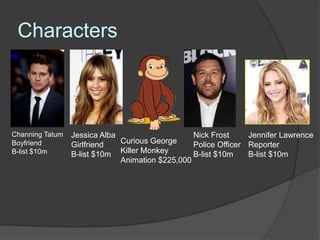
Characters


Channing Tatum   Jessica Alba                    Nick Frost     Jennifer Lawrence
Boyfriend        Girlfriend   Curious George     Police Officer Reporter
B-list $10m      B-list $10m Killer Monkey       B-list $10m    B-list $10m
                              Animation $225,000
Narrative theory in the plot.
   Todorov- this is the theory of equilibrium, disequilibrium and equilibrium. He stated that
    films and programmes begin with an equilibrium. Then agents of disruption cause
    disequilibrium, a period of unsettlement and disquiet. This is then followed by a
    renewed state of peace and harmony and a new equilibrium brings all the chaos to an
    end.
   Propp- Discovered that in stories there were always 8 types of characters evident.
    These are: the hero, the villain, the donor, the dispatcher, the false hero, the helper, the
    princess and her father.
   Levi-Strauss- Narrative tension is based on opposition or conflict. This can be as
    simple as two characters fighting, but more often functions at an ideological level.
   Roland Barthes- The narrative will establish enigmas or mysteries as it goes along.
    Essentially, the narrative functions to establish and then solve these mysteries.
   The theory that suits my narrative: My story is never-ending is has a circular
    narrative which is a narrative theory in addition of the theories described above.
Audience theory in your marketing
strategy.
     Hypodermic needle- Where the media is like a syringe and it injects ideas attitudes and
      beliefs into the audience. In some cases this may work but some people are affected in
      different ways. This theory still has uses that people will go and do what's shown on TV.
     Uses and gratifications- We all have different uses for media we all make choices over
      what we watch.
 1.   Information- we may want to find out about society and the world.
 2.   Personal identity- we may watch televisions for models for our behavior for instance we may identify with
      soap characters on their situations.
 3.   Integration and social interaction- we use the media to found out about the circumstances of other people
      perhaps through empathy or sympathy.
 4.   Entertainment- enjoyment, relaxation, fill the time
     Two step flow- We are more likely to be affected by the media if we discuss it with others.
      Are opinions are affected by the way our friends have view the media.

Blockbusterrr

  • 1.
  • 2.
    Story line  Newspaper print at the start showing that how many people die on this day over 13years. Its valentines day and there is a shop called teddy Hak which sells teddy's and also valentines gift. There is a gift in the shop which is a monkey and it looks like a stuffed teddy but its not its real and its called Curious George. A boy buys it for his girlfriend and takes it home with him as her gift but the girl doesn’t like it she thinks its creepy and the monkey hears her say she don’t like it and gets angry with the girl and tortures her physically and mentally, people think she is doing it herself as well as the boyfriend, later that night they go to the valley where everyone goes every year on valentines day not only to have valentines night, but also it is a memorial for the 13 girls that have died in this valley. Curious George goes to the valley drowns the girl in the valley then jumps in the valley with her so it looks like she done it herself, big scene where police cars and helicopters come. At the end you see the monkey get out of the river at another town, puts himself in a valentines shop and waits for another year to repeat the story again.
  • 3.
    7 characteristics of blockbusters.  1. It is a ‘star vehicle’.  2. A large production budget e.g. $100 million plus.  3. A large marketing budget- posters, TV spots, PR e.g. interviews with magazines, TV chat shows, Teaser trailers and theatrical trailers.  4. A range of merchandising- products branded with the film e.g. Disney shop products toy story toys e.g. buzz light year dolls branded pens, watches etc.  5. A wide demographic- appeals to as large audience as possible young/old; male/female; ABC1, C2, D.  6. A holiday release date.  7. Worldwide release.
  • 4.
    Characters Channing Tatum Jessica Alba Nick Frost Jennifer Lawrence Boyfriend Girlfriend Curious George Police Officer Reporter B-list $10m B-list $10m Killer Monkey B-list $10m B-list $10m Animation $225,000
  • 5.
    Narrative theory inthe plot.  Todorov- this is the theory of equilibrium, disequilibrium and equilibrium. He stated that films and programmes begin with an equilibrium. Then agents of disruption cause disequilibrium, a period of unsettlement and disquiet. This is then followed by a renewed state of peace and harmony and a new equilibrium brings all the chaos to an end.  Propp- Discovered that in stories there were always 8 types of characters evident. These are: the hero, the villain, the donor, the dispatcher, the false hero, the helper, the princess and her father.  Levi-Strauss- Narrative tension is based on opposition or conflict. This can be as simple as two characters fighting, but more often functions at an ideological level.  Roland Barthes- The narrative will establish enigmas or mysteries as it goes along. Essentially, the narrative functions to establish and then solve these mysteries.  The theory that suits my narrative: My story is never-ending is has a circular narrative which is a narrative theory in addition of the theories described above.
  • 6.
    Audience theory inyour marketing strategy.  Hypodermic needle- Where the media is like a syringe and it injects ideas attitudes and beliefs into the audience. In some cases this may work but some people are affected in different ways. This theory still has uses that people will go and do what's shown on TV.  Uses and gratifications- We all have different uses for media we all make choices over what we watch. 1. Information- we may want to find out about society and the world. 2. Personal identity- we may watch televisions for models for our behavior for instance we may identify with soap characters on their situations. 3. Integration and social interaction- we use the media to found out about the circumstances of other people perhaps through empathy or sympathy. 4. Entertainment- enjoyment, relaxation, fill the time  Two step flow- We are more likely to be affected by the media if we discuss it with others. Are opinions are affected by the way our friends have view the media.