Black and
  White
 imagery
‘Even now, now, very
now an old black ram
is tupping your white
yew’
‘Black’ is the colour of night, or ‘evil’. It can also represent ideas such as
  power, wealth, mystery, fear, unhappiness, sadness and anger. Many of these we can relate
  to Othello’s character at some point in the play.


    ‘Even now, now, very
    now an old black ram
    is tupping your white
    yew’
‘White’ represents purity, innocence, goodness and virginity. It
juxtaposes the colour black and the quote suggests it’s             Immediately marks a
unnatural for them to be together. It paints Othello as a savage    difference between
bully who is using his size to take advantage of Brabanto's         Othello and his
small, innocent daughter.                                           European peers.
Repetition of ‘now’ places emphasis on the         List of 3 – a powerful
  importance and urgency of the action being         rhetoric device.
  carried out.


‘Even now, now, very
now an old black ram
is tupping your white
yew’                                                   Iago equates Othello's
                                                       ethnicity with bestiality
Vulgar and animalist language used in description.
Graphic imagery making something romantic into
something disturbing and an unwelcoming thought.
If you’re thinkin’ about
  my baby,
 it don’t matter if
 you’re black or
 white.
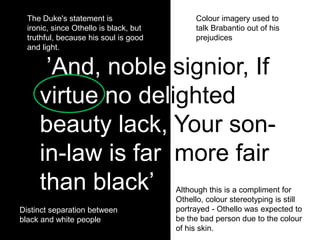
The Duke's statement is                    Colour imagery used to
  ironic, since Othello is black, but        talk Brabantio out of his
  truthful, because his soul is good         prejudices
  and light.


      ’And, noble signior, If
     virtue no delighted
     beauty lack, Your son-
Light and dark are again juxtaposed


     in-law is far more fair
     than black’                        Although this is a compliment for
                                        Othello, colour stereotyping is still
Distinct separation between             portrayed - Othello was expected to
black and white people                  be the bad person due to the colour
                                        of his skin.
If you’re thinkin’ about
  my baby,
 it don’t matter if
 you’re black or
 white.
More subtle black and white imagery
Most of the scenes in which Iago 'furthers his
 evil plan' are set at night, as are other scenes
 of chaos and sources of disaster. For
 example, the actual elopement of Othello and
 Desdemona; most of Iago's meetings with
 Roderigo; all the actions carried out by
 Roderigo to further Iago's plans – rousing
 Brabantio, getting Cassio drunk and into a
 fight, and Desdemona's murder. (plot
 spoiler, sorry!)
‘Hell and
 night, shall bring
 this monstrous
 birth to the
 world's light.’
Black and white are symbols of good and
  evil. They are also a pair, so without
  white as the symbol of good you cannot
  fully understand the idea of black as
  evil. In Othello Shakespeare plays with
  the traditional conception of black and
  white and good and evil in society and
  culture. Shakespeare assigns the ‘good’
  character, Othello, black ethnicity and
  the ‘evil’ character, Iago, white ethnicity.
I’m not gunna spend
  my life being a colour
‘Arise, black
 vengeance, from the
 hollow cell!’
If you’re thinkin’ about
  my baby,
 it don’t matter if
 you’re black or
 white.
The constant references of dark
 versus light work well as a
 parallel to the theme of good
 versus evil running throughout
 the play.
If you’re thinkin’ of
  being my brother,
 it don’t matter if
 you’re black or
 white.
The theme and imagery of black and
 white is used throughout the play to
 metaphorically represent events at
 the time. Eventually, the light and
 love between Desdemona and
 Othello falls into darkness and
 despair, ultimately ending with the
 "black devil" of despair and darkness
 triumphing violently in the final act.
‘O, the more angel
 she, and you the
 blacker devil!’
‘Run from her
 guardage to the sooty
 bosom of such a thing
 as thou’
‘My name, that was
 as fresh as Dian's
 visage, is now
 begrimed and black
 as mine own face.’
‘Put out the
 light, and then
 put out the
 light.’
Othello - Black and white imagery

Othello - Black and white imagery

  • 1.
    Black and White imagery
  • 2.
    ‘Even now, now,very now an old black ram is tupping your white yew’
  • 3.
    ‘Black’ is thecolour of night, or ‘evil’. It can also represent ideas such as power, wealth, mystery, fear, unhappiness, sadness and anger. Many of these we can relate to Othello’s character at some point in the play. ‘Even now, now, very now an old black ram is tupping your white yew’ ‘White’ represents purity, innocence, goodness and virginity. It juxtaposes the colour black and the quote suggests it’s Immediately marks a unnatural for them to be together. It paints Othello as a savage difference between bully who is using his size to take advantage of Brabanto's Othello and his small, innocent daughter. European peers.
  • 4.
    Repetition of ‘now’places emphasis on the List of 3 – a powerful importance and urgency of the action being rhetoric device. carried out. ‘Even now, now, very now an old black ram is tupping your white yew’ Iago equates Othello's ethnicity with bestiality Vulgar and animalist language used in description. Graphic imagery making something romantic into something disturbing and an unwelcoming thought.
  • 6.
    If you’re thinkin’about my baby, it don’t matter if you’re black or white.
  • 8.
    The Duke's statementis Colour imagery used to ironic, since Othello is black, but talk Brabantio out of his truthful, because his soul is good prejudices and light. ’And, noble signior, If virtue no delighted beauty lack, Your son- Light and dark are again juxtaposed in-law is far more fair than black’ Although this is a compliment for Othello, colour stereotyping is still Distinct separation between portrayed - Othello was expected to black and white people be the bad person due to the colour of his skin.
  • 9.
    If you’re thinkin’about my baby, it don’t matter if you’re black or white.
  • 10.
    More subtle blackand white imagery Most of the scenes in which Iago 'furthers his evil plan' are set at night, as are other scenes of chaos and sources of disaster. For example, the actual elopement of Othello and Desdemona; most of Iago's meetings with Roderigo; all the actions carried out by Roderigo to further Iago's plans – rousing Brabantio, getting Cassio drunk and into a fight, and Desdemona's murder. (plot spoiler, sorry!)
  • 13.
    ‘Hell and night,shall bring this monstrous birth to the world's light.’
  • 14.
    Black and whiteare symbols of good and evil. They are also a pair, so without white as the symbol of good you cannot fully understand the idea of black as evil. In Othello Shakespeare plays with the traditional conception of black and white and good and evil in society and culture. Shakespeare assigns the ‘good’ character, Othello, black ethnicity and the ‘evil’ character, Iago, white ethnicity.
  • 16.
    I’m not gunnaspend my life being a colour
  • 17.
    ‘Arise, black vengeance,from the hollow cell!’
  • 18.
    If you’re thinkin’about my baby, it don’t matter if you’re black or white.
  • 19.
    The constant referencesof dark versus light work well as a parallel to the theme of good versus evil running throughout the play.
  • 22.
    If you’re thinkin’of being my brother, it don’t matter if you’re black or white.
  • 23.
    The theme andimagery of black and white is used throughout the play to metaphorically represent events at the time. Eventually, the light and love between Desdemona and Othello falls into darkness and despair, ultimately ending with the "black devil" of despair and darkness triumphing violently in the final act.
  • 25.
    ‘O, the moreangel she, and you the blacker devil!’
  • 27.
    ‘Run from her guardage to the sooty bosom of such a thing as thou’
  • 29.
    ‘My name, thatwas as fresh as Dian's visage, is now begrimed and black as mine own face.’
  • 31.
    ‘Put out the light, and then put out the light.’