Five things every growing
business owner should know
about employment law
By Christine Broad

October 2013

The information in this presentation is general in nature and does not
constitute formal legal advice.
www.blandslaw.com.au
1)

Employment contracts

2)

Policies and procedures

3)

Performance management

4)

Unfair dismissal

5)

Genuine redundancy

6)

Recent case studies

7)

Summary: five things
www.blandslaw.com.au
oNot just words on paper
- set clear expectations for both parties
- employee confidence in entitlements
- business protection
- may prevent problems
- help manage issues
oDo you have employment contracts for all your
employees?

www.blandslaw.com.au
o All employees should have an employment contract
o Well-drafted contracts can be short and
straightforward
o Can tailor contract to cover particular employees – e.g.
allowances; flexible work arrangements; restraints etc
o Can keep costs down by having a basic pro forma
contract (modified as needed)
Key tip: Remember to review your employment
contracts from time to time

www.blandslaw.com.au
Some essential inclusions:
‒Term (ie fixed or ongoing)
‒Pay and hours
‒Entitlements
‒Termination and notice
‒Confidentiality

Some extras to consider:
‒Probationary period and terms
‒Intellectual property
‒Restraint and non-solicitation
‒ Allowances (phone; travel etc)
www.blandslaw.com.au
Why do you need them?
oPolicies set out expectations and obligations for
employers and employees
oClarify what is required of employees and what
they can expect from you
oReduce the chance of issues arising in the first
place
oSet out processes to deal with issues if they do
arise.

www.blandslaw.com.au
If you do already have policies:
oAre they sufficient to cover your workplace (ie tailored
to your needs)?
oAre they regularly reviewed to ensure they are legally
compliant?
oAre employees provided with training in relation to
these policies?
oDo they cover everything – what is left out ? (eg social
media)
Key tip: Ensure you have essential workplace policies
in place and employees have been trained
www.blandslaw.com.au
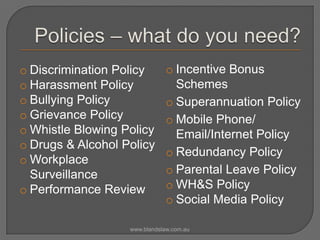
o Discrimination Policy
o Harassment Policy
o Bullying Policy
o Grievance Policy
o Whistle Blowing Policy
o Drugs & Alcohol Policy
o Workplace
Surveillance
o Performance Review

o Incentive Bonus
Schemes
o Superannuation Policy
o Mobile Phone/
Email/Internet Policy
o Redundancy Policy
o Parental Leave Policy
o WH&S Policy
o Social Media Policy

www.blandslaw.com.au
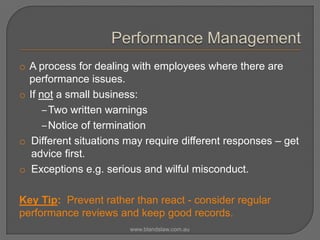
o A process for dealing with employees where there are
performance issues.
o If not a small business:
‒Two written warnings
‒Notice of termination
o Different situations may require different responses – get
advice first.
o Exceptions e.g. serious and wilful misconduct.
Key Tip: Prevent rather than react - consider regular
performance reviews and keep good records.
www.blandslaw.com.au
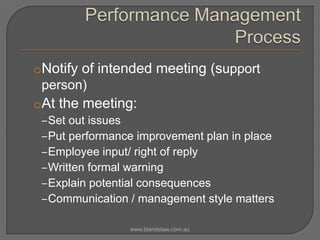
oNotify of intended meeting (support
person)
oAt the meeting:
‒Set out issues
‒Put performance improvement plan in place
‒Employee input/ right of reply
‒Written formal warning
‒Explain potential consequences
‒Communication / management style matters
www.blandslaw.com.au
o

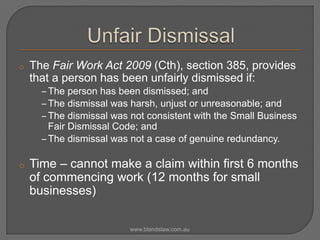
The Fair Work Act 2009 (Cth), section 385, provides
that a person has been unfairly dismissed if:
‒ The person has been dismissed; and
‒ The dismissal was harsh, unjust or unreasonable; and
‒ The dismissal was not consistent with the Small Business
Fair Dismissal Code; and
‒ The dismissal was not a case of genuine redundancy.

o

Time – cannot make a claim within first 6 months
of commencing work (12 months for small
businesses)
www.blandslaw.com.au
o Small business (for the purposes of the Code):
fewer than 15 employees.
o Need a valid reason – conduct or capacity
o One warning
o Procedural fairness
o Need to demonstrate compliance with the Codekeep records

Key Tip: Process is critical. Check your obligations
at the outset.
www.blandslaw.com.au
o Must relate to a role and not a person
o Must not be related to any performance issues
o Covered by the National Employment Standards
(NES) – larger businesses
o Processes to follow
‒ Alternative re-deployment
‒ Consider junior roles/less pay
‒ Applicable payouts – will depend on business size; duration

of employment etc

Key Tip: Genuine redundancy must relate to a role
that is no longer required. Ensure alternative roles
are considered.
www.blandslaw.com.au
McCauley v Club Resort Holdings Pty Ltd
o Sexual harassment claim
o Poorly handled and investigated by the employer
o Queensland tribunal described the handling of the
situation as ‘inept and unprofessional’.
o Employer ordered to pay $35,490 as compensation.
Lessons for employers:
o Must have clearly communicated policies which cover
acceptable behaviour.
o Need a complaints process to deal with policy
breaches.
o The complaints process must be consistently followed.
www.blandslaw.com.au
Stephen Edward Ryan v Whitehaven Coal Mining Pty Ltd
o Issue- annual leave loading payable on termination.
Case revolved around an issue of statutory interpretation
(s90(2) Fair Work Act).
Lesson for employers:
o Generally where leave loading would otherwise apply to
annual leave taken during the period of employment,
then employees will be entitled to be paid leave loading
on any accrued annual leave at the time of termination.

www.blandslaw.com.au
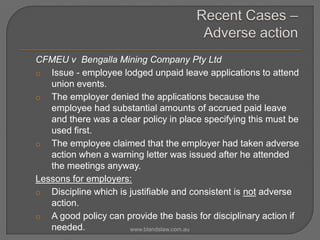
CFMEU v Bengalla Mining Company Pty Ltd
o Issue - employee lodged unpaid leave applications to attend
union events.
o The employer denied the applications because the
employee had substantial amounts of accrued paid leave
and there was a clear policy in place specifying this must be
used first.
o The employee claimed that the employer had taken adverse
action when a warning letter was issued after he attended
the meetings anyway.
Lessons for employers:
o Discipline which is justifiable and consistent is not adverse
action.
o A good policy can provide the basis for disciplinary action if
needed.
www.blandslaw.com.au
1)
2)
3)

4)
5)

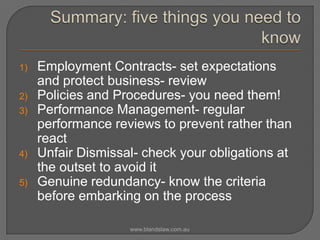
Employment Contracts- set expectations
and protect business- review
Policies and Procedures- you need them!
Performance Management- regular
performance reviews to prevent rather than
react
Unfair Dismissal- check your obligations at
the outset to avoid it
Genuine redundancy- know the criteria
before embarking on the process
www.blandslaw.com.au
oIf you are unsure, get some advice on your
specific situation. It is better to act early before a
problem escalates.
oFor general information, The Fair Work
Ombudsman website is a useful reference point:
www.fairwork.gov.au

www.blandslaw.com.au
o Private company owned by Andrew Bland
o Established in 2003 and located in North
Ryde, NSW.
o Core expertise:
• Industrial relations / Employment law

o Additional expertise:
• All aspects of general commercial law;
• Social media law.

www.blandslaw.com.au
o For more information, please contact:
Christine Broad
Solicitor, BlandsLaw
Christine.broad@blandslaw.com.au
T: (02) 9805 5600
Articles/blogs: www.blandslaw.com.au

www.blandslaw.com.au

BlandsLaw webinar: Five things every growing business owner should know about employment law

  • 1.
    Five things everygrowing business owner should know about employment law By Christine Broad October 2013 The information in this presentation is general in nature and does not constitute formal legal advice. www.blandslaw.com.au
  • 2.
    1) Employment contracts 2) Policies andprocedures 3) Performance management 4) Unfair dismissal 5) Genuine redundancy 6) Recent case studies 7) Summary: five things www.blandslaw.com.au
  • 3.
    oNot just wordson paper - set clear expectations for both parties - employee confidence in entitlements - business protection - may prevent problems - help manage issues oDo you have employment contracts for all your employees? www.blandslaw.com.au
  • 4.
    o All employeesshould have an employment contract o Well-drafted contracts can be short and straightforward o Can tailor contract to cover particular employees – e.g. allowances; flexible work arrangements; restraints etc o Can keep costs down by having a basic pro forma contract (modified as needed) Key tip: Remember to review your employment contracts from time to time www.blandslaw.com.au
  • 5.
    Some essential inclusions: ‒Term(ie fixed or ongoing) ‒Pay and hours ‒Entitlements ‒Termination and notice ‒Confidentiality Some extras to consider: ‒Probationary period and terms ‒Intellectual property ‒Restraint and non-solicitation ‒ Allowances (phone; travel etc) www.blandslaw.com.au
  • 6.
    Why do youneed them? oPolicies set out expectations and obligations for employers and employees oClarify what is required of employees and what they can expect from you oReduce the chance of issues arising in the first place oSet out processes to deal with issues if they do arise. www.blandslaw.com.au
  • 7.
    If you doalready have policies: oAre they sufficient to cover your workplace (ie tailored to your needs)? oAre they regularly reviewed to ensure they are legally compliant? oAre employees provided with training in relation to these policies? oDo they cover everything – what is left out ? (eg social media) Key tip: Ensure you have essential workplace policies in place and employees have been trained www.blandslaw.com.au
  • 8.
    o Discrimination Policy oHarassment Policy o Bullying Policy o Grievance Policy o Whistle Blowing Policy o Drugs & Alcohol Policy o Workplace Surveillance o Performance Review o Incentive Bonus Schemes o Superannuation Policy o Mobile Phone/ Email/Internet Policy o Redundancy Policy o Parental Leave Policy o WH&S Policy o Social Media Policy www.blandslaw.com.au
  • 9.
    o A processfor dealing with employees where there are performance issues. o If not a small business: ‒Two written warnings ‒Notice of termination o Different situations may require different responses – get advice first. o Exceptions e.g. serious and wilful misconduct. Key Tip: Prevent rather than react - consider regular performance reviews and keep good records. www.blandslaw.com.au
  • 10.
    oNotify of intendedmeeting (support person) oAt the meeting: ‒Set out issues ‒Put performance improvement plan in place ‒Employee input/ right of reply ‒Written formal warning ‒Explain potential consequences ‒Communication / management style matters www.blandslaw.com.au
  • 11.
    o The Fair WorkAct 2009 (Cth), section 385, provides that a person has been unfairly dismissed if: ‒ The person has been dismissed; and ‒ The dismissal was harsh, unjust or unreasonable; and ‒ The dismissal was not consistent with the Small Business Fair Dismissal Code; and ‒ The dismissal was not a case of genuine redundancy. o Time – cannot make a claim within first 6 months of commencing work (12 months for small businesses) www.blandslaw.com.au
  • 12.
    o Small business(for the purposes of the Code): fewer than 15 employees. o Need a valid reason – conduct or capacity o One warning o Procedural fairness o Need to demonstrate compliance with the Codekeep records Key Tip: Process is critical. Check your obligations at the outset. www.blandslaw.com.au
  • 13.
    o Must relateto a role and not a person o Must not be related to any performance issues o Covered by the National Employment Standards (NES) – larger businesses o Processes to follow ‒ Alternative re-deployment ‒ Consider junior roles/less pay ‒ Applicable payouts – will depend on business size; duration of employment etc Key Tip: Genuine redundancy must relate to a role that is no longer required. Ensure alternative roles are considered. www.blandslaw.com.au
  • 14.
    McCauley v ClubResort Holdings Pty Ltd o Sexual harassment claim o Poorly handled and investigated by the employer o Queensland tribunal described the handling of the situation as ‘inept and unprofessional’. o Employer ordered to pay $35,490 as compensation. Lessons for employers: o Must have clearly communicated policies which cover acceptable behaviour. o Need a complaints process to deal with policy breaches. o The complaints process must be consistently followed. www.blandslaw.com.au
  • 15.
    Stephen Edward Ryanv Whitehaven Coal Mining Pty Ltd o Issue- annual leave loading payable on termination. Case revolved around an issue of statutory interpretation (s90(2) Fair Work Act). Lesson for employers: o Generally where leave loading would otherwise apply to annual leave taken during the period of employment, then employees will be entitled to be paid leave loading on any accrued annual leave at the time of termination. www.blandslaw.com.au
  • 16.
    CFMEU v BengallaMining Company Pty Ltd o Issue - employee lodged unpaid leave applications to attend union events. o The employer denied the applications because the employee had substantial amounts of accrued paid leave and there was a clear policy in place specifying this must be used first. o The employee claimed that the employer had taken adverse action when a warning letter was issued after he attended the meetings anyway. Lessons for employers: o Discipline which is justifiable and consistent is not adverse action. o A good policy can provide the basis for disciplinary action if needed. www.blandslaw.com.au
  • 17.
    1) 2) 3) 4) 5) Employment Contracts- setexpectations and protect business- review Policies and Procedures- you need them! Performance Management- regular performance reviews to prevent rather than react Unfair Dismissal- check your obligations at the outset to avoid it Genuine redundancy- know the criteria before embarking on the process www.blandslaw.com.au
  • 18.
    oIf you areunsure, get some advice on your specific situation. It is better to act early before a problem escalates. oFor general information, The Fair Work Ombudsman website is a useful reference point: www.fairwork.gov.au www.blandslaw.com.au
  • 19.
    o Private companyowned by Andrew Bland o Established in 2003 and located in North Ryde, NSW. o Core expertise: • Industrial relations / Employment law o Additional expertise: • All aspects of general commercial law; • Social media law. www.blandslaw.com.au
  • 20.
    o For moreinformation, please contact: Christine Broad Solicitor, BlandsLaw Christine.broad@blandslaw.com.au T: (02) 9805 5600 Articles/blogs: www.blandslaw.com.au www.blandslaw.com.au