 What is Bitcoin cash?
 Bitcoin cash system
 Why was bitcoin cash created
 Cash created
 Blockchain ?what is that again?
 Is Bitcoin Cash Cheaper to Use than Bitcoin
Core?
 Where Can I Buy Bitcoin Cash?
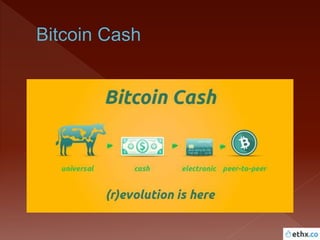
 Bitcoin Cash (BCH) is an upgraded version of the Bitcoin Core
software. It was released on August 1st, 2017.
 A purely peer-to-peer version of electronic cash would allow
online payments to be sent directly from one party to another
without going through a financial institution. Digital signatures
provide part of the solution, but the main benefits are lost if a
trusted third party is still required to prevent double-spending.
We propose a solution to the double-spending problem using a
peer-to-peer network. The network timestamps transactions by
hashing them into an ongoing chain of hash-based proof-of-
work, forming a record that cannot be changed without redoing
the proof-of-work.
 . The longest chain not only serves as proof of
the sequence of events witnessed, but proof
that it came from the largest pool of CPU power.
As long as a majority of CPU power is
controlled by nodes that are not cooperating to
attack the network, they'll generate the longest
chain and outpace attackers. The network itself
requires minimal structure. Messages are
broadcast on a best effort basis, and nodes can
leave and rejoin the network at will, accepting
the longest proof-of-work chain as proof of what
happened while they were gone.
 Bitcoin Cash was created to bring back the
essential qualities of money inherent in the
original Bitcoin software. Over the years, these
qualities were filtered out of Bitcoin Core and
progress was stifled by various people,
organizations, and companies involved in
Bitcoin protocol development. The result is that
Bitcoin Core is currently unusable as money
due to increasingly high fees per transactions
and transfer times taking hours to days. This is
all because of the problems created by Bitcoin
Core’s blocks being full.
 Basically speaking, “blocks” are groupings of new
transactions that are added to the blockchain. In Bitcoin,
transactions are processed block by block. Bitcoin was
designed to target 6 blocks per hour, or one every ten
minutes. Years ago, an artificial limit to the size of blocks
was added to the Bitcoin Core code to prevent a possible
attack vector where a mass number of transactions could
weaken the network. At the time, transactions were free to
make, so an attacker could send a huge number of
transactions between his own wallets, forcing everyone
else on the network to download and store large amounts
of data. The block size limit was arbitrarily set at 1MB (i.e.,
the size of storage offered by a floppy disk from the mid-
1980s).
 At the time, this was still thousands of times higher than
the actual usage of the network demanded. It is clear that
the block size limit was never meant to stifle growth of the
network, but merely to defend against a theoretical attack
vector.
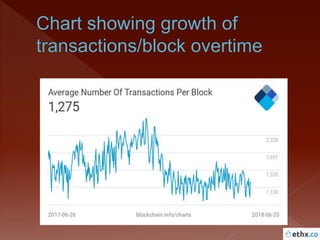
User adoption of Bitcoin began slowly, and it wasn’t until
2012 that the blockchain was processing 250 transactions
per block, or approximately 1,500 transactions per hour. It
took two more years for this number to double, and by
2014 the Bitcoin network was processing 500 transactions
per block.
 The artificially small blocksize led to network congestion
as demand for bitcoin transactions has continued to grow.
Remember, to be verified and processed, a bitcoin
transaction must be included in a block. If blocks are full,
your transaction must wait to be included in the next block,
but the next block is already full because others paid a
higher fee than you, etc. This congestion has led to an
ever increasing “fee market” where users pay extra to “cut
in line” and move their transactions to the top of the list of
pending transactions, known as the mempool. At the time
of publication, there are more than 280,000 unconfirmed
Bitcoin Core transactions.
 o describe how the block size limit affects the speed and
cost of transactions on the blockchain, let us use the
following example:
 It’s Saturday night and you’re about to visit the hottest club
in town. Before this club became a big deal, it was a small
local joint with a cool crowd, good music, and reasonably
priced drinks in a small venue.
 All of a sudden, people started talking about this venue
and telling their friends, and now everyone wants to get in.
The problem is, the club is in a building that can only hold
2,500 people. In this analogy, think of the club as a “block”,
with limited storage capacity or size, and think of each
patron as a bitcoin transaction.
 Despite this situation and much complaint from the community, the
club management has stubbornly refused to move or build a larger
building, and insist that a full club and ten times as many patrons
waiting in line outside is not only good for business but that it would be
impossible to expand their building to accommodate more patrons
even if they wanted to.
 In Bitcoin Core, the mempool is the lineup of people waiting to get into
the club and the transaction fees are the cover charge the bouncer
requires to let you into the 2,500 person capacity club.
 At an average cost of as high as $140 per transaction and a line up of
over 270,000 unconfirmed transactions, Bitcoin Core, a system that
was created to explicitly be a “peer-to-peer-electronic cash system”
has now become unusable for merchants and has priced out the
majority of users in developed countries, let alone the entirety of users
in smaller, developing countries.
 Yes. Because transaction fees in both versions of Bitcoin are
measured in satoshis-per-byte (a unit of Bitcoin is divisible to 8
decimal places and the smallest unit is called a “satoshi”) the
way you have to accurately measure Bitcoin fees is not in
dollars, but in satoshis.
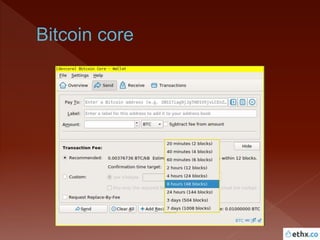
 Because Bitcoin Core blocks are always full and there’s a large
line up of people, currently, the bouncer is charging more than
900 satoshis per byte for inclusion into a block. At the time of
writing, it costs more than $30 to make a single Bitcoin
transaction.
 By comparison, Bitcoin Cash’s average fee is 19 satoshis per
byte. With Bitcoin Cash, you can also set your fees manually as
low as 2 satoshis per byte and be included into the next block,
because there is plenty of room for everyone who wants to send
a transaction.
 Bitcoin Core fees are above $30 as of December
21, 2017. This means that an address with less
than $30 in it will be unusable as one must pay at
least $30 in fees to even broadcast the transaction.
Imagine trying to buy a sandwich for $7 and being
told by the cashier, “That will be $37, please.” Even
an address with $100 on it will lose a
whopping thirty percent of their money as soon as
they try to use it. Imagine you give your friend a
$100 bill, but once it changes hands it’s only worth
$70 to them. As soon as they use it, it becomes
worth only $40. This is the current state of Bitcoin
Core, completely broken.
 Supporters of Bitcoin Core often say that Bitcoin Core was
never meant to be a currency and that its true classification is as
a store of value, or “digital gold.”
 Bitcoin Core developers have crippled the network due, in part,
to faulty Economic understanding
 To that end, they embrace and even encourage high-fees and
slow transaction times. Apart from the fact that this is in direct
opposition to the spirit of the Bitcoin whitepaper—Bitcoin: A
Peer-to-Peer Electronic Cash System—such a claim is
nonsensical since something can only be a store of value in
relation to its ability to store and recall utility. If you lose more
than $30 of value every time you want to use it, are you storing
value or losing value? Bitcoin Core, as of late 2017, is more
accurately understood as a volatile, speculative asset that is not
reliably useful as a store of value, much less a form of money.
 Average Bitcoin Cash transactions cost
pennies (or less) and confirm in an average
of 10 minutes, because the mempool of
pending transactions is cleared with each
new block. This means that Bitcoin Cash can
be used in a similar manner as…well, cash.
 coinbase and it’s exchange GDAX announced full buy and
sell support for Bitcoin Cash. Create an account and to
make your first BCH purchase. You can also find a list of
local buyers and sellers through the Local Bitcoin
Cash platform. Instant crypto-to-crypto exchanges
like Shapeshift and Changelly also support converting
BTC to BCH. Also, the Bitcoin.com Wallet will have Shape
Shift integration as of early 2018. For Canadians, nTrust is
also an option.
 For a full list of websites to buy and sell Bitcoin Cash, view
the exchange listings on BitcoinCash.org

Bitcoin cash

  • 2.
     What isBitcoin cash?  Bitcoin cash system  Why was bitcoin cash created  Cash created  Blockchain ?what is that again?  Is Bitcoin Cash Cheaper to Use than Bitcoin Core?  Where Can I Buy Bitcoin Cash?
  • 3.
     Bitcoin Cash(BCH) is an upgraded version of the Bitcoin Core software. It was released on August 1st, 2017.  A purely peer-to-peer version of electronic cash would allow online payments to be sent directly from one party to another without going through a financial institution. Digital signatures provide part of the solution, but the main benefits are lost if a trusted third party is still required to prevent double-spending. We propose a solution to the double-spending problem using a peer-to-peer network. The network timestamps transactions by hashing them into an ongoing chain of hash-based proof-of- work, forming a record that cannot be changed without redoing the proof-of-work.
  • 4.
     . Thelongest chain not only serves as proof of the sequence of events witnessed, but proof that it came from the largest pool of CPU power. As long as a majority of CPU power is controlled by nodes that are not cooperating to attack the network, they'll generate the longest chain and outpace attackers. The network itself requires minimal structure. Messages are broadcast on a best effort basis, and nodes can leave and rejoin the network at will, accepting the longest proof-of-work chain as proof of what happened while they were gone.
  • 6.
     Bitcoin Cashwas created to bring back the essential qualities of money inherent in the original Bitcoin software. Over the years, these qualities were filtered out of Bitcoin Core and progress was stifled by various people, organizations, and companies involved in Bitcoin protocol development. The result is that Bitcoin Core is currently unusable as money due to increasingly high fees per transactions and transfer times taking hours to days. This is all because of the problems created by Bitcoin Core’s blocks being full.
  • 8.
     Basically speaking,“blocks” are groupings of new transactions that are added to the blockchain. In Bitcoin, transactions are processed block by block. Bitcoin was designed to target 6 blocks per hour, or one every ten minutes. Years ago, an artificial limit to the size of blocks was added to the Bitcoin Core code to prevent a possible attack vector where a mass number of transactions could weaken the network. At the time, transactions were free to make, so an attacker could send a huge number of transactions between his own wallets, forcing everyone else on the network to download and store large amounts of data. The block size limit was arbitrarily set at 1MB (i.e., the size of storage offered by a floppy disk from the mid- 1980s).
  • 9.
     At thetime, this was still thousands of times higher than the actual usage of the network demanded. It is clear that the block size limit was never meant to stifle growth of the network, but merely to defend against a theoretical attack vector. User adoption of Bitcoin began slowly, and it wasn’t until 2012 that the blockchain was processing 250 transactions per block, or approximately 1,500 transactions per hour. It took two more years for this number to double, and by 2014 the Bitcoin network was processing 500 transactions per block.
  • 11.
     The artificiallysmall blocksize led to network congestion as demand for bitcoin transactions has continued to grow. Remember, to be verified and processed, a bitcoin transaction must be included in a block. If blocks are full, your transaction must wait to be included in the next block, but the next block is already full because others paid a higher fee than you, etc. This congestion has led to an ever increasing “fee market” where users pay extra to “cut in line” and move their transactions to the top of the list of pending transactions, known as the mempool. At the time of publication, there are more than 280,000 unconfirmed Bitcoin Core transactions.
  • 13.
     o describehow the block size limit affects the speed and cost of transactions on the blockchain, let us use the following example:  It’s Saturday night and you’re about to visit the hottest club in town. Before this club became a big deal, it was a small local joint with a cool crowd, good music, and reasonably priced drinks in a small venue.  All of a sudden, people started talking about this venue and telling their friends, and now everyone wants to get in. The problem is, the club is in a building that can only hold 2,500 people. In this analogy, think of the club as a “block”, with limited storage capacity or size, and think of each patron as a bitcoin transaction.
  • 14.
     Despite thissituation and much complaint from the community, the club management has stubbornly refused to move or build a larger building, and insist that a full club and ten times as many patrons waiting in line outside is not only good for business but that it would be impossible to expand their building to accommodate more patrons even if they wanted to.  In Bitcoin Core, the mempool is the lineup of people waiting to get into the club and the transaction fees are the cover charge the bouncer requires to let you into the 2,500 person capacity club.  At an average cost of as high as $140 per transaction and a line up of over 270,000 unconfirmed transactions, Bitcoin Core, a system that was created to explicitly be a “peer-to-peer-electronic cash system” has now become unusable for merchants and has priced out the majority of users in developed countries, let alone the entirety of users in smaller, developing countries.
  • 16.
     Yes. Becausetransaction fees in both versions of Bitcoin are measured in satoshis-per-byte (a unit of Bitcoin is divisible to 8 decimal places and the smallest unit is called a “satoshi”) the way you have to accurately measure Bitcoin fees is not in dollars, but in satoshis.  Because Bitcoin Core blocks are always full and there’s a large line up of people, currently, the bouncer is charging more than 900 satoshis per byte for inclusion into a block. At the time of writing, it costs more than $30 to make a single Bitcoin transaction.  By comparison, Bitcoin Cash’s average fee is 19 satoshis per byte. With Bitcoin Cash, you can also set your fees manually as low as 2 satoshis per byte and be included into the next block, because there is plenty of room for everyone who wants to send a transaction.
  • 17.
     Bitcoin Corefees are above $30 as of December 21, 2017. This means that an address with less than $30 in it will be unusable as one must pay at least $30 in fees to even broadcast the transaction. Imagine trying to buy a sandwich for $7 and being told by the cashier, “That will be $37, please.” Even an address with $100 on it will lose a whopping thirty percent of their money as soon as they try to use it. Imagine you give your friend a $100 bill, but once it changes hands it’s only worth $70 to them. As soon as they use it, it becomes worth only $40. This is the current state of Bitcoin Core, completely broken.
  • 18.
     Supporters ofBitcoin Core often say that Bitcoin Core was never meant to be a currency and that its true classification is as a store of value, or “digital gold.”  Bitcoin Core developers have crippled the network due, in part, to faulty Economic understanding  To that end, they embrace and even encourage high-fees and slow transaction times. Apart from the fact that this is in direct opposition to the spirit of the Bitcoin whitepaper—Bitcoin: A Peer-to-Peer Electronic Cash System—such a claim is nonsensical since something can only be a store of value in relation to its ability to store and recall utility. If you lose more than $30 of value every time you want to use it, are you storing value or losing value? Bitcoin Core, as of late 2017, is more accurately understood as a volatile, speculative asset that is not reliably useful as a store of value, much less a form of money.
  • 20.
     Average BitcoinCash transactions cost pennies (or less) and confirm in an average of 10 minutes, because the mempool of pending transactions is cleared with each new block. This means that Bitcoin Cash can be used in a similar manner as…well, cash.
  • 22.
     coinbase andit’s exchange GDAX announced full buy and sell support for Bitcoin Cash. Create an account and to make your first BCH purchase. You can also find a list of local buyers and sellers through the Local Bitcoin Cash platform. Instant crypto-to-crypto exchanges like Shapeshift and Changelly also support converting BTC to BCH. Also, the Bitcoin.com Wallet will have Shape Shift integration as of early 2018. For Canadians, nTrust is also an option.  For a full list of websites to buy and sell Bitcoin Cash, view the exchange listings on BitcoinCash.org