1 - BASIC CONCEPTS1 - BASIC CONCEPTS
1 © Alexei Gudkov 2017
©
AlexeiG
udkov
Base
 There are nodes, which compose the network.
 Th d h i f ti ith h The nodes exchange information with each
other.
 The historical data is identical and immutable
for every node.for every node.
2 © Alexei Gudkov 2017
©
AlexeiG
udkov
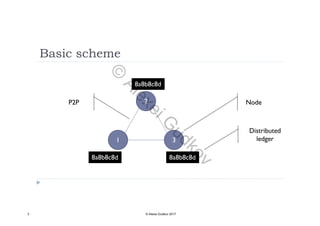
Basic scheme
8a8b8c8d
2 NodeP2P
1 3
Distributed
ledger1 3
8a8b8c8d
ledger
8a8b8c8d
3 © Alexei Gudkov 2017
©
AlexeiG
udkov
2 – Decentralization / Distribution2 Decentralization / Distribution
4 © Alexei Gudkov 2017
©
AlexeiG
udkov
Decentralized system
 Th bl k h i t i d t li d The blockchain system is decentralized.
 There is no single center for all participants.
 Local centers could exist.
5 © Alexei Gudkov 2017
©
AlexeiG
udkov
Center
Decentralized system has more than one center.Decentralized system has more than one center.
Distributed system try to escape from any centralization onDistributed system try to escape from any centralization on
every level.
6 © Alexei Gudkov 2017
©
AlexeiG
udkov
Types of network
1. Decentralized – no common center.
2 F t l t i l d t li ti2. Fractal – symmetrical decentralization.
3. Distributed – no center at all at every level.y
4. Diversified – distribution of nodes’
characteristicscharacteristics.
7 © Alexei Gudkov 2017
©
AlexeiG
udkov
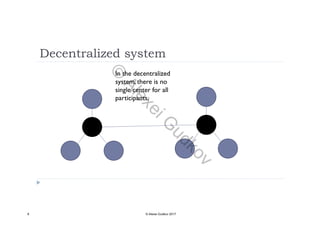
Decentralized system
In the decentralized
system, there is no
single center for all
participants.
8 © Alexei Gudkov 2017
©
AlexeiG
udkov
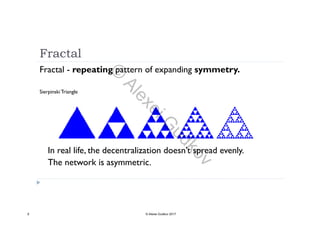
Fractal
Fractal - repeating pattern of expanding symmetry.
Sierpinski Triangle
In real life, the decentralization doesn’t spread evenly.
The network is asymmetric.The network is asymmetric.
9 © Alexei Gudkov 2017
©
AlexeiG
udkov
Distributed system
One of the features of blockchain technology is not
only decentralization but also distribution.only decentralization but also distribution.
Di t ib t d t m i t m i hi h iDistributed system is a system in which processing
and data are spread or share among multiple nodes.
Distributed system has no centre at all.
10 © Alexei Gudkov 2017
©
AlexeiG
udkov
Distributed system advantages
Distributed system is able to remove the certainDistributed system is able to remove the certain
intermediaries,
 to increase the speed of reconciliation; to increase the speed of reconciliation;
 reduce costs;
 manage data safely and efficiently manage data safely and efficiently.
11 © Alexei Gudkov 2017
©
AlexeiG
udkov
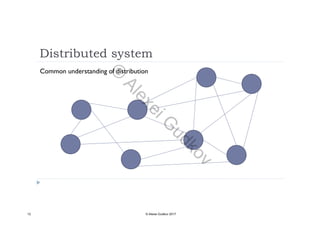
Distributed system
Common understanding of distribution
12 © Alexei Gudkov 2017
©
AlexeiG
udkov
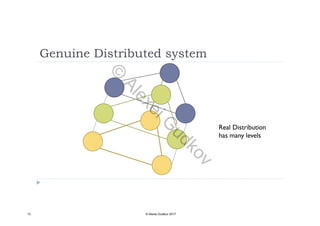
Genuine Distributed system
Real Distribution
has many levelsy
13 © Alexei Gudkov 2017
©
AlexeiG
udkov
3 – Problems with3 Problems with
Decentralization and Distribution
14 © Alexei Gudkov 2017
©
AlexeiG
udkov
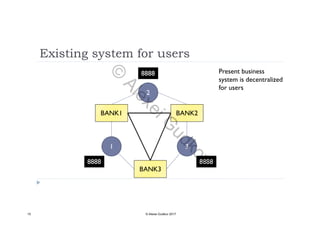
Existing system for users
8888 Present business
system is decentralized
for users
2
BANK1 BANK2
for users
BANK1 BANK2
1 3
8888 8888
BANK3
15 © Alexei Gudkov 2017
©
AlexeiG
udkov
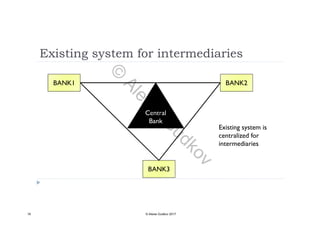
Existing system for intermediaries
BANK1 BANK2
Central
Existing system is
centralized for
Central
Bank
intermediaries
BANK3
16 © Alexei Gudkov 2017
©
AlexeiG
udkov
Is it really distributed?
Is the ethereum network really distributed?
 One principle of work. One principle of work.
 A few software.
 Big mining pools Big mining pools.
B k h l f l d hBitcoin network has element of centralization due to the
use of specialized hardware ASICs, which need to solve
computational problem (proof of work)computational problem (proof of work).
17 © Alexei Gudkov 2017
©
AlexeiG
udkov
Centralized mining - Bitcoin
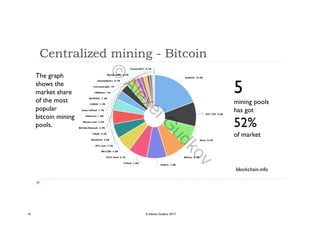
The graph
shows the
5market share
of the most
popular
5
mining pools
has got
bitcoin mining
pools.
g
52%
of market
blockchain.info
18 © Alexei Gudkov 2017
©
AlexeiG
udkov
Country centralization
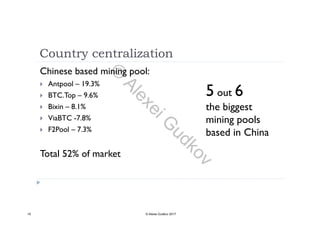
Chinese based mining pool:
 Antpool – 19.3%
5 6
p
 BTC.Top – 9.6%
 Bixin – 8.1%
5 out 6
the biggest
 ViaBTC -7.8%
 F2Pool – 7.3%
mining pools
based in China
Total 52% of market
19 © Alexei Gudkov 2017
©
AlexeiG
udkov
Centralized mining - ethereum
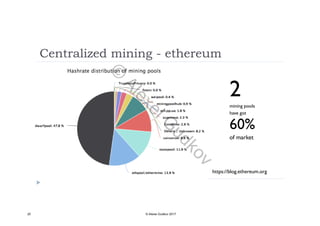
22mining pools
have gothave got
60%
of marketof market
https://blog.ethereum.org
20 © Alexei Gudkov 2017
©
AlexeiG
udkov
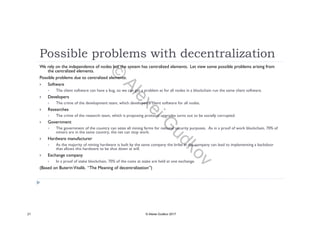
Possible problems with decentralization
We rely on the independence of nodes but the system has centralized elements. Let view some possible problems arising from
the centralized elements.
Possible problems due to centralized elements:
 Software
 The client software can have a bug, so we can get a problem as for all nodes in a blockchain run the same client software.
 Developers
 The crime of the development team, which developed a client software for all nodes.
 Researches
 The crime of the research team, which is proposing protocol upgrades turns out to be socially corrupted.
 Government
 The government of the country can seize all mining farms for national security purposes. As in a proof of work blockchain, 70% of
miners are in the same country, the net can stop work.
 Hardware manufacturer Hardware manufacturer
 As the majority of mining hardware is built by the same company the bribe in the company can lead to implementing a backdoor
that allows this hardware to be shut down at will.
 Exchange company
 In a proof of stake blockchain, 70% of the coins at stake are held at one exchange.
(Based on ButerinVitalik. “The Meaning of decentralization”)
21 © Alexei Gudkov 2017
©
AlexeiG
udkov
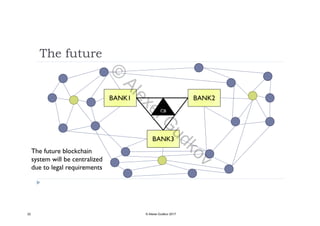
The future
BANK1 BANK2
CB
BANK3BANK3
The future blockchain
system will be centralized
due to legal requirements
22 © Alexei Gudkov 2017
©
AlexeiG
udkov
4 -Distributed Ledger - Blockchain4 Distributed Ledger Blockchain
23 © Alexei Gudkov 2017
©
AlexeiG
udkov
Distributed Ledger Technology
 The distributed ledger is a way to record the transaction. In
the standard centralized system, the one ledger is a book or
computer file with number of copies. But cryptocurrencies use
distributed ledger the main features of which are duplicated
d d t li d E h i i l f th l d iand decentralized consensus. Each original of the ledger is
distributed to a peer-to-peer system with cryptographic
authentication and authorization.authentication and authorization.
 Distributed ledger data can be either "permissioned" or
"unpermissioned" to control who can view it.p
24 © Alexei Gudkov 2017
©
AlexeiG
udkov
Features of the decentralized network
 Decentralization – no single center.
 Sustainability – network is resistant Sustainability network is resistant.
 Anonymity – name is not given or known.
 Privacy there are secret personal matters Privacy – there are secret personal matters.
 Storage – data are stored in distributed ledgers.
A b l h k bl f Accessibility – the network is accessible for everyone.
 Speed – operations and transactions are relatively fast.
25 © Alexei Gudkov 2017
©
AlexeiG
udkov
Distribution in a legal sense
 Refusing from the legal system in favor of natural law.
 No government. No government.
 No control.
 Light disclosure Light disclosure.
 Escaping from punishment.
P bl i h h i f i h Problems with the protection of rights.
26 © Alexei Gudkov 2017
©
AlexeiG
udkov
Peer-to-Peer Networks
 Network in which peers are able to communicate with
each other directly, via the logical overlay links withouty g y
any central server.
 In P2P networks, nodes both provide and use resources., p
27 © Alexei Gudkov 2017
©
AlexeiG
udkov
Hyperledger
 Don’t mess Distributed ledger with Hyperledger, which is
an open source collaborative effort created to advancep
cross-industry blockchain technologies, hosted by The
Linux Foundation.
28 © Alexei Gudkov 2017
©
AlexeiG
udkov
Blockchain
Blockchain - sequence of blocks, which record the
transactions.
Blockchain is a type of distributed ledger / database.
Blockchain data is immutableBlockchain data is immutable.
29 © Alexei Gudkov 2017
©
AlexeiG
udkov
Trust and blockchain
 In contrast to common opinion, the Blockchain doesn’t
provide trust.p
 The Blockchain is the trustless system.
 It is guaranteeing an execution of transaction regardless It is guaranteeing an execution of transaction regardless
the personal relationship or trust.
30 © Alexei Gudkov 2017
©
AlexeiG
udkov
BlockBlock
31 © Alexei Gudkov 2017
©
AlexeiG
udkov
Block
A block is a software-generated container that bundles
together the messages relating to a particular transaction.
Information on transactions is included in a block.
Bitcoin block explorer https://blockchain.info/
Ethereum block explorer https://etherscan.io/
32 © Alexei Gudkov 2017
©
AlexeiG
udkov
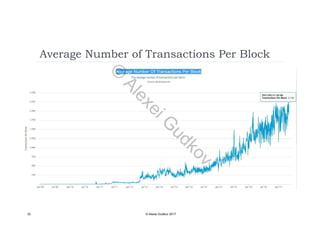
Average Number of Transactions Per Block
33 © Alexei Gudkov 2017
©
AlexeiG
udkov
Block structure
A block in the ethereum blockchain consists of:
 a header,,
 a list of transactions,
 a list of uncle blocks.
34 © Alexei Gudkov 2017
©
AlexeiG
udkov
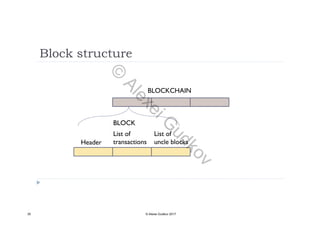
Block structure
BLOCKCHAIN
List of List of
BLOCK
Header transactions uncle blocks
35 © Alexei Gudkov 2017
©
AlexeiG
udkov
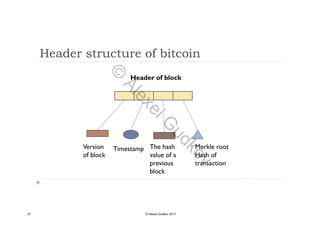
Header
Header includes
 Version of block
 Previous block (hash value of a previous block)
 Merkle root
 Timestamp (date and time of block creation)
36 © Alexei Gudkov 2017
©
AlexeiG
udkov
Header structure of bitcoin
Header of block
The hash
value of a
previous
Merkle root
Hash of
transaction
Version
of block
Timestamp
previous
block
transaction
37 © Alexei Gudkov 2017
©
AlexeiG
udkov
Timestamp
Timestamp can be different for different computers.
The valid timestamp must be less than network adjusted
timetime.
38 © Alexei Gudkov 2017
©
AlexeiG
udkov

Basic blockchain

  • 1.
    1 - BASICCONCEPTS1 - BASIC CONCEPTS 1 © Alexei Gudkov 2017 © AlexeiG udkov
  • 2.
    Base  There arenodes, which compose the network.  Th d h i f ti ith h The nodes exchange information with each other.  The historical data is identical and immutable for every node.for every node. 2 © Alexei Gudkov 2017 © AlexeiG udkov
  • 3.
    Basic scheme 8a8b8c8d 2 NodeP2P 13 Distributed ledger1 3 8a8b8c8d ledger 8a8b8c8d 3 © Alexei Gudkov 2017 © AlexeiG udkov
  • 4.
    2 – Decentralization/ Distribution2 Decentralization / Distribution 4 © Alexei Gudkov 2017 © AlexeiG udkov
  • 5.
    Decentralized system  Thbl k h i t i d t li d The blockchain system is decentralized.  There is no single center for all participants.  Local centers could exist. 5 © Alexei Gudkov 2017 © AlexeiG udkov
  • 6.
    Center Decentralized system hasmore than one center.Decentralized system has more than one center. Distributed system try to escape from any centralization onDistributed system try to escape from any centralization on every level. 6 © Alexei Gudkov 2017 © AlexeiG udkov
  • 7.
    Types of network 1.Decentralized – no common center. 2 F t l t i l d t li ti2. Fractal – symmetrical decentralization. 3. Distributed – no center at all at every level.y 4. Diversified – distribution of nodes’ characteristicscharacteristics. 7 © Alexei Gudkov 2017 © AlexeiG udkov
  • 8.
    Decentralized system In thedecentralized system, there is no single center for all participants. 8 © Alexei Gudkov 2017 © AlexeiG udkov
  • 9.
    Fractal Fractal - repeatingpattern of expanding symmetry. Sierpinski Triangle In real life, the decentralization doesn’t spread evenly. The network is asymmetric.The network is asymmetric. 9 © Alexei Gudkov 2017 © AlexeiG udkov
  • 10.
    Distributed system One ofthe features of blockchain technology is not only decentralization but also distribution.only decentralization but also distribution. Di t ib t d t m i t m i hi h iDistributed system is a system in which processing and data are spread or share among multiple nodes. Distributed system has no centre at all. 10 © Alexei Gudkov 2017 © AlexeiG udkov
  • 11.
    Distributed system advantages Distributedsystem is able to remove the certainDistributed system is able to remove the certain intermediaries,  to increase the speed of reconciliation; to increase the speed of reconciliation;  reduce costs;  manage data safely and efficiently manage data safely and efficiently. 11 © Alexei Gudkov 2017 © AlexeiG udkov
  • 12.
    Distributed system Common understandingof distribution 12 © Alexei Gudkov 2017 © AlexeiG udkov
  • 13.
    Genuine Distributed system RealDistribution has many levelsy 13 © Alexei Gudkov 2017 © AlexeiG udkov
  • 14.
    3 – Problemswith3 Problems with Decentralization and Distribution 14 © Alexei Gudkov 2017 © AlexeiG udkov
  • 15.
    Existing system forusers 8888 Present business system is decentralized for users 2 BANK1 BANK2 for users BANK1 BANK2 1 3 8888 8888 BANK3 15 © Alexei Gudkov 2017 © AlexeiG udkov
  • 16.
    Existing system forintermediaries BANK1 BANK2 Central Existing system is centralized for Central Bank intermediaries BANK3 16 © Alexei Gudkov 2017 © AlexeiG udkov
  • 17.
    Is it reallydistributed? Is the ethereum network really distributed?  One principle of work. One principle of work.  A few software.  Big mining pools Big mining pools. B k h l f l d hBitcoin network has element of centralization due to the use of specialized hardware ASICs, which need to solve computational problem (proof of work)computational problem (proof of work). 17 © Alexei Gudkov 2017 © AlexeiG udkov
  • 18.
    Centralized mining -Bitcoin The graph shows the 5market share of the most popular 5 mining pools has got bitcoin mining pools. g 52% of market blockchain.info 18 © Alexei Gudkov 2017 © AlexeiG udkov
  • 19.
    Country centralization Chinese basedmining pool:  Antpool – 19.3% 5 6 p  BTC.Top – 9.6%  Bixin – 8.1% 5 out 6 the biggest  ViaBTC -7.8%  F2Pool – 7.3% mining pools based in China Total 52% of market 19 © Alexei Gudkov 2017 © AlexeiG udkov
  • 20.
    Centralized mining -ethereum 22mining pools have gothave got 60% of marketof market https://blog.ethereum.org 20 © Alexei Gudkov 2017 © AlexeiG udkov
  • 21.
    Possible problems withdecentralization We rely on the independence of nodes but the system has centralized elements. Let view some possible problems arising from the centralized elements. Possible problems due to centralized elements:  Software  The client software can have a bug, so we can get a problem as for all nodes in a blockchain run the same client software.  Developers  The crime of the development team, which developed a client software for all nodes.  Researches  The crime of the research team, which is proposing protocol upgrades turns out to be socially corrupted.  Government  The government of the country can seize all mining farms for national security purposes. As in a proof of work blockchain, 70% of miners are in the same country, the net can stop work.  Hardware manufacturer Hardware manufacturer  As the majority of mining hardware is built by the same company the bribe in the company can lead to implementing a backdoor that allows this hardware to be shut down at will.  Exchange company  In a proof of stake blockchain, 70% of the coins at stake are held at one exchange. (Based on ButerinVitalik. “The Meaning of decentralization”) 21 © Alexei Gudkov 2017 © AlexeiG udkov
  • 22.
    The future BANK1 BANK2 CB BANK3BANK3 Thefuture blockchain system will be centralized due to legal requirements 22 © Alexei Gudkov 2017 © AlexeiG udkov
  • 23.
    4 -Distributed Ledger- Blockchain4 Distributed Ledger Blockchain 23 © Alexei Gudkov 2017 © AlexeiG udkov
  • 24.
    Distributed Ledger Technology The distributed ledger is a way to record the transaction. In the standard centralized system, the one ledger is a book or computer file with number of copies. But cryptocurrencies use distributed ledger the main features of which are duplicated d d t li d E h i i l f th l d iand decentralized consensus. Each original of the ledger is distributed to a peer-to-peer system with cryptographic authentication and authorization.authentication and authorization.  Distributed ledger data can be either "permissioned" or "unpermissioned" to control who can view it.p 24 © Alexei Gudkov 2017 © AlexeiG udkov
  • 25.
    Features of thedecentralized network  Decentralization – no single center.  Sustainability – network is resistant Sustainability network is resistant.  Anonymity – name is not given or known.  Privacy there are secret personal matters Privacy – there are secret personal matters.  Storage – data are stored in distributed ledgers. A b l h k bl f Accessibility – the network is accessible for everyone.  Speed – operations and transactions are relatively fast. 25 © Alexei Gudkov 2017 © AlexeiG udkov
  • 26.
    Distribution in alegal sense  Refusing from the legal system in favor of natural law.  No government. No government.  No control.  Light disclosure Light disclosure.  Escaping from punishment. P bl i h h i f i h Problems with the protection of rights. 26 © Alexei Gudkov 2017 © AlexeiG udkov
  • 27.
    Peer-to-Peer Networks  Networkin which peers are able to communicate with each other directly, via the logical overlay links withouty g y any central server.  In P2P networks, nodes both provide and use resources., p 27 © Alexei Gudkov 2017 © AlexeiG udkov
  • 28.
    Hyperledger  Don’t messDistributed ledger with Hyperledger, which is an open source collaborative effort created to advancep cross-industry blockchain technologies, hosted by The Linux Foundation. 28 © Alexei Gudkov 2017 © AlexeiG udkov
  • 29.
    Blockchain Blockchain - sequenceof blocks, which record the transactions. Blockchain is a type of distributed ledger / database. Blockchain data is immutableBlockchain data is immutable. 29 © Alexei Gudkov 2017 © AlexeiG udkov
  • 30.
    Trust and blockchain In contrast to common opinion, the Blockchain doesn’t provide trust.p  The Blockchain is the trustless system.  It is guaranteeing an execution of transaction regardless It is guaranteeing an execution of transaction regardless the personal relationship or trust. 30 © Alexei Gudkov 2017 © AlexeiG udkov
  • 31.
    BlockBlock 31 © AlexeiGudkov 2017 © AlexeiG udkov
  • 32.
    Block A block isa software-generated container that bundles together the messages relating to a particular transaction. Information on transactions is included in a block. Bitcoin block explorer https://blockchain.info/ Ethereum block explorer https://etherscan.io/ 32 © Alexei Gudkov 2017 © AlexeiG udkov
  • 33.
    Average Number ofTransactions Per Block 33 © Alexei Gudkov 2017 © AlexeiG udkov
  • 34.
    Block structure A blockin the ethereum blockchain consists of:  a header,,  a list of transactions,  a list of uncle blocks. 34 © Alexei Gudkov 2017 © AlexeiG udkov
  • 35.
    Block structure BLOCKCHAIN List ofList of BLOCK Header transactions uncle blocks 35 © Alexei Gudkov 2017 © AlexeiG udkov
  • 36.
    Header Header includes  Versionof block  Previous block (hash value of a previous block)  Merkle root  Timestamp (date and time of block creation) 36 © Alexei Gudkov 2017 © AlexeiG udkov
  • 37.
    Header structure ofbitcoin Header of block The hash value of a previous Merkle root Hash of transaction Version of block Timestamp previous block transaction 37 © Alexei Gudkov 2017 © AlexeiG udkov
  • 38.
    Timestamp Timestamp can bedifferent for different computers. The valid timestamp must be less than network adjusted timetime. 38 © Alexei Gudkov 2017 © AlexeiG udkov