1. 3D Visualization and Imaging:
•3D visualization involves creating digital
representations of objects using various imaging
techniques.
•In bioprinting, this often involves medical imaging
techniques like CT scans and MRI to capture the
anatomical structure of the tissue or organ to be
printed.
•These images are then used to create a digital 3D
model for designing the bioprinted structure.
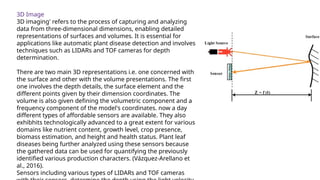
3D Image
3D imaging' refers to the process of capturing and analyzing
data from three-dimensional dimensions, enabling detailed
representations of surfaces and volumes. It is essential for
applications like automatic plant disease detection and involves
techniques such as LIDARs and TOF cameras for depth
determination.
There are two main 3D representations i.e. one concerned with
the surface and other with the volume presentations. The first
one involves the depth details, the surface element and the
different points given by their dimension coordinates. The
volume is also given defining the volumetric component and a
frequency component of the model's coordinates. now a day
different types of affordable sensors are available. They also
exhibhits technologically advanced to a great extent for various
domains like nutrient content, growth level, crop presence,
biomass estimation, and height and health status. Plant leaf
diseases being further analyzed using these sensors because
the gathered data can be used for quantifying the previously
identified various production characters. (Vázquez-Arellano et
al., 2016).
Sensors including various types of LIDARs and TOF cameras
How Does 3D Image Visualization Work? Example: MRI
In MRI machines, greyscale intensity is related to the strength of the signal emitted by proton particles
during relaxation, and after the use of very strong magnetic fields. As different tissues have varying
concentrations of protons, different greyscale intensities are used to create the image. By comparison, in a
CT scan, the greyscale intensity at a particular voxel relates to the X-ray absorption by the subject at a
particular location.
From these processes, a reconstructed image volume is obtained: Raw data taken from a CT or MRI scanner
is converted into tomography images for visualization, which is typically completed using the software
associated with the scanner itself. A 3D bitmap of greyscale intensities is the result, wherein a voxel (3D
pixels) grid is produced. This image data can then be imported to software and visualized in different ways.
For example, in Synopsys Simpleware software, 3D image visualization can involve the following options:
•The background volume can be GPU rendered for quick and easy visualization of the 3D data, creating a
realistic object that can be interacted with by the user.
•Live 3D rendering can be used to carry out instant changes to the image, including lighting, transparency,
background gradients, and model shading, making it straightforward to create a more realistic-looking
model, depending on the application.
•3D stereoscopic visualization can be applied, for example in modes such as checkerboard, anaglyph, and
crystal eyes, to provide a different perspective on the image data.
2. 3D Modeling and Design:
•3D modeling techniques allow for the creation of digital representations of the desired tissue or
organ.
•This can involve various methods, including box modeling, edge modeling, spline/NURBS modeling,
subdivision modeling, and digital sculpting.
•The design phase is crucial for determining the structure, shape, and internal architecture of the
bioprinted construct.
3D modeling is the process of creating three-dimensional images or graphics to represent real
objects and surfaces. The representation is usually done mathematically by manipulating the points
in a virtual space. These points, technically known as vertices, are used to form a mesh, which gives
the shape of an object.
Common Techniques Used in 3D Modeling
1. Box modelling In the box modeling technique the artist uses a geometric shape, like a cube,
cylinder or sphere, and shapes it until the intended appearance is achieved.
2. Contour/Edge modelling Edge modeling is another type of polygonal technique, although it is
different from the box technique. In this process, the modelers develop the model piece by piece
instead of refining a primitive shape.
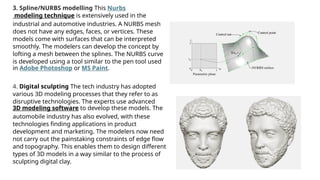
3. Spline/NURBS modelling This Nurbs
modeling technique is extensively used in the
industrial and automotive industries. A NURBS mesh
does not have any edges, faces, or vertices. These
models come with surfaces that can be interpreted
smoothly. The modelers can develop the concept by
lofting a mesh between the splines. The NURBS curve
is developed using a tool similar to the pen tool used
in Adobe Photoshop or MS Paint.
4. Digital sculpting The tech industry has adopted
various 3D modeling processes that they refer to as
disruptive technologies. The experts use advanced
3D modeling software to develop these models. The
automobile industry has also evolved, with these
technologies finding applications in product
development and marketing. The modelers now need
not carry out the painstaking constraints of edge flow
and topography. This enables them to design different
types of 3D models in a way similar to the process of
sculpting digital clay.
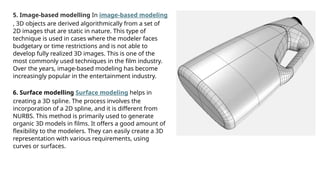
5. Image-based modelling In image-based modeling
, 3D objects are derived algorithmically from a set of
2D images that are static in nature. This type of
technique is used in cases where the modeler faces
budgetary or time restrictions and is not able to
develop fully realized 3D images. This is one of the
most commonly used techniques in the film industry.
Over the years, image-based modeling has become
increasingly popular in the entertainment industry.
6. Surface modelling Surface modeling helps in
creating a 3D spline. The process involves the
incorporation of a 2D spline, and it is different from
NURBS. This method is primarily used to generate
organic 3D models in films. It offers a good amount of
flexibility to the modelers. They can easily create a 3D
representation with various requirements, using
curves or surfaces.
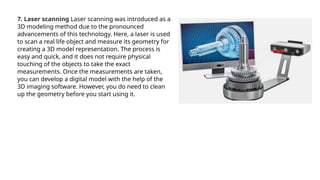
7. Laser scanning Laser scanning was introduced as a
3D modeling method due to the pronounced
advancements of this technology. Here, a laser is used
to scan a real life object and measure its geometry for
creating a 3D model representation. The process is
easy and quick, and it does not require physical
touching of the objects to take the exact
measurements. Once the measurements are taken,
you can develop a digital model with the help of the
3D imaging software. However, you do need to clean
up the geometry before you start using it.
3. 3D Manufacturing: Materials and Methods:
•3D bioprinting uses specialized 3D printers that
deposit materials layer by layer.
•Unlike traditional 3D printing, bioprinting utilizes
bioinks, which are materials that can contain living
cells, growth factors, and other biological
components.
•Common bioprinting methods include inkjet
bioprinting, extrusion bioprinting, and laser-assisted
bioprinting.
3D printing empowers you to prototype and manufacture parts for a wide range of applications
quickly and cost-effectively. But choosing the right 3D printing process is just one side of the
coin. Ultimately, it'll be largely up to the materials to enable you to create parts with the desired
mechanical properties, functional characteristics, or looks.
This comprehensive guide to 3D printing materials showcases the most popular plastic and metal
3D printing materials available, compares their properties, applications, and describes a
framework that you can use to choose the right one for your project.
Plastic 3D Printing Materials and Processes There are dozens of plastic materials available for 3D
printing, each with its unique qualities that make it best suited to specific use cases. To simplify the
process of finding the material best suited for a given part or product, let’s first look at the main types
of plastics and the different 3D printing processes.
Types of Plastic Materials
There are the two main types of plastics:
Thermoplastics are the most commonly used type of plastic. The main feature that sets them apart
from thermosets is their ability to go through numerous melt and solidification cycles. Thermoplastics
can be heated and formed into the desired shape. The process is reversible, as no chemical bonding
takes place, which makes recycling or melting and reusing thermoplastics feasible. Thermosetting
plastics (also referred to as thermosets) remain in a permanent solid state after curing. Polymers in
thermosetting materials cross-link during a curing process that is induced by heat, light, or suitable
radiation. Thermosetting plastics decompose when heated rather than melting, and will not reform
upon cooling. Recycling thermosets or returning the material back into its base ingredients is not
possible.
Plastic 3D Printing Processes
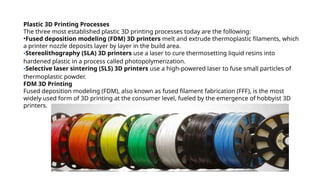
The three most established plastic 3D printing processes today are the following:
•Fused deposition modeling (FDM) 3D printers melt and extrude thermoplastic filaments, which
a printer nozzle deposits layer by layer in the build area.
•Stereolithography (SLA) 3D printers use a laser to cure thermosetting liquid resins into
hardened plastic in a process called photopolymerization.
•Selective laser sintering (SLS) 3D printers use a high-powered laser to fuse small particles of
thermoplastic powder.
FDM 3D Printing
Fused deposition modeling (FDM), also known as fused filament fabrication (FFF), is the most
widely used form of 3D printing at the consumer level, fueled by the emergence of hobbyist 3D
printers.
Metal 3D Printing
Beyond plastics, there are multiple 3D printing processes available for metal 3D printing.
•Metal FDM
Metal FDM printers work similarly to traditional FDM printers, but use extrude metal rods held
together by polymer binders. The finished “green” parts are then sintered in a furnace to remove
the binder.
•Selective Laser Melting (SLM) and Direct Metal Laser Sintering (DMLS)
SLM and DMLS metal 3D printers work similarly to SLS printers, but instead of fusing polymer
powders, they fuse metal powder particles together layer by layer using a laser. SLM and DMLS 3D
printers can create strong, accurate, and complex metal products, making this process ideal for
aerospace, automotive, and medical applications.
Popular Metal 3D Printing Materials
Titanium is lightweight and has excellent mechanical characteristics. It is strong, hard and highly
resistant to heat, oxidation, and acid.
Stainless steel has high strength, high ductility, and is resistant to corrosion.
Aluminum is a lightweight, durable, strong, and has good thermal properties.
Tool steel is a hard, scratch-resistant material that you can use to print end-use tools and other
high-strength parts..
Nickel alloys have high tensile, creep and rupture strength and are heat and corrosion resistant.
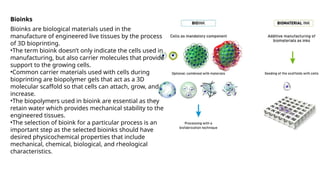
Bioinks
Bioinks are biological materials used in the
manufacture of engineered live tissues by the process
of 3D bioprinting.
•The term bioink doesn’t only indicate the cells used in
manufacturing, but also carrier molecules that provide
support to the growing cells.
•Common carrier materials used with cells during
bioprinting are biopolymer gels that act as a 3D
molecular scaffold so that cells can attach, grow, and
increase.
•The biopolymers used in bioink are essential as they
retain water which provides mechanical stability to the
engineered tissues.
•The selection of bioink for a particular process is an
important step as the selected bioinks should have
desired physicochemical properties that include
mechanical, chemical, biological, and rheological
characteristics.
4. Core Principles and Physical Foundations of 3D
Bioprinting:
•Biomimicry:
•Bioprinting aims to mimic the natural structure and
function of living tissues.
•Layer-by-layer deposition:
•3D bioprinters deposit materials in a precise, layer-by-
layer fashion, similar to traditional 3D printing.
•Cell viability and functionality:
•Maintaining cell viability and function is crucial during
the bioprinting process.
•Bioink properties:
•Bioinks must be biocompatible, printable, and able to
support cell growth and differentiation.
3D Bioprinting Technology (Types)
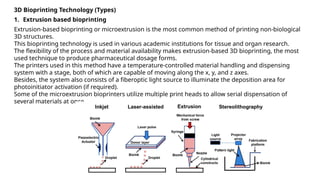
1. Extrusion based bioprinting
Extrusion-based bioprinting or microextrusion is the most common method of printing non-biological
3D structures.
This bioprinting technology is used in various academic institutions for tissue and organ research.
The flexibility of the process and material availability makes extrusion-based 3D bioprinting, the most
used technique to produce pharmaceutical dosage forms.
The printers used in this method have a temperature-controlled material handling and dispensing
system with a stage, both of which are capable of moving along the x, y, and z axes.
Besides, the system also consists of a fiberoptic light source to illuminate the deposition area for
photoinitiator activation (if required).
Some of the microextrusion bioprinters utilize multiple print heads to allow serial dispensation of
several materials at once.
2. Inkjet-based bioprinting
•Inkjet bioprinting or drop-on-demand bioprinting is the most commonly used technology for both
non-biological and biological applications.
•This technology was initially only used for 2D ink-based printing but was later modified by
replacing the ink in the cartridge with biological material, and the paper was replaced by an
electronically controlled elevator stage to provide control.
•Currently, inkjet bioprinting can be performed on bioprinters that are custom-designed to handle
and print biological materials with high precision, speed, and resolution.
•One of the limitations of inkjet bioprinting is that the biological materials have to be in a liquid
form to enable droplet formation.
3. Pressure-assisted bioprinting (PAB)
Pressure-assisted bioprinting is based on the extrusion of biomaterials out of the nozzle of the
printer in order to fabricate a 3D biological structure.
Some of the common biomaterial used in this method include hydrogels, cells and proteins, and
ceramic material solutions, collagen and chitosan, etc.
The speed of the printers remains low, and it provides about 40-80% cell viability.
The use of pressure-assisted bioprinting allows room temperature processing and direct
incorporation of homogenous cells onto the substrate.
4. Laser-assisted bioprinting (LAB)
•Laser-assisted bioprinting is the method of depositing biomaterials onto a surface by using a
laser as a source of energy.
•Traditionally, this technique was limited to transferring metals, but it has since been modified to
be applied to biological materials like cells, DNA, and peptides.
•A laser-assisted bioprinter consists of a pulsed laser beam, a focusing system, a ribbon with
donor transport support, a layer of biological material prepared in a liquid solution with a
receiving substrate facing the projector.
•The biomaterials to be used in laser-assisted bioprinting include a hydrogel, culture media, cells,
proteins, and ceramic materials.
•The speed of the bioprinters is medium, and the method retains about 95% of cell viability.
5. Stereolithography (STL)
•Stereolithography is a freeform, nozzle free technique used to produce the 3D structure of
biological and non-biological materials.
•The stereolithography technique has the highest fabrication accuracy, and a large number of
materials can be used in the process.
•The technique utilizes light-sensitive hydrogels that are deposited in a layer-by-layer fashion to
form a 3D structure.
•The speed of this method is very fast (about 40,000 mm/s) with cell viability of more than 90%.
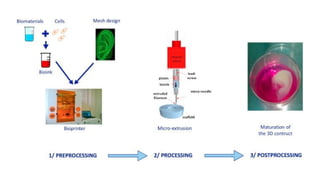
5. Basic Process of 3D Bioprinting:
•Problem Identification:
•Define the need for a bioprinted tissue or organ (e.g.,
a skin graft, a heart valve).
•Design:
•Create a digital 3D model of the desired structure
based on imaging data and design specifications.
•Material Selection:
•Choose appropriate bioinks and other materials
based on the application and printing method.
•Object Fabrication:
•The bioprinting process involves depositing the
selected materials layer by layer to build the structure.
•Post-processing and maturation:
•The bioprinted construct may require further
processing and maturation in a bioreactor to develop
its full functionality.

BIOPRINTING and its application 3D Visualization and Imaging

  • 1.
    1. 3D Visualizationand Imaging: •3D visualization involves creating digital representations of objects using various imaging techniques. •In bioprinting, this often involves medical imaging techniques like CT scans and MRI to capture the anatomical structure of the tissue or organ to be printed. •These images are then used to create a digital 3D model for designing the bioprinted structure.
  • 2.
    3D Image 3D imaging'refers to the process of capturing and analyzing data from three-dimensional dimensions, enabling detailed representations of surfaces and volumes. It is essential for applications like automatic plant disease detection and involves techniques such as LIDARs and TOF cameras for depth determination. There are two main 3D representations i.e. one concerned with the surface and other with the volume presentations. The first one involves the depth details, the surface element and the different points given by their dimension coordinates. The volume is also given defining the volumetric component and a frequency component of the model's coordinates. now a day different types of affordable sensors are available. They also exhibhits technologically advanced to a great extent for various domains like nutrient content, growth level, crop presence, biomass estimation, and height and health status. Plant leaf diseases being further analyzed using these sensors because the gathered data can be used for quantifying the previously identified various production characters. (Vázquez-Arellano et al., 2016). Sensors including various types of LIDARs and TOF cameras
  • 3.
    How Does 3DImage Visualization Work? Example: MRI In MRI machines, greyscale intensity is related to the strength of the signal emitted by proton particles during relaxation, and after the use of very strong magnetic fields. As different tissues have varying concentrations of protons, different greyscale intensities are used to create the image. By comparison, in a CT scan, the greyscale intensity at a particular voxel relates to the X-ray absorption by the subject at a particular location. From these processes, a reconstructed image volume is obtained: Raw data taken from a CT or MRI scanner is converted into tomography images for visualization, which is typically completed using the software associated with the scanner itself. A 3D bitmap of greyscale intensities is the result, wherein a voxel (3D pixels) grid is produced. This image data can then be imported to software and visualized in different ways. For example, in Synopsys Simpleware software, 3D image visualization can involve the following options: •The background volume can be GPU rendered for quick and easy visualization of the 3D data, creating a realistic object that can be interacted with by the user. •Live 3D rendering can be used to carry out instant changes to the image, including lighting, transparency, background gradients, and model shading, making it straightforward to create a more realistic-looking model, depending on the application. •3D stereoscopic visualization can be applied, for example in modes such as checkerboard, anaglyph, and crystal eyes, to provide a different perspective on the image data.
  • 4.
    2. 3D Modelingand Design: •3D modeling techniques allow for the creation of digital representations of the desired tissue or organ. •This can involve various methods, including box modeling, edge modeling, spline/NURBS modeling, subdivision modeling, and digital sculpting. •The design phase is crucial for determining the structure, shape, and internal architecture of the bioprinted construct. 3D modeling is the process of creating three-dimensional images or graphics to represent real objects and surfaces. The representation is usually done mathematically by manipulating the points in a virtual space. These points, technically known as vertices, are used to form a mesh, which gives the shape of an object. Common Techniques Used in 3D Modeling 1. Box modelling In the box modeling technique the artist uses a geometric shape, like a cube, cylinder or sphere, and shapes it until the intended appearance is achieved. 2. Contour/Edge modelling Edge modeling is another type of polygonal technique, although it is different from the box technique. In this process, the modelers develop the model piece by piece instead of refining a primitive shape.
  • 5.
    3. Spline/NURBS modellingThis Nurbs modeling technique is extensively used in the industrial and automotive industries. A NURBS mesh does not have any edges, faces, or vertices. These models come with surfaces that can be interpreted smoothly. The modelers can develop the concept by lofting a mesh between the splines. The NURBS curve is developed using a tool similar to the pen tool used in Adobe Photoshop or MS Paint. 4. Digital sculpting The tech industry has adopted various 3D modeling processes that they refer to as disruptive technologies. The experts use advanced 3D modeling software to develop these models. The automobile industry has also evolved, with these technologies finding applications in product development and marketing. The modelers now need not carry out the painstaking constraints of edge flow and topography. This enables them to design different types of 3D models in a way similar to the process of sculpting digital clay.
  • 6.
    5. Image-based modellingIn image-based modeling , 3D objects are derived algorithmically from a set of 2D images that are static in nature. This type of technique is used in cases where the modeler faces budgetary or time restrictions and is not able to develop fully realized 3D images. This is one of the most commonly used techniques in the film industry. Over the years, image-based modeling has become increasingly popular in the entertainment industry. 6. Surface modelling Surface modeling helps in creating a 3D spline. The process involves the incorporation of a 2D spline, and it is different from NURBS. This method is primarily used to generate organic 3D models in films. It offers a good amount of flexibility to the modelers. They can easily create a 3D representation with various requirements, using curves or surfaces.
  • 7.
    7. Laser scanningLaser scanning was introduced as a 3D modeling method due to the pronounced advancements of this technology. Here, a laser is used to scan a real life object and measure its geometry for creating a 3D model representation. The process is easy and quick, and it does not require physical touching of the objects to take the exact measurements. Once the measurements are taken, you can develop a digital model with the help of the 3D imaging software. However, you do need to clean up the geometry before you start using it.
  • 8.
    3. 3D Manufacturing:Materials and Methods: •3D bioprinting uses specialized 3D printers that deposit materials layer by layer. •Unlike traditional 3D printing, bioprinting utilizes bioinks, which are materials that can contain living cells, growth factors, and other biological components. •Common bioprinting methods include inkjet bioprinting, extrusion bioprinting, and laser-assisted bioprinting.
  • 9.
    3D printing empowersyou to prototype and manufacture parts for a wide range of applications quickly and cost-effectively. But choosing the right 3D printing process is just one side of the coin. Ultimately, it'll be largely up to the materials to enable you to create parts with the desired mechanical properties, functional characteristics, or looks. This comprehensive guide to 3D printing materials showcases the most popular plastic and metal 3D printing materials available, compares their properties, applications, and describes a framework that you can use to choose the right one for your project. Plastic 3D Printing Materials and Processes There are dozens of plastic materials available for 3D printing, each with its unique qualities that make it best suited to specific use cases. To simplify the process of finding the material best suited for a given part or product, let’s first look at the main types of plastics and the different 3D printing processes. Types of Plastic Materials There are the two main types of plastics: Thermoplastics are the most commonly used type of plastic. The main feature that sets them apart from thermosets is their ability to go through numerous melt and solidification cycles. Thermoplastics can be heated and formed into the desired shape. The process is reversible, as no chemical bonding takes place, which makes recycling or melting and reusing thermoplastics feasible. Thermosetting plastics (also referred to as thermosets) remain in a permanent solid state after curing. Polymers in thermosetting materials cross-link during a curing process that is induced by heat, light, or suitable radiation. Thermosetting plastics decompose when heated rather than melting, and will not reform upon cooling. Recycling thermosets or returning the material back into its base ingredients is not possible.
  • 10.
    Plastic 3D PrintingProcesses The three most established plastic 3D printing processes today are the following: •Fused deposition modeling (FDM) 3D printers melt and extrude thermoplastic filaments, which a printer nozzle deposits layer by layer in the build area. •Stereolithography (SLA) 3D printers use a laser to cure thermosetting liquid resins into hardened plastic in a process called photopolymerization. •Selective laser sintering (SLS) 3D printers use a high-powered laser to fuse small particles of thermoplastic powder. FDM 3D Printing Fused deposition modeling (FDM), also known as fused filament fabrication (FFF), is the most widely used form of 3D printing at the consumer level, fueled by the emergence of hobbyist 3D printers.
  • 11.
    Metal 3D Printing Beyondplastics, there are multiple 3D printing processes available for metal 3D printing. •Metal FDM Metal FDM printers work similarly to traditional FDM printers, but use extrude metal rods held together by polymer binders. The finished “green” parts are then sintered in a furnace to remove the binder. •Selective Laser Melting (SLM) and Direct Metal Laser Sintering (DMLS) SLM and DMLS metal 3D printers work similarly to SLS printers, but instead of fusing polymer powders, they fuse metal powder particles together layer by layer using a laser. SLM and DMLS 3D printers can create strong, accurate, and complex metal products, making this process ideal for aerospace, automotive, and medical applications. Popular Metal 3D Printing Materials Titanium is lightweight and has excellent mechanical characteristics. It is strong, hard and highly resistant to heat, oxidation, and acid. Stainless steel has high strength, high ductility, and is resistant to corrosion. Aluminum is a lightweight, durable, strong, and has good thermal properties. Tool steel is a hard, scratch-resistant material that you can use to print end-use tools and other high-strength parts.. Nickel alloys have high tensile, creep and rupture strength and are heat and corrosion resistant.
  • 12.
    Bioinks Bioinks are biologicalmaterials used in the manufacture of engineered live tissues by the process of 3D bioprinting. •The term bioink doesn’t only indicate the cells used in manufacturing, but also carrier molecules that provide support to the growing cells. •Common carrier materials used with cells during bioprinting are biopolymer gels that act as a 3D molecular scaffold so that cells can attach, grow, and increase. •The biopolymers used in bioink are essential as they retain water which provides mechanical stability to the engineered tissues. •The selection of bioink for a particular process is an important step as the selected bioinks should have desired physicochemical properties that include mechanical, chemical, biological, and rheological characteristics.
  • 14.
    4. Core Principlesand Physical Foundations of 3D Bioprinting: •Biomimicry: •Bioprinting aims to mimic the natural structure and function of living tissues. •Layer-by-layer deposition: •3D bioprinters deposit materials in a precise, layer-by- layer fashion, similar to traditional 3D printing. •Cell viability and functionality: •Maintaining cell viability and function is crucial during the bioprinting process. •Bioink properties: •Bioinks must be biocompatible, printable, and able to support cell growth and differentiation.
  • 15.
    3D Bioprinting Technology(Types) 1. Extrusion based bioprinting Extrusion-based bioprinting or microextrusion is the most common method of printing non-biological 3D structures. This bioprinting technology is used in various academic institutions for tissue and organ research. The flexibility of the process and material availability makes extrusion-based 3D bioprinting, the most used technique to produce pharmaceutical dosage forms. The printers used in this method have a temperature-controlled material handling and dispensing system with a stage, both of which are capable of moving along the x, y, and z axes. Besides, the system also consists of a fiberoptic light source to illuminate the deposition area for photoinitiator activation (if required). Some of the microextrusion bioprinters utilize multiple print heads to allow serial dispensation of several materials at once.
  • 16.
    2. Inkjet-based bioprinting •Inkjetbioprinting or drop-on-demand bioprinting is the most commonly used technology for both non-biological and biological applications. •This technology was initially only used for 2D ink-based printing but was later modified by replacing the ink in the cartridge with biological material, and the paper was replaced by an electronically controlled elevator stage to provide control. •Currently, inkjet bioprinting can be performed on bioprinters that are custom-designed to handle and print biological materials with high precision, speed, and resolution. •One of the limitations of inkjet bioprinting is that the biological materials have to be in a liquid form to enable droplet formation. 3. Pressure-assisted bioprinting (PAB) Pressure-assisted bioprinting is based on the extrusion of biomaterials out of the nozzle of the printer in order to fabricate a 3D biological structure. Some of the common biomaterial used in this method include hydrogels, cells and proteins, and ceramic material solutions, collagen and chitosan, etc. The speed of the printers remains low, and it provides about 40-80% cell viability. The use of pressure-assisted bioprinting allows room temperature processing and direct incorporation of homogenous cells onto the substrate.
  • 17.
    4. Laser-assisted bioprinting(LAB) •Laser-assisted bioprinting is the method of depositing biomaterials onto a surface by using a laser as a source of energy. •Traditionally, this technique was limited to transferring metals, but it has since been modified to be applied to biological materials like cells, DNA, and peptides. •A laser-assisted bioprinter consists of a pulsed laser beam, a focusing system, a ribbon with donor transport support, a layer of biological material prepared in a liquid solution with a receiving substrate facing the projector. •The biomaterials to be used in laser-assisted bioprinting include a hydrogel, culture media, cells, proteins, and ceramic materials. •The speed of the bioprinters is medium, and the method retains about 95% of cell viability. 5. Stereolithography (STL) •Stereolithography is a freeform, nozzle free technique used to produce the 3D structure of biological and non-biological materials. •The stereolithography technique has the highest fabrication accuracy, and a large number of materials can be used in the process. •The technique utilizes light-sensitive hydrogels that are deposited in a layer-by-layer fashion to form a 3D structure. •The speed of this method is very fast (about 40,000 mm/s) with cell viability of more than 90%.
  • 18.
    5. Basic Processof 3D Bioprinting: •Problem Identification: •Define the need for a bioprinted tissue or organ (e.g., a skin graft, a heart valve). •Design: •Create a digital 3D model of the desired structure based on imaging data and design specifications. •Material Selection: •Choose appropriate bioinks and other materials based on the application and printing method. •Object Fabrication: •The bioprinting process involves depositing the selected materials layer by layer to build the structure. •Post-processing and maturation: •The bioprinted construct may require further processing and maturation in a bioreactor to develop its full functionality.