various diseases like liver,
kidney, diabetes, malnutrition
and immunity
Group members:
Fareeha Nadeem
Aneesa Nisar
Tayyaba Bari
Sajida Kashif
Rimsha Khan
Biomarkers
 Biomarkers are molecules that indicate normal or
abnormal process taking place in your body and may be
a sign of an underlying condition or disease.
Examples of Biomarkers:
 Various types of molecules, such as DNA
(genes), proteins or hormones, can serve as biomarkers,
since they all indicate something about your health.
 Biomarkers are objective medical signs (as opposed to
symptoms reported by the patient) used to measure the
 presence of disease
 progress of disease
 the effects of treatment.
Liver Biomarkers
 Alkaline phosphatase (ALP )
 Serum glutamate pyruvate transaminase ( SGPT )
 Serum glutamate oxalate transaminase ( SGOT )
 Gamma Glutamyl Transferase(GGT )
 Alpha fetoprotein(AFP as LFT)
 Ceruloplasmin (Cp as LFT
 5 ‘ nucleotidase
Contin…
ALP
 Normal range: 30 - 95 IU/L
 ALP occurs in in all tissues, especially liver, bone. bile duct, kidney & the
placenta.
 The ALP used to help diagnose certain liver diseases and bone disorders.
 A rise in serum ALP is usually associated with elevated serum bilirubin, is
an indicator of biliary obstruction(obstructive/posthepatic jaundice).
 ALP is also elevated in cirrhosis of liver & hepatic tumors.
5 ‘ Nucleosidase
 Normal range: 2-15 U/L
 The serum activity of 5'-nucleotidase is elevated in hepatobiliary disease &
this parallels ALP.
 The 5'-nucleotidase is not altered in bone disease (as is the case with ALP).
Contin…
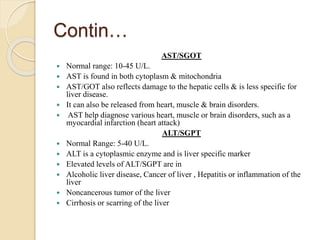
AST/SGOT
 Normal range: 10-45 U/L.
 AST is found in both cytoplasm & mitochondria
 AST/GOT also reflects damage to the hepatic cells & is less specific for
liver disease.
 It can also be released from heart, muscle & brain disorders.
 AST help diagnose various heart, muscle or brain disorders, such as a
myocardial infarction (heart attack)
ALT/SGPT
 Normal Range: 5-40 U/L.
 ALT is a cytoplasmic enzyme and is liver specific marker
 Elevated levels of ALT/SGPT are in
 Alcoholic liver disease, Cancer of liver , Hepatitis or inflammation of the
liver
 Noncancerous tumor of the liver
 Cirrhosis or scarring of the liver
Contin…
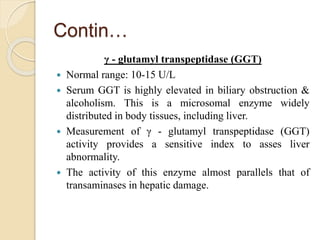
γ - glutamyl transpeptidase (GGT)
 Normal range: 10-15 U/L
 Serum GGT is highly elevated in biliary obstruction &
alcoholism. This is a microsomal enzyme widely
distributed in body tissues, including liver.
 Measurement of γ - glutamyl transpeptidase (GGT)
activity provides a sensitive index to asses liver
abnormality.
 The activity of this enzyme almost parallels that of
transaminases in hepatic damage.
Contin…
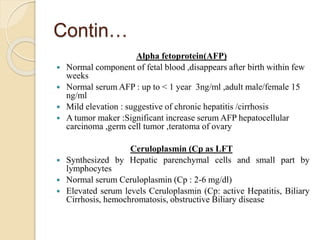
Alpha fetoprotein(AFP)
 Normal component of fetal blood ,disappears after birth within few
weeks
 Normal serum AFP : up to < 1 year 3ng/ml ,adult male/female 15
ng/ml
 Mild elevation : suggestive of chronic hepatitis /cirrhosis
 A tumor maker :Significant increase serum AFP hepatocellular
carcinoma ,germ cell tumor ,teratoma of ovary
Ceruloplasmin (Cp as LFT
 Synthesized by Hepatic parenchymal cells and small part by
lymphocytes
 Normal serum Ceruloplasmin (Cp : 2-6 mg/dl)
 Elevated serum levels Ceruloplasmin (Cp: active Hepatitis, Biliary
Cirrhosis, hemochromatosis, obstructive Biliary disease
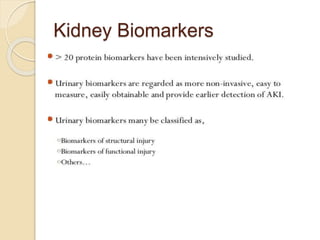
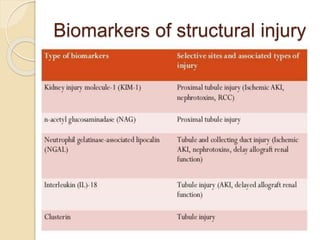
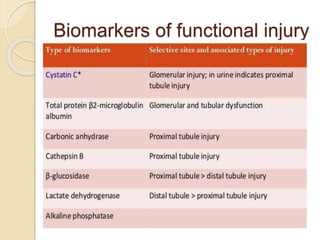
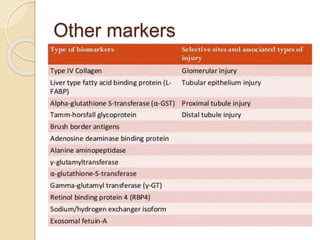
Kidney Biomarkers
Biomarkers of structural injury
Biomarkers of functional injury
Other markers
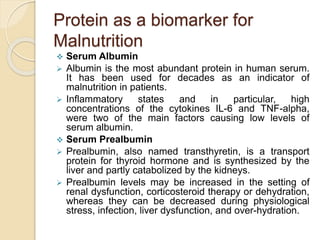
Protein as a biomarker for
Malnutrition
 Serum Albumin
 Albumin is the most abundant protein in human serum.
It has been used for decades as an indicator of
malnutrition in patients.
 Inflammatory states and in particular, high
concentrations of the cytokines IL-6 and TNF-alpha,
were two of the main factors causing low levels of
serum albumin.
 Serum Prealbumin
 Prealbumin, also named transthyretin, is a transport
protein for thyroid hormone and is synthesized by the
liver and partly catabolized by the kidneys.
 Prealbumin levels may be increased in the setting of
renal dysfunction, corticosteroid therapy or dehydration,
whereas they can be decreased during physiological
stress, infection, liver dysfunction, and over-hydration.
Contin…
 Transferrin
 This acute-phase reactant is a transport protein for iron.
 During iron-deficiency the levels of transferrin are
elevated whereas they are decreased in iron-overload
states.
 Retinol-Binding Protein (RBP)
 This is a low molecular weight protein with the
physiological role to transport retinol from the liver to
target organs.
 It is more difficult to measure and it is influenced by the
vitamin A status. For these reasons there RBP
measurements have not found widespread application.
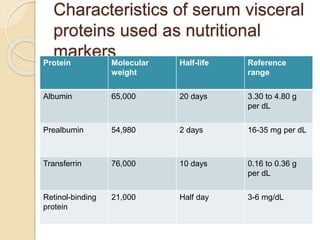
Characteristics of serum visceral
proteins used as nutritional
markers
Protein Molecular
weight
Half-life Reference
range
Albumin 65,000 20 days 3.30 to 4.80 g
per dL
Prealbumin 54,980 2 days 16-35 mg per dL
Transferrin 76,000 10 days 0.16 to 0.36 g
per dL
Retinol-binding
protein
21,000 Half day 3-6 mg/dL
Protein as a biomarker for
Immunity
 How is protein related to Immune function?
 The immune system is a wonderful collaboration between cells
and proteins that work together to provide defense against
infection.
 Immune system is dispersed throughout the body to provide
rapid responses to infection.
 What are Immune Biomarkers?
 Specific blood-borne immunomodulatory factors can serve as
potential biomarkers. E.g.
 Cytokines which are known for their regulatory role
in immune responses and their specific signaling functions
between immune cells, are good candidates.
 Cytokines are small molecules that orchestrate immune responses
and as such have great potential as biomarkers for both human and
veterinary fields.
Cytokines
 Cytokines are a large group of proteins, peptides or
glycoproteins that are secreted by specific cells of immune
system.
 Cytokines are a category of signaling molecules that mediate
and regulate immunity, inflammation and hematopoiesis.
 Cytokines can be further subdivided into
1. Interleukins (IL)
2. Interferons (IFN)
3. Chemokines
4. Tumor necrosis factors (TNF)
 Which may promote either pro-inflammatory or anti-
inflammatory responses. They have the capacity to stimulate
and modulate the immune system and are therefore great
indicators of normal immunological processes, pathological
processes or responses to treatment.
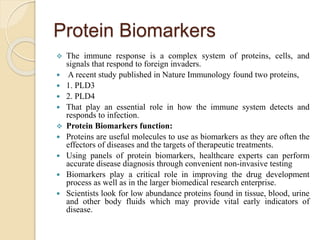
Protein Biomarkers
 The immune response is a complex system of proteins, cells, and
signals that respond to foreign invaders.
 A recent study published in Nature Immunology found two proteins,
 1. PLD3
 2. PLD4
 That play an essential role in how the immune system detects and
responds to infection.
 Protein Biomarkers function:
 Proteins are useful molecules to use as biomarkers as they are often the
effectors of diseases and the targets of therapeutic treatments.
 Using panels of protein biomarkers, healthcare experts can perform
accurate disease diagnosis through convenient non-invasive testing
 Biomarkers play a critical role in improving the drug development
process as well as in the larger biomedical research enterprise.
 Scientists look for low abundance proteins found in tissue, blood, urine
and other body fluids which may provide vital early indicators of
disease.
Biomarkers used in Diabetes
 HbA1c ( hemoglobin A1c)
 FA (fructosamine)
 GA (glycated albumin)
 OGTT (oral glucose tolerance test)
 1, 5 AG (1, 5 anhydroglucitol)
HbA1c
 Mechanism of action
 HbA1c forms when glucose attaches to the amino-
terminal group of the β subunit of hemoglobin.
 Advantage
 Increased HbA1c levels are associated with increased
morbidity and mortality
More reliable biomarker of chronic glycemia
HbA1c correlates with greater convenience,
greater pre-analytical stability, and less day-to-day
perturbation during periods of stress and illness.
Disadvantage
HbA1c threshold for prediabetes does not consider
ethnicity, BMI, and age, all of which may significantly
alter HbA1c levels.
HbA1c is not always a reliable measure of average
circulating glucose levels.
Changes in the production rate or circulating life span
of red blood cells affect HbA1c levels, as well as
hemoglobin variants such as HbS, HbC, HbD, and
HbE
FA
 Mechanism of action
 FA is a ketoamine created by glycosylation of total serum proteins,
primarily albumin.
 Advantages
 FA reflects average blood glucose concentration over the previous 1–
4 weeks.
FA is especially beneficial in conditions that affect hemoglobin status
or rate of erythrocyte turnover.
 Disadvantage
 FA has higher within-subject variation and falsely low levels in
conditions leading to rapid albumin turnover.
GA
 Mechanism of action
 Glycosylation of albumin and measured by the ratio of GA to total
albumin.
 Advantages
 GA is a superior index of glycemic control than HbA1c in patients
with renal failure, hemolytic anemia, and those receiving blood
transfusions.
 Disadvantage
 Inaccurate when there are changes in albumin turnover
Falsely lower levels in obesity.
OGTT
 Measures fasting and 2-hour plasma glucose levels.
 Advantages
 OGTT is more strongly correlated with IR and secretion than
HbA1c
OGTT provides important information with regard to risk that
HbA1c or FPG cannot
 Disadvantages
 OGTT is variable, invasive, and time consuming It is inconvenient
because it requires fasting and shows day-to-day perturbation
during periods of stress and illness
1,5 AG
 1,5 AG is a dietary monosaccharide. Plasma concentrations
are inversely correlated with plasma glucose 60.
 Advantages
 1,5 AG is a useful biomarker as it reflects glucose levels
within the past 10–14 days
It is stable, replicable, and less costly compared to other
glycemic diagnostic tests
 Disadvantages
 Plasma 1,5 AG levels can change based on dietary habits, sex,
and race.
Levels are also affected by renal hemodynamics or treatment
with SGLT2 inhibitors
Contin…
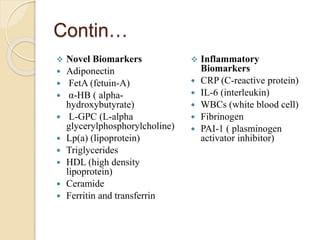
 Novel Biomarkers
 Adiponectin
 FetA (fetuin-A)
 α-HB ( alpha-
hydroxybutyrate)
 L-GPC (L-alpha
glycerylphosphorylcholine)
 Lp(a) (lipoprotein)
 Triglycerides
 HDL (high density
lipoprotein)
 Ceramide
 Ferritin and transferrin
 Inflammatory
Biomarkers
 CRP (C-reactive protein)
 IL-6 (interleukin)
 WBCs (white blood cell)
 Fibrinogen
 PAI-1 ( plasminogen
activator inhibitor)

Biomarkers.pptx

  • 1.
    various diseases likeliver, kidney, diabetes, malnutrition and immunity Group members: Fareeha Nadeem Aneesa Nisar Tayyaba Bari Sajida Kashif Rimsha Khan
  • 2.
    Biomarkers  Biomarkers aremolecules that indicate normal or abnormal process taking place in your body and may be a sign of an underlying condition or disease. Examples of Biomarkers:  Various types of molecules, such as DNA (genes), proteins or hormones, can serve as biomarkers, since they all indicate something about your health.  Biomarkers are objective medical signs (as opposed to symptoms reported by the patient) used to measure the  presence of disease  progress of disease  the effects of treatment.
  • 3.
    Liver Biomarkers  Alkalinephosphatase (ALP )  Serum glutamate pyruvate transaminase ( SGPT )  Serum glutamate oxalate transaminase ( SGOT )  Gamma Glutamyl Transferase(GGT )  Alpha fetoprotein(AFP as LFT)  Ceruloplasmin (Cp as LFT  5 ‘ nucleotidase
  • 4.
    Contin… ALP  Normal range:30 - 95 IU/L  ALP occurs in in all tissues, especially liver, bone. bile duct, kidney & the placenta.  The ALP used to help diagnose certain liver diseases and bone disorders.  A rise in serum ALP is usually associated with elevated serum bilirubin, is an indicator of biliary obstruction(obstructive/posthepatic jaundice).  ALP is also elevated in cirrhosis of liver & hepatic tumors. 5 ‘ Nucleosidase  Normal range: 2-15 U/L  The serum activity of 5'-nucleotidase is elevated in hepatobiliary disease & this parallels ALP.  The 5'-nucleotidase is not altered in bone disease (as is the case with ALP).
  • 5.
    Contin… AST/SGOT  Normal range:10-45 U/L.  AST is found in both cytoplasm & mitochondria  AST/GOT also reflects damage to the hepatic cells & is less specific for liver disease.  It can also be released from heart, muscle & brain disorders.  AST help diagnose various heart, muscle or brain disorders, such as a myocardial infarction (heart attack) ALT/SGPT  Normal Range: 5-40 U/L.  ALT is a cytoplasmic enzyme and is liver specific marker  Elevated levels of ALT/SGPT are in  Alcoholic liver disease, Cancer of liver , Hepatitis or inflammation of the liver  Noncancerous tumor of the liver  Cirrhosis or scarring of the liver
  • 6.
    Contin… γ - glutamyltranspeptidase (GGT)  Normal range: 10-15 U/L  Serum GGT is highly elevated in biliary obstruction & alcoholism. This is a microsomal enzyme widely distributed in body tissues, including liver.  Measurement of γ - glutamyl transpeptidase (GGT) activity provides a sensitive index to asses liver abnormality.  The activity of this enzyme almost parallels that of transaminases in hepatic damage.
  • 7.
    Contin… Alpha fetoprotein(AFP)  Normalcomponent of fetal blood ,disappears after birth within few weeks  Normal serum AFP : up to < 1 year 3ng/ml ,adult male/female 15 ng/ml  Mild elevation : suggestive of chronic hepatitis /cirrhosis  A tumor maker :Significant increase serum AFP hepatocellular carcinoma ,germ cell tumor ,teratoma of ovary Ceruloplasmin (Cp as LFT  Synthesized by Hepatic parenchymal cells and small part by lymphocytes  Normal serum Ceruloplasmin (Cp : 2-6 mg/dl)  Elevated serum levels Ceruloplasmin (Cp: active Hepatitis, Biliary Cirrhosis, hemochromatosis, obstructive Biliary disease
  • 8.
  • 9.
  • 10.
  • 11.
  • 12.
    Protein as abiomarker for Malnutrition  Serum Albumin  Albumin is the most abundant protein in human serum. It has been used for decades as an indicator of malnutrition in patients.  Inflammatory states and in particular, high concentrations of the cytokines IL-6 and TNF-alpha, were two of the main factors causing low levels of serum albumin.  Serum Prealbumin  Prealbumin, also named transthyretin, is a transport protein for thyroid hormone and is synthesized by the liver and partly catabolized by the kidneys.  Prealbumin levels may be increased in the setting of renal dysfunction, corticosteroid therapy or dehydration, whereas they can be decreased during physiological stress, infection, liver dysfunction, and over-hydration.
  • 13.
    Contin…  Transferrin  Thisacute-phase reactant is a transport protein for iron.  During iron-deficiency the levels of transferrin are elevated whereas they are decreased in iron-overload states.  Retinol-Binding Protein (RBP)  This is a low molecular weight protein with the physiological role to transport retinol from the liver to target organs.  It is more difficult to measure and it is influenced by the vitamin A status. For these reasons there RBP measurements have not found widespread application.
  • 14.
    Characteristics of serumvisceral proteins used as nutritional markers Protein Molecular weight Half-life Reference range Albumin 65,000 20 days 3.30 to 4.80 g per dL Prealbumin 54,980 2 days 16-35 mg per dL Transferrin 76,000 10 days 0.16 to 0.36 g per dL Retinol-binding protein 21,000 Half day 3-6 mg/dL
  • 15.
    Protein as abiomarker for Immunity  How is protein related to Immune function?  The immune system is a wonderful collaboration between cells and proteins that work together to provide defense against infection.  Immune system is dispersed throughout the body to provide rapid responses to infection.  What are Immune Biomarkers?  Specific blood-borne immunomodulatory factors can serve as potential biomarkers. E.g.  Cytokines which are known for their regulatory role in immune responses and their specific signaling functions between immune cells, are good candidates.  Cytokines are small molecules that orchestrate immune responses and as such have great potential as biomarkers for both human and veterinary fields.
  • 16.
    Cytokines  Cytokines area large group of proteins, peptides or glycoproteins that are secreted by specific cells of immune system.  Cytokines are a category of signaling molecules that mediate and regulate immunity, inflammation and hematopoiesis.  Cytokines can be further subdivided into 1. Interleukins (IL) 2. Interferons (IFN) 3. Chemokines 4. Tumor necrosis factors (TNF)  Which may promote either pro-inflammatory or anti- inflammatory responses. They have the capacity to stimulate and modulate the immune system and are therefore great indicators of normal immunological processes, pathological processes or responses to treatment.
  • 17.
    Protein Biomarkers  Theimmune response is a complex system of proteins, cells, and signals that respond to foreign invaders.  A recent study published in Nature Immunology found two proteins,  1. PLD3  2. PLD4  That play an essential role in how the immune system detects and responds to infection.  Protein Biomarkers function:  Proteins are useful molecules to use as biomarkers as they are often the effectors of diseases and the targets of therapeutic treatments.  Using panels of protein biomarkers, healthcare experts can perform accurate disease diagnosis through convenient non-invasive testing  Biomarkers play a critical role in improving the drug development process as well as in the larger biomedical research enterprise.  Scientists look for low abundance proteins found in tissue, blood, urine and other body fluids which may provide vital early indicators of disease.
  • 18.
    Biomarkers used inDiabetes  HbA1c ( hemoglobin A1c)  FA (fructosamine)  GA (glycated albumin)  OGTT (oral glucose tolerance test)  1, 5 AG (1, 5 anhydroglucitol)
  • 19.
    HbA1c  Mechanism ofaction  HbA1c forms when glucose attaches to the amino- terminal group of the β subunit of hemoglobin.  Advantage  Increased HbA1c levels are associated with increased morbidity and mortality More reliable biomarker of chronic glycemia HbA1c correlates with greater convenience, greater pre-analytical stability, and less day-to-day perturbation during periods of stress and illness.
  • 20.
    Disadvantage HbA1c threshold forprediabetes does not consider ethnicity, BMI, and age, all of which may significantly alter HbA1c levels. HbA1c is not always a reliable measure of average circulating glucose levels. Changes in the production rate or circulating life span of red blood cells affect HbA1c levels, as well as hemoglobin variants such as HbS, HbC, HbD, and HbE
  • 21.
    FA  Mechanism ofaction  FA is a ketoamine created by glycosylation of total serum proteins, primarily albumin.  Advantages  FA reflects average blood glucose concentration over the previous 1– 4 weeks. FA is especially beneficial in conditions that affect hemoglobin status or rate of erythrocyte turnover.  Disadvantage  FA has higher within-subject variation and falsely low levels in conditions leading to rapid albumin turnover.
  • 22.
    GA  Mechanism ofaction  Glycosylation of albumin and measured by the ratio of GA to total albumin.  Advantages  GA is a superior index of glycemic control than HbA1c in patients with renal failure, hemolytic anemia, and those receiving blood transfusions.  Disadvantage  Inaccurate when there are changes in albumin turnover Falsely lower levels in obesity.
  • 23.
    OGTT  Measures fastingand 2-hour plasma glucose levels.  Advantages  OGTT is more strongly correlated with IR and secretion than HbA1c OGTT provides important information with regard to risk that HbA1c or FPG cannot  Disadvantages  OGTT is variable, invasive, and time consuming It is inconvenient because it requires fasting and shows day-to-day perturbation during periods of stress and illness
  • 24.
    1,5 AG  1,5AG is a dietary monosaccharide. Plasma concentrations are inversely correlated with plasma glucose 60.  Advantages  1,5 AG is a useful biomarker as it reflects glucose levels within the past 10–14 days It is stable, replicable, and less costly compared to other glycemic diagnostic tests  Disadvantages  Plasma 1,5 AG levels can change based on dietary habits, sex, and race. Levels are also affected by renal hemodynamics or treatment with SGLT2 inhibitors
  • 25.
    Contin…  Novel Biomarkers Adiponectin  FetA (fetuin-A)  α-HB ( alpha- hydroxybutyrate)  L-GPC (L-alpha glycerylphosphorylcholine)  Lp(a) (lipoprotein)  Triglycerides  HDL (high density lipoprotein)  Ceramide  Ferritin and transferrin  Inflammatory Biomarkers  CRP (C-reactive protein)  IL-6 (interleukin)  WBCs (white blood cell)  Fibrinogen  PAI-1 ( plasminogen activator inhibitor)