 Photosynthesis
 The Process of Photosynthesis
 Factors affecting Photosynthesis
 Photosynthetic Pigments
 Light-Dependent Reactions of
Photosynthesis
 Light-Inependent Reactions of
Photosynthesis
 Role of Chloroplast in Photosynthesis
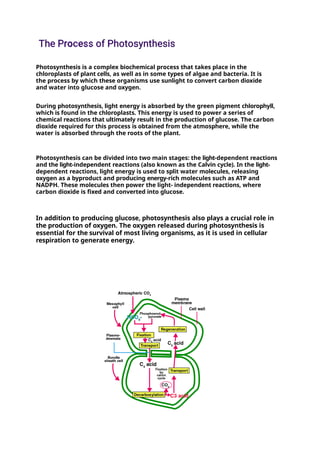
The C4 Pathway
Importance of Photosynthesis in the
Global Ecosystem
Evolution of Photosynthesis in
Plants
is the process by which plants, some bacteria and some protistans use the
energy from sunlight to produce glucose from carbon dioxide and water. This glucose can
be converted into pyruvate which releases adenosine triphosphate (ATP) by cellular
respiration. Oxygen is also formed.
Photosynthesis may be summarised by the word equation:
carbon dioxide +
water
glucose +
oxygen
The conversion of usable sunlight energy into chemical energy is associated with
the action of the green pigment chlorophyll.
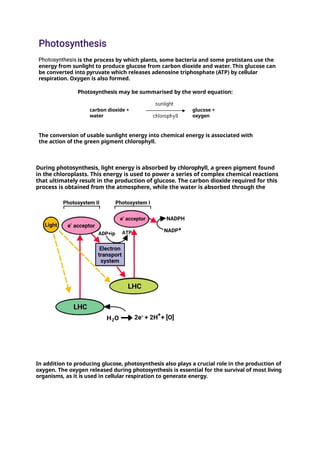
During photosynthesis, light energy is absorbed by chlorophyll, a green pigment found
in the chloroplasts. This energy is used to power a series of complex chemical reactions
that ultimately result in the production of glucose. The carbon dioxide required for this
process is obtained from the atmosphere, while the water is absorbed through the
roots of the plant.
In addition to producing glucose, photosynthesis also plays a crucial role in the production of
oxygen. The oxygen released during photosynthesis is essential for the survival of most living
organisms, as it is used in cellular respiration to generate energy.
Photosynthesis is a complex biochemical process that takes place in the
chloroplasts of plant cells, as well as in some types of algae and bacteria. It is
the process by which these organisms use sunlight to convert carbon dioxide
and water into glucose and oxygen.
During photosynthesis, light energy is absorbed by the green pigment chlorophyll,
which is found in the chloroplasts. This energy is used to power a series of
chemical reactions that ultimately result in the production of glucose. The carbon
dioxide required for this process is obtained from the atmosphere, while the
water is absorbed through the roots of the plant.
Photosynthesis can be divided into two main stages: the light-dependent reactions
and the light-independent reactions (also known as the Calvin cycle). In the light-
dependent reactions, light energy is used to split water molecules, releasing
oxygen as a byproduct and producing energy-rich molecules such as ATP and
NADPH. These molecules then power the light- independent reactions, where
carbon dioxide is fixed and converted into glucose.
In addition to producing glucose, photosynthesis also plays a crucial role in
the production of oxygen. The oxygen released during photosynthesis is
essential for the survival of most living organisms, as it is used in cellular
respiration to generate energy.
1.Light intensity: Photosynthesis requires light energy, so the
rate of photosynthesis increases with higher light intensity.
However, beyond a certain point, the rate of photosynthesis
may plateau as the plant becomes saturated with light.
2.Carbon Dioxide Concentration: Carbon dioxide is a key
reactant in photosynthesis, and an increase in its
concentration can lead to an increase in the rate of
photosynthesis, up to a certain point.
3.Temperature: Photosynthesis is a biochemical process that is
sensitive to temperature. As temperature increases, the rate of
photosynthesis generally increases, up to an optimal
temperature. However, at very high temperatures, the enzymes
involved in photosynthesis can become denatured, leading to a
decrease in the rate of photosynthesis.
4.Water Availability: Water is also essential for photosynthesis,
as it is one of the reactants in the process. A lack of water can
limit the rate of photosynthesis, as it can lead to stomatal
closure and reduce the uptake of carbon dioxide.
5.Chlorophyll concentration: The amount of chlorophyll in the
plant can also affect the rate of photosynthesis. A higher
concentration of chlorophyll can lead to a higher rate of
photosynthesis, as there are more pigment molecules available
to absorb light energy.
6.Nutrient Availability: Other nutrients such as nitrogen,
phosphorus, and potassium are also important for the process of
photosynthesis. A deficiency in these nutrients can limit the rate
of photosynthesis.
These factors interact with each other and can vary depending
on the plant species and environmental conditions.
Understanding these factors is important for optimizing
agricultural practices and improving crop yields.
Photosynthetic pigments are molecules found in the
chloroplasts of plant cells that are responsible for
capturing light energy during photosynthesis. The main
photosynthetic pigments are chlorophyll a, chlorophyll b,
carotenoids, and phycobilins.
Chlorophyll a is the primary pigment involved in
photosynthesis and is responsible for capturing light
energy and converting it into chemical energy.
Chlorophyll b works in conjunction with chlorophyll a to
broaden the range of light wavelengths that can be
absorbed.
Carotenoids are accessory pigments that help to capture
light energy and also protect the plant from damage
caused by excessive light. They are responsible for the
yellow, orange, and red colors seen in leaves during the
fall.
Phycobilins are found in certain types of algae and
cyanobacteria, and they also serve as accessory pigments
to capture light energy.
These pigments are located in the thylakoid membranes
of the chloroplasts, where they are organized into
photosystems that are responsible for capturing and
transferring light energy to the reaction centers of
photosynthesis.
The different pigments have specific absorption spectra,
meaning they can absorb different wavelengths of light.
This allows plants to efficiently capture a broad range of
light energy for photosynthesis.
Overall, Photosynthetic pigments play a crucial role in
the process of photosynthesis by capturing light energy
and converting it into chemical energy that can be used
by the plant for growth and development.
The light-dependent reactions of photosynthesis take place in
the thylakoid membranes of the chloroplasts and are
responsible for capturing and converting light energy into
chemical energy in the form of ATP and NADPH.
These reactions involve a series of complex processes, including
photophosphorylation, the splitting of water molecules, and the
transfer of electrons through the electron transport chain.
The process begins with the absorption of light by the
photosynthetic pigments, which excites electrons and causes
them to move to a higher energy state. These high-energy
electrons are then passed along the electron transport chain,
where they release energy that is used to pump protons across
the thylakoid membrane, creating a proton gradient.
Meanwhile, water molecules are split by an enzyme called water-
splitting complex, releasing oxygen, protons, and electrons. The
electrons from water replace the ones lost by the photosystem
II, ensuring that the process can continue.
As the electrons continue to move through the electron transport
chain, they eventually reach photosystem I, where they are re-
energized by another round of light absorption. This energy is
used to reduce NADP+ to NADPH, which is a molecule that carries
high-energy electrons to the Calvin cycle, where they are used to
fuel the production of sugars.
In addition to producing NADPH, the light-dependent reactions
also generate ATP through a process called
photophosphorylation. As the protons flow back across the
thylakoid membrane through ATP synthase, this enzyme uses the
energy released to convert ADP and inorganic phosphate into
ATP.
Overall, the light-dependent reactions of photosynthesis are
essential for capturing light energy and converting it into
chemical energy that can be used to power the Calvin cycle and
produce organic molecules for the plant's growth and
metabolism.
The light-independent reactions of photosynthesis, also
known as the Calvin cycle, take place in the stroma of
the chloroplasts and are responsible for using the
chemical energy produced in the light-dependent
reactions to convert carbon dioxide into organic
molecules, specifically glucose.
The Calvin cycle begins with the enzyme RuBisCO
catalyzing the fixation of carbon dioxide by combining it
with a five-carbon sugar molecule, ribulose-1,5-
bisphosphate (RuBP). This reaction produces two
molecules of 3-phosphoglycerate (3-PGA), which are then
converted into glyceraldehyde-3-phosphate (G3P) through
a series of reduction and regeneration steps.
Some of the G3P molecules produced are used to
regenerate RuBP, allowing the cycle to continue. The
remaining G3P molecules are used to synthesize
glucose and other carbohydrates, which can be used
by the plant for energy or stored for later use.
In addition to producing glucose, the Calvin cycle also
regenerates the molecules needed to continue the cycle,
such as RuBP and ATP. This ensures that the cycle can
continue to operate and produce organic molecules as
long as there is an adequate supply of ATP, NADPH, and
carbon dioxide.
Overall, the light-independent reactions of
photosynthesis are essential for converting carbon
dioxide into organic molecules using the chemical
energy produced in the light-dependent reactions,
ultimately providing the plant with the energy and
building blocks it needs for growth and survival.
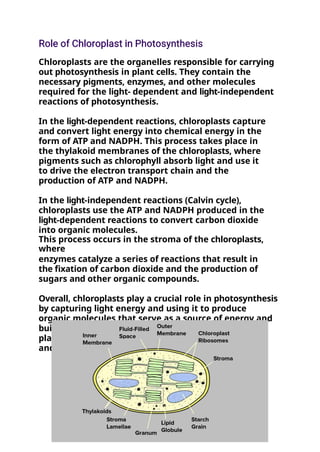
Chloroplasts are the organelles responsible for carrying
out photosynthesis in plant cells. They contain the
necessary pigments, enzymes, and other molecules
required for the light- dependent and light-independent
reactions of photosynthesis.
In the light-dependent reactions, chloroplasts capture
and convert light energy into chemical energy in the
form of ATP and NADPH. This process takes place in
the thylakoid membranes of the chloroplasts, where
pigments such as chlorophyll absorb light and use it
to drive the electron transport chain and the
production of ATP and NADPH.
In the light-independent reactions (Calvin cycle),
chloroplasts use the ATP and NADPH produced in the
light-dependent reactions to convert carbon dioxide
into organic molecules.
This process occurs in the stroma of the chloroplasts,
where
enzymes catalyze a series of reactions that result in
the fixation of carbon dioxide and the production of
sugars and other organic compounds.
Overall, chloroplasts play a crucial role in photosynthesis
by capturing light energy and using it to produce
organic molecules that serve as a source of energy and
building blocks for the plant. Without chloroplasts,
plants would not be able to carry out photosynthesis
and produce their own food.
The C4 pathway is an alternative photosynthetic pathway used by certain plants to fix
carbon dioxide and carry out photosynthesis. This pathway is an adaptation to hot and
dry environments, as it helps plants minimize water loss and increase the efficiency of
carbon fixation.
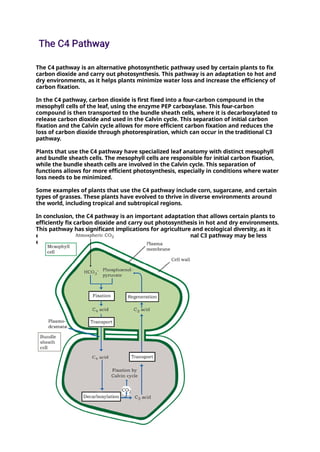
In the C4 pathway, carbon dioxide is first fixed into a four-carbon compound in the
mesophyll cells of the leaf, using the enzyme PEP carboxylase. This four-carbon
compound is then transported to the bundle sheath cells, where it is decarboxylated to
release carbon dioxide and used in the Calvin cycle. This separation of initial carbon
fixation and the Calvin cycle allows for more efficient carbon fixation and reduces the
loss of carbon dioxide through photorespiration, which can occur in the traditional C3
pathway.
Plants that use the C4 pathway have specialized leaf anatomy with distinct mesophyll
and bundle sheath cells. The mesophyll cells are responsible for initial carbon fixation,
while the bundle sheath cells are involved in the Calvin cycle. This separation of
functions allows for more efficient photosynthesis, especially in conditions where water
loss needs to be minimized.
Some examples of plants that use the C4 pathway include corn, sugarcane, and certain
types of grasses. These plants have evolved to thrive in diverse environments around
the world, including tropical and subtropical regions.
In conclusion, the C4 pathway is an important adaptation that allows certain plants to
efficiently fix carbon dioxide and carry out photosynthesis in hot and dry environments.
This pathway has significant implications for agriculture and ecological diversity, as it
enables plants to thrive in conditions where the traditional C3 pathway may be less
efficient.
Photosynthesis is essential for the global ecosystem as it
is the process by which plants, algae, and some bacteria
convert light energy into chemical energy, producing
oxygen and organic compounds in the process. This
process is the foundation of the food chain, as it provides
the energy source for all living organisms. Additionally,
photosynthesis plays a crucial role in regulating the
Earth's atmosphere by removing carbon dioxide and
releasing oxygen, which is essential for the survival of
aerobic organisms.
Furthermore, photosynthesis is a key factor in
maintaining biodiversity and ecological balance. It
provides the energy and nutrients necessary for the
growth and development of plants, which in turn
support a wide range of animal species.
Additionally, photosynthesis contributes to the cycling
of
nutrients and the maintenance of ecosystems
through the production of organic matter.
In addition to its ecological importance, photosynthesis
also has significant implications for human society. It is
the basis for agriculture and food production, as plants
use photosynthesis to produce the carbohydrates,
proteins, and fats that form the basis of the human diet.
Moreover, photosynthesis is being studied for its potential
in biofuel production, as it offers a renewable and
sustainable source of energy.
In summary, photosynthesis is a fundamental process
that sustains life on Earth and has far-reaching
implications for both natural ecosystems and human
society. Understanding and appreciating the importance
of photosynthesis is crucial for addressing current
environmental challenges and ensuring the long-term
sustainability of our planet.
In conclusion, the evolution of photosynthesis in plants
is a complex and intricate process that has played a
crucial role in shaping the development of life on Earth.
From the ancient cyanobacteria to the diverse array of
plant species we see today, the evolution of
photosynthesis has involved numerous genetic, cellular,
and physiological adaptations that have allowed plants
to efficiently capture and utilize light energy for the
production of organic compounds and oxygen.
The emergence of chloroplasts, the evolution of
pigments, and the development of various physiological
and anatomical adaptations have all contributed to the
success and diversification of plants in different
environments.
Understanding the evolutionary history of
photosynthesis not
only provides insights into the history of life on Earth
but also has practical implications for agriculture,
biofuel production, and climate change mitigation.
Overall, the evolution of photosynthesis in plants is a
remarkable journey that continues to shape the
biological world around us, and further research in
this area holds great potential for addressing current
and future challenges related to food security,
renewable energy, and environmental sustainability.
Biology Practical File (vishnu sharma).pptx

Biology Practical File (vishnu sharma).pptx

  • 4.
     Photosynthesis  TheProcess of Photosynthesis  Factors affecting Photosynthesis  Photosynthetic Pigments  Light-Dependent Reactions of Photosynthesis  Light-Inependent Reactions of Photosynthesis  Role of Chloroplast in Photosynthesis The C4 Pathway Importance of Photosynthesis in the Global Ecosystem Evolution of Photosynthesis in Plants
  • 5.
    is the processby which plants, some bacteria and some protistans use the energy from sunlight to produce glucose from carbon dioxide and water. This glucose can be converted into pyruvate which releases adenosine triphosphate (ATP) by cellular respiration. Oxygen is also formed. Photosynthesis may be summarised by the word equation: carbon dioxide + water glucose + oxygen The conversion of usable sunlight energy into chemical energy is associated with the action of the green pigment chlorophyll. During photosynthesis, light energy is absorbed by chlorophyll, a green pigment found in the chloroplasts. This energy is used to power a series of complex chemical reactions that ultimately result in the production of glucose. The carbon dioxide required for this process is obtained from the atmosphere, while the water is absorbed through the roots of the plant. In addition to producing glucose, photosynthesis also plays a crucial role in the production of oxygen. The oxygen released during photosynthesis is essential for the survival of most living organisms, as it is used in cellular respiration to generate energy.
  • 6.
    Photosynthesis is acomplex biochemical process that takes place in the chloroplasts of plant cells, as well as in some types of algae and bacteria. It is the process by which these organisms use sunlight to convert carbon dioxide and water into glucose and oxygen. During photosynthesis, light energy is absorbed by the green pigment chlorophyll, which is found in the chloroplasts. This energy is used to power a series of chemical reactions that ultimately result in the production of glucose. The carbon dioxide required for this process is obtained from the atmosphere, while the water is absorbed through the roots of the plant. Photosynthesis can be divided into two main stages: the light-dependent reactions and the light-independent reactions (also known as the Calvin cycle). In the light- dependent reactions, light energy is used to split water molecules, releasing oxygen as a byproduct and producing energy-rich molecules such as ATP and NADPH. These molecules then power the light- independent reactions, where carbon dioxide is fixed and converted into glucose. In addition to producing glucose, photosynthesis also plays a crucial role in the production of oxygen. The oxygen released during photosynthesis is essential for the survival of most living organisms, as it is used in cellular respiration to generate energy.
  • 7.
    1.Light intensity: Photosynthesisrequires light energy, so the rate of photosynthesis increases with higher light intensity. However, beyond a certain point, the rate of photosynthesis may plateau as the plant becomes saturated with light. 2.Carbon Dioxide Concentration: Carbon dioxide is a key reactant in photosynthesis, and an increase in its concentration can lead to an increase in the rate of photosynthesis, up to a certain point. 3.Temperature: Photosynthesis is a biochemical process that is sensitive to temperature. As temperature increases, the rate of photosynthesis generally increases, up to an optimal temperature. However, at very high temperatures, the enzymes involved in photosynthesis can become denatured, leading to a decrease in the rate of photosynthesis. 4.Water Availability: Water is also essential for photosynthesis, as it is one of the reactants in the process. A lack of water can limit the rate of photosynthesis, as it can lead to stomatal closure and reduce the uptake of carbon dioxide. 5.Chlorophyll concentration: The amount of chlorophyll in the plant can also affect the rate of photosynthesis. A higher concentration of chlorophyll can lead to a higher rate of photosynthesis, as there are more pigment molecules available to absorb light energy. 6.Nutrient Availability: Other nutrients such as nitrogen, phosphorus, and potassium are also important for the process of photosynthesis. A deficiency in these nutrients can limit the rate of photosynthesis. These factors interact with each other and can vary depending on the plant species and environmental conditions. Understanding these factors is important for optimizing agricultural practices and improving crop yields.
  • 8.
    Photosynthetic pigments aremolecules found in the chloroplasts of plant cells that are responsible for capturing light energy during photosynthesis. The main photosynthetic pigments are chlorophyll a, chlorophyll b, carotenoids, and phycobilins. Chlorophyll a is the primary pigment involved in photosynthesis and is responsible for capturing light energy and converting it into chemical energy. Chlorophyll b works in conjunction with chlorophyll a to broaden the range of light wavelengths that can be absorbed. Carotenoids are accessory pigments that help to capture light energy and also protect the plant from damage caused by excessive light. They are responsible for the yellow, orange, and red colors seen in leaves during the fall. Phycobilins are found in certain types of algae and cyanobacteria, and they also serve as accessory pigments to capture light energy. These pigments are located in the thylakoid membranes of the chloroplasts, where they are organized into photosystems that are responsible for capturing and transferring light energy to the reaction centers of photosynthesis. The different pigments have specific absorption spectra, meaning they can absorb different wavelengths of light. This allows plants to efficiently capture a broad range of light energy for photosynthesis. Overall, Photosynthetic pigments play a crucial role in the process of photosynthesis by capturing light energy and converting it into chemical energy that can be used by the plant for growth and development.
  • 9.
    The light-dependent reactionsof photosynthesis take place in the thylakoid membranes of the chloroplasts and are responsible for capturing and converting light energy into chemical energy in the form of ATP and NADPH. These reactions involve a series of complex processes, including photophosphorylation, the splitting of water molecules, and the transfer of electrons through the electron transport chain. The process begins with the absorption of light by the photosynthetic pigments, which excites electrons and causes them to move to a higher energy state. These high-energy electrons are then passed along the electron transport chain, where they release energy that is used to pump protons across the thylakoid membrane, creating a proton gradient. Meanwhile, water molecules are split by an enzyme called water- splitting complex, releasing oxygen, protons, and electrons. The electrons from water replace the ones lost by the photosystem II, ensuring that the process can continue. As the electrons continue to move through the electron transport chain, they eventually reach photosystem I, where they are re- energized by another round of light absorption. This energy is used to reduce NADP+ to NADPH, which is a molecule that carries high-energy electrons to the Calvin cycle, where they are used to fuel the production of sugars. In addition to producing NADPH, the light-dependent reactions also generate ATP through a process called photophosphorylation. As the protons flow back across the thylakoid membrane through ATP synthase, this enzyme uses the energy released to convert ADP and inorganic phosphate into ATP. Overall, the light-dependent reactions of photosynthesis are essential for capturing light energy and converting it into chemical energy that can be used to power the Calvin cycle and produce organic molecules for the plant's growth and metabolism.
  • 10.
    The light-independent reactionsof photosynthesis, also known as the Calvin cycle, take place in the stroma of the chloroplasts and are responsible for using the chemical energy produced in the light-dependent reactions to convert carbon dioxide into organic molecules, specifically glucose. The Calvin cycle begins with the enzyme RuBisCO catalyzing the fixation of carbon dioxide by combining it with a five-carbon sugar molecule, ribulose-1,5- bisphosphate (RuBP). This reaction produces two molecules of 3-phosphoglycerate (3-PGA), which are then converted into glyceraldehyde-3-phosphate (G3P) through a series of reduction and regeneration steps. Some of the G3P molecules produced are used to regenerate RuBP, allowing the cycle to continue. The remaining G3P molecules are used to synthesize glucose and other carbohydrates, which can be used by the plant for energy or stored for later use. In addition to producing glucose, the Calvin cycle also regenerates the molecules needed to continue the cycle, such as RuBP and ATP. This ensures that the cycle can continue to operate and produce organic molecules as long as there is an adequate supply of ATP, NADPH, and carbon dioxide. Overall, the light-independent reactions of photosynthesis are essential for converting carbon dioxide into organic molecules using the chemical energy produced in the light-dependent reactions, ultimately providing the plant with the energy and building blocks it needs for growth and survival.
  • 11.
    Chloroplasts are theorganelles responsible for carrying out photosynthesis in plant cells. They contain the necessary pigments, enzymes, and other molecules required for the light- dependent and light-independent reactions of photosynthesis. In the light-dependent reactions, chloroplasts capture and convert light energy into chemical energy in the form of ATP and NADPH. This process takes place in the thylakoid membranes of the chloroplasts, where pigments such as chlorophyll absorb light and use it to drive the electron transport chain and the production of ATP and NADPH. In the light-independent reactions (Calvin cycle), chloroplasts use the ATP and NADPH produced in the light-dependent reactions to convert carbon dioxide into organic molecules. This process occurs in the stroma of the chloroplasts, where enzymes catalyze a series of reactions that result in the fixation of carbon dioxide and the production of sugars and other organic compounds. Overall, chloroplasts play a crucial role in photosynthesis by capturing light energy and using it to produce organic molecules that serve as a source of energy and building blocks for the plant. Without chloroplasts, plants would not be able to carry out photosynthesis and produce their own food.
  • 12.
    The C4 pathwayis an alternative photosynthetic pathway used by certain plants to fix carbon dioxide and carry out photosynthesis. This pathway is an adaptation to hot and dry environments, as it helps plants minimize water loss and increase the efficiency of carbon fixation. In the C4 pathway, carbon dioxide is first fixed into a four-carbon compound in the mesophyll cells of the leaf, using the enzyme PEP carboxylase. This four-carbon compound is then transported to the bundle sheath cells, where it is decarboxylated to release carbon dioxide and used in the Calvin cycle. This separation of initial carbon fixation and the Calvin cycle allows for more efficient carbon fixation and reduces the loss of carbon dioxide through photorespiration, which can occur in the traditional C3 pathway. Plants that use the C4 pathway have specialized leaf anatomy with distinct mesophyll and bundle sheath cells. The mesophyll cells are responsible for initial carbon fixation, while the bundle sheath cells are involved in the Calvin cycle. This separation of functions allows for more efficient photosynthesis, especially in conditions where water loss needs to be minimized. Some examples of plants that use the C4 pathway include corn, sugarcane, and certain types of grasses. These plants have evolved to thrive in diverse environments around the world, including tropical and subtropical regions. In conclusion, the C4 pathway is an important adaptation that allows certain plants to efficiently fix carbon dioxide and carry out photosynthesis in hot and dry environments. This pathway has significant implications for agriculture and ecological diversity, as it enables plants to thrive in conditions where the traditional C3 pathway may be less efficient.
  • 13.
    Photosynthesis is essentialfor the global ecosystem as it is the process by which plants, algae, and some bacteria convert light energy into chemical energy, producing oxygen and organic compounds in the process. This process is the foundation of the food chain, as it provides the energy source for all living organisms. Additionally, photosynthesis plays a crucial role in regulating the Earth's atmosphere by removing carbon dioxide and releasing oxygen, which is essential for the survival of aerobic organisms. Furthermore, photosynthesis is a key factor in maintaining biodiversity and ecological balance. It provides the energy and nutrients necessary for the growth and development of plants, which in turn support a wide range of animal species. Additionally, photosynthesis contributes to the cycling of nutrients and the maintenance of ecosystems through the production of organic matter. In addition to its ecological importance, photosynthesis also has significant implications for human society. It is the basis for agriculture and food production, as plants use photosynthesis to produce the carbohydrates, proteins, and fats that form the basis of the human diet. Moreover, photosynthesis is being studied for its potential in biofuel production, as it offers a renewable and sustainable source of energy. In summary, photosynthesis is a fundamental process that sustains life on Earth and has far-reaching implications for both natural ecosystems and human society. Understanding and appreciating the importance of photosynthesis is crucial for addressing current environmental challenges and ensuring the long-term sustainability of our planet.
  • 14.
    In conclusion, theevolution of photosynthesis in plants is a complex and intricate process that has played a crucial role in shaping the development of life on Earth. From the ancient cyanobacteria to the diverse array of plant species we see today, the evolution of photosynthesis has involved numerous genetic, cellular, and physiological adaptations that have allowed plants to efficiently capture and utilize light energy for the production of organic compounds and oxygen. The emergence of chloroplasts, the evolution of pigments, and the development of various physiological and anatomical adaptations have all contributed to the success and diversification of plants in different environments. Understanding the evolutionary history of photosynthesis not only provides insights into the history of life on Earth but also has practical implications for agriculture, biofuel production, and climate change mitigation. Overall, the evolution of photosynthesis in plants is a remarkable journey that continues to shape the biological world around us, and further research in this area holds great potential for addressing current and future challenges related to food security, renewable energy, and environmental sustainability.