ANTIRHEUMATOID DRUGS
RHEUMATOID ARTHRITIS (RA)
• Rheumatoid arthritis (RA) is a chronic inflammatory disease of
unknown aetiology marked by a symmetric, peripheral
polyarthritis.
• The wrists, metacarpophalangeal (MCP), and proximal
interphalangeal (PIP) joints stand out as the most frequently
involved joints.
2
3
RHEUMATOID ARTHRITIS (RA)
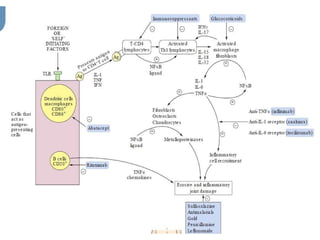
• The inflammatory infiltrate is made up of: T cells, B cells, plasma
cells, dendritic cells, mast cells and granulocytes.
• Activated T cells stimulate macrophages and fibroblast-like
synovocytes to generate proinflammatory mediators and proteases
that drive the synovial inflammatory response and destroy the
cartilage and bone.
• T H 1 cells produce interferon γ (IFN- γ), Iymphotoxin β and TNF-α
whereas T H 2 cells predominately secret interleukin (IL)-4, IL-5, IL-6,
IL- I0 and IL- 13.
4
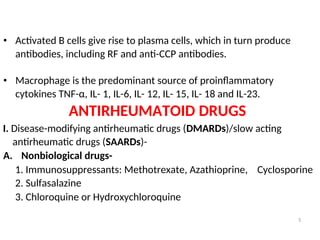
• Activated B cells give rise to plasma cells, which in turn produce
antibodies, including RF and anti-CCP antibodies.
• Macrophage is the predominant source of proinflammatory
cytokines TNF-α, IL- 1, IL-6, IL- 12, IL- 15, IL- 18 and IL-23.
ANTIRHEUMATOID DRUGS
I. Disease-modifying antirheumatic drugs (DMARDs)/slow acting
antirheumatic drugs (SAARDs)-
A. Nonbiological drugs-
1. Immunosuppressants: Methotrexate, Azathioprine, Cyclosporine
2. Sulfasalazine
3. Chloroquine or Hydroxychloroquine
5
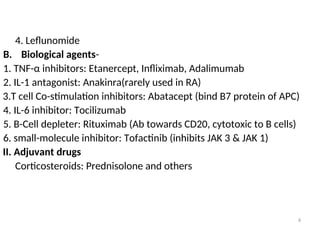
4. Leflunomide
B. Biological agents-
1. TNF-α inhibitors: Etanercept, Infliximab, Adalimumab
2. IL-1 antagonist: Anakinra(rarely used in RA)
3.T cell Co-stimulation inhibitors: Abatacept (bind B7 protein of APC)
4. IL-6 inhibitor: Tocilizumab
5. B-Cell depleter: Rituximab (Ab towards CD20, cytotoxic to B cells)
6. small-molecule inhibitor: Tofactinib (inhibits JAK 3 & JAK 1)
II. Adjuvant drugs
Corticosteroids: Prednisolone and others
6
METHOTREXATE
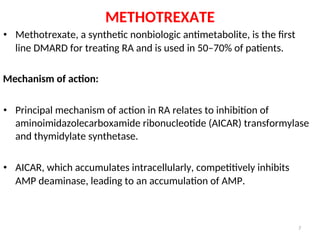
• Methotrexate, a synthetic nonbiologic antimetabolite, is the first
line DMARD for treating RA and is used in 50–70% of patients.
Mechanism of action:
• Principal mechanism of action in RA relates to inhibition of
aminoimidazolecarboxamide ribonucleotide (AICAR) transformylase
and thymidylate synthetase.
• AICAR, which accumulates intracellularly, competitively inhibits
AMP deaminase, leading to an accumulation of AMP.
7
METHOTREXATE
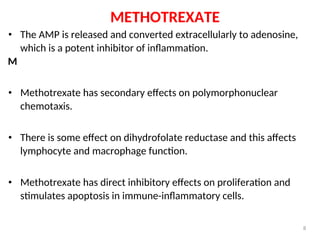
• The AMP is released and converted extracellularly to adenosine,
which is a potent inhibitor of inflammation.
M
• Methotrexate has secondary effects on polymorphonuclear
chemotaxis.
• There is some effect on dihydrofolate reductase and this affects
lymphocyte and macrophage function.
• Methotrexate has direct inhibitory effects on proliferation and
stimulates apoptosis in immune-inflammatory cells.
8
METHOTREXATE
• Additionally, it inhibits proinflammatory cytokines linked to
rheumatoid synovitis.
Adverse Effects:
• Nausea and mucosal ulcers are the most common.
• Many other side effects such as leukopenia, anaemia, stomatitis, GI
ulcerations, and alopecia are the result of inhibiting cellular
proliferation.
• Progressive dose-related hepatotoxicity in the form of enzyme
elevation occurs frequently.
9
METHOTREXATE
• A rare hypersensitivity-like lung reaction with acute shortness of
breath has been documented.
• This drug is contraindicated in pregnancy.
10
AZATHIOPRINE
• Azathioprine is a synthetic nonbiologic DMARD.
• converting to 6-mercaptopurine (active metabolite)
• It selectively affects differentiation and function of T cells and inhibits
cytolytic lymphocytes; CMI is primarily depressed.
Adverse Effects:
• Bone marrow suppression, GI disturbances, and some increase in
infection risk.
• Lymphomas may be increased.
• Rarely, fever, rash and hepatotoxicity.
11
SULFASALAZINE
• It is a compound of 5-aminosalicylic acid (5-ASA) with sulfapyridine
linked through an azo bond.
• The azo bond is split by colonic bacteria to release 5-ASA and
sulfapyridine.
• Sulfapyridine absorbed systemically appears to be the active moiety
for rheumatoid ararthritis. (contrast ulcerative colitis, in which 5ASA
acting locally in the colon is the active component).
Mechanism of Action
12
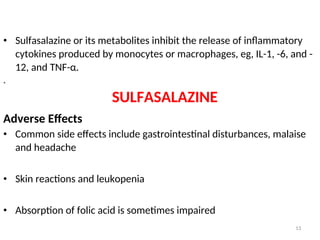
• Sulfasalazine or its metabolites inhibit the release of inflammatory
cytokines produced by monocytes or macrophages, eg, IL-1, -6, and -
12, and TNF-α.
.
SULFASALAZINE
Adverse Effects
• Common side effects include gastrointestinal disturbances, malaise
and headache
• Skin reactions and leukopenia
• Absorption of folic acid is sometimes impaired
13
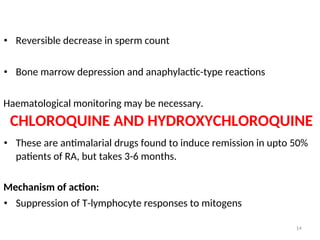
• Reversible decrease in sperm count
• Bone marrow depression and anaphylactic-type reactions
Haematological monitoring may be necessary.
CHLOROQUINE AND HYDROXYCHLOROQUINE
• These are antimalarial drugs found to induce remission in upto 50%
patients of RA, but takes 3-6 months.
Mechanism of action:
• Suppression of T-lymphocyte responses to mitogens
14
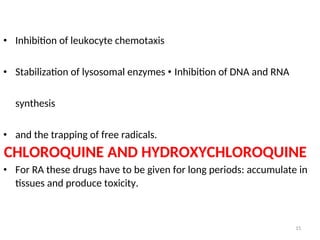
• Inhibition of leukocyte chemotaxis
• Stabilization of lysosomal enzymes • Inhibition of DNA and RNA
synthesis
• and the trapping of free radicals.
CHLOROQUINE AND HYDROXYCHLOROQUINE
• For RA these drugs have to be given for long periods: accumulate in
tissues and produce toxicity.
15
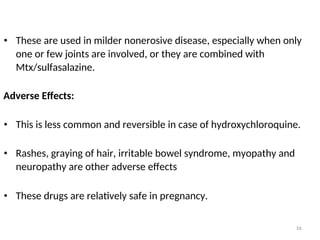
• These are used in milder nonerosive disease, especially when only
one or few joints are involved, or they are combined with
Mtx/sulfasalazine.
Adverse Effects:
• This is less common and reversible in case of hydroxychloroquine.
• Rashes, graying of hair, irritable bowel syndrome, myopathy and
neuropathy are other adverse effects
• These drugs are relatively safe in pregnancy.
16
LEFLUNOMIDE
• Leflunomide is as effective as methotrexate in RA, including
inhibition of bony damage.
Mechanism of Action:
• Leflunomide undergoes rapid conversion to its active metabolite
which inhibits dihydroorotate dehydrogenase, leading to a decrease
in ribonucleotide synthesis and the arrest of stimulated cells in the
G1 phase of cell growth.
• Consequently, leflunomide inhibits T-cell proliferation and reduces
production of autoantibodies by B cells.
17
• Secondary effects include increase of IL-10 receptor mRNA,
decreased IL-8 receptor type A mRNA, and decreased TNF-
αdependent nuclear factor kappa B (NF-κB) activation.
LEFLUNOMIDE
Adverse Effects:
• Diarrhea occurs in approximately 25% of patients given leflunomide.
• Elevation in liver enzymes
• Other adverse effects are mild alopecia, weight gain, and increased
blood pressure.
18
• Leukopenia and thrombocytopenia occur rarely.
• This drug is contraindicated in pregnancy.
19
Biologic DMARDs
• They are protein therapeutics designed mostly to target cytokines
and cell-surface molecules.
• All of them produce prominent adverse effects, are expensive,
and are used only as reserve drugs for severe refractory disease.
TNF-α-BLOCKING AGENTS
Adalimumab
• Fully human IgG1 anti-TNF monoclonal antibody.
21
TNF-α-BLOCKING AGENTS
• Complexes with soluble TNF-α and prevents its interaction with
p55 and p75 cell surface receptors.
• This results in down-regulation of macrophage and T-cell function.
Infliximab
• IgG1 monoclonal antibody that binds with high affinity to soluble
and possibly membranebound TNF-α.
• Its mechanism of action probably is the same as that of
adalimumab.
22
Etanercept
• A recombinant fusion protein consisting of two soluble TNF p75
receptor moieties linked to the Fc portion of human IgG1.
• It binds TNF-α molecules and also inhibits lymphotoxin-α.
23
TNF-α-BLOCKING AGENTS
Golimumab
• A human monoclonal antibody with a high affinity for soluble and
membrane-bound TNF-α.
• Effectively neutralizes the inflammatory effects produced by TNF-
α seen in diseases such as RA.
Certolizumab
• A recombinant, humanized antibody Fab fragment conjugated to
a polyethylene glycol (PEG) with specificity for human TNF-α.
24
• Certolizumab neutralizes membrane-bound and soluble TNF-α in a
dose-dependent manner.
Certolizumab
• Additionally, certolizumab does not contain an Fc region, found
on a complete antibody, and does not fix complement or cause
antibody dependent cell-mediated cytotoxicity in vitro.
Adverse Effects of TNF- α -Blocking Agents
• TNF-α-blocking agents have multiple adverse effects in common.
25
TNF-α-BLOCKING AGENTS
• The risk of bacterial infections and macrophage-dependent
infection (including tuberculosis, fungal, and other opportunistic
infections) is increased.
• Activation of latent tuberculosis is lower with etanercept than
with other TNF-α-blocking agents.
Adverse Effects of TNF- α -Blocking Agents
• Increased risk of HBV reactivation.
• Increased risk of skin cancers—including melanoma
26
• In patients with borderline or overt heart failure (HF), TNF-
αblocking agents can exacerbate HF.
• TNF-α-blocking agents can induce the immune system to develop
anti-drug antibodies in about 17% of cases.
27
ABATACEPT
• Abatacept binds to CD80 and 86, thereby inhibiting the binding to
CD28 and preventing the activation of T cells.
Adverse Effects:
• There is a slightly increased risk of infection (as with other biologic
DMARDs), predominantly of the upper respiratory tract.
28
TOCILIZUMAB
• Tocilizumab, a humanized antibody, binds to soluble and
membrane-bound IL-6 receptors, and inhibits the IL-6-mediated
signaling via these receptors.
Adverse Effects:
• Similar to those of TNF-α blocking agents.
RITUXIMAB
• Rituximab is a chimeric monoclonal antibody biologic agent that
targets CD20 B lymphocytes.
29
• Depletion of B lymphocytes reduces inflammation by decreasing the
presentation of antigens to T lymphocytes and inhibiting the
secretion of proinflammatory cytokines.
Adverse Effects:
• About 30% of patients develop rash with the first treatment; this
incidence decreases progressively with each course of therapy and
usually do not require discontinuation of therapy.
• Increased risk of infection and reactivation of hepatitis B virus (HBV)
infection, not associated with either activation of tuberculosis or the
occurrence of lymphomas or other tumors.
30
GLUCOCORTICOID DRUGS
• Corticosteroids have been used in 60–70% of rheumatoid
arthritis patients. They are capable of slowing the appearance of
new bone erosions.
• The corticosteroids used in arthritic conditions are usually
prednisone, methylprednisolone and prednisolone.
• However, the short-acting hydrocortisone and the long-acting
dexamethasone and betamethasone can also be used.
31
• Intra-articular corticosteroids are often helpful to alleviate
painful symptoms .
• Prolonged use of these drugs leads to serious and disabling
toxic effects.
NSAIDs
• NSAIDs provide analgesic and anti-inflammatory benefits for joint
pain and swelling.
• However, they do not prevent joint damage or change the
underlying disease.
32
• It is appropriate for a patient to begin taking an NSAID along with a
DMARD for “bridge therapy” to provide symptomatic relief until the
therapeutic effect of the DMARD is observed.
• Selecting NSAID depends on multiple patient-specific factors
including cardiovascular risk, potential for gastrointestinal-related
adverse events.
THANK YOU
33

Rheumatoid arthritis ..................

  • 1.
  • 2.
    RHEUMATOID ARTHRITIS (RA) •Rheumatoid arthritis (RA) is a chronic inflammatory disease of unknown aetiology marked by a symmetric, peripheral polyarthritis. • The wrists, metacarpophalangeal (MCP), and proximal interphalangeal (PIP) joints stand out as the most frequently involved joints. 2
  • 3.
  • 4.
    RHEUMATOID ARTHRITIS (RA) •The inflammatory infiltrate is made up of: T cells, B cells, plasma cells, dendritic cells, mast cells and granulocytes. • Activated T cells stimulate macrophages and fibroblast-like synovocytes to generate proinflammatory mediators and proteases that drive the synovial inflammatory response and destroy the cartilage and bone. • T H 1 cells produce interferon γ (IFN- γ), Iymphotoxin β and TNF-α whereas T H 2 cells predominately secret interleukin (IL)-4, IL-5, IL-6, IL- I0 and IL- 13. 4
  • 5.
    • Activated Bcells give rise to plasma cells, which in turn produce antibodies, including RF and anti-CCP antibodies. • Macrophage is the predominant source of proinflammatory cytokines TNF-α, IL- 1, IL-6, IL- 12, IL- 15, IL- 18 and IL-23. ANTIRHEUMATOID DRUGS I. Disease-modifying antirheumatic drugs (DMARDs)/slow acting antirheumatic drugs (SAARDs)- A. Nonbiological drugs- 1. Immunosuppressants: Methotrexate, Azathioprine, Cyclosporine 2. Sulfasalazine 3. Chloroquine or Hydroxychloroquine 5
  • 6.
    4. Leflunomide B. Biologicalagents- 1. TNF-α inhibitors: Etanercept, Infliximab, Adalimumab 2. IL-1 antagonist: Anakinra(rarely used in RA) 3.T cell Co-stimulation inhibitors: Abatacept (bind B7 protein of APC) 4. IL-6 inhibitor: Tocilizumab 5. B-Cell depleter: Rituximab (Ab towards CD20, cytotoxic to B cells) 6. small-molecule inhibitor: Tofactinib (inhibits JAK 3 & JAK 1) II. Adjuvant drugs Corticosteroids: Prednisolone and others 6
  • 7.
    METHOTREXATE • Methotrexate, asynthetic nonbiologic antimetabolite, is the first line DMARD for treating RA and is used in 50–70% of patients. Mechanism of action: • Principal mechanism of action in RA relates to inhibition of aminoimidazolecarboxamide ribonucleotide (AICAR) transformylase and thymidylate synthetase. • AICAR, which accumulates intracellularly, competitively inhibits AMP deaminase, leading to an accumulation of AMP. 7
  • 8.
    METHOTREXATE • The AMPis released and converted extracellularly to adenosine, which is a potent inhibitor of inflammation. M • Methotrexate has secondary effects on polymorphonuclear chemotaxis. • There is some effect on dihydrofolate reductase and this affects lymphocyte and macrophage function. • Methotrexate has direct inhibitory effects on proliferation and stimulates apoptosis in immune-inflammatory cells. 8
  • 9.
    METHOTREXATE • Additionally, itinhibits proinflammatory cytokines linked to rheumatoid synovitis. Adverse Effects: • Nausea and mucosal ulcers are the most common. • Many other side effects such as leukopenia, anaemia, stomatitis, GI ulcerations, and alopecia are the result of inhibiting cellular proliferation. • Progressive dose-related hepatotoxicity in the form of enzyme elevation occurs frequently. 9
  • 10.
    METHOTREXATE • A rarehypersensitivity-like lung reaction with acute shortness of breath has been documented. • This drug is contraindicated in pregnancy. 10
  • 11.
    AZATHIOPRINE • Azathioprine isa synthetic nonbiologic DMARD. • converting to 6-mercaptopurine (active metabolite) • It selectively affects differentiation and function of T cells and inhibits cytolytic lymphocytes; CMI is primarily depressed. Adverse Effects: • Bone marrow suppression, GI disturbances, and some increase in infection risk. • Lymphomas may be increased. • Rarely, fever, rash and hepatotoxicity. 11
  • 12.
    SULFASALAZINE • It isa compound of 5-aminosalicylic acid (5-ASA) with sulfapyridine linked through an azo bond. • The azo bond is split by colonic bacteria to release 5-ASA and sulfapyridine. • Sulfapyridine absorbed systemically appears to be the active moiety for rheumatoid ararthritis. (contrast ulcerative colitis, in which 5ASA acting locally in the colon is the active component). Mechanism of Action 12
  • 13.
    • Sulfasalazine orits metabolites inhibit the release of inflammatory cytokines produced by monocytes or macrophages, eg, IL-1, -6, and - 12, and TNF-α. . SULFASALAZINE Adverse Effects • Common side effects include gastrointestinal disturbances, malaise and headache • Skin reactions and leukopenia • Absorption of folic acid is sometimes impaired 13
  • 14.
    • Reversible decreasein sperm count • Bone marrow depression and anaphylactic-type reactions Haematological monitoring may be necessary. CHLOROQUINE AND HYDROXYCHLOROQUINE • These are antimalarial drugs found to induce remission in upto 50% patients of RA, but takes 3-6 months. Mechanism of action: • Suppression of T-lymphocyte responses to mitogens 14
  • 15.
    • Inhibition ofleukocyte chemotaxis • Stabilization of lysosomal enzymes • Inhibition of DNA and RNA synthesis • and the trapping of free radicals. CHLOROQUINE AND HYDROXYCHLOROQUINE • For RA these drugs have to be given for long periods: accumulate in tissues and produce toxicity. 15
  • 16.
    • These areused in milder nonerosive disease, especially when only one or few joints are involved, or they are combined with Mtx/sulfasalazine. Adverse Effects: • This is less common and reversible in case of hydroxychloroquine. • Rashes, graying of hair, irritable bowel syndrome, myopathy and neuropathy are other adverse effects • These drugs are relatively safe in pregnancy. 16
  • 17.
    LEFLUNOMIDE • Leflunomide isas effective as methotrexate in RA, including inhibition of bony damage. Mechanism of Action: • Leflunomide undergoes rapid conversion to its active metabolite which inhibits dihydroorotate dehydrogenase, leading to a decrease in ribonucleotide synthesis and the arrest of stimulated cells in the G1 phase of cell growth. • Consequently, leflunomide inhibits T-cell proliferation and reduces production of autoantibodies by B cells. 17
  • 18.
    • Secondary effectsinclude increase of IL-10 receptor mRNA, decreased IL-8 receptor type A mRNA, and decreased TNF- αdependent nuclear factor kappa B (NF-κB) activation. LEFLUNOMIDE Adverse Effects: • Diarrhea occurs in approximately 25% of patients given leflunomide. • Elevation in liver enzymes • Other adverse effects are mild alopecia, weight gain, and increased blood pressure. 18
  • 19.
    • Leukopenia andthrombocytopenia occur rarely. • This drug is contraindicated in pregnancy. 19
  • 21.
    Biologic DMARDs • Theyare protein therapeutics designed mostly to target cytokines and cell-surface molecules. • All of them produce prominent adverse effects, are expensive, and are used only as reserve drugs for severe refractory disease. TNF-α-BLOCKING AGENTS Adalimumab • Fully human IgG1 anti-TNF monoclonal antibody. 21
  • 22.
    TNF-α-BLOCKING AGENTS • Complexeswith soluble TNF-α and prevents its interaction with p55 and p75 cell surface receptors. • This results in down-regulation of macrophage and T-cell function. Infliximab • IgG1 monoclonal antibody that binds with high affinity to soluble and possibly membranebound TNF-α. • Its mechanism of action probably is the same as that of adalimumab. 22
  • 23.
    Etanercept • A recombinantfusion protein consisting of two soluble TNF p75 receptor moieties linked to the Fc portion of human IgG1. • It binds TNF-α molecules and also inhibits lymphotoxin-α. 23
  • 24.
    TNF-α-BLOCKING AGENTS Golimumab • Ahuman monoclonal antibody with a high affinity for soluble and membrane-bound TNF-α. • Effectively neutralizes the inflammatory effects produced by TNF- α seen in diseases such as RA. Certolizumab • A recombinant, humanized antibody Fab fragment conjugated to a polyethylene glycol (PEG) with specificity for human TNF-α. 24
  • 25.
    • Certolizumab neutralizesmembrane-bound and soluble TNF-α in a dose-dependent manner. Certolizumab • Additionally, certolizumab does not contain an Fc region, found on a complete antibody, and does not fix complement or cause antibody dependent cell-mediated cytotoxicity in vitro. Adverse Effects of TNF- α -Blocking Agents • TNF-α-blocking agents have multiple adverse effects in common. 25
  • 26.
    TNF-α-BLOCKING AGENTS • Therisk of bacterial infections and macrophage-dependent infection (including tuberculosis, fungal, and other opportunistic infections) is increased. • Activation of latent tuberculosis is lower with etanercept than with other TNF-α-blocking agents. Adverse Effects of TNF- α -Blocking Agents • Increased risk of HBV reactivation. • Increased risk of skin cancers—including melanoma 26
  • 27.
    • In patientswith borderline or overt heart failure (HF), TNF- αblocking agents can exacerbate HF. • TNF-α-blocking agents can induce the immune system to develop anti-drug antibodies in about 17% of cases. 27
  • 28.
    ABATACEPT • Abatacept bindsto CD80 and 86, thereby inhibiting the binding to CD28 and preventing the activation of T cells. Adverse Effects: • There is a slightly increased risk of infection (as with other biologic DMARDs), predominantly of the upper respiratory tract. 28
  • 29.
    TOCILIZUMAB • Tocilizumab, ahumanized antibody, binds to soluble and membrane-bound IL-6 receptors, and inhibits the IL-6-mediated signaling via these receptors. Adverse Effects: • Similar to those of TNF-α blocking agents. RITUXIMAB • Rituximab is a chimeric monoclonal antibody biologic agent that targets CD20 B lymphocytes. 29
  • 30.
    • Depletion ofB lymphocytes reduces inflammation by decreasing the presentation of antigens to T lymphocytes and inhibiting the secretion of proinflammatory cytokines. Adverse Effects: • About 30% of patients develop rash with the first treatment; this incidence decreases progressively with each course of therapy and usually do not require discontinuation of therapy. • Increased risk of infection and reactivation of hepatitis B virus (HBV) infection, not associated with either activation of tuberculosis or the occurrence of lymphomas or other tumors. 30
  • 31.
    GLUCOCORTICOID DRUGS • Corticosteroidshave been used in 60–70% of rheumatoid arthritis patients. They are capable of slowing the appearance of new bone erosions. • The corticosteroids used in arthritic conditions are usually prednisone, methylprednisolone and prednisolone. • However, the short-acting hydrocortisone and the long-acting dexamethasone and betamethasone can also be used. 31
  • 32.
    • Intra-articular corticosteroidsare often helpful to alleviate painful symptoms . • Prolonged use of these drugs leads to serious and disabling toxic effects. NSAIDs • NSAIDs provide analgesic and anti-inflammatory benefits for joint pain and swelling. • However, they do not prevent joint damage or change the underlying disease. 32
  • 33.
    • It isappropriate for a patient to begin taking an NSAID along with a DMARD for “bridge therapy” to provide symptomatic relief until the therapeutic effect of the DMARD is observed. • Selecting NSAID depends on multiple patient-specific factors including cardiovascular risk, potential for gastrointestinal-related adverse events. THANK YOU 33