Bioinformatics and BLAST
Overview
• Recap of last time
• Similarity discussion
• Algorithms:
– Needleman-Wunsch
– Smith-Waterman
– BLAST
• Implementation issues and current
research
Recap from Last Time
• Genome consists of entire DNA sequence
of a species
• DNA is the blueprint
• Contains individual genes
• Genes are composed of four nucleotides
(A,C,G,T)
• RNA transcribes DNA into proteins
• Proteins consist of 20 amino acids
• Proteins perform the actual functions
Recap from Last Time
• Identify similarities among the same gene
from pig, sheep, and rabbit
• Things that were hard:
– Manually matching letters
– Deciding what “similar” meant
• Things that would have made it harder:
– What if you had the whole genome?
– What if there were missing letters/gaps?
Why do similarity search?
• Similarity indicates conserved function
• Human and mouse genes are more than 80%
similar at sequence level
• But these genes are small fraction of genome
• Most sequences in the genome are not
recognizably similar
• Comparing sequences helps us understand
function
– Locate similar gene in another species to
understand your new gene
– Rosetta stone
Issues to consider
• Dealing with gaps
– Do we want gaps in alignment?
– What are disadvantages of
• Many small gaps?
• Some big gaps?
Warning: similarity not
transitive!
• If 1 is “similar” to 2, and 3 is “similar” to 2,
is 1 similar to 3?
• Not necessarily
– AAAAAABBBBBB is similar to AAAAAA and
BBBBBB
– But AAAAAA is not similar to BBBBBB
• “not transitive unless alignments are
overlapping”
Summary
• Why are biological sequences similar to
one another?
– Start out similar, follow different paths
• Knowledge of how and why sequences
change over time can help you interpret
similarities and differences between them
BLAST
• Basic Local Alignment Search Tool
• Algorithm for comparing a given sequence
against sequences in a database
• A match between two sequences is an
alignment
• Many BLAST databases and web services
available
Example BLAST questions
• Which bacterial species have a protein
that is related in lineage to a protein
whose amino-acid sequence I know?
• Where does the DNA I’ve sequenced
come from?
• What other genes encode proteins that
exhibit structures similar to the one I’ve
just determined?
Background: Identifying Similarity
• Algorithms to match sequences:
– Needleman-Wunsch
– Smith Waterman
– BLAST
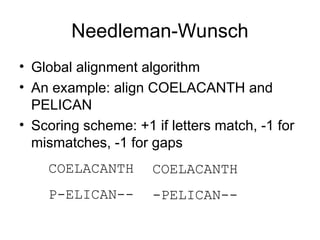
Needleman-Wunsch
• Global alignment algorithm
• An example: align COELACANTH and
PELICAN
• Scoring scheme: +1 if letters match, -1 for
mismatches, -1 for gaps
COELACANTH
P-ELICAN--
COELACANTH
-PELICAN--
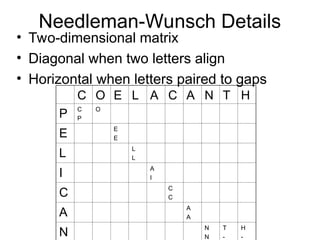
Needleman-Wunsch Details
• Two-dimensional matrix
• Diagonal when two letters align
• Horizontal when letters paired to gaps
C O E L A C A N T H
P
C
P
O
E
E
E
L L
L
I
A
I
C C
C
A A
A
N N
N
T
-
H
-
Needleman-Wunsch
• In reality, each cell of matrix contains
score and pointer
• Score is derived from scoring scheme (-1
or +1 in our example)
• Pointer is an arrow that points up, left, or
diagonal
• After initializing matrix, compute the score
and arrow for each cell
Algorithm
• For each cell, compute
– Match score: sum of preceding diagonal cell and
score of aligning the two letters (+1 if match, -1 if
no match)
– Horizontal gap score: sum of score to the left and
gap score (-1)
– Vertical gap score: sum of score above and gap
score (-1)
• Choose highest score and point arrow towards
maximum cell
• When you finish, trace arrows back from lower
right to get alignment
Smith-Waterman
• Modification of Needleman-Wunsch
– Edges of matrix initialized to 0
– Maximum score never less than 0
– No pointer unless score greater than 0
– Trace-back starts at highest score (rather than
lower right) and ends at 0
• How do these changes affect the algorithm?
Global vs. Local
• Global – both sequences aligned along
entire lengths
• Local – best subsequence alignment
found
• Global alignment of two genomic
sequences may not align exons
• Local alignment would only pick out
maximum scoring exon
Complexity
• O(mn) time and memory
• This is impractical for long sequences!
• Observation: during fill phase of the
algorithm, we only use two rows at a time
• Instead of calculating whole matrix,
calculate score of maximum scoring
alignment, and restrict search along
diagonal
Other Observations
• Most boxes have a score of 0 – wasted
computation
• Idea: make alignments where positive
scores most likely (approximation)
• BLAST
Caveats
• Alignments play by computational, not
biological, rules
• Similarity metrics may not capture biology
• Approximation may be preferred to reduce
computational costs
• Any two sequences can be aligned
– challenge is finding the proper meaning
BLAST
• Set of programs that search sequence
databases for statistically significant
similarities
• Complex- requires multiple steps and
many parameters
• Five traditional BLAST programs:
– BLASTN – nucleotides
– BLASTSP, BLASTX, TBLASTN, TBLASTX -
proteins
BLAST Algorithm
• Consider a graph with one sequence
along X axis and one along Y axis
• Each pair of letters has score
• Alignment is a sequence of paired letters
(may contain gaps)
Observations
• Recall Smith-Waterman will find maximum
scoring alignment between two sequences
• But in practice, may have several good
alignments or none
• What we really want is all statistically
significant alignments
Observations (continued)
• Searching entire search space is
expensive!
• BLAST can explore smaller search space
• Tradeoff: faster searches but may miss
some hits
BLAST Overview
• Three heuristic layers: seeding, extension,
and evaluation
• Seeding – identify where to start alignment
• Extension – extending alignment from
seeds
• Evaluation – Determine which alignments
are statistically significant
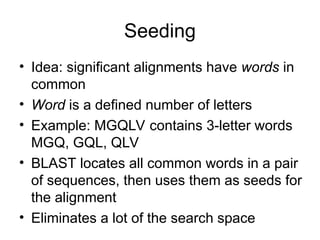
Seeding
• Idea: significant alignments have words in
common
• Word is a defined number of letters
• Example: MGQLV contains 3-letter words
MGQ, GQL, QLV
• BLAST locates all common words in a pair
of sequences, then uses them as seeds for
the alignment
• Eliminates a lot of the search space
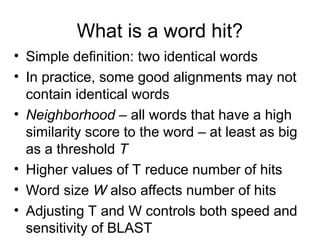
What is a word hit?
• Simple definition: two identical words
• In practice, some good alignments may not
contain identical words
• Neighborhood – all words that have a high
similarity score to the word – at least as big
as a threshold T
• Higher values of T reduce number of hits
• Word size W also affects number of hits
• Adjusting T and W controls both speed and
sensitivity of BLAST
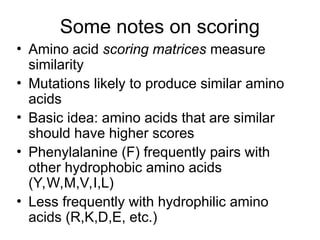
Some notes on scoring
• Amino acid scoring matrices measure
similarity
• Mutations likely to produce similar amino
acids
• Basic idea: amino acids that are similar
should have higher scores
• Phenylalanine (F) frequently pairs with
other hydrophobic amino acids
(Y,W,M,V,I,L)
• Less frequently with hydrophilic amino
acids (R,K,D,E, etc.)
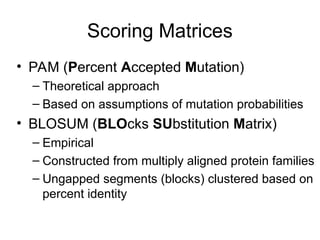
Scoring Matrices
• PAM (Percent Accepted Mutation)
– Theoretical approach
– Based on assumptions of mutation probabilities
• BLOSUM (BLOcks SUbstitution Matrix)
– Empirical
– Constructed from multiply aligned protein families
– Ungapped segments (blocks) clustered based on
percent identity
Seeding Implementation Details
• BLASTN (nucleotides)– seeds always
identical, T never used
• To speed up BLASTN, increase W
• BLASTP uses W size 2 or 3
• To speed up protein searches, set W=3
and T to a large value
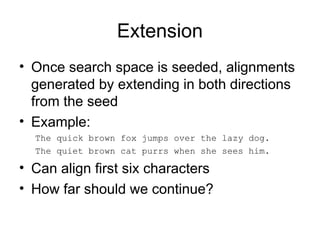
Extension
• Once search space is seeded, alignments
generated by extending in both directions
from the seed
• Example:
The quick brown fox jumps over the lazy dog.
The quiet brown cat purrs when she sees him.
• Can align first six characters
• How far should we continue?
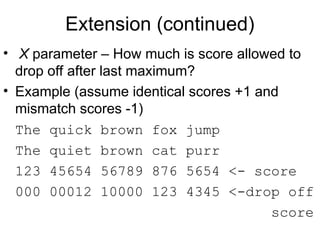
Extension (continued)
• X parameter – How much is score allowed to
drop off after last maximum?
• Example (assume identical scores +1 and
mismatch scores -1)
The quick brown fox jump
The quiet brown cat purr
123 45654 56789 876 5654 <- score
000 00012 10000 123 4345 <-drop off
score
What is a good value of X?
• Small X risks premature termination
• But little benefit to a very large X
• Generally better to use large value
• W and T better for controlling speed than
X
Implementation Details
• Extension differs in BLASTN and BLASTP
• Nucleotide sequences can be stored in
compressed state (2 bits per nucleotide)
• If sequence contains N (unknown), replace
with random nucleotide
• Two-bit approximation may cause
extension to terminate prematurely
Evaluation
• Determine which alignments are
statistically significant
• Simplest: throw out alignments below a
score threshold S
• In practice, determining a good threshold
complicated by multiple high scoring pairs
(HSPs)
Implementation Details
• Recall three phases: seeding, extension,
evaluation
• In reality, two rounds of extension and
evaluation, gapped and ungapped
• Gapped extension and evaluation only if
ungapped alignments exceed thresholds
Storage/Implementation
• Most BLAST databases are either a
collection of files and scripts or simple
relational schema
• What are limitations of these approaches?
Limitations of BLAST
• Can only search for a single query (e.g. find all
genes similar to TTGGACAGGATCGA)
• What about more complex queries?
• “Find all genes in the human genome that are
expressed in the liver and have a
TTGGACAGGATCGA (allowing 1 or 2
mismatches) followed by GCCGCG within 40
symbols in a 4000 symbol stretch upstream
from the gene”
Evaluating complex queries
• Idea: write a script that make multiple calls to
a BLAST database
• An example query plan:
1. Search for all instances of the two patterns in the
human genome
2. Combine results to find all pairs within 40
symbols of each other
3. Consult a gene database to see if pair is
upstream of any known gene
4. Consult database to check if gene expressed in
liver
Bioinformatics detailed explaination with diagrams

  • 1.
  • 2.
    Overview • Recap oflast time • Similarity discussion • Algorithms: – Needleman-Wunsch – Smith-Waterman – BLAST • Implementation issues and current research
  • 3.
    Recap from LastTime • Genome consists of entire DNA sequence of a species • DNA is the blueprint • Contains individual genes • Genes are composed of four nucleotides (A,C,G,T) • RNA transcribes DNA into proteins • Proteins consist of 20 amino acids • Proteins perform the actual functions
  • 4.
    Recap from LastTime • Identify similarities among the same gene from pig, sheep, and rabbit • Things that were hard: – Manually matching letters – Deciding what “similar” meant • Things that would have made it harder: – What if you had the whole genome? – What if there were missing letters/gaps?
  • 5.
    Why do similaritysearch? • Similarity indicates conserved function • Human and mouse genes are more than 80% similar at sequence level • But these genes are small fraction of genome • Most sequences in the genome are not recognizably similar • Comparing sequences helps us understand function – Locate similar gene in another species to understand your new gene – Rosetta stone
  • 6.
    Issues to consider •Dealing with gaps – Do we want gaps in alignment? – What are disadvantages of • Many small gaps? • Some big gaps?
  • 7.
    Warning: similarity not transitive! •If 1 is “similar” to 2, and 3 is “similar” to 2, is 1 similar to 3? • Not necessarily – AAAAAABBBBBB is similar to AAAAAA and BBBBBB – But AAAAAA is not similar to BBBBBB • “not transitive unless alignments are overlapping”
  • 8.
    Summary • Why arebiological sequences similar to one another? – Start out similar, follow different paths • Knowledge of how and why sequences change over time can help you interpret similarities and differences between them
  • 9.
    BLAST • Basic LocalAlignment Search Tool • Algorithm for comparing a given sequence against sequences in a database • A match between two sequences is an alignment • Many BLAST databases and web services available
  • 10.
    Example BLAST questions •Which bacterial species have a protein that is related in lineage to a protein whose amino-acid sequence I know? • Where does the DNA I’ve sequenced come from? • What other genes encode proteins that exhibit structures similar to the one I’ve just determined?
  • 11.
    Background: Identifying Similarity •Algorithms to match sequences: – Needleman-Wunsch – Smith Waterman – BLAST
  • 12.
    Needleman-Wunsch • Global alignmentalgorithm • An example: align COELACANTH and PELICAN • Scoring scheme: +1 if letters match, -1 for mismatches, -1 for gaps COELACANTH P-ELICAN-- COELACANTH -PELICAN--
  • 13.
    Needleman-Wunsch Details • Two-dimensionalmatrix • Diagonal when two letters align • Horizontal when letters paired to gaps C O E L A C A N T H P C P O E E E L L L I A I C C C A A A N N N T - H -
  • 14.
    Needleman-Wunsch • In reality,each cell of matrix contains score and pointer • Score is derived from scoring scheme (-1 or +1 in our example) • Pointer is an arrow that points up, left, or diagonal • After initializing matrix, compute the score and arrow for each cell
  • 15.
    Algorithm • For eachcell, compute – Match score: sum of preceding diagonal cell and score of aligning the two letters (+1 if match, -1 if no match) – Horizontal gap score: sum of score to the left and gap score (-1) – Vertical gap score: sum of score above and gap score (-1) • Choose highest score and point arrow towards maximum cell • When you finish, trace arrows back from lower right to get alignment
  • 16.
    Smith-Waterman • Modification ofNeedleman-Wunsch – Edges of matrix initialized to 0 – Maximum score never less than 0 – No pointer unless score greater than 0 – Trace-back starts at highest score (rather than lower right) and ends at 0 • How do these changes affect the algorithm?
  • 17.
    Global vs. Local •Global – both sequences aligned along entire lengths • Local – best subsequence alignment found • Global alignment of two genomic sequences may not align exons • Local alignment would only pick out maximum scoring exon
  • 18.
    Complexity • O(mn) timeand memory • This is impractical for long sequences! • Observation: during fill phase of the algorithm, we only use two rows at a time • Instead of calculating whole matrix, calculate score of maximum scoring alignment, and restrict search along diagonal
  • 19.
    Other Observations • Mostboxes have a score of 0 – wasted computation • Idea: make alignments where positive scores most likely (approximation) • BLAST
  • 20.
    Caveats • Alignments playby computational, not biological, rules • Similarity metrics may not capture biology • Approximation may be preferred to reduce computational costs • Any two sequences can be aligned – challenge is finding the proper meaning
  • 21.
    BLAST • Set ofprograms that search sequence databases for statistically significant similarities • Complex- requires multiple steps and many parameters • Five traditional BLAST programs: – BLASTN – nucleotides – BLASTSP, BLASTX, TBLASTN, TBLASTX - proteins
  • 22.
    BLAST Algorithm • Considera graph with one sequence along X axis and one along Y axis • Each pair of letters has score • Alignment is a sequence of paired letters (may contain gaps)
  • 23.
    Observations • Recall Smith-Watermanwill find maximum scoring alignment between two sequences • But in practice, may have several good alignments or none • What we really want is all statistically significant alignments
  • 24.
    Observations (continued) • Searchingentire search space is expensive! • BLAST can explore smaller search space • Tradeoff: faster searches but may miss some hits
  • 25.
    BLAST Overview • Threeheuristic layers: seeding, extension, and evaluation • Seeding – identify where to start alignment • Extension – extending alignment from seeds • Evaluation – Determine which alignments are statistically significant
  • 26.
    Seeding • Idea: significantalignments have words in common • Word is a defined number of letters • Example: MGQLV contains 3-letter words MGQ, GQL, QLV • BLAST locates all common words in a pair of sequences, then uses them as seeds for the alignment • Eliminates a lot of the search space
  • 27.
    What is aword hit? • Simple definition: two identical words • In practice, some good alignments may not contain identical words • Neighborhood – all words that have a high similarity score to the word – at least as big as a threshold T • Higher values of T reduce number of hits • Word size W also affects number of hits • Adjusting T and W controls both speed and sensitivity of BLAST
  • 28.
    Some notes onscoring • Amino acid scoring matrices measure similarity • Mutations likely to produce similar amino acids • Basic idea: amino acids that are similar should have higher scores • Phenylalanine (F) frequently pairs with other hydrophobic amino acids (Y,W,M,V,I,L) • Less frequently with hydrophilic amino acids (R,K,D,E, etc.)
  • 29.
    Scoring Matrices • PAM(Percent Accepted Mutation) – Theoretical approach – Based on assumptions of mutation probabilities • BLOSUM (BLOcks SUbstitution Matrix) – Empirical – Constructed from multiply aligned protein families – Ungapped segments (blocks) clustered based on percent identity
  • 30.
    Seeding Implementation Details •BLASTN (nucleotides)– seeds always identical, T never used • To speed up BLASTN, increase W • BLASTP uses W size 2 or 3 • To speed up protein searches, set W=3 and T to a large value
  • 31.
    Extension • Once searchspace is seeded, alignments generated by extending in both directions from the seed • Example: The quick brown fox jumps over the lazy dog. The quiet brown cat purrs when she sees him. • Can align first six characters • How far should we continue?
  • 32.
    Extension (continued) • Xparameter – How much is score allowed to drop off after last maximum? • Example (assume identical scores +1 and mismatch scores -1) The quick brown fox jump The quiet brown cat purr 123 45654 56789 876 5654 <- score 000 00012 10000 123 4345 <-drop off score
  • 33.
    What is agood value of X? • Small X risks premature termination • But little benefit to a very large X • Generally better to use large value • W and T better for controlling speed than X
  • 34.
    Implementation Details • Extensiondiffers in BLASTN and BLASTP • Nucleotide sequences can be stored in compressed state (2 bits per nucleotide) • If sequence contains N (unknown), replace with random nucleotide • Two-bit approximation may cause extension to terminate prematurely
  • 35.
    Evaluation • Determine whichalignments are statistically significant • Simplest: throw out alignments below a score threshold S • In practice, determining a good threshold complicated by multiple high scoring pairs (HSPs)
  • 36.
    Implementation Details • Recallthree phases: seeding, extension, evaluation • In reality, two rounds of extension and evaluation, gapped and ungapped • Gapped extension and evaluation only if ungapped alignments exceed thresholds
  • 37.
    Storage/Implementation • Most BLASTdatabases are either a collection of files and scripts or simple relational schema • What are limitations of these approaches?
  • 38.
    Limitations of BLAST •Can only search for a single query (e.g. find all genes similar to TTGGACAGGATCGA) • What about more complex queries? • “Find all genes in the human genome that are expressed in the liver and have a TTGGACAGGATCGA (allowing 1 or 2 mismatches) followed by GCCGCG within 40 symbols in a 4000 symbol stretch upstream from the gene”
  • 39.
    Evaluating complex queries •Idea: write a script that make multiple calls to a BLAST database • An example query plan: 1. Search for all instances of the two patterns in the human genome 2. Combine results to find all pairs within 40 symbols of each other 3. Consult a gene database to see if pair is upstream of any known gene 4. Consult database to check if gene expressed in liver