A Sustainable Agenda for Biofuel Production and Trade
Simonetta Zarrilli
United Nations Conference of Trade and Development
UNCTAD
30 September 2009
Biofuels
Liquid transportation fuels derived from agricultural,
forest or any other organic material - feedstock
Ethanol – alcohol produced mainly from grains and sugar
crops. It can be used directly in cars designed to run on it or
blended with gasoline. Gasoline additive. Spirits
Biodiesel – Synthetic diesel-like fuel produced from vegetable
oils, animal fats or recycled cooking grease. It can be used
directly in cars designed to run on it or blended with
mineral diesel
Why Biofuels?
Reduce GHG emissions to mitigate climate change
Enhance energy security, energy diversification and energy
access and reduce expenditure on energy
Attract investments, including through the use of CDM
Accelerate technological innovation
Relatively easy alternative to fossil fuels
Provide new end-markets for agricultural products
Boost employment and growth for rural communities
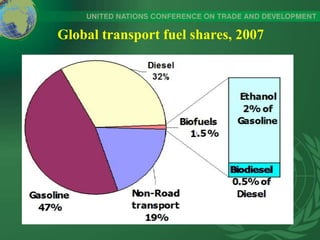
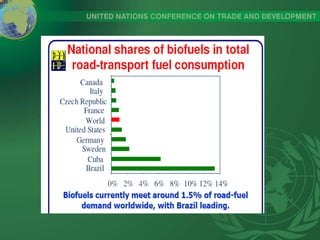
Global transport fuel shares, 2007
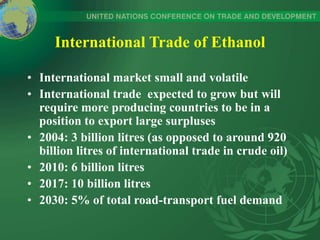
International Trade of Ethanol
• International market small and volatile
• International trade expected to grow but will
require more producing countries to be in a
position to export large surpluses
• 2004: 3 billion litres (as opposed to around 920
billion litres of international trade in crude oil)
• 2010: 6 billion litres
• 2017: 10 billion litres
• 2030: 5% of total road-transport fuel demand
International Trade of Ethanol
Brazil dominates exports (63% in 06-07), but other
developing countries such as China, South Africa,
Pakistan, Caribbean Basin Initiatives (CBI) – are
becoming active exporters
Largest ethanol importer – USA
Japan, Germany, the Netherlands
Biofuels - through which instruments?
Around 50 developed and developing countries have set up
regulatory frameworks on bio-energy, including biofuels
• Mandated amounts and blending targets
– Mandatory blend of biofuels with fossil fuels per unit of
fuel sold (eg Brazil); mandatory target of biofuels that
refiners and blenders have to meet (eg USA)
• Support measures
– Subsidies, grants, reduced-cost credits, tax exemption
• Import tariffs. But several preferential arrangements 
duty-free or reduced tariffs
– EU, ethanol: Euro 0.102/liter (denatured alcohol); Euro
0.192/litee (un-denaturated alcohol)
– USA, ethanol: $ 0.54/gallon ($ 0.1427/liter) + 2.5% ad
valorem tariff
– Japan, ethanol: 27.2%
EU and USA regimes for biofuels
• EU 20/20/20 Strategy
– 20% reduction in greenhouse gases, 20% improvement in
efficiency, 20% generation of energy from renewables (10%
from renewables in the transport sector) by 2020
• USA Energy Independence and Security Act – EISA
– Increase energy efficiency and the availability of renewable
energy
• Minimum annual levels of renewable fuel in US
transportation fuel
– 9 billion gallons (~ 34 billion litres) in 2008
– 36 billion gallons (~ 137 billion litres) in 2022
Brazil
• National Alcohol Programme – 1975
• 20-25% mandatory blending with
gasoline
• Flex cars programme – launched in 2003
• In December 2007 represented 86.8% of
total vehicle sales
• Mandatory blending for biodiesel – 2%
 5% by 2013
Other countries
• China: 15% blending target in five
provinces by 2010
• Canada: 5% blending target by 2010
• Australia: 10% blending target
• India: 5% blending target; 10% by 2012
• Philippines: 5% in 2009; 10% by 2011
• South Africa: 8% blending target
Biofuels and their global relevance
• The biofuels policies put in place by major countries will
have global impacts on land use, on pattern of trade, on
where feedstock and biofuel production will take place, and
on land and food prices
• The global effects will be magnified once other countries
put in place similar policies 
Issue of global relevance Possible impacts on all countries
What is the policy space left, especially
for small and medium countries?
Challenges
Enough land for all purposes?
– Probably yes, especially with new technologies
Impact of higher food prices on the world’s poor
– Negative, especially in the short terms and for countries with
large proportion of urban poor and rural landless workers.
Positive effects possible in the longer term for land owners
Will small producers benefit from emerging feedstock/
biofuels markets?
– Probably only if supporting mechanisms and
arrangements are in place
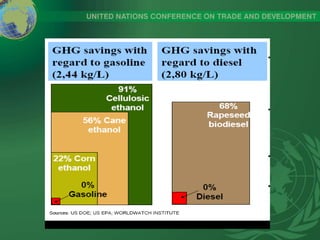
Emissions reduction and environmental concerns
– Biofuels are not necessarily carbon-neutral
– Possible environmental degradation
Not all feedstock are created equal…
• The way they are produced matters
• The energy yield also matters
• Land use changes or expansion may alter
GHG
• Conversion methods also matter
Policy instruments should reflect this
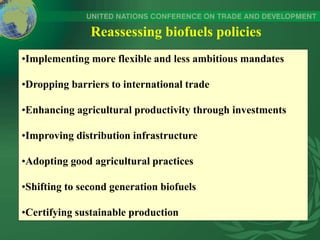
Reassessing biofuels policies
•Implementing more flexible and less ambitious mandates
•Dropping barriers to international trade
•Enhancing agricultural productivity through investments
•Improving distribution infrastructure
•Adopting good agricultural practices
•Shifting to second generation biofuels
•Certifying sustainable production
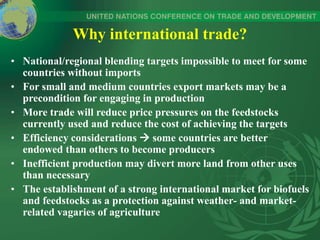
Why international trade?
• National/regional blending targets impossible to meet for some
countries without imports
• For small and medium countries export markets may be a
precondition for engaging in production
• More trade will reduce price pressures on the feedstocks
currently used and reduce the cost of achieving the targets
• Efficiency considerations  some countries are better
endowed than others to become producers
• Inefficient production may divert more land from other uses
than necessary
• The establishment of a strong international market for biofuels
and feedstocks as a protection against weather- and market-
related vagaries of agriculture
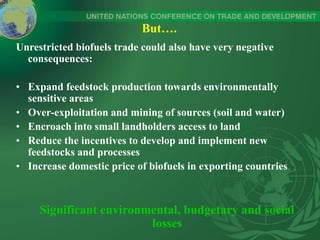
But….
Unrestricted biofuels trade could also have very negative
consequences:
• Expand feedstock production towards environmentally
sensitive areas
• Over-exploitation and mining of sources (soil and water)
• Encroach into small landholders access to land
• Reduce the incentives to develop and implement new
feedstocks and processes
• Increase domestic price of biofuels in exporting countries
Significant environmental, budgetary and social
losses
WTO-related issues
• Classification Issues
• WTO negotiations on EGS  reduction and
elimination of tariff and non-tariff barriers
But for the time being no agreement either on
definition or on modalities for liberalization.
Difficulties in finding overall agreement
• Bilateral, regional agreements? Ad Hoc
Agreement?
UNCTAD Biofuels Initiative
• Launched in June 2005 in Paris/IEA
• Serves as a “meeting point” for existing
initiatives/activities on biofuels
• Provides developing countries with:
– Economic, legal and trade policy analysis
– Capacity building activities
– Consensus building tools
THANK YOU
Simonetta.Zarrilli@unctad.org

BiofuelsGeneralSept09Rev.ppt

  • 1.
    A Sustainable Agendafor Biofuel Production and Trade Simonetta Zarrilli United Nations Conference of Trade and Development UNCTAD 30 September 2009
  • 2.
    Biofuels Liquid transportation fuelsderived from agricultural, forest or any other organic material - feedstock Ethanol – alcohol produced mainly from grains and sugar crops. It can be used directly in cars designed to run on it or blended with gasoline. Gasoline additive. Spirits Biodiesel – Synthetic diesel-like fuel produced from vegetable oils, animal fats or recycled cooking grease. It can be used directly in cars designed to run on it or blended with mineral diesel
  • 3.
    Why Biofuels? Reduce GHGemissions to mitigate climate change Enhance energy security, energy diversification and energy access and reduce expenditure on energy Attract investments, including through the use of CDM Accelerate technological innovation Relatively easy alternative to fossil fuels Provide new end-markets for agricultural products Boost employment and growth for rural communities
  • 4.
  • 8.
    International Trade ofEthanol • International market small and volatile • International trade expected to grow but will require more producing countries to be in a position to export large surpluses • 2004: 3 billion litres (as opposed to around 920 billion litres of international trade in crude oil) • 2010: 6 billion litres • 2017: 10 billion litres • 2030: 5% of total road-transport fuel demand
  • 9.
    International Trade ofEthanol Brazil dominates exports (63% in 06-07), but other developing countries such as China, South Africa, Pakistan, Caribbean Basin Initiatives (CBI) – are becoming active exporters Largest ethanol importer – USA Japan, Germany, the Netherlands
  • 10.
    Biofuels - throughwhich instruments? Around 50 developed and developing countries have set up regulatory frameworks on bio-energy, including biofuels • Mandated amounts and blending targets – Mandatory blend of biofuels with fossil fuels per unit of fuel sold (eg Brazil); mandatory target of biofuels that refiners and blenders have to meet (eg USA) • Support measures – Subsidies, grants, reduced-cost credits, tax exemption • Import tariffs. But several preferential arrangements  duty-free or reduced tariffs – EU, ethanol: Euro 0.102/liter (denatured alcohol); Euro 0.192/litee (un-denaturated alcohol) – USA, ethanol: $ 0.54/gallon ($ 0.1427/liter) + 2.5% ad valorem tariff – Japan, ethanol: 27.2%
  • 11.
    EU and USAregimes for biofuels • EU 20/20/20 Strategy – 20% reduction in greenhouse gases, 20% improvement in efficiency, 20% generation of energy from renewables (10% from renewables in the transport sector) by 2020 • USA Energy Independence and Security Act – EISA – Increase energy efficiency and the availability of renewable energy • Minimum annual levels of renewable fuel in US transportation fuel – 9 billion gallons (~ 34 billion litres) in 2008 – 36 billion gallons (~ 137 billion litres) in 2022
  • 12.
    Brazil • National AlcoholProgramme – 1975 • 20-25% mandatory blending with gasoline • Flex cars programme – launched in 2003 • In December 2007 represented 86.8% of total vehicle sales • Mandatory blending for biodiesel – 2%  5% by 2013
  • 13.
    Other countries • China:15% blending target in five provinces by 2010 • Canada: 5% blending target by 2010 • Australia: 10% blending target • India: 5% blending target; 10% by 2012 • Philippines: 5% in 2009; 10% by 2011 • South Africa: 8% blending target
  • 14.
    Biofuels and theirglobal relevance • The biofuels policies put in place by major countries will have global impacts on land use, on pattern of trade, on where feedstock and biofuel production will take place, and on land and food prices • The global effects will be magnified once other countries put in place similar policies  Issue of global relevance Possible impacts on all countries What is the policy space left, especially for small and medium countries?
  • 15.
    Challenges Enough land forall purposes? – Probably yes, especially with new technologies Impact of higher food prices on the world’s poor – Negative, especially in the short terms and for countries with large proportion of urban poor and rural landless workers. Positive effects possible in the longer term for land owners Will small producers benefit from emerging feedstock/ biofuels markets? – Probably only if supporting mechanisms and arrangements are in place Emissions reduction and environmental concerns – Biofuels are not necessarily carbon-neutral – Possible environmental degradation
  • 16.
    Not all feedstockare created equal… • The way they are produced matters • The energy yield also matters • Land use changes or expansion may alter GHG • Conversion methods also matter Policy instruments should reflect this
  • 18.
    Reassessing biofuels policies •Implementingmore flexible and less ambitious mandates •Dropping barriers to international trade •Enhancing agricultural productivity through investments •Improving distribution infrastructure •Adopting good agricultural practices •Shifting to second generation biofuels •Certifying sustainable production
  • 19.
    Why international trade? •National/regional blending targets impossible to meet for some countries without imports • For small and medium countries export markets may be a precondition for engaging in production • More trade will reduce price pressures on the feedstocks currently used and reduce the cost of achieving the targets • Efficiency considerations  some countries are better endowed than others to become producers • Inefficient production may divert more land from other uses than necessary • The establishment of a strong international market for biofuels and feedstocks as a protection against weather- and market- related vagaries of agriculture
  • 20.
    But…. Unrestricted biofuels tradecould also have very negative consequences: • Expand feedstock production towards environmentally sensitive areas • Over-exploitation and mining of sources (soil and water) • Encroach into small landholders access to land • Reduce the incentives to develop and implement new feedstocks and processes • Increase domestic price of biofuels in exporting countries Significant environmental, budgetary and social losses
  • 21.
    WTO-related issues • ClassificationIssues • WTO negotiations on EGS  reduction and elimination of tariff and non-tariff barriers But for the time being no agreement either on definition or on modalities for liberalization. Difficulties in finding overall agreement • Bilateral, regional agreements? Ad Hoc Agreement?
  • 22.
    UNCTAD Biofuels Initiative •Launched in June 2005 in Paris/IEA • Serves as a “meeting point” for existing initiatives/activities on biofuels • Provides developing countries with: – Economic, legal and trade policy analysis – Capacity building activities – Consensus building tools
  • 23.