BIOCHEMICAL
REACTIONS –
PART 1
DR.POOVVIZHI
MICROBIOLOGY JR
GMC AKOLA
WHY BIOCHEMICALS?
It guides us in identification of organism.
To know about cultural characteristics.
To help in differentiating commensals from pathogenic organism.
To monitor the strain pattern.
Optimal PH for Catalase action is 7.
3% / 30% hydrogen peroxide stored in dark brown bottle under
refrigeration.
18 to 24 hrs culture of the organism to be tested
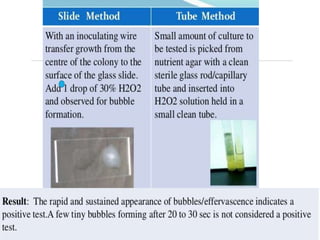
Methods:
•Slide method
•Tube method
•Direct plate method
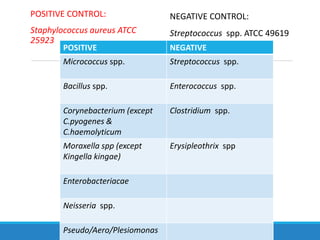
POSITIVE CONTROL:
Staphylococcus aureus ATCC
25923
NEGATIVE CONTROL:
Streptococcus spp. ATCC 49619
POSITIVE NEGATIVE
Micrococcus spp. Streptococcus spp.
Bacillus spp. Enterococcus spp.
Corynebacterium (except
C.pyogenes &
C.haemolyticum
Clostridium spp.
Moraxella spp (except
Kingella kingae)
Erysipleothrix spp
Enterobacteriacae
Neisseria spp.
Pseudo/Aero/Plesiomonas
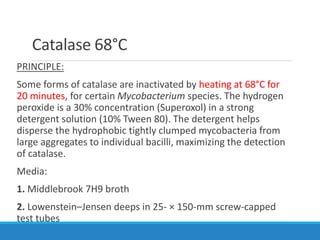
Catalase 68°C
PRINCIPLE:
Some forms of catalase are inactivated by heating at 68°C for
20 minutes, for certain Mycobacterium species. The hydrogen
peroxide is a 30% concentration (Superoxol) in a strong
detergent solution (10% Tween 80). The detergent helps
disperse the hydrophobic tightly clumped mycobacteria from
large aggregates to individual bacilli, maximizing the detection
of catalase.
Media:
1. Middlebrook 7H9 broth
2. Lowenstein–Jensen deeps in 25- × 150-mm screw-capped
test tubes
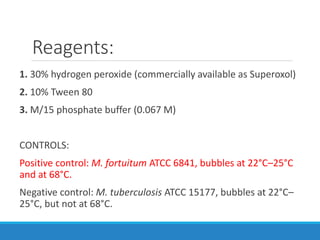
Reagents:
1. 30% hydrogen peroxide (commercially available as Superoxol)
2. 10% Tween 80
3. M/15 phosphate buffer (0.067 M)
CONTROLS:
Positive control: M. fortuitum ATCC 6841, bubbles at 22°C–25°C
and at 68°C.
Negative control: M. tuberculosis ATCC 15177, bubbles at 22°C–
25°C, but not at 68°C.
HEAT-STABLE CATALASE
TEST
Add 0.5 mL of sterile 0.067 M phosphate buffer to each tube.
Inoculate the buffer with a 2–3 heaping loopfuls of growth of the
organism to be tested (2–4 weeks old).
Thoroughly emulsify the culture in the buffer.
Incubate the tubes in a 68°C water bath for exactly 20 minutes.
Remove the tubes & Cool to room temperature.
Add 0.5 mL of Tween 80–hydrogen peroxide reagent.
Allow the tubes to sit at room temperature for 20 minutes.
Semiquantitative Catalase Test
Inoculate Dubos Tween broth or Middlebrook 7H9 broth with a loopful
of the culture to be tested.
Incubate for 7 days at 37°C.
Mix for 5–10 seconds on a vortex.
Transfer six drops to a LJ deep (prepared in 25- × 150-mm tubes).
Incubate the deeps for 14 days at 37°C. Be sure caps are loose.
Add 1 mL of freshly prepared Tween 80–hydrogen peroxide reagent.
Allow tests to sit at room temperature for 5 minutes.
Measure the column of bubbles.
Interpretation
1. Heat-stable catalase test:
The appearance of bubbles indicates a positive test; lack of
bubbles is a negative reaction. M. tuberculosis and other
mycobacteria lose their catalase activity when heated to
68°C.
2. Semiquantitative catalase test:
High catalase reaction: >45 mm of foam
Low catalase reaction: <45 mm of foam
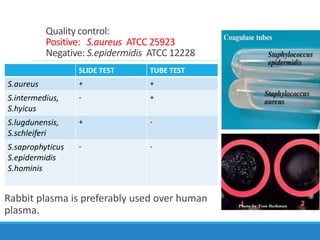
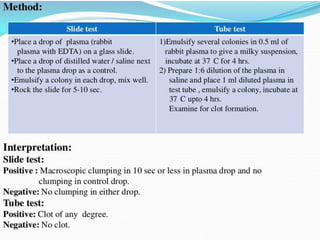
COAGULASE TEST
Quality control:
Positive: S.aureus ATCC 25923
Negative: S.epidermidis ATCC 12228
Rabbit plasma is preferably used over human
plasma.
SLIDE TEST TUBE TEST
S.aureus + +
S.intermedius,
S.hyicus
- +
S.lugdunensis,
S.schleiferi
+ -
S.saprophyticus
S.epidermidis
S.hominis
- -
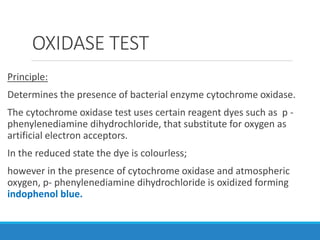
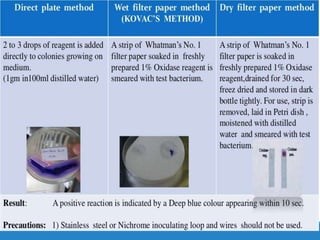
OXIDASE TEST
Principle:
Determines the presence of bacterial enzyme cytochrome oxidase.
The cytochrome oxidase test uses certain reagent dyes such as p -
phenylenediamine dihydrochloride, that substitute for oxygen as
artificial electron acceptors.
In the reduced state the dye is colourless;
however in the presence of cytochrome oxidase and atmospheric
oxygen, p- phenylenediamine dihydrochloride is oxidized forming
indophenol blue.
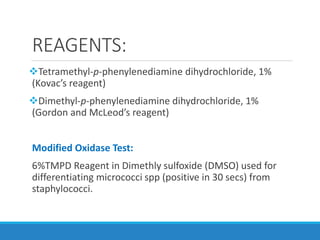
REAGENTS:
Tetramethyl-p-phenylenediamine dihydrochloride, 1%
(Kovac’s reagent)
Dimethyl-p-phenylenediamine dihydrochloride, 1%
(Gordon and McLeod’s reagent)
Modified Oxidase Test:
6%TMPD Reagent in Dimethly sulfoxide (DMSO) used for
differentiating micrococci spp (positive in 30 secs) from
staphylococci.
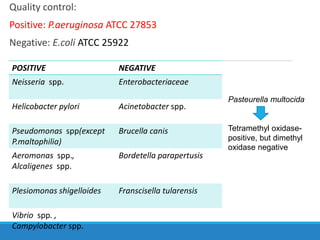
Quality control:
Positive: P.aeruginosa ATCC 27853
Negative: E.coli ATCC 25922
POSITIVE NEGATIVE
Neisseria spp. Enterobacteriaceae
Helicobacter pylori Acinetobacter spp.
Pseudomonas spp(except
P.maltophilia)
Brucella canis
Aeromonas spp.,
Alcaligenes spp.
Bordetella parapertusis
Plesiomonas shigelloides Franscisella tularensis
Vibrio spp. ,
Campylobacter spp.
Pasteurella multocida
Tetramethyl oxidase-
positive, but dimethyl
oxidase negative
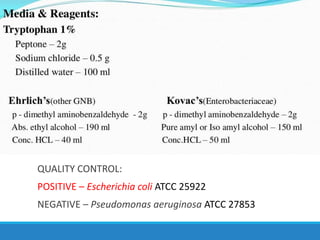
QUALITY CONTROL:
POSITIVE – Escherichia coli ATCC 25922
NEGATIVE – Pseudomonas aeruginosa ATCC 27853
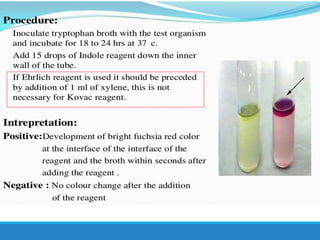
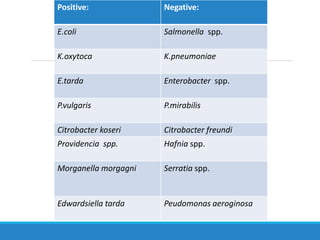
Positive: Negative:
E.coli Salmonella spp.
K.oxytoca K.pneumoniae
E.tarda Enterobacter spp.
P.vulgaris P.mirabilis
Citrobacter koseri Citrobacter freundi
Providencia spp. Hafnia spp.
Morganella morgagni Serratia spp.
Edwardsiella tarda Peudomonas aeroginosa
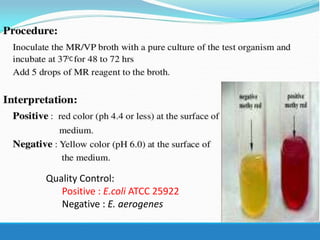
Quality Control:
Positive : E.coli ATCC 25922
Negative : E. aerogenes
OC
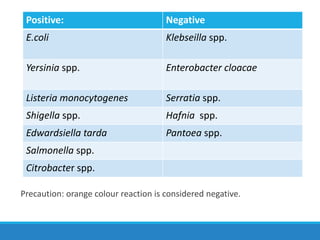
Precaution: orange colour reaction is considered negative.
Positive: Negative
E.coli Klebseilla spp.
Yersinia spp. Enterobacter cloacae
Listeria monocytogenes Serratia spp.
Shigella spp. Hafnia spp.
Edwardsiella tarda Pantoea spp.
Salmonella spp.
Citrobacter spp.
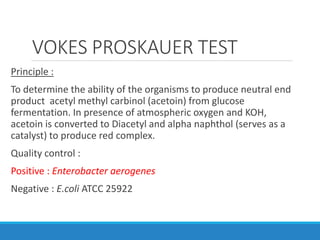
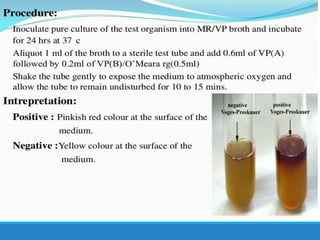
VOKES PROSKAUER TEST
Principle :
To determine the ability of the organisms to produce neutral end
product acetyl methyl carbinol (acetoin) from glucose
fermentation. In presence of atmospheric oxygen and KOH,
acetoin is converted to Diacetyl and alpha naphthol (serves as a
catalyst) to produce red complex.
Quality control :
Positive : Enterobacter aerogenes
Negative : E.coli ATCC 25922
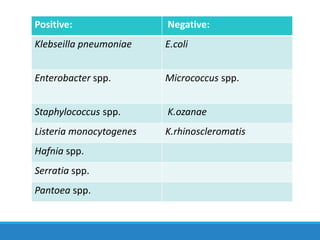
Positive: Negative:
Klebseilla pneumoniae E.coli
Enterobacter spp. Micrococcus spp.
Staphylococcus spp. K.ozanae
Listeria monocytogenes K.rhinoscleromatis
Hafnia spp.
Serratia spp.
Pantoea spp.
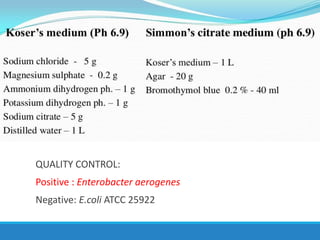
QUALITY CONTROL:
Positive : Enterobacter aerogenes
Negative: E.coli ATCC 25922
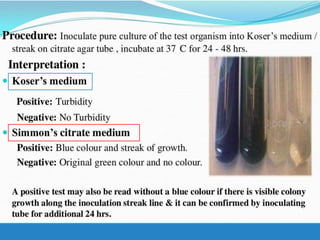
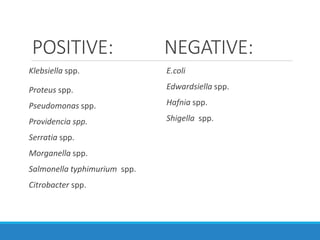
POSITIVE: NEGATIVE:
Klebsiella spp.
Proteus spp.
Pseudomonas spp.
Providencia spp.
Serratia spp.
Morganella spp.
Salmonella typhimurium spp.
Citrobacter spp.
E.coli
Edwardsiella spp.
Hafnia spp.
Shigella spp.
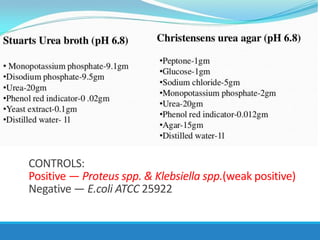
CONTROLS:
Positive — Proteus spp. & Klebsiella spp.(weak positive)
Negative — E.coli ATCC 25922
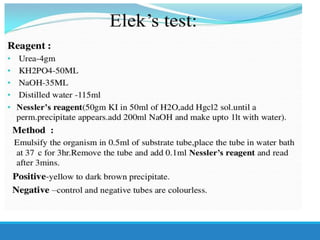
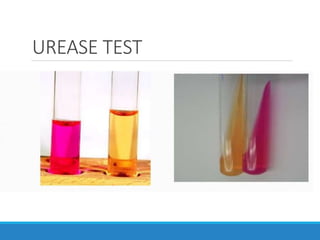
UREASE TEST
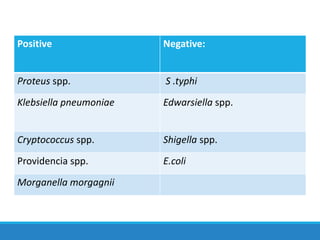
Positive Negative:
Proteus spp. S .typhi
Klebsiella pneumoniae Edwarsiella spp.
Cryptococcus spp. Shigella spp.
Providencia spp. E.coli
Morganella morgagnii
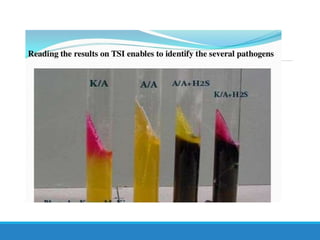
Quality control:
A/A : E.coli ATCC 25922
K/ A H2S+ : S.typhi
K/ NC : P.aeruginosa ATCC 27853
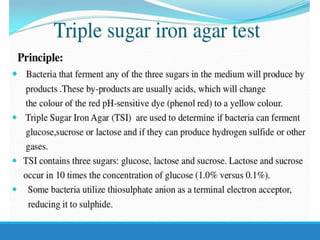
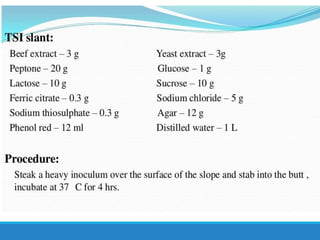
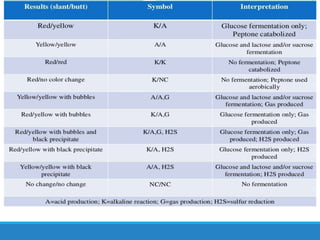
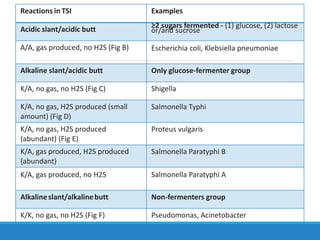
Reactions in TSI Examples
Acidic slant/acidic butt ≥2 sugars fermented - (1) glucose, (2) lactose
or/and sucrose
A/A, gas produced, no H2S (Fig B) Escherichia coli, Klebsiella pneumoniae
Alkaline slant/acidic butt Only glucose-fermenter group
K/A, no gas, no H2S (Fig C) Shigella
K/A, no gas, H2S produced (small
amount) (Fig D)
Salmonella Typhi
K/A, no gas, H2S produced
(abundant) (Fig E)
Proteus vulgaris
K/A, gas produced, H2S produced
(abundant)
Salmonella Paratyphi B
K/A, gas produced, no H2S Salmonella Paratyphi A
Alkalineslant/alkalinebutt Non-fermenters group
K/K, no gas, no H2S (Fig F) Pseudomonas, Acinetobacter
REFERENCES
▰ Koneman Colour Atlas and Diagnostic Microbiology -7th edition
▰ Koneman Colour Atlas and Diagnostic Microbiology – Biochemicals chart
▰ Essentials of Medical Microbiology – 3rd edition
▰ Textbook of Microbiology by Ananthanarayanan and Panikar 11th edition
▰ Bailey and Scott’s Diagnostic microbiology: A textbook for isolation and
identification of pathogenic microorganisms. In 15th edition Edited by Forbes
BA, Sahm DF, Weissfeld AS. St. Louis: The Mosby Company
▰ Practical Medical Microbiology by Mackie and McCartney – 14th edition
BIOCHEMICAL REACTIONS – PART 1.pptx

BIOCHEMICAL REACTIONS – PART 1.pptx

  • 1.
  • 2.
    WHY BIOCHEMICALS? It guidesus in identification of organism. To know about cultural characteristics. To help in differentiating commensals from pathogenic organism. To monitor the strain pattern.
  • 4.
    Optimal PH forCatalase action is 7. 3% / 30% hydrogen peroxide stored in dark brown bottle under refrigeration. 18 to 24 hrs culture of the organism to be tested Methods: •Slide method •Tube method •Direct plate method
  • 6.
    POSITIVE CONTROL: Staphylococcus aureusATCC 25923 NEGATIVE CONTROL: Streptococcus spp. ATCC 49619 POSITIVE NEGATIVE Micrococcus spp. Streptococcus spp. Bacillus spp. Enterococcus spp. Corynebacterium (except C.pyogenes & C.haemolyticum Clostridium spp. Moraxella spp (except Kingella kingae) Erysipleothrix spp Enterobacteriacae Neisseria spp. Pseudo/Aero/Plesiomonas
  • 7.
    Catalase 68°C PRINCIPLE: Some formsof catalase are inactivated by heating at 68°C for 20 minutes, for certain Mycobacterium species. The hydrogen peroxide is a 30% concentration (Superoxol) in a strong detergent solution (10% Tween 80). The detergent helps disperse the hydrophobic tightly clumped mycobacteria from large aggregates to individual bacilli, maximizing the detection of catalase. Media: 1. Middlebrook 7H9 broth 2. Lowenstein–Jensen deeps in 25- × 150-mm screw-capped test tubes
  • 8.
    Reagents: 1. 30% hydrogenperoxide (commercially available as Superoxol) 2. 10% Tween 80 3. M/15 phosphate buffer (0.067 M) CONTROLS: Positive control: M. fortuitum ATCC 6841, bubbles at 22°C–25°C and at 68°C. Negative control: M. tuberculosis ATCC 15177, bubbles at 22°C– 25°C, but not at 68°C.
  • 9.
    HEAT-STABLE CATALASE TEST Add 0.5mL of sterile 0.067 M phosphate buffer to each tube. Inoculate the buffer with a 2–3 heaping loopfuls of growth of the organism to be tested (2–4 weeks old). Thoroughly emulsify the culture in the buffer. Incubate the tubes in a 68°C water bath for exactly 20 minutes. Remove the tubes & Cool to room temperature. Add 0.5 mL of Tween 80–hydrogen peroxide reagent. Allow the tubes to sit at room temperature for 20 minutes.
  • 10.
    Semiquantitative Catalase Test InoculateDubos Tween broth or Middlebrook 7H9 broth with a loopful of the culture to be tested. Incubate for 7 days at 37°C. Mix for 5–10 seconds on a vortex. Transfer six drops to a LJ deep (prepared in 25- × 150-mm tubes). Incubate the deeps for 14 days at 37°C. Be sure caps are loose. Add 1 mL of freshly prepared Tween 80–hydrogen peroxide reagent. Allow tests to sit at room temperature for 5 minutes. Measure the column of bubbles.
  • 11.
    Interpretation 1. Heat-stable catalasetest: The appearance of bubbles indicates a positive test; lack of bubbles is a negative reaction. M. tuberculosis and other mycobacteria lose their catalase activity when heated to 68°C. 2. Semiquantitative catalase test: High catalase reaction: >45 mm of foam Low catalase reaction: <45 mm of foam
  • 12.
  • 13.
    Quality control: Positive: S.aureusATCC 25923 Negative: S.epidermidis ATCC 12228 Rabbit plasma is preferably used over human plasma. SLIDE TEST TUBE TEST S.aureus + + S.intermedius, S.hyicus - + S.lugdunensis, S.schleiferi + - S.saprophyticus S.epidermidis S.hominis - -
  • 15.
    OXIDASE TEST Principle: Determines thepresence of bacterial enzyme cytochrome oxidase. The cytochrome oxidase test uses certain reagent dyes such as p - phenylenediamine dihydrochloride, that substitute for oxygen as artificial electron acceptors. In the reduced state the dye is colourless; however in the presence of cytochrome oxidase and atmospheric oxygen, p- phenylenediamine dihydrochloride is oxidized forming indophenol blue.
  • 16.
    REAGENTS: Tetramethyl-p-phenylenediamine dihydrochloride, 1% (Kovac’sreagent) Dimethyl-p-phenylenediamine dihydrochloride, 1% (Gordon and McLeod’s reagent) Modified Oxidase Test: 6%TMPD Reagent in Dimethly sulfoxide (DMSO) used for differentiating micrococci spp (positive in 30 secs) from staphylococci.
  • 18.
    Quality control: Positive: P.aeruginosaATCC 27853 Negative: E.coli ATCC 25922 POSITIVE NEGATIVE Neisseria spp. Enterobacteriaceae Helicobacter pylori Acinetobacter spp. Pseudomonas spp(except P.maltophilia) Brucella canis Aeromonas spp., Alcaligenes spp. Bordetella parapertusis Plesiomonas shigelloides Franscisella tularensis Vibrio spp. , Campylobacter spp. Pasteurella multocida Tetramethyl oxidase- positive, but dimethyl oxidase negative
  • 20.
    QUALITY CONTROL: POSITIVE –Escherichia coli ATCC 25922 NEGATIVE – Pseudomonas aeruginosa ATCC 27853
  • 22.
    Positive: Negative: E.coli Salmonellaspp. K.oxytoca K.pneumoniae E.tarda Enterobacter spp. P.vulgaris P.mirabilis Citrobacter koseri Citrobacter freundi Providencia spp. Hafnia spp. Morganella morgagni Serratia spp. Edwardsiella tarda Peudomonas aeroginosa
  • 25.
    Quality Control: Positive :E.coli ATCC 25922 Negative : E. aerogenes OC
  • 26.
    Precaution: orange colourreaction is considered negative. Positive: Negative E.coli Klebseilla spp. Yersinia spp. Enterobacter cloacae Listeria monocytogenes Serratia spp. Shigella spp. Hafnia spp. Edwardsiella tarda Pantoea spp. Salmonella spp. Citrobacter spp.
  • 27.
    VOKES PROSKAUER TEST Principle: To determine the ability of the organisms to produce neutral end product acetyl methyl carbinol (acetoin) from glucose fermentation. In presence of atmospheric oxygen and KOH, acetoin is converted to Diacetyl and alpha naphthol (serves as a catalyst) to produce red complex. Quality control : Positive : Enterobacter aerogenes Negative : E.coli ATCC 25922
  • 30.
    Positive: Negative: Klebseilla pneumoniaeE.coli Enterobacter spp. Micrococcus spp. Staphylococcus spp. K.ozanae Listeria monocytogenes K.rhinoscleromatis Hafnia spp. Serratia spp. Pantoea spp.
  • 32.
    QUALITY CONTROL: Positive :Enterobacter aerogenes Negative: E.coli ATCC 25922
  • 34.
    POSITIVE: NEGATIVE: Klebsiella spp. Proteusspp. Pseudomonas spp. Providencia spp. Serratia spp. Morganella spp. Salmonella typhimurium spp. Citrobacter spp. E.coli Edwardsiella spp. Hafnia spp. Shigella spp.
  • 36.
    CONTROLS: Positive — Proteusspp. & Klebsiella spp.(weak positive) Negative — E.coli ATCC 25922
  • 38.
  • 40.
    Positive Negative: Proteus spp.S .typhi Klebsiella pneumoniae Edwarsiella spp. Cryptococcus spp. Shigella spp. Providencia spp. E.coli Morganella morgagnii
  • 42.
    Quality control: A/A :E.coli ATCC 25922 K/ A H2S+ : S.typhi K/ NC : P.aeruginosa ATCC 27853
  • 46.
    Reactions in TSIExamples Acidic slant/acidic butt ≥2 sugars fermented - (1) glucose, (2) lactose or/and sucrose A/A, gas produced, no H2S (Fig B) Escherichia coli, Klebsiella pneumoniae Alkaline slant/acidic butt Only glucose-fermenter group K/A, no gas, no H2S (Fig C) Shigella K/A, no gas, H2S produced (small amount) (Fig D) Salmonella Typhi K/A, no gas, H2S produced (abundant) (Fig E) Proteus vulgaris K/A, gas produced, H2S produced (abundant) Salmonella Paratyphi B K/A, gas produced, no H2S Salmonella Paratyphi A Alkalineslant/alkalinebutt Non-fermenters group K/K, no gas, no H2S (Fig F) Pseudomonas, Acinetobacter
  • 47.
    REFERENCES ▰ Koneman ColourAtlas and Diagnostic Microbiology -7th edition ▰ Koneman Colour Atlas and Diagnostic Microbiology – Biochemicals chart ▰ Essentials of Medical Microbiology – 3rd edition ▰ Textbook of Microbiology by Ananthanarayanan and Panikar 11th edition ▰ Bailey and Scott’s Diagnostic microbiology: A textbook for isolation and identification of pathogenic microorganisms. In 15th edition Edited by Forbes BA, Sahm DF, Weissfeld AS. St. Louis: The Mosby Company ▰ Practical Medical Microbiology by Mackie and McCartney – 14th edition