Biochemical part-4
By: Raju Yadav
M.Sc. Medical Microbiology
Nitrate Reduction Test
• Nitrate reduction test is used for the differentiation of members of Enterobacteriaceae based on
their ability to produce nitrate reductase enzyme that hydrolyzes nitrate (NO3-) to nitrite (NO2-),
which may then again be degraded to various nitrogen products like nitrogen oxide, nitrous oxide
and ammonia (NH3) depending on the enzyme system of the organism and the atmosphere in
which it is growing.
• Anaerobic metabolism requires an electron acceptor other than atmospheric oxygen (O2). Many
gram-negative bacteria use nitrate as the final electron acceptor.
Principle:
• Heavy inoculum of test organism is incubated in nitrate broth. After 4 hrs incubation, the broth is
tested for reduction of nitrate (NO3
–
) to nitrite (NO2
–
) by adding sulfanilic acid reagent and α-
naphthylamine.
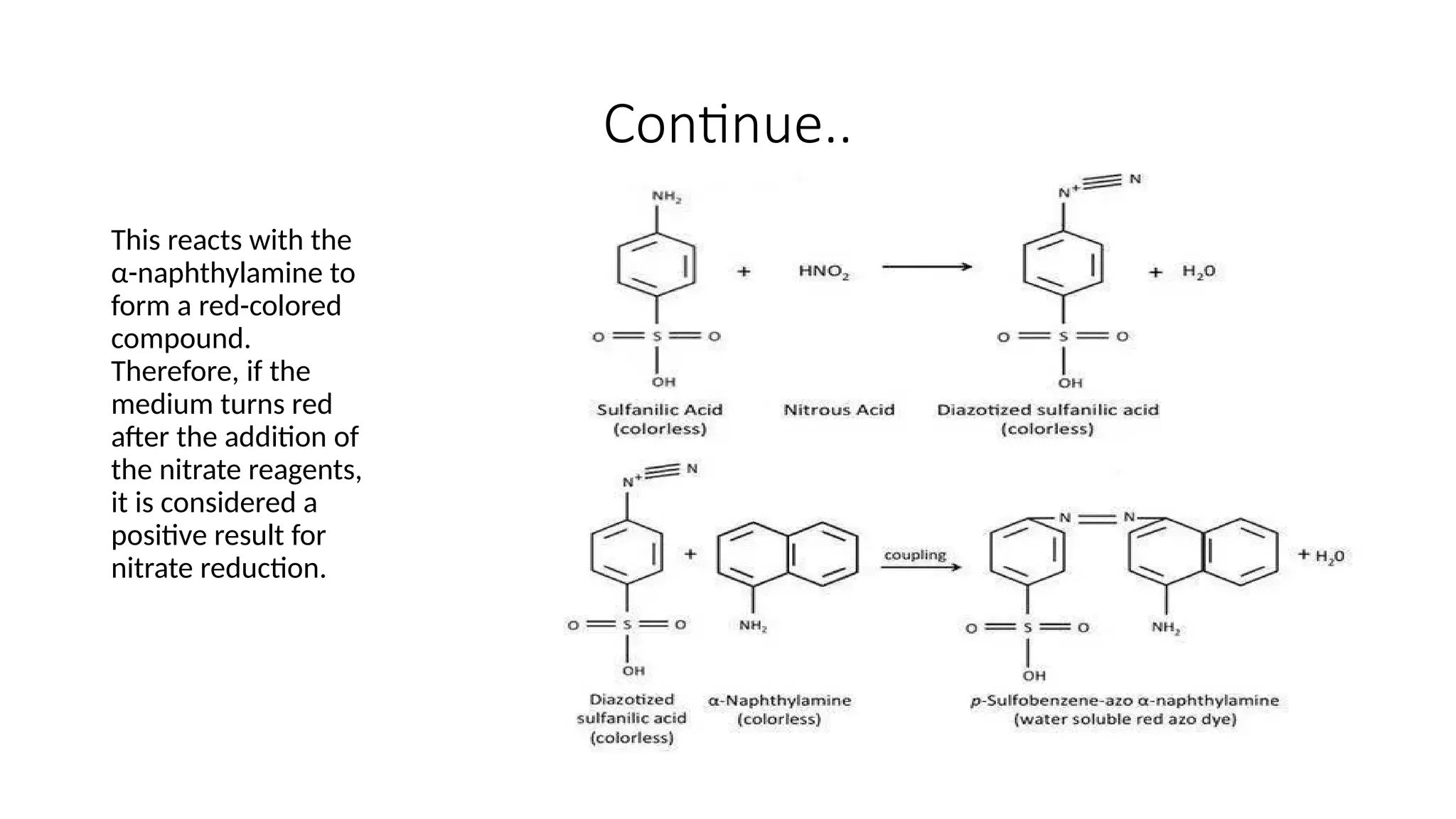
1. If the organism has reduced nitrate to nitrite, the nitrites in the medium will form nitrous acid.
When sulfanilic acid is added, it will react with the nitrous acid to produce diazotized sulfanilic
acid.
Continue..
This reacts with the
α-naphthylamine to
form a red-colored
compound.
Therefore, if the
medium turns red
after the addition of
the nitrate reagents,
it is considered a
positive result for
nitrate reduction.
Continue….
2. If the medium does not turn red after the addition of the reagents, it can mean that the
organism was unable to reduce the nitrate, or the organism was able to denitrify the nitrate or
nitrite to produce ammonia or molecular nitrogen.
3. Therefore, another step is needed in the test. Add a small amount of powdered zinc. If the
tube turns red after the addition of the zinc, it means that unreduced nitrate was present*.
Therefore, the red color on the second step is a negative result.
• The addition of the zinc reduced the nitrate to nitrite, and the nitrite in the medium formed
nitrous acid, which reacted with sulfanilic acid. The diazotized sulfanilic acid that was thereby
produced reacted with the α-naphthylamine to create the red complex.
• If the medium does not turn red after the addition of the zinc powder, then the result is called a
positive complete. If no red color forms, there was no nitrate to reduce. Since there was no nitrite
present in the medium, either, that means that denitrification took place and ammonia or
molecular nitrogen were formed. This kind of reaction is done during aerobic denitrification. The
process starts with nitrate (NO3-) being reduced to nitrite (NO2-), then to nitric oxide (NO), then
to nitrous oxide (N2O), and finally to dinitrogen gas (N2).
Continue…
• Procedure:
• Inoculate nitrate broth with a heavy growth of test organism using an aseptic technique.
• Incubate at an appropriate temperature for 24 to 48 hours
• Add one dropper full of sulfanilic acid and one dropper full of an α-naphthylamine to each broth.
Then observe for the color change. If red color is formed then the test is positive and if red color
is absent, then add small amount of zinc dust and observe for the color change, if the red color
formed then the test is negative.
• If even after addition of zinc the red color does not appear, then the reaction is also consider as
positive.
Result and Interpretation
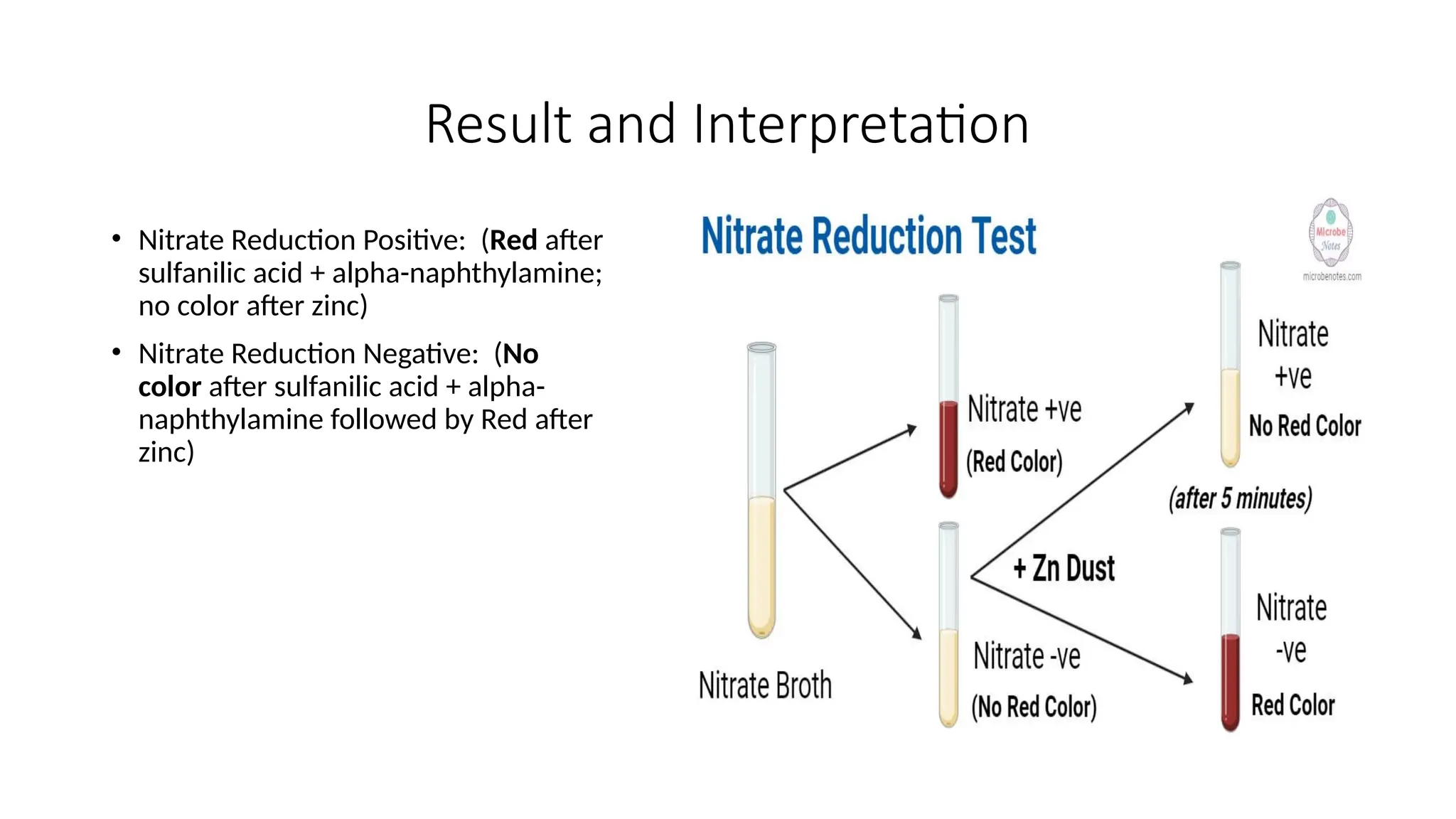
• Nitrate Reduction Positive: (Red after
sulfanilic acid + alpha-naphthylamine;
no color after zinc)
• Nitrate Reduction Negative: (No
color after sulfanilic acid + alpha-
naphthylamine followed by Red after
zinc)
Starch Hydrolysis Test
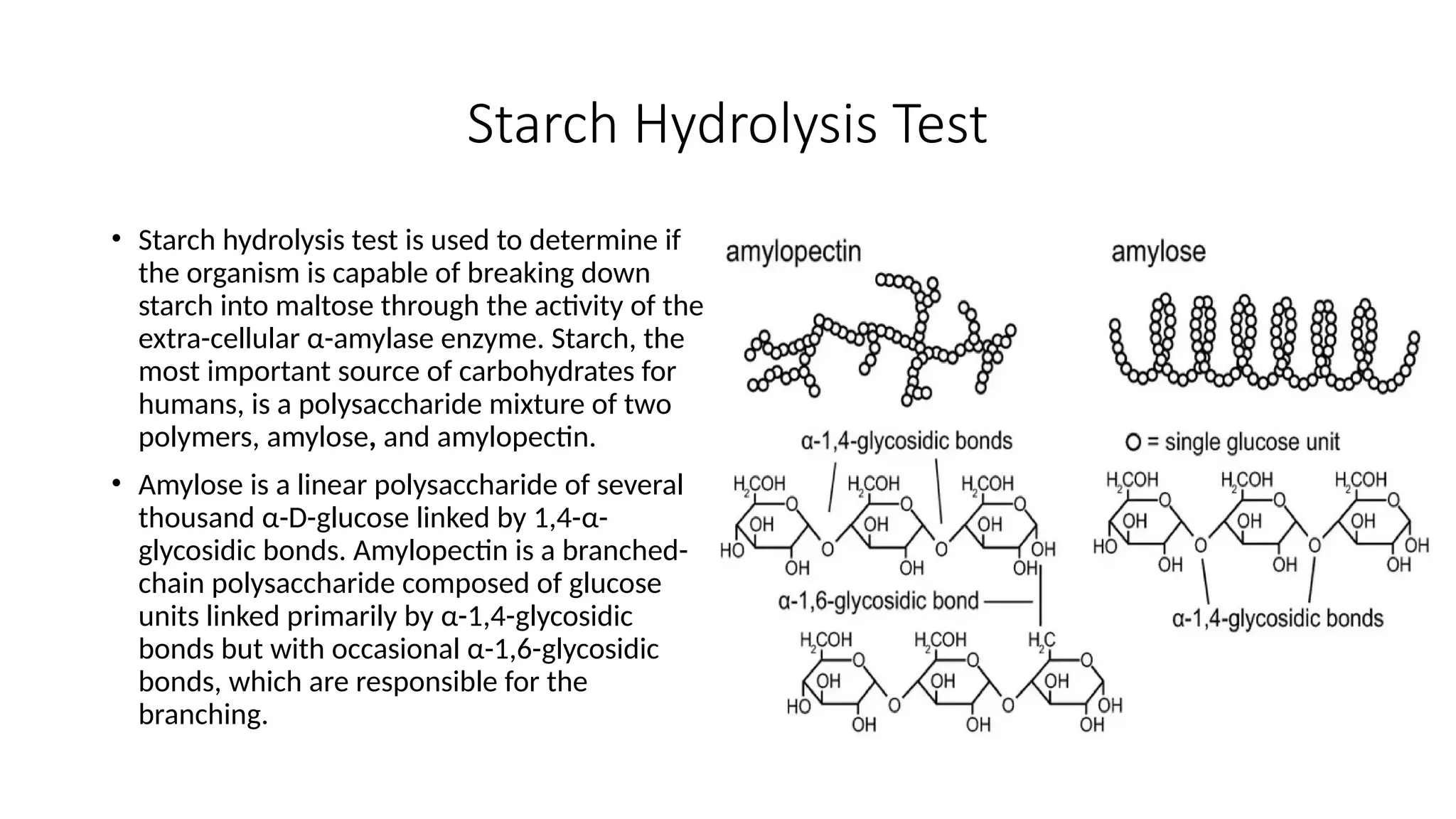
• Starch hydrolysis test is used to determine if
the organism is capable of breaking down
starch into maltose through the activity of the
extra-cellular α-amylase enzyme. Starch, the
most important source of carbohydrates for
humans, is a polysaccharide mixture of two
polymers, amylose, and amylopectin.
• Amylose is a linear polysaccharide of several
thousand α-D-glucose linked by 1,4-α-
glycosidic bonds. Amylopectin is a branched-
chain polysaccharide composed of glucose
units linked primarily by α-1,4-glycosidic
bonds but with occasional α-1,6-glycosidic
bonds, which are responsible for the
branching.
Continue…
Principle:
• Starch molecules are too large to enter the bacterial cell, so only bacteria that secrete exoenzymes
(α -amylase and oligo-1,6-glucosidase) are able to hydrolyze starch into subunits (dextrin, maltose, or
glucose). These molecules are readily transported into the bacterial cell to be used in metabolism.
• In starch hydrolysis test (also known as amylase test), we use starch agar, which is a differential
nutritive medium. The test organisms are inoculated onto a starch plate and incubated at 30°C until
growth is seen (i.e. up to 48 hours). The Petri plate is then flooded with an iodine solution.
• If there is no enzyme present, and therefore no hydrolysis, the amylose, and iodine react together to
form a blue color. Depending on the concentration of the iodine used, iodine turns blue, purple, or
black in the presence of starch.
• When bacteria capable of producing α-amylase and oligo-1,6-glucosidase are grown on starch agar,
they secrete enzymes into the surrounding areas and hydrolyze the starch. As no amylose is present
in the medium surrounding the bacterial colony, clearing around the bacterial growth is seen (there
is no color development).
Continue…
Test Procedure
• Pick a few colonies of the test organism using a sterile swab or loop.
• Streak a starch plate in the form of a line across the width of the plate. Several cultures can be
tested on a single agar plate, each represented by a line or the plate may be divided into four
quadrants for this purpose.
• Incubate plate at 37 °C for 48 hours.
• Add 2-3 drops of 10% iodine solution directly onto the edge of colonies. Wait 10-15 minutes and
record the results. Read plates immediately after the addition of iodine, as the blue color fades.
Result and Interpretation
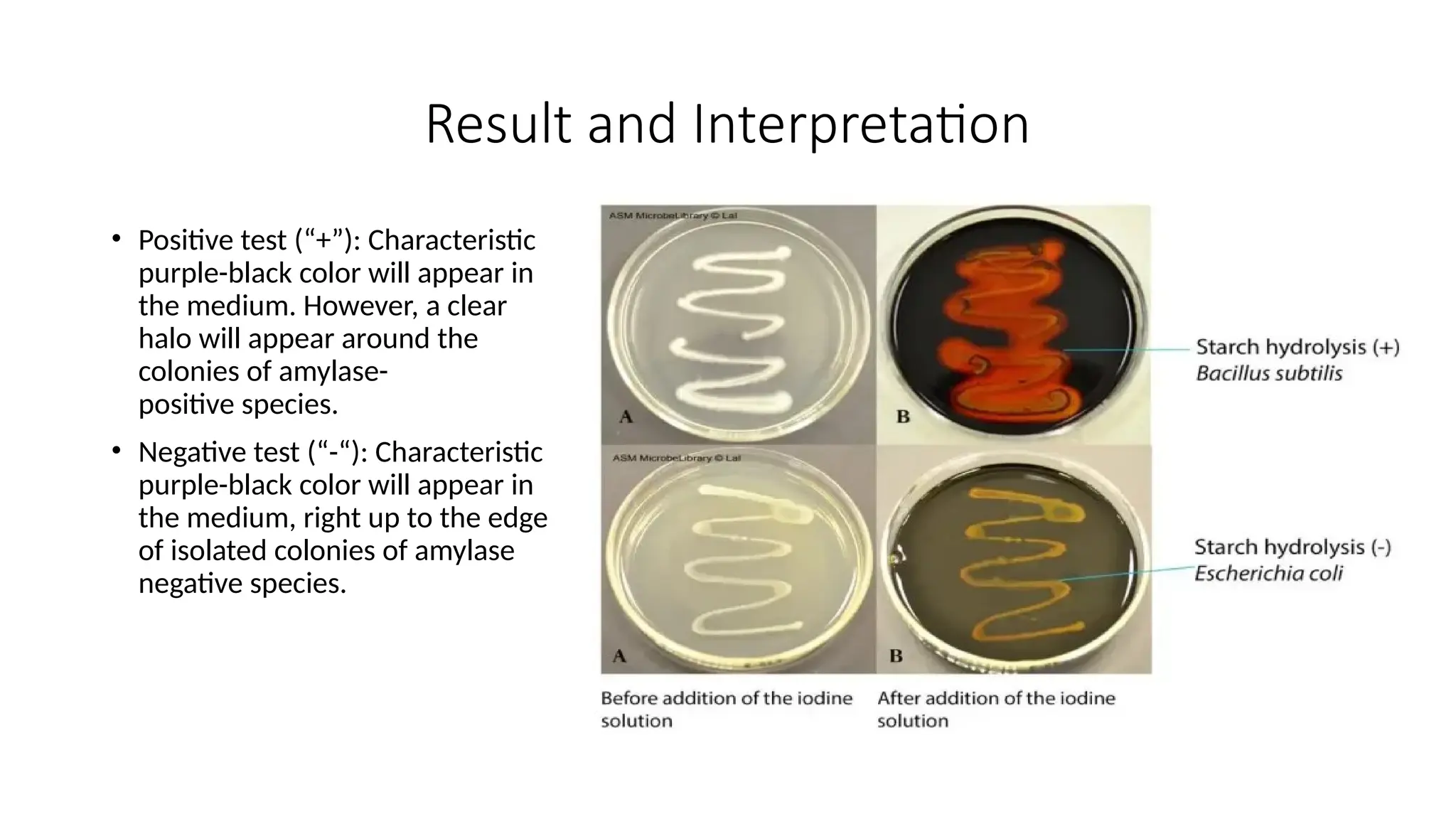
• Positive test (“+”): Characteristic
purple-black color will appear in
the medium. However, a clear
halo will appear around the
colonies of amylase-
positive species.
• Negative test (“-“): Characteristic
purple-black color will appear in
the medium, right up to the edge
of isolated colonies of amylase
negative species.
Biochemical part-4. step wise follow plz

  • 1.
    Biochemical part-4 By: RajuYadav M.Sc. Medical Microbiology
  • 2.
    Nitrate Reduction Test •Nitrate reduction test is used for the differentiation of members of Enterobacteriaceae based on their ability to produce nitrate reductase enzyme that hydrolyzes nitrate (NO3-) to nitrite (NO2-), which may then again be degraded to various nitrogen products like nitrogen oxide, nitrous oxide and ammonia (NH3) depending on the enzyme system of the organism and the atmosphere in which it is growing. • Anaerobic metabolism requires an electron acceptor other than atmospheric oxygen (O2). Many gram-negative bacteria use nitrate as the final electron acceptor. Principle: • Heavy inoculum of test organism is incubated in nitrate broth. After 4 hrs incubation, the broth is tested for reduction of nitrate (NO3 – ) to nitrite (NO2 – ) by adding sulfanilic acid reagent and α- naphthylamine. 1. If the organism has reduced nitrate to nitrite, the nitrites in the medium will form nitrous acid. When sulfanilic acid is added, it will react with the nitrous acid to produce diazotized sulfanilic acid.
  • 3.
    Continue.. This reacts withthe α-naphthylamine to form a red-colored compound. Therefore, if the medium turns red after the addition of the nitrate reagents, it is considered a positive result for nitrate reduction.
  • 4.
    Continue…. 2. If themedium does not turn red after the addition of the reagents, it can mean that the organism was unable to reduce the nitrate, or the organism was able to denitrify the nitrate or nitrite to produce ammonia or molecular nitrogen. 3. Therefore, another step is needed in the test. Add a small amount of powdered zinc. If the tube turns red after the addition of the zinc, it means that unreduced nitrate was present*. Therefore, the red color on the second step is a negative result. • The addition of the zinc reduced the nitrate to nitrite, and the nitrite in the medium formed nitrous acid, which reacted with sulfanilic acid. The diazotized sulfanilic acid that was thereby produced reacted with the α-naphthylamine to create the red complex. • If the medium does not turn red after the addition of the zinc powder, then the result is called a positive complete. If no red color forms, there was no nitrate to reduce. Since there was no nitrite present in the medium, either, that means that denitrification took place and ammonia or molecular nitrogen were formed. This kind of reaction is done during aerobic denitrification. The process starts with nitrate (NO3-) being reduced to nitrite (NO2-), then to nitric oxide (NO), then to nitrous oxide (N2O), and finally to dinitrogen gas (N2).
  • 5.
    Continue… • Procedure: • Inoculatenitrate broth with a heavy growth of test organism using an aseptic technique. • Incubate at an appropriate temperature for 24 to 48 hours • Add one dropper full of sulfanilic acid and one dropper full of an α-naphthylamine to each broth. Then observe for the color change. If red color is formed then the test is positive and if red color is absent, then add small amount of zinc dust and observe for the color change, if the red color formed then the test is negative. • If even after addition of zinc the red color does not appear, then the reaction is also consider as positive.
  • 6.
    Result and Interpretation •Nitrate Reduction Positive: (Red after sulfanilic acid + alpha-naphthylamine; no color after zinc) • Nitrate Reduction Negative: (No color after sulfanilic acid + alpha- naphthylamine followed by Red after zinc)
  • 7.
    Starch Hydrolysis Test •Starch hydrolysis test is used to determine if the organism is capable of breaking down starch into maltose through the activity of the extra-cellular α-amylase enzyme. Starch, the most important source of carbohydrates for humans, is a polysaccharide mixture of two polymers, amylose, and amylopectin. • Amylose is a linear polysaccharide of several thousand α-D-glucose linked by 1,4-α- glycosidic bonds. Amylopectin is a branched- chain polysaccharide composed of glucose units linked primarily by α-1,4-glycosidic bonds but with occasional α-1,6-glycosidic bonds, which are responsible for the branching.
  • 8.
    Continue… Principle: • Starch moleculesare too large to enter the bacterial cell, so only bacteria that secrete exoenzymes (α -amylase and oligo-1,6-glucosidase) are able to hydrolyze starch into subunits (dextrin, maltose, or glucose). These molecules are readily transported into the bacterial cell to be used in metabolism. • In starch hydrolysis test (also known as amylase test), we use starch agar, which is a differential nutritive medium. The test organisms are inoculated onto a starch plate and incubated at 30°C until growth is seen (i.e. up to 48 hours). The Petri plate is then flooded with an iodine solution. • If there is no enzyme present, and therefore no hydrolysis, the amylose, and iodine react together to form a blue color. Depending on the concentration of the iodine used, iodine turns blue, purple, or black in the presence of starch. • When bacteria capable of producing α-amylase and oligo-1,6-glucosidase are grown on starch agar, they secrete enzymes into the surrounding areas and hydrolyze the starch. As no amylose is present in the medium surrounding the bacterial colony, clearing around the bacterial growth is seen (there is no color development).
  • 9.
    Continue… Test Procedure • Picka few colonies of the test organism using a sterile swab or loop. • Streak a starch plate in the form of a line across the width of the plate. Several cultures can be tested on a single agar plate, each represented by a line or the plate may be divided into four quadrants for this purpose. • Incubate plate at 37 °C for 48 hours. • Add 2-3 drops of 10% iodine solution directly onto the edge of colonies. Wait 10-15 minutes and record the results. Read plates immediately after the addition of iodine, as the blue color fades.
  • 10.
    Result and Interpretation •Positive test (“+”): Characteristic purple-black color will appear in the medium. However, a clear halo will appear around the colonies of amylase- positive species. • Negative test (“-“): Characteristic purple-black color will appear in the medium, right up to the edge of isolated colonies of amylase negative species.