Jonah Price
BIG HISTORY
JOURNEY OF MAN
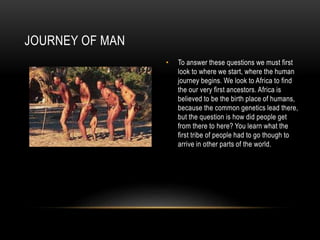
• To answer these questions we must first
look to where we start, where the human
journey begins. We look to Africa to find
the our very first ancestors. Africa is
believed to be the birth place of humans,
because the common genetics lead there,
but the question is how did people get
from there to here? You learn what the
first tribe of people had to go though to
arrive in other parts of the world.
GUNS, GERMS AND STEEL
• How did modern civilization begin?
• Although a growing population is one
reason for increased development
civilization, raw materials are a
necessity to create a modern
civilization. Some civilizations are cut
off from muscular animals such as
Ox and Water Buffalo, but even if
they do have access to another
muscular animal that animal must be
compliant with humans, also the
civilization must have a well
nourishing plant food source. Without
these two key factors a human
society can not develop at as rapid
as other societies.
THE COLUMBIAN EXCHANGE
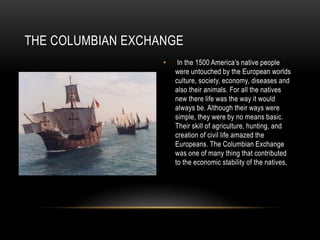
• In the 1500 America’s native people
were untouched by the European worlds
culture, society, economy, diseases and
also their animals. For all the natives
new there life was the way it would
always be. Although their ways were
simple, they were by no means basic.
Their skill of agriculture, hunting, and
creation of civil life amazed the
Europeans. The Columbian Exchange
was one of many thing that contributed
to the economic stability of the natives,
PEOPLES AND EMPIRES
• Major Empires: the Byzantine Empire, the
Catholic Church as Empire, the Spanish
Empire, British Empire, Napoleon's Empire,
and the European Colonial systems into the
20th Century.
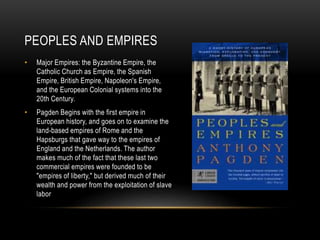
• Pagden Begins with the first empire in
European history, and goes on to examine the
land-based empires of Rome and the
Hapsburgs that gave way to the empires of
England and the Netherlands. The author
makes much of the fact that these last two
commercial empires were founded to be
"empires of liberty," but derived much of their
wealth and power from the exploitation of slave
labor

Mid Term

  • 1.
  • 2.
    JOURNEY OF MAN •To answer these questions we must first look to where we start, where the human journey begins. We look to Africa to find the our very first ancestors. Africa is believed to be the birth place of humans, because the common genetics lead there, but the question is how did people get from there to here? You learn what the first tribe of people had to go though to arrive in other parts of the world.
  • 3.
    GUNS, GERMS ANDSTEEL • How did modern civilization begin? • Although a growing population is one reason for increased development civilization, raw materials are a necessity to create a modern civilization. Some civilizations are cut off from muscular animals such as Ox and Water Buffalo, but even if they do have access to another muscular animal that animal must be compliant with humans, also the civilization must have a well nourishing plant food source. Without these two key factors a human society can not develop at as rapid as other societies.
  • 4.
    THE COLUMBIAN EXCHANGE •In the 1500 America’s native people were untouched by the European worlds culture, society, economy, diseases and also their animals. For all the natives new there life was the way it would always be. Although their ways were simple, they were by no means basic. Their skill of agriculture, hunting, and creation of civil life amazed the Europeans. The Columbian Exchange was one of many thing that contributed to the economic stability of the natives,
  • 5.
    PEOPLES AND EMPIRES •Major Empires: the Byzantine Empire, the Catholic Church as Empire, the Spanish Empire, British Empire, Napoleon's Empire, and the European Colonial systems into the 20th Century. • Pagden Begins with the first empire in European history, and goes on to examine the land-based empires of Rome and the Hapsburgs that gave way to the empires of England and the Netherlands. The author makes much of the fact that these last two commercial empires were founded to be "empires of liberty," but derived much of their wealth and power from the exploitation of slave labor