BIG DATA USE CASES IN
TELCOS
How telcos use Hadoop & Big Data to
derive Business values
Overview
Data is most strategic assets for Communication
Servicer Providers (CSPs)
CSPs have access to unprecedented amounts of
data sources – virtually on goldmine of
information.
In a great position to capitalize on these valuable
data sets and gain insights.
Hence, CSPs are adopting Hadoop and Big Data
Analytics solutions to turn data into valuable
business insights.
Hadoop is used in multiple ways to meet
business objectives such as:
 Operational data store to drive
operational efficiencies -increasing
storage capacity, improving
performance and reducing costs.
 Build specific data applications on
top of Hadoop to drive real-time
analytics and actionable insights.
Overview
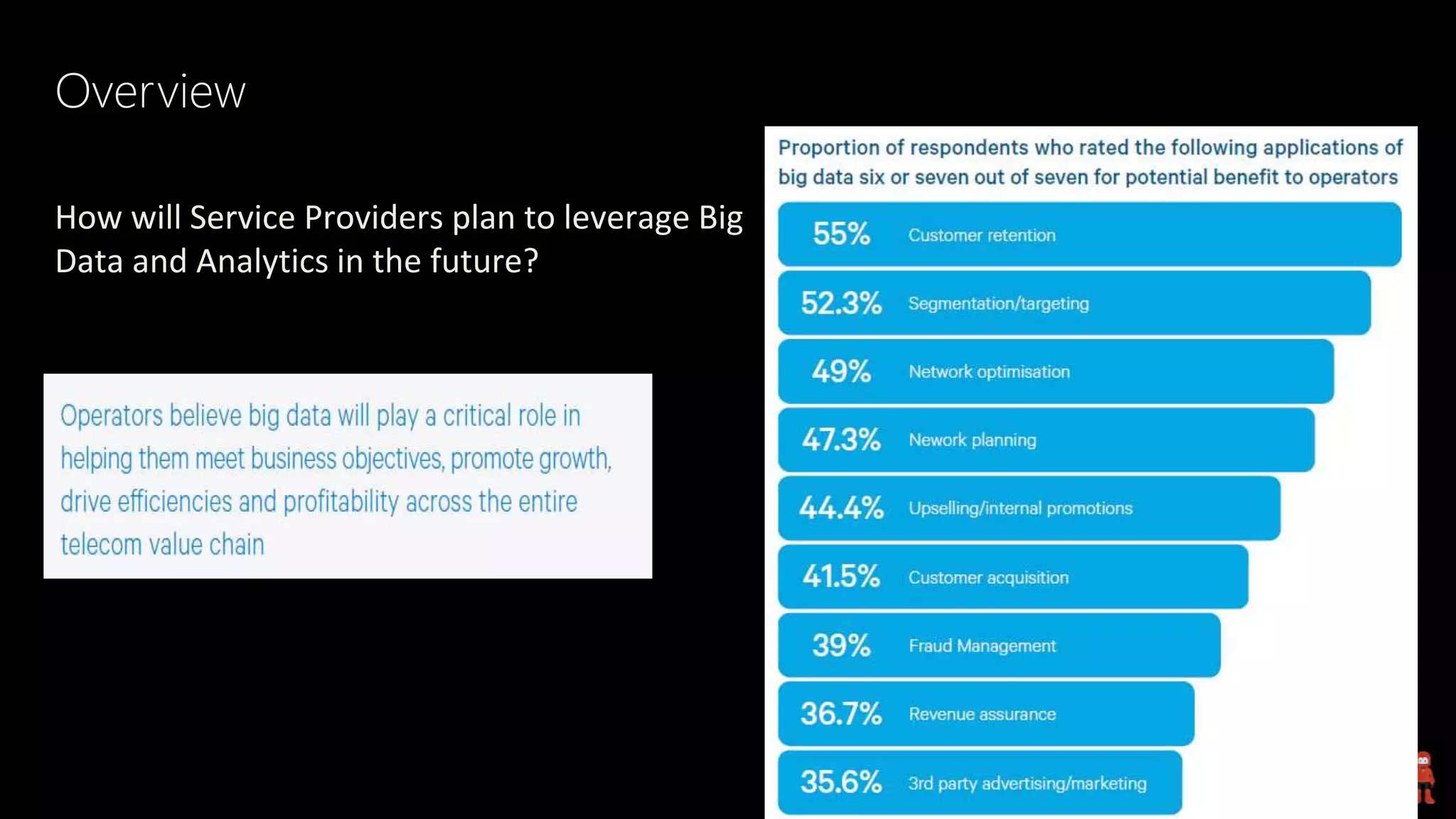
How will Service Providers plan to leverage Big
Data and Analytics in the future?
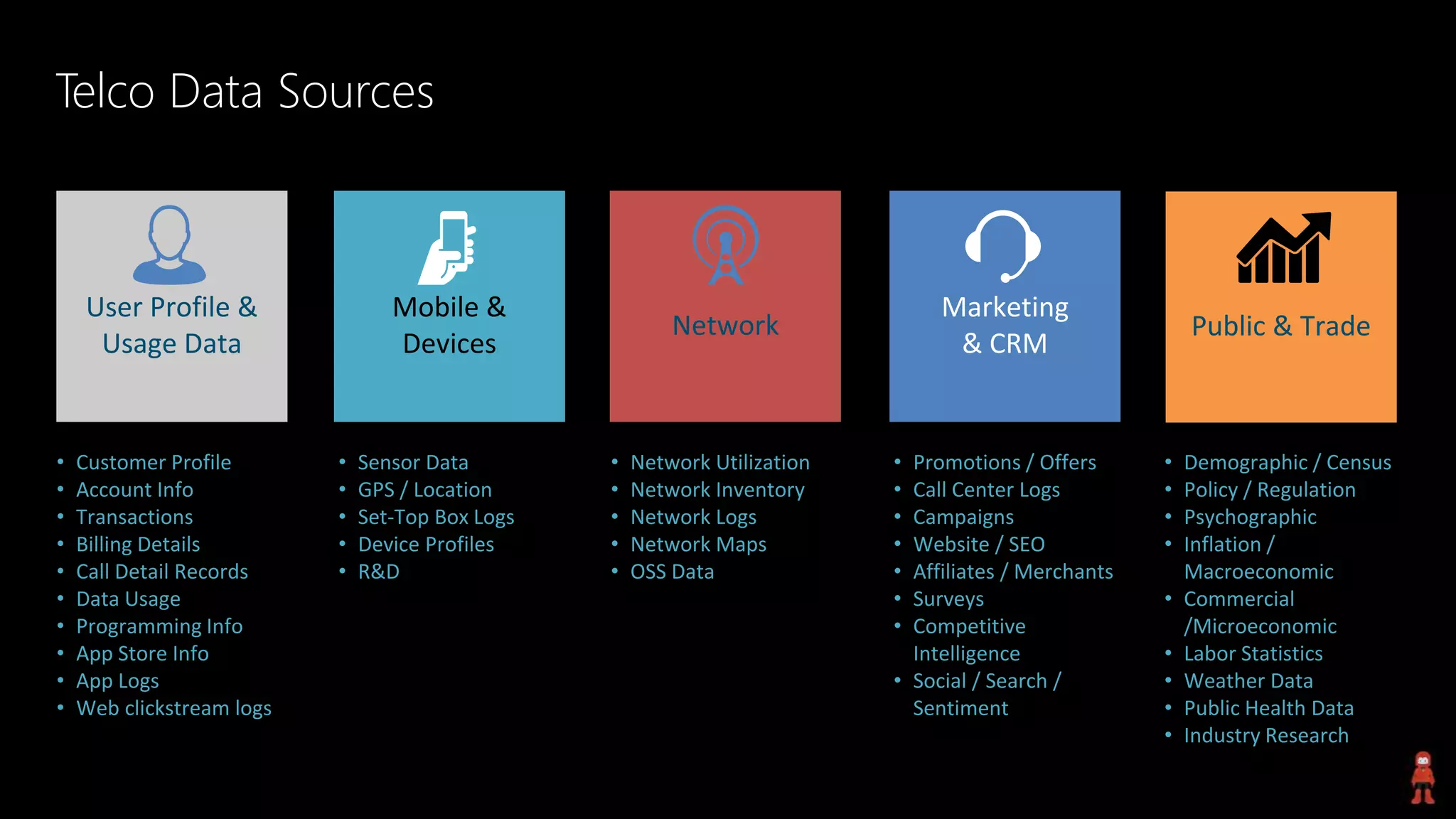
Telco Data Sources
User Profile &
Usage Data
• Customer Profile
• Account Info
• Transactions
• Billing Details
• Call Detail Records
• Data Usage
• Programming Info
• App Store Info
• App Logs
• Web clickstream logs
Mobile &
Devices
• Sensor Data
• GPS / Location
• Set-Top Box Logs
• Device Profiles
• R&D
Network
• Network Utilization
• Network Inventory
• Network Logs
• Network Maps
• OSS Data
Marketing
& CRM
• Promotions / Offers
• Call Center Logs
• Campaigns
• Website / SEO
• Affiliates / Merchants
• Surveys
• Competitive
Intelligence
• Social / Search /
Sentiment
Public & Trade
• Demographic / Census
• Policy / Regulation
• Psychographic
• Inflation /
Macroeconomic
• Commercial
/Microeconomic
• Labor Statistics
• Weather Data
• Public Health Data
• Industry Research
Network
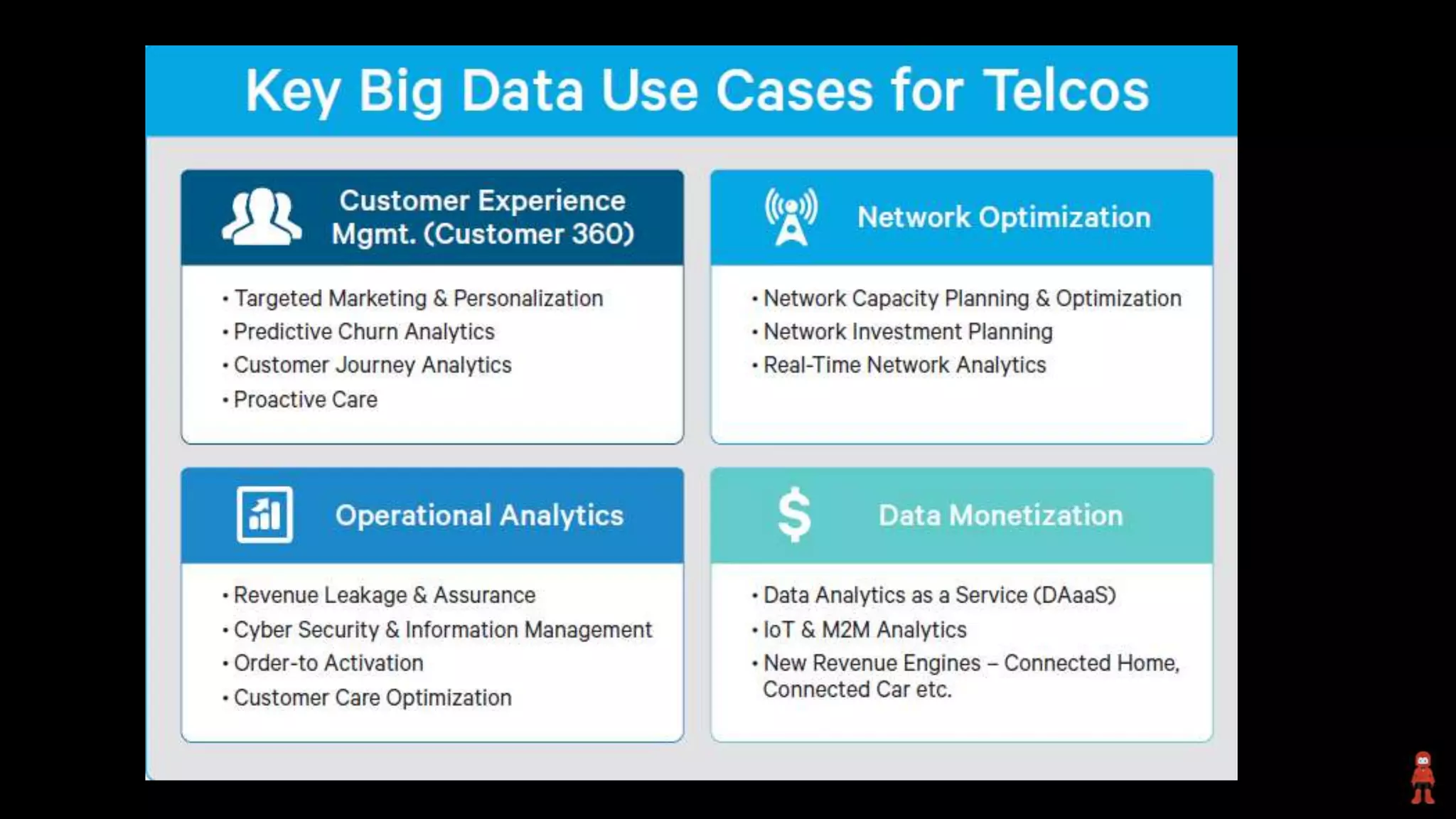
Customer Experience Management (Customer 360)
Improving and optimizing the customer experience is key to maintaining a market
differentiation and driving down churn.
Telcos are leveraging Hadoop and big data analytics to gain a true 360-degree view of their
customers.
Using detailed Customer Profiles, telcos could;
 Do targeted micro-segmentation of their consumer base
 Offer a compelling customer experience
 Develop personalized offer recommendations
 Predict and prevent churn
Targeting Marketing & Personalization
Create targeted customer micro-segments to offer more
personalized offers. For example:
 Personalized data top-up plans or up-sell
recommendations based on data usage device
 Upgrade campaigns based on specific customer
preferences
 Discounts or tailored offers based on recent
purchases or enquiries or calls into the call
center.
Offer personalized product offerings based on;
 Subscriber's usage & device patterns, and
billing data
 Customer support requests and purchase
history
 Buying preferences combined with their
demographic information, location and socio-
economic influences.
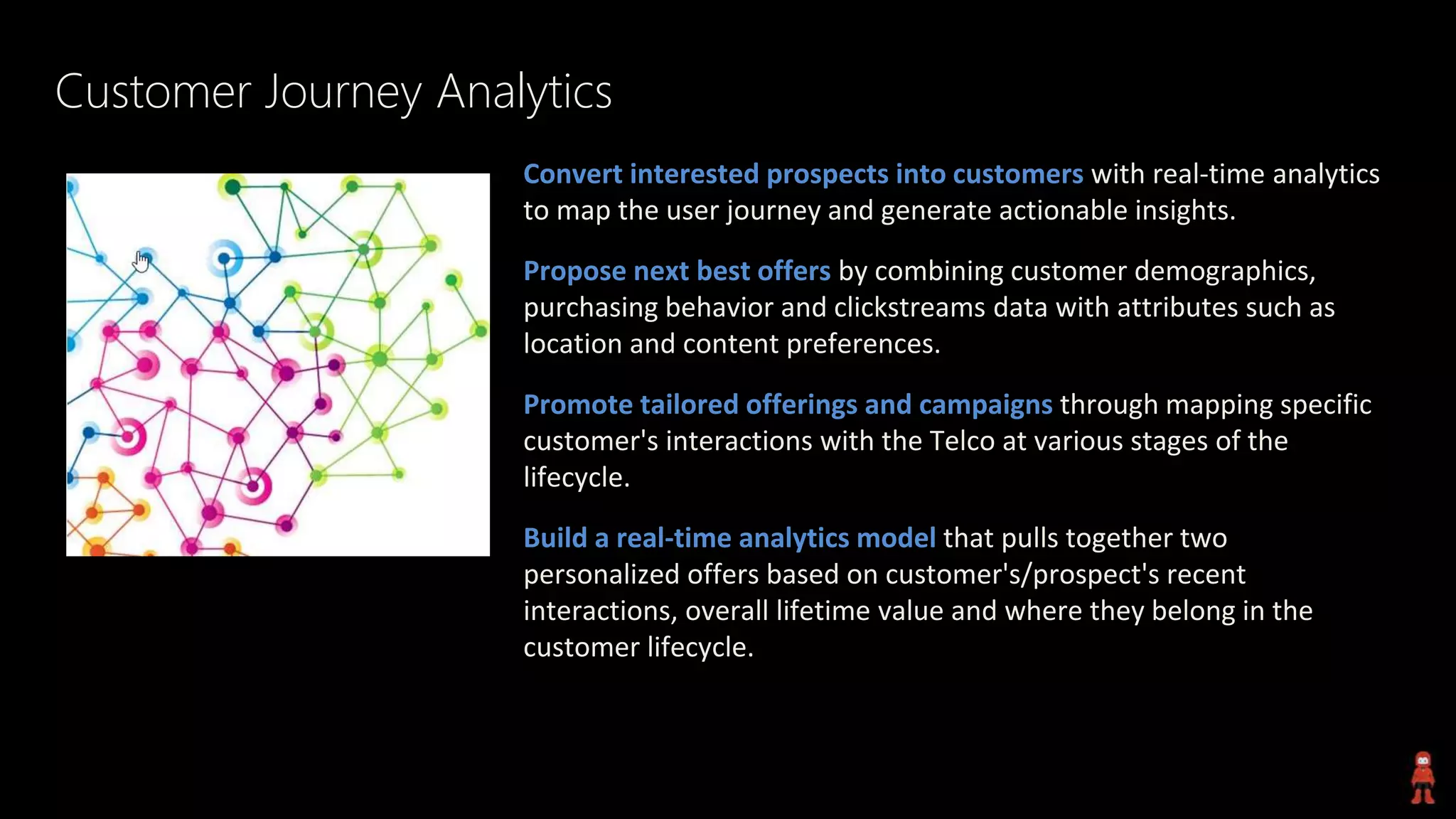
Customer Journey Analytics
Convert interested prospects into customers with real-time analytics
to map the user journey and generate actionable insights.
Propose next best offers by combining customer demographics,
purchasing behavior and clickstreams data with attributes such as
location and content preferences.
Promote tailored offerings and campaigns through mapping specific
customer's interactions with the Telco at various stages of the
lifecycle.
Build a real-time analytics model that pulls together two
personalized offers based on customer's/prospect's recent
interactions, overall lifetime value and where they belong in the
customer lifecycle.
Proactive Care
To provide compelling Customer Experience, telcos are
building intelligence and analytics tools so as to proactively
identify issues and fix it or offer a solution before it impacts
the customer.
Identify and pre-emptively resolve potential issues
Service Providers are proactively fixing issues or reaching out
to customers to help resolve issues before they negatively
impact the experience.
Identify customer experience issues for
their high-value customers and proactively
fix those issues or engage with customers.
Telkomsel, in Indonesia, for example, has built a
proactive dashboard, based on the Cloudera
platform, for their broadband services to
Predictive Churn Analytics
Predict and Prevent Churn
Service Providers are effectively using big data analytics
to bring together various data points including - quality
of service, network performance, subscriber billing
information, details on calls to the care centers, and
social media sentiment analysis to build an effective
model to predict and prevent churn.
Launch retention campaigns
 Identify and address "at risk" customers via
outbound channels.
 Proactively reach out to high value customers,
who have negative experience or who shared
a negative sentiment regarding the service in
social media
 Address such issues and offer them discounts
or service credits to prevent customers from
defecting.
Network Optimization & Analytics
Increasing Capital Expenditure (CAPEX)
To sustain explosive growth in mobile data, CSPs should invest heavily in their networks,
pumping in as much as 18 - 20% of their revenues every year.
Network capacity is a highly valuable resource.
Telcos are starting to leverage big data & analytics to:
 Effectively monitor and manage network capacity
 Build predictive capacity models and use it for prioritizing and planning network
expansion decisions.
Network Capacity Planning & Optimization
Prioritize expansion for new capacity roll out
Using real-time capacity data, CSP's can visualize and
pinpoint highly congested areas where network usage is
nearing its capacity thresholds.
Increase uptake in excess network capacity areas
CSPs can plan on running specific customer campaigns or
promotions to increase network utilization.
Based on real-time traffic analytics CSPs can;
 Develop predictive capacity forecasting
models
 Track actual versus forecasted traffic to fine-
tune the model
 Plan for supplemental capacity in case of
outages.
Save millions of dollars by effectively optimizing and
utilizing network capacity.
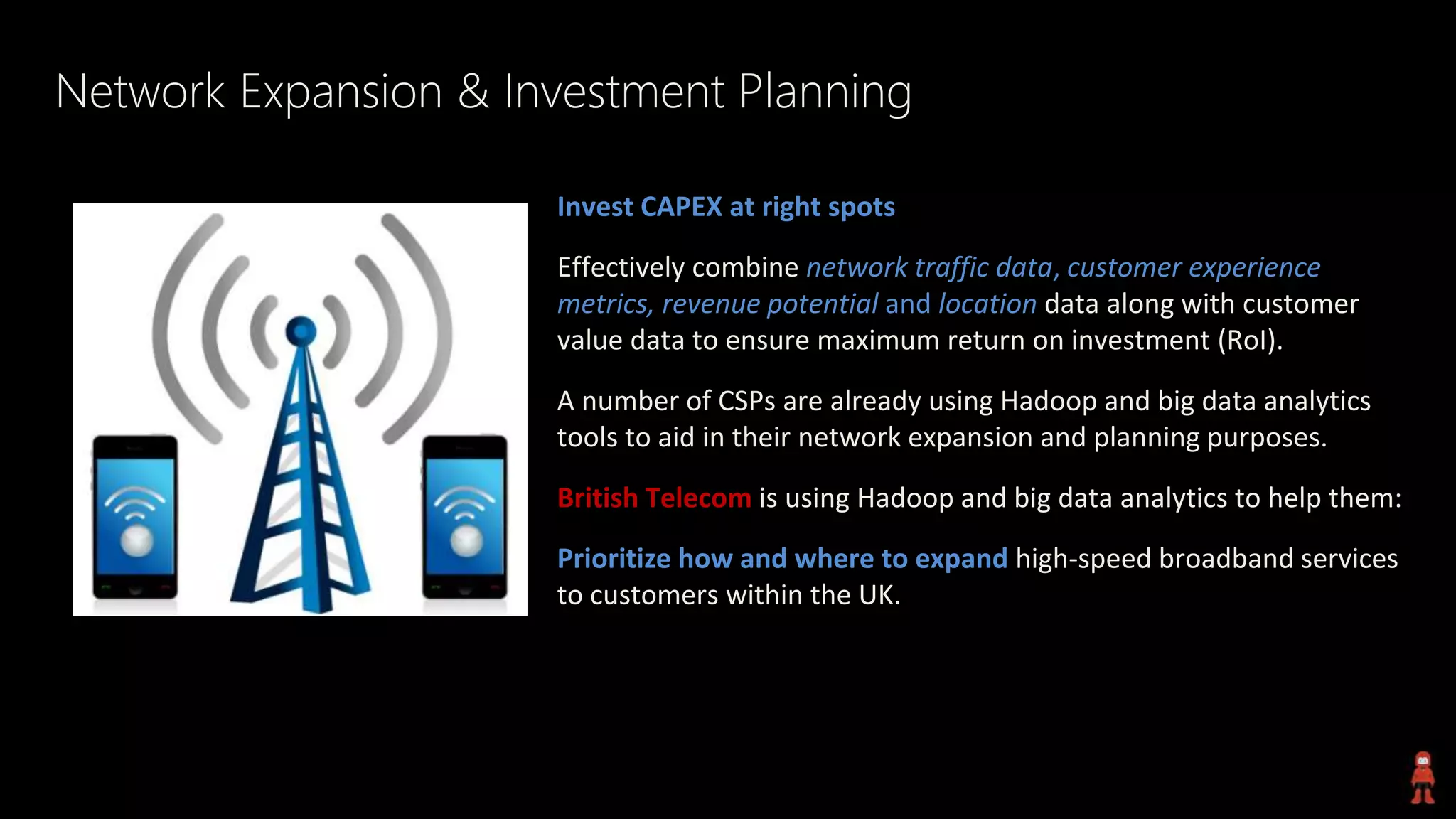
Network Expansion & Investment Planning
Invest CAPEX at right spots
Effectively combine network traffic data, customer experience
metrics, revenue potential and location data along with customer
value data to ensure maximum return on investment (RoI).
A number of CSPs are already using Hadoop and big data analytics
tools to aid in their network expansion and planning purposes.
British Telecom is using Hadoop and big data analytics to help them:
Prioritize how and where to expand high-speed broadband services
to customers within the UK.
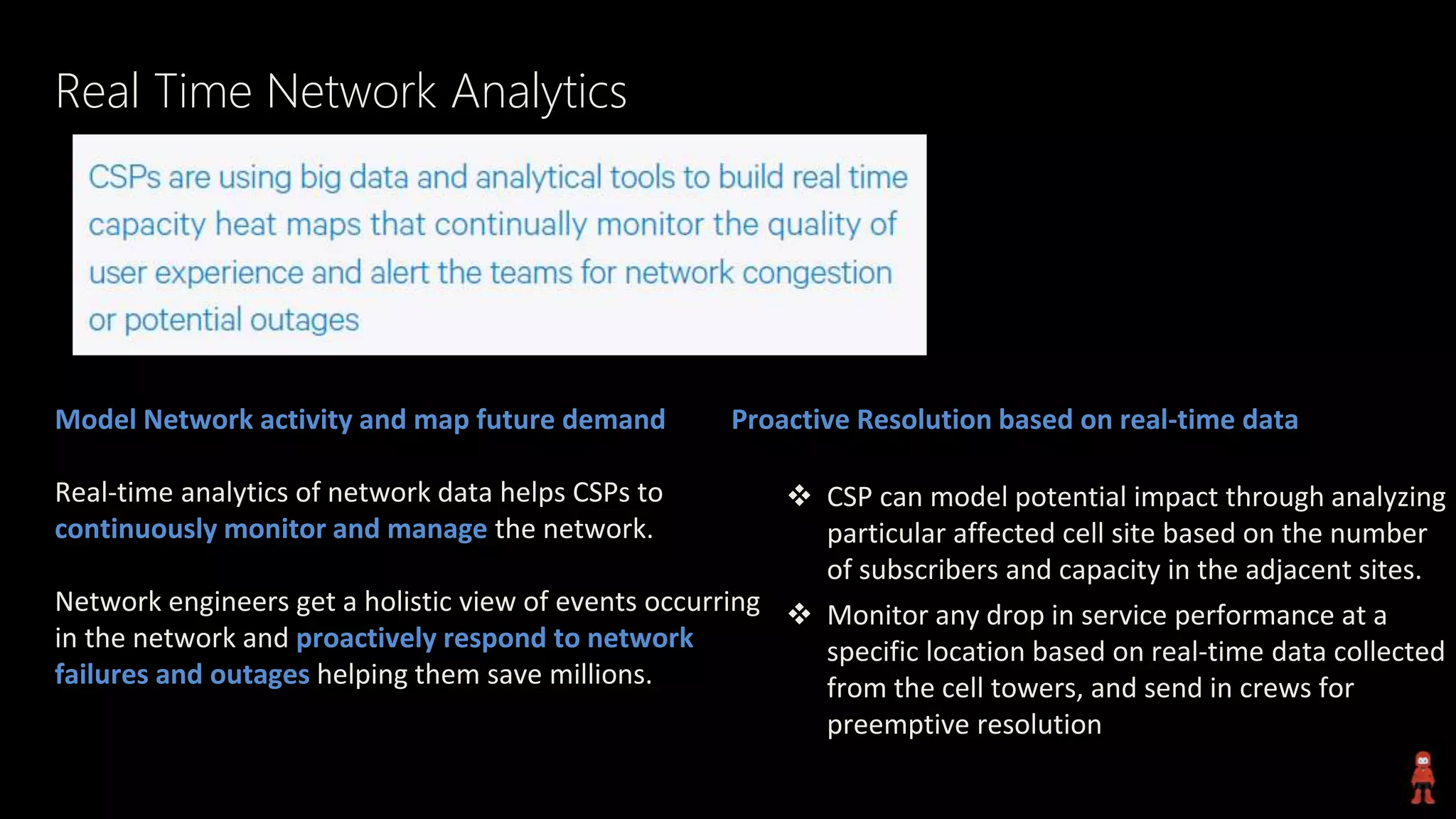
Real Time Network Analytics
Model Network activity and map future demand
Real-time analytics of network data helps CSPs to
continuously monitor and manage the network.
Network engineers get a holistic view of events occurring
in the network and proactively respond to network
failures and outages helping them save millions.
Proactive Resolution based on real-time data
 CSP can model potential impact through analyzing
particular affected cell site based on the number
of subscribers and capacity in the adjacent sites.
 Monitor any drop in service performance at a
specific location based on real-time data collected
from the cell towers, and send in crews for
preemptive resolution
Telco Operational Analytics
Augment internal Telco operations
Use Big Data to drive core Telco operations to;
 Enhance internal efficiencies
 Influence process improvements
 Implement cost saving measures
Telcos are adopting Big Data solutions powered by Hadoop to;
 Plug and minimize revenue leakage,
 Manage network and cyber security
 Drive down order-to-activation lead-times
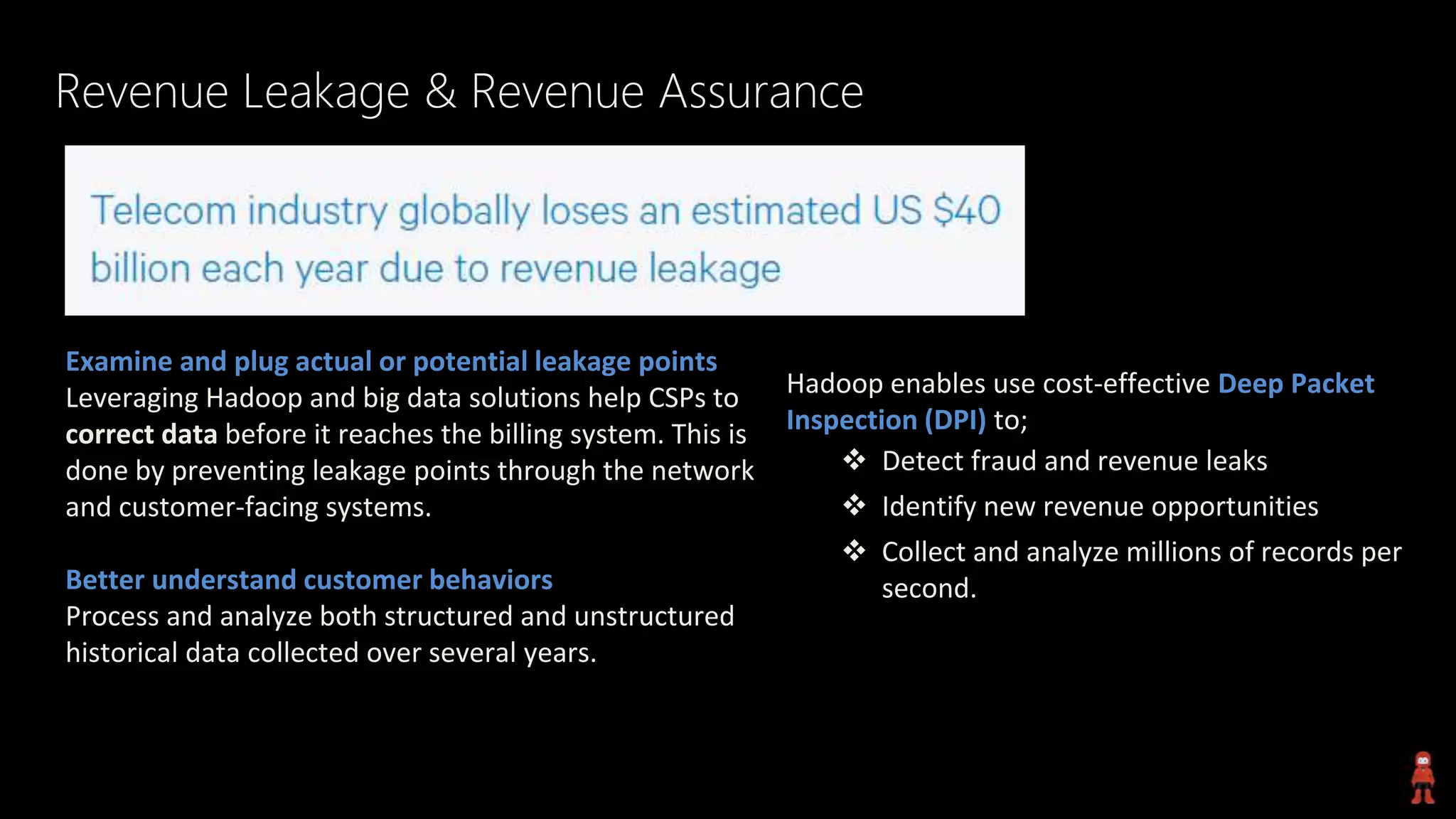
Revenue Leakage & Revenue Assurance
Examine and plug actual or potential leakage points
Leveraging Hadoop and big data solutions help CSPs to
correct data before it reaches the billing system. This is
done by preventing leakage points through the network
and customer-facing systems.
Better understand customer behaviors
Process and analyze both structured and unstructured
historical data collected over several years.
Hadoop enables use cost-effective Deep Packet
Inspection (DPI) to;
 Detect fraud and revenue leaks
 Identify new revenue opportunities
 Collect and analyze millions of records per
second.
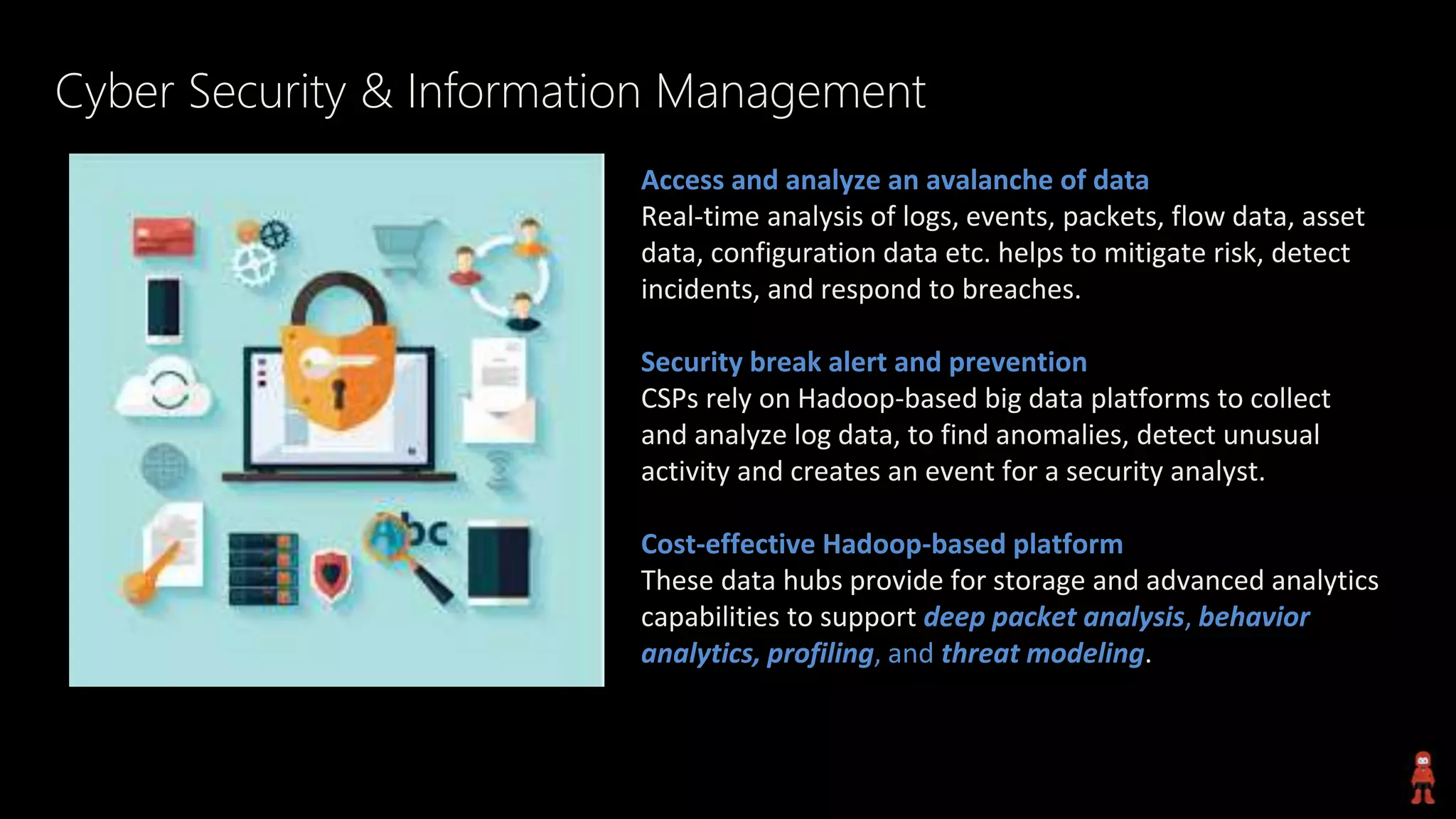
Cyber Security & Information Management
Access and analyze an avalanche of data
Real-time analysis of logs, events, packets, flow data, asset
data, configuration data etc. helps to mitigate risk, detect
incidents, and respond to breaches.
Security break alert and prevention
CSPs rely on Hadoop-based big data platforms to collect
and analyze log data, to find anomalies, detect unusual
activity and creates an event for a security analyst.
Cost-effective Hadoop-based platform
These data hubs provide for storage and advanced analytics
capabilities to support deep packet analysis, behavior
analytics, profiling, and threat modeling.
Data Monetization
CSPs have unique advantage to access valuable data sources such as;
 Devise
 Application usage
 Preferences etc.
 Subscriber demographics
 Subscriber location
 Network usage
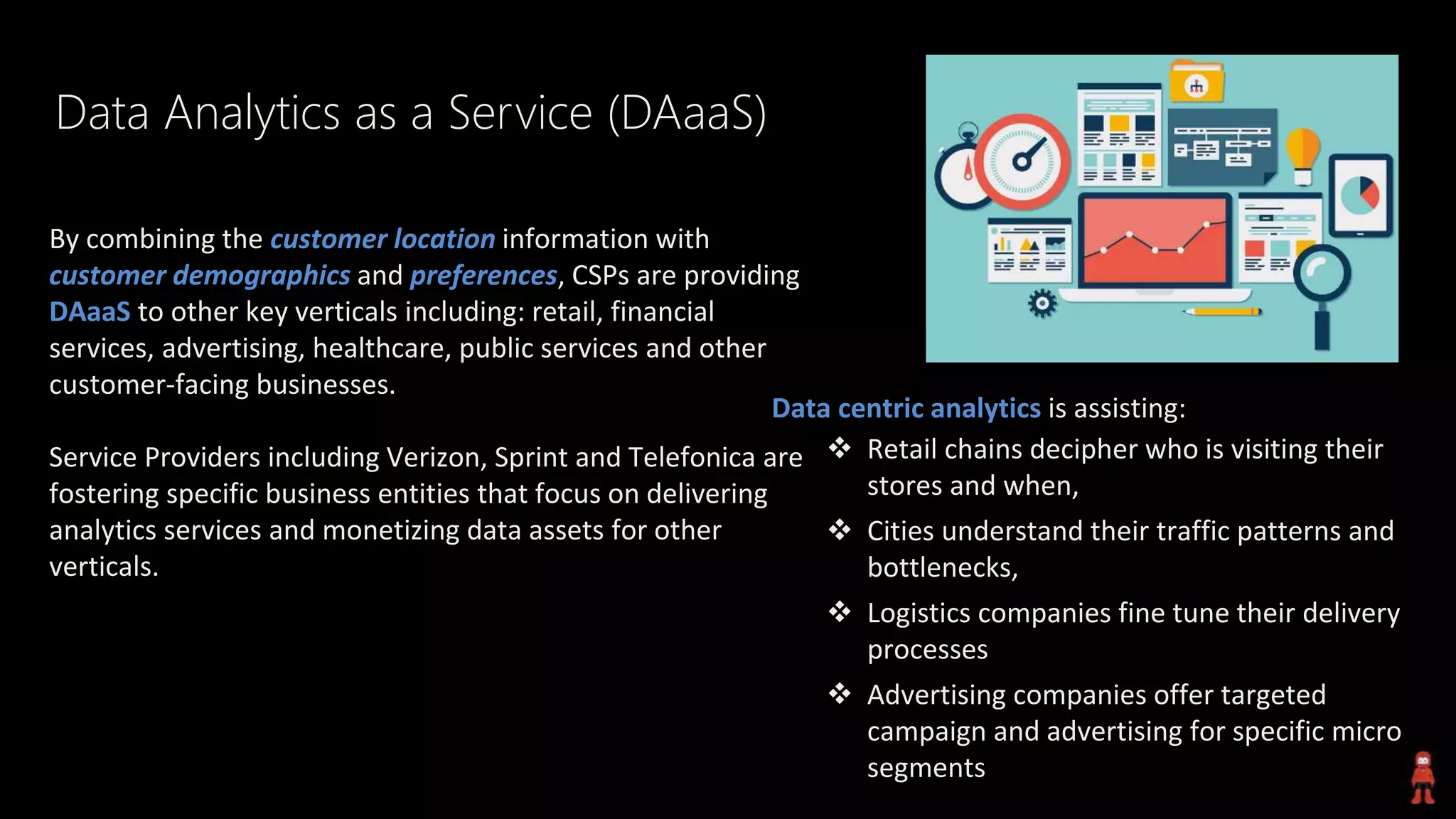
Data Analytics as a Service (DAaaS)
By combining the customer location information with
customer demographics and preferences, CSPs are providing
DAaaS to other key verticals including: retail, financial
services, advertising, healthcare, public services and other
customer-facing businesses.
Service Providers including Verizon, Sprint and Telefonica are
fostering specific business entities that focus on delivering
analytics services and monetizing data assets for other
verticals.
Data centric analytics is assisting:
 Retail chains decipher who is visiting their
stores and when,
 Cities understand their traffic patterns and
bottlenecks,
 Logistics companies fine tune their delivery
processes
 Advertising companies offer targeted
campaign and advertising for specific micro
segments
Internet of Things (IoT) & Machine-to-Machine (M2M) Analytics
CSPs could play a dominant role across the value chain
from collecting the streaming data, to processing, storing,
analyzing and serving intelligence back to their end
customers.
Enrich Data and valuable insights
Provide valuable insights to the enterprise verticals by
adding location based and geo-spatial elements to the
streaming data to enrich the insights of incoming data.
Data Integrators and Aggregators
Provide security through encryption and analytics to
petabytes of data streaming in multiple formats in real-
time from sensors across multiple geographies
CSPs are leveraging Hadoop as the ideal platform to
collect, store, secure, manage and analyze data sets
in real-time.
CSPs are now driving the evolution of key loT concepts
including connected homes, connected cars, e-health
and smart cities
thank you

Big Data use cases in telcos

  • 1.
    BIG DATA USECASES IN TELCOS How telcos use Hadoop & Big Data to derive Business values
  • 2.
    Overview Data is moststrategic assets for Communication Servicer Providers (CSPs) CSPs have access to unprecedented amounts of data sources – virtually on goldmine of information. In a great position to capitalize on these valuable data sets and gain insights. Hence, CSPs are adopting Hadoop and Big Data Analytics solutions to turn data into valuable business insights. Hadoop is used in multiple ways to meet business objectives such as:  Operational data store to drive operational efficiencies -increasing storage capacity, improving performance and reducing costs.  Build specific data applications on top of Hadoop to drive real-time analytics and actionable insights.
  • 3.
    Overview How will ServiceProviders plan to leverage Big Data and Analytics in the future?
  • 4.
    Telco Data Sources UserProfile & Usage Data • Customer Profile • Account Info • Transactions • Billing Details • Call Detail Records • Data Usage • Programming Info • App Store Info • App Logs • Web clickstream logs Mobile & Devices • Sensor Data • GPS / Location • Set-Top Box Logs • Device Profiles • R&D Network • Network Utilization • Network Inventory • Network Logs • Network Maps • OSS Data Marketing & CRM • Promotions / Offers • Call Center Logs • Campaigns • Website / SEO • Affiliates / Merchants • Surveys • Competitive Intelligence • Social / Search / Sentiment Public & Trade • Demographic / Census • Policy / Regulation • Psychographic • Inflation / Macroeconomic • Commercial /Microeconomic • Labor Statistics • Weather Data • Public Health Data • Industry Research Network
  • 6.
    Customer Experience Management(Customer 360) Improving and optimizing the customer experience is key to maintaining a market differentiation and driving down churn. Telcos are leveraging Hadoop and big data analytics to gain a true 360-degree view of their customers. Using detailed Customer Profiles, telcos could;  Do targeted micro-segmentation of their consumer base  Offer a compelling customer experience  Develop personalized offer recommendations  Predict and prevent churn
  • 7.
    Targeting Marketing &Personalization Create targeted customer micro-segments to offer more personalized offers. For example:  Personalized data top-up plans or up-sell recommendations based on data usage device  Upgrade campaigns based on specific customer preferences  Discounts or tailored offers based on recent purchases or enquiries or calls into the call center. Offer personalized product offerings based on;  Subscriber's usage & device patterns, and billing data  Customer support requests and purchase history  Buying preferences combined with their demographic information, location and socio- economic influences.
  • 8.
    Customer Journey Analytics Convertinterested prospects into customers with real-time analytics to map the user journey and generate actionable insights. Propose next best offers by combining customer demographics, purchasing behavior and clickstreams data with attributes such as location and content preferences. Promote tailored offerings and campaigns through mapping specific customer's interactions with the Telco at various stages of the lifecycle. Build a real-time analytics model that pulls together two personalized offers based on customer's/prospect's recent interactions, overall lifetime value and where they belong in the customer lifecycle.
  • 9.
    Proactive Care To providecompelling Customer Experience, telcos are building intelligence and analytics tools so as to proactively identify issues and fix it or offer a solution before it impacts the customer. Identify and pre-emptively resolve potential issues Service Providers are proactively fixing issues or reaching out to customers to help resolve issues before they negatively impact the experience. Identify customer experience issues for their high-value customers and proactively fix those issues or engage with customers. Telkomsel, in Indonesia, for example, has built a proactive dashboard, based on the Cloudera platform, for their broadband services to
  • 10.
    Predictive Churn Analytics Predictand Prevent Churn Service Providers are effectively using big data analytics to bring together various data points including - quality of service, network performance, subscriber billing information, details on calls to the care centers, and social media sentiment analysis to build an effective model to predict and prevent churn. Launch retention campaigns  Identify and address "at risk" customers via outbound channels.  Proactively reach out to high value customers, who have negative experience or who shared a negative sentiment regarding the service in social media  Address such issues and offer them discounts or service credits to prevent customers from defecting.
  • 11.
    Network Optimization &Analytics Increasing Capital Expenditure (CAPEX) To sustain explosive growth in mobile data, CSPs should invest heavily in their networks, pumping in as much as 18 - 20% of their revenues every year. Network capacity is a highly valuable resource. Telcos are starting to leverage big data & analytics to:  Effectively monitor and manage network capacity  Build predictive capacity models and use it for prioritizing and planning network expansion decisions.
  • 12.
    Network Capacity Planning& Optimization Prioritize expansion for new capacity roll out Using real-time capacity data, CSP's can visualize and pinpoint highly congested areas where network usage is nearing its capacity thresholds. Increase uptake in excess network capacity areas CSPs can plan on running specific customer campaigns or promotions to increase network utilization. Based on real-time traffic analytics CSPs can;  Develop predictive capacity forecasting models  Track actual versus forecasted traffic to fine- tune the model  Plan for supplemental capacity in case of outages. Save millions of dollars by effectively optimizing and utilizing network capacity.
  • 13.
    Network Expansion &Investment Planning Invest CAPEX at right spots Effectively combine network traffic data, customer experience metrics, revenue potential and location data along with customer value data to ensure maximum return on investment (RoI). A number of CSPs are already using Hadoop and big data analytics tools to aid in their network expansion and planning purposes. British Telecom is using Hadoop and big data analytics to help them: Prioritize how and where to expand high-speed broadband services to customers within the UK.
  • 14.
    Real Time NetworkAnalytics Model Network activity and map future demand Real-time analytics of network data helps CSPs to continuously monitor and manage the network. Network engineers get a holistic view of events occurring in the network and proactively respond to network failures and outages helping them save millions. Proactive Resolution based on real-time data  CSP can model potential impact through analyzing particular affected cell site based on the number of subscribers and capacity in the adjacent sites.  Monitor any drop in service performance at a specific location based on real-time data collected from the cell towers, and send in crews for preemptive resolution
  • 15.
    Telco Operational Analytics Augmentinternal Telco operations Use Big Data to drive core Telco operations to;  Enhance internal efficiencies  Influence process improvements  Implement cost saving measures Telcos are adopting Big Data solutions powered by Hadoop to;  Plug and minimize revenue leakage,  Manage network and cyber security  Drive down order-to-activation lead-times
  • 16.
    Revenue Leakage &Revenue Assurance Examine and plug actual or potential leakage points Leveraging Hadoop and big data solutions help CSPs to correct data before it reaches the billing system. This is done by preventing leakage points through the network and customer-facing systems. Better understand customer behaviors Process and analyze both structured and unstructured historical data collected over several years. Hadoop enables use cost-effective Deep Packet Inspection (DPI) to;  Detect fraud and revenue leaks  Identify new revenue opportunities  Collect and analyze millions of records per second.
  • 17.
    Cyber Security &Information Management Access and analyze an avalanche of data Real-time analysis of logs, events, packets, flow data, asset data, configuration data etc. helps to mitigate risk, detect incidents, and respond to breaches. Security break alert and prevention CSPs rely on Hadoop-based big data platforms to collect and analyze log data, to find anomalies, detect unusual activity and creates an event for a security analyst. Cost-effective Hadoop-based platform These data hubs provide for storage and advanced analytics capabilities to support deep packet analysis, behavior analytics, profiling, and threat modeling.
  • 18.
    Data Monetization CSPs haveunique advantage to access valuable data sources such as;  Devise  Application usage  Preferences etc.  Subscriber demographics  Subscriber location  Network usage
  • 19.
    Data Analytics asa Service (DAaaS) By combining the customer location information with customer demographics and preferences, CSPs are providing DAaaS to other key verticals including: retail, financial services, advertising, healthcare, public services and other customer-facing businesses. Service Providers including Verizon, Sprint and Telefonica are fostering specific business entities that focus on delivering analytics services and monetizing data assets for other verticals. Data centric analytics is assisting:  Retail chains decipher who is visiting their stores and when,  Cities understand their traffic patterns and bottlenecks,  Logistics companies fine tune their delivery processes  Advertising companies offer targeted campaign and advertising for specific micro segments
  • 20.
    Internet of Things(IoT) & Machine-to-Machine (M2M) Analytics CSPs could play a dominant role across the value chain from collecting the streaming data, to processing, storing, analyzing and serving intelligence back to their end customers. Enrich Data and valuable insights Provide valuable insights to the enterprise verticals by adding location based and geo-spatial elements to the streaming data to enrich the insights of incoming data. Data Integrators and Aggregators Provide security through encryption and analytics to petabytes of data streaming in multiple formats in real- time from sensors across multiple geographies CSPs are leveraging Hadoop as the ideal platform to collect, store, secure, manage and analyze data sets in real-time. CSPs are now driving the evolution of key loT concepts including connected homes, connected cars, e-health and smart cities
  • 21.