BIG DATA
A Competitive Landscape Overview
Bisakha Praharaj
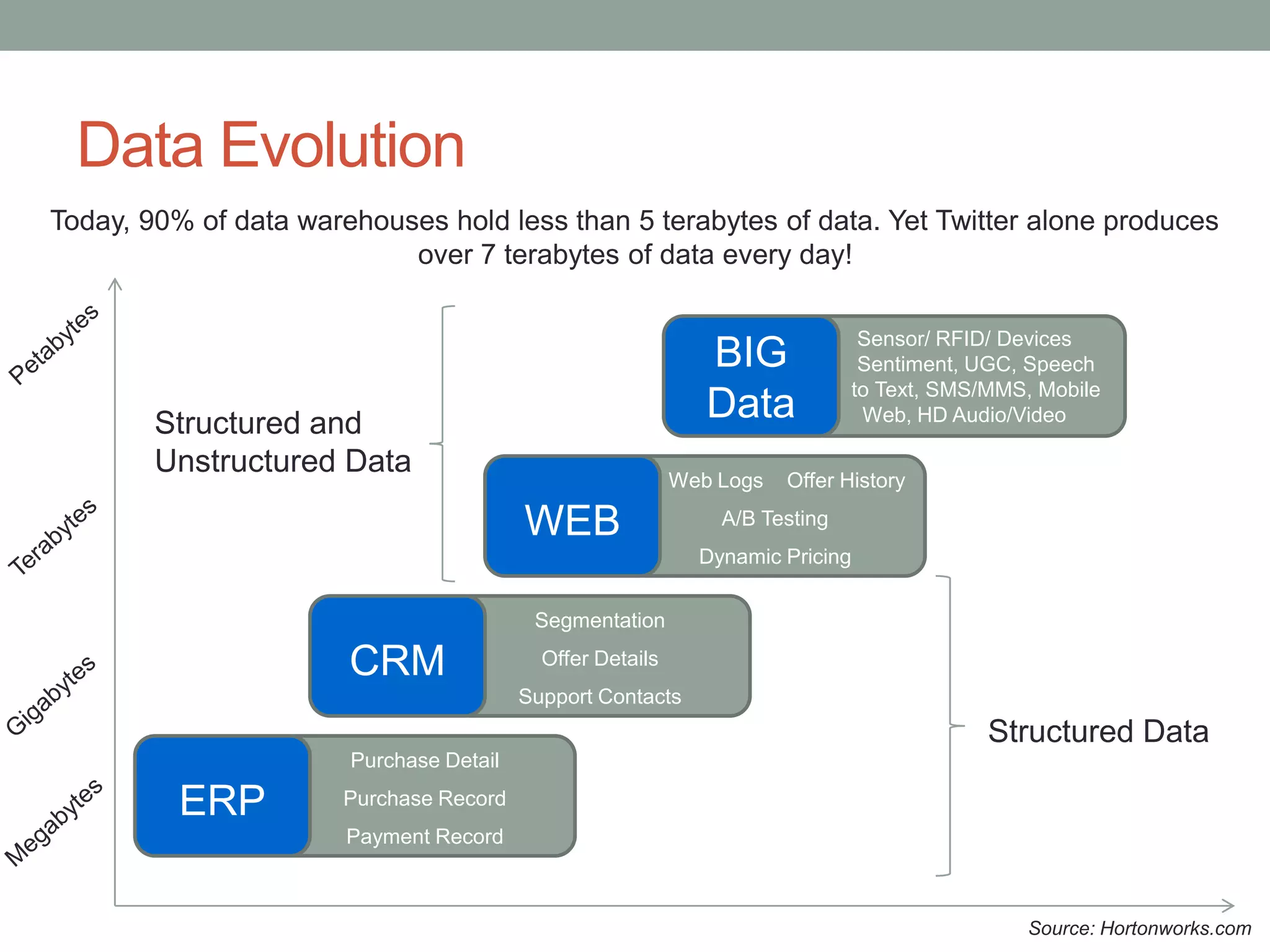
Data Evolution
Purchase Detail
Purchase Record
Payment Record
ERP
Segmentation
Offer Details
Support Contacts
CRM
Web Logs Offer History
A/B Testing
Dynamic Pricing
WEB
Sensor/ RFID/ Devices
Sentiment, UGC, Speech
to Text, SMS/MMS, Mobile
Web, HD Audio/Video
BIG
Data
Structured Data
Structured and
Unstructured Data
Source: Hortonworks.com
Today, 90% of data warehouses hold less than 5 terabytes of data. Yet Twitter alone produces
over 7 terabytes of data every day!
What is Big Data?
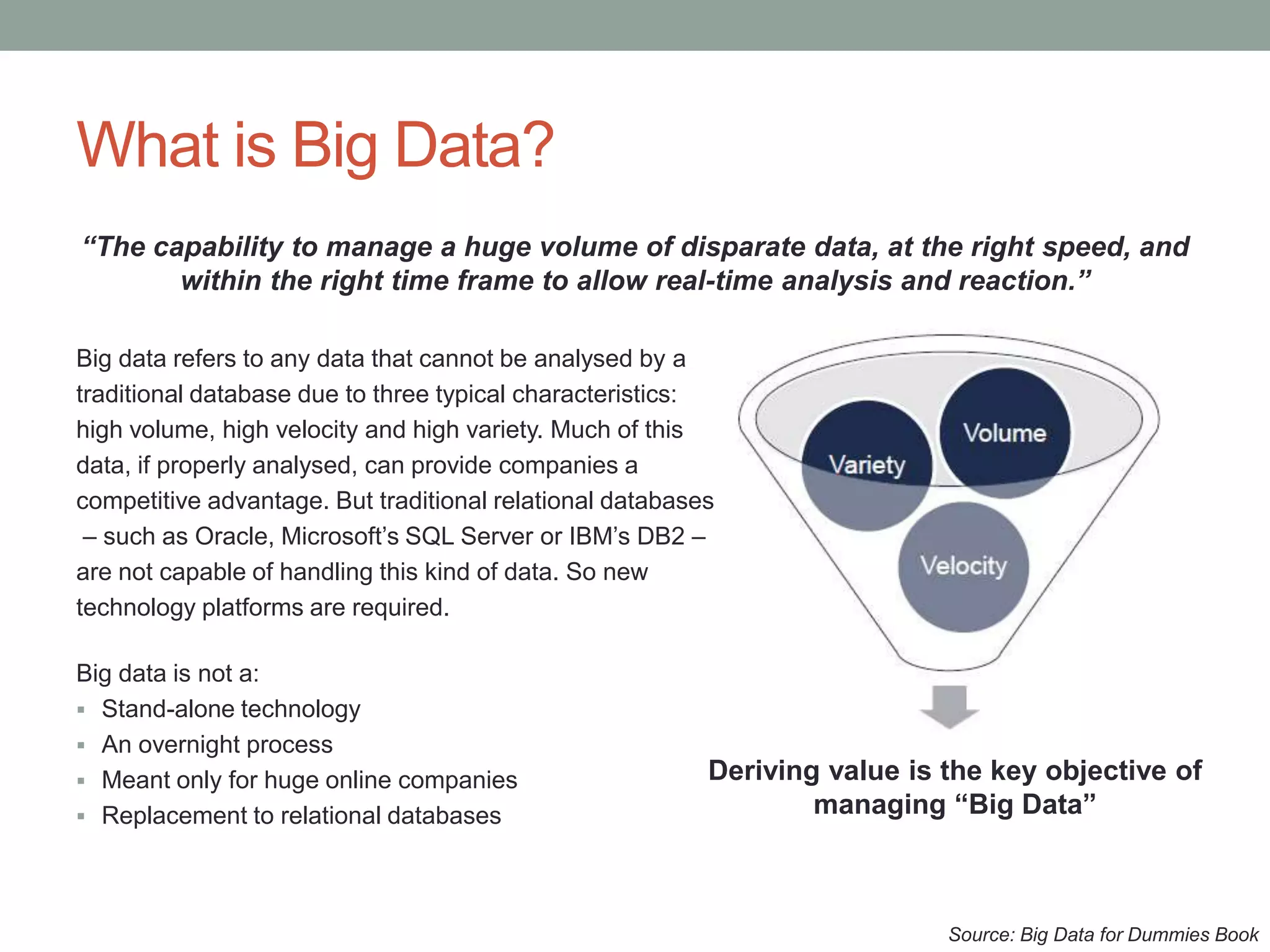
“The capability to manage a huge volume of disparate data, at the right speed, and
within the right time frame to allow real-time analysis and reaction.”
Big data refers to any data that cannot be analysed by a
traditional database due to three typical characteristics:
high volume, high velocity and high variety. Much of this
data, if properly analysed, can provide companies a
competitive advantage. But traditional relational databases
– such as Oracle, Microsoft’s SQL Server or IBM’s DB2 –
are not capable of handling this kind of data. So new
technology platforms are required.
Big data is not a:
 Stand-alone technology
 An overnight process
 Meant only for huge online companies
 Replacement to relational databases
Source: Big Data for Dummies Book
Deriving value is the key objective of
managing “Big Data”
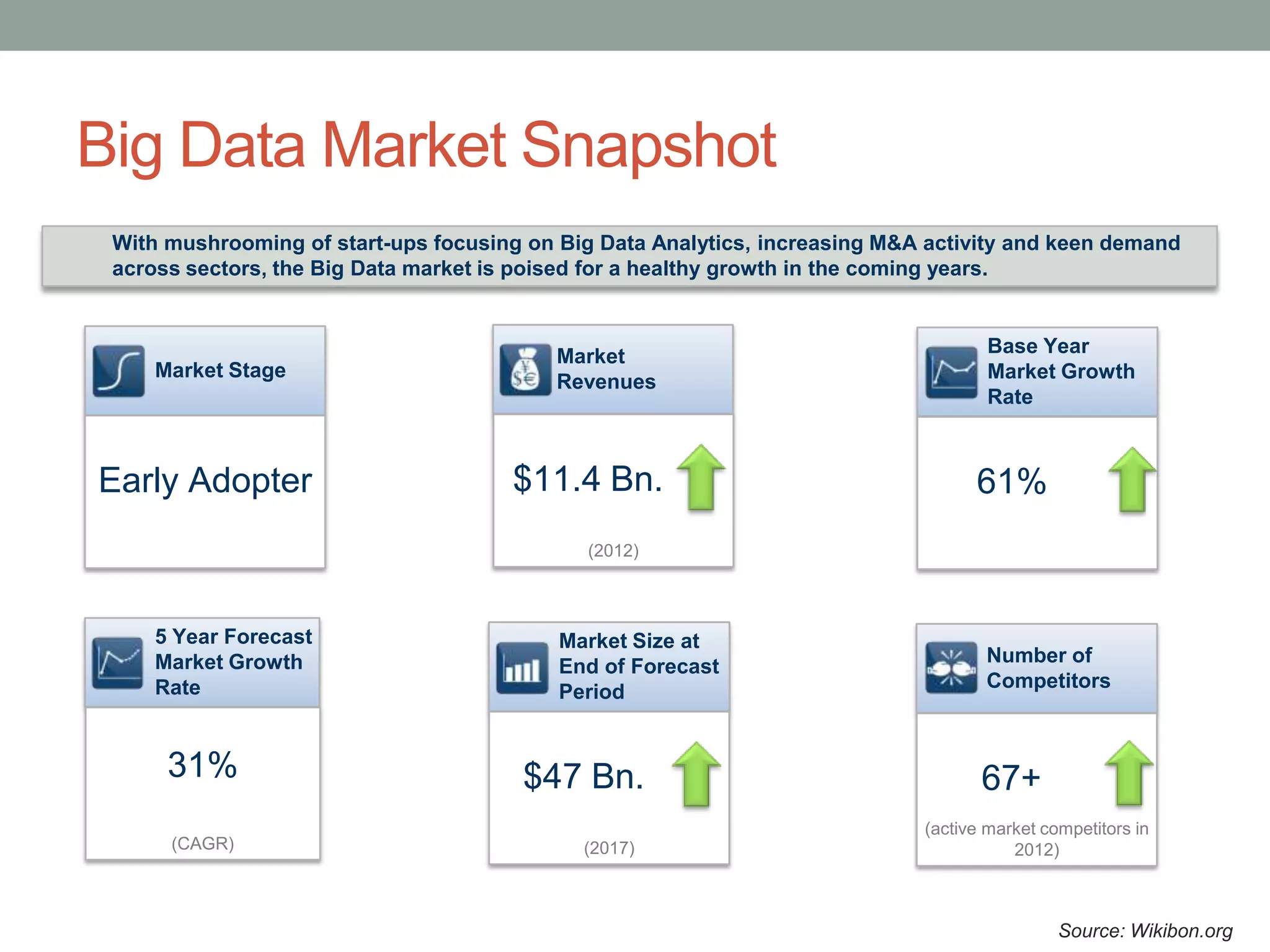
Big Data Market Snapshot
Market Stage
Early Adopter
5 Year Forecast
Market Growth
Rate
31%
(CAGR)
Market
Revenues
$11.4 Bn.
(2012)
Market Size at
End of Forecast
Period
$47 Bn.
(2017)
Base Year
Market Growth
Rate
61%
Number of
Competitors
67+
(active market competitors in
2012)
With mushrooming of start-ups focusing on Big Data Analytics, increasing M&A activity and keen demand
across sectors, the Big Data market is poised for a healthy growth in the coming years.
Source: Wikibon.org
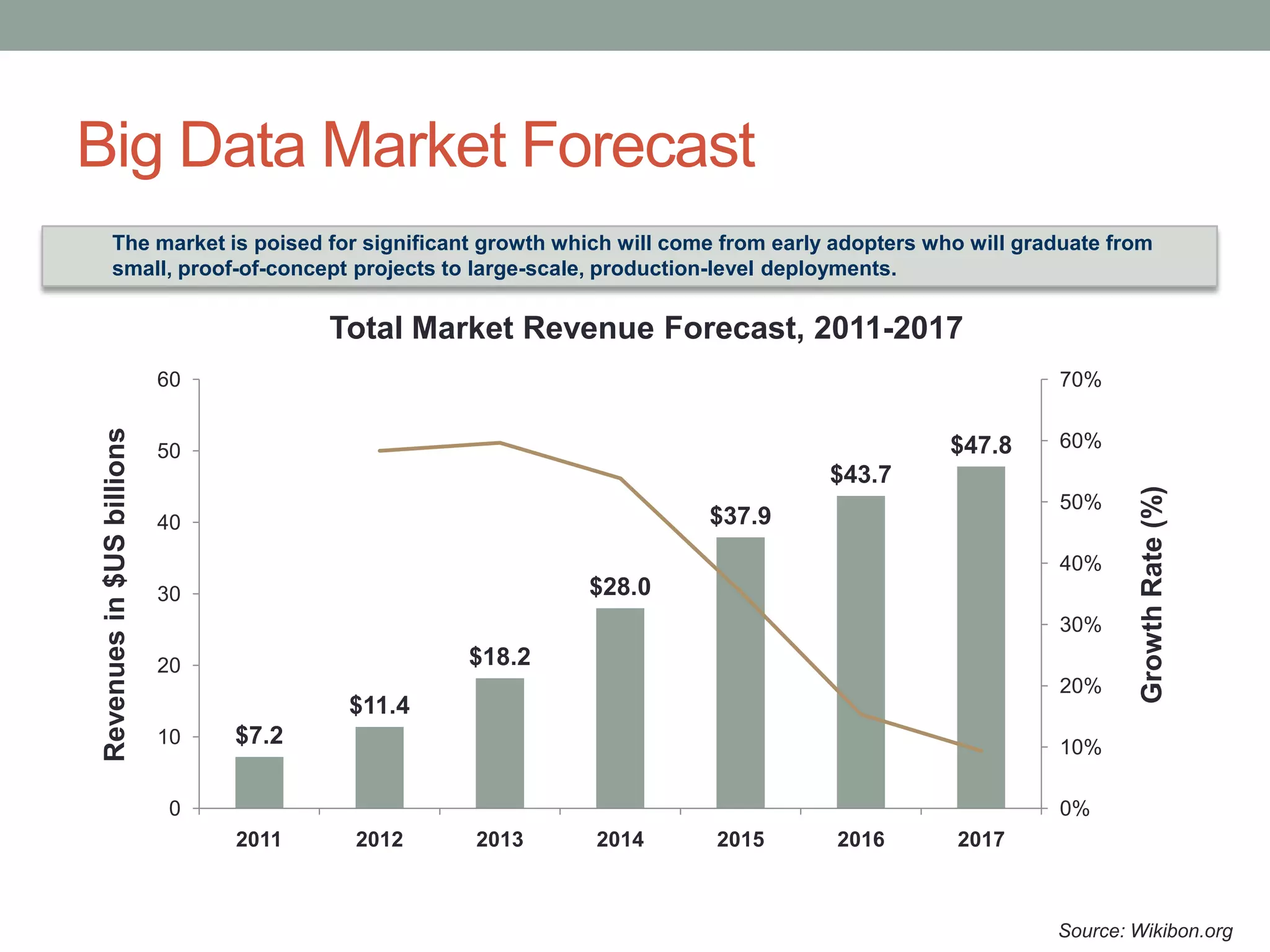
Big Data Market Forecast
$7.2
$11.4
$18.2
$28.0
$37.9
$43.7
$47.8
0%
10%
20%
30%
40%
50%
60%
70%
0
10
20
30
40
50
60
2011 2012 2013 2014 2015 2016 2017
GrowthRate(%)
Revenuesin$USbillions
Total Market Revenue Forecast, 2011-2017
The market is poised for significant growth which will come from early adopters who will graduate from
small, proof-of-concept projects to large-scale, production-level deployments.
Source: Wikibon.org
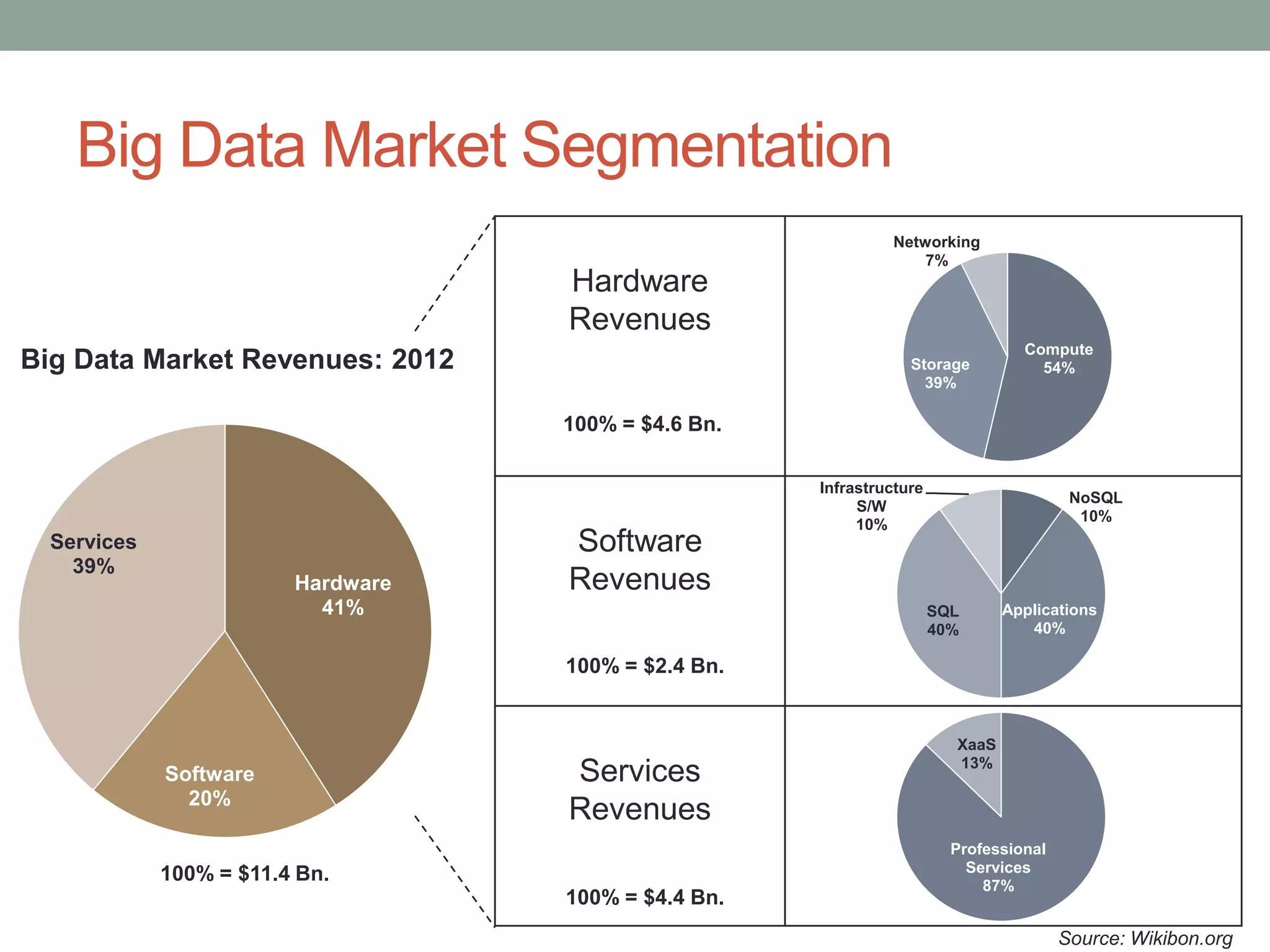
Hardware
41%
Software
20%
Services
39%
Big Data Market Revenues: 2012
Big Data Market Segmentation
Hardware
Revenues
Software
Revenues
Services
Revenues
Compute
54%Storage
39%
Networking
7%
100% = $11.4 Bn.
100% = $4.6 Bn.
100% = $2.4 Bn.
100% = $4.4 Bn.
NoSQL
10%
Applications
40%
SQL
40%
Infrastructure
S/W
10%
Professional
Services
87%
XaaS
13%
Source: Wikibon.org
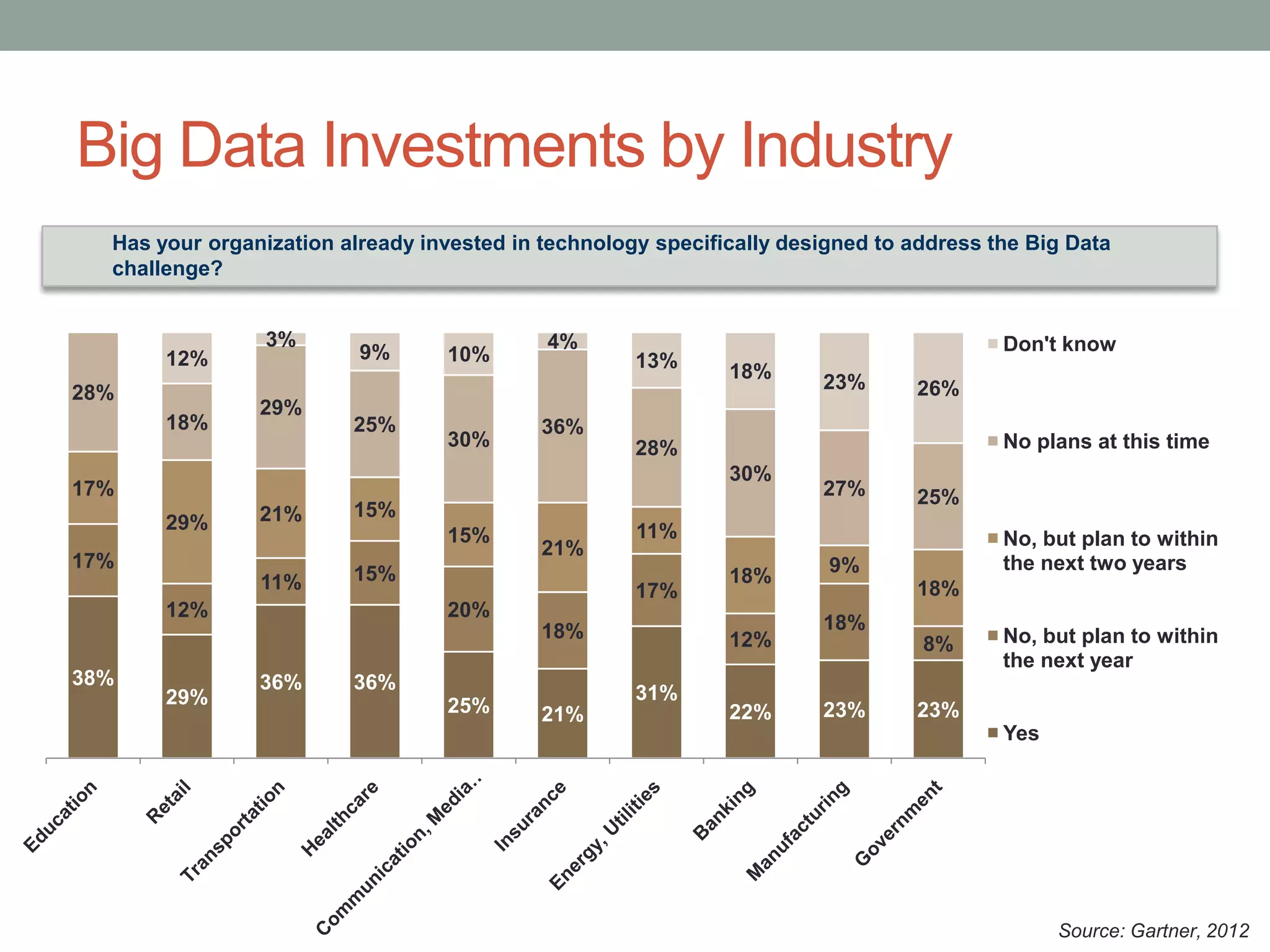
Big Data Investments by Industry
38%
29%
36% 36%
25% 21%
31%
22% 23% 23%
17%
12%
11% 15%
20%
18%
17%
12%
18%
8%
17%
29% 21% 15%
15%
21%
11%
18%
9%
18%
28%
18%
29%
25%
30%
36%
28%
30%
27% 25%
12%
3%
9% 10%
4%
13%
18%
23% 26%
Don't know
No plans at this time
No, but plan to within
the next two years
No, but plan to within
the next year
Yes
Has your organization already invested in technology specifically designed to address the Big Data
challenge?
Source: Gartner, 2012
Hardware
Revenues
Software
Revenues
Services
Revenues
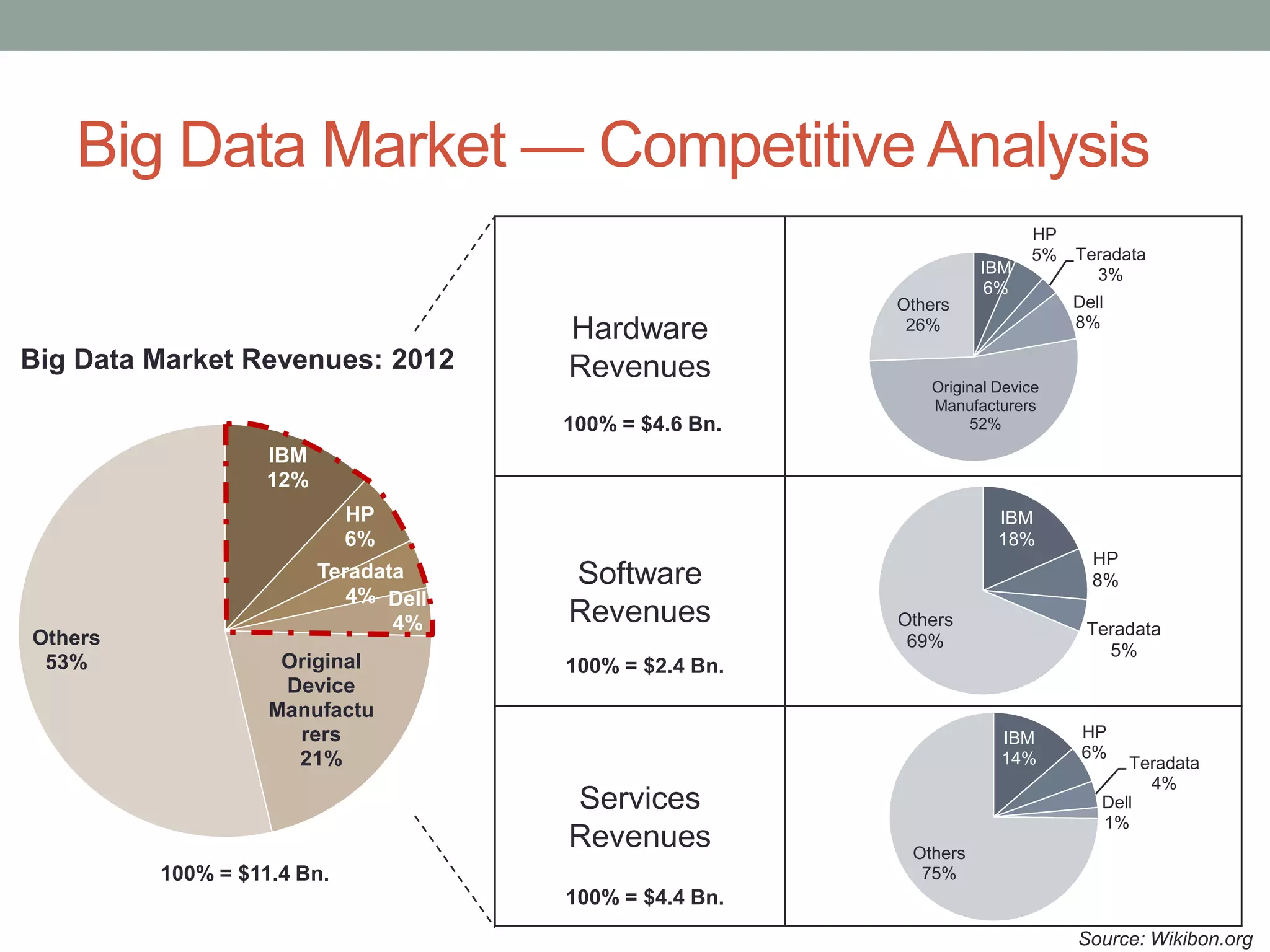
Big Data Market — Competitive Analysis
IBM
12%
HP
6%
Teradata
4% Dell
4%
Original
Device
Manufactu
rers
21%
Others
53%
Big Data Market Revenues: 2012
Source: Wikibon.org
IBM
6%
HP
5% Teradata
3%
Dell
8%
Original Device
Manufacturers
52%
Others
26%
IBM
18%
HP
8%
Teradata
5%
Others
69%
IBM
14%
HP
6%
Teradata
4%
Dell
1%
Others
75%100% = $11.4 Bn.
100% = $4.6 Bn.
100% = $2.4 Bn.
100% = $4.4 Bn.
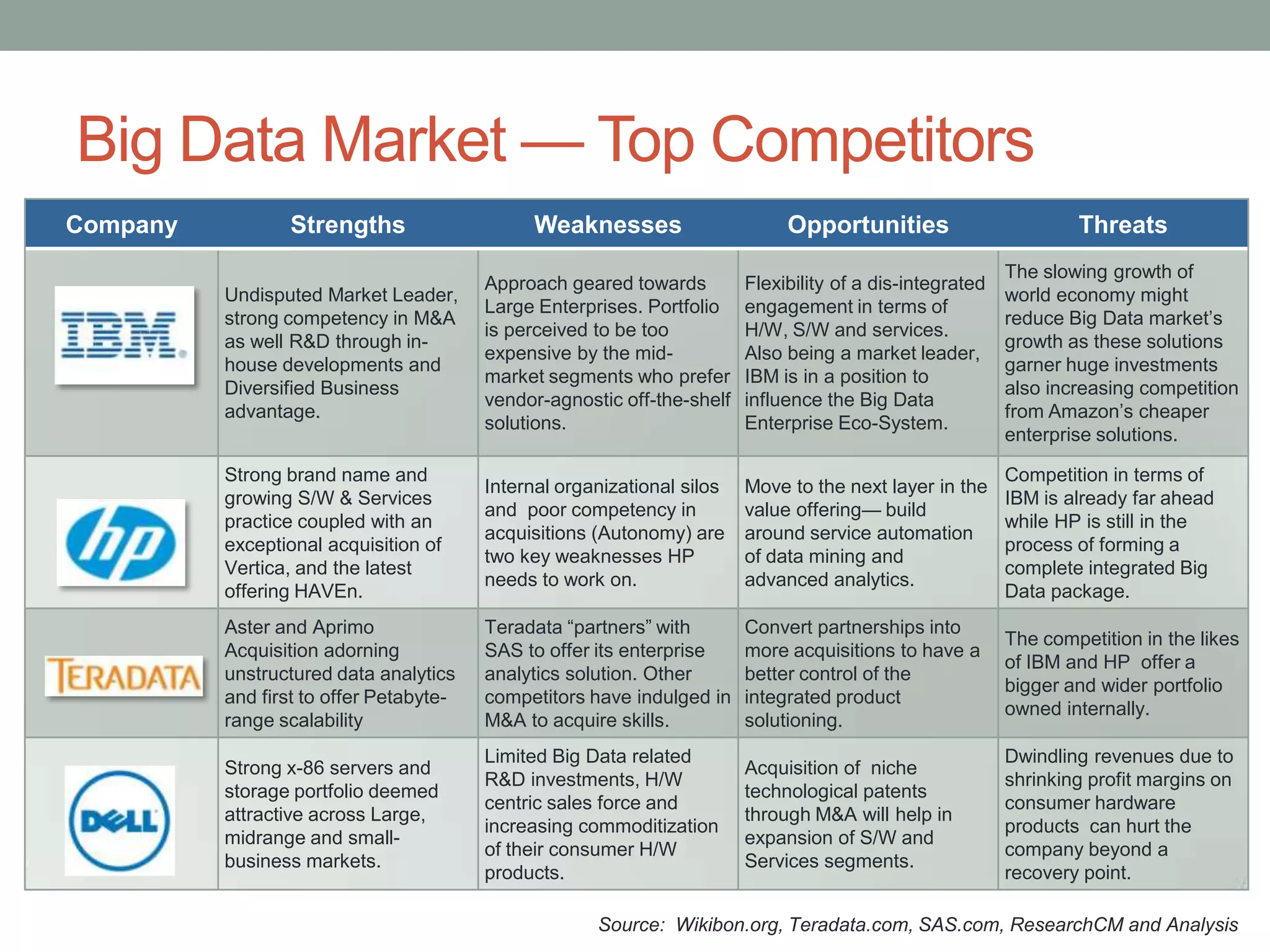
Big Data Market — Top Competitors
Company Strengths Weaknesses Opportunities Threats
Undisputed Market Leader,
strong competency in M&A
as well R&D through in-
house developments and
Diversified Business
advantage.
Approach geared towards
Large Enterprises. Portfolio
is perceived to be too
expensive by the mid-
market segments who prefer
vendor-agnostic off-the-shelf
solutions.
Flexibility of a dis-integrated
engagement in terms of
H/W, S/W and services.
Also being a market leader,
IBM is in a position to
influence the Big Data
Enterprise Eco-System.
The slowing growth of
world economy might
reduce Big Data market’s
growth as these solutions
garner huge investments
also increasing competition
from Amazon’s cheaper
enterprise solutions.
Strong brand name and
growing S/W & Services
practice coupled with an
exceptional acquisition of
Vertica, and the latest
offering HAVEn.
Internal organizational silos
and poor competency in
acquisitions (Autonomy) are
two key weaknesses HP
needs to work on.
Move to the next layer in the
value offering— build
around service automation
of data mining and
advanced analytics.
Competition in terms of
IBM is already far ahead
while HP is still in the
process of forming a
complete integrated Big
Data package.
Aster and Aprimo
Acquisition adorning
unstructured data analytics
and first to offer Petabyte-
range scalability
Teradata ―partners‖ with
SAS to offer its enterprise
analytics solution. Other
competitors have indulged in
M&A to acquire skills.
Convert partnerships into
more acquisitions to have a
better control of the
integrated product
solutioning.
The competition in the likes
of IBM and HP offer a
bigger and wider portfolio
owned internally.
Strong x-86 servers and
storage portfolio deemed
attractive across Large,
midrange and small-
business markets.
Limited Big Data related
R&D investments, H/W
centric sales force and
increasing commoditization
of their consumer H/W
products.
Acquisition of niche
technological patents
through M&A will help in
expansion of S/W and
Services segments.
Dwindling revenues due to
shrinking profit margins on
consumer hardware
products can hurt the
company beyond a
recovery point.
Source: Wikibon.org, Teradata.com, SAS.com, ResearchCM and Analysis
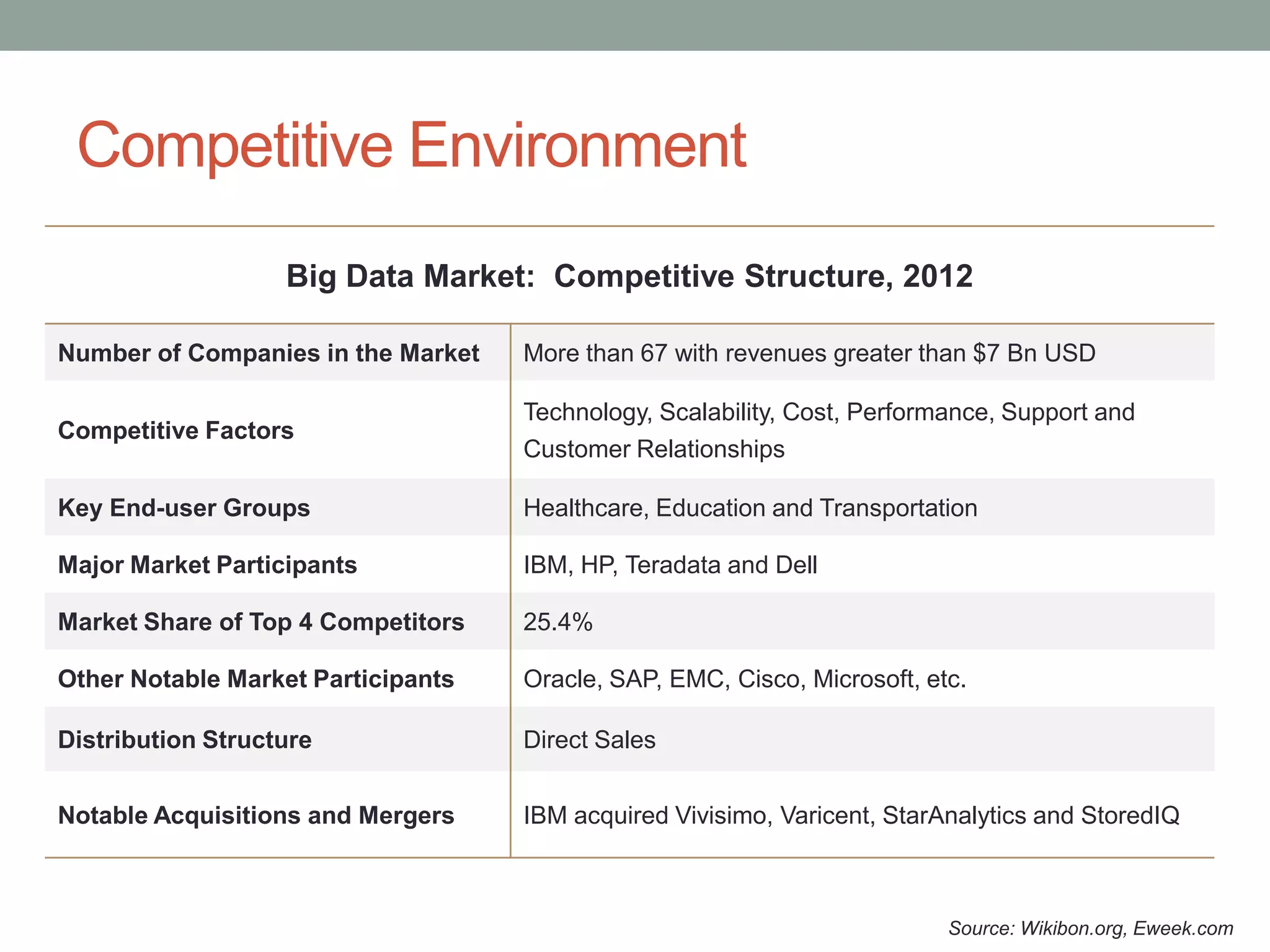
Competitive Environment
Big Data Market: Competitive Structure, 2012
Number of Companies in the Market More than 67 with revenues greater than $7 Bn USD
Competitive Factors
Technology, Scalability, Cost, Performance, Support and
Customer Relationships
Key End-user Groups Healthcare, Education and Transportation
Major Market Participants IBM, HP, Teradata and Dell
Market Share of Top 4 Competitors 25.4%
Other Notable Market Participants Oracle, SAP, EMC, Cisco, Microsoft, etc.
Distribution Structure Direct Sales
Notable Acquisitions and Mergers IBM acquired Vivisimo, Varicent, StarAnalytics and StoredIQ
Source: Wikibon.org, Eweek.com
THANK YOU!

Big data competitive landscape overview

  • 1.
    BIG DATA A CompetitiveLandscape Overview Bisakha Praharaj
  • 2.
    Data Evolution Purchase Detail PurchaseRecord Payment Record ERP Segmentation Offer Details Support Contacts CRM Web Logs Offer History A/B Testing Dynamic Pricing WEB Sensor/ RFID/ Devices Sentiment, UGC, Speech to Text, SMS/MMS, Mobile Web, HD Audio/Video BIG Data Structured Data Structured and Unstructured Data Source: Hortonworks.com Today, 90% of data warehouses hold less than 5 terabytes of data. Yet Twitter alone produces over 7 terabytes of data every day!
  • 3.
    What is BigData? “The capability to manage a huge volume of disparate data, at the right speed, and within the right time frame to allow real-time analysis and reaction.” Big data refers to any data that cannot be analysed by a traditional database due to three typical characteristics: high volume, high velocity and high variety. Much of this data, if properly analysed, can provide companies a competitive advantage. But traditional relational databases – such as Oracle, Microsoft’s SQL Server or IBM’s DB2 – are not capable of handling this kind of data. So new technology platforms are required. Big data is not a:  Stand-alone technology  An overnight process  Meant only for huge online companies  Replacement to relational databases Source: Big Data for Dummies Book Deriving value is the key objective of managing “Big Data”
  • 4.
    Big Data MarketSnapshot Market Stage Early Adopter 5 Year Forecast Market Growth Rate 31% (CAGR) Market Revenues $11.4 Bn. (2012) Market Size at End of Forecast Period $47 Bn. (2017) Base Year Market Growth Rate 61% Number of Competitors 67+ (active market competitors in 2012) With mushrooming of start-ups focusing on Big Data Analytics, increasing M&A activity and keen demand across sectors, the Big Data market is poised for a healthy growth in the coming years. Source: Wikibon.org
  • 5.
    Big Data MarketForecast $7.2 $11.4 $18.2 $28.0 $37.9 $43.7 $47.8 0% 10% 20% 30% 40% 50% 60% 70% 0 10 20 30 40 50 60 2011 2012 2013 2014 2015 2016 2017 GrowthRate(%) Revenuesin$USbillions Total Market Revenue Forecast, 2011-2017 The market is poised for significant growth which will come from early adopters who will graduate from small, proof-of-concept projects to large-scale, production-level deployments. Source: Wikibon.org
  • 6.
    Hardware 41% Software 20% Services 39% Big Data MarketRevenues: 2012 Big Data Market Segmentation Hardware Revenues Software Revenues Services Revenues Compute 54%Storage 39% Networking 7% 100% = $11.4 Bn. 100% = $4.6 Bn. 100% = $2.4 Bn. 100% = $4.4 Bn. NoSQL 10% Applications 40% SQL 40% Infrastructure S/W 10% Professional Services 87% XaaS 13% Source: Wikibon.org
  • 7.
    Big Data Investmentsby Industry 38% 29% 36% 36% 25% 21% 31% 22% 23% 23% 17% 12% 11% 15% 20% 18% 17% 12% 18% 8% 17% 29% 21% 15% 15% 21% 11% 18% 9% 18% 28% 18% 29% 25% 30% 36% 28% 30% 27% 25% 12% 3% 9% 10% 4% 13% 18% 23% 26% Don't know No plans at this time No, but plan to within the next two years No, but plan to within the next year Yes Has your organization already invested in technology specifically designed to address the Big Data challenge? Source: Gartner, 2012
  • 8.
    Hardware Revenues Software Revenues Services Revenues Big Data Market— Competitive Analysis IBM 12% HP 6% Teradata 4% Dell 4% Original Device Manufactu rers 21% Others 53% Big Data Market Revenues: 2012 Source: Wikibon.org IBM 6% HP 5% Teradata 3% Dell 8% Original Device Manufacturers 52% Others 26% IBM 18% HP 8% Teradata 5% Others 69% IBM 14% HP 6% Teradata 4% Dell 1% Others 75%100% = $11.4 Bn. 100% = $4.6 Bn. 100% = $2.4 Bn. 100% = $4.4 Bn.
  • 9.
    Big Data Market— Top Competitors Company Strengths Weaknesses Opportunities Threats Undisputed Market Leader, strong competency in M&A as well R&D through in- house developments and Diversified Business advantage. Approach geared towards Large Enterprises. Portfolio is perceived to be too expensive by the mid- market segments who prefer vendor-agnostic off-the-shelf solutions. Flexibility of a dis-integrated engagement in terms of H/W, S/W and services. Also being a market leader, IBM is in a position to influence the Big Data Enterprise Eco-System. The slowing growth of world economy might reduce Big Data market’s growth as these solutions garner huge investments also increasing competition from Amazon’s cheaper enterprise solutions. Strong brand name and growing S/W & Services practice coupled with an exceptional acquisition of Vertica, and the latest offering HAVEn. Internal organizational silos and poor competency in acquisitions (Autonomy) are two key weaknesses HP needs to work on. Move to the next layer in the value offering— build around service automation of data mining and advanced analytics. Competition in terms of IBM is already far ahead while HP is still in the process of forming a complete integrated Big Data package. Aster and Aprimo Acquisition adorning unstructured data analytics and first to offer Petabyte- range scalability Teradata ―partners‖ with SAS to offer its enterprise analytics solution. Other competitors have indulged in M&A to acquire skills. Convert partnerships into more acquisitions to have a better control of the integrated product solutioning. The competition in the likes of IBM and HP offer a bigger and wider portfolio owned internally. Strong x-86 servers and storage portfolio deemed attractive across Large, midrange and small- business markets. Limited Big Data related R&D investments, H/W centric sales force and increasing commoditization of their consumer H/W products. Acquisition of niche technological patents through M&A will help in expansion of S/W and Services segments. Dwindling revenues due to shrinking profit margins on consumer hardware products can hurt the company beyond a recovery point. Source: Wikibon.org, Teradata.com, SAS.com, ResearchCM and Analysis
  • 10.
    Competitive Environment Big DataMarket: Competitive Structure, 2012 Number of Companies in the Market More than 67 with revenues greater than $7 Bn USD Competitive Factors Technology, Scalability, Cost, Performance, Support and Customer Relationships Key End-user Groups Healthcare, Education and Transportation Major Market Participants IBM, HP, Teradata and Dell Market Share of Top 4 Competitors 25.4% Other Notable Market Participants Oracle, SAP, EMC, Cisco, Microsoft, etc. Distribution Structure Direct Sales Notable Acquisitions and Mergers IBM acquired Vivisimo, Varicent, StarAnalytics and StoredIQ Source: Wikibon.org, Eweek.com
  • 11.