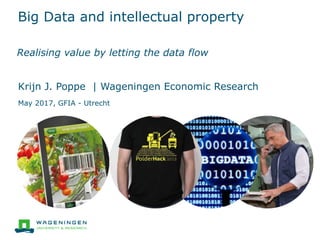
Big Data and intellectual property
Realising value by letting the data flow
Krijn J. Poppe | Wageningen Economic Research
May 2017, GFIA - Utrecht
Effect of data unclear, leads to uncertainty
• Governance issues for farmers:
• Do I own my own data? Who has access to my data? Privacy?
• Do network-effects create natural monopolies?
• Do companies gain market power on future markets?
• Are there lock-ins, can I change suppliers easily?
• Become a franchiser with the risks but not the returns?
 New business models, but many data-driven initiatives
still explore viable models to capture the value of data.
 Changes farm management, implications for the family
farm as a dominant organisational form?
 Unclear: towards a centralisation scenario in chains or
towards disruptive innovation, regional scenario ?
2
DATA-FAIR:
Open Software
Ecosystem
Stakeholders
Platforms
Apps + services
Knowledge models
Security, Privacy, Trust
Business models
Data sharing
Our approach: innovate together
Farmer
Open Architecture & Infrastructure
Event-driven, Configurable, Customizable
Standards & Open Datasets
Real-time data sharing
IoT layer
Essential parts of the solution
 Data gets value by combining and
aggregating
 Prevent data-monopolists by
exchanging data between current firms
 Define (joint) ownership of data
 Exchange data based on consents /
authorisations
 Design a business model of a service,
 Design the governance of a service,
 Especially of Agricultural Business
Collaboration and Data Exchange
Facilities (ABCDEFs).
4
Thanks for your
attention
krijn.poppe@wur.nl
www.wur.nl

Big Data and IPR

  • 1.
    Big Data andintellectual property Realising value by letting the data flow Krijn J. Poppe | Wageningen Economic Research May 2017, GFIA - Utrecht
  • 2.
    Effect of dataunclear, leads to uncertainty • Governance issues for farmers: • Do I own my own data? Who has access to my data? Privacy? • Do network-effects create natural monopolies? • Do companies gain market power on future markets? • Are there lock-ins, can I change suppliers easily? • Become a franchiser with the risks but not the returns?  New business models, but many data-driven initiatives still explore viable models to capture the value of data.  Changes farm management, implications for the family farm as a dominant organisational form?  Unclear: towards a centralisation scenario in chains or towards disruptive innovation, regional scenario ? 2
  • 3.
    DATA-FAIR: Open Software Ecosystem Stakeholders Platforms Apps +services Knowledge models Security, Privacy, Trust Business models Data sharing Our approach: innovate together Farmer Open Architecture & Infrastructure Event-driven, Configurable, Customizable Standards & Open Datasets Real-time data sharing IoT layer
  • 4.
    Essential parts ofthe solution  Data gets value by combining and aggregating  Prevent data-monopolists by exchanging data between current firms  Define (joint) ownership of data  Exchange data based on consents / authorisations  Design a business model of a service,  Design the governance of a service,  Especially of Agricultural Business Collaboration and Data Exchange Facilities (ABCDEFs). 4
  • 5.