News Update as @ 1530 hours, Thursday 17 July 2014
Feedback: bh24admin@zimpapers.co.zwEmail: bh24feedback@zimpapers.co.zw
By Fidelis Munyoro
The Supreme Court has dismissed an
appeal in the case in which Base Min-
erals Zimbabwe was seeking to quash
a High Court decision made in favour
of Mabwe Minerals Zimbabwe in a dis-
pute over control of barite Dodge Mine
in Shamva.
Justice Vernanda Ziyambi threw out
the appeal for lack of merit. “The unan-
imous decision of this court is that the
appeal be and is hereby dismissed with
cost,” she said.
Base Minerals had approached the
Supreme Court on appeal after the
High Court stopped it from interfering
withMabweMineralsminingoperations
at Dodge Mine in Shamva. The firm,
whichclaimedtobetheholderofatrib-
ute of more than six disputed mining
claims at Dodge Mine, had deployed
an army of armed security personnel
who cut through locks and barriers,
chasing Mabwe Minerals guards from
the premises and took occupation of
the mine in the face of a court order
against it.
On appeal, the firm’s lawyer Francis
Katsande argued that the lower court
erred when it dealt with an application
forinterdictbroughtbeforeitbyMabwe
Minerals when there was an application
for same relief pending before another
court. The judge, argued Katsande,
went remiss by deciding on a matter
already before the same court.
But Mabwe Minerals lawyer Adv
Sithembiso Magwaliba urged the court
to throw out the appeal for want of
compliance with procedure.
He argued that Base Minerals submis-
sion that when it deployed its guards at
the mine it wanted to enforce a tribute
agreement was misplaced in a spolia-
tion process adding that a tribute could
not be enforced by guns and violence.
Adv Magwaliba said Mabwe Minerals
were the rightful owners of the mine.
He also said the notice of appeal was
fatally defective and could not be
allowed. Mabwe Minerals, which is
engaged in the mining and commercial
sales of industrial minerals and met-
als, acquired the mineral and metal
rights for 110 hectares (272 acres) at
its Dodge barite mine in Shamva early
this year.
The company mainly mines barite, a
crystalline mineral of barium sulfate
(can be white, yellow or colourless)
that is used in paint manufacturing and
is mostly used as industrial mineral and
is also a chief source of barium chem-
icals.
The hydrothermal barite deposits on
Dodge Mine are considered world class
due to their high percentage content of
barium sulfate.
Court dismisses Base Minerals Zimbabwe's appeal
Justice Ziyambi
2 NEWS
Mabwe Minerals director Tapiwa
Gurupira told The Herald early this year
that the company’s property now cov-
ers a total area of 233 hectares (576
acres).
He said with the extension, the Dodge
Mine property range now extends to
include all of the first three mountains
and a portion of the fourth mountain
moving east-to-west. He said Mabwe
Minerals has been targeting the expan-
sionsincetheareawasgravitymapped
in 2012 indicating the continued pres-
ence of barite towards the largest
mountain on the western end.
Gurupira said with a number of third
party geologists having visited the
mine, it was certain the company aims
for expansion this year.
Mabwe Minerals has been making
plans to initiate a drilling programme
that is necessary to complete the grav-
ity mapping interpretation with volume
estimates.
Now that the Dodge Mine extension
certificate has been issued by the office
of the Mining Commissioners, WGB
Kinsey & Company intends to proceed
with finalising the drilling plan.
Mabwe Minerals Inc. is a US based nat-
uralresourcesandhardassetcompany
engaged in the mining, logistics and
commercial sales of industrial minerals
and metals, with first focus on barite
and limestone. •
By Funny Hudzerema
Adherence to quality standards can
contribute to the growth of the Zim-
babwean economy, an international
standards expert has said.
International Organisation for Stand-
ards (ISO) expert Jochen Fornather
said strengthening standards adher-
ence results in the production and
provision of goods and services that
match the requirements of the global
market.
“All sectors must be in the SAZ to
increase economic development
through the standardisation of prod-
ucts engagement by all stakeholders.
"Through the standardisation of goods
and services can result in economic
development of about 25 percent and
can reduce barriers to trade in Zim-
babwe, in Africa and the world," said
Fornather.
He was speaking at a standards work-
shop that was jointly organised by
SAZ and the ISO.
Fornather said Zimbabwe can draw
lessons from the European Union
where standardisation is of economic
importance.
“Every euro invested in standardi-
sation generates a forty-fold return
and standard goods reduce the level
of reduction of transaction costs,”
he said. “For example, the Austrian
standards body has managed to con-
tribute about 2,5 million euros every
year through the standardisation of
goods and services."
Even at the World Trade Organisation
(WTO) level, the issue of standards is
central as it drives the international
trade without barriers agenda.
A Zimtrade survey released in May
this year showed that 42 percent of
products from manufacturing sector
were certified, a factor that was hin-
dering Zimbabwe's export growth.
SAZ director general Eve Gadzikwa
said for Zimbabwe to achieve business
success issues relating to competi-
tiveness, trade and consumer protec-
tion needed to be addressed. •
'Standards key to economic growth'
BH24
By Rumbidzayi Zinyuke
Meikles Africa employees say they
might not benefit anything from the
Employee Share Ownership Trust
formed in line with the country’s indi-
genisation laws as they are yet to
receive any funds to purchase the 24
million shares promised by the com-
pany.
Last year, the group said it would
extend assistance to the ESOT if the
funds on deposit held by the Reserve
Bank of Zimbabwe were repaid. The
central bank owes Meikles approxi-
mately $76,5 million dating back to
1998.
Representatives of different arms
of the Meikles group told the the-
matic committee on Indigenisation,
empowerment and economic devel-
opment that only one third of the 10
percent they were promised when
the ESOT was formed has been paid
for so far.
“The board of trustees borrowed
$1,4 million from the Old Mutual
pension fund to which we contribute
and bought eight million shares. We
however do not have any money to
pay for the remaining shares and we
are still waiting for the Government
to pay what it owes to the company,”
said Rodney Mutinhiri, chairperson of
the Worker’s committee.
He said the employees would only
start benefitting from the ESOT once
payment for the remaining shares
was complete which meant that
those who retired or are laid off work
will not benefit.
“We are not going to benefit anything
from the ESOT until we have paid for
all the shares and received the share
certificate.
This means we will not how many
shares each individual is entitled to
until that happens. At the same time,
we cannot see its growth on our
money in the pension fund because it
is tied up in the shares,” he said.
Chairman of the Tanganda Tea Com-
pany worker’s committee Blame
Donza said management had refused
their offer to contribute towards the
payment of the shares. “When we
met them in April, management said
at the moment there is no money so
even if we contribute it will not make
a difference because there is a lot of
money needed.
We had suggested contributing at
least $5 per employee every month
so that we can pool money to pay for
the shares.
We were concerned that some of our
workers were retiring and leaving
with benefiting from the ESOT,” he
said.
The representatives said they believe
the company is stalling the comple-
tion of the payment to avoid trans-
ferring the shares to the employees.
They alleged the group is just putting
a show for Government to believe
they had complied with indigenisation
requirements. •
4 NEWS
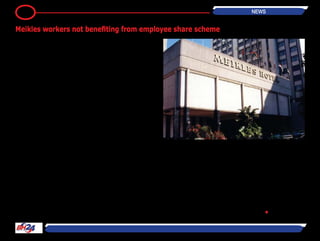
Meikles workers not benefiting from employee share scheme
5 MINING
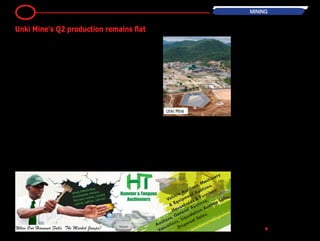
Unki Mine's Q2 production remains flat
By Tawanda Musarurwa
Local platinum producer Unki Mine's
output for the second quarter ended
30 June 2014 was flat at 15 000
ounces.
In its latest Q2 update, Anglo Ameri-
can Platinum (Angloplat) which owns
the Unki Mine, said the long-drawn-
out strike had no material effect on
Unki and the group's other South
Africa-based platinum mine - the
Mogalakwena and other joint opera-
tions and associates.
"The industrial action did not impact
production at the Mogalakwena and
Unki mines nor at the majority of the
joint operations and associates.
"Mogalakwena mine's production
increased by 23 percent to 96 000
ounces, due to higher achieved 4E
head grade and increased concen-
trator throughput, supported by the
mining productivity improvement
programmes. Unki mine production
was flat at 15 000 ounces," said the
group.
Unki is the third largest platinum pro-
ducer in Zimbabwe.
In the first quarter of the current
year, Unki's platinum output bumped
4 percent, a factor the company then
attributedtohighervolumesdelivered
to the concentrator and throughput
at the mills. Unki's production figures
in the first two quarters of the year
are however below guidance as the
mine produced 67 000 ounces in the
prior year, but this remains a fraction
of Amplats’ 1,5 million ounce annual
output.
Angloplat has so far invested $350
million at Unki since it started opera-
tions, producing 67 000 refined plati-
num ounces in 2013.
Production at Unki been on a steady
rise since the mine was fully commis-
sioned at the beginning of 2011.
The smaller mines notwithstanding,
Angloplat said the huge South Afri-
ca-based platinum producers were
negatively impacted by the strike,
which led to a decline in overall
refined platinum output.
"Equivalent refined platinum pro-
duction decreased by 40 percent to
358 000 ounces, primarily due to the
industrial action, which began on 23
January 2014 and which affected the
Rustenburg, Amandelbult and Union
mines in South Africa. The industrial
action concluded on 24 June 2014.
The total platinum ounces lost due
to the industrial action for the second
quarter was 239,000 ounces.
"Total lost production from the indus-
trial action during H1 2014 was 424
000 ounces and a further 16,000
ounces has been lost during the ramp
up of operations as "safe return to
work" procedures are undertaken
before mining can commence. In
addition, production was 44,000
ounces lower due to the consolidation
of mines at Rustenburg and Union
as part of the restructuring in 2013,"
said AngloPlat. •
Unki Mine
BH24
7 NEWS
BH24 Reporter
Jersey-registered and London-listed
Masawara is set to extend its con-
trol of Zimbabwe's largest holding
company, TA Holdings by buying out
minority shareholders in the group.
Masawara - an investment com-
pany focused on acquiring interests
in companies and projects based in
Zimbabwe and the Southern African
region - have offered to acquire all
the issued ordinary shares in TA Hold-
ings not currently under its ambit.
Masawara presently holds an effective
39 percent interest in TA Holdings.
In a cautionary statement released
today, TA Holdings announced that it
had received an offer from Masawara
to purchase 58,96 percent of the
ordinary issued share capital of the
company at a price of 20,6 cents per
share through a scheme of arrange-
ment.
"(S)hareholders are advised that
the directors have received an offer
from Masawara Mauritius Limited
(“Masawara”), a wholly owned sub-
sidiary of Masawara Plc, for Masawara
or its affiliates to acquire all the issued
ordinary shares in TA Holdings Lim-
ited (“the Company”) not currently
held by companies under the control
of Masawara Plc, constituting 58,96
percent of the ordinary issued share
capital of the Company, at a price
of $0,206 (twenty point six United
States cents) per share through a
scheme of arrangement under Sec-
tion 191 of the Companies Act (Chap-
ter 23:04)," reads part of the caution-
ary.
"The requisite notice of the scheme of
arrangement and the scheme docu-
ment incorporating an explanatory
statement, the fair and reasonable
opinion of the independent financial
advisor appointed by the independ-
ent directors of the Company and the
independent directors’ opinion and
voting recommendations will be sent
to the Company’s shareholders in due
course.
"The offer is subject to all applicable
regulatory approvals being met." •
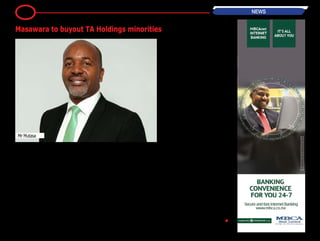
Masawara to buyout TA Holdings minorities
Mr Mutasa
AdM-DI156506-
BH24
BH24 Reporter
Beneficiation and value addition will
be the running theme for the 34th
SADC Summit which will be hosted
by Zimbabwe, an official has said.
The Summit is set for Victoria Falls
next month.
Addressing journalists on the prepa-
rations for the 34th SADC Summit
Foreign Affairs Minister Simbarashe
Mumbengegwi on Wednesday said
the beneficiation theme was in line
with the country's long-term eco-
nomic strategy. "(T)his time we
have selected a theme on the “SADC
Strategy for Economic Transforma-
tion: Leveraging the Region’s Diverse
Resources for Sustainable Economic
and Social Development through
Beneficiation and Value Addition”.
"This theme has been selected very
carefully because Zimbabwe believes
very strongly in the importance of
beneficiating and value adding of
our natural resources," said Minister
Mumbengegwi. "I think you have all
head how President Robert Mugabe
has never stopped talking about this
issue. Why should we always export
our natural resources in their raw
form? By so doing, we only get about
10 percent of the value of our prod-
ucts whether they be in agriculture,
mining or whatever, we lose a lot.
"So, the question of value addition is
critical not only to Zimbabwe but to
the whole of SADC, so in consultation
with the secretariat we have come up
with this particular theme."
The Government fully appreciates
the importance of beneficiating its
minerals (as shown by strategies
announced by Finance Minister Pat-
rick Chinamasa in the 2014 National
Budget). Minister Mumbengegwi
said the problem was not peculiar
to Zimbabwe, but it was common
amongst the SADC countries as well.
"The SADC region is endowed with
resources, the same as Africa as a
whole. Very rich in resources, but the
paradox is that with such abundance
of natural resources we are poor.
"That’s the paradox. Why are we
poor? Because we do not get the full
benefit of our natural resources and
this is the thrust we would want to
champion not only during President
Mugabe’s chairmanship of SADC, but
to be able to come up with strategies
and programmes of action which can
continue even after President Mug-
abe has left the chairmanship of the
organisation because this is a critical
area not only for SADC but for the
whole African continent and other
developing countries," he said.
He however highlighted that apart
from discussing the theme, there
will also be other administrative
aspects that the Summit will address,
although the overall agenda is yet to
be finalised. Zimbabwe will assume
the chairmanship of SADC from
August this year to August 2015. To
this extent, the country will host all
meetings of SADC with the Summit
among the most important of these.
•
9 NEWS
Beneficiation to top 34th Sadc Summit agenda
Minister Mumbengegwi
BH24
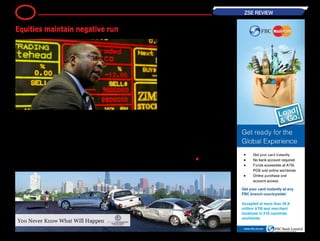
The equities market has remained
sluggish as the week heads to a
close, going down 0.32 percent in
today's trades.
The industrial index slipped by 0.59
points to close at 185.49 points as
losses weighed heavy. Hippo lost
10 cents to trade at 70 cents, while
cement producer Lafarge dropped 8
cents to trade at 55 cents.
AFDIS shed 3 cents to close at 32
cents. Other losses were in TSL which
dropped 2 cents to close at 24 cents
and NTS which slipped a cent to close
at 1.70 cents. On the upside, Colcom
led the movers with a 2.70 cents gain
to close at 25 cents, and giant retailer
OK Zimbabwe recovered a cent to
close at 18 cents.
Zimplow added 0.60 cents to close
at 8.60 cents and MASH (MASH.zw)
added 0.10 cent to 2.40 cents.
Econet gained 0.50 cents to close
at 74.50 cents after reports that the
giant telecoms firm's subscriber base
grew by 4.1 percent in the first quar-
ter of this year to reach nine million.
The mining index was 0.90 points (or
1.60 percent) higher to close at 57.02
points as Bindura traded 0.10 cents
firmer at 4.60 cents.
Falgold, Hwange and Riozim all main-
tained previous trading levels. ―
BH24 Reporter •
11 ZSE REVIEW
Equities maintain negative run
SPECIALISTS IN DRIVESHAFTS AND PROPSHAFTS, STEERING RACKS, BALL JOINTS, DRAGLINKS,
TIE ROD ENDS, CV JOINTS, TRANSMISSIONS, UNIVERSAL JOINTS, FLANGES, BEARINGS,
BUSHES, YOKES, GENERAL ENGINEERING, BELL SPARES, AIR BRAKES AND PNUEMATICS, SUPPLY
AND SERVICE EXCHANGE FOR COMPLETE AXLES, ENGINES AND GEARBOXES.
NATIONAL PROPSHAFTS CENTRE
No. 17033 CEDORA ROAD, P.O. BOX GT 1244,
GRANITESIDE, HARARE, ZIMBABWE.
Website: www.propshaftscenter.co.zw
TEL: 770638-43, 086 4406 8386
CELL: 0772 470665, 0712 204396,
086 44068386, 0712 749578
Email: sales@nationalpropshafts.co.zw
MUTARE PROPSHAFTS CENTRE
12 A RIVERSIDE DRIVE
P.O.BOX 1869, MUTARE, ZIMBABWE
Website: www.propshaftscenter.co.zw
Tel: 66084, 086 4406 8385, Fax: 68597
Cell: 0712 204396,
0772 715388, 0773 782502
Email: sales@mpc.co.zw, mpc@mweb.co.zw
BELL DIFFS
COMPRESSORS UNIVERSAL JOINTS
TA 1919 PUMPS, WATER PLATES &
DOUBLE BOSH PUMPS
MT643 TRANSMISSIONS
STEERING COUPLINGS
FOOT BRAKE & VALVESCENTRE BEARINGS
PROPSHAFTS SPARES
SPIDER BEARINGS
BOOSTERS
PROPSHAFT COUPLINGS
PROPSHAFTS & DRIVE SHAFTS
TRACK RODS &
DRAGLINKS
BH24
Government, through the indigenisa-
tion and empowerment laws, made
a call to foreign owned companies to
empower their employees through
Employee Share Ownership Trusts.
The ESOTs are envisioned in the Indi-
genisation and Economic Empower-
ment (General) Regulations of 2010.
Many of the companies have complied
and ceded the requisite 10 percent
to their employees in a move that is
supposed to see workers reaping the
benefits of the empowerment drive.
Big mining companies such as Zim-
babwe Platinum Holdings, Mimosa
and Anglo Platinum launched their
employee share schemes alongside
community share ownership schemes
while corporates like Meikles, Old
Mutual, Delta Beverages and BAT
Zimbabwe also launched theirs.
Basically, an employee share owner-
ship scheme is a contribution plan that
provides a company’s workers with an
ownership interest in the company.
Under such schemes, companies
provide their employees with stock
ownership, typically at no cost to the
employees.
The model of Zimbabwe’s indigenisa-
tion law places prominence on wealth
creation through broad-based par-
ticipation of the indigenous people in
economic activity.
But since the launch of these ESOTs
(and some of the CSOTs), we have
noticed little to no change in the liveli-
hoods of the people targeted by such
drives.
What has happened is that the
schemes have become mere decora-
tions; a means to avoid punishment
from a Government that expects the
companies to contribute to communi-
ties and employees livelihoods.
Senators today heard that the Meikles
ESOT is yet to take effect because
there is no money to pay for the
shares.
Although Meikles promised to help
its employees to buy the 10 percent
stake, the condition was only after
Government has paid back more than
$80 million owed to the company by
the RBZ.
So this means if the Government does
not have the capacity to pay Meikles,
the employees suffer.
It basically means they are holding
Government ransom!
And workers whose pension money
was taken to pay for part of the stake
will lose out on both the ESOT and
their pension if they retire before Gov-
ernment pays its debt.
That management has also denied the
employees the chance to pay for their
own shares means they just want to
have something to hold over them or
they just want to keep hold of those
shares. Unless they are paid for, they
belong to Meikles not the employees.
These big companies have a com-
munity as well as employees for so
long and they are getting away with it
because there have been loopholes in
the manner in which the programme
was carried out.
So Government should do a few things
to correct this problem.
First, Government should close off all
those loopholes being manipulated by
companies so that they do not have a
choice but contribute to the welfare of
employees and communities.
Then it should go back to the draw-
ing board and make the provisions for
ESOTs and CSOTs clear. Government
should also make time frames for
the operationalisation of the schemes
clear so that companies comply with
these provisions on time. Or else it will
take decades for the schemes to start
benefitting the employees.
Last, Government should ensure that
all companies that launched ESOTs
and CSOTs are making good their
promise.
We are tired of empty promises,
promises made to make the powers
that be happy but not followed up with
action.
It’s time we see some action! Employ-
ees should receive their benefits for
working for that company before they
die. After all, their children might not
even benefit once they are gone. •
13 BH24 COMMENT
ESOTs should make a difference in workers' lives
BH24
Ford Motor Corporation announced 17
new vehicles for Sub-Saharan Africa on
Thursday, as carmakers jostle for posi-
tions in one of the last major markets
where potential growth remains largely
untapped.
The models, among 25 to be intro-
duced by 2016 in a broader product
offensive across the Middle East and
Africa, draw on the US auto giant's
global vehicle architectures to offer
more up-to-date features for markets
such as South Africa. "Middle East and
Africa is the final frontier for global
automotive growth," Ford's regional
chief Jim Benintende said. "We're put-
ting the infrastructure and people in
place to participate."
Western carmakers are showing
renewed interest in Africa, in some
cases reviving previously abandoned
manufacturing sites or considering
new ones. Chinese brands are also
a growing presence on the streets
of cities such as Nairobi and Lagos.
On Wednesday, PSA Peugeot Citroen
announced the gradual resumption of
car assembly in Nigeria, Africa's most
populous country, and said it may soon
add a second and third model there.
Total vehicle sales across the Middle
East and Africa region are expected to
grow 40 percent by the end of the dec-
ade, according to Ford's projections.
The planned model roll-out includes
updated versions of the Focus compact
and Fusion large car, escorted by Ford's
resurrected Mustang sports car. They
bring a step up in fuel economy, touch-
screen connectivity and other features
intended to hone Ford's competitive-
ness against more spartan rivals in
African markets.
At the start of this year, Ford created
its Middle East & Africa business unit
in a region that includes 67 countries,
part of which until this year reported to
Ford's Europe operations, part to North
America and part to Asia-Pacific. Ford
sold about 200,000 autos in the Mid-
dle East and Africa in 2013, including
a sales increase of 40 percent in South
Africa to 64,500 vehicles, its top mar-
ket in the region. Its second-biggest
market in the region is Saudi Arabia,
where it sold 54,000 vehicles last year.
IHS Automotive consultancy said Ford
was fifth in South African auto sales
last year with a 9 percent market
share and sixth in Saudi Arabia with
a 4 percent market share. But Ford's
long-established South African manu-
facturing base may yet be undermined
by industrial unrest. Ford was forced to
halt one of its two plants in the country
this week as a wave of strikes that had
crippled the mining sector and broader
economyspreadtoautosuppliers,with
workers seeking pay increases of 12
percent to 15 percent.
The stoppages have also hit General
Motors, Toyota, and Mercedes-Benz
and may soon affect BMW and Nissan
unless resolved swiftly. Ford regional
chief Benintende has sought to play
down suggestions that unrest could
ultimately force the Dearborn, Mich-
igan-based automaker to move pro-
duction elsewhere. ― Reuters •
15 REGIONAL News
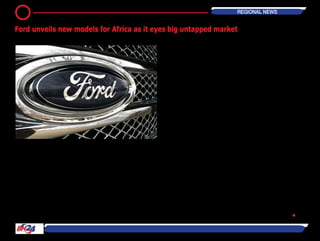
Ford unveils new models for Africa as it eyes big untapped market
BH24
17 DIARY OF EVENTS
The black arrow indicate level of load shedding across the country.
POWER GENERATION STATS
Gen Station
14 July 2014
Energy
(Megawatts)
Hwange 421 MW
Kariba 750 MW
Harare 45 MW
Munyati 29 MW
Bulawayo 0 MW
Imports 0 MW
Total 1245 MW
23 -25 July - Mine Entra, Place: Zimbabwe Inter-
national Exhibition Centre, Bulawayo
24 July - OK Zimbabwe Thirteenth Annual Gen-
eral Meeting Place: OKMart Functions Room,
First Floor, OKMart, 30 Chiremba Road, Hillside, Time:
15:00 hours.
1 August - Sixteenth Annual General Meeting
of the members of Econet Wireless Zimbabwe
Limited, Place: Econet Park, 2 Old Mutare Road,
Msasa, Harare, Time; 10.00am
THE BH24 DIARY
BH24
19 zse
ZSE
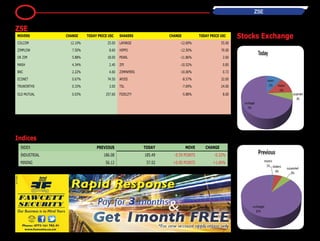
Movers CHANGE Today Price USc SHAKERS Change TODAY Price USc
Colcom 12.10% 25.00 Lafarge -12.69% 55.00
Zimplow 7.50% 8.60 Hippo -12.50% 70.00
OK Zim 5.88% 18.00 Pearl -11.86% 2.60
Mash 4.34% 2.40 ZPI -10.52% 0.85
BNC 2.22% 4.60 Zimpapers -10.00% 0.72
Econet 0.67% 74.50 AFDIS -8.57% 32.00
Truworths 0.33% 3.00 TSL -7.69% 24.00
Old Mutual 0.03% 257.60 Fidelity -5.88% 8.00
Indices
Index Previous Today Move Change
Industrial 186.08 185.49 -0.59 points -0.32%
Mining 56.12 57.02 +0.90 points +1.60%
Stocks Exchange
BH24
21 AFRICA StockS
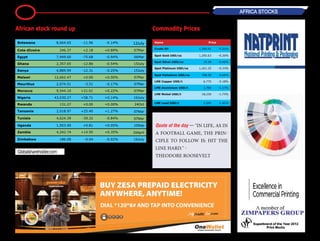
Botswana 8,664.65 -11.96 -0.14% 12July
Cote dIvoire 246.37 +2.18 +0.89% 07Mar
Egypt 7,949.60 -75.68 -0.94% 06Mar
Ghana 2,357.65 -12.86 -0.54% 15July
Kenya 4,889.99 -12.31 -0.25% 15July
Malawi 12,662.47 +0.00 +0.00% 07Mar
Mauritius 2,074.51 -3.51 -0.17% 07Mar
Morocco 9,544.10 +21.01 +0.22% 07Mar
Nigeria 43,030.27 +58.71 +0.14% 16July
Rwanda 131.27 +0.00 +0.00% 24Oct
Tanzania 2,018.97 +25.40 +1.27% 07Mar
Tunisia 4,624.39 -39.32 -0.84% 07Mar
Uganda 1,503.90 +0.81 +0.05% 10Sep
Zambia 4,242.74 +14.95 +0.35% 10April
Zimbabwe 186.08 -0.04 -0.02% 16July
African stock round up Commodity Prices
Name Price
Crude Oil 1,300.91 -0.21%
Spot Gold USD/oz 1,292.63 -0.26%
Spot Silver USD/oz 19.38 -0.46%
Spot Platinum USD/oz 1,421.25 -0.33%
Spot Palladium USD/oz 798.50 -0.64%
LME Copper USD/t 6,770 -0.18%
LME Aluminium USD/t 1,780 -1.17%
LME Nickel USD/t 18,230 -1.73%
LME Lead USD/t 2,095 -1.41%
Quote of the day — "In life, as in
a football game, the prin-
ciple to follow is: Hit the
line hard." -
Theodore Roosevelt
Globalshareholder.com
BH24
Gold extended an advance from a
three-week low amid signs of increased
demand in China and India, the world’s
two largest consumers. Palladium
climbed to the highest level since 2001.
Bullion for immediate delivery rose
as much as 0.7 percent to $1,308.31
an ounce and traded at $1,305.34 at
3:25 p.m. in Singapore, according to
Bloomberg generic pricing.
The metal fell to $1,292.26 on July 15,
the lowest level since June 19 as inves-
tors assessed prospects for higher U.S.
interest rates.
Palladium climbed 0.9 percent after the
U.S. and Europe increased sanctions on
Russia, the biggest producer.
Gold imports by India jumped 65 per-
cent to $3.12 billion in June from $1.89
billion a year earlier, after the central
bank allowed more banks and traders
to buy bullion overseas, the Commerce
Ministry said yesterday.
In China, which surpassed India last
year as the biggest consumer, volumes
for the benchmark spot contract in
Shanghai rose for a second day yes-
terday to a one-week high of 13,421
kilograms.
“The drop below $1,300 has gener-
ated some buying interest, especially
from physical users,” said Zhu Siquan,
an analyst at GF Futures Co. in Guang-
zhou, China. “Gold continues to take
cues from the Federal Reserve and U.S.
economic data.”
Fed Chair Janet Yellen said yesterday
that while she’s optimistic about the
economy, accommodation is necessary.
U.S. data today may show improve-
ments in the housing market after a
report yesterday showed industrial pro-
duction climbed in June.
SPDR Holdings
Gold sank the most in more than three
decades in 2013 amid expectations
the Fed will reduce stimulus as the U.S
economy recovers. Prices rebounded
8.6 percent this year, in part as U.S.
policy makers pledged to keep interest
rates low.
Gold for August delivery added 0.5
percent to $1,305.60 an ounce on
the Comex. Holdings in the SPDR
Gold Trust, the biggest bullion-backed
exchange traded product, fell to 806.03
metric tons yesterday, the first decline
in a week.
Palladiumforimmediatedeliveryroseto
$881.50 an ounce. The Obama admin-
istration, acting in concert with the
European Union, imposed sanctions on
Russian banks, energy companies and
defense firms yesterday in a bid to pun-
ish it over Ukraine.
The metal, used in pollution-control
devices for cars, has advanced 23 per-
cent this year after a five-month mine
strike reduced production in South
Africa, the second-biggest producer,
amid rising global auto sales.
Spot platinum increased 0.6 percent
to $1,493.75 an ounce. Silver added
0.3 percent to $20.8260 an ounce. ―
Bloomberg •
23 INTERNATIONAL NEWS
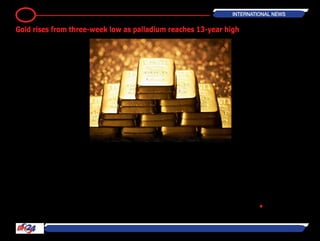
Gold rises from three-week low as palladium reaches 13-year high
By Nigel Gambanga
There are more people signing up for
mobile connections but fewer calls are
being made by these same subscrib-
ers.
This fact has been expressed by
the Postal and Telecommunications
Regulatory Authority of Zimbabwe
(POTRAZ)'s Sector Performance Report
for the first quarter of 2014.
The report has provided a snapshot
perspective on the state of telecoms
in Zimbabwe, with a notable decline
in mobile traffic being registered in the
first quarter of the year.
While the number of subscribers has
gone up by 1,9 percent the data in the
report shows a 20,7 percent decline
in total mobile traffic from 2,4 billion
minutes in the last quarter of 2013 to
1,9 billion minutes in the first quarter
of 2014.
Ironically the largest decline in mobile
traffic was noted in net-on-net traffic,
this is despite the string of on-net call
promotions from operators such as the
bundles promotions from Econet and
Telecel as well as NetOne's dollar a day
feast.
An obvious trend regarding traffic has
been the decline of international traffic,
which is attributable to the proliferation
of alternatives for communication such
as WhatsApp and VoIP solutions like
Skype and Viber.
Inversely Internet subscriptions are
up by 2,9 percent with 98 percent of
total internet connections being noted
through mobile data. This should trig-
ger a greater focus on data solutions
from the MNOs, something that has
already started with OTT services for
Facebook and WhatsApp.
Traffic between mobile operators and
VoIP operators has increased, with
incoming calls from VoIP up 20,6 per-
cent and outgoing calls up by 1,6 per-
cent. According to the report, this is a
result of interconnection agreements
between IAPs and MNOs.
Hopefully these agreements stretch
into fair pricing policies which could be
an issue judging from how the three
MNOs are offering voice call discounts
that encroach into the VoIP operators'
pricing models. The declining trend in
mobile traffic is attributable to inter-
twined factors actually.
These include a tougher challenge on
the average subscriber’s disposable
income, the emergence of alternatives
such as Instant Messaging (WhatsApp
is the biggest culprit/subscriber's sav-
iour here) and a greater awareness of
the possibilities presented by broad-
band. The era of data is definitely
upon us judging from the facts on the
ground.
In a not-so-friendly economic environ-
ment the average subscriber will spend
less on voice calls, particularly when
such communication can be substi-
tuted by cheap alternatives.
It's even more convenient when
these alternatives are offered through
affordable bundles. ― TechZim •
24 Analysis
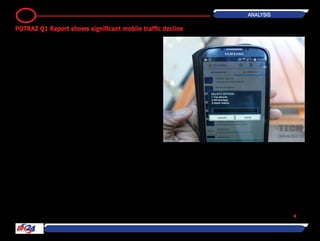
POTRAZ Q1 Report shows significant mobile traffic decline

Court dismisses Base Minerals Zimbabwe's appeal

  • 1.
    News Update as@ 1530 hours, Thursday 17 July 2014 Feedback: bh24admin@zimpapers.co.zwEmail: bh24feedback@zimpapers.co.zw By Fidelis Munyoro The Supreme Court has dismissed an appeal in the case in which Base Min- erals Zimbabwe was seeking to quash a High Court decision made in favour of Mabwe Minerals Zimbabwe in a dis- pute over control of barite Dodge Mine in Shamva. Justice Vernanda Ziyambi threw out the appeal for lack of merit. “The unan- imous decision of this court is that the appeal be and is hereby dismissed with cost,” she said. Base Minerals had approached the Supreme Court on appeal after the High Court stopped it from interfering withMabweMineralsminingoperations at Dodge Mine in Shamva. The firm, whichclaimedtobetheholderofatrib- ute of more than six disputed mining claims at Dodge Mine, had deployed an army of armed security personnel who cut through locks and barriers, chasing Mabwe Minerals guards from the premises and took occupation of the mine in the face of a court order against it. On appeal, the firm’s lawyer Francis Katsande argued that the lower court erred when it dealt with an application forinterdictbroughtbeforeitbyMabwe Minerals when there was an application for same relief pending before another court. The judge, argued Katsande, went remiss by deciding on a matter already before the same court. But Mabwe Minerals lawyer Adv Sithembiso Magwaliba urged the court to throw out the appeal for want of compliance with procedure. He argued that Base Minerals submis- sion that when it deployed its guards at the mine it wanted to enforce a tribute agreement was misplaced in a spolia- tion process adding that a tribute could not be enforced by guns and violence. Adv Magwaliba said Mabwe Minerals were the rightful owners of the mine. He also said the notice of appeal was fatally defective and could not be allowed. Mabwe Minerals, which is engaged in the mining and commercial sales of industrial minerals and met- als, acquired the mineral and metal rights for 110 hectares (272 acres) at its Dodge barite mine in Shamva early this year. The company mainly mines barite, a crystalline mineral of barium sulfate (can be white, yellow or colourless) that is used in paint manufacturing and is mostly used as industrial mineral and is also a chief source of barium chem- icals. The hydrothermal barite deposits on Dodge Mine are considered world class due to their high percentage content of barium sulfate. Court dismisses Base Minerals Zimbabwe's appeal Justice Ziyambi
  • 2.
    2 NEWS Mabwe Mineralsdirector Tapiwa Gurupira told The Herald early this year that the company’s property now cov- ers a total area of 233 hectares (576 acres). He said with the extension, the Dodge Mine property range now extends to include all of the first three mountains and a portion of the fourth mountain moving east-to-west. He said Mabwe Minerals has been targeting the expan- sionsincetheareawasgravitymapped in 2012 indicating the continued pres- ence of barite towards the largest mountain on the western end. Gurupira said with a number of third party geologists having visited the mine, it was certain the company aims for expansion this year. Mabwe Minerals has been making plans to initiate a drilling programme that is necessary to complete the grav- ity mapping interpretation with volume estimates. Now that the Dodge Mine extension certificate has been issued by the office of the Mining Commissioners, WGB Kinsey & Company intends to proceed with finalising the drilling plan. Mabwe Minerals Inc. is a US based nat- uralresourcesandhardassetcompany engaged in the mining, logistics and commercial sales of industrial minerals and metals, with first focus on barite and limestone. • By Funny Hudzerema Adherence to quality standards can contribute to the growth of the Zim- babwean economy, an international standards expert has said. International Organisation for Stand- ards (ISO) expert Jochen Fornather said strengthening standards adher- ence results in the production and provision of goods and services that match the requirements of the global market. “All sectors must be in the SAZ to increase economic development through the standardisation of prod- ucts engagement by all stakeholders. "Through the standardisation of goods and services can result in economic development of about 25 percent and can reduce barriers to trade in Zim- babwe, in Africa and the world," said Fornather. He was speaking at a standards work- shop that was jointly organised by SAZ and the ISO. Fornather said Zimbabwe can draw lessons from the European Union where standardisation is of economic importance. “Every euro invested in standardi- sation generates a forty-fold return and standard goods reduce the level of reduction of transaction costs,” he said. “For example, the Austrian standards body has managed to con- tribute about 2,5 million euros every year through the standardisation of goods and services." Even at the World Trade Organisation (WTO) level, the issue of standards is central as it drives the international trade without barriers agenda. A Zimtrade survey released in May this year showed that 42 percent of products from manufacturing sector were certified, a factor that was hin- dering Zimbabwe's export growth. SAZ director general Eve Gadzikwa said for Zimbabwe to achieve business success issues relating to competi- tiveness, trade and consumer protec- tion needed to be addressed. • 'Standards key to economic growth'
  • 3.
  • 4.
    By Rumbidzayi Zinyuke MeiklesAfrica employees say they might not benefit anything from the Employee Share Ownership Trust formed in line with the country’s indi- genisation laws as they are yet to receive any funds to purchase the 24 million shares promised by the com- pany. Last year, the group said it would extend assistance to the ESOT if the funds on deposit held by the Reserve Bank of Zimbabwe were repaid. The central bank owes Meikles approxi- mately $76,5 million dating back to 1998. Representatives of different arms of the Meikles group told the the- matic committee on Indigenisation, empowerment and economic devel- opment that only one third of the 10 percent they were promised when the ESOT was formed has been paid for so far. “The board of trustees borrowed $1,4 million from the Old Mutual pension fund to which we contribute and bought eight million shares. We however do not have any money to pay for the remaining shares and we are still waiting for the Government to pay what it owes to the company,” said Rodney Mutinhiri, chairperson of the Worker’s committee. He said the employees would only start benefitting from the ESOT once payment for the remaining shares was complete which meant that those who retired or are laid off work will not benefit. “We are not going to benefit anything from the ESOT until we have paid for all the shares and received the share certificate. This means we will not how many shares each individual is entitled to until that happens. At the same time, we cannot see its growth on our money in the pension fund because it is tied up in the shares,” he said. Chairman of the Tanganda Tea Com- pany worker’s committee Blame Donza said management had refused their offer to contribute towards the payment of the shares. “When we met them in April, management said at the moment there is no money so even if we contribute it will not make a difference because there is a lot of money needed. We had suggested contributing at least $5 per employee every month so that we can pool money to pay for the shares. We were concerned that some of our workers were retiring and leaving with benefiting from the ESOT,” he said. The representatives said they believe the company is stalling the comple- tion of the payment to avoid trans- ferring the shares to the employees. They alleged the group is just putting a show for Government to believe they had complied with indigenisation requirements. • 4 NEWS Meikles workers not benefiting from employee share scheme
  • 5.
    5 MINING Unki Mine'sQ2 production remains flat By Tawanda Musarurwa Local platinum producer Unki Mine's output for the second quarter ended 30 June 2014 was flat at 15 000 ounces. In its latest Q2 update, Anglo Ameri- can Platinum (Angloplat) which owns the Unki Mine, said the long-drawn- out strike had no material effect on Unki and the group's other South Africa-based platinum mine - the Mogalakwena and other joint opera- tions and associates. "The industrial action did not impact production at the Mogalakwena and Unki mines nor at the majority of the joint operations and associates. "Mogalakwena mine's production increased by 23 percent to 96 000 ounces, due to higher achieved 4E head grade and increased concen- trator throughput, supported by the mining productivity improvement programmes. Unki mine production was flat at 15 000 ounces," said the group. Unki is the third largest platinum pro- ducer in Zimbabwe. In the first quarter of the current year, Unki's platinum output bumped 4 percent, a factor the company then attributedtohighervolumesdelivered to the concentrator and throughput at the mills. Unki's production figures in the first two quarters of the year are however below guidance as the mine produced 67 000 ounces in the prior year, but this remains a fraction of Amplats’ 1,5 million ounce annual output. Angloplat has so far invested $350 million at Unki since it started opera- tions, producing 67 000 refined plati- num ounces in 2013. Production at Unki been on a steady rise since the mine was fully commis- sioned at the beginning of 2011. The smaller mines notwithstanding, Angloplat said the huge South Afri- ca-based platinum producers were negatively impacted by the strike, which led to a decline in overall refined platinum output. "Equivalent refined platinum pro- duction decreased by 40 percent to 358 000 ounces, primarily due to the industrial action, which began on 23 January 2014 and which affected the Rustenburg, Amandelbult and Union mines in South Africa. The industrial action concluded on 24 June 2014. The total platinum ounces lost due to the industrial action for the second quarter was 239,000 ounces. "Total lost production from the indus- trial action during H1 2014 was 424 000 ounces and a further 16,000 ounces has been lost during the ramp up of operations as "safe return to work" procedures are undertaken before mining can commence. In addition, production was 44,000 ounces lower due to the consolidation of mines at Rustenburg and Union as part of the restructuring in 2013," said AngloPlat. • Unki Mine
  • 6.
  • 7.
    7 NEWS BH24 Reporter Jersey-registeredand London-listed Masawara is set to extend its con- trol of Zimbabwe's largest holding company, TA Holdings by buying out minority shareholders in the group. Masawara - an investment com- pany focused on acquiring interests in companies and projects based in Zimbabwe and the Southern African region - have offered to acquire all the issued ordinary shares in TA Hold- ings not currently under its ambit. Masawara presently holds an effective 39 percent interest in TA Holdings. In a cautionary statement released today, TA Holdings announced that it had received an offer from Masawara to purchase 58,96 percent of the ordinary issued share capital of the company at a price of 20,6 cents per share through a scheme of arrange- ment. "(S)hareholders are advised that the directors have received an offer from Masawara Mauritius Limited (“Masawara”), a wholly owned sub- sidiary of Masawara Plc, for Masawara or its affiliates to acquire all the issued ordinary shares in TA Holdings Lim- ited (“the Company”) not currently held by companies under the control of Masawara Plc, constituting 58,96 percent of the ordinary issued share capital of the Company, at a price of $0,206 (twenty point six United States cents) per share through a scheme of arrangement under Sec- tion 191 of the Companies Act (Chap- ter 23:04)," reads part of the caution- ary. "The requisite notice of the scheme of arrangement and the scheme docu- ment incorporating an explanatory statement, the fair and reasonable opinion of the independent financial advisor appointed by the independ- ent directors of the Company and the independent directors’ opinion and voting recommendations will be sent to the Company’s shareholders in due course. "The offer is subject to all applicable regulatory approvals being met." • Masawara to buyout TA Holdings minorities Mr Mutasa
  • 8.
  • 9.
    BH24 Reporter Beneficiation andvalue addition will be the running theme for the 34th SADC Summit which will be hosted by Zimbabwe, an official has said. The Summit is set for Victoria Falls next month. Addressing journalists on the prepa- rations for the 34th SADC Summit Foreign Affairs Minister Simbarashe Mumbengegwi on Wednesday said the beneficiation theme was in line with the country's long-term eco- nomic strategy. "(T)his time we have selected a theme on the “SADC Strategy for Economic Transforma- tion: Leveraging the Region’s Diverse Resources for Sustainable Economic and Social Development through Beneficiation and Value Addition”. "This theme has been selected very carefully because Zimbabwe believes very strongly in the importance of beneficiating and value adding of our natural resources," said Minister Mumbengegwi. "I think you have all head how President Robert Mugabe has never stopped talking about this issue. Why should we always export our natural resources in their raw form? By so doing, we only get about 10 percent of the value of our prod- ucts whether they be in agriculture, mining or whatever, we lose a lot. "So, the question of value addition is critical not only to Zimbabwe but to the whole of SADC, so in consultation with the secretariat we have come up with this particular theme." The Government fully appreciates the importance of beneficiating its minerals (as shown by strategies announced by Finance Minister Pat- rick Chinamasa in the 2014 National Budget). Minister Mumbengegwi said the problem was not peculiar to Zimbabwe, but it was common amongst the SADC countries as well. "The SADC region is endowed with resources, the same as Africa as a whole. Very rich in resources, but the paradox is that with such abundance of natural resources we are poor. "That’s the paradox. Why are we poor? Because we do not get the full benefit of our natural resources and this is the thrust we would want to champion not only during President Mugabe’s chairmanship of SADC, but to be able to come up with strategies and programmes of action which can continue even after President Mug- abe has left the chairmanship of the organisation because this is a critical area not only for SADC but for the whole African continent and other developing countries," he said. He however highlighted that apart from discussing the theme, there will also be other administrative aspects that the Summit will address, although the overall agenda is yet to be finalised. Zimbabwe will assume the chairmanship of SADC from August this year to August 2015. To this extent, the country will host all meetings of SADC with the Summit among the most important of these. • 9 NEWS Beneficiation to top 34th Sadc Summit agenda Minister Mumbengegwi
  • 10.
  • 11.
    The equities markethas remained sluggish as the week heads to a close, going down 0.32 percent in today's trades. The industrial index slipped by 0.59 points to close at 185.49 points as losses weighed heavy. Hippo lost 10 cents to trade at 70 cents, while cement producer Lafarge dropped 8 cents to trade at 55 cents. AFDIS shed 3 cents to close at 32 cents. Other losses were in TSL which dropped 2 cents to close at 24 cents and NTS which slipped a cent to close at 1.70 cents. On the upside, Colcom led the movers with a 2.70 cents gain to close at 25 cents, and giant retailer OK Zimbabwe recovered a cent to close at 18 cents. Zimplow added 0.60 cents to close at 8.60 cents and MASH (MASH.zw) added 0.10 cent to 2.40 cents. Econet gained 0.50 cents to close at 74.50 cents after reports that the giant telecoms firm's subscriber base grew by 4.1 percent in the first quar- ter of this year to reach nine million. The mining index was 0.90 points (or 1.60 percent) higher to close at 57.02 points as Bindura traded 0.10 cents firmer at 4.60 cents. Falgold, Hwange and Riozim all main- tained previous trading levels. ― BH24 Reporter • 11 ZSE REVIEW Equities maintain negative run
  • 12.
    SPECIALISTS IN DRIVESHAFTSAND PROPSHAFTS, STEERING RACKS, BALL JOINTS, DRAGLINKS, TIE ROD ENDS, CV JOINTS, TRANSMISSIONS, UNIVERSAL JOINTS, FLANGES, BEARINGS, BUSHES, YOKES, GENERAL ENGINEERING, BELL SPARES, AIR BRAKES AND PNUEMATICS, SUPPLY AND SERVICE EXCHANGE FOR COMPLETE AXLES, ENGINES AND GEARBOXES. NATIONAL PROPSHAFTS CENTRE No. 17033 CEDORA ROAD, P.O. BOX GT 1244, GRANITESIDE, HARARE, ZIMBABWE. Website: www.propshaftscenter.co.zw TEL: 770638-43, 086 4406 8386 CELL: 0772 470665, 0712 204396, 086 44068386, 0712 749578 Email: sales@nationalpropshafts.co.zw MUTARE PROPSHAFTS CENTRE 12 A RIVERSIDE DRIVE P.O.BOX 1869, MUTARE, ZIMBABWE Website: www.propshaftscenter.co.zw Tel: 66084, 086 4406 8385, Fax: 68597 Cell: 0712 204396, 0772 715388, 0773 782502 Email: sales@mpc.co.zw, mpc@mweb.co.zw BELL DIFFS COMPRESSORS UNIVERSAL JOINTS TA 1919 PUMPS, WATER PLATES & DOUBLE BOSH PUMPS MT643 TRANSMISSIONS STEERING COUPLINGS FOOT BRAKE & VALVESCENTRE BEARINGS PROPSHAFTS SPARES SPIDER BEARINGS BOOSTERS PROPSHAFT COUPLINGS PROPSHAFTS & DRIVE SHAFTS TRACK RODS & DRAGLINKS BH24
  • 13.
    Government, through theindigenisa- tion and empowerment laws, made a call to foreign owned companies to empower their employees through Employee Share Ownership Trusts. The ESOTs are envisioned in the Indi- genisation and Economic Empower- ment (General) Regulations of 2010. Many of the companies have complied and ceded the requisite 10 percent to their employees in a move that is supposed to see workers reaping the benefits of the empowerment drive. Big mining companies such as Zim- babwe Platinum Holdings, Mimosa and Anglo Platinum launched their employee share schemes alongside community share ownership schemes while corporates like Meikles, Old Mutual, Delta Beverages and BAT Zimbabwe also launched theirs. Basically, an employee share owner- ship scheme is a contribution plan that provides a company’s workers with an ownership interest in the company. Under such schemes, companies provide their employees with stock ownership, typically at no cost to the employees. The model of Zimbabwe’s indigenisa- tion law places prominence on wealth creation through broad-based par- ticipation of the indigenous people in economic activity. But since the launch of these ESOTs (and some of the CSOTs), we have noticed little to no change in the liveli- hoods of the people targeted by such drives. What has happened is that the schemes have become mere decora- tions; a means to avoid punishment from a Government that expects the companies to contribute to communi- ties and employees livelihoods. Senators today heard that the Meikles ESOT is yet to take effect because there is no money to pay for the shares. Although Meikles promised to help its employees to buy the 10 percent stake, the condition was only after Government has paid back more than $80 million owed to the company by the RBZ. So this means if the Government does not have the capacity to pay Meikles, the employees suffer. It basically means they are holding Government ransom! And workers whose pension money was taken to pay for part of the stake will lose out on both the ESOT and their pension if they retire before Gov- ernment pays its debt. That management has also denied the employees the chance to pay for their own shares means they just want to have something to hold over them or they just want to keep hold of those shares. Unless they are paid for, they belong to Meikles not the employees. These big companies have a com- munity as well as employees for so long and they are getting away with it because there have been loopholes in the manner in which the programme was carried out. So Government should do a few things to correct this problem. First, Government should close off all those loopholes being manipulated by companies so that they do not have a choice but contribute to the welfare of employees and communities. Then it should go back to the draw- ing board and make the provisions for ESOTs and CSOTs clear. Government should also make time frames for the operationalisation of the schemes clear so that companies comply with these provisions on time. Or else it will take decades for the schemes to start benefitting the employees. Last, Government should ensure that all companies that launched ESOTs and CSOTs are making good their promise. We are tired of empty promises, promises made to make the powers that be happy but not followed up with action. It’s time we see some action! Employ- ees should receive their benefits for working for that company before they die. After all, their children might not even benefit once they are gone. • 13 BH24 COMMENT ESOTs should make a difference in workers' lives
  • 14.
  • 15.
    Ford Motor Corporationannounced 17 new vehicles for Sub-Saharan Africa on Thursday, as carmakers jostle for posi- tions in one of the last major markets where potential growth remains largely untapped. The models, among 25 to be intro- duced by 2016 in a broader product offensive across the Middle East and Africa, draw on the US auto giant's global vehicle architectures to offer more up-to-date features for markets such as South Africa. "Middle East and Africa is the final frontier for global automotive growth," Ford's regional chief Jim Benintende said. "We're put- ting the infrastructure and people in place to participate." Western carmakers are showing renewed interest in Africa, in some cases reviving previously abandoned manufacturing sites or considering new ones. Chinese brands are also a growing presence on the streets of cities such as Nairobi and Lagos. On Wednesday, PSA Peugeot Citroen announced the gradual resumption of car assembly in Nigeria, Africa's most populous country, and said it may soon add a second and third model there. Total vehicle sales across the Middle East and Africa region are expected to grow 40 percent by the end of the dec- ade, according to Ford's projections. The planned model roll-out includes updated versions of the Focus compact and Fusion large car, escorted by Ford's resurrected Mustang sports car. They bring a step up in fuel economy, touch- screen connectivity and other features intended to hone Ford's competitive- ness against more spartan rivals in African markets. At the start of this year, Ford created its Middle East & Africa business unit in a region that includes 67 countries, part of which until this year reported to Ford's Europe operations, part to North America and part to Asia-Pacific. Ford sold about 200,000 autos in the Mid- dle East and Africa in 2013, including a sales increase of 40 percent in South Africa to 64,500 vehicles, its top mar- ket in the region. Its second-biggest market in the region is Saudi Arabia, where it sold 54,000 vehicles last year. IHS Automotive consultancy said Ford was fifth in South African auto sales last year with a 9 percent market share and sixth in Saudi Arabia with a 4 percent market share. But Ford's long-established South African manu- facturing base may yet be undermined by industrial unrest. Ford was forced to halt one of its two plants in the country this week as a wave of strikes that had crippled the mining sector and broader economyspreadtoautosuppliers,with workers seeking pay increases of 12 percent to 15 percent. The stoppages have also hit General Motors, Toyota, and Mercedes-Benz and may soon affect BMW and Nissan unless resolved swiftly. Ford regional chief Benintende has sought to play down suggestions that unrest could ultimately force the Dearborn, Mich- igan-based automaker to move pro- duction elsewhere. ― Reuters • 15 REGIONAL News Ford unveils new models for Africa as it eyes big untapped market
  • 16.
  • 17.
    17 DIARY OFEVENTS The black arrow indicate level of load shedding across the country. POWER GENERATION STATS Gen Station 14 July 2014 Energy (Megawatts) Hwange 421 MW Kariba 750 MW Harare 45 MW Munyati 29 MW Bulawayo 0 MW Imports 0 MW Total 1245 MW 23 -25 July - Mine Entra, Place: Zimbabwe Inter- national Exhibition Centre, Bulawayo 24 July - OK Zimbabwe Thirteenth Annual Gen- eral Meeting Place: OKMart Functions Room, First Floor, OKMart, 30 Chiremba Road, Hillside, Time: 15:00 hours. 1 August - Sixteenth Annual General Meeting of the members of Econet Wireless Zimbabwe Limited, Place: Econet Park, 2 Old Mutare Road, Msasa, Harare, Time; 10.00am THE BH24 DIARY
  • 18.
  • 19.
    19 zse ZSE Movers CHANGEToday Price USc SHAKERS Change TODAY Price USc Colcom 12.10% 25.00 Lafarge -12.69% 55.00 Zimplow 7.50% 8.60 Hippo -12.50% 70.00 OK Zim 5.88% 18.00 Pearl -11.86% 2.60 Mash 4.34% 2.40 ZPI -10.52% 0.85 BNC 2.22% 4.60 Zimpapers -10.00% 0.72 Econet 0.67% 74.50 AFDIS -8.57% 32.00 Truworths 0.33% 3.00 TSL -7.69% 24.00 Old Mutual 0.03% 257.60 Fidelity -5.88% 8.00 Indices Index Previous Today Move Change Industrial 186.08 185.49 -0.59 points -0.32% Mining 56.12 57.02 +0.90 points +1.60% Stocks Exchange
  • 20.
  • 21.
    21 AFRICA StockS Botswana8,664.65 -11.96 -0.14% 12July Cote dIvoire 246.37 +2.18 +0.89% 07Mar Egypt 7,949.60 -75.68 -0.94% 06Mar Ghana 2,357.65 -12.86 -0.54% 15July Kenya 4,889.99 -12.31 -0.25% 15July Malawi 12,662.47 +0.00 +0.00% 07Mar Mauritius 2,074.51 -3.51 -0.17% 07Mar Morocco 9,544.10 +21.01 +0.22% 07Mar Nigeria 43,030.27 +58.71 +0.14% 16July Rwanda 131.27 +0.00 +0.00% 24Oct Tanzania 2,018.97 +25.40 +1.27% 07Mar Tunisia 4,624.39 -39.32 -0.84% 07Mar Uganda 1,503.90 +0.81 +0.05% 10Sep Zambia 4,242.74 +14.95 +0.35% 10April Zimbabwe 186.08 -0.04 -0.02% 16July African stock round up Commodity Prices Name Price Crude Oil 1,300.91 -0.21% Spot Gold USD/oz 1,292.63 -0.26% Spot Silver USD/oz 19.38 -0.46% Spot Platinum USD/oz 1,421.25 -0.33% Spot Palladium USD/oz 798.50 -0.64% LME Copper USD/t 6,770 -0.18% LME Aluminium USD/t 1,780 -1.17% LME Nickel USD/t 18,230 -1.73% LME Lead USD/t 2,095 -1.41% Quote of the day — "In life, as in a football game, the prin- ciple to follow is: Hit the line hard." - Theodore Roosevelt Globalshareholder.com
  • 22.
  • 23.
    Gold extended anadvance from a three-week low amid signs of increased demand in China and India, the world’s two largest consumers. Palladium climbed to the highest level since 2001. Bullion for immediate delivery rose as much as 0.7 percent to $1,308.31 an ounce and traded at $1,305.34 at 3:25 p.m. in Singapore, according to Bloomberg generic pricing. The metal fell to $1,292.26 on July 15, the lowest level since June 19 as inves- tors assessed prospects for higher U.S. interest rates. Palladium climbed 0.9 percent after the U.S. and Europe increased sanctions on Russia, the biggest producer. Gold imports by India jumped 65 per- cent to $3.12 billion in June from $1.89 billion a year earlier, after the central bank allowed more banks and traders to buy bullion overseas, the Commerce Ministry said yesterday. In China, which surpassed India last year as the biggest consumer, volumes for the benchmark spot contract in Shanghai rose for a second day yes- terday to a one-week high of 13,421 kilograms. “The drop below $1,300 has gener- ated some buying interest, especially from physical users,” said Zhu Siquan, an analyst at GF Futures Co. in Guang- zhou, China. “Gold continues to take cues from the Federal Reserve and U.S. economic data.” Fed Chair Janet Yellen said yesterday that while she’s optimistic about the economy, accommodation is necessary. U.S. data today may show improve- ments in the housing market after a report yesterday showed industrial pro- duction climbed in June. SPDR Holdings Gold sank the most in more than three decades in 2013 amid expectations the Fed will reduce stimulus as the U.S economy recovers. Prices rebounded 8.6 percent this year, in part as U.S. policy makers pledged to keep interest rates low. Gold for August delivery added 0.5 percent to $1,305.60 an ounce on the Comex. Holdings in the SPDR Gold Trust, the biggest bullion-backed exchange traded product, fell to 806.03 metric tons yesterday, the first decline in a week. Palladiumforimmediatedeliveryroseto $881.50 an ounce. The Obama admin- istration, acting in concert with the European Union, imposed sanctions on Russian banks, energy companies and defense firms yesterday in a bid to pun- ish it over Ukraine. The metal, used in pollution-control devices for cars, has advanced 23 per- cent this year after a five-month mine strike reduced production in South Africa, the second-biggest producer, amid rising global auto sales. Spot platinum increased 0.6 percent to $1,493.75 an ounce. Silver added 0.3 percent to $20.8260 an ounce. ― Bloomberg • 23 INTERNATIONAL NEWS Gold rises from three-week low as palladium reaches 13-year high
  • 24.
    By Nigel Gambanga Thereare more people signing up for mobile connections but fewer calls are being made by these same subscrib- ers. This fact has been expressed by the Postal and Telecommunications Regulatory Authority of Zimbabwe (POTRAZ)'s Sector Performance Report for the first quarter of 2014. The report has provided a snapshot perspective on the state of telecoms in Zimbabwe, with a notable decline in mobile traffic being registered in the first quarter of the year. While the number of subscribers has gone up by 1,9 percent the data in the report shows a 20,7 percent decline in total mobile traffic from 2,4 billion minutes in the last quarter of 2013 to 1,9 billion minutes in the first quarter of 2014. Ironically the largest decline in mobile traffic was noted in net-on-net traffic, this is despite the string of on-net call promotions from operators such as the bundles promotions from Econet and Telecel as well as NetOne's dollar a day feast. An obvious trend regarding traffic has been the decline of international traffic, which is attributable to the proliferation of alternatives for communication such as WhatsApp and VoIP solutions like Skype and Viber. Inversely Internet subscriptions are up by 2,9 percent with 98 percent of total internet connections being noted through mobile data. This should trig- ger a greater focus on data solutions from the MNOs, something that has already started with OTT services for Facebook and WhatsApp. Traffic between mobile operators and VoIP operators has increased, with incoming calls from VoIP up 20,6 per- cent and outgoing calls up by 1,6 per- cent. According to the report, this is a result of interconnection agreements between IAPs and MNOs. Hopefully these agreements stretch into fair pricing policies which could be an issue judging from how the three MNOs are offering voice call discounts that encroach into the VoIP operators' pricing models. The declining trend in mobile traffic is attributable to inter- twined factors actually. These include a tougher challenge on the average subscriber’s disposable income, the emergence of alternatives such as Instant Messaging (WhatsApp is the biggest culprit/subscriber's sav- iour here) and a greater awareness of the possibilities presented by broad- band. The era of data is definitely upon us judging from the facts on the ground. In a not-so-friendly economic environ- ment the average subscriber will spend less on voice calls, particularly when such communication can be substi- tuted by cheap alternatives. It's even more convenient when these alternatives are offered through affordable bundles. ― TechZim • 24 Analysis POTRAZ Q1 Report shows significant mobile traffic decline