News Update as @ 1530 hours, Tuesday 3 June 2014
Feedback: bh24admin@zimpapers.co.zwEmail: bh24feedback@zimpapers.co.zw
By Tawanda Musarurwa
The Government should set internation-
allycompetitivemarketpricesforartisanal
gold producers to discourage smuggling,
theGovernanceofAfrica’sResourcesPro-
gramme(GARP)hassaid.
The move will also strengthen due dili-
gence and incentivise better practices in
small-scale gold production in the coun-
try."Policymakersneedtoensurethatfair
prices are set for the gold produced by
artisanal and small-scale miners, as this
willincentivisebetterminingpractices.
"Betterpricingisalsocrucialtoaddressthe
problem of gold being smuggled to bet-
ter-paying markets. It is estimated that
more than 15 tonnes of gold, amounting
to over $400 million, were smuggled out
of Zimbabwe between 2002 and 2007,"
said the institute in a policy briefing enti-
tled 'Revamping Artisanal Gold Mining in
Zimbabwe to Catalyse Poverty Reduc-
tion'. GARP (which runs under the South
African Institute of Foreign Affairs) "aims
to improve policies governing Africa’s
abundantnaturalresources".
Small-scale gold mining is seen as con-
tributingsignificantlytothecountry'stotal
gold output. It has been estimated that
artisanal and small-scale gold producers
contribute over one tonne of gold to Zim-
babwe’smonthlyoutput.
Official estimates from the Ministry of
Mines and Development suggest that
small-scale miners were responsible for
30 percent of the 11,79 tonnes of gold
produced in 2012. But experts believe
that the contribution of the small-scale
goldproducerscouldbegreaterifthesec-
tor'sregulatoryframeworkisimproved.
According to GARP, local small-scale pro-
ducers can benefit from well-defined land
rights and lower licensing fees as this will
help streamline registration and regula-
toryoversightofthesector.
"WhileZimbabwe’sMineandMineralsAct
of 2006 does make provision for the reg-
istration of land holdings smaller than 2
ha,amajorpartoftheproblemisrelated
to the absence of policies directed at the
artisanal gold miners, who operate on a
farsmallerscale.
"This problem is exacerbated by the thin
line separating registered artisanal and
small-scale gold miners from the unreg-
istered, illegal ones. The government has
focused its policymaking initiatives on
improving the governance of medium-
and small-scale mining and has mostly
neglectedartisanalminers...
"A revamped regulatory regime will
encourage artisanal gold miners to enter
the formal market, thereby realising their
productivitypotential,strengtheningenvi-
ronmental compliance and expanding
legalmarketingopportunities,"readspart
oftheGARPpolicybriefing.
At a broader level, GARP suggests that
Zimbabwe should forge a partnership
with the Africa Mining Development Cen-
tre to formulate a Country Mining Vision
and improve local expertise in artisanal
goldmining. •
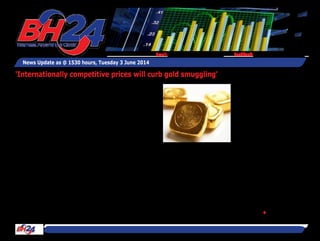
'Internationally competitive prices will curb gold smuggling'
2 NEWS
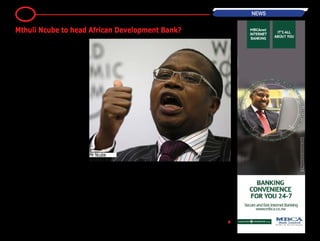
Native Zimbabwean Mthuli Ncube is
makingabidtoheadtheAfricanDevel-
opment Bank, taking over from current
President Donald Kaberuka whose sec-
ond five-year term expires next May.
Ncube, who is currently the AfDB's
chief economist, is lobbying South Afri-
ca's finance minister and other officials
for the country to nominate him for the
post.
A spokeswoman in South Africa's
finance ministry on Monday said only
that the government will discuss suc-
cession at the bank with its neighbours
in the Southern African Development
Community.
If South Africa agrees to nominate
Ncube and convinces enough powerful
African nations to back him, he would
become its first president from south-
ern Africa since the 1980s.
Ncube, who has been the pan-conti-
nental lender's economist since 2010,
said he would focus on policies to
spread the benefits of Africa's rapid
economic growth to the majority of its
billion citizens who remain poor.
But as one of the continent's richest
countries, South Africa could face a
backlash from other powerful African
nations eager to secure the plumb post
for themselves, said Catherine Grant,
head of economic diplomacy at the
South African Institute of International
Affairs.
That is what happened in 2012 when
Zuma campaigned to install his ex-wife
in the African Union's top job.
Nkosazana Dlamini-Zuma, a popular
former foreign minister, won the sup-
port of enough countries to assume a
four-year term as head of the bloc's
executive, but not before offending the
leaders of Rwanda, Nigeria and other
nations who said South Africa shouldn't
have breached a long-standing agree-
ment to keep the coveted post with a
lessinfluentialAfricannation.—WSJ•
Mthuli Ncube to head African Development Bank?
Mr Ncube
By Tawanda Musarurwa
Equity Researchers GECR predict that
Cambria Africa Plc's financial position
will turn positive in FY2017, despite the
company widening its losses in the first
half of its current financial year. For the
first half of its financial year ended Feb-
ruary 28, 2014 Cambria Africa's loss
position widened as Millchem Holdings
chemicals distribution unit was nega-
tively affected by a difficult operating
environment in the country.
For the latest half-year period, the
group's total revenues from continuing
operations decreased by 3 percent to
$4,18 million, compared to last year's
first half period figure of $4,29 million.
Overall gross profits decreased by 1
percent to $2,34 million, but margins
improved by 1,28 percentage points to
56,03 percent, driven by the Payserv
Africa subsidiary, which grew gross
profits by 6 percent.
Operating expenses increased by
10.26 percent to $3,78 million as
the group ramped up investment in
long-term growth and central costs
remained unchanged. Accordingly, the
operating loss increased by 33 percent
to $1,44 million.
Including net finance costs of $635k
and taxes of $161k, the loss from con-
tinuing operations increased by 49 per-
cent to $2,23 million.
But GECR is maintaining a positive
long-term outlook for the investment
company:
"With Cambria investing in top-line
growth, we remain of the belief that
it may turn earnings before interest,
taxes, depreciation, and amortisation
(EBITDA) positive in FY17, reaching
margins of circa 15 percent soon after.
Additional funding will be required, but
we expect that this should come from
the sale of the Leopard Rock Hotel
asset," say the equity analysts.
Cambria currently disposing non-core
assets so that it can focus purely on
Millchem and payrolls and transactions
processing company Payserv.
The group makes the substance of its
revenue in Zimbabwe, but is seeking
to expand into other African countries.
For the six-months period under
review, Payserv revenue grew 2 per-
cent to $2,2 million, while Millchem
revenue contracted 7 percent to $2,0
million, while profit margin rose three
percentage points to 93 percent at
Payserv and fell 4 percentage points to
16 percent at Millchem.
Added GECR:
"While the decline in revenues is dis-
appointing, we note that (i) the fact
Cambria was able to keep revenues
relatively flat despite significant issues
in the operating environment provides
confidence in the underlying busi-
nesses; and, (ii) Cambria is currently in
the midst of executing its strategic plan
that will see it expand into neighbour-
ing regions." •
3 NEWS
Cambria's financial position to turn in FY2017: GECR
By Lynn Murahwa
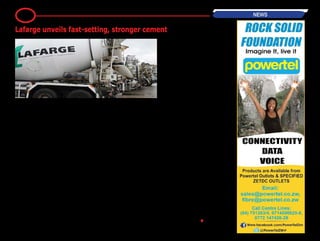
Cement manufacturer Lafarge Cement
(Zimbabwe) has launched a new
fast-setting cement product - Supa Set.
According to Lafarge Supa Set dries
"within 15 to 20 minutes". Speaking at
the launch yesterday evening Lafarge
marketingmanagerEdithMatekairesaid
the new brand will result in improved
workability.
“Our product is fast setting and is strong
toofferlesscracksandasmootherfinish.
It is a 42.5 ounce cement type meaning
it is higher grade cement compared to
traditional ones on the market,' she said.
The Government has said the initiative
by Lafarge Cement in producing a quick
dryingandstrongercementwillaidinthe
rehabilitation of the country’s infrastruc-
ture. Also speaking at launch Minister
Industry and Commerce Mike Bimha
said the introduction of this new product
shows innovation on the part of the pri-
vate sector towards the rehabilitation of
the country's infrastructure.
“To me Supa Set is indication of the pro-
gress and innovation that the industry is
making in meeting the changing market
needs and providing solution to bridge
infrastructure development gaps in this
country” he said.
Bimha said Government is conscious of
the strenuous economic environment
facing the country and he believes that
a partnership with the private sector
will aid the country’s economic growth.
“Government is aware of the difficult
operating economic environment in the
country, the tight liquidity crunch in the
market, limited lines of credit, the incon-
sistent power supplies among a plethora
of challenges have been some of the
inhibiting factors for industrial recovery
and growth. "However may I assure
you as Government that we are working
tirelessly to address these problems and
I am confident that in partnership with
the private sector we will together turn
around the economy and attain sustain-
able growth” he said.
The Minister acknowledged the role
beingplayedbyLafargeincontributingto
the country's infrastructure developing,
highlighting that Zimbabwe's economic
growth is impossible without effectives
services and that ZimAsset depends on
the enhancement of infrastructure and
accompanying services.
“The country’s economy cannot grow
and develop without the provision of
appropriate economic and social infra-
structure. There is therefore need to
improve the quality of infrastructure ser-
vices in Zimbabwe in order to promote a
sustainableandsharedeconomicgrowth
inthecountry...Lafargehasintroduceda
stronger cement product at this juncture
in order to match the requirements for
the construction industry in the context
of new projects that are in the pipeline in
this country” he said. •
4 NEWS
Lafarge unveils fast-setting, stronger cement
By Rumbidzayi Zinyuke
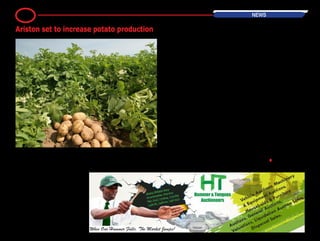
Diversified agricultural concern Ariston
Holdings Ltd plans to increase produc-
tion of potatoes and other short rota-
tion crops to boost revenues in 2015.
The company’s revenues come from
tea, bananas, potatoes, macadamia
nuts and apples.
Group chief executive Anxious Masuka
said the company would focus on short
rotation crops which would spur its
‘exponential growth’. “The productivity
is not as it should be and our objective
is to ensure that we lower the cost of
production as quickly as possible and
lower the margins. Short rotation crops
will help us achieve this.
“Potato consumption is going up so
we are increasing our production. We
started potato production recently with
a yield as low as 500 tonnes per year
but we expect them to grow to 13 000
tonnes in 2015,” he said.
The company produced 2,154 tonnes
of potatoes last year. The local market
produces approximately 5000 tonnes
of potatoes but demand has been
pegged at 35 000 tonnes per year.
Masuka said production growth would
be anchored on access to superior vari-
eties of seed potato.
He also said the group would also
expand the macadamia plantation
from 500 to 600 hectares while apples
will also be increased by 100 percent.
He said the production of macada-
mia nuts, which are in high demand
in China and Europe, would increase
exports. Last year macadamia produc-
tion stood at 1,173 tonnes.
“We are working on making sure you
get better quality nuts. The total recov-
ery for macadamia nuts in Southern
Africa is somewhere in the region of 35
percent and if you are ranging at about
28 percent as we are targeting then
you are almost there,” he said.
He said 80 percent of the macadamia
nuts are exported with China receiving
the bulk of the produce. He said the
group had planted more than 1000
hectares of tea. •
NEWS5
Ariston set to increase potato production
By Rumbidzayi Zinyuke
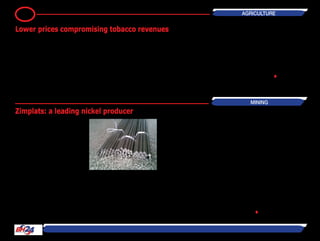
Zimplats has become the one of the
largest nickel producers in the country
as the company is getting more than
5000 tonnes of nickel in addition to 10
other minerals from its ore.
Chief operating officer Stanely Segula
said in addition to platinum, Zimplats
produces significant quantities of palla-
dium, rhodium, gold, nickel and copper
among others.
“We are one of the largest producers
of nickel despite the fact that it is not
our core business and there are other
players in that field,” he said.
At full production Zimplats produces
6,4 million tonnes of platinum ore
which passes through the concentrator
and smelter to produce 7 000 tonnes
of matte. During refinery, the minerals
are then separated to produce different
quantities of the minerals.
Segula said the company’s production
includes 220 000 tonnes of palladium,
30 000 ounces of gold, 20 000 ounces
of Rhodium, 5000 tonnes of nickel and
3 800 tonnes of copper.
He said in the half year to Decem-
ber 2012, nickel had contributed 11
percent to Zimplats’ revenue and 10
percent in 2013 while palladium con-
tributed 18 percent and 21 percent in
2012 and 2013 respectiely.
Among the base metals exploited in
Zimbabwe, nickel dominates in terms
of value. National production only
peaked at 12 000 tonnes annually in
1999, but production fell significantly
in the past decade largely due the
adverse prices as well as the effects of
the difficult operating environment for
the companies.
Production comes from several mines
located on the greenstone belt and
from PGM mining operations as a
by-product. Nickel yields cobalt as a
by-product.
Zimbabwe’s nickel production is dom-
inated by Bindura Nickel Corporation
which runs Trojan mine and RioZim
which owns Empress Nickel mine in
Kadoma. •
AGRICULTURE6
BH24 Reporter
Prevailing lower prices for tobacco has
meant that Zimbabwe will not fully ben-
efitfromthelastyear'sincreasedoutput.
LatestTobaccoIndustrymarketingBoard
(TIMB) figures show that the average
price for a kilogramme of tobacco stands
at $3,18, which is 14 percent lower than
the $3,71 for the same period last year.
This means that although the initially set
target of 180 million kgs will be met -
even as early as the close of this week,
the financial benefit will be lower than
wouldhaveresultedifpriceswerehigher,
or at least remained at last year's levels.
TIMBfiguresshowthat177,4millionkgs
have been sold to the value of $564 mil-
lion kgs. In terms of mass, this is a 31,6
percent positive variant from the 134,7
million kgs sold in 2013.
But the growth in terms of monetary
value is only 13 percent higher from
the $499,4 million achieved last year
prior comparable period. Meanwhile the
percentage of rejected bales is lower
this year to date at 5,6 percent from 7
percent same time last year, which is
possibly indicative of increased farmer
educationinhandlingandtransportingof
the crop to the floors. •
Lower prices compromising tobacco revenues
Zimplats: a leading nickel producer
MINING
BH24
The equities market continues on a
bullish streak, today further bumping
0.68 percent. The Industrials Index
gained 1.19 points to close at 176.10
points following gains in selected heav-
yweight counters.
Giant telecoms Econet rose 0.93 cents
to 67.03 cents, while conglomerate
Innscor advanced a cent to settle at 72
cents.
Also gaining a cent was TSL which
bumped to trade at 30 cents.
Other gainers included Hippo which
gained 5 cents to trade at 55 cents,
Meikles which went up 1.49 cents to
settle at 17.99 cents, and SeedCo
which pushed up 0.30 cents to 72.50
cents.
On the downside, Turnall eased a cent
to 2 cents and CBZ shed 0.01 cents to
close at 14.99 cents.
TheMiningIndexwashoweverweaker,
shedding 0.17 points (or 0.50 percent)
to close at 33.54 points due to Hwange
which lost 0.29 points to 4.51 cents.
Bindura was up 0.02 cents to trade at
2.20 cents.
But Falgold and RioZim both main-
tained previous trading levels.
— BH24 Reporter •
8 ZSE REVIEW
Equities continue on bullish run
Zimbabwe can no longer afford
to remain a primary commodity
exporter.
The International Monetary Fund in
its report following a Staff Monitoring
Programme visitation to Zimbabwe
in March, warned that "downside
risks to the outlook include the pos-
sibility of further weakening of export
prices".
The reality and the impact of this
warning is borne out this year's
tobacco marketing season which has
seen the local tobacco being sold at
lower prices compared to the prior
marketing season.
Figures from the Tobacco Industry
Marketing Board show that the aver-
age price for a kilogramme of tobacco
stands at $3,18, which is 14 percent
lower than the $3,71 for the same
period last year.
This means that despite the signif-
icantly higher output of the golden
leaf last year will not result in much
monetary gain for Zimbabwe.
This highlights a key point: so long
as the country largely remains an
exporter of primary goods it will con-
tinue depending on uncontrollable
external factors for its gains.
As long as we remain an exporter of
primary goods we will remain at the
mercy of the vagaries of global trade.
And this does not just apply to
tobacco, but also to most if not all
of the minerals that the country pro-
duces.
A brief survey of international prices
of various metals since the beginning
of the year show that the prices have
largely remained flat or are dipping.
As recently as yesterday Reuters
reported that gold slid for a fifth
straight session in its longest los-
ing streak since November, hurt by
stronger global equities and weak
physical demand in China.
Continuous dependence on raw
material exports will prove ruinous to
the country in the long-run.
It therefore places a premium on the
need for Zimbabwe to enhance its
industrial capacity.
In such a way, a large portion - if
not all - of the raw material output,
whether it comes from mining or
agriculture (as the key base sectors)
will be value-added.
Value addition increases the value of
the country's exports, which places
it in a better position to control the
prices of the commodities that it is
selling.
Additionally, if Zimbabwe becomes a
net exporter of value added products
there are other direct benefits that
accrue to the country, for instance,
increased formal employment as
industries are revived.
Another key issue that will be
addressed is the re-establishment
of forward and backward linkages
between the primary sectors (mining
and agriculture) and the manufactur-
ing sector.
These linkages are key, and are per-
haps why these sectors have not
been performing up to par in recent
years.
ZimAsset acknowledges the impor-
tance of value addition and/or benefi-
ciation to the Zimbabwean economy.
It is time policy is turned into practical
action. •
9 BH24 COMMENT
Zimbabwe needs to shift from raw exports
Platinum producers Anglo American
Platinum (Amplats) and Impala Plati-
num (Implats) on Monday announced
thattheLabourCourthaddismissedthe
Association of Mineworkers and Con-
struction Union’s (AMCU’s) application
against the companies, relating to their
direct-communication campaigns.
AMCU last month brought the appli-
cation on an urgent basis seeking to
prevent the employers from communi-
cating wage settlement offers directly to
AMCU workers and to prevent Implats
from conducting surveys to determine
whetheritsemployeeswantedtoreturn
to work.
Labour Court judge Rob le Grange ruled
against AMCU and the matter was
struck off the roll as it lacked urgency,
the platinum producers said in a state-
ment.
“The employers believe that any means
available should be used to ensure that
employees are fully informed of the
position of the companies and the offer
that has been made, and that employ-
ees should be allowed to make an elec-
tion whether or not they wish to return
to work. The companies have been
inundated by calls from employees
seeking information, and will now con-
tinue to communicate with employees
on a regular basis,” the companies said.
Meanwhile, AMCU’s application relating
to this matter against Lonmin had been
postponed.
AMCU members were still striking at
Lonmin, Implats and Amplats demand-
ing an entry-level basic wage of R12
500 over a four-year period, while the
platinum producers’ latest offer would
see workers earn a minimum cash
remuneration – comprising basic wages
and holiday, living-out and other allow-
ances – of R12 500 a month by 2017.
The strike, which was now in its fifth
month,hadcostemployersandemploy-
ees about R20.6-billion and R9.2-billion
in earnings respectively. AMCU could
not immediately be reached for com-
ment. — MiningWeekly •
10 REGIONAL News
Labour Court rules against AMCU
11 DIARY OF EVENTS
The black arrow indicate level of load shedding across the country.
POWER GENERATION STATS
Gen Station
3 June 2014
Energy
(Megawatts)
Hwange 598 MW
Kariba 750 MW
Harare 34 MW
Munyati 16 MW
Bulawayo 20 MW
Imports 30 MW
Total 1448 MW
3 June - First Mutual Life
eleventh Annual General
Meeting of the shareholders
Place: Ground Floor, First Mutual
Park, 100 Borrowdale Road,
Borrowdale, Time: 14:30
3 June - ABC Holdings Annual
General Meeting of share-
holders Place: Boardroom, ABC
House, BancABC Botswana, Plot
62433, Fairground Office Park,
Gaborone, Botswana, Time:
09:30
11 June - Rainbow Tourism
Group 15th Annual General
Meeting of the Shareholders,
Place: Jacaranda Rooms 2 and
3 at the Rainbow Towers Hotel
and Conference Centre, 1 Pen-
nefather Avenue, Harare, Time:
12:00
26 June - Masimba Holdings
Limited Thirty-Ninth Annual
General Meeting of Mem-
bers for the period ended 31
December 2013, Place: 44 Til-
bury Road, Willowvale, Harare,
Zimbabwe, Time: 12:00
THE BH24 DIARY
BH24
13 zse
ZSE
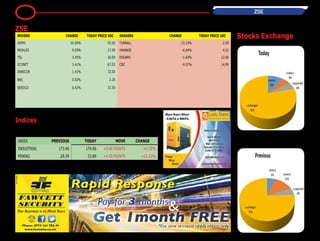
Movers CHANGE Today Price USc SHAKERS Change TODAY Price USc
Hippo 10.00% 55.00 Turnall -33.33% 2.00
Meikles 9.03% 17.99 Hwange -6.04% 4.51
TSL 3.45% 30.00 Edgars -1.64% 12.00
Econet 1.41% 67.03 CBZ -0.07% 14.99
Innscor 1.41% 72.00
BNC 0.92% 2.20
SeedCo 0.42% 72.50
Indices
Index Previous Today Move Change
Industrial 173.46 174.06 +0.60 points +0.35%
Mining 29.39 33.89 +4.50 points +15.31%
Stocks Exchange
14 AFRICA StockS
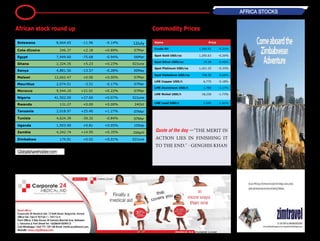
Botswana 8,664.65 -11.96 -0.14% 12July
Cote dIvoire 246.37 +2.18 +0.89% 07Mar
Egypt 7,949.60 -75.68 -0.94% 06Mar
Ghana 2,324.35 +5.23 +0.23% 02June
Kenya 4,881.56 -13.57 -0.28% 30May
Malawi 12,662.47 +0.00 +0.00% 07Mar
Mauritius 2,074.51 -3.51 -0.17% 07Mar
Morocco 9,544.10 +21.01 +0.22% 07Mar
Nigeria 41,502.00 +27.60 +0.07% 02June
Rwanda 131.27 +0.00 +0.00% 24Oct
Tanzania 2,018.97 +25.40 +1.27% 07Mar
Tunisia 4,624.39 -39.32 -0.84% 07Mar
Uganda 1,503.90 +0.81 +0.05% 10Sep
Zambia 4,242.74 +14.95 +0.35% 10April
Zimbabwe 174.91 +0.02 +0.01% 02June
African stock round up Commodity Prices
Name Price
Crude Oil 1,300.91 -0.21%
Spot Gold USD/oz 1,292.63 -0.26%
Spot Silver USD/oz 19.38 -0.46%
Spot Platinum USD/oz 1,421.25 -0.33%
Spot Palladium USD/oz 798.50 -0.64%
LME Copper USD/t 6,770 -0.18%
LME Aluminium USD/t 1,780 -1.17%
LME Nickel USD/t 18,230 -1.73%
LME Lead USD/t 2,095 -1.41%
Quote of the day —"The merit in
action lies in finishing it
to the end." - Genghis Khan
Globalshareholder.com
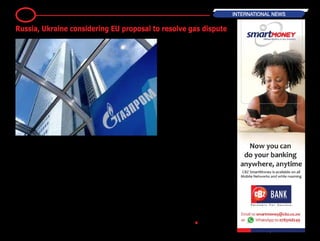
European Energy Commissioner
Günther Oettinger emerged from the
negotiations held in Brussels on Mon-
day to announce that the heads of
Russia's Gazprom and Ukraine's Nafto-
gaz had agreed to consider an EU-pro-
posed plan to resolve the dispute.
Oettinger said the proposal foresaw
Ukraine paying a lower price than
Russia is currently charging it for gas,
while at the same time setting out a
repayment schedule for Kyiv to pay of
millions of dollars in debt for supplies it
has already taken delivery of.
The Commissioner declined to divulge
what the proposed price was, beyond
saying that it was lower than the
$485 (357 euros) that Russia cur-
rently charges Ukraine per 1,000 cubic
meters and higher than the discounted
$268 it once charged Kyiv.
Oettinger said the two CEOs had asked
for time to evaluate the legal, financial
and economic aspects of the proposal,
in consultation with their respective
governments.
He added that he hoped the deal could
be wrapped up in further talks in the
next few days and that the two sides
had agreed that there would be no
interruption to supplies while the pro-
posal was under consideration.
"My request and my expectation is
that we (will) come up with a package
that covers the period until June next
year," Oettinger said. First installment
received
Earlier on Monday, Russia confirmed
that it had received a Ukranian pay-
ment of $786.4 million dollars, a first
installmentonwhatMoscowsaysisthe
$5.2 billion owed to it by Kyiv.
Russia had threatened to cut off the
flow of gas to Kyiv on Tuesday if no
payment had been received.
The latest gas dispute between Mos-
cow and Kyiv began after Ukraine's
pro-Kremlin President Viktor Yanuk-
ovych was toppled and fled to Russia
back in February. Moscow responded
by imposing a sharp increase on the
price of gas it charges Ukraine.
The European Union is keen to help
resolve the dispute, as Ukraine is a key
transit country for Russian gas imports
to the EU. —DW •
15 INTERNATIONAL NEWS
Russia, Ukraine considering EU proposal to resolve gas dispute
By Carlos Lopes
(This is the second of a two-part
series on the effects of illicit activ-
ities on peace and security in sub
Saharan Africa by United Nations
Economic Commission for Africa
(UNECA) executive secretary Car-
los Lopes, published on his blog
'Africa Cheetah Run')
Internal and external factors
Notallconflictsaremotivatedorcaused
solely by economic imperatives. In
some countries conflicts have been
fueled by political or social exclusion.
The Rwanda genocide for example,
was fomented by the Tutsi alienation
and exclusion for decades.
In Uganda, Kony’s Lord’s Resistance
Army rebellion was fuelled by ethnic
retribution sentiment. The rise of the
SPLM/A in 1983 was a result of mar-
ginalization of South Sudan.
Some conflicts have been sparked by a
mix of factors. The conflict in Somalia
for instance, was caused by a combi-
nation of internal power disputes and
also economic stress provoked by the
pillaging of its coast. The conflict in the
Democratic Republic of Congo involved
seven neighbouring nations fighting for
influence and geo-strategic concerns.
In North Africa, the ousting of govern-
ments in Tunisia, Egypt and Libya, that
precipitated other conflicts in the Arab
world, clearly demonstrates the ripple
effects of social unrest snowballed by
youthfrustrations.Lackofemployment
opportunities can undermine social
cohesion and political stability.
Causes of conflict can be a complex
mixture of issues affecting different
stakeholders. The magnifying of ten-
sion points contributes to entrench
conflict.
Funding belligerent becomes attractive
to many, provided the logic of the dis-
pute brings economic gains.
Illicit financial flows and weak state
capacity are symbiotic; and tend to
reinforce each other. Transnational
cartels operating as net-warriors are a
threat to state sovereignty.
In Mexico, criminal networks have
influenced change at the local and
transnational levels imposing a recon-
figuration of power structures. Criminal
enclaves have proliferated in Myanmar,
Afghanistan and Colombia.
There are networks operating a global
value chain of a criminal nature. The
driversbothintermsofscopeandneed
areinternational.Addressingtrans-bor-
der organized crime requires a conti-
nental and international response.
Many individual countries in Africa vic-
tims of transnational criminal activities,
such as Guinea-Bissau or Mali, do not
have the adequate capacity to respond
to illicit activities.
As a result, there is a need for col-
lective focus on drivers which can
help establish regional and national
security enforcement strategies and
mechanisms. Inflation of domestic cur-
16 Analysis
Illicit activities impact on peace and security (PART 2)
rencies caused by the inflow of illegal
drugs, contraband, under-invoicing of
imports or outright smuggling, stimu-
lateboomsincertaineconomicsectors,
such as construction or real estate.
Overvalued local currencies have other
devastating economic effects such as
discouraging the production of legal
exports by making imports cheaper,
forcing local producers to compete
against cheap imports. Illicit flows can
have the same effects as the so-called
Dutch disease.
Actually, quite often, the natural
resources richness is married to crim-
inal activity, reinforcing the negative
consequences of a “Dutch like disease”,
impeding real economic transformation
and socially inclusive policies.
Gangs, terrorist and criminal agents
like an environment where they can
move financial assets to profitable
investments that hide their wealth.
The money laundering operations of
organized crime groups pose a seri-
ous and growing threat to peace and
security. Ransoms collected by Somali
pirates are reportedly being laundered
through Khat exports or real estate
business in neighboring metropolis.
Firearms trans-Saharan trafficking to
rebel movements is allegedly being
mixed with other trafficking, such as
human and drugs related, that find
their way into nice villas or quasi legit-
imate activities. Illegal ivory trade is
rampant in many parts of Africa. In
fact, African countries are prone to
criminalsupplychainsthatareresourc-
ing conflicts.
For instance, according to UNODC,
some $1.25bn in cocaine is trafficked
from South America to West Africa
and on to Europe. A policy response to
these threats is very complex. A West
Africa Commission on Drugs, headed
by President Obasanjo is busy looking
into the intricacies of such operations.
Bad economic governance
Africa’s recent commodities boom has
been a major source of public revenue,
contributing to economic growth. Ide-
ally natural resources wealth should
enable Africa to power its economies
and determine the quality, pace and
extent of its transformations. Natural
resources have traditionally been one
of the main driving forces behind our
continent’s economic fortunes but also
a contributor to some of our most vio-
lent conflicts.
The highest illicit financial flows were
recorded in African countries that are
resource and mineral rich mainly in
oil, precious metals and minerals. The
policy and legal frameworks for the
mining sector have traditionally been
designed to attract investment, and
raise resources for rent-seeking or
un-strategic spending rather than to
encourage transformation.
Moreover, the share of resource rents
retained by African countries has often
been limited on the account of over-
generous concessions that are always
made in the race to the bottom for
mining investment, as well as to the
information asymmetries which typi-
cally characterize the mining sector.
It has also not worked in the light oftax
leakages through transfer pricing and
trade mispricing. It is estimated that
between 1970 and 2008, illicit financial
flows linked to trade mispricing alone
cost the continent $854 billion.
The lost resources on the African con-
tinent are a clear indication that now,
more than ever, Governments need to
enforce and implement principles and
standard operating procedures which
17 Analysis
could reduce the amount of leakages
that incur through illicit financial flows.
They also need to negotiate better! For
starters,thesettingupoffinancialintel-
ligence units to curtail, track and repat-
riate illicit financial flows will be crucial
in ensuring that resources lost can
be tracked and eventually returned.
The implementation of the Extractive
Industries Transparency International
(EITI) guidelines will ensure that nego-
tiations between companies working
in the extractive industry and Govern-
ments are transparent.
Frameworks such as the Kimberley
process will see to it that diamonds are
notillegallytraded,whileinitiativessuch
as “publish what you pay” will enforce
moretransparencyintheindustry. The
blood diamonds syndrome still exists.
Actually what happens with Coltan or
logging is no different.
Despite slow global recovery, African
countries continue to record impres-
sive economic growth. However, this
growth has been unequal. It could also
have been higher if the high levels of
illicit financial flows leaving the conti-
nent had been invested in the conti-
nent.
While the abundance of natural
resources is considered the golden
avenue to poverty alleviation and eco-
nomic growth, the business environ-
ment in many African countries has
produced a conducive environment
for multinational companies and local
companies alike to illicitly transfer
funds to offshore safe havens with little
or no repercussions.
When revenue which should be paid to
governments is illicitly diverted to other
sources abroad, social protection and
welfare programmes suffer. Unemploy-
ment and lack of opportunities often
drive the bulging youth to possible
alternatives of survival that include
criminal entrepreneurship.
Improved governance and leadership
are vital in addressing these important
findings. We need to re-evaluate our
governance in order to discern whether
or not we are adequately equipped to
provide stability, while being flexible
enough to address the variety of issues
relating to illicit financial flows.
Interestingly, promoting a develop-
mental state provides both opportuni-
ties and limitations in pursuing these
goals. A developmental state facilitates
coherence, drive and better allocation
of resources. But, it also has the poten-
tial to limit dissent if proper organic
forms of inclusion are not taken into
account, as we can learn from Asia.
For a developmental state, addressing
illicit financial flows and strengthening
regulatory and governance institu-
tions is important. But a more effective
approach is needed in order to address
these flows root causes. Long-term
development visions and strategies
canpromotebetterresourcesmanage-
ment and less corruption.
Theywillsucceedwhenprovidingsocial
cohesion and respect for diversity.
However, national efforts alone will not
suffice. Given the trans-national ingre-
dients of both illicit flows and conflict, it
is necessary to take care of peace and
security in the neighbourhood.
A holistic regional pact for security
could unite African countries around
their common interests in security and
development. Such a pact would lock
in or lock out any actor responding or
not to the collective imperatives.
An African-owned agenda, devised and
implemented by Africans, tantamount
to the principle of African solutions to
African problems, is a good start. Africa
has already made strong commit-
ments for its security, architecture in
order to achieve the stated objective of
silencingthegunsby2020.Thetimeto
act is now! •
18 Analysis

Can internationally competitive prices curb gold smuggling?

  • 1.
    News Update as@ 1530 hours, Tuesday 3 June 2014 Feedback: bh24admin@zimpapers.co.zwEmail: bh24feedback@zimpapers.co.zw By Tawanda Musarurwa The Government should set internation- allycompetitivemarketpricesforartisanal gold producers to discourage smuggling, theGovernanceofAfrica’sResourcesPro- gramme(GARP)hassaid. The move will also strengthen due dili- gence and incentivise better practices in small-scale gold production in the coun- try."Policymakersneedtoensurethatfair prices are set for the gold produced by artisanal and small-scale miners, as this willincentivisebetterminingpractices. "Betterpricingisalsocrucialtoaddressthe problem of gold being smuggled to bet- ter-paying markets. It is estimated that more than 15 tonnes of gold, amounting to over $400 million, were smuggled out of Zimbabwe between 2002 and 2007," said the institute in a policy briefing enti- tled 'Revamping Artisanal Gold Mining in Zimbabwe to Catalyse Poverty Reduc- tion'. GARP (which runs under the South African Institute of Foreign Affairs) "aims to improve policies governing Africa’s abundantnaturalresources". Small-scale gold mining is seen as con- tributingsignificantlytothecountry'stotal gold output. It has been estimated that artisanal and small-scale gold producers contribute over one tonne of gold to Zim- babwe’smonthlyoutput. Official estimates from the Ministry of Mines and Development suggest that small-scale miners were responsible for 30 percent of the 11,79 tonnes of gold produced in 2012. But experts believe that the contribution of the small-scale goldproducerscouldbegreaterifthesec- tor'sregulatoryframeworkisimproved. According to GARP, local small-scale pro- ducers can benefit from well-defined land rights and lower licensing fees as this will help streamline registration and regula- toryoversightofthesector. "WhileZimbabwe’sMineandMineralsAct of 2006 does make provision for the reg- istration of land holdings smaller than 2 ha,amajorpartoftheproblemisrelated to the absence of policies directed at the artisanal gold miners, who operate on a farsmallerscale. "This problem is exacerbated by the thin line separating registered artisanal and small-scale gold miners from the unreg- istered, illegal ones. The government has focused its policymaking initiatives on improving the governance of medium- and small-scale mining and has mostly neglectedartisanalminers... "A revamped regulatory regime will encourage artisanal gold miners to enter the formal market, thereby realising their productivitypotential,strengtheningenvi- ronmental compliance and expanding legalmarketingopportunities,"readspart oftheGARPpolicybriefing. At a broader level, GARP suggests that Zimbabwe should forge a partnership with the Africa Mining Development Cen- tre to formulate a Country Mining Vision and improve local expertise in artisanal goldmining. • 'Internationally competitive prices will curb gold smuggling'
  • 2.
    2 NEWS Native ZimbabweanMthuli Ncube is makingabidtoheadtheAfricanDevel- opment Bank, taking over from current President Donald Kaberuka whose sec- ond five-year term expires next May. Ncube, who is currently the AfDB's chief economist, is lobbying South Afri- ca's finance minister and other officials for the country to nominate him for the post. A spokeswoman in South Africa's finance ministry on Monday said only that the government will discuss suc- cession at the bank with its neighbours in the Southern African Development Community. If South Africa agrees to nominate Ncube and convinces enough powerful African nations to back him, he would become its first president from south- ern Africa since the 1980s. Ncube, who has been the pan-conti- nental lender's economist since 2010, said he would focus on policies to spread the benefits of Africa's rapid economic growth to the majority of its billion citizens who remain poor. But as one of the continent's richest countries, South Africa could face a backlash from other powerful African nations eager to secure the plumb post for themselves, said Catherine Grant, head of economic diplomacy at the South African Institute of International Affairs. That is what happened in 2012 when Zuma campaigned to install his ex-wife in the African Union's top job. Nkosazana Dlamini-Zuma, a popular former foreign minister, won the sup- port of enough countries to assume a four-year term as head of the bloc's executive, but not before offending the leaders of Rwanda, Nigeria and other nations who said South Africa shouldn't have breached a long-standing agree- ment to keep the coveted post with a lessinfluentialAfricannation.—WSJ• Mthuli Ncube to head African Development Bank? Mr Ncube
  • 3.
    By Tawanda Musarurwa EquityResearchers GECR predict that Cambria Africa Plc's financial position will turn positive in FY2017, despite the company widening its losses in the first half of its current financial year. For the first half of its financial year ended Feb- ruary 28, 2014 Cambria Africa's loss position widened as Millchem Holdings chemicals distribution unit was nega- tively affected by a difficult operating environment in the country. For the latest half-year period, the group's total revenues from continuing operations decreased by 3 percent to $4,18 million, compared to last year's first half period figure of $4,29 million. Overall gross profits decreased by 1 percent to $2,34 million, but margins improved by 1,28 percentage points to 56,03 percent, driven by the Payserv Africa subsidiary, which grew gross profits by 6 percent. Operating expenses increased by 10.26 percent to $3,78 million as the group ramped up investment in long-term growth and central costs remained unchanged. Accordingly, the operating loss increased by 33 percent to $1,44 million. Including net finance costs of $635k and taxes of $161k, the loss from con- tinuing operations increased by 49 per- cent to $2,23 million. But GECR is maintaining a positive long-term outlook for the investment company: "With Cambria investing in top-line growth, we remain of the belief that it may turn earnings before interest, taxes, depreciation, and amortisation (EBITDA) positive in FY17, reaching margins of circa 15 percent soon after. Additional funding will be required, but we expect that this should come from the sale of the Leopard Rock Hotel asset," say the equity analysts. Cambria currently disposing non-core assets so that it can focus purely on Millchem and payrolls and transactions processing company Payserv. The group makes the substance of its revenue in Zimbabwe, but is seeking to expand into other African countries. For the six-months period under review, Payserv revenue grew 2 per- cent to $2,2 million, while Millchem revenue contracted 7 percent to $2,0 million, while profit margin rose three percentage points to 93 percent at Payserv and fell 4 percentage points to 16 percent at Millchem. Added GECR: "While the decline in revenues is dis- appointing, we note that (i) the fact Cambria was able to keep revenues relatively flat despite significant issues in the operating environment provides confidence in the underlying busi- nesses; and, (ii) Cambria is currently in the midst of executing its strategic plan that will see it expand into neighbour- ing regions." • 3 NEWS Cambria's financial position to turn in FY2017: GECR
  • 4.
    By Lynn Murahwa Cementmanufacturer Lafarge Cement (Zimbabwe) has launched a new fast-setting cement product - Supa Set. According to Lafarge Supa Set dries "within 15 to 20 minutes". Speaking at the launch yesterday evening Lafarge marketingmanagerEdithMatekairesaid the new brand will result in improved workability. “Our product is fast setting and is strong toofferlesscracksandasmootherfinish. It is a 42.5 ounce cement type meaning it is higher grade cement compared to traditional ones on the market,' she said. The Government has said the initiative by Lafarge Cement in producing a quick dryingandstrongercementwillaidinthe rehabilitation of the country’s infrastruc- ture. Also speaking at launch Minister Industry and Commerce Mike Bimha said the introduction of this new product shows innovation on the part of the pri- vate sector towards the rehabilitation of the country's infrastructure. “To me Supa Set is indication of the pro- gress and innovation that the industry is making in meeting the changing market needs and providing solution to bridge infrastructure development gaps in this country” he said. Bimha said Government is conscious of the strenuous economic environment facing the country and he believes that a partnership with the private sector will aid the country’s economic growth. “Government is aware of the difficult operating economic environment in the country, the tight liquidity crunch in the market, limited lines of credit, the incon- sistent power supplies among a plethora of challenges have been some of the inhibiting factors for industrial recovery and growth. "However may I assure you as Government that we are working tirelessly to address these problems and I am confident that in partnership with the private sector we will together turn around the economy and attain sustain- able growth” he said. The Minister acknowledged the role beingplayedbyLafargeincontributingto the country's infrastructure developing, highlighting that Zimbabwe's economic growth is impossible without effectives services and that ZimAsset depends on the enhancement of infrastructure and accompanying services. “The country’s economy cannot grow and develop without the provision of appropriate economic and social infra- structure. There is therefore need to improve the quality of infrastructure ser- vices in Zimbabwe in order to promote a sustainableandsharedeconomicgrowth inthecountry...Lafargehasintroduceda stronger cement product at this juncture in order to match the requirements for the construction industry in the context of new projects that are in the pipeline in this country” he said. • 4 NEWS Lafarge unveils fast-setting, stronger cement
  • 5.
    By Rumbidzayi Zinyuke Diversifiedagricultural concern Ariston Holdings Ltd plans to increase produc- tion of potatoes and other short rota- tion crops to boost revenues in 2015. The company’s revenues come from tea, bananas, potatoes, macadamia nuts and apples. Group chief executive Anxious Masuka said the company would focus on short rotation crops which would spur its ‘exponential growth’. “The productivity is not as it should be and our objective is to ensure that we lower the cost of production as quickly as possible and lower the margins. Short rotation crops will help us achieve this. “Potato consumption is going up so we are increasing our production. We started potato production recently with a yield as low as 500 tonnes per year but we expect them to grow to 13 000 tonnes in 2015,” he said. The company produced 2,154 tonnes of potatoes last year. The local market produces approximately 5000 tonnes of potatoes but demand has been pegged at 35 000 tonnes per year. Masuka said production growth would be anchored on access to superior vari- eties of seed potato. He also said the group would also expand the macadamia plantation from 500 to 600 hectares while apples will also be increased by 100 percent. He said the production of macada- mia nuts, which are in high demand in China and Europe, would increase exports. Last year macadamia produc- tion stood at 1,173 tonnes. “We are working on making sure you get better quality nuts. The total recov- ery for macadamia nuts in Southern Africa is somewhere in the region of 35 percent and if you are ranging at about 28 percent as we are targeting then you are almost there,” he said. He said 80 percent of the macadamia nuts are exported with China receiving the bulk of the produce. He said the group had planted more than 1000 hectares of tea. • NEWS5 Ariston set to increase potato production
  • 6.
    By Rumbidzayi Zinyuke Zimplatshas become the one of the largest nickel producers in the country as the company is getting more than 5000 tonnes of nickel in addition to 10 other minerals from its ore. Chief operating officer Stanely Segula said in addition to platinum, Zimplats produces significant quantities of palla- dium, rhodium, gold, nickel and copper among others. “We are one of the largest producers of nickel despite the fact that it is not our core business and there are other players in that field,” he said. At full production Zimplats produces 6,4 million tonnes of platinum ore which passes through the concentrator and smelter to produce 7 000 tonnes of matte. During refinery, the minerals are then separated to produce different quantities of the minerals. Segula said the company’s production includes 220 000 tonnes of palladium, 30 000 ounces of gold, 20 000 ounces of Rhodium, 5000 tonnes of nickel and 3 800 tonnes of copper. He said in the half year to Decem- ber 2012, nickel had contributed 11 percent to Zimplats’ revenue and 10 percent in 2013 while palladium con- tributed 18 percent and 21 percent in 2012 and 2013 respectiely. Among the base metals exploited in Zimbabwe, nickel dominates in terms of value. National production only peaked at 12 000 tonnes annually in 1999, but production fell significantly in the past decade largely due the adverse prices as well as the effects of the difficult operating environment for the companies. Production comes from several mines located on the greenstone belt and from PGM mining operations as a by-product. Nickel yields cobalt as a by-product. Zimbabwe’s nickel production is dom- inated by Bindura Nickel Corporation which runs Trojan mine and RioZim which owns Empress Nickel mine in Kadoma. • AGRICULTURE6 BH24 Reporter Prevailing lower prices for tobacco has meant that Zimbabwe will not fully ben- efitfromthelastyear'sincreasedoutput. LatestTobaccoIndustrymarketingBoard (TIMB) figures show that the average price for a kilogramme of tobacco stands at $3,18, which is 14 percent lower than the $3,71 for the same period last year. This means that although the initially set target of 180 million kgs will be met - even as early as the close of this week, the financial benefit will be lower than wouldhaveresultedifpriceswerehigher, or at least remained at last year's levels. TIMBfiguresshowthat177,4millionkgs have been sold to the value of $564 mil- lion kgs. In terms of mass, this is a 31,6 percent positive variant from the 134,7 million kgs sold in 2013. But the growth in terms of monetary value is only 13 percent higher from the $499,4 million achieved last year prior comparable period. Meanwhile the percentage of rejected bales is lower this year to date at 5,6 percent from 7 percent same time last year, which is possibly indicative of increased farmer educationinhandlingandtransportingof the crop to the floors. • Lower prices compromising tobacco revenues Zimplats: a leading nickel producer MINING
  • 7.
  • 8.
    The equities marketcontinues on a bullish streak, today further bumping 0.68 percent. The Industrials Index gained 1.19 points to close at 176.10 points following gains in selected heav- yweight counters. Giant telecoms Econet rose 0.93 cents to 67.03 cents, while conglomerate Innscor advanced a cent to settle at 72 cents. Also gaining a cent was TSL which bumped to trade at 30 cents. Other gainers included Hippo which gained 5 cents to trade at 55 cents, Meikles which went up 1.49 cents to settle at 17.99 cents, and SeedCo which pushed up 0.30 cents to 72.50 cents. On the downside, Turnall eased a cent to 2 cents and CBZ shed 0.01 cents to close at 14.99 cents. TheMiningIndexwashoweverweaker, shedding 0.17 points (or 0.50 percent) to close at 33.54 points due to Hwange which lost 0.29 points to 4.51 cents. Bindura was up 0.02 cents to trade at 2.20 cents. But Falgold and RioZim both main- tained previous trading levels. — BH24 Reporter • 8 ZSE REVIEW Equities continue on bullish run
  • 9.
    Zimbabwe can nolonger afford to remain a primary commodity exporter. The International Monetary Fund in its report following a Staff Monitoring Programme visitation to Zimbabwe in March, warned that "downside risks to the outlook include the pos- sibility of further weakening of export prices". The reality and the impact of this warning is borne out this year's tobacco marketing season which has seen the local tobacco being sold at lower prices compared to the prior marketing season. Figures from the Tobacco Industry Marketing Board show that the aver- age price for a kilogramme of tobacco stands at $3,18, which is 14 percent lower than the $3,71 for the same period last year. This means that despite the signif- icantly higher output of the golden leaf last year will not result in much monetary gain for Zimbabwe. This highlights a key point: so long as the country largely remains an exporter of primary goods it will con- tinue depending on uncontrollable external factors for its gains. As long as we remain an exporter of primary goods we will remain at the mercy of the vagaries of global trade. And this does not just apply to tobacco, but also to most if not all of the minerals that the country pro- duces. A brief survey of international prices of various metals since the beginning of the year show that the prices have largely remained flat or are dipping. As recently as yesterday Reuters reported that gold slid for a fifth straight session in its longest los- ing streak since November, hurt by stronger global equities and weak physical demand in China. Continuous dependence on raw material exports will prove ruinous to the country in the long-run. It therefore places a premium on the need for Zimbabwe to enhance its industrial capacity. In such a way, a large portion - if not all - of the raw material output, whether it comes from mining or agriculture (as the key base sectors) will be value-added. Value addition increases the value of the country's exports, which places it in a better position to control the prices of the commodities that it is selling. Additionally, if Zimbabwe becomes a net exporter of value added products there are other direct benefits that accrue to the country, for instance, increased formal employment as industries are revived. Another key issue that will be addressed is the re-establishment of forward and backward linkages between the primary sectors (mining and agriculture) and the manufactur- ing sector. These linkages are key, and are per- haps why these sectors have not been performing up to par in recent years. ZimAsset acknowledges the impor- tance of value addition and/or benefi- ciation to the Zimbabwean economy. It is time policy is turned into practical action. • 9 BH24 COMMENT Zimbabwe needs to shift from raw exports
  • 10.
    Platinum producers AngloAmerican Platinum (Amplats) and Impala Plati- num (Implats) on Monday announced thattheLabourCourthaddismissedthe Association of Mineworkers and Con- struction Union’s (AMCU’s) application against the companies, relating to their direct-communication campaigns. AMCU last month brought the appli- cation on an urgent basis seeking to prevent the employers from communi- cating wage settlement offers directly to AMCU workers and to prevent Implats from conducting surveys to determine whetheritsemployeeswantedtoreturn to work. Labour Court judge Rob le Grange ruled against AMCU and the matter was struck off the roll as it lacked urgency, the platinum producers said in a state- ment. “The employers believe that any means available should be used to ensure that employees are fully informed of the position of the companies and the offer that has been made, and that employ- ees should be allowed to make an elec- tion whether or not they wish to return to work. The companies have been inundated by calls from employees seeking information, and will now con- tinue to communicate with employees on a regular basis,” the companies said. Meanwhile, AMCU’s application relating to this matter against Lonmin had been postponed. AMCU members were still striking at Lonmin, Implats and Amplats demand- ing an entry-level basic wage of R12 500 over a four-year period, while the platinum producers’ latest offer would see workers earn a minimum cash remuneration – comprising basic wages and holiday, living-out and other allow- ances – of R12 500 a month by 2017. The strike, which was now in its fifth month,hadcostemployersandemploy- ees about R20.6-billion and R9.2-billion in earnings respectively. AMCU could not immediately be reached for com- ment. — MiningWeekly • 10 REGIONAL News Labour Court rules against AMCU
  • 11.
    11 DIARY OFEVENTS The black arrow indicate level of load shedding across the country. POWER GENERATION STATS Gen Station 3 June 2014 Energy (Megawatts) Hwange 598 MW Kariba 750 MW Harare 34 MW Munyati 16 MW Bulawayo 20 MW Imports 30 MW Total 1448 MW 3 June - First Mutual Life eleventh Annual General Meeting of the shareholders Place: Ground Floor, First Mutual Park, 100 Borrowdale Road, Borrowdale, Time: 14:30 3 June - ABC Holdings Annual General Meeting of share- holders Place: Boardroom, ABC House, BancABC Botswana, Plot 62433, Fairground Office Park, Gaborone, Botswana, Time: 09:30 11 June - Rainbow Tourism Group 15th Annual General Meeting of the Shareholders, Place: Jacaranda Rooms 2 and 3 at the Rainbow Towers Hotel and Conference Centre, 1 Pen- nefather Avenue, Harare, Time: 12:00 26 June - Masimba Holdings Limited Thirty-Ninth Annual General Meeting of Mem- bers for the period ended 31 December 2013, Place: 44 Til- bury Road, Willowvale, Harare, Zimbabwe, Time: 12:00 THE BH24 DIARY
  • 12.
  • 13.
    13 zse ZSE Movers CHANGEToday Price USc SHAKERS Change TODAY Price USc Hippo 10.00% 55.00 Turnall -33.33% 2.00 Meikles 9.03% 17.99 Hwange -6.04% 4.51 TSL 3.45% 30.00 Edgars -1.64% 12.00 Econet 1.41% 67.03 CBZ -0.07% 14.99 Innscor 1.41% 72.00 BNC 0.92% 2.20 SeedCo 0.42% 72.50 Indices Index Previous Today Move Change Industrial 173.46 174.06 +0.60 points +0.35% Mining 29.39 33.89 +4.50 points +15.31% Stocks Exchange
  • 14.
    14 AFRICA StockS Botswana8,664.65 -11.96 -0.14% 12July Cote dIvoire 246.37 +2.18 +0.89% 07Mar Egypt 7,949.60 -75.68 -0.94% 06Mar Ghana 2,324.35 +5.23 +0.23% 02June Kenya 4,881.56 -13.57 -0.28% 30May Malawi 12,662.47 +0.00 +0.00% 07Mar Mauritius 2,074.51 -3.51 -0.17% 07Mar Morocco 9,544.10 +21.01 +0.22% 07Mar Nigeria 41,502.00 +27.60 +0.07% 02June Rwanda 131.27 +0.00 +0.00% 24Oct Tanzania 2,018.97 +25.40 +1.27% 07Mar Tunisia 4,624.39 -39.32 -0.84% 07Mar Uganda 1,503.90 +0.81 +0.05% 10Sep Zambia 4,242.74 +14.95 +0.35% 10April Zimbabwe 174.91 +0.02 +0.01% 02June African stock round up Commodity Prices Name Price Crude Oil 1,300.91 -0.21% Spot Gold USD/oz 1,292.63 -0.26% Spot Silver USD/oz 19.38 -0.46% Spot Platinum USD/oz 1,421.25 -0.33% Spot Palladium USD/oz 798.50 -0.64% LME Copper USD/t 6,770 -0.18% LME Aluminium USD/t 1,780 -1.17% LME Nickel USD/t 18,230 -1.73% LME Lead USD/t 2,095 -1.41% Quote of the day —"The merit in action lies in finishing it to the end." - Genghis Khan Globalshareholder.com
  • 15.
    European Energy Commissioner GüntherOettinger emerged from the negotiations held in Brussels on Mon- day to announce that the heads of Russia's Gazprom and Ukraine's Nafto- gaz had agreed to consider an EU-pro- posed plan to resolve the dispute. Oettinger said the proposal foresaw Ukraine paying a lower price than Russia is currently charging it for gas, while at the same time setting out a repayment schedule for Kyiv to pay of millions of dollars in debt for supplies it has already taken delivery of. The Commissioner declined to divulge what the proposed price was, beyond saying that it was lower than the $485 (357 euros) that Russia cur- rently charges Ukraine per 1,000 cubic meters and higher than the discounted $268 it once charged Kyiv. Oettinger said the two CEOs had asked for time to evaluate the legal, financial and economic aspects of the proposal, in consultation with their respective governments. He added that he hoped the deal could be wrapped up in further talks in the next few days and that the two sides had agreed that there would be no interruption to supplies while the pro- posal was under consideration. "My request and my expectation is that we (will) come up with a package that covers the period until June next year," Oettinger said. First installment received Earlier on Monday, Russia confirmed that it had received a Ukranian pay- ment of $786.4 million dollars, a first installmentonwhatMoscowsaysisthe $5.2 billion owed to it by Kyiv. Russia had threatened to cut off the flow of gas to Kyiv on Tuesday if no payment had been received. The latest gas dispute between Mos- cow and Kyiv began after Ukraine's pro-Kremlin President Viktor Yanuk- ovych was toppled and fled to Russia back in February. Moscow responded by imposing a sharp increase on the price of gas it charges Ukraine. The European Union is keen to help resolve the dispute, as Ukraine is a key transit country for Russian gas imports to the EU. —DW • 15 INTERNATIONAL NEWS Russia, Ukraine considering EU proposal to resolve gas dispute
  • 16.
    By Carlos Lopes (Thisis the second of a two-part series on the effects of illicit activ- ities on peace and security in sub Saharan Africa by United Nations Economic Commission for Africa (UNECA) executive secretary Car- los Lopes, published on his blog 'Africa Cheetah Run') Internal and external factors Notallconflictsaremotivatedorcaused solely by economic imperatives. In some countries conflicts have been fueled by political or social exclusion. The Rwanda genocide for example, was fomented by the Tutsi alienation and exclusion for decades. In Uganda, Kony’s Lord’s Resistance Army rebellion was fuelled by ethnic retribution sentiment. The rise of the SPLM/A in 1983 was a result of mar- ginalization of South Sudan. Some conflicts have been sparked by a mix of factors. The conflict in Somalia for instance, was caused by a combi- nation of internal power disputes and also economic stress provoked by the pillaging of its coast. The conflict in the Democratic Republic of Congo involved seven neighbouring nations fighting for influence and geo-strategic concerns. In North Africa, the ousting of govern- ments in Tunisia, Egypt and Libya, that precipitated other conflicts in the Arab world, clearly demonstrates the ripple effects of social unrest snowballed by youthfrustrations.Lackofemployment opportunities can undermine social cohesion and political stability. Causes of conflict can be a complex mixture of issues affecting different stakeholders. The magnifying of ten- sion points contributes to entrench conflict. Funding belligerent becomes attractive to many, provided the logic of the dis- pute brings economic gains. Illicit financial flows and weak state capacity are symbiotic; and tend to reinforce each other. Transnational cartels operating as net-warriors are a threat to state sovereignty. In Mexico, criminal networks have influenced change at the local and transnational levels imposing a recon- figuration of power structures. Criminal enclaves have proliferated in Myanmar, Afghanistan and Colombia. There are networks operating a global value chain of a criminal nature. The driversbothintermsofscopeandneed areinternational.Addressingtrans-bor- der organized crime requires a conti- nental and international response. Many individual countries in Africa vic- tims of transnational criminal activities, such as Guinea-Bissau or Mali, do not have the adequate capacity to respond to illicit activities. As a result, there is a need for col- lective focus on drivers which can help establish regional and national security enforcement strategies and mechanisms. Inflation of domestic cur- 16 Analysis Illicit activities impact on peace and security (PART 2)
  • 17.
    rencies caused bythe inflow of illegal drugs, contraband, under-invoicing of imports or outright smuggling, stimu- lateboomsincertaineconomicsectors, such as construction or real estate. Overvalued local currencies have other devastating economic effects such as discouraging the production of legal exports by making imports cheaper, forcing local producers to compete against cheap imports. Illicit flows can have the same effects as the so-called Dutch disease. Actually, quite often, the natural resources richness is married to crim- inal activity, reinforcing the negative consequences of a “Dutch like disease”, impeding real economic transformation and socially inclusive policies. Gangs, terrorist and criminal agents like an environment where they can move financial assets to profitable investments that hide their wealth. The money laundering operations of organized crime groups pose a seri- ous and growing threat to peace and security. Ransoms collected by Somali pirates are reportedly being laundered through Khat exports or real estate business in neighboring metropolis. Firearms trans-Saharan trafficking to rebel movements is allegedly being mixed with other trafficking, such as human and drugs related, that find their way into nice villas or quasi legit- imate activities. Illegal ivory trade is rampant in many parts of Africa. In fact, African countries are prone to criminalsupplychainsthatareresourc- ing conflicts. For instance, according to UNODC, some $1.25bn in cocaine is trafficked from South America to West Africa and on to Europe. A policy response to these threats is very complex. A West Africa Commission on Drugs, headed by President Obasanjo is busy looking into the intricacies of such operations. Bad economic governance Africa’s recent commodities boom has been a major source of public revenue, contributing to economic growth. Ide- ally natural resources wealth should enable Africa to power its economies and determine the quality, pace and extent of its transformations. Natural resources have traditionally been one of the main driving forces behind our continent’s economic fortunes but also a contributor to some of our most vio- lent conflicts. The highest illicit financial flows were recorded in African countries that are resource and mineral rich mainly in oil, precious metals and minerals. The policy and legal frameworks for the mining sector have traditionally been designed to attract investment, and raise resources for rent-seeking or un-strategic spending rather than to encourage transformation. Moreover, the share of resource rents retained by African countries has often been limited on the account of over- generous concessions that are always made in the race to the bottom for mining investment, as well as to the information asymmetries which typi- cally characterize the mining sector. It has also not worked in the light oftax leakages through transfer pricing and trade mispricing. It is estimated that between 1970 and 2008, illicit financial flows linked to trade mispricing alone cost the continent $854 billion. The lost resources on the African con- tinent are a clear indication that now, more than ever, Governments need to enforce and implement principles and standard operating procedures which 17 Analysis
  • 18.
    could reduce theamount of leakages that incur through illicit financial flows. They also need to negotiate better! For starters,thesettingupoffinancialintel- ligence units to curtail, track and repat- riate illicit financial flows will be crucial in ensuring that resources lost can be tracked and eventually returned. The implementation of the Extractive Industries Transparency International (EITI) guidelines will ensure that nego- tiations between companies working in the extractive industry and Govern- ments are transparent. Frameworks such as the Kimberley process will see to it that diamonds are notillegallytraded,whileinitiativessuch as “publish what you pay” will enforce moretransparencyintheindustry. The blood diamonds syndrome still exists. Actually what happens with Coltan or logging is no different. Despite slow global recovery, African countries continue to record impres- sive economic growth. However, this growth has been unequal. It could also have been higher if the high levels of illicit financial flows leaving the conti- nent had been invested in the conti- nent. While the abundance of natural resources is considered the golden avenue to poverty alleviation and eco- nomic growth, the business environ- ment in many African countries has produced a conducive environment for multinational companies and local companies alike to illicitly transfer funds to offshore safe havens with little or no repercussions. When revenue which should be paid to governments is illicitly diverted to other sources abroad, social protection and welfare programmes suffer. Unemploy- ment and lack of opportunities often drive the bulging youth to possible alternatives of survival that include criminal entrepreneurship. Improved governance and leadership are vital in addressing these important findings. We need to re-evaluate our governance in order to discern whether or not we are adequately equipped to provide stability, while being flexible enough to address the variety of issues relating to illicit financial flows. Interestingly, promoting a develop- mental state provides both opportuni- ties and limitations in pursuing these goals. A developmental state facilitates coherence, drive and better allocation of resources. But, it also has the poten- tial to limit dissent if proper organic forms of inclusion are not taken into account, as we can learn from Asia. For a developmental state, addressing illicit financial flows and strengthening regulatory and governance institu- tions is important. But a more effective approach is needed in order to address these flows root causes. Long-term development visions and strategies canpromotebetterresourcesmanage- ment and less corruption. Theywillsucceedwhenprovidingsocial cohesion and respect for diversity. However, national efforts alone will not suffice. Given the trans-national ingre- dients of both illicit flows and conflict, it is necessary to take care of peace and security in the neighbourhood. A holistic regional pact for security could unite African countries around their common interests in security and development. Such a pact would lock in or lock out any actor responding or not to the collective imperatives. An African-owned agenda, devised and implemented by Africans, tantamount to the principle of African solutions to African problems, is a good start. Africa has already made strong commit- ments for its security, architecture in order to achieve the stated objective of silencingthegunsby2020.Thetimeto act is now! • 18 Analysis