CALENDER OF EVENTS
Zimbabwe to host inaugural African
Marketing Summit in 2014

The body comprises a membership of partners
in six countries including South Africa, Nigeria,
Zambia, Kenya, Ghana and Zimbabwe.
AMC secretary-general Gillian Rusike said the
hosting of the summit would promote the
local marketing industry and the country as a
destination.
“Our vision is ambitious and it completely
challenges the way in which Africa has been thought
of before. We want to provoke Africans marketing
professionals to champion the development of
Africa through home grown solutions as we better
understand our continent than outsiders,” he said.
He added that hosting of the event in Zimbabwe
posed a greater challenge for local professionals
to prove that they were a cut above the rest in
Africa and beyond.
Rusike said besides being able to bring visitors to
the country, hosting of such events in the country
would facilitate the image building of the nation
hence also contributing to national development
at large.

Zimbabwe has won another opportunity to host
a high-profile event that is set to bring in more
recognition to the country as marketers will host
the inaugural African Marketing Summit in the
country next year.
The summit which comes hard on the heels of
the successful co-hosting of the UNWTO General
Assembly in Victoria Falls, will run under the
theme “Making Africa a Better Business Giant
through Marketing” from March 26-28.
The African Marketing Confederation, the host,
is a pan-African body of marketing professionals
aiming to spearhead the development of the
highest possible marketing standards across Africa.
It recognises that the continent’s unique and
varying cultures, languages, standards of education
and levels of development require home-grown
marketing approaches designed and nurtured by
Africans themselves.

Hundreds of delegates from emerging and
developed markets are expected to participate,
including
CEOs,
academics,
marketing
practitioners, government officials, entrepreneurs
and world-renowned thinkers, among others from
around the world who share a common interest
in sustainable development through business as a
whole, and through marketing in particular.
The event will also feature leading multinational
companies, African marketing institutions,
universities, Chambers of Commerce and other
bodies.
COMPANY NEWS

Ziscosteel; will the sleeping
giant finally awake?
Minister of Industry and
Commerce, Mike Bimha says the
re-opening of redundant New
Zim Steel, formerly, Ziscosteel,
is one of his top priorities
following his appointment in
mid-September.
The giant Redcliff company, was
rechristened New Zim Steel after
government signed a US$750
million takeover deal with India’s
Essar Africa Holdings (Essar).
Essar now effectively owns 54
percent of the derelict steel
producer, whose re-opening
since closure over five years ago,
has been a matter of false starts
in the past two years.
The deal between Essar and
government was penned in
2011, during the lifespan of
the coalition government, with
Professor Welshman Ncube, the
then Industry and Commerce
Minister having taken a lead role
in facilitating the takeover.
But operationalization of the
deal took what many analysts
describe as a political turn,
despite cabinet and President
Robert Mugabe having officiated
at the event when pen was to put
to paper between government
and Essar on transfer of
shareholding.

Allocation of mineral claims,
which had presumably been
handed over to Essar when
it acquired the stake became
the major issue, stalling the
operationalization of the deal.

between Essar and Zisco
management,” the new industry
minister said.

“A lot of progress has been made
and the coming in of a new
government will ensure that
Ncube, a Movement for there is speed in terms of the
Democratic Change minister execution (of the deal).”
failed to convince his then Mines
counterpart, Obert Mpofu from Bimha also believes that the fact
Zanu PF, to hand over the claims that the new cabinet is entirely
as presumably agreed with Essar. made up of members of the
ruling party, Zanu PF, other than
The
Mines
and
Mining coalition, will ensure that there
Development
ministry,
it is smooth facilitation in ensuring
appeared seemed to argue that that the obstacles standing in
Ncube had sold off Ziscosteel the way of operationalizing the
and the claims the company deal are addressed.
owned for a song and wanted
Essar to separately pay for the “The mere fact of having an
entire cabinet from Zanu PF
revalued mineral resource.
will ensure that communication
Disagreements on this matter, is faster and accessibility is
have to date stalled the much guaranteed and I am sure that
awaited re-opening of New Zim we all have that a common
Steel.
agenda to ensure that what
we promised the electorate is
General elections, finally held realised,” he said.
on July 31 and disputably won
by Zanu PF, also further delayed Walter Chidhakwa now heads
finalisation of the matter as the mines ministry.
politicians, who have the final
say on the deal, hit the campaign To ensure smooth facilitation
of the deal, the Office of the
trail.
President and Cabinet is now
But Bimha, once Ncube’s deputy chairing a committee, comprised
and has taken over the reigns officials from the ministries of
told the Business Star, progress mines and industry as well as
in ensuring the matter is finalised from Essar.
will now be fast tracked now
that President Mugabe has set The delay in ensuring New Zim
Steel comes back to life has not
up a new government.
been without consequences for
“With the coming of a new the country as an investment
government, we will ensure that hungry destination, the steel
progress is accelerated. There industry as well as the workers
have been a lot of meeting and their families.
The New Zim Steel deal is arguably one of the “Since 2010, no one has talked or shown concern
biggest investment deals that Zimbabwe managed about the lives of the workers,” says Ziscosteel
to clinch at a time when the international investor artisan’s union chairperson Obert Shokombisi.
community largely shunned the country.
“There has been great talk about the deal and
Government’s continued insistence on localisation mining rights but nothing about the human
laws which force foreigners to cede at least resources.
51 percent shareholding to locals made the
And without funding to bank on, New Zim Steel
investment climate unattractive.
has struggled not only to pay the workers but also
Economists however say that government’s owes other stakeholders including utilities over
bungling of the New Zim Steel did not do the $120 million.
economy any good in the eyes of potential
Industrialists say finalization of the deal therefore
investors.
remains critical not only of the workers and the
“For such a big investment of close to a billion town of Redcliff in particular which has been
dollars, government was supposed to handle this turned into a ghost town, but the economy as a
deal with great care,” said one economist.
whole.
“Taking years to finalise the deal when you are
trying to attract other investors to invest in the
country will just not work.”
The Engineering, Iron and Steel Association says
delays in re-opening the firm had seen the steel
industry struggling to boost its capacity which is
hovering below 20 percent, with 15 companies in
the sector having been placed under liquidation.
Workers have also borne the brunt of the
government’s ineffective handling the deal.
At signing of the deal, Essar had committed to
retaining the 3 500 workers who were employed
by Ziscosteel. Further investments would have
seen the company employing 3 500 workers.
The company would also have paid the salaries
debt, which employees were owed by Ziscosteel.
Bimha says discussions on assisting the workers
with among others school fees for their children
have been going on in the background.
But the workers, who have been made redundant
for too long, say their livelihood has turned into a
nightmare due to failure to re-open the company.
The workers, who have not been paid for months
and are owed in excess of $15 million are struggling
to make ends meet at a time when the cost of
living is on an increase.

New Zim Steel has the potential not only to
earn the economy the much needed foreign
currency through exports but to also serve as local
companies will no longer need to import steel.
4.2 Overview of Economic
Performance in Zimbabwe Economic
Growth

The economic growth rate
for Zimbabwe is estimated
Statistics Highlights
to reach 5% by the year end,
on the backdrop of expected
4.1 Global Tourism Overview
positive performance in the
According to the latest figures
mining and agricultural sectors.
availed by the UNWTO for
This estimated growth is a 0.6
the first four months of the
percentage point increase from
year (January to April 2013),
the annual economic growth
international tourist arrivals
of 4.4% in 2012. Tourism is a
went up by 4% compared to the
sensitive sector which thrives
same period in 2012. This was
well when the economy is
an increase from 287 million
growing. A growing economy has
to 298 million which reflects a
a positive impact on disposable
generally robust tourism sector,
income among locals which is a
despite the on-going economic
positive stimulant for domestic
challenges in some parts of the
tourism.
world.
Inflation As of June 2013, the
The UNWTO reports positive
country’s year-on-year inflation,
growth in all regions, with the
as measured by the Consumer
strongest growth in Asia and the
Price Index (CPI), increased
Pacific (6.3%), Europe (4.9%) the
marginally by 1.87%, according
Middle East (4.7%), and weaker
to figures released by the
growth in the Americas (0.5%)
Zimbabwe National Statistics
and Africa (1.8%).
Agency (ZimStat). The annual
By sub-region, South-East Asia inflation is projected to reach
(12%) and Central and Eastern 2.9% by December 2013. This
Europe (9%) continued to be low rate of inflation is conducive
the star performers while in for economic growth since
Africa, the sub-Sahara region experts point out that inflation
registered a 3% increase against should be maintained between
a 0.1% decline for North Africa. 1% and 5% per annum for
2013 First Half Tourism

optimal economic growth.
However, a ripple effect may
still be felt in the economy, due
to the 5cent per litre increase
on excise duty on petrol and
diesel for the period March to
December 2013.
Interest Rates
As a result of the prevailing
liquidity constraints attributable
to limited foreign direct
investments as well as a perennial
trade deficit, credit remains very
expensive in the country with
financial institutions charging,
on average, annual interest
rates of 10% for corporates
and 14, 5% for individuals. The
country badly needs to revamp
its tired product by carrying
out refurbishment of existing
tourism facilities and investing
in new facilities. However, these
high interest rates continue to
inhibit access to finance, thus
restricting development of the
tourism sector.
4.3 Tourist Arrivals into
Zimbabwe - First Quarter 2013

Preliminary results of tourist
arrivals into the world’s
regions for the first Half of
2013 show Africa, Europe and
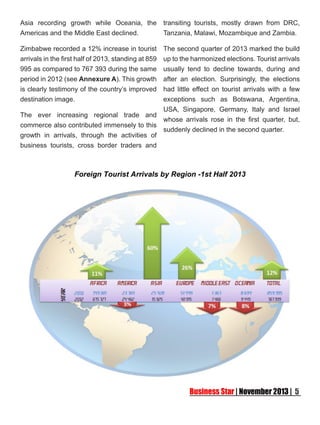
Asia recording growth while Oceania, the
Americas and the Middle East declined.
Zimbabwe recorded a 12% increase in tourist
arrivals in the first half of 2013, standing at 859
995 as compared to 767 393 during the same
period in 2012 (see Annexure A). This growth
is clearly testimony of the country’s improved
destination image.

transiting tourists, mostly drawn from DRC,
Tanzania, Malawi, Mozambique and Zambia.

The second quarter of 2013 marked the build
up to the harmonized elections. Tourist arrivals
usually tend to decline towards, during and
after an election. Surprisingly, the elections
had little effect on tourist arrivals with a few
exceptions such as Botswana, Argentina,
USA, Singapore, Germany, Italy and Israel
The ever increasing regional trade and
whose arrivals rose in the first quarter, but,
commerce also contributed immensely to this
suddenly declined in the second quarter.
growth in arrivals, through the activities of
business tourists, cross border traders and
The market share for the overseas arrivals
into Zimbabwe stood at 13% (compared to the
market share for African arrivals, at 87%). This
share went up 1 percentage point this year
from 12% in 2012.
The combined arrivals from all overseas
markets rose by 20% this year compared
to last year, on the backdrop of exceptional
increases from Europe (26%) and Asia
(60%) with UK, France and China specifically
registering outstanding performances.

Zimbabwe. In Asia, China is rapidly becoming
the major engine driving global tourism,
(having generated 83 million trips to all parts
of the world in 2012) and continues to grow.
Arrivals from China grew by about three
times as much in 2013 as in 2012, yielding a
whopping 310% growth.

Europe recorded a 26% growth in arrivals
with United Kingdom (72%) and France (76%)
being the star performers from this region.
However, the major markets of Germany and
Italy registered decline, without which they
Mainland Africa had an 11% increase in
could have otherwise fueled further growth of
arrivals having risen from 675 727 in 2012
European arrivals to Zimbabwe.
to 749 301, with South Africa, Mozambique
and Zambia contributing over 70% of all The Middle East declined by 7%, with the
arrivals from this region.
major market of with Israel tumbling by 9%
during the period under review.
The Americas declined by 3%, having
fallen from 24 462 in 2012 to 23 764 on the Oceania grew by 8% buoyed by Australia
background of a 6% decline in USA arrivals.
which is the only market with positive results
from this region, whilst New Zealand recorded
Asia exhibited a sterling performance having
a 37% decline.
recorded a 60% growth in arrivals into
4.4 Hotel Occupancy of 2013 as compared to 2012 resumption of Air Zimbabwe
whose whole length had flights between Victoria Falls
Statistics
In the first half of this
year, average hotel room
occupancy levels rose by 2
percentage points to stand at
41%, from 39% in 2012. On
the other hand the average
hotel bed occupancy levels,
contracted by 5 percentage
points from 37% in 2012 to
32% this year.
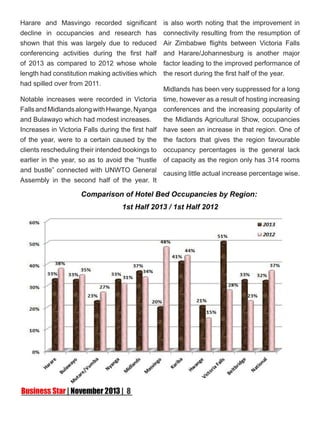
Hotel Room Occupancies:
1st Half 2013 / 1st Half 2012
Harare
and
Masvingo
recorded significant decline
in occupancies and research
has shown that this was largely
due to reduced conferencing
activities during the first half

constitution making activities
which had spilled over from
2011.

Notable
increases
were
recorded in Victoria Falls and
Midlands along with Hwange,
Nyanga and Bulawayo which
had modest increases. 	
Increases in Victoria Falls
during the first half of the year,
were to a certain caused by
the clients rescheduling their
intended bookings to earlier
in the year, so as to avoid the
“hustle and bustle” connected
with
UNWTO
General
Assembly in the second half
of the year. It is also worth
noting that the improvement in
connectivity resulting from the

and Harare/Johannesburg is
another major factor leading
to the improved performance
of the resort during the first
half of the year.
Midlands has been very
suppressed for a long time,
however as a result of hosting
increasing conferences and
the increasing popularity of the
Midlands Agricultural Show,
occupancies have seen an
increase in that region. One
of the factors that gives the
region favourable occupancy
percentages is the general
lack of capacity as the region
only has 314 rooms causing
little actual increase to seem
huge percentage wise.
Harare and Masvingo recorded significant
decline in occupancies and research has
shown that this was largely due to reduced
conferencing activities during the first half
of 2013 as compared to 2012 whose whole
length had constitution making activities which
had spilled over from 2011.
Notable increases were recorded in Victoria
Falls and Midlands along with Hwange, Nyanga
and Bulawayo which had modest increases. 	
Increases in Victoria Falls during the first half
of the year, were to a certain caused by the
clients rescheduling their intended bookings to
earlier in the year, so as to avoid the “hustle
and bustle” connected with UNWTO General
Assembly in the second half of the year. It

is also worth noting that the improvement in
connectivity resulting from the resumption of
Air Zimbabwe flights between Victoria Falls
and Harare/Johannesburg is another major
factor leading to the improved performance of
the resort during the first half of the year.
Midlands has been very suppressed for a long
time, however as a result of hosting increasing
conferences and the increasing popularity of
the Midlands Agricultural Show, occupancies
have seen an increase in that region. One of
the factors that gives the region favourable
occupancy percentages is the general lack
of capacity as the region only has 314 rooms
causing little actual increase percentage wise.
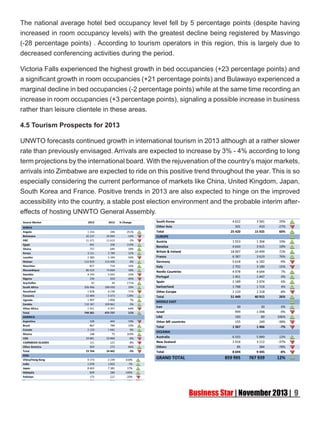
The national average hotel bed occupancy level fell by 5 percentage points (despite having
increased in room occupancy levels) with the greatest decline being registered by Masvingo
(-28 percentage points) . According to tourism operators in this region, this is largely due to
decreased conferencing activities during the period.
Victoria Falls experienced the highest growth in bed occupancies (+23 percentage points) and
a significant growth in room occupancies (+21 percentage points) and Bulawayo experienced a
marginal decline in bed occupancies (-2 percentage points) while at the same time recording an
increase in room occupancies (+3 percentage points), signaling a possible increase in business
rather than leisure clientele in these areas.
4.5 Tourism Prospects for 2013
UNWTO forecasts continued growth in international tourism in 2013 although at a rather slower
rate than previously envisaged. Arrivals are expected to increase by 3% - 4% according to long
term projections by the international board. With the rejuvenation of the country’s major markets,
arrivals into Zimbabwe are expected to ride on this positive trend throughout the year. This is so
especially considering the current performance of markets like China, United Kingdom, Japan,
South Korea and France. Positive trends in 2013 are also expected to hinge on the improved
accessibility into the country, a stable post election environment and the probable interim aftereffects of hosting UNWTO General Assembly.
Africa provides highest growth
opportunities for broadband
Mobile broadband is the fastest growing
technology in human history, according to the
2013 edition of the ITU’s State of Broadband
Report which was released on 21 September.
Released in New York at the 8th meeting of the
Broadband Commission for Digital Development,
the report reveals that mobile broadband
subscriptions, which allow users to access the
web via smartphones, tablets and WiFi-connected
laptops, are growing at a rate of 30% per year. By
the end of 2013 there will be more than three times
as many mobile broadband connections as there
are conventional fixed broadband subscriptions,
read the acc ompanying press release. The State
of Broadband is a unique global snapshot of
broadband network access and affordability, with
country-by country data measuring broadband
access against the four key targets set by the 60
members of the Broadband Commission in 2011.
The Republic of Korea continues to have the
world’s highest household broadband penetration
at over 97%. Switzerland leads the world in fixed
broadband subscriptions per capita, at over 40%.
By comparison, the US ranks 24th in terms of
household broadband penetration, and 20th in
the world for fixed broadband subscriptions per
capita, just behind Finland and ahead of Japan. In
terms of internet use, there are now more than
70 countries where over 50% of the population is
online. The top ten countries for internet use are
all located in Europe, with the exception of New
Zealand (8th) and Qatar (10th).
Significantly, notes the report, by the end of
2013, the number of broadband subscriptions
in the developing world will exceed the number
of broadband subscriptions in the developed
world for the first time, in both fixed and mobile,
respectively. Much of this fresh growth is located
in emerging markets - Budde Communications
(2013) notes that Africa is the region with the
largest remaining growth potential in the world,
and estimates that the market in telecom services

will grow by 1.5 billion people, almost half the
remaining market worldwide, by 2050. We thus
expect the continent to continue to see increased
investment in the ICT sector, as companies look to
exploit the obvious opportunities.
- imara
Africa’s technology and business
leaders have in their hands an
unprecedented
opportunity
to
surpass
their
global
counterparts.

If we can harness the vast and
growing sources of information
known as “Big Data”, members
of the C-suite – particularly
Chief Marketing Officers (CMOs)
and Chief Information Officers
(CIOs), who increasingly share
the responsibility for growth
and innovation – stand to not
only significantly boost our
organisations’ bottom lines,
but catapult our brands into
positions of global leadership
and best practice.
But to do so requires uniquely
African approaches to the
selection and use of Big Data
which align with our continent’s
fast-evolving
socio-economic
and technological landscape.

The currency of data
What is Big Data? The Internet
and computing technologies
have, particularly in the past
decade, resulted in exponential
growth in digital information
which exists in the world – in
fact, more than 90 per cent of
data currently in existence was
created in the past two years.
We call this abundance of
information “Big Data”, and

it has seismic implications for
consumers, technologists, and
business leaders alike.

technologies to manage and
analyse Big Data is typically
a prolonged and technically
intensive task. By incorporating
Analysis of Big Data can identify Big Data at the very foundation
trends,
weaknesses,
and of
their
investment
in
opportunities which would be technology and strategy, African
otherwise invisible to human CMOs and CIOs have the chance
observation – as long as the to get ahead of their global
right tools and strategies are in counterparts in their ability to
place to convert these stockpiles make smarter, faster decisions.
of information into meaningful
insights.
Redefining best-practice
Many commentators are calling
data the “next commodity”: like
natural resources traditionally,
those who can access and refine
it will have increasingly clear
advantages and growth potential
over those who don’t.

For it to be effective, Africa needs
to approach Big Data differently
to the rest of the world. This is
because Africa’s technological
and infrastructural environments
continue to diverge from those
of other continents.

CMOs and CIOs will need to
work together to turn Big Data’s
potential into tangible insights
and improvements. Alliances
between marketers and IT staff
are already becoming more
frequent, and for good reason.

Mobile devices, for example, are
the primary, often sole means of
Internet access for a burgeoning
percentage of the population.

They both count innovation as
a major part of their portfolios;
they share common goals around
improving quality of services; and
their efforts are held responsible
for core organisational growth –
or decline.
Big Data has relevance to all these
areas and the complementary
skills of the CMO and CIO are
essential to its effective use.
Organisations the world over are
taking steps to build Big Data
into how they make decisions,
invest, and even safeguard the
future of entire populations.
But

retrofitting

existing

That has already had significant
impact on the evolution
of e-commerce in Africa,
where mobile-centric online
marketplaces and peer-topeer networks are seeing rapid
success and growth – not the big
e-tailing shops that dominate
online trades in the United
States or Europe.
That, in turn, will define the
nature of Big Data in Africa,
from the source (predominantly
mobile devices and transactions)
to what it is used for (building
new marketplace platforms,
or identifying gaps in current
mobile payment channels).

Tapping mobile growth
African CMOs and CIOs have the
distinct advantage of the
many entrepreneurs from the
burgeoning IT ecosystem of
start-ups. These businesses are
developing innovative means
of tapping this growing mobilebased business landscape.
By
adopting
home-grown
innovations
from
micropayments, to retail supply chains
and banking for the unbanked
and using these to expand locally
and globally, smart African
CMOs and CIOs who work
together will be able to more
efficiently and effectively target
consumers and deliver beyond
their expectations.

algorithms and mobile phone
data, allowing the base platform
to deliver equal – if not better
–results. By taking advantage of
these opportunities, rather than
approaching them as roadblocks,
businesses can turn Big Data to
its most powerful applications.

A smarter marketplace
These applications hold great
promise for how CMOs and
CIOs create more efficient
marketplaces and seamless
transactions.

Many of Africa’s most promising
start-ups are turning global
notions of e-commerce on their
That is not to say African business head, often through the canny
leaders cannot learn from their use of mobile devices to form
overseas counterparts when it networks where buyers, sellers,
comes to Big Data.
and advice-givers can share both
opportunities and information
Take, for example, Nairobi’s latest in a more fluid, physically
efforts to reduce congestion unconstrained manner.
and augment public transport
services using Big Data and The
same
approaches
analytics. IBM’s approach will hold
promise
for
much
collect and analyse data from the larger companies and even
Kenyan capital’s transport grid governments. For example,
to predict and identify delays, creating more resilient networks
automatically reroute transport for
sharing
public-service
to optimal pathways, and notify information is in practice not so
commuters via live SMS and different from developing online
mobile app updates – all based marketplaces for trading goods.
on a similar approach developed
by IBM for Singapore’s transport Big Data and analytics have
the potential to enrich these
network.
networks with insight – into
However, Kenya’s infrastructure wherever inefficiencies and
lacks the coverage of sensors market failures are occurring,
and monitoring infrastructure and how to potentially fix these.
which the Singaporean system
Combined, they can match buyers
relies on for success.
and sellers more efficiently, or
IBM adapted the Singapore allow marketers to deliver more
solution
by
drawing
on accurate recommendations for

future purchases.

Predicting behaviours
They can enable marketers to
predict consumer behaviors
and deliver messages with
more timeliness and resonance
than otherwise possible – with
potentially life-saving results
if applied to public-service
announcements in industries
like government and healthcare.
Only by joining their expertise
in behavior and technology can
CMOs and CIOs use Big Data to
power growth and innovation in
their organisations.
And only with approaches that
leverage the nuances of our
cities and cultures, rather than
simply adhering to a “one-sizefits-all” global model, can Africa’s
businesses and governments
excel at Big Data – so much so
that the rest of the world may
soon turn to them for guidance.
For that to happen, though,
Africa’s top leaders need to put
Big Data on their agenda as a key
opportunity.
Written by Kidane Z. Haile, IBM
Software Group Director of
Information Management Labs,
Africa
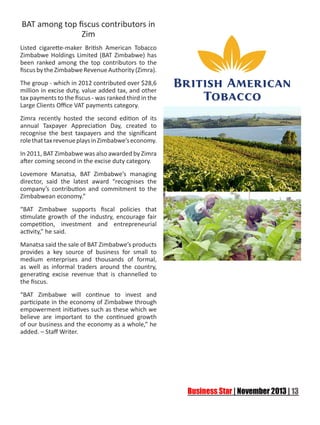
BAT among top fiscus contributors in
Zim
Listed cigarette-maker British American Tobacco
Zimbabwe Holdings Limited (BAT Zimbabwe) has
been ranked among the top contributors to the
fiscus by the Zimbabwe Revenue Authority (Zimra).
The group - which in 2012 contributed over $28,6
million in excise duty, value added tax, and other
tax payments to the fiscus - was ranked third in the
Large Clients Office VAT payments category.
Zimra recently hosted the second edition of its
annual Taxpayer Appreciation Day, created to
recognise the best taxpayers and the significant
role that tax revenue plays in Zimbabwe’s economy.
In 2011, BAT Zimbabwe was also awarded by Zimra
after coming second in the excise duty category.
Lovemore Manatsa, BAT Zimbabwe’s managing
director, said the latest award “recognises the
company’s contribution and commitment to the
Zimbabwean economy.”
“BAT Zimbabwe supports fiscal policies that
stimulate growth of the industry, encourage fair
competition, investment and entrepreneurial
activity,” he said.
Manatsa said the sale of BAT Zimbabwe’s products
provides a key source of business for small to
medium enterprises and thousands of formal,
as well as informal traders around the country,
generating excise revenue that is channelled to
the fiscus.
“BAT Zimbabwe will continue to invest and
participate in the economy of Zimbabwe through
empowerment initiatives such as these which we
believe are important to the continued growth
of our business and the economy as a whole,” he
added. – Staff Writer.
COVER STORY

Mark Tunmer

Imara CEO to head Global Alliance Partners


facilitated transactions in 57
countries worth nearly $32
billion describing it as an honour.
He said the election showed
the rising importance of Africa
on the global economic and
financial scene.
“It is also a strong signal that Africa
features high on the agenda of
leading players active in areas
such as mergers and acquisitions,
private equity transactions,
corporate fund raising and asset
management,” Tunmer said.

on the setting up of stock
exchanges in Botswana, Malawi
and Swaziland and that his
experience would help him in his
duties leading the huge network

“All partners are fully licensed and
together have completed over
1,100 corporate transactions in
57 countries. GAP manages or
advises in excess of $6,5 billion
in individual and institutional
funds,” Imara said.
The chief executive officer of
GAP is involved in all levels of
African investment banking
the world economy.
group Imara, Mark Tunmer
will head the Global Alliance He said that it was heartening “Its key role is to bridge the
between
investment
Partners (GAP), an international that GAP with its vast reach gap
in
leading,
network of financial service was giving increasing attention opportunities
companies following his election to opportunities in Africa. emerging and frontier markets,
Tunmer said the election was and key sources of investment
as chairman.
According to Imara, GAP is “a an important opportunity to risk capital,” Imara explained.
Hong Kong-registered network market Africa to the world. In its annual report for 2013
Imara said that the African
of international, mid-market
financial services companies “During my tenure as GAP continent remained a favourable
dedicated to providing its chairman I will do everything investment destination.
client base with local service I can to showcase new growth “The Board continues to hold the
across
our view that African capital markets
and expertise coupled with opportunities
international reach and access continent. Immense potential remain attractive to investors,
in private equity, corporate fund is evident. It’s vital that Africa offering upside potential for the
raising, stock brokering and fund capitalises on it,” he said. Group,” Imara said.
The group said its concern was
management”.
Tunmer is also the group’s head on the volatility of world markets
Imara explained that GAP was
dedicated to fostering worldwide of securities and country head and their potential to impact
negatively on future results.
investment and business growth. for Malawi.
“He has more than 25 years Imara said Zimbabwe was an
Registered
in
Botswana of African stockbroking and important centre for its business
Imara provides investment advisory experience and has and added that it was too early
banking, asset management been instrumental in raising to gauge the effects of the reand
stockbroking
services more than $450 million in election of President Robert
across sub-Saharan Africa. capital markets across sub- Mugabe and Zanu (PF).
Saharan Africa through listings, “It is still too early to assess what
Harare-based Tunmer accepted privatisation and rights issues,” impact future economic and
investment policies in Zimbabwe
his election as chairman of the Imara said in a statement.
alliance which has collectively The firm said that Tunmer had may have on the Imara Group.
in the past acted as an advisor Short term fluctuations do not
overly concern the Board which continues to
see positive opportunities for Imara’s business in
Zimbabwe over the medium to long term,” Imara
said.
For the financial year ended April 30 2013 Imara
pointed out that the performance of the group was
generally disappointing despite some highlights.

second half against a continuing slowdown in
China and the Eurozone problems although on the
positive side there are signs of a turnaround in the
United States of America,” Imara said.
Imara said it anticipated that the continued growth
in interest in Africa would contribute to greater
inflows, which should in turn return the group to
profit in the year ahead.
“Market conditions remained difficult although  The group recently said the re-election of President
there was an increase in liquidity, while most Mugabe had led to a sell-off on the stock market
markets registered positive gains. The performance but at the same time created a value opportunity
of the African markets excluding South Africa, was for others. This created a record month for trading
better with eleven closing the year under review volumes.
in positive territory in US$ terms,” Imara said.
The group recorded a mixed bag of results on the These volumes in the aftermath of the elections
continent.
were driven almost exclusively by foreigners who
“Of the larger markets Nigeria was up 49 percent, according to Imara were aware of the volatility of
Kenya 34 percent and Zimbabwe 47 percent Zimbabwean politics.
while Egypt was down 8 percent and Morocco 12 Equity markets in sub-Saharan Africa have reached
percent.
healthy levels and Zimbabwe due to the problems
it has suffered has some catching up to do, so there
“As usual the Group performed better in the is long-term growth potential, Imara explained.
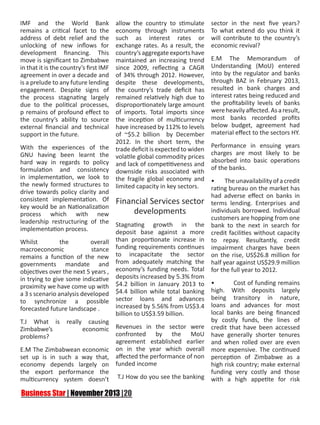
Telecel scoops various
excellence awards
Telecel Zimbabwe was last week,
for the second year running,
presented with the Best Call
Centre Award at the Contact
Centre Association of Zimbabwe
(CCAZ)
Customer
Service
Excellence awards ceremony.

Year Award is given to a company
whose product or service is a
totally new idea in Zimbabwe.
The new product is supposed
to have market dominance over
other new products launched
during the same period and
demonstrate overall marketing
excellence and innovation.

Telecel Red was introduced early
Multichoice was the first runner- this year. It is the first product of
up for the award, while NetOne its kind in Zimbabwe. It is a new
pricing concept that commits
was second runner-up.
the customer to payment of
Telecel was also named first a fixed monthly subscription
runner-up for the Overall Most that enables him/her to make
Customer Focused Organisation local calls, access local data and
in the telecommunications send local text messages worth
sector, while Telecel Zimbabwe up to five times the cost of the
customer operations director subscription.
Zodwa Chinyenze was named
first runner-up for the Most The product comes with three
Customer Focused Executive of plans that subscribers can
the Year in the Private Sector choose from which are Telecel
Red 30, Telecel Red 60 and
Award.
Telecel Red 150.
The previous day Telecel
Zimbabwe had scooped two Telecel Red 30 includes unlimited
awards at the Marketers calls to a frequently used Telecel
Association
of
Zimbabwe number. Telecel Red 60 includes
Exceptional Marketing Awards, unlimited calls to any Telecel
where the company won the number. Telecel Red 150 allows
Exceptional Product of the unlimited calls to any local phone
Year Award for its Telecel Red network, as well as unlimited
product, while its marketing local text calls and data.
director, Octivious Kahiya, was Each of the three plans come
named Marketer of the Year.
with two contract options. There
The Marketers Association
of Zimbabwe awards are
held every year to celebrate
marketing excellence. They are
meant to recognise marketing
programmes and the people
behind them that display
innovation and creativity and
are key for change.

is a post-paid option which
allows for usage outside of the
package provisions, such as for
international usage and where
the plan’s local usage limit has
been reached, on credit up to a
set limit with the additional cost
billed at the end of the billing
period.

The Exceptional Product of the

The flexible option combines the
advantages of a contract with

those of recharging airtime using
scratch cards. It allows customers
to use a scratch recharge card for
usage outside of the package,
such as international usage and
usage once the cost of local
calls, text messages and data has
reached the monthly limit.
Mr Kahiya said Telecel’s winning
of the Exceptional Product of
the Year Award demonstrated
the company’s efforts to bring
value to the market and to its
subscribers.
Mrs Chinyenze, who heads
Telecel’s
customer
service
department,
said
Telecel’s
customer focus was key to its
winning of both the marketing
and customer care awards.

Commenting on her own award
as first runner-up for the Most
Customer Focused Executive of
the Year in the Private Sector
Award, Mrs Chinyenze said she
had a passion for customer
service excellence.
“I have a passion for service
excellence and have tried to
mobilise the company and
emphasise the importance of
customer service. I believe it
should be the strategic focus of
Telecel,” Mrs Chinyenze said.
She said, given the high priority
Telecel gives customer service, it
had come as no surprise to hear
that she and the company had been nominated
for customer service awards.
“I believe we have done well as an organisation.
Personally I have invested considerable time and
commitment to ensure that Telecel is known for
the best customer experience,” she said.
The Telecel Call Centre is easily accessible to
customers and is staffed by customer service agents
who have been trained to deal with customer calls
and respond effectively to customers’ queries.
The CCAZ Best Call Centre award is awarded to the
company that would have made the best use of
technologies as a core strategy of their commitment
to elevate the overall system efficiency, resources
management and customer service quality. In
addition connectivity and harmonisation of these
technologies is also taken into consideration.

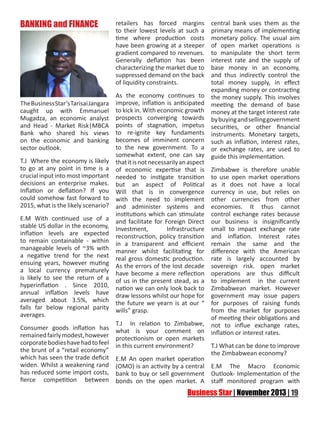
Issued on behalf of Telecel Zimbabwe by MHPR
Public Relations Consultants, 59 Van Praagh
Avenue, Milton Park, Harare.Tel 251538-40. E-mail
mail@mhpr.co.zw
Contact Person: Chengetai Chinembiri
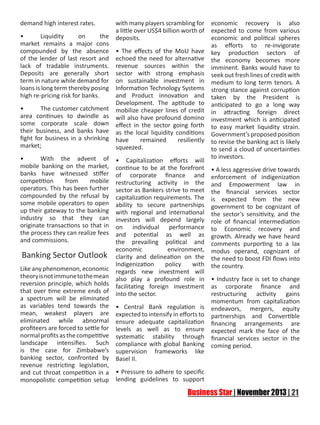
BANKING and FINANCE

The Business Star’s Tarisai Jangara
caught up with Emmanuel
Mugadza, an economic analyst
and Head - Market Risk|MBCA
Bank who shared his views
on the economic and banking
sector outlook.
T.J Where the economy is likely
to go at any point in time is a
crucial input into most important
decisions an enterprise makes.
Inflation or deflation? If you
could somehow fast forward to
2015, what is the likely scenario?
E.M With continued use of a
stable US dollar in the economy,
inflation levels are expected
to remain containable - within
manageable levels of ~3% with
a negative trend for the next
ensuing years, however muting
a local currency prematurely
is likely to see the return of a
hyperinflation . Since 2010,
annual inflation levels have
averaged about 3.5%, which
falls far below regional parity
averages.
Consumer goods inflation has
remained fairly modest, however
corporate bodies have had to feel
the brunt of a “retail economy”
which has seen the trade deficit
widen. Whilst a weakening rand
has reduced some import costs,
fierce competition between

retailers has forced margins
to their lowest levels at such a
time where production costs
have been growing at a steeper
gradient compared to revenues.
Generally deflation has been
characterizing the market due to
suppressed demand on the back
of liquidity constraints.

central bank uses them as the
primary means of implementing
monetary policy. The usual aim
of open market operations is
to manipulate the short term
interest rate and the supply of
base money in an economy,
and thus indirectly control the
total money supply, in effect
expanding money or contracting
As the economy continues to the money supply. This involves
improve, inflation is anticipated meeting the demand of base
to kick in. With economic growth money at the target interest rate
prospects converging towards by buying and selling government
points of stagnation, impetus securities, or other financial
to re-ignite key fundaments instruments. Monetary targets,
becomes of imminent concern such as inflation, interest rates,
to the new government. To a or exchange rates, are used to
somewhat extent, one can say guide this implementation.
that it is not necessarily an aspect
of economic expertise that is Zimbabwe is therefore unable
needed to instigate transition to use open market operations
but an aspect of Political as it does not have a local
Will that is in convergence currency in use, but relies on
with the need to implement other currencies from other
and administer systems and economies. It thus cannot
institutions which can stimulate control exchange rates because
and facilitate for Foreign Direct our business is insignificantly
Investment,
Infrastructure small to impact exchange rate
reconstruction, policy transition and inflation. Interest rates
in a transparent and efficient remain the same and the
manner whilst facilitating for difference with the American
real gross domestic production. rate is largely accounted by
As the errors of the lost decade sovereign risk. open market
have become a mere reflection operations are thus difficult
of us in the present stead, as a to implement in the current
nation we can only look back to Zimbabwean market. However
draw lessons whilst our hope for government may issue papers
the future we yearn is at our “ for purposes of raising funds
wills” grasp.
from the market for purposes
of meeting their obligations and
T.J In relation to Zimbabwe, not to influe exchange rates,
what is your comment on inflation or interest rates.
protectionism or open markets
in this current environment?
T.J What can be done to improve
the Zimbabwean economy?
E.M An open market operation
(OMO) is an activity by a central E.M The Macro Economic
bank to buy or sell government Outlook- Implementation of the
bonds on the open market. A staff monitored program with
IMF and the World Bank
remains a critical facet to the
address of debt relief and the
unlocking of new inflows for
development financing. This
move is significant to Zimbabwe
in that it is the country’s first IMF
agreement in over a decade and
is a prelude to any future lending
engagement. Despite signs of
the process stagnating largely
due to the political processes,
p remains of profound effect to
the country’s ability to source
external financial and technical
support in the future.
With the experiences of the
GNU having been learnt the
hard way in regards to policy
formulation and consistency
in implementation, we look to
the newly formed structures to
drive towards policy clarity and
consistent implementation. Of
key would be an Nationalization
process which with new
leadership restructuring of the
implementation process.
Whilst
the
overall
macroeconomic
stance
remains a function of the new
governments mandate and
objectives over the next 5 years ,
in trying to give some indicative
proximity we have come up with
a 3 s scenario analysis developed
to synchronize a possible
forecasted future landscape .

allow the country to stimulate
economy through instruments
such as interest rates or
exchange rates. As a result, the
country’s aggregate exports have
maintained an increasing trend
since 2009, reflecting a CAGR
of 34% through 2012. However,
despite these developments,
the country’s trade deficit has
remained relatively high due to
disproportionately large amount
of imports. Total imports since
the inception of multicurrency
have increased by 112% to levels
of ~$5.2 billion by December
2012. In the short term, the
trade deficit is expected to widen
volatile global commodity prices
and lack of competitiveness and
downside risks associated with
the fragile global economy and
limited capacity in key sectors.

Financial Services sector
developments
Stagnating growth in the
deposit base against a more
than proportionate increase in
funding requirements continues
to incapacitate the sector
from adequately matching the
economy’s funding needs. Total
deposits increased by 5.3% from
$4.2 billion in January 2013 to
$4.4 billion while total banking
sector loans and advances
increased by 5.56% from US$3.4
billion to US$3.59 billion.

sector in the next five years?
To what extend do you think it
will contribute to the country’s
economic revival?
E.M The Memorandum of
Understanding (MoU) entered
into by the regulator and banks
through BAZ in February 2013,
resulted in bank charges and
interest rates being reduced and
the profitability levels of banks
were heavily affected. As a result,
most banks recorded profits
below budget, agreement had
material effect to the sectors HY.
Performance in ensuing years
charges are most likely to be
absorbed into basic operations
of the banks.
•
The unavailability of a credit
rating bureau on the market has
had adverse effect on banks in
terms lending. Enterprises and
individuals borrowed. Individual
customers are hopping from one
bank to the next in search for
credit facilities without capacity
to repay. Resultantly, credit
impairment charges have been
on the rise, US$26.8 million for
half year against US$29.9 million
for the full year to 2012.

•
Cost of funding remains
high. With deposits largely
being transitory in nature,
loans and advances for most
local banks are being financed
by costly funds, the lines of
T.J What is really causing
Revenues in the sector were credit that have been accessed
Zimbabwe’s
economic
confronted by the MoU have generally shorter tenures
problems?
agreement established earlier and when rolled over are even
E.M The Zimbabwean economic on in the year which overall more expensive. The continued
set up is in such a way that, affected the performance of non perception of Zimbabwe as a
economy depends largely on funded income
high risk country; make external
the export performance the
funding very costly and those
multicurrency system doesn’t T.J How do you see the banking with a high appetite for risk
demand high interest rates.
• 	
Liquidity
on
the
market remains a major cons
compounded by the absence
of the lender of last resort and
lack of tradable instruments.
Deposits are generally short
term in nature while demand for
loans is long term thereby posing
high re-pricing risk for banks.
•
The customer catchment
area continues to dwindle as
some corporate scale down
their business, and banks have
fight for business in a shrinking
market;
•	
With the advent of
mobile banking on the market,
banks have witnessed stiffer
competition
from
mobile
operators. This has been further
compounded by the refusal by
some mobile operators to open
up their gateway to the banking
industry so that they can
originate transactions so that in
the process they can realize fees
and commissions.

Banking Sector Outlook

with many players scrambling for
a little over US$4 billion worth of
deposits.

economic recovery is also
expected to come from various
economic and political spheres
as efforts to re-invigorate
• The effects of the MoU have key production sectors of
echoed the need for alternative the economy becomes more
revenue sources within the imminent. Banks would have to
sector with strong emphasis seek out fresh lines of credit with
on sustainable investment in medium to long term tenors. A
Information Technology Systems strong stance against corruption
and Product innovation and taken by the President is
Development. The aptitude to anticipated to go a long way
mobilize cheaper lines of credit in attracting foreign direct
will also have profound domino investment which is anticipated
effect in the sector going forth to easy market liquidity strain.
as the local liquidity conditions Government’s proposed position
have
remained
resiliently to revise the banking act is likely
squeezed.
to send a cloud of uncertainties
to investors.
• Capitalization efforts will
continue to be at the forefront • A less aggressive drive towards
of corporate finance and enforcement of indigenization
restructuring activity in the and Empowerment law in
sector as Bankers strive to meet the financial services sector
capitalization requirements. The is expected from the new
ability to secure partnerships government to be cognizant of
with regional and international the sector’s sensitivity, and the
investors will depend largely role of financial intermediation
on individual performance to Economic recovery and
and potential as well as growth. Already we have heard
the prevailing political and comments purporting to a lax
economic
environment, modus operand, cognizant of
clarity and delineation on the the need to boost FDI flows into
Indigenization
policy
with the country.
regards new investment will
also play a profound role in • Industry face is set to change
facilitating foreign investment as corporate finance and
into the sector.
restructuring activity gains
momentum from capitalization
• Central Bank regulation is endeavors, mergers, equity
expected to intensify in efforts to partnerships and Convertible
ensure adequate capitalization financing arrangements are
levels as well as to ensure expected mark the face of the
systematic stability through financial services sector in the
compliance with global Banking coming period.
supervision frameworks like
Basel II.

Like any phenomenon, economic
theory is not immune to the mean
reversion principle, which holds
that over time extreme ends of
a spectrum will be eliminated
as variables tend towards the
mean, weakest players are
eliminated while abnormal
profiteers are forced to settle for
normal profits as the competitive
landscape intensifies. Such
is the case for Zimbabwe’s
banking sector, confronted by
revenue restricting legislation,
and cut throat competition in a • Pressure to adhere to specific
monopolistic competition setup lending guidelines to support
CABS records surplus
ZIMBABWE’S largest mortgage lender, Central
African Building Society (Cabs), recorded a surplus
of $10,7 million in the first half of the year helped
by an improvement in interest and non-interest
income, latest financial results show.
In unaudited financial results for the first six
months of the year, net income interest rose by
29% to $2,7 million from $1,95 million recorded in
the same period the previous year.
The growth was aided by an increase in loans and
advances which in the period went up to $296,8
million from $245 million registered in the same
period in the previous year.
“Net interest contributed 56% of the building
society’s total income,” Cabs said in a statement
accompanying financial results.
Fee and commission income grew by 13% to
$12,2 million buoyed by an increase in transaction
volumes during the period.
Comparatively, operating costs increased by 33%
to $17,4 million from $13,1 million achieved in the
same period last year as the building society was
on expansion drive during the period.
As a result, the cost to income ratio went up to 62%
compared to 58% recorded in the same period last
year.
Cabs said total assets grew by 18% to $117 million
driven by a deposit growth of 21 % in the period
under review.
In the same period the building society’s loans
and advances increased to $296,8 million up from
$278 million recorded in December last year.
Cabs added that 10-year mortgage loans improved
to $104 million from $94 million achieved in the
same period the previous year.
In that period, under review Cabs opened an
additional branch and rolled out banking agents to
improve accessibility.

Points of sale acquired through Zimswitch reached
73% while text-a-cash mobile remittances products
exceeded revenue and usage target. Going forward
the building society said it will pursue growth
initiatives to enhance its role in both housing and
financing. – Staff writer
AGRICULTURE and FARMING
Land ownership key to national food
security

after the production of the tobacco there is a
marketing board which operates a stop order
system for repayment and they have been happy
with that,” the minister said.

Chinamasa said farmers must ensure they honour
THE ZIMBABWEAN government is prioritizing the their debts and submit bankable proposals to
land question in respect of land ownership and access funding from banks under terms that are
tenure to unlock full potential in the agriculture yet to be finalized.
sector, a top official has said.
“I know farmers who have no land, they are illegally
Zimbabwe’s fast track land reform programme renting land from those who have offer letters
of 2000, according to the Commercial Farmers and those are being funded by banks, there is no
Union, displaced most of the 4 500 active large collateral. Lets strengthen the collection of debts,
scale commercial farmers much to the detriment let’s have a system that strengths the collection
of national food security.
of debts which are lent to farmers ad we do that
through stop orders.”
This move disrupted land title and banks have
been reluctant to fund farmers citing a lack of “When I had discussions with the bankers they
collateral.
obviously would raise issues about collateral and
what a view but I put to them the suggestion and
Finance Minister Patrick Chinamasa allayed fears
I have already out it to my colleague. We need
farmers would continue facing funding problems
to revive in a serious way the farmers stop order
on the basis that they lacked security as a lasting
system. We need to revive it and make it work
solution was currently being formulated under
especially for crops that are delivered to GMB and
the Ministry of Lands.
I don’t c any legal problems even to extend that
“Obviously the issue you have raised is a separate system to other buyers of grain, that something
issue and is being handled in the Ministry of Lands that we can look at.”
and at an appropriate moment that situation will
Chinamasa argued the problem with local
be ratified,” said Chinamasa recently.
agriculture is a marketing one.
The finance minister however said funding should
Agriculture minister Joseph Made added grain
still be available to farmers whether or not the
buyers must ensure timeously payment to farmers
land tenure system is revised.
so that they are able to go back to the fields.
“First I been meeting the bankers and I want to
“The issue of collateral, if you go worldwide, you
emphasise this, people fund not because you
will that is not the way things are done as people
have security but because what you are doing is
are suggesting,” made said.
viable. What you are doing can produce a cash
flow which shows you can pay back the loan that He said local banks were currently funding
what matters,” the Finance minister said.
bankable projects of any size.
He said discussions were at an advanced stage
with bankers for a viable funding solution with a
stop order system as a possible option.

“It’s not only tobacco, cotton, potatoes and may
crops that are being funded by banks and to small
producers that will surprise you.”

“So you have a situation where contractors are
funding tobacco producers in communal areas,
you know they are funding up to the tune of
US$100 000 with no security because they know

This comes at a time when government has
reaffirmed its commitment to agriculture,
unveiling a US$160 million grain support scheme
for the sector earlier this month.
The scheme will benefit 1, 6 million households
across the country with 10kg of maize or grain
seed, 50kg of compound D fertilizer, 50kg
fertilizer ammonium nitrate and 50kg lime in old
resettlement, small scale and A1 farming areas
for the coming farming season with an option for
livestock production at a cost equivalent to the
grain

Inputs
Chinamasa said US$39, 1 million will be used to
buy seeds, US$50, 1 million for buying compund
D, US$57 million for ammonia nitrate and another
US$11 million to buy Lime.
The move is, according to Chinamasa, a step
towards reviving the agricultural sector which
has suffered from a chaotic land reform and
subsequent lack of funding.
The long term objective is to see Zimbabwe regain
its breadbasket status for the SADC region while
ensuring farming recovers to pole position as the
economic backbone.
Chinamasa sad government will address crop
pricing challenges to stimulate production going
forward.
“What we have also not mentioned is that we
are most unhappy with what is happening in the
cotton industry, the Ministry of Industry is going
to look into that issue, we are very unhappy that
traditional growers of cotton are moving to other
crops such as tobacco. This is a very unsatisfactory
development, something we should not accept
because cotton opens up more opportunities for
us because it has more value chains.”
US biotech expert on Agribiotechnology
Sizani Weza

regulation development, as well as building of
scientific capacity in biotechnology. His area of
expertise is in Plant Breeding and Genomics and
has conducted research on the development and
deployment of transgenic crop plants.
“We have so much data on these GMOs and we
have the data to answer the questions. GMOs are
as safe as the other foods we have if not safer.
GMOs are the most studied foods in history,” said
Dr. Parrott who has published over 80 journal
articles in refereed publications, along with 12
book chapters and three patents.

A visiting United States biotechnology expert, Dr
Wayne Parrott, says the use of biotechnology can
enhance agribusiness and fears about genetically
modified organisms (GMOs) are founded more on
technical concerns than their safety to health.
Biotechnology harnesses living systems and
organisms to develop or make technologies and
products that help improve our lives and the health
of plants and animals. Currently, there are more
than 250 biotechnology healthcare products and
vaccines available to patients, many for previously
untreatable diseases.
More than 13.3 million farmers around the world
use agricultural biotechnology to increase yields,
prevent damage from insects and pests and
reduce farming’s impact on the environment. Yet
concerns about any products of biotechnology
such as GMOs continue.
It’s safe, says Dr Parrott. “Before anything reaches
the market, it has to be reviewed by the food
safety authorities in almost all countries,” Wayne
Parrott who was in Zimbabwe mid-September.
“With these multiple safety layers built into the
system, it’s an expensive and lengthy process with
millions of dollars’ worth of testing required.”
Dr. Parrott, a professor of Crop Science at the
University of Georgia, was in the country where
he participated in several outreach programs
designed to foster dialogue on agricultural
biotechnology, ultimately supporting policy and

Addressing farmers and academics at an event
sponsored by the National Biotechnology Authority
of Zimbabwe, in collaboration with the University
of Zimbabwe, Climate XL, and the United States
Embassy; noted that the debate on biotechnology
had an invariable centered on the safety of GMOs.
“It is true that it is a topic that is debated,” noted
Dr Parrott. “The information has not reached the
people, we have a technology where the private
sector beat the public sector as far as getting to
the marketplace, and as far as the private sector
goes half of those suppliers are European.”
He said concerns about costs to farmers and other
public bodies were a non-issue given that “most
GMO seeds are coming off patent and are entering
the public domain.”
“Eighty percent of the GMO research is by public
institutions around the world it ministries of
agriculture, universities, international research
centers- and the products of their developments
have just started entering the market scene,” said
Dr Parrott.
Among other issues tacked during Dr Parrott’s
visit where biotechnology research in Zimbabwe;
strategic partnerships for biotechnology research;
benefits, risks and drawbacks of increased use
of biotechnology to the business community;
key concerns of consumers and how they can be
addressed; priority areas of biotechnology and
how to engage on the topic.
Local scientists noted that Zimbabwe has potential
to lead among African countries in biotechnology
research but there were no resources. Over 20
years ago, the University of Zimbabwe started
a Master of Science program in Biotechnology
which produced just over 80 graduates, noted Dr
Idah Sithole- Niang, Professor of Molecular Biology
and Virology at the University of Zimbabwe. She
said some of the graduates are prominent in
the biotech industry in South Africa and other
countries in 38 now fully doctored. The program
has been re-enacted this year and will have a fresh
intake in January 2014.
Prof Idah Sithole- Niang: “Zimbabwe was one of
the first African countries to enact a Biosafety law,
and spearhead that with related research. The
potential still exists to get back there…in Kenya
and Uganda- scientists are excelling in conducting
research. We are lagging behind. If you just infuse
that with the resources we can become a giant.”
Dr Fiona Robertson of Agritech Zimbabwe said
seed potato production has decreased over the
last 10 years because of lack of equipment and
limited support from the government to produce
the seeds. She said the country had very good
regulations; in place since 1988 but have not been
tested but these have not been tested.
Professor Sithole Niang, who is also deputy
chairperson of the Research Council of Zimbabwe,
said there have been discussions to establish a
research fund modeled along the South African
National Research Foundation to fund targeted
research. “We have a policy that recognizes
biotechnology as one way of addressing socioeconomic development challenges.”
RETAIL and MARKETING
CUSTOMER SERVICE and its BASICS
by Gerald Brent.

Companies, sole traders and those blessed with
the entrepreneurial gift, spend inordinate amounts
of time and energy focussing on increasing sales
and profits, and rightly so. Always on the hunt for
new opportunities, we create front end strategies,
strategic partnerships and referral mechanisms to
build the ever evolving sales pipeline. Included
in this front end activity is often expensive
advertising, laborious and intensive activity with,
at times, little in the way of results. Perhaps there
is an easier way?
Ockham’s Razor (one of the statements linked to
the medieval philosopher, William of Ockham, and
that accentuates the shaving away of unnecessary
assumptions) indicated that “the best solution to
a problem is usually the easiest one”. Business
owners and managers tend to overcomplicate the
problems and issues that surround us, and the
looking for the one cause with the easiest solution
is at the heart of the statement.
In my personal experience, both as a business
owner and a customer, one of the ‘easier ways’
sits right under our progressive and analytical
noses. I think because of its profound simplicity,
it escapes our notice. That ‘easier way’ is the
provision of exceptional customer service and the
adding of significant value to both our existing and
new clients.
For our purposes here, I will use both a positive
and negative, personally experienced an example

for reinforcement.
Walking with some friends on a warm summer
evening along the along the first street in Harare,
the place was abuzz and most restaurants were
overflowing with patrons. We walked past one
that had only a few customers but enticed us
nevertheless due to its aromatic impact. We
decided to eat there. What happened over the
next hour helped me understand why the place
was empty. The welcome was gloomy, we had to
ask for water, I lit the candle on our table, we had
to wait (and wait) for the waitress (who was not
busy), we had to get up and get serviettes, there
was no eye contact as they walked past us… and
so it went. Food was great, service was lousy and I
have never been back, nor ever will.
The antithesis to this experience was my first visit
to Hotel in Harare, Zimbabwe. Warmly welcomed,
called by name, preferences listed, rooms cleaned
perfectly, etc, made for ongoing and repeat visits.
Having stayed there over a 2-month period, I
decided, for a bit of variety, to try out another
hotel in the vicinity. The rooms and presentation
were excellent but the service was incredibly
average. The cleaner left dirty cups in my room,
no one called me by name, my booking was
messed up, eye contact was lacking and so on.
Needless to say, I am back at the first Hotel. Upon
my return, nothing had changed. Warm greetings
with numerous “nice to see you Mr Brent” and I
am treated as if I am the most important person
there. What was I thinking by trying somewhere
else?
The restaurant referred to above, like many other
businesses, is potentially spending thousands of
dollars on advertising, but lousy customer service
only gives them one time business rather than
repeat business. Thus the bottom line is seriously
impacted by both increased advertising spend
and decreased patronage; not a great recipe
for any business. The hotel on the other hand,
after dealing with them once, created a pathway
back, with no additional marketing cost and have
extracted large amounts of revenue from my
wallet.
The Easy Way – For A Healthy Bottom
Line
For new clients:
	Add value straight up. This might be in
the form of an upgrade to what they have
paid for, a small thank you gift, additional
service or product for free, etc.
	Ensure you explain the process, what they
can expect, your pricing, etc.
	Take the risk away. Offer strong guarantees
in favour of the client that emphasises
that you have to perform and that their
business is valued.
	Call them by name.

general client base.
	Referrals
	Again, one of the simplest, easiest and
overlooked ways of generating business.
Simply asking for referrals works.
Acquisition cost is next to nothing and is
the absolute best way of filling your sales
pipeline.
	Training Your Frontline Team
	Easy but neglected. Train your people to
smile (or yourself for that matter), talk
intelligibly, look at customers in the eye,
go out of your way to make the customer’s
experience incredible. It might mean
making coffee for them, cleaning up after
a job (in the tradesman’s case), showing
them around, explaining the process, etc.

After they have completed their first lot of business
with you, follow them up with a phone call to
ensure their complete satisfaction, send them a Surveys And Follow Up
loyalty card or discount voucher to assist in their The best method here is a phone call. Vehicles
return.
service centres must emulate this. Within 24 hours
Ask their permission to be added to your mail of a car being serviced, and without faltering in five
out list and ensure you keep in touch with them years, make a phone call to ensure the customer is
through newsletters, updates, etc, every 30 days. happy with the service received.

For existing clients:
	Develop a system that when they call or
walk in, their details are easily accessible.
Train yourself and your team to remember
names.
	Create levels of memberships that have
increasing value.
	Reward them for their ongoing patronage.
Examples might include upgrades, free
entry to upcoming events, social invites,
special client evenings, Christmas gifts,
complimentary drinks, etc.
	Give preferential treatment. Categorise
your customers, allowing you to understand
who your top tier is and provide something
in addition to what you would for your

In closing, some personally experienced examples:

The Great
	Staff who remember my name with the
simplicity of a genuine smile.
	Employees who notice the small things,
taking it upon themselves to improve my
condition.
	The taxi driver, mindful of my time and
money takes the quickest route.
	The company, hotel or store that makes me
feel like I am their most important client,
not just a number or dollar.

The Bad
	The waitress who asks “do ‘yous’ want a
drink?”
	The retail assistant who says “are you
happy browsing?” Reinterpreted… “please
do not bother me, I have got better things
to do”.
	The tradesman who grunts and leaves a
mess.
	Sales people who are more interested in
getting the sale than in my needs.

The Ugly
	Telephony support who upon hearing my
complaint say “I understand”. How can
they? They are not me!
	Invoices that end up double what I expected
because things were not explained properly
at the start.
	The bank that provides one teller for
lunchtime queues.
	Overhearing foul language from reception
staff.
As in all things, what you value, shapes your
actions. And, if your company puts me first and
communicates I am important, I will more than
happily be a long-term, paying customer. I will
refer my friends, be your evangelist and open my
wallet. It will then mean decreased marketing
costs, increased sales and profit for you. Easy!
Marketing and ICT with Matildah Zijenah

“THE CASE FOR FACEBOOK”
With over 1 billion users worldwide Facebook
the social networking site continues to grow and
engulf novices and old hands in its wake. More and
more companies are setting up base on Facebook
(following the conversation) hunting down fans
through the omnipresent “Like” without which a
fan base cannot be built. Research has shown that
people “Like” Facebook Pages because they want
to stay up-to-date with a particular company’s
activity and get to know them better. Another
reason people click “Like” is the long standing need
for brand association stemmed in the inspirational
values that guide our actions as humans. People
want to be associated with brands whose values,
add value to their own lives and Facebook provides
a permission based platform for people to segment
themselves based on these very principles. This
of course leaves organizations of every industry
shape and size to window shop and identity their
target markets in a ready to use form i.e “conduct
market research”, offer highly targeted valuable
information and service ” at a fraction of what it
would normally cost.
While Facebook marketing is on the rise among
businesses, many are still struggling to master
the basics. Like the general idea of a marketing
campaign strategy to launch a product. When
setting up a Facebook page you have to have a
strategy in place - a plan of action. Failure to plan
can and will in most cases result in an unstructured
approach that is not authentic enough to encourage
those “Likes” to interact with your brand and incite
the kind of action that leads to the viral sharing
synonymous with inspired content. In Zimbabwe
our corporates have been a long time coming onto
the digital platform, but I am happy to report that

the few that have dared venture into this territory
have found that their audience had been awaiting
their arrival. I do not know about you but every
time I see a familiar Zimbabwean brand or any
brand proudly Zimbabwean on Facebook I am
prompted emotionally to “Like” its page.
Because the reality is true in Zimbabwe as it is
around the world that communities are gathering
online and a conversation about your brand has
ensued with or without your participation. Have
you considered social media as another channel
of communication over the last few months? Is
your business taking advantage of the Facebook
platform? Are you still not sure if it is worth your
time and effort? You are not alone
But guess what? I’ve got you covered I have some
specific how-to advice so you can get rolling along
the social media platform. Below are six key
issues to consider when venturing into Facebook
country!!!

1.	

Objectives

First and foremost outline your purpose for setting
up a Facebook page, and remember you can
have multiple objectives that include: enhancing
customer service, increasing traffic to your
website, building brand awareness, increased
customer engagement, or building an email list.
Whatever or however many your objectives are
they must be clear and your page should reflect
this purpose. Once you have determined these
objective the next step is to prioritize them so that
you align your efforts with the most important of
your objectives for setting up your Facebook page

2.	

Content

Facebook is a social place; people do not expect to
be bombarded with sales pitch upon sales pitch. Infact the opposite is true. People want content that
is relevant, fun and useful to them and their friends
in order for them to share it. Think carefully about
the content you upload onto your Facebook page
whether it’s images, videos, funny commercials or
information that is valuable to your audience. I
recommend having a structured approach. Plan in
advance use the calendar to guide your Facebook
activities, and this will ensure
you do not become repetitive
and boring.
The moment
you become predictable your
audience will stop visiting your
page, now that you do not
want to happen given the new
Facebook algorithm-driven news
feed. This new feature means
that just because someone
“Likes” your page, does not
mean they will see your wall
posts or status updates. This
now requires engaging content
that will get comments and
shares. So it is critical to keep
your content relevant, personal
and varied in order to show up
on profile news feeds. Facebook
insights can help you track which
content is most effective for
your target audience. They have
“Liked your page now it is your
job to make them stay. According
to Facebook spokeswoman
Annie Ta “Facebook is all about
authenticity, so if your company
is not being authentic or engaging
with customers in a way that
feels genuine, the community
will see right through it”.

undeniable and focused visual
brand presentation. Ensure that
your designs echo the needs of
your audience with whom you
are trying to reach out to. So
get your Facebook administrator
to take full advantage of this
branding
opportunity
and
be counted amongst the top
Facebook pages...you never
know you may be subject to a
case study, which would be great
PR for your organization.

opportunity to convert from fan
to paying customer. You can also
promote your page offline and
you should in all your traditional
channels of communication that
include and are not limited to
billboards, newspaper adverts,
radio infomercials and any other
outdoor signage you may have.

5.	

Time management

A lot of the time my new clients
will say to me “It’s not that big
of a deal is it Matilda just set up
4.	 Promote
our Facebook page and we will
Whilst Facebook is not a platform take it from there”. Well I do
for you to broadcast business not think so, unless of course
however, you must promote you have someone designated
your page in order for your to manage your page then
audience to find your brand and you will not be serving your
your relevant content. Research audience effectively. It takes a
has shown that only about 3-5% great deal of time to plan what
of your fans actually see the content you will put out to your
information that you publish fans, its frequency and quantity
onto your wall, as a result in all have to be considered.
order to enhance your visibility Time management is critical
you have to promote your especially if your main objective
page. There are a number of is to enhance customer service,
ways you can do this and these the time in which it takes you
include offering sweepstakes to respond to complaints and
and contests that offer prices comments
will
determine
that are of value to your fans. how your fans interact with
3.	 Aesthetics
You can also use Facebook you. It is in bad taste not to
A lot of people overlook the advertising through sponsored respond to comments within
importance of design for their stories, promoted posts, you 24 hours of them being posted.
Facebook Page; a lot can be can also target people that have It is important to have a clear
done with timelines and cover liked your page to promote Facebook strategy in place as to
timelines to clearly stamp your targeted content. Remember how you will communicate with
brand identity. Facebook now those segments I spoke about your audience; you need a policy
offers much more screen real earlier, you can use these wisely in place to deal with the negative
estate for your Facebook Page when promoting specific content aspects of being on social media
than was offered in the not so that you do not annoy those that clearly outlines how you
so distant past, when all we fans of yours to whom the will address such issues when
had to work with was a profile content is not relevant. You can they do arise. Timely responses,
picture and a few custom tabs. also promote your Facebook relevant content and constant
Facebook has made it a priority page on your website, too monitoring will ensure that your
to continuously enhance its many organizations do not link fans have their needs met and
visual offering, providing brands their website to their page, will stay engaged.
the essentials to create an this really amounts to a missed
6.	

Terms of engagement

There are few rules that you pledge to abide by when you set up a Facebook Page, and these dear
readers cannot be broken under any circumstances. As with any terms of engagement should Facebook
find you violating any of its terms your Page will come under scrutiny and risk being shut down. Hence
just as you will take the time to learn how the tools of Facebook work so too must you learn the rules of
engagement. Ensure that you are not setting up your Facebook Page on a personal profile page, consider
Facebook rules when setting up contests and events. I guess one violation that will get Facebook on
your Page tail is tagging people in photos that you upload into your Page from an event you have
hosted or from elsewhere. Not only does Facebook find it offensive but in general people do not like
to be tagged in photos without their consent. Take the time to get well acquainted with all the rules
stipulated to ensure that all your hard work does not end up in the Facebook recycle bin.
So...Remember above all else it is not about you broadcasting your brand, it’s about you know your
target audience enough to share relevant content that is engaging on an ongoing basis. Lastly, offer
more of the content that resonates with your audience, use Facebook Insights to guide your decision.
Here’s wishing you as many relevant “Likes” as your relevant Facebook page can contain!!!!
Matildah Zijenah, the Founder and CEO of Identity 365 Media Lab writes in her own capacity. She can
be contacted on mzijenah@yahoo.com.
LEADERSHIP PERSPECTIVE

The modern executive is taught
— in business schools and in
In Praise of Micromanagement many jobs — that to manage
people effectively is to delegate,
and then get out of the way. I
teach our masters of business
administration students at
Dartmouth’s Tuck School of
What do Steve Jobs, Mickey Business much the same thing,
Drexler, and Jeff Bezos all have in except for one caveat: Delegating
common?
is only step one. It’s not delegate
and forget; it must be delegate
They are all builders of giant
and be intimately involved with
brands, from Apple to J Crew,
what happens next.
to Amazon? Yes, but there’s
something else you might not You don’t want to, and can’t, do
realise they have in common, everyone else’s job for them.
and it is directly related to their But why would you walk away,
success — each is (or was) an as so many managers do? When
unmitigated,
unapologetic, you have deep passion for your
micromanager!
business, your job, you also have
a responsibility to be involved
What gives? How could the bane
with how your vision is executed.
of many of our performance
You will likely step on some toes
reviews actually be a good
along the way and you may go
thing? I can’t tell you how
too far on occasion, but which
many leadership experts have
is worse: occasionally butting
listed micromanagement as
in on a subordinate’s work to
Public Enemy No. 1. But, when
make a point, or not providing
strategically applied, it can be
real-time feedback to help that
a powerful tool not only to get
subordinate grow and excel? The
things done, but to develop
dichotomy between delegation
talent as well.
and micromanagement is false
If not for Tim Cook, perhaps the and misleading. It’s not one or
legend of Steve Jobs would not the other, it’s both! And if that
doesn’t sound so easy to do,
have turned out quite so well.
well, welcome to the big leagues
Why would you micromanage of leadership.
anyway? Here’s a bad answer:
because you don’t trust anyone Being able to handle, and
else to do his or her job as well indeed thrive, by doing two
as you could. A better answer: opposing things at once is
because you are so passionate a hallmark of great leaders.
about what you are doing that Such “ambidextrous” leaders
you are always striving to make it intensely execute today’s game
better. The best answer: because plan while sowing the seeds
you have a vision for what your for what comes next. They are
business should look like and deeply analytical at the same
you are prepared to back up that time as they are looking for
creative solutions to business
vision with action.

challenges. And they are handson delegators. It’s a paradox only
for the tired and the timid.

And now the fine print
Micromanagers
must
be
selective. You can’t delve into the
details of everything, and in fact
superstar micromanagers don’t.
Mickey Drexler might interview
every single corporate hire —
and more — at the $2.2 billion
J Crew, but he lets other leaders
manage the IT function. Steve
Jobs was intimately involved
with each product the company
designed, and was even famously
involved in designing the glass
stairs at the Apple stores. But
financial and operational issues
were delegated to second-incommand and current Apple
chief executive officer Tim Cook.
Even Jeff Immelt, CEO of bluechip industrial conglomerate
General Electric, is a selective
micromanager.
For
him,
intimately knowing the top 500
executives in the company, what
their performance and potential
looks like and what they need
to develop further, are always
at the top of his agenda. That’s
not a bad role model for any
manager, at any level, come to
think of it.
One key: micromanagers must
be experts. What could be worse
than a manager immersed in
the details who really doesn’t
know his stuff? Sam Walton
spent most of his time flying in
his little airplane to visit stores,
deepening his knowledge as he
went. When he had something
to say, there was deep credibility
behind it.
There is a natural limit to when micromanagement makes sense. Once a job, or a company, becomes
too complex or too big, it becomes that much harder to gain the visibility and time you need to stay
expert. This is a real danger zone for would-be micromanagers. You just don’t have enough time in the
day, or energy in the belly, to keep up at the pace that is necessary. Either you embrace the principle of
selective micromanagement, or you go down trying to do what cannot be done.
Finally, it takes a strong, trusted team to be a micromanager. Could Steve Jobs have spent weeks with
the iPhone design team if there was no one else to mind the store? If not for Tim Cook, perhaps the
legend of Steve Jobs would not have turned out quite so well.
The good news is that the best micromanagers are often the best talent developers. Their attention to
detail, their intimate knowledge of the business and their deep involvement in what’s going on actually
enables more, not less, delegation. Their position in the centre of the work creates an opportunity for
micromanagers to challenge subordinates with big assignments precisely because they are informed.
Delegating big does not carry the same degree of risk that it might for the typical manager.
And so, the final paradox of the micromanager is this: micromanagers actually help other people get
better at what they do. - Capital
The Most Successful
Leaders Do 15 Things
Automatically, Every Day

all areas becomes learned and
instinctual over a period of time.
Successful leaders have learned
the mastery of anticipating
patterns,
finding
Leadership is learned behavior business
opportunities
in
pressure
that becomes unconscious
and automatic over time. For situations, serving the people
example, leaders can make they lead and overcoming
several important decisions hardships. No wonder the best
about an issue in the time it CEOs are paid so much money.
takes others to understand the In 2011, salaries for the 200
question. Many people wonder top-paid CEOs rose 5 percent
how leaders know how to make to a median $14.5 million per
the best decisions, often under year, according to a study by
immense pressure. The process compensation-data company
of making these decisions Equilar for The New York Times.
comes from an accumulation
of experiences and encounters If you are looking to advance
with a multitude of difference your career into a leadership
circumstances, personality types capacity and / or already assume
and unforeseen failures. More leadership responsibilities –
so, the decision making process here are 15 things you must
is an acute understanding do automatically, every day, to
of being familiar with the be a successful leader in the
cause and effect of behavioral workplace:
and circumstantial patterns; Why Top Talent Leaves: Top
knowing the intelligence and 10 Reasons Boiled Down to 1
interconnection points of the Erika Andersen Erika Andersen
variables involved in these Contributor
patterns allows a leader to
confidently make decisions and 15 Ways To Identify Bad
project the probability of their Leaders Mike Myatt Mike Myatt
desired outcomes. The most Contributor
successful leaders are instinctual
decision makers. Having done it The Seven Habits of Spectacularly
so many times throughout their Unsuccessful Executives Eric
careers, they become immune Jackson Eric Jackson Contributor
to the pressure associated with
decision making and extremely Why You’re Not A Leader Mike
intuitive about the process of Myatt Mike Myatt Contributor
making the most strategic and
Make Others Feel
best decisions. This is why most 1.
senior executives will tell you Safe to Speak-Up
they depend strongly upon their
“gut-feel” when making difficult Many times leaders intimidate
decisions at a moment’s notice. their colleagues with their title
and power when they walk into a
Beyond
decision
making, room. Successful leaders deflect
successful leadership across attention away from themselves

and encourage others to voice
their opinions. They are experts
at making others feel safe
to speak-up and confidently
share their perspectives and
points of view. They use their
executive presence to create an
approachable environment.

2. Make Decisions
Successful leaders are expert
decision makers. They either
facilitate the dialogue to
empower their colleagues to
reach a strategic conclusion
or they do it themselves.
They focus on “making things
happen” at all times – decision
making activities that sustain
progress.
Successful leaders
have mastered the art of
politicking and thus don’t waste
their time on issues that disrupt
momentum. They know how to
make 30 decisions in 30 minutes.

3.Communicate
Expectations
Successful leaders are great
communicators, and this is
especially true when it comes
to “performance expectations.”
In doing so, they remind their
colleagues of the organization’s
core values and mission
statement – ensuring that their
vision is properly translated
and actionable objectives are
properly executed.
I had a boss that managed the
team by reminding us of the
expectations that she had of
the group. She made it easy
for the team to stay focused
and on track. The protocol
she implemented – by clearly
communicating
expectations
– increased performance and
helped to identify those on the
team that could not keep up
with the standards she expected
from us.

4. Challenge People to
Think
The most successful leaders
understand their colleagues’
mindsets, capabilities and areas
for improvement. They use this
knowledge/insight to challenge
their teams to think and stretch
them to reach for more. These
types of leaders excel in keeping
their people on their toes,
never allowing them to get
comfortable and enabling them
with the tools to grow.
If you are not thinking, you’re not
learning new things. If you’re
not learning, you’re not growing
– and over time becoming
irrelevant in your work.

Leading by example sounds easy,
but few leaders are consistent
with this one. Successful leaders
practice what they preach and
are mindful of their actions. They
know everyone is watching them
and therefore are incredibly
intuitive about detecting those
who are observing their every
move, waiting to detect a
performance shortfall.

9. Properly Allocate and
Deploy Talent

7. Measure & Reward
Performance

The Seven Habits of Spectacularly
Unsuccessful Executives Eric
Jackson Eric Jackson Contributor

Great leaders always have a
strong “pulse” on business
performance and those people
who are the performance
champions. Not only do they
review the numbers and
measure performance ROI, they
are active in acknowledging
hard work and efforts (no matter
the result). Successful leaders
never take consistent performers
for granted and are mindful of
rewarding them.

Why You’re Not A Leader Mike
Myatt Mike Myatt Contributor

5. Be Accountable to 8. Provide Continuous
Others
Feedback

Why Top Talent Leaves: Top
10 Reasons Boiled Down to 1
Erika Andersen Erika Andersen
Contributor
15 Ways To Identify Bad
Leaders Mike Myatt Mike Myatt
Contributor

Successful leaders know their
talent pool and how to use it.
They are experts at activating the
capabilities of their colleagues
and knowing when to deploy
their unique skill sets given the
circumstances at hand.

10. Ask Questions, Seek
Counsel

Successful leaders ask questions
and seek counsel all the time.
From the outside, they appear
Successful leaders allow their Employees want their leaders to know-it-all – yet on the inside,
colleagues to manage them. This to know that they are paying they have a deep thirst for
doesn’t mean they are allowing attention to them and they knowledge and constantly are on
others to control them – but appreciate any insights along the the look-out to learn new things
rather becoming accountable to way. Successful leaders always because of their commitment
assure they are being proactive provide feedback and they to making themselves better
to their colleagues needs.
welcome reciprocal feedback through the wisdom of others.
by
creating
trustworthy
Beyond just mentoring and
relationships
with
their 11.
Problem Solve;
sponsoring selected employees,
colleagues.. They understand
being accountable to others is a
the power of perspective and Avoid Procrastination
sign that your leader is focused
have learned the importance of Successful
leaders
tackle
more on your success than just
feedback early on in their career issues head-on and know how
their own.
as it has served them to enable to discover the heart of the
workplace advancement.
matter at hand.
They don’t
6. Lead by Example
procrastinate and thus become
incredibly proficient at problem solving; they learn
from and don’t avoid uncomfortable circumstances
(they welcome them).
Getting ahead in life is about doing the things that
most people don’t like doing.

12. Positive Energy & Attitude
Successful leaders create a positive and inspiring
workplace culture. They know how to set the
tone and bring an attitude that motivates their
colleagues to take action.
As such, they are
likeable, respected and strong willed. They don’t
allow failures to disrupt momentum.

13. Be a Great Teacher
Many employees in the workplace will tell you
that their leaders have stopped being teachers.
Successful leaders never stop teaching because
they are so self-motivated to learn themselves.
They use teaching to keep their colleagues wellinformed and knowledgeable through statistics,
trends, and other newsworthy items.
Successful leaders take the time to mentor their
colleagues and make the investment to sponsor
those who have proven they are able and eager to
advance.

14. Invest in Relationships
Successful leaders don’t focus on protecting their
domain – instead they expand it by investing
in mutually beneficial relationships. Successful
leaders associate themselves with “lifters and
other leaders” – the types of people that can
broaden their sphere of influence. Not only for
their own advancement, but that of others.
Leaders share the harvest of their success to help
build momentum for those around them.

15. Genuinely Enjoy Responsibilities
Successful leaders love being leaders – not for
the sake of power but for the meaningful and
purposeful impact they can create. When you
have reached a senior level of leadership – it’s
about your ability to serve others and this can’t
be accomplished unless you genuinely enjoy what
you do.
In the end, successful leaders are able to sustain
their success because these 15 things ultimately
allow them to increase the value of their
organization’s brand – while at the same time
minimize the operating risk profile. They serve as
the enablers of talent, culture and results.
STRATEGY and
MANAGEMENT
10 office personalities
Which one are you?

Every office has a wide
range
of
personalities.
Here,
LondonOffices.com
spokesperson Michael Davies
identifies ten office types. Which
one are you?

2.	

Lazy Git

Nothing annoys office workers
more than having someone in
their team who doesn’t pull
their weight.

favour could you?” If you are
confronted with this question on
a regular basis, then I’m afraid
you are the office mug.

Every office has a mug – someone
who will always say yes to any
Whether it is not doing their fair task you give them regardless
share of the work or relying on of the job, tasks which are often
others to carry them through, mind numbingly boring such as
lazy gits are generally more photocopying, binding reports
preoccupied about checking etc.
their Facebook than the task in
Inevitably, there is a fine line
hand.
between giving your fellow
If you have developed ways colleagues a hand and being
which waste time but make you used. Many mugs delude
look busy, such as tidying your themselves by thinking that they
inbox or organising your desk, are just being helpful or that their
then you probably fall into this assistance will be reciprocated,
category.
but they are wrong.

When you are doing someone
else’s work you are not doing
1.
Brown-noser
Stress pots are highly volatile your own and this has a direct
Every office has one of these. people. From the moment they impact on both yours and your
These shameless sycophants wake up until they go to bed they team’s productivity. In business
the ability to say no is just as
suck up to management in the are worrying about something.
important as the ability to say
hope of promotion.
For them, the tiniest set back yes.
Have you ever commented on can mean the end of the world
your boss’s appearance or do as they know it and result in a 5.
Skiver
you stick your head round their nuclear explosion emanating
Is there someone in your office
office door each afternoon and from their desk.
who pulls just one to many
offer to get them lunch?
It is fairly easy to spot if you are “sickies” for it to be believable?
If you have then you definitely seen as the office powder keg. If If yes then you have a skiver in
fall into the brown nose category you would describe yourself as a your midst.
and you should start to think very “control freak” then alarm bells
Skivers are arguably worse than
carefully about your behaviour. should start to ring now.
lazy gits as at least the latter
Not only will this alienate your
Whilst you may see yourself as bother to turn up for work,
colleagues, more often than
not management can see right obsessed with the detail, others however both are weak links
will see you as a ticking time in the office chain and their
through it.
bomb ready to blow up in their behaviour needs to be nipped in
Trying to get a promotion face over the smallest error.
the bud.
through brown nosing rather
How do you know if you fall into
than hard work is, to all intents 4.
Mug
this category? Well, ask yourself
and purposes cheating, and
remember, cheats never prosper. “You couldn’t do me a huge how many times you have

3.	

Stress Pot
passed a hangover off as flu – if the answer is more
than once then you are a skiver.

6.

Chatterbox

If you would describe yourself as having a bubbly
personality who gets on with everybody and
enjoys a good gossip, then you are quite possibly
the office chatterbox.
There is nothing wrong with chatting about
what was on TV last night or if the right person
got kicked off X Factor, but don’t let it happen
to the detriment of yours and your colleague’s
productivity.
Everyone enjoys a good natter but every now and
again people would actually like to get some work
done. Understand when the conversation has
ended and shut up.

7.

Credit Hogger

Credit hogging can take many forms. These range
from not congratulating a colleague for a good
idea all the way to passing off someone’s idea as
your own.
Hogging the credit for a successful task will win
you no friends in the office, and I’m afraid to say
middle management is often guilty of this.

Remember a workplace is a team, and for a
team to work successfully praise needs to be
distributed evenly. Credit hoggers are greedy and
will come to regret it the next time they ask their
colleagues for help.

8.

Worker Bee

Routine is everything for the worker bee, their
day is planned to the minute and there is very
little room for anything else.
Perhaps due to their reputation for being
unspeakable dull, worker bee’s never feel fully
part of the office team and as such can be seen as
an outsider.

9.

Joker

Humour is essential for any office environment. If
you can’t have a laugh with your colleagues then
office moral is seriously affected.
However, when it comes to humour it is
essential to know the lines not to cross and more
importantly when to stop. The office joker is
someone who is oblivious to these points.
Do you always feel the need to be funny? Do you
equate making people laugh with them liking
you? If so, you are in danger of becoming the
office joker. You try and turn everything into a
joke even when it is not funny.
If this sounds like you then be very careful
because one day you may say something that
could backfire on you badly and land you out of a
job.

10. Machiavelli
Has your ambition to succeed made you ruthless?
Are you prepared to leave bodies in your
wake to achieve success? If so then you are a
Machiavellian.
The Machiavellian is extremely cunning, they
know where they want to get and will stop at
nothing to achieve this.

You are the first to arrive at work and the last to
leave. You eat lunch at your desk and have so few
toilet breaks people think your bladder is made of
stone.

There is nothing wrong with ambition, for some
it’s what gets them out of bed in the morning and
what motivates them to work hard, however, this
determination can turn to ruthlessness.

Conversation between colleagues is limited
strictly to business and going for a drink after
work is completely off the cards.

They will tend to be very quiet about their
ambitions however, their aim will ultimately be
to build people up for a fall, then stand back and
wait to take their place.
To those Machiavellis out there remember this: “He who wields the
dagger never wears the crown.”
P0ROMOTION
ADELAIDE ACRES-The
best choice for business
and leisure hospitality
Adelaide Acres Conference
Centre is the most attractive
location and perfect choice
for doing business affairs and
celebrating various ceremonies
confidently. Because of its
superior levels of service
excellence designed from unique
concepts, the Centre has since
developed to become the most
sought after lodge of choice.
Over the years, Adelaide
Acres
Conference
Centre
has
continuously
gained
popularity to become the top
travel destination for business
meetings, workshops, seminars,
parties, dinners, celebrations,
family holidays, wedding and
honeymoon and congresses.
Traditionally known as Kutsuro
(Rabbit) due to roasting of
rabbits, the Centre has evolved
to take a stylish outlook which
has resulted in rising demand
from local and international
guests.
A spacious joint located just off
the Harare-Masvingo highway,
Adelaide Acres is perfect
getaway for guests seeking for
a quieter environment and yet
offers close-distance access to
the capital city, Harare.
It offers a range of facilities and
the best of service, which aim to
provide the best comfort for all
guests during their stay. These

facilities include the following:

1.	 Accommodation
Adelaide Acres offers best
accommodation
facilities
that have established a
reputation for redefining
the paradigm of luxury and
excellence service amongst
leisure resorts around the
country and is acknowledged
for offering quality and value.
Comprised of standard and
grass thatched chalets, the
rooms are spacious enough
for a great stay and offer
the comfort that matches
the best in the business and
leisure.

2. 	Conferencing
The Centre provides fully
baked
comprehensive
conference services to its
valued clients. It offers
best facilities for any type
of conference-right from
commerce and industry
to
academics.
Being
conveniently located from
the Harare City Centre, the
Conference centre is an ideal
place for productive business
as it combines a learning
environment with excellent
indoor conference facility for
100 delegates and a garden
conference facility for 600
delegates.
Guests
are
assured
of
personalised
and
professional service from
the beginning to the end of
their conference, meeting,
seminar of function.

3.	

Weddings and
Grand Banquets

Adelaide
Acres
has
banqueting halls with state
of the art conferencing
equipment. The capacity
of each hall is up to 100
guests while the garden is
another alternative with the
capacity to accommodate
large gatherings. The place
offers wedding, anniversary,
graduation,
engagements
and birthday parties with
everything, a venue that
makes it magical.
With serene surroundings,
luxurious
rooms
and
legendary service, a stay at
Adelaide Acres promises all
of these benefits and more.
Its unforgettable experience.
4. 	 Comprehensive Menus
The Centre serves a variety
of Zimbabwean traditional
and international mouthwatering and finger-licking
menus painstakingly put
together to suit every palate.

5. 	Braai/Bar
Our
Centre
provides
enjoyable bar and braai
services to exceed your
expectation. The traditional
tsuro braai will reignites
enjoyable outing at weekend,
evenings and holidays. With
ice cold beer you will expect
nothing short of fantastic
outing.
6.	 Recreational facilities
The Center also provides facilities for recreational sports like basketball, volleyball, soccer, darts and
chess which will bring total excitement to our guests.

7.	 Superior levels of service excellence
The convenience and grandeur of the stay at Adelaide Acres is further accentuated by trained staff
that provide exceptionally attentive, personalised and warm service which is truly an epitome
of luxury. The Centre strives to ensure that guests are always satisfied with the services and the
facilities provided to them so that every moment spent at the lodge remains a memorable one.
Quality, efficient and versatile is the principles of our events team.
Tranquil surroundings, elegant interiors and beautifully landscaped gardens with glancing monkeys
create a soothing and intimate ambience.
The Importance of
Business Systems
By Tony Fantulla.

It can be very frustrating for a
company owner or business
manager when an organization
has great staff, good products, a
strong vision and clear direction,
yet the company’s growth is
impeded by a plague of simple,
recurring mistakes that detract
from customer satisfaction
and make it near impossible to
reach KPIs (key performance
indicators).
What is more, it seems that
many of these mistakes, or the
issues which lead to them, end
up on the CEO’s desk, robbing
him or her of valuable time that
could be spent working on the
business rather than in it.
Having great staff, good products
and a strong vision for the future
are important building blocks for
the success of any organization.
However, of equal importance is
the glue that holds these building
blocks together, creating the
foundation for success. That
glue is business systems.
Every business has systems in
place to some degree. Those
systems may be passed on from
employer to employee via word
of mouth or they may exist in the
form of a manual or standard
operating procedures. They
may be as complicated as those
used by organizations like OK
Mart, where everything is done
a specific way, or as simple as a
flow chart. Either way, ensuring
that business systems are as
accurate, comprehensive and up

to date as possible is imperative
in ensuring both short- and longterm success… and it is simple.
Yet, surprisingly, most business
owners avoid it and then miss
the secret that systems contain.
Business systemization does not
need to be hard or complicated.
It starts with simply documenting
how things are done. This may
seem obvious to some readers
but the importance of this task
cannot be overstated, even for
businesses that may already
have some form of business
systems in place. It is only when
the people involved in specific
tasks go back to basics and
document everything that they
do that holes in existing systems
become apparent. For newer
businesses, this task is equally
important, as this develops the
foundation upon which the
future success of an organization
will rest. Furthermore, it will
force owners or managers to
think through areas of their
business processes which may
have previously been addressed
in an ad hoc manner.
This task may be referred to as
completing a systems manual,
operations manual or polices and
procedures manual. Whatever it
is called, the purpose is to capture
the collective intelligence or
‘know how’ of everyone in the
business. The why, what, when,
where, who and how of the
business. The business system!
What are the most important
business systems?
The top three critical systems
are:

1. Sales system, which should
outline how the business finds
prospects, presents, quotes and
closes sales
2. Delivery or fulfilment system,
which details how the product or
service is delivered to customers
3. Customer service system,
which shows clearly and
concisely how the business stays
in contact with customers over
time
A sales system might begin
by outlining, in simple steps,
everything from how an inquiry
by a potential customer is dealt
with and how sales staff should
conduct prospecting calls, to how
a customer’s needs are assessed,
a product or service presented,
a sale closed and processed and
payment collected.
This may seem simplistic and
generic, but this is only the first
step in a much larger process.
Even for existing systems, it is
important to go back to this stage
to ensure nothing is missing.
Use only simple bullet points to
outline each step in the process
at this stage. Once completed,
this enables the creation of
more comprehensive, detailed
systems.
This
process
should
be
completed for all areas of the
business, including:
· Advertising and marketing
systems
· Accounts payable, receivable
and payroll systems
· Recruiting, hiring, inducting,
training
and
performance
systems
· Customer service systems
· Production, warehousing,
inventory and logistics systems
· Safety and quality systems
· Administration, reception and
record-keeping systems
Once the basic outline for the
procedures in each area of the
business has been completed,
expand on each of the steps with
a paragraph or two on the critical
elements involved. It is at this
stage that written procedures
start to become specific to the
company.
This process will also help
to identify any additional
instructional documents that
may be needed for extra detail.
Examples of such documents
may include ‘How to arrange
a meeting with a customer’. It
is important to remember that
what may seem obvious to an
owner or manager may not be
obvious to new employees.
Part of the reason for creating
business systems is to minimize
the amount of time spent
explaining things, while ensuring
continuity of action across staff
and departments.
Once completed, there may be
five to twenty pages that explain
all of the actions required, along
with the rules and guidelines
which govern the decisions
made along the way. Typically,
when one system ends, another
starts; in the case of sales, the
next system is the product/
service delivery or fulfillment
system.

How
to
measure
effectiveness of systems

the

When a system is working, it
will be obvious! There should
be no customer complaints,
no late deliveries and no staff
complaining about things or
each other. There should be only
harmony and productivity in
action and all targets being met.

Once a library of documented
systems is in place, attention
can be focused on specific
areas within the business with
a view to updating the systems
governing that area to ensure
they deliver set goals.

The implementation of properly
documented, effective business
systems enable owners and/
or managers to reap many
To test systems, try:
additional benefits, some of
which will impact on them
· Asking two different staff
personally as well as the
members to explain a system
business. For example, once the
and comparing their responses
systems that they are personally
against the owner’s or manager’s
managing are documented, it
personal interpretation
is possible to begin delegating
· Interviewing customers to those tasks, effectively removing
determine their satisfaction with themselves from that function
without creating chaos in the
the service provided
business.
· Asking customers to explain
their experience with the Once owners are spending less
time doing the actual work of
business, both good and bad!
the business, they are free to
At each step in any system, the do the most important work
effectiveness can be analysed of all, commonly referred to
by looking at the inputs and as working on it, not in it! This
outputs of a step and measuring leaves them time to focus on
the result. In many cases, it is things like: business purpose
necessary to determine what and cultural development;
the goals are for certain steps strategy development and
first, in order to determine if the planning; market identification,
system is delivering upon those measurement and product
development; development of
targets.
the team and its collective skills;
In the sales system for instance, innovation and improvement;
it may be possible to determine financial
planning
and
the effectiveness of the system investment.
by measuring how many new
customer proposals end up as Why develop systems?
sales. If a standard or goal has
been set already, the result can Consider that a systemized
be consistently measured to business, with an up-todetermine if the system requires date operations manual, will
experience:
changing.
Developing systems

· Higher productivity through
staff not carrying out tasks incorrectly or needing
to continually ask for confirmation or clarity
· Greater customer satisfaction and confidence
resulting in higher average sale process and
increased repeat business
· Better accountability of staff through easier
measurement of their performance against the
systems
· Ease of movement of staff into, out of and around
the business
· Less reliance upon key individuals, most of all the
owner, as a result of systems being in place and
available for training and up-skilling others
· Greater control over the flow of information
throughout the business leading to less double
handling and resulting in a reduction of errors
Beware of the traps of systemization
In undertaking the literal task of writing
documents, creating folders, files, forms and
checklists, manuals and all the other contents of a
system, another problem may develop: how best
to organize and deliver the contents in a logical
way to the people who will benefit most – staff.
There are many tools available to assist in
controlling the development of a systems manual,
such as software applications, for example. This
can and will be a low-cost undertaking, provided
the tools are researched and the project is planned
effectively. Making a plan of just how this whole
project will look at the start is critical. Research
the available tools and expertise required and
evaluate the intended method before jumping in
too far.
All the best with your system development; may
your business deliver you the life you deserve.
COMMUNICATIONS
7 ways to deliver
communications that
build trust

you’re only going to know these
things if you’re listening.

Keep your customers happy by
keeping dialogue with them
simple.

A lot of small businesses try
to fudge just how small they
are. It’s pretty common for the
websites of one-man-bands to
say We work with… or, Our tried
and tested processes. Or they
say, We are located in… – and
the rest of the sentence never
mentions the laptop on the
kitchen table.

Building relationships with
clients and customers has
never been more important.
Consumers are spoiled for
choice. But after bank bail-outs
and big business failures, they’re
cynical too.
Customers want to feel they
matter to your business – that
they know you and you know
them and they can trust you.
So how does a small business
build strong relationships that
are built on trust? How can your
communications make people
more liable to trust what you
say, and who you claim to be?

1. Listen to your
customers

2. Be honest

At one level it’s understandable
– micro-businesses don’t want
to miss out on large customers.
But keep firmly in mind that this
is the age of the small business.
Big corporations are keener than
ever to work with small – even
tiny – outfits.
So be honest and be confident
about who you are and what you
offer. You may not offer scale –
but you offer flexibility, cost
efficiency and a personal touch.

cover your backside
If you’re talking about the
service you give, never say you’ll
“aim to” do something.
We aim to exceed your
expectations! is meaningless. It
conveys a lack of confidence and
commitment – sometimes you
will, and sometimes you won’t.
For the best Sunday lunch you’ve
ever had is much better than,
We aim to give you the best
Sunday lunch. That’s because it’s
confident, and it’s a promise the
customer knows you’re going to
have to live up to.

5. Don’t use “official”
language when the
going gets tough
Every company, however big
or small, has to deal with
complaints. Whatever happens,
don’t go into official mode when
you receive a complaint.

With regard to your abovementioned letter… is just going
How often do you ask your
customers what they want? Or if If you know it’s only once in a to make you sound unhelpful
the service you’re giving them is blue moon that a customer’s and pompous. I’m sorry you
spot on?
delivery will arrive next day, didn’t enjoy your meal with us…
don’t promise that it will. You’ll is language that’s much more
Give
your
customers just end up with annoyed and likely to resolve the issue and
turn the complainer into a loyal
opportunities to talk to you. inconvenienced customers.
customer.
Listening to customers will help
you decide the best methods for Instead, write from the heart:
communicating with them.
6. Hide the wiring
Sometimes our deliveries get
there overnight, but usually they
It’s no good using email as take two or three days. If you So many organisations talk
your number one form of need this product urgently, we endlessly about their fantastic
communication, for example, if can arrange special delivery.
processes. Usually, the customer
your clients would prefer you to
doesn’t care so much how a
text – or they have firewalls that
of
4. Don’t use words to piecewantsoftware works –it they
block your e-newsletters. And
just
to know how
will

3. Be really honest
make their lives or businesses easier and more
profitable.
It’s just like when you buy a shiny new gadget. You
don’t want to see the wiring inside. You just want
to see what it does. So don’t talk about the features
of what you offer – talk about the benefits.
It’s the same for every business. If you run a
cleaning service, the main thing your customers
will want to know is that you’ll keep their home or
office spic and span, with no fuss at all. The types
of products you use and the methods you use to
hire staff could be important to a procurement
department, but they’re not your headline.

7. Read it out loud
Read your communications back out loud to
yourself. Do they make you sound like someone
you’d trust? Or do they make you sound pompous
or evasive? If you sound trustworthy to yourself,
there’s a good chance you’re well on the road to
building trust with your customers. Joseph Dennis
The top five things a
website must have to
generate a response
By Philip Brookes

content on your page, and (very
significantly) getting plenty of
links from other high-quality
sites to your site. It is well worth
speaking to a specialist about
this before you start building
your website.

For every successful website on
the Internet, there are many
Awareness
more that do not achieve their
goals. What is the difference Promoting a message is not
between the few that succeed enough – people need to notice
and the many that do not?
it. Your message needs to be
Outlined below are five ‘plain clear and prominent. This applies
English’ marketing concepts both on your website (where you
which you should focus on in need to decide what your key
all of your marketing, including message/s are and ensure that
online, to ensure you are taking they are powerfully presented
a holistic and comprehensive from your home page) and in
view. If you are working with your advertisements. If you place
an online marketing specialist, ads with Google Adwords, or use
ask her to explain how her ‘geek banner advertising at other sites,
monitor the effectiveness of
speak’ fits into this framework.
these and, if you are not getting
enough ‘click-throughs’ to your
Exposure
website, review the message
The first step is to generate presentation to see if you could
exposure – this may be on improve its effectiveness.
business cards, letter heads,
Understanding
direct mail, online advertising,
mass media and outdoor
advertising, or any number of You have advertised and
other promotional channels. promoted, attracted a large
Encourage ‘electronic word of number of viewers to your site,
mouth’, in which people pass on and still you are not getting the
results you expected. Maybe
the message to their friends.
people do not understand what
One key area of exposure is to you are offering.
make sure your website shows up
on Google when people search An effective website needs to be
using particular search terms usable and useful. It needs to:
(keywords). The art and science • Be intuitive and logical to
of coming up at the beginning navigate – it is important to place
of the Google search results information and navigation in
is referred to as search engine locations where people expect
optimisation, and it involves a to find it, to label items in ways
whole range of factors, including which make sense to your
naming conventions for your users, and to avoid clutter and
pages, headings, wording of the confusion

• Answer the questions
potential customers may have
– do not bombard them with
data they are not interested in,
but do include answers to all the
questions they are likely to ask,
and give them an obvious way to
contact you if they have further
queries you failed to address

Desire
Make them want it! You cannot
afford to scrimp on presentation.
Get a professional graphic
designer and photographer to
develop professional imagery
and present your website,
company and products in a
manner that befits the audience
you are serving.
Your website is the online
representation of your entire
company, so keep it maintained,
updated and professional.

Action
A call to action is one of the most
commonly overlooked features
on a website.
Once you have done all the hard
work of promoting, attracting,
explaining and building desire,
do not waste it by putting
roadblocks in the way of the
purchase.
Make your ‘Buy Now’, ‘Enquire’,
‘Receive Free Sample’ buttons
clear and obvious.
Philip Brookes is Director of Aktiv Tactics, a
marketing communications consultancy working
with businesses and not-for-profit organisations
in the Asia-Pacific region to “Get Your Message
Heard”. He has a particular interest in poverty
relief, and using social media and viral marketing
techniques to effect social change. You can
follow his blog at blog.aktiv.com.au. For more
information, visit www.aktiv.com.au
TECHNOLOGY

Cloud computing gets its name
from the drawings typically used
to describe the Internet. Cloud
computing is a new consumption
and delivery model for IT
services. The concept of cloud
computing represents a shift in
thought, in that end users need
not know the details of a specific
technology. The service is fully
managed by the provider. Users
can consume services at a rate
that is set by their particular
needs. This on-demand service
can be provided at any time.
The term cloud remains a source
of confusion for many. And
cloud hosting is a concept many
business owners are keen to get
to grips with if it means saving
money and increasing scalability
and reliability.
Essentially, rather than owning
a physical product, cloud
refers to the virtual provision
of infrastructure or services.
In the case of cloud hosting,
providers own, run and maintain
enormously powerful servers
that businesses pay to access,
either to store data or operate
their websites. One of the
biggest advantages is that the
capacity can expand or contract
according to a company’s needs.
In addition, a raft of software
as a service (SaaS) companies
have emerged to offer online

services that replace the need
to purchase and run software on
internal servers. Cloud hosting
and cloud computing services
are typically (excluding free SaaS
services) paid for and supplied
on a metered or subscription
basis as opposed to a capital
expenditure outlay on hardware,
so have an immediate impact on
your investment budgeting and
monthly accounting.

you’ve paid a hosting company
to ensure your website doesn’t
go down. Sound familiar?

The emergence of cloud hosting
appears to mark the demise of
‘business as usual’. For small
businesses, the advantages
of cloud hosting are distinct
– no costly software licenses,
the flexibility to work from
anywhere, global collaboration
and a reduced hardware bill.
The two main cloud hosting Like gas, electricity and water,
options are dedicated hosting for many cloud computing is
or a shared web hosting service. another utility.
The former typically describes
the lease of a server which But what of the security risks?
is entirely dedicated to your And how do you manage
business, although stored in an cashflow and scaling your
external data centre. The latter needs up and down as activity
describes the sharing of server demands? Will you also forgo
capacity between large numbers a level of control, such as being
of users, which can be used by forced to deal with the impact
updated software used by your
anyone.
cloud hosting company may
The risks, rewards and realities have on other programs you
of switching to cloud hosting
run? Throw in the jargon and the
risks and realities are key factors
Should your business take the alongside the obvious rewards.
leap from software licences
to remote servers and cloud The Benefits of Cloud Computing
computing?
According
to
International
Efficient,
flexible,
reliable Data Corporation (IDC), “The
and less costly. But is cloud proliferation
of
devices,
computing really all it’s cracked compliance, improved systems
up to be? As a business owner performance, online commerce
you, like so many others, have and increased replication to
probably been drawn to the secondary or backup sites
cloud like a moth to a flickering is contributing to an annual
light.
doubling of the amount of
information transmitted over
For years tradition has dictated the Internet.” The cost of dealing
that businesses of a certain size with this amount of data is
buy a server, put it in a cupboard something that companies must
or small room somewhere in the address. In today’s economy,
office, and then backup the data companies are looking at any
on tapes each day. Your email cost-saving
measures,
and
needs have been served by a the bottom line is that cloud
series of software licenses. And
computing
provides
much
greater flexibility than previous
computing models.

access anytime, anywhere, requirements and controls
making your life so much easier! placed on access. Because your
data is in the cloud, you may not
Monitor
projects
more realize that the data must reside
The benefits of cloud computing effectively. Stay within budget in a physical location. Your cloud
are many. One is reduced cost, and ahead of completion cycle provider should agree in writing
since you pay as you go. Other times.
to provide the level of security
benefits are the portability of
required for your customers.
the application is that users can Less personnel training is
work from home, work, or at needed. It takes fewer people to 2.Who has access?
client locations. This increased do more work on a cloud, with
mobility means employees can a minimal learning curve on Access control is a key concern,
because insider attacks are a
access information anywhere hardware and software issues.
huge risk. A potential hacker
they are. There is also the ability
Minimize
licensing
new is someone who has been
of cloud computing to free-up
software. Stretch and grow entrusted with approved access
IT workers who may have been
without the need to buy to the server. Anyone considering
occupied performing updates,
expensive software licenses or using the cloud needs to look
installing patches, or providing
programs.
at who is managing their data
application support.
and what types of controls are
Improve flexibility. You can
applied to these individuals.
Benefits of cloud
change direction without serious
“people” or “financial” issues at 3. What are your regulatory
hosting
stake.
requirements?
Achieve economies of scale
– increase volume output or
Organizations operating in the
Security issues and
productivity with fewer people.
points to consider when different countries have many
Your cost per unit, project or
regulatory requirements that
cloud hosting
product plummets.
they must abide by (e.g., ISO
27002, Safe Harbor, ITIL, and
Reduce spending on technology While cost and ease of use are COBIT). You must ensure that
infrastructure. Maintain easy two great benefits of cloud your cloud provider is able to
access to your information with computing, there are significant meet these requirements and is
minimal upfront spending. Pay security concerns that need to willing to undergo certification,
as you go (weekly, quarterly or be addressed when considering accreditation, and review.
moving critical applications and
yearly), based on demand.
sensitive data to public and 4. Do you have the right to audit?
Globalize your workforce on the shared cloud environments. To
cheap. People worldwide can address these concerns, the This particular item is no small
access the cloud, provided they cloud provider must develop matter; the cloud provider
have an Internet connection.
sufficient controls to provide should agree in writing to the
the same or a greater level of terms of audit.
Streamline processes. Get more security than the organization
work done in less time with less would have if the cloud were not 5. What type of training does the
people.
used. Listed here are ten items provider offer their employees?
Reduce capital costs. There’s to review when considering This is actually a rather important
no need to spend big money on cloud computing.
item, because people will always
hardware, software or licensing 1.Where’s the data?
be the weakest link in security.
fees.
Knowing how your provider
Different countries have different trains their employees
Improve accessibility. You have
is an important item to review.
6. What type of data classification
system does the provider use?
Questions you should be
concerned with here include:
Is the data classified? How is
your data separated from other
users? Encryption should also be
discussed. Is it being used while
the data is at rest and in transit?
You will also want to know what
type of encryption is being used.
As an example, there is a big
difference between WEP and
WPA2.
7. What are the service level
agreement (SLA) terms?
The SLA serves as a contracted
level of guaranteed service
between the cloud provider and
the customer that specifies what
level of services will be provided.
8. What is the long-term viability
of the provider?
How long has the cloud provider
been in business and what is
their track record. If they go
out of business, what happens
to your data? Will your data
be returned, and if so, in what
format? As an example, in 2007,
online storage service MediaMax
went out of business following a
system administration error that
deleted active customer data.
The failed company left behind
unhappy users and focused
concern on the reliability of
cloud computing.

from the cloud provider? While
many providers promote their
services as being unhackable,
cloud-based services are an
attractive target to hackers.
10. What is the disaster recovery/
business continuity plan (DR/
BCP)?
While you may not know
the physical location of your
services, it is physically located
somewhere.
All
physical
locations face threats such as
fire, storms, natural disasters,
and loss of power. In case of
any of these events, how will
the cloud provider respond, and
what guarantee of continued
services are they promising? As
an example, in February 2009,
Nokia’s Contacts On Ovi servers
crashed. The last reliable backup
that Nokia could recover was
dated January 23rd, meaning
anything synced and stored
by users between January
23rd and February 9th was lost
completely.

Even basic services such as e-mail
require a thorough review before
moving the service to the cloud.
While some organizations are
starting to move their e-mail to
cloud services hosted by Gmail,
Yahoo e-mail, and others,there
are issues to consider. In
February 2009, Gmail reported
an outage that affected its EU
users. In January 2010, it was
reported that Gmail had been
targeted by attackers seeking to
gain access to Chinese human
9. What happens if there is a rights activists. It was further
reported by MSNBC that foreign
security breach?
correspondents
may
have
If a security incident occurs, been targeted. Although these
what support will you receive services have many controls

built in, it is not impossible for
them to be compromised.
Questions that companies need
to ask before outsourcing even
something as basic as e-mail
include:
• Can you function with no
e-mail?
• How easy would it be to migrate
to another e-mail provider?
•What is your email retention
policy, and do you have a legal
requirement to keep your email
for a specific amount of time?
• Would your clients be
concerned that you store email
with sensitive information on a
third-party server?

Cloud Computing
Attacks
As more companies move
to cloud computing, look for
hackers to follow. Some of the
potential attack vectors criminals
may attempt include:
•Denial of Service (DoS) attacks Some security professionals
have argued that the cloud is
more vulnerable to DoS attacks,
because it is shared by many
users, which makes DoS attacks
much more damaging. Twitter
suffered a devastating DoS attack
during 2009.
• Side Channel attacks –An
attacker could attempt to
compromise the cloud by placing
a malicious virtual machine in
close proximity to a target cloud
server and then launching a side
channel attack.
• Authentication attacks –
Authentication is a weak point in hosted and virtual services and is frequently targeted. There are
many different ways to authenticate users; for example, based on what a person knows, has, or is. The
mechanisms used to secure the authentication process and the methods used are a frequent target of
attackers.
•Man-in-the-middle cryptographic attacks –This attack is carried out when an attacker places himself
between two users. Anytime attackers can place themselves in the communication’s path, there is the
possibility that they can intercept and modify communications.

Conclusion
Cloud computing offers real benefits to companies seeking a competitive edge in today’s economy. Many
more providers are moving into this area, and the competition is driving prices even lower. Attractive
pricing,the ability to free up staff for other duties, and the ability to pay for “as needed” services will
continue to drive more businesses to consider cloud computing. The decision to move to cloud-based
services should fit into the organization’s overall corporate objectives. Before any services are moved to
the cloud, the organization’s senior management should ensure such actions are consistent with their
strategic plans and meet acceptance criteria that address the ten items discussed in this article.
Just as there are advantages to cloud computing, there are also several key security issues to keep in
mind.One such concern is that cloud computing blurs the natural perimeter between the protected inside
the hostile outside. The security of any cloud-based services must be closely reviewed to understand
what protections your information has. There is also the issue of availability. This availability could be
jeopardized by a denial of service or by the service provider suffering a failure or going out of business.
AFRICA

Kaberuka highlighted the need
to improve infrastructure on
Elumelu calls on African the continent, stating that
businesses could only grow
entrepreneurs to take if the infrastructure gap was
addressed. Angolan investor
business to BRICS
Isabella Dos Santos stressed
JOHANNESBURG - During a panel the need for investment in
discussion held at the first BRICS ‘soft infrastructure’ stating
Business Council meeting in broadband technology would
Johannesburg this week, African have a transformative effective
business leader Tony O Elumelu, similar to mobile technology in
Chairman of Heirs Holdings, Africa.
called on the BRICS business
leaders to make room for African Mo Ibrahim livened up the
entrepreneurs looking to expand audience with his delivery, but
their businesses beyond the behind the jokes were very real
continent to the BRICS countries. and critical messages about
Africa’s poor global image and
In front of an influential audience the importance of governance.
of business leaders from BRICS He talked about his foundation’s
and 19 other African countries, governance index which was
Elumelu spoke of the need for one of the most comprehensive
mutually beneficial partnerships in the world, measuring
between African countries and 88
parameters
including
the BRICS nations: “A new crop transparency
corruption,
of African entrepreneurs are education and health. His final
emerging who have ambitions message to investors was; “Don’t
beyond the continent. They come to Africa and help, come
should be investing in the BRICS and make money because the
countries in the same way that highest return on investment is
BRICS are investing in Africa – in Africa. Enjoy making money
this relationship needs to go in Africa but please behave”.
both ways.”
South African Johann Rupert,
Elumelu was speaking at a panel Chairman of Richemont and
session on “Specific measures Remgro talked about the critical
and initiatives to increase things he looked for as an
business, trade, manufacturing, investor - regardless of where
and investment ties between his investment was located. He
the BRICS countries and listed the four critical areas as:
Africa”. The discussion, which the rule of law, independence of
was moderated by Donald the judiciary, security of property
Kaberuka, President of the and transparency of markets.
African Development Bank,
also provided valuable insights Elumelu summed up the
from other prominent African general consensus of the BRICS
council
meeting
business leaders, including Mo business
Ibrahim, Isabella Dos Santos and when he concluded that: “As
African business leaders, and
Johann Rupert.

as Africapitalists, we agree that
we have amongst us enough
resources to make things happen
in Africa. We must share the
opportunities on the continent.
There are enough of us to
make a difference. We need to
work together to find ways of
increasing trade and investment
ties between the BRICS nations
and Africa.”
- APO
WORLD
APEC Leaders Urge
Fewer Protectionist
Policies to Boost
Growth

company officials in Bali. “It
is important to maintain that
public support for openness
and integration because unless
you have that -- if we all close
ourselves up, or even hinder
the process of trading and doing
business with one another
-- I think we are just going to
make things worse for all the
countries.”

tight time line” and leaders will
discuss if it is feasible. U.S. Trade
Representative Michael Froman
said yesterday the “finish line
is in sight” and TPP officials are
trying very hard to complete the
deal this year.
All the TPP countries are
members of APEC, set up in
1989 to advance free trade
and investment in an area that
accounts for half of the world’s
total gross domestic product and
45 percent of global commerce.

Global growth will probably be
slower and less balanced than
Asia-Pacific leaders are calling for desired, as the world economy
vigilance against protectionism is too weak and “risks remain
as economic growth slows tilted to the downside,” trade
‘Vital Chance’
in parts of the region and and foreign ministers from the
completion of a 12-nation trade 21-member grouping said in a “With markets struggling to
pact looks set to be delayed statement yesterday.
emerge from a devastating
further.
global recession, we need the
jobs, growth and economic
TPP Traction
Asia-Pacific
Economic
opportunity a free trade
Cooperation economies must A slowdown in China and India is agreement could provide,”
also improve infrastructure reverberating across the region Jay Timmons, president of the
to spur trade and investment, with the Asian Development Washington-based
National
Indonesian President Susilo Bank forecasting expansion at Association of Manufacturers,
Bambang Yudhoyono said in a a four-year low in 2013, putting and Phil O’Reilly, chief executive
speech in Bali to about 1,000 pressure on policy makers to of Business New Zealand, said
business executives. In Malaysia, bolster their economies. The in a joint commentary on TPP.
Prime Minister Najib Razak said Group of 20 countries repeated “With every month that passes
the year-end deadline for the their concern last month that without a deal, we miss vital
Trans-Pacific Partnership may stimulus pullback in developed chances to boost trade and
not be met.
nations may prove damaging to investment.”
Policy makers are seeking to global markets.
APEC ministers said yesterday
support their economies via new TPP governments are seeking they will recommend their
markets for goods and services momentum during the Bali leaders extend through the
as an uneven global recovery meetings on the pact as end of 2016 a commitment to
and volatility in financial markets concessions sought by countries combat protectionist measures
constrain growth. Companies hinder progress in completing and roll back such policies that
should encourage governments negotiations. The accord, which exist.
to curb barriers to trade instead involves countries such as the
of asking for measures to U.S., Australia, Japan, Malaysia “We reaffirmed our commitment
safeguard their industries from and Vietnam, would link an area to keep markets open and to
competition, Singapore Prime with about $28 trillion in annual refrain from raising new barriers
Minister Lee Hsien Loong said.
to investment or to trade in
economic output.
goods and services, imposing
“Every business lobbies their Malaysia’s Najib said today the new export restrictions, or
government in order to look end of 2013 deadline is a “very implementing WTO-inconsistent
after their interests,” Lee told
measures in all areas, including those that stimulate exports,” the ministers said.

Infrastructure Challenge
Sixty-eight percent of chief executive officers in the Asia-Pacific region plan to increase investments
next year, with China, the U.S. and Australia among top destinations over the next three to five years, a
PricewaterhouseCoopers report showed.
“We need to develop more and better infrastructure as an essential element for our connectivity,”
Yudhoyono said today. “This will of course help not only to facilitate trade and investment, but also
boost job creation. APEC needs to tackle inefficiency in the supply chain. We have to make it easier,
cheaper, and faster to conduct trade in goods and services across borders.” -Broombeg
China logs best growth
so far this year

China’s gross domestic product
(GDP) rose 7.8 percent on year
in the third quarter, the National
Bureau of Statistics reported on
Friday, up from 7.5 percent in the
second quarter and in line with
expectations.
“The uptick in growth reflects
both better exports and solid
domestic demand, although the
easing of industrial output growth
in September indicates that the
recovery is tepid,” said Louis Kuijs,
chief China economist at RBS.
Industrial
output
growth
moderated to 10.2 percent on
year in September, compared with
10.4 percent in August. Still, Kuijs
remains upbeat on his outlook
for the world’s second-largest
economy.
“We expect global demand
momentum to pick up as the
economic upturn in the U.S. and
Europe takes hold and see this as
key to our growth projection for
China,” he said, forecasting full-year
growth of 7.7 percent for 2013, and
8.2 percent in 2014.
“Against this more constructive
global backdrop, and with domestic
demand momentum remaining
solid, we expect GDP growth to be
above the government’s ‘bottom
line’ in 2014, thus alleviating
pressures to stimulate the
economy,” he added. Earlier this
year, Premier Li Keqiang identified

7 percent as the “bottom line”
for growth, local media reported,
saying that this this threshold must
not be breached.
With the impact of government
stimulus
fading,
many
are
questioning whether growth levels
posted in the third quarter will be
sustainable. In late-July, Beijing
unveiled a package of measures
to boost the economy, which
included eliminating taxes on small
businesses, reducing costs for
exporters and lining up funds for
the construction of railways.
According to Ting Lu, chief China
economist at Bank of America
Merrill Lynch, on a quarterly basis,
growth likely peaked in the Julyto-September period. In the third
quarter, growth rose 2.2 percent on
quarter, up from 1.9 percent in the
previous three months.
However, in year-on-year terms, he
notes that growth could rebound
again, to around 7.8-8.0 percent,
in the first half of 2014 on a low
comparison base.
Raymond Yeung, senior economist
at ANZ believes it’s too early to
conclude
whether
economic
expansion in the mainland has
peaked.
“We expect a slowdown in the fourth
quarter, but it’s too premature
to conclude a decline of growth
momentum. The Third Plenary
Session is coming up in November
- while we don’t expect any major
stimulus to expand growth, they are
undergoing reforms that will help
China growth in a more sustainable
manner,” he said.
Yeung, however, notes there are
two main risks that lie ahead for the
mainland economy: tight monetary
policy and a strong yuan.
With

credit

growth

remaining

robust in the recent months, the
People’s Bank of China could
tighten liquidity if credit expands
in an undesirable manner, he said.
On the currency front, renewed
strength in the yuan could hurt the
country’s export competitiveness
and dampen some of the growth
momentum.
Modest declines in other economic
indicators released on Friday could
add to uncertainty. Fixed asset
investment growth softened to
20.2 percent on year in the first
nine months of 2013, from 20.3
percent in the first eight months
of the year. Retail sales growth,
meantime, edged down to 13.3
percent on year, from 13.4 percent
in the previous month.
— CNBC’s Ansuya Harjani
Issue 7 november 2013

Issue 7 november 2013

  • 5.
    CALENDER OF EVENTS Zimbabweto host inaugural African Marketing Summit in 2014 The body comprises a membership of partners in six countries including South Africa, Nigeria, Zambia, Kenya, Ghana and Zimbabwe. AMC secretary-general Gillian Rusike said the hosting of the summit would promote the local marketing industry and the country as a destination. “Our vision is ambitious and it completely challenges the way in which Africa has been thought of before. We want to provoke Africans marketing professionals to champion the development of Africa through home grown solutions as we better understand our continent than outsiders,” he said. He added that hosting of the event in Zimbabwe posed a greater challenge for local professionals to prove that they were a cut above the rest in Africa and beyond. Rusike said besides being able to bring visitors to the country, hosting of such events in the country would facilitate the image building of the nation hence also contributing to national development at large. Zimbabwe has won another opportunity to host a high-profile event that is set to bring in more recognition to the country as marketers will host the inaugural African Marketing Summit in the country next year. The summit which comes hard on the heels of the successful co-hosting of the UNWTO General Assembly in Victoria Falls, will run under the theme “Making Africa a Better Business Giant through Marketing” from March 26-28. The African Marketing Confederation, the host, is a pan-African body of marketing professionals aiming to spearhead the development of the highest possible marketing standards across Africa. It recognises that the continent’s unique and varying cultures, languages, standards of education and levels of development require home-grown marketing approaches designed and nurtured by Africans themselves. Hundreds of delegates from emerging and developed markets are expected to participate, including CEOs, academics, marketing practitioners, government officials, entrepreneurs and world-renowned thinkers, among others from around the world who share a common interest in sustainable development through business as a whole, and through marketing in particular. The event will also feature leading multinational companies, African marketing institutions, universities, Chambers of Commerce and other bodies.
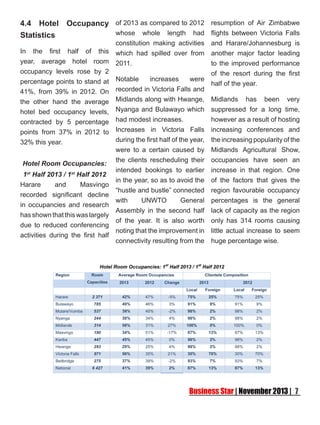
  • 6.
    COMPANY NEWS Ziscosteel; willthe sleeping giant finally awake? Minister of Industry and Commerce, Mike Bimha says the re-opening of redundant New Zim Steel, formerly, Ziscosteel, is one of his top priorities following his appointment in mid-September. The giant Redcliff company, was rechristened New Zim Steel after government signed a US$750 million takeover deal with India’s Essar Africa Holdings (Essar). Essar now effectively owns 54 percent of the derelict steel producer, whose re-opening since closure over five years ago, has been a matter of false starts in the past two years. The deal between Essar and government was penned in 2011, during the lifespan of the coalition government, with Professor Welshman Ncube, the then Industry and Commerce Minister having taken a lead role in facilitating the takeover. But operationalization of the deal took what many analysts describe as a political turn, despite cabinet and President Robert Mugabe having officiated at the event when pen was to put to paper between government and Essar on transfer of shareholding. Allocation of mineral claims, which had presumably been handed over to Essar when it acquired the stake became the major issue, stalling the operationalization of the deal. between Essar and Zisco management,” the new industry minister said. “A lot of progress has been made and the coming in of a new government will ensure that Ncube, a Movement for there is speed in terms of the Democratic Change minister execution (of the deal).” failed to convince his then Mines counterpart, Obert Mpofu from Bimha also believes that the fact Zanu PF, to hand over the claims that the new cabinet is entirely as presumably agreed with Essar. made up of members of the ruling party, Zanu PF, other than The Mines and Mining coalition, will ensure that there Development ministry, it is smooth facilitation in ensuring appeared seemed to argue that that the obstacles standing in Ncube had sold off Ziscosteel the way of operationalizing the and the claims the company deal are addressed. owned for a song and wanted Essar to separately pay for the “The mere fact of having an entire cabinet from Zanu PF revalued mineral resource. will ensure that communication Disagreements on this matter, is faster and accessibility is have to date stalled the much guaranteed and I am sure that awaited re-opening of New Zim we all have that a common Steel. agenda to ensure that what we promised the electorate is General elections, finally held realised,” he said. on July 31 and disputably won by Zanu PF, also further delayed Walter Chidhakwa now heads finalisation of the matter as the mines ministry. politicians, who have the final say on the deal, hit the campaign To ensure smooth facilitation of the deal, the Office of the trail. President and Cabinet is now But Bimha, once Ncube’s deputy chairing a committee, comprised and has taken over the reigns officials from the ministries of told the Business Star, progress mines and industry as well as in ensuring the matter is finalised from Essar. will now be fast tracked now that President Mugabe has set The delay in ensuring New Zim Steel comes back to life has not up a new government. been without consequences for “With the coming of a new the country as an investment government, we will ensure that hungry destination, the steel progress is accelerated. There industry as well as the workers have been a lot of meeting and their families.
  • 7.
    The New ZimSteel deal is arguably one of the “Since 2010, no one has talked or shown concern biggest investment deals that Zimbabwe managed about the lives of the workers,” says Ziscosteel to clinch at a time when the international investor artisan’s union chairperson Obert Shokombisi. community largely shunned the country. “There has been great talk about the deal and Government’s continued insistence on localisation mining rights but nothing about the human laws which force foreigners to cede at least resources. 51 percent shareholding to locals made the And without funding to bank on, New Zim Steel investment climate unattractive. has struggled not only to pay the workers but also Economists however say that government’s owes other stakeholders including utilities over bungling of the New Zim Steel did not do the $120 million. economy any good in the eyes of potential Industrialists say finalization of the deal therefore investors. remains critical not only of the workers and the “For such a big investment of close to a billion town of Redcliff in particular which has been dollars, government was supposed to handle this turned into a ghost town, but the economy as a deal with great care,” said one economist. whole. “Taking years to finalise the deal when you are trying to attract other investors to invest in the country will just not work.” The Engineering, Iron and Steel Association says delays in re-opening the firm had seen the steel industry struggling to boost its capacity which is hovering below 20 percent, with 15 companies in the sector having been placed under liquidation. Workers have also borne the brunt of the government’s ineffective handling the deal. At signing of the deal, Essar had committed to retaining the 3 500 workers who were employed by Ziscosteel. Further investments would have seen the company employing 3 500 workers. The company would also have paid the salaries debt, which employees were owed by Ziscosteel. Bimha says discussions on assisting the workers with among others school fees for their children have been going on in the background. But the workers, who have been made redundant for too long, say their livelihood has turned into a nightmare due to failure to re-open the company. The workers, who have not been paid for months and are owed in excess of $15 million are struggling to make ends meet at a time when the cost of living is on an increase. New Zim Steel has the potential not only to earn the economy the much needed foreign currency through exports but to also serve as local companies will no longer need to import steel.
  • 8.
    4.2 Overview ofEconomic Performance in Zimbabwe Economic Growth The economic growth rate for Zimbabwe is estimated Statistics Highlights to reach 5% by the year end, on the backdrop of expected 4.1 Global Tourism Overview positive performance in the According to the latest figures mining and agricultural sectors. availed by the UNWTO for This estimated growth is a 0.6 the first four months of the percentage point increase from year (January to April 2013), the annual economic growth international tourist arrivals of 4.4% in 2012. Tourism is a went up by 4% compared to the sensitive sector which thrives same period in 2012. This was well when the economy is an increase from 287 million growing. A growing economy has to 298 million which reflects a a positive impact on disposable generally robust tourism sector, income among locals which is a despite the on-going economic positive stimulant for domestic challenges in some parts of the tourism. world. Inflation As of June 2013, the The UNWTO reports positive country’s year-on-year inflation, growth in all regions, with the as measured by the Consumer strongest growth in Asia and the Price Index (CPI), increased Pacific (6.3%), Europe (4.9%) the marginally by 1.87%, according Middle East (4.7%), and weaker to figures released by the growth in the Americas (0.5%) Zimbabwe National Statistics and Africa (1.8%). Agency (ZimStat). The annual By sub-region, South-East Asia inflation is projected to reach (12%) and Central and Eastern 2.9% by December 2013. This Europe (9%) continued to be low rate of inflation is conducive the star performers while in for economic growth since Africa, the sub-Sahara region experts point out that inflation registered a 3% increase against should be maintained between a 0.1% decline for North Africa. 1% and 5% per annum for 2013 First Half Tourism optimal economic growth. However, a ripple effect may still be felt in the economy, due to the 5cent per litre increase on excise duty on petrol and diesel for the period March to December 2013. Interest Rates As a result of the prevailing liquidity constraints attributable to limited foreign direct investments as well as a perennial trade deficit, credit remains very expensive in the country with financial institutions charging, on average, annual interest rates of 10% for corporates and 14, 5% for individuals. The country badly needs to revamp its tired product by carrying out refurbishment of existing tourism facilities and investing in new facilities. However, these high interest rates continue to inhibit access to finance, thus restricting development of the tourism sector. 4.3 Tourist Arrivals into Zimbabwe - First Quarter 2013 Preliminary results of tourist arrivals into the world’s regions for the first Half of 2013 show Africa, Europe and
  • 9.
    Asia recording growthwhile Oceania, the Americas and the Middle East declined. Zimbabwe recorded a 12% increase in tourist arrivals in the first half of 2013, standing at 859 995 as compared to 767 393 during the same period in 2012 (see Annexure A). This growth is clearly testimony of the country’s improved destination image. transiting tourists, mostly drawn from DRC, Tanzania, Malawi, Mozambique and Zambia. The second quarter of 2013 marked the build up to the harmonized elections. Tourist arrivals usually tend to decline towards, during and after an election. Surprisingly, the elections had little effect on tourist arrivals with a few exceptions such as Botswana, Argentina, USA, Singapore, Germany, Italy and Israel The ever increasing regional trade and whose arrivals rose in the first quarter, but, commerce also contributed immensely to this suddenly declined in the second quarter. growth in arrivals, through the activities of business tourists, cross border traders and
  • 10.
    The market sharefor the overseas arrivals into Zimbabwe stood at 13% (compared to the market share for African arrivals, at 87%). This share went up 1 percentage point this year from 12% in 2012. The combined arrivals from all overseas markets rose by 20% this year compared to last year, on the backdrop of exceptional increases from Europe (26%) and Asia (60%) with UK, France and China specifically registering outstanding performances. Zimbabwe. In Asia, China is rapidly becoming the major engine driving global tourism, (having generated 83 million trips to all parts of the world in 2012) and continues to grow. Arrivals from China grew by about three times as much in 2013 as in 2012, yielding a whopping 310% growth. Europe recorded a 26% growth in arrivals with United Kingdom (72%) and France (76%) being the star performers from this region. However, the major markets of Germany and Italy registered decline, without which they Mainland Africa had an 11% increase in could have otherwise fueled further growth of arrivals having risen from 675 727 in 2012 European arrivals to Zimbabwe. to 749 301, with South Africa, Mozambique and Zambia contributing over 70% of all The Middle East declined by 7%, with the arrivals from this region. major market of with Israel tumbling by 9% during the period under review. The Americas declined by 3%, having fallen from 24 462 in 2012 to 23 764 on the Oceania grew by 8% buoyed by Australia background of a 6% decline in USA arrivals. which is the only market with positive results from this region, whilst New Zealand recorded Asia exhibited a sterling performance having a 37% decline. recorded a 60% growth in arrivals into
  • 11.
    4.4 Hotel Occupancyof 2013 as compared to 2012 resumption of Air Zimbabwe whose whole length had flights between Victoria Falls Statistics In the first half of this year, average hotel room occupancy levels rose by 2 percentage points to stand at 41%, from 39% in 2012. On the other hand the average hotel bed occupancy levels, contracted by 5 percentage points from 37% in 2012 to 32% this year. Hotel Room Occupancies: 1st Half 2013 / 1st Half 2012 Harare and Masvingo recorded significant decline in occupancies and research has shown that this was largely due to reduced conferencing activities during the first half constitution making activities which had spilled over from 2011. Notable increases were recorded in Victoria Falls and Midlands along with Hwange, Nyanga and Bulawayo which had modest increases. Increases in Victoria Falls during the first half of the year, were to a certain caused by the clients rescheduling their intended bookings to earlier in the year, so as to avoid the “hustle and bustle” connected with UNWTO General Assembly in the second half of the year. It is also worth noting that the improvement in connectivity resulting from the and Harare/Johannesburg is another major factor leading to the improved performance of the resort during the first half of the year. Midlands has been very suppressed for a long time, however as a result of hosting increasing conferences and the increasing popularity of the Midlands Agricultural Show, occupancies have seen an increase in that region. One of the factors that gives the region favourable occupancy percentages is the general lack of capacity as the region only has 314 rooms causing little actual increase to seem huge percentage wise.
  • 12.
    Harare and Masvingorecorded significant decline in occupancies and research has shown that this was largely due to reduced conferencing activities during the first half of 2013 as compared to 2012 whose whole length had constitution making activities which had spilled over from 2011. Notable increases were recorded in Victoria Falls and Midlands along with Hwange, Nyanga and Bulawayo which had modest increases. Increases in Victoria Falls during the first half of the year, were to a certain caused by the clients rescheduling their intended bookings to earlier in the year, so as to avoid the “hustle and bustle” connected with UNWTO General Assembly in the second half of the year. It is also worth noting that the improvement in connectivity resulting from the resumption of Air Zimbabwe flights between Victoria Falls and Harare/Johannesburg is another major factor leading to the improved performance of the resort during the first half of the year. Midlands has been very suppressed for a long time, however as a result of hosting increasing conferences and the increasing popularity of the Midlands Agricultural Show, occupancies have seen an increase in that region. One of the factors that gives the region favourable occupancy percentages is the general lack of capacity as the region only has 314 rooms causing little actual increase percentage wise.
  • 13.
    The national averagehotel bed occupancy level fell by 5 percentage points (despite having increased in room occupancy levels) with the greatest decline being registered by Masvingo (-28 percentage points) . According to tourism operators in this region, this is largely due to decreased conferencing activities during the period. Victoria Falls experienced the highest growth in bed occupancies (+23 percentage points) and a significant growth in room occupancies (+21 percentage points) and Bulawayo experienced a marginal decline in bed occupancies (-2 percentage points) while at the same time recording an increase in room occupancies (+3 percentage points), signaling a possible increase in business rather than leisure clientele in these areas. 4.5 Tourism Prospects for 2013 UNWTO forecasts continued growth in international tourism in 2013 although at a rather slower rate than previously envisaged. Arrivals are expected to increase by 3% - 4% according to long term projections by the international board. With the rejuvenation of the country’s major markets, arrivals into Zimbabwe are expected to ride on this positive trend throughout the year. This is so especially considering the current performance of markets like China, United Kingdom, Japan, South Korea and France. Positive trends in 2013 are also expected to hinge on the improved accessibility into the country, a stable post election environment and the probable interim aftereffects of hosting UNWTO General Assembly.
  • 14.
    Africa provides highestgrowth opportunities for broadband Mobile broadband is the fastest growing technology in human history, according to the 2013 edition of the ITU’s State of Broadband Report which was released on 21 September. Released in New York at the 8th meeting of the Broadband Commission for Digital Development, the report reveals that mobile broadband subscriptions, which allow users to access the web via smartphones, tablets and WiFi-connected laptops, are growing at a rate of 30% per year. By the end of 2013 there will be more than three times as many mobile broadband connections as there are conventional fixed broadband subscriptions, read the acc ompanying press release. The State of Broadband is a unique global snapshot of broadband network access and affordability, with country-by country data measuring broadband access against the four key targets set by the 60 members of the Broadband Commission in 2011. The Republic of Korea continues to have the world’s highest household broadband penetration at over 97%. Switzerland leads the world in fixed broadband subscriptions per capita, at over 40%. By comparison, the US ranks 24th in terms of household broadband penetration, and 20th in the world for fixed broadband subscriptions per capita, just behind Finland and ahead of Japan. In terms of internet use, there are now more than 70 countries where over 50% of the population is online. The top ten countries for internet use are all located in Europe, with the exception of New Zealand (8th) and Qatar (10th). Significantly, notes the report, by the end of 2013, the number of broadband subscriptions in the developing world will exceed the number of broadband subscriptions in the developed world for the first time, in both fixed and mobile, respectively. Much of this fresh growth is located in emerging markets - Budde Communications (2013) notes that Africa is the region with the largest remaining growth potential in the world, and estimates that the market in telecom services will grow by 1.5 billion people, almost half the remaining market worldwide, by 2050. We thus expect the continent to continue to see increased investment in the ICT sector, as companies look to exploit the obvious opportunities. - imara
  • 15.
    Africa’s technology andbusiness leaders have in their hands an unprecedented opportunity to surpass their global counterparts. If we can harness the vast and growing sources of information known as “Big Data”, members of the C-suite – particularly Chief Marketing Officers (CMOs) and Chief Information Officers (CIOs), who increasingly share the responsibility for growth and innovation – stand to not only significantly boost our organisations’ bottom lines, but catapult our brands into positions of global leadership and best practice. But to do so requires uniquely African approaches to the selection and use of Big Data which align with our continent’s fast-evolving socio-economic and technological landscape. The currency of data What is Big Data? The Internet and computing technologies have, particularly in the past decade, resulted in exponential growth in digital information which exists in the world – in fact, more than 90 per cent of data currently in existence was created in the past two years. We call this abundance of information “Big Data”, and it has seismic implications for consumers, technologists, and business leaders alike. technologies to manage and analyse Big Data is typically a prolonged and technically intensive task. By incorporating Analysis of Big Data can identify Big Data at the very foundation trends, weaknesses, and of their investment in opportunities which would be technology and strategy, African otherwise invisible to human CMOs and CIOs have the chance observation – as long as the to get ahead of their global right tools and strategies are in counterparts in their ability to place to convert these stockpiles make smarter, faster decisions. of information into meaningful insights. Redefining best-practice Many commentators are calling data the “next commodity”: like natural resources traditionally, those who can access and refine it will have increasingly clear advantages and growth potential over those who don’t. For it to be effective, Africa needs to approach Big Data differently to the rest of the world. This is because Africa’s technological and infrastructural environments continue to diverge from those of other continents. CMOs and CIOs will need to work together to turn Big Data’s potential into tangible insights and improvements. Alliances between marketers and IT staff are already becoming more frequent, and for good reason. Mobile devices, for example, are the primary, often sole means of Internet access for a burgeoning percentage of the population. They both count innovation as a major part of their portfolios; they share common goals around improving quality of services; and their efforts are held responsible for core organisational growth – or decline. Big Data has relevance to all these areas and the complementary skills of the CMO and CIO are essential to its effective use. Organisations the world over are taking steps to build Big Data into how they make decisions, invest, and even safeguard the future of entire populations. But retrofitting existing That has already had significant impact on the evolution of e-commerce in Africa, where mobile-centric online marketplaces and peer-topeer networks are seeing rapid success and growth – not the big e-tailing shops that dominate online trades in the United States or Europe. That, in turn, will define the nature of Big Data in Africa, from the source (predominantly mobile devices and transactions) to what it is used for (building new marketplace platforms, or identifying gaps in current mobile payment channels). Tapping mobile growth African CMOs and CIOs have the
  • 16.
    distinct advantage ofthe many entrepreneurs from the burgeoning IT ecosystem of start-ups. These businesses are developing innovative means of tapping this growing mobilebased business landscape. By adopting home-grown innovations from micropayments, to retail supply chains and banking for the unbanked and using these to expand locally and globally, smart African CMOs and CIOs who work together will be able to more efficiently and effectively target consumers and deliver beyond their expectations. algorithms and mobile phone data, allowing the base platform to deliver equal – if not better –results. By taking advantage of these opportunities, rather than approaching them as roadblocks, businesses can turn Big Data to its most powerful applications. A smarter marketplace These applications hold great promise for how CMOs and CIOs create more efficient marketplaces and seamless transactions. Many of Africa’s most promising start-ups are turning global notions of e-commerce on their That is not to say African business head, often through the canny leaders cannot learn from their use of mobile devices to form overseas counterparts when it networks where buyers, sellers, comes to Big Data. and advice-givers can share both opportunities and information Take, for example, Nairobi’s latest in a more fluid, physically efforts to reduce congestion unconstrained manner. and augment public transport services using Big Data and The same approaches analytics. IBM’s approach will hold promise for much collect and analyse data from the larger companies and even Kenyan capital’s transport grid governments. For example, to predict and identify delays, creating more resilient networks automatically reroute transport for sharing public-service to optimal pathways, and notify information is in practice not so commuters via live SMS and different from developing online mobile app updates – all based marketplaces for trading goods. on a similar approach developed by IBM for Singapore’s transport Big Data and analytics have the potential to enrich these network. networks with insight – into However, Kenya’s infrastructure wherever inefficiencies and lacks the coverage of sensors market failures are occurring, and monitoring infrastructure and how to potentially fix these. which the Singaporean system Combined, they can match buyers relies on for success. and sellers more efficiently, or IBM adapted the Singapore allow marketers to deliver more solution by drawing on accurate recommendations for future purchases. Predicting behaviours They can enable marketers to predict consumer behaviors and deliver messages with more timeliness and resonance than otherwise possible – with potentially life-saving results if applied to public-service announcements in industries like government and healthcare. Only by joining their expertise in behavior and technology can CMOs and CIOs use Big Data to power growth and innovation in their organisations. And only with approaches that leverage the nuances of our cities and cultures, rather than simply adhering to a “one-sizefits-all” global model, can Africa’s businesses and governments excel at Big Data – so much so that the rest of the world may soon turn to them for guidance. For that to happen, though, Africa’s top leaders need to put Big Data on their agenda as a key opportunity. Written by Kidane Z. Haile, IBM Software Group Director of Information Management Labs, Africa
  • 17.
    BAT among topfiscus contributors in Zim Listed cigarette-maker British American Tobacco Zimbabwe Holdings Limited (BAT Zimbabwe) has been ranked among the top contributors to the fiscus by the Zimbabwe Revenue Authority (Zimra). The group - which in 2012 contributed over $28,6 million in excise duty, value added tax, and other tax payments to the fiscus - was ranked third in the Large Clients Office VAT payments category. Zimra recently hosted the second edition of its annual Taxpayer Appreciation Day, created to recognise the best taxpayers and the significant role that tax revenue plays in Zimbabwe’s economy. In 2011, BAT Zimbabwe was also awarded by Zimra after coming second in the excise duty category. Lovemore Manatsa, BAT Zimbabwe’s managing director, said the latest award “recognises the company’s contribution and commitment to the Zimbabwean economy.” “BAT Zimbabwe supports fiscal policies that stimulate growth of the industry, encourage fair competition, investment and entrepreneurial activity,” he said. Manatsa said the sale of BAT Zimbabwe’s products provides a key source of business for small to medium enterprises and thousands of formal, as well as informal traders around the country, generating excise revenue that is channelled to the fiscus. “BAT Zimbabwe will continue to invest and participate in the economy of Zimbabwe through empowerment initiatives such as these which we believe are important to the continued growth of our business and the economy as a whole,” he added. – Staff Writer.
  • 18.
    COVER STORY Mark Tunmer ImaraCEO to head Global Alliance Partners
  • 19.
        facilitated transactions in57 countries worth nearly $32 billion describing it as an honour. He said the election showed the rising importance of Africa on the global economic and financial scene. “It is also a strong signal that Africa features high on the agenda of leading players active in areas such as mergers and acquisitions, private equity transactions, corporate fund raising and asset management,” Tunmer said. on the setting up of stock exchanges in Botswana, Malawi and Swaziland and that his experience would help him in his duties leading the huge network “All partners are fully licensed and together have completed over 1,100 corporate transactions in 57 countries. GAP manages or advises in excess of $6,5 billion in individual and institutional funds,” Imara said. The chief executive officer of GAP is involved in all levels of African investment banking the world economy. group Imara, Mark Tunmer will head the Global Alliance He said that it was heartening “Its key role is to bridge the between investment Partners (GAP), an international that GAP with its vast reach gap in leading, network of financial service was giving increasing attention opportunities companies following his election to opportunities in Africa. emerging and frontier markets, Tunmer said the election was and key sources of investment as chairman. According to Imara, GAP is “a an important opportunity to risk capital,” Imara explained. Hong Kong-registered network market Africa to the world. In its annual report for 2013 Imara said that the African of international, mid-market financial services companies “During my tenure as GAP continent remained a favourable dedicated to providing its chairman I will do everything investment destination. client base with local service I can to showcase new growth “The Board continues to hold the across our view that African capital markets and expertise coupled with opportunities international reach and access continent. Immense potential remain attractive to investors, in private equity, corporate fund is evident. It’s vital that Africa offering upside potential for the raising, stock brokering and fund capitalises on it,” he said. Group,” Imara said. The group said its concern was management”. Tunmer is also the group’s head on the volatility of world markets Imara explained that GAP was dedicated to fostering worldwide of securities and country head and their potential to impact negatively on future results. investment and business growth. for Malawi. “He has more than 25 years Imara said Zimbabwe was an Registered in Botswana of African stockbroking and important centre for its business Imara provides investment advisory experience and has and added that it was too early banking, asset management been instrumental in raising to gauge the effects of the reand stockbroking services more than $450 million in election of President Robert across sub-Saharan Africa. capital markets across sub- Mugabe and Zanu (PF). Saharan Africa through listings, “It is still too early to assess what Harare-based Tunmer accepted privatisation and rights issues,” impact future economic and investment policies in Zimbabwe his election as chairman of the Imara said in a statement. alliance which has collectively The firm said that Tunmer had may have on the Imara Group. in the past acted as an advisor Short term fluctuations do not

  • 20.
    overly concern theBoard which continues to see positive opportunities for Imara’s business in Zimbabwe over the medium to long term,” Imara said. For the financial year ended April 30 2013 Imara pointed out that the performance of the group was generally disappointing despite some highlights. second half against a continuing slowdown in China and the Eurozone problems although on the positive side there are signs of a turnaround in the United States of America,” Imara said. Imara said it anticipated that the continued growth in interest in Africa would contribute to greater inflows, which should in turn return the group to profit in the year ahead. “Market conditions remained difficult although  The group recently said the re-election of President there was an increase in liquidity, while most Mugabe had led to a sell-off on the stock market markets registered positive gains. The performance but at the same time created a value opportunity of the African markets excluding South Africa, was for others. This created a record month for trading better with eleven closing the year under review volumes. in positive territory in US$ terms,” Imara said. The group recorded a mixed bag of results on the These volumes in the aftermath of the elections continent. were driven almost exclusively by foreigners who “Of the larger markets Nigeria was up 49 percent, according to Imara were aware of the volatility of Kenya 34 percent and Zimbabwe 47 percent Zimbabwean politics. while Egypt was down 8 percent and Morocco 12 Equity markets in sub-Saharan Africa have reached percent. healthy levels and Zimbabwe due to the problems it has suffered has some catching up to do, so there “As usual the Group performed better in the is long-term growth potential, Imara explained.
  • 21.
    Telecel scoops various excellenceawards Telecel Zimbabwe was last week, for the second year running, presented with the Best Call Centre Award at the Contact Centre Association of Zimbabwe (CCAZ) Customer Service Excellence awards ceremony. Year Award is given to a company whose product or service is a totally new idea in Zimbabwe. The new product is supposed to have market dominance over other new products launched during the same period and demonstrate overall marketing excellence and innovation. Telecel Red was introduced early Multichoice was the first runner- this year. It is the first product of up for the award, while NetOne its kind in Zimbabwe. It is a new pricing concept that commits was second runner-up. the customer to payment of Telecel was also named first a fixed monthly subscription runner-up for the Overall Most that enables him/her to make Customer Focused Organisation local calls, access local data and in the telecommunications send local text messages worth sector, while Telecel Zimbabwe up to five times the cost of the customer operations director subscription. Zodwa Chinyenze was named first runner-up for the Most The product comes with three Customer Focused Executive of plans that subscribers can the Year in the Private Sector choose from which are Telecel Red 30, Telecel Red 60 and Award. Telecel Red 150. The previous day Telecel Zimbabwe had scooped two Telecel Red 30 includes unlimited awards at the Marketers calls to a frequently used Telecel Association of Zimbabwe number. Telecel Red 60 includes Exceptional Marketing Awards, unlimited calls to any Telecel where the company won the number. Telecel Red 150 allows Exceptional Product of the unlimited calls to any local phone Year Award for its Telecel Red network, as well as unlimited product, while its marketing local text calls and data. director, Octivious Kahiya, was Each of the three plans come named Marketer of the Year. with two contract options. There The Marketers Association of Zimbabwe awards are held every year to celebrate marketing excellence. They are meant to recognise marketing programmes and the people behind them that display innovation and creativity and are key for change. is a post-paid option which allows for usage outside of the package provisions, such as for international usage and where the plan’s local usage limit has been reached, on credit up to a set limit with the additional cost billed at the end of the billing period. The Exceptional Product of the The flexible option combines the advantages of a contract with those of recharging airtime using scratch cards. It allows customers to use a scratch recharge card for usage outside of the package, such as international usage and usage once the cost of local calls, text messages and data has reached the monthly limit. Mr Kahiya said Telecel’s winning of the Exceptional Product of the Year Award demonstrated the company’s efforts to bring value to the market and to its subscribers. Mrs Chinyenze, who heads Telecel’s customer service department, said Telecel’s customer focus was key to its winning of both the marketing and customer care awards. Commenting on her own award as first runner-up for the Most Customer Focused Executive of the Year in the Private Sector Award, Mrs Chinyenze said she had a passion for customer service excellence. “I have a passion for service excellence and have tried to mobilise the company and emphasise the importance of customer service. I believe it should be the strategic focus of Telecel,” Mrs Chinyenze said. She said, given the high priority Telecel gives customer service, it had come as no surprise to hear

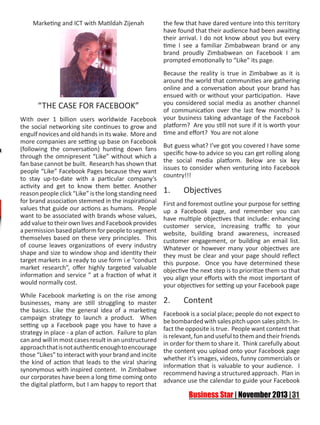
  • 22.
    that she andthe company had been nominated for customer service awards. “I believe we have done well as an organisation. Personally I have invested considerable time and commitment to ensure that Telecel is known for the best customer experience,” she said. The Telecel Call Centre is easily accessible to customers and is staffed by customer service agents who have been trained to deal with customer calls and respond effectively to customers’ queries. The CCAZ Best Call Centre award is awarded to the company that would have made the best use of technologies as a core strategy of their commitment to elevate the overall system efficiency, resources management and customer service quality. In addition connectivity and harmonisation of these technologies is also taken into consideration. Issued on behalf of Telecel Zimbabwe by MHPR Public Relations Consultants, 59 Van Praagh Avenue, Milton Park, Harare.Tel 251538-40. E-mail mail@mhpr.co.zw Contact Person: Chengetai Chinembiri

  • 23.
    BANKING and FINANCE TheBusiness Star’s Tarisai Jangara caught up with Emmanuel Mugadza, an economic analyst and Head - Market Risk|MBCA Bank who shared his views on the economic and banking sector outlook. T.J Where the economy is likely to go at any point in time is a crucial input into most important decisions an enterprise makes. Inflation or deflation? If you could somehow fast forward to 2015, what is the likely scenario? E.M With continued use of a stable US dollar in the economy, inflation levels are expected to remain containable - within manageable levels of ~3% with a negative trend for the next ensuing years, however muting a local currency prematurely is likely to see the return of a hyperinflation . Since 2010, annual inflation levels have averaged about 3.5%, which falls far below regional parity averages. Consumer goods inflation has remained fairly modest, however corporate bodies have had to feel the brunt of a “retail economy” which has seen the trade deficit widen. Whilst a weakening rand has reduced some import costs, fierce competition between retailers has forced margins to their lowest levels at such a time where production costs have been growing at a steeper gradient compared to revenues. Generally deflation has been characterizing the market due to suppressed demand on the back of liquidity constraints. central bank uses them as the primary means of implementing monetary policy. The usual aim of open market operations is to manipulate the short term interest rate and the supply of base money in an economy, and thus indirectly control the total money supply, in effect expanding money or contracting As the economy continues to the money supply. This involves improve, inflation is anticipated meeting the demand of base to kick in. With economic growth money at the target interest rate prospects converging towards by buying and selling government points of stagnation, impetus securities, or other financial to re-ignite key fundaments instruments. Monetary targets, becomes of imminent concern such as inflation, interest rates, to the new government. To a or exchange rates, are used to somewhat extent, one can say guide this implementation. that it is not necessarily an aspect of economic expertise that is Zimbabwe is therefore unable needed to instigate transition to use open market operations but an aspect of Political as it does not have a local Will that is in convergence currency in use, but relies on with the need to implement other currencies from other and administer systems and economies. It thus cannot institutions which can stimulate control exchange rates because and facilitate for Foreign Direct our business is insignificantly Investment, Infrastructure small to impact exchange rate reconstruction, policy transition and inflation. Interest rates in a transparent and efficient remain the same and the manner whilst facilitating for difference with the American real gross domestic production. rate is largely accounted by As the errors of the lost decade sovereign risk. open market have become a mere reflection operations are thus difficult of us in the present stead, as a to implement in the current nation we can only look back to Zimbabwean market. However draw lessons whilst our hope for government may issue papers the future we yearn is at our “ for purposes of raising funds wills” grasp. from the market for purposes of meeting their obligations and T.J In relation to Zimbabwe, not to influe exchange rates, what is your comment on inflation or interest rates. protectionism or open markets in this current environment? T.J What can be done to improve the Zimbabwean economy? E.M An open market operation (OMO) is an activity by a central E.M The Macro Economic bank to buy or sell government Outlook- Implementation of the bonds on the open market. A staff monitored program with


  • 24.
    IMF and theWorld Bank remains a critical facet to the address of debt relief and the unlocking of new inflows for development financing. This move is significant to Zimbabwe in that it is the country’s first IMF agreement in over a decade and is a prelude to any future lending engagement. Despite signs of the process stagnating largely due to the political processes, p remains of profound effect to the country’s ability to source external financial and technical support in the future. With the experiences of the GNU having been learnt the hard way in regards to policy formulation and consistency in implementation, we look to the newly formed structures to drive towards policy clarity and consistent implementation. Of key would be an Nationalization process which with new leadership restructuring of the implementation process. Whilst the overall macroeconomic stance remains a function of the new governments mandate and objectives over the next 5 years , in trying to give some indicative proximity we have come up with a 3 s scenario analysis developed to synchronize a possible forecasted future landscape . allow the country to stimulate economy through instruments such as interest rates or exchange rates. As a result, the country’s aggregate exports have maintained an increasing trend since 2009, reflecting a CAGR of 34% through 2012. However, despite these developments, the country’s trade deficit has remained relatively high due to disproportionately large amount of imports. Total imports since the inception of multicurrency have increased by 112% to levels of ~$5.2 billion by December 2012. In the short term, the trade deficit is expected to widen volatile global commodity prices and lack of competitiveness and downside risks associated with the fragile global economy and limited capacity in key sectors. Financial Services sector developments Stagnating growth in the deposit base against a more than proportionate increase in funding requirements continues to incapacitate the sector from adequately matching the economy’s funding needs. Total deposits increased by 5.3% from $4.2 billion in January 2013 to $4.4 billion while total banking sector loans and advances increased by 5.56% from US$3.4 billion to US$3.59 billion. sector in the next five years? To what extend do you think it will contribute to the country’s economic revival? E.M The Memorandum of Understanding (MoU) entered into by the regulator and banks through BAZ in February 2013, resulted in bank charges and interest rates being reduced and the profitability levels of banks were heavily affected. As a result, most banks recorded profits below budget, agreement had material effect to the sectors HY. Performance in ensuing years charges are most likely to be absorbed into basic operations of the banks. • The unavailability of a credit rating bureau on the market has had adverse effect on banks in terms lending. Enterprises and individuals borrowed. Individual customers are hopping from one bank to the next in search for credit facilities without capacity to repay. Resultantly, credit impairment charges have been on the rise, US$26.8 million for half year against US$29.9 million for the full year to 2012. • Cost of funding remains high. With deposits largely being transitory in nature, loans and advances for most local banks are being financed by costly funds, the lines of T.J What is really causing Revenues in the sector were credit that have been accessed Zimbabwe’s economic confronted by the MoU have generally shorter tenures problems? agreement established earlier and when rolled over are even E.M The Zimbabwean economic on in the year which overall more expensive. The continued set up is in such a way that, affected the performance of non perception of Zimbabwe as a economy depends largely on funded income high risk country; make external the export performance the funding very costly and those multicurrency system doesn’t T.J How do you see the banking with a high appetite for risk
  • 25.
    demand high interestrates. • Liquidity on the market remains a major cons compounded by the absence of the lender of last resort and lack of tradable instruments. Deposits are generally short term in nature while demand for loans is long term thereby posing high re-pricing risk for banks. • The customer catchment area continues to dwindle as some corporate scale down their business, and banks have fight for business in a shrinking market; • With the advent of mobile banking on the market, banks have witnessed stiffer competition from mobile operators. This has been further compounded by the refusal by some mobile operators to open up their gateway to the banking industry so that they can originate transactions so that in the process they can realize fees and commissions. Banking Sector Outlook with many players scrambling for a little over US$4 billion worth of deposits. economic recovery is also expected to come from various economic and political spheres as efforts to re-invigorate • The effects of the MoU have key production sectors of echoed the need for alternative the economy becomes more revenue sources within the imminent. Banks would have to sector with strong emphasis seek out fresh lines of credit with on sustainable investment in medium to long term tenors. A Information Technology Systems strong stance against corruption and Product innovation and taken by the President is Development. The aptitude to anticipated to go a long way mobilize cheaper lines of credit in attracting foreign direct will also have profound domino investment which is anticipated effect in the sector going forth to easy market liquidity strain. as the local liquidity conditions Government’s proposed position have remained resiliently to revise the banking act is likely squeezed. to send a cloud of uncertainties to investors. • Capitalization efforts will continue to be at the forefront • A less aggressive drive towards of corporate finance and enforcement of indigenization restructuring activity in the and Empowerment law in sector as Bankers strive to meet the financial services sector capitalization requirements. The is expected from the new ability to secure partnerships government to be cognizant of with regional and international the sector’s sensitivity, and the investors will depend largely role of financial intermediation on individual performance to Economic recovery and and potential as well as growth. Already we have heard the prevailing political and comments purporting to a lax economic environment, modus operand, cognizant of clarity and delineation on the the need to boost FDI flows into Indigenization policy with the country. regards new investment will also play a profound role in • Industry face is set to change facilitating foreign investment as corporate finance and into the sector. restructuring activity gains momentum from capitalization • Central Bank regulation is endeavors, mergers, equity expected to intensify in efforts to partnerships and Convertible ensure adequate capitalization financing arrangements are levels as well as to ensure expected mark the face of the systematic stability through financial services sector in the compliance with global Banking coming period. supervision frameworks like Basel II. Like any phenomenon, economic theory is not immune to the mean reversion principle, which holds that over time extreme ends of a spectrum will be eliminated as variables tend towards the mean, weakest players are eliminated while abnormal profiteers are forced to settle for normal profits as the competitive landscape intensifies. Such is the case for Zimbabwe’s banking sector, confronted by revenue restricting legislation, and cut throat competition in a • Pressure to adhere to specific monopolistic competition setup lending guidelines to support
  • 27.
    CABS records surplus ZIMBABWE’Slargest mortgage lender, Central African Building Society (Cabs), recorded a surplus of $10,7 million in the first half of the year helped by an improvement in interest and non-interest income, latest financial results show. In unaudited financial results for the first six months of the year, net income interest rose by 29% to $2,7 million from $1,95 million recorded in the same period the previous year. The growth was aided by an increase in loans and advances which in the period went up to $296,8 million from $245 million registered in the same period in the previous year. “Net interest contributed 56% of the building society’s total income,” Cabs said in a statement accompanying financial results. Fee and commission income grew by 13% to $12,2 million buoyed by an increase in transaction volumes during the period. Comparatively, operating costs increased by 33% to $17,4 million from $13,1 million achieved in the same period last year as the building society was on expansion drive during the period. As a result, the cost to income ratio went up to 62% compared to 58% recorded in the same period last year. Cabs said total assets grew by 18% to $117 million driven by a deposit growth of 21 % in the period under review. In the same period the building society’s loans and advances increased to $296,8 million up from $278 million recorded in December last year. Cabs added that 10-year mortgage loans improved to $104 million from $94 million achieved in the same period the previous year. In that period, under review Cabs opened an additional branch and rolled out banking agents to improve accessibility. Points of sale acquired through Zimswitch reached 73% while text-a-cash mobile remittances products exceeded revenue and usage target. Going forward the building society said it will pursue growth initiatives to enhance its role in both housing and financing. – Staff writer
  • 28.
    AGRICULTURE and FARMING Landownership key to national food security after the production of the tobacco there is a marketing board which operates a stop order system for repayment and they have been happy with that,” the minister said. Chinamasa said farmers must ensure they honour THE ZIMBABWEAN government is prioritizing the their debts and submit bankable proposals to land question in respect of land ownership and access funding from banks under terms that are tenure to unlock full potential in the agriculture yet to be finalized. sector, a top official has said. “I know farmers who have no land, they are illegally Zimbabwe’s fast track land reform programme renting land from those who have offer letters of 2000, according to the Commercial Farmers and those are being funded by banks, there is no Union, displaced most of the 4 500 active large collateral. Lets strengthen the collection of debts, scale commercial farmers much to the detriment let’s have a system that strengths the collection of national food security. of debts which are lent to farmers ad we do that through stop orders.” This move disrupted land title and banks have been reluctant to fund farmers citing a lack of “When I had discussions with the bankers they collateral. obviously would raise issues about collateral and what a view but I put to them the suggestion and Finance Minister Patrick Chinamasa allayed fears I have already out it to my colleague. We need farmers would continue facing funding problems to revive in a serious way the farmers stop order on the basis that they lacked security as a lasting system. We need to revive it and make it work solution was currently being formulated under especially for crops that are delivered to GMB and the Ministry of Lands. I don’t c any legal problems even to extend that “Obviously the issue you have raised is a separate system to other buyers of grain, that something issue and is being handled in the Ministry of Lands that we can look at.” and at an appropriate moment that situation will Chinamasa argued the problem with local be ratified,” said Chinamasa recently. agriculture is a marketing one. The finance minister however said funding should Agriculture minister Joseph Made added grain still be available to farmers whether or not the buyers must ensure timeously payment to farmers land tenure system is revised. so that they are able to go back to the fields. “First I been meeting the bankers and I want to “The issue of collateral, if you go worldwide, you emphasise this, people fund not because you will that is not the way things are done as people have security but because what you are doing is are suggesting,” made said. viable. What you are doing can produce a cash flow which shows you can pay back the loan that He said local banks were currently funding what matters,” the Finance minister said. bankable projects of any size. He said discussions were at an advanced stage with bankers for a viable funding solution with a stop order system as a possible option. “It’s not only tobacco, cotton, potatoes and may crops that are being funded by banks and to small producers that will surprise you.” “So you have a situation where contractors are funding tobacco producers in communal areas, you know they are funding up to the tune of US$100 000 with no security because they know This comes at a time when government has reaffirmed its commitment to agriculture, unveiling a US$160 million grain support scheme for the sector earlier this month.
  • 29.
    The scheme willbenefit 1, 6 million households across the country with 10kg of maize or grain seed, 50kg of compound D fertilizer, 50kg fertilizer ammonium nitrate and 50kg lime in old resettlement, small scale and A1 farming areas for the coming farming season with an option for livestock production at a cost equivalent to the grain Inputs Chinamasa said US$39, 1 million will be used to buy seeds, US$50, 1 million for buying compund D, US$57 million for ammonia nitrate and another US$11 million to buy Lime. The move is, according to Chinamasa, a step towards reviving the agricultural sector which has suffered from a chaotic land reform and subsequent lack of funding. The long term objective is to see Zimbabwe regain its breadbasket status for the SADC region while ensuring farming recovers to pole position as the economic backbone. Chinamasa sad government will address crop pricing challenges to stimulate production going forward. “What we have also not mentioned is that we are most unhappy with what is happening in the cotton industry, the Ministry of Industry is going to look into that issue, we are very unhappy that traditional growers of cotton are moving to other crops such as tobacco. This is a very unsatisfactory development, something we should not accept because cotton opens up more opportunities for us because it has more value chains.”
  • 30.
    US biotech experton Agribiotechnology Sizani Weza regulation development, as well as building of scientific capacity in biotechnology. His area of expertise is in Plant Breeding and Genomics and has conducted research on the development and deployment of transgenic crop plants. “We have so much data on these GMOs and we have the data to answer the questions. GMOs are as safe as the other foods we have if not safer. GMOs are the most studied foods in history,” said Dr. Parrott who has published over 80 journal articles in refereed publications, along with 12 book chapters and three patents. A visiting United States biotechnology expert, Dr Wayne Parrott, says the use of biotechnology can enhance agribusiness and fears about genetically modified organisms (GMOs) are founded more on technical concerns than their safety to health. Biotechnology harnesses living systems and organisms to develop or make technologies and products that help improve our lives and the health of plants and animals. Currently, there are more than 250 biotechnology healthcare products and vaccines available to patients, many for previously untreatable diseases. More than 13.3 million farmers around the world use agricultural biotechnology to increase yields, prevent damage from insects and pests and reduce farming’s impact on the environment. Yet concerns about any products of biotechnology such as GMOs continue. It’s safe, says Dr Parrott. “Before anything reaches the market, it has to be reviewed by the food safety authorities in almost all countries,” Wayne Parrott who was in Zimbabwe mid-September. “With these multiple safety layers built into the system, it’s an expensive and lengthy process with millions of dollars’ worth of testing required.” Dr. Parrott, a professor of Crop Science at the University of Georgia, was in the country where he participated in several outreach programs designed to foster dialogue on agricultural biotechnology, ultimately supporting policy and Addressing farmers and academics at an event sponsored by the National Biotechnology Authority of Zimbabwe, in collaboration with the University of Zimbabwe, Climate XL, and the United States Embassy; noted that the debate on biotechnology had an invariable centered on the safety of GMOs. “It is true that it is a topic that is debated,” noted Dr Parrott. “The information has not reached the people, we have a technology where the private sector beat the public sector as far as getting to the marketplace, and as far as the private sector goes half of those suppliers are European.” He said concerns about costs to farmers and other public bodies were a non-issue given that “most GMO seeds are coming off patent and are entering the public domain.” “Eighty percent of the GMO research is by public institutions around the world it ministries of agriculture, universities, international research centers- and the products of their developments have just started entering the market scene,” said Dr Parrott.
  • 31.
    Among other issuestacked during Dr Parrott’s visit where biotechnology research in Zimbabwe; strategic partnerships for biotechnology research; benefits, risks and drawbacks of increased use of biotechnology to the business community; key concerns of consumers and how they can be addressed; priority areas of biotechnology and how to engage on the topic. Local scientists noted that Zimbabwe has potential to lead among African countries in biotechnology research but there were no resources. Over 20 years ago, the University of Zimbabwe started a Master of Science program in Biotechnology which produced just over 80 graduates, noted Dr Idah Sithole- Niang, Professor of Molecular Biology and Virology at the University of Zimbabwe. She said some of the graduates are prominent in the biotech industry in South Africa and other countries in 38 now fully doctored. The program has been re-enacted this year and will have a fresh intake in January 2014. Prof Idah Sithole- Niang: “Zimbabwe was one of the first African countries to enact a Biosafety law, and spearhead that with related research. The potential still exists to get back there…in Kenya and Uganda- scientists are excelling in conducting research. We are lagging behind. If you just infuse that with the resources we can become a giant.” Dr Fiona Robertson of Agritech Zimbabwe said seed potato production has decreased over the last 10 years because of lack of equipment and limited support from the government to produce the seeds. She said the country had very good regulations; in place since 1988 but have not been tested but these have not been tested. Professor Sithole Niang, who is also deputy chairperson of the Research Council of Zimbabwe, said there have been discussions to establish a research fund modeled along the South African National Research Foundation to fund targeted research. “We have a policy that recognizes biotechnology as one way of addressing socioeconomic development challenges.”
  • 32.
    RETAIL and MARKETING CUSTOMERSERVICE and its BASICS by Gerald Brent. Companies, sole traders and those blessed with the entrepreneurial gift, spend inordinate amounts of time and energy focussing on increasing sales and profits, and rightly so. Always on the hunt for new opportunities, we create front end strategies, strategic partnerships and referral mechanisms to build the ever evolving sales pipeline. Included in this front end activity is often expensive advertising, laborious and intensive activity with, at times, little in the way of results. Perhaps there is an easier way? Ockham’s Razor (one of the statements linked to the medieval philosopher, William of Ockham, and that accentuates the shaving away of unnecessary assumptions) indicated that “the best solution to a problem is usually the easiest one”. Business owners and managers tend to overcomplicate the problems and issues that surround us, and the looking for the one cause with the easiest solution is at the heart of the statement. In my personal experience, both as a business owner and a customer, one of the ‘easier ways’ sits right under our progressive and analytical noses. I think because of its profound simplicity, it escapes our notice. That ‘easier way’ is the provision of exceptional customer service and the adding of significant value to both our existing and new clients. For our purposes here, I will use both a positive and negative, personally experienced an example for reinforcement. Walking with some friends on a warm summer evening along the along the first street in Harare, the place was abuzz and most restaurants were overflowing with patrons. We walked past one that had only a few customers but enticed us nevertheless due to its aromatic impact. We decided to eat there. What happened over the next hour helped me understand why the place was empty. The welcome was gloomy, we had to ask for water, I lit the candle on our table, we had to wait (and wait) for the waitress (who was not busy), we had to get up and get serviettes, there was no eye contact as they walked past us… and so it went. Food was great, service was lousy and I have never been back, nor ever will. The antithesis to this experience was my first visit to Hotel in Harare, Zimbabwe. Warmly welcomed, called by name, preferences listed, rooms cleaned perfectly, etc, made for ongoing and repeat visits. Having stayed there over a 2-month period, I decided, for a bit of variety, to try out another hotel in the vicinity. The rooms and presentation were excellent but the service was incredibly average. The cleaner left dirty cups in my room, no one called me by name, my booking was messed up, eye contact was lacking and so on. Needless to say, I am back at the first Hotel. Upon my return, nothing had changed. Warm greetings with numerous “nice to see you Mr Brent” and I am treated as if I am the most important person there. What was I thinking by trying somewhere else? The restaurant referred to above, like many other businesses, is potentially spending thousands of dollars on advertising, but lousy customer service only gives them one time business rather than repeat business. Thus the bottom line is seriously impacted by both increased advertising spend and decreased patronage; not a great recipe for any business. The hotel on the other hand, after dealing with them once, created a pathway back, with no additional marketing cost and have extracted large amounts of revenue from my wallet.
  • 33.
    The Easy Way– For A Healthy Bottom Line For new clients:  Add value straight up. This might be in the form of an upgrade to what they have paid for, a small thank you gift, additional service or product for free, etc.  Ensure you explain the process, what they can expect, your pricing, etc.  Take the risk away. Offer strong guarantees in favour of the client that emphasises that you have to perform and that their business is valued.  Call them by name. general client base.  Referrals  Again, one of the simplest, easiest and overlooked ways of generating business. Simply asking for referrals works. Acquisition cost is next to nothing and is the absolute best way of filling your sales pipeline.  Training Your Frontline Team  Easy but neglected. Train your people to smile (or yourself for that matter), talk intelligibly, look at customers in the eye, go out of your way to make the customer’s experience incredible. It might mean making coffee for them, cleaning up after a job (in the tradesman’s case), showing them around, explaining the process, etc. After they have completed their first lot of business with you, follow them up with a phone call to ensure their complete satisfaction, send them a Surveys And Follow Up loyalty card or discount voucher to assist in their The best method here is a phone call. Vehicles return. service centres must emulate this. Within 24 hours Ask their permission to be added to your mail of a car being serviced, and without faltering in five out list and ensure you keep in touch with them years, make a phone call to ensure the customer is through newsletters, updates, etc, every 30 days. happy with the service received. For existing clients:  Develop a system that when they call or walk in, their details are easily accessible. Train yourself and your team to remember names.  Create levels of memberships that have increasing value.  Reward them for their ongoing patronage. Examples might include upgrades, free entry to upcoming events, social invites, special client evenings, Christmas gifts, complimentary drinks, etc.  Give preferential treatment. Categorise your customers, allowing you to understand who your top tier is and provide something in addition to what you would for your In closing, some personally experienced examples: The Great  Staff who remember my name with the simplicity of a genuine smile.  Employees who notice the small things, taking it upon themselves to improve my condition.  The taxi driver, mindful of my time and money takes the quickest route.  The company, hotel or store that makes me feel like I am their most important client, not just a number or dollar. The Bad  The waitress who asks “do ‘yous’ want a
  • 34.
    drink?”  The retail assistantwho says “are you happy browsing?” Reinterpreted… “please do not bother me, I have got better things to do”.  The tradesman who grunts and leaves a mess.  Sales people who are more interested in getting the sale than in my needs. The Ugly  Telephony support who upon hearing my complaint say “I understand”. How can they? They are not me!  Invoices that end up double what I expected because things were not explained properly at the start.  The bank that provides one teller for lunchtime queues.  Overhearing foul language from reception staff. As in all things, what you value, shapes your actions. And, if your company puts me first and communicates I am important, I will more than happily be a long-term, paying customer. I will refer my friends, be your evangelist and open my wallet. It will then mean decreased marketing costs, increased sales and profit for you. Easy!
  • 35.
    Marketing and ICTwith Matildah Zijenah “THE CASE FOR FACEBOOK” With over 1 billion users worldwide Facebook the social networking site continues to grow and engulf novices and old hands in its wake. More and more companies are setting up base on Facebook (following the conversation) hunting down fans through the omnipresent “Like” without which a fan base cannot be built. Research has shown that people “Like” Facebook Pages because they want to stay up-to-date with a particular company’s activity and get to know them better. Another reason people click “Like” is the long standing need for brand association stemmed in the inspirational values that guide our actions as humans. People want to be associated with brands whose values, add value to their own lives and Facebook provides a permission based platform for people to segment themselves based on these very principles. This of course leaves organizations of every industry shape and size to window shop and identity their target markets in a ready to use form i.e “conduct market research”, offer highly targeted valuable information and service ” at a fraction of what it would normally cost. While Facebook marketing is on the rise among businesses, many are still struggling to master the basics. Like the general idea of a marketing campaign strategy to launch a product. When setting up a Facebook page you have to have a strategy in place - a plan of action. Failure to plan can and will in most cases result in an unstructured approach that is not authentic enough to encourage those “Likes” to interact with your brand and incite the kind of action that leads to the viral sharing synonymous with inspired content. In Zimbabwe our corporates have been a long time coming onto the digital platform, but I am happy to report that the few that have dared venture into this territory have found that their audience had been awaiting their arrival. I do not know about you but every time I see a familiar Zimbabwean brand or any brand proudly Zimbabwean on Facebook I am prompted emotionally to “Like” its page. Because the reality is true in Zimbabwe as it is around the world that communities are gathering online and a conversation about your brand has ensued with or without your participation. Have you considered social media as another channel of communication over the last few months? Is your business taking advantage of the Facebook platform? Are you still not sure if it is worth your time and effort? You are not alone But guess what? I’ve got you covered I have some specific how-to advice so you can get rolling along the social media platform. Below are six key issues to consider when venturing into Facebook country!!! 1. Objectives First and foremost outline your purpose for setting up a Facebook page, and remember you can have multiple objectives that include: enhancing customer service, increasing traffic to your website, building brand awareness, increased customer engagement, or building an email list. Whatever or however many your objectives are they must be clear and your page should reflect this purpose. Once you have determined these objective the next step is to prioritize them so that you align your efforts with the most important of your objectives for setting up your Facebook page 2. Content Facebook is a social place; people do not expect to be bombarded with sales pitch upon sales pitch. Infact the opposite is true. People want content that is relevant, fun and useful to them and their friends in order for them to share it. Think carefully about the content you upload onto your Facebook page whether it’s images, videos, funny commercials or information that is valuable to your audience. I recommend having a structured approach. Plan in advance use the calendar to guide your Facebook
  • 36.
    activities, and thiswill ensure you do not become repetitive and boring. The moment you become predictable your audience will stop visiting your page, now that you do not want to happen given the new Facebook algorithm-driven news feed. This new feature means that just because someone “Likes” your page, does not mean they will see your wall posts or status updates. This now requires engaging content that will get comments and shares. So it is critical to keep your content relevant, personal and varied in order to show up on profile news feeds. Facebook insights can help you track which content is most effective for your target audience. They have “Liked your page now it is your job to make them stay. According to Facebook spokeswoman Annie Ta “Facebook is all about authenticity, so if your company is not being authentic or engaging with customers in a way that feels genuine, the community will see right through it”. undeniable and focused visual brand presentation. Ensure that your designs echo the needs of your audience with whom you are trying to reach out to. So get your Facebook administrator to take full advantage of this branding opportunity and be counted amongst the top Facebook pages...you never know you may be subject to a case study, which would be great PR for your organization. opportunity to convert from fan to paying customer. You can also promote your page offline and you should in all your traditional channels of communication that include and are not limited to billboards, newspaper adverts, radio infomercials and any other outdoor signage you may have. 5. Time management A lot of the time my new clients will say to me “It’s not that big of a deal is it Matilda just set up 4. Promote our Facebook page and we will Whilst Facebook is not a platform take it from there”. Well I do for you to broadcast business not think so, unless of course however, you must promote you have someone designated your page in order for your to manage your page then audience to find your brand and you will not be serving your your relevant content. Research audience effectively. It takes a has shown that only about 3-5% great deal of time to plan what of your fans actually see the content you will put out to your information that you publish fans, its frequency and quantity onto your wall, as a result in all have to be considered. order to enhance your visibility Time management is critical you have to promote your especially if your main objective page. There are a number of is to enhance customer service, ways you can do this and these the time in which it takes you include offering sweepstakes to respond to complaints and and contests that offer prices comments will determine that are of value to your fans. how your fans interact with 3. Aesthetics You can also use Facebook you. It is in bad taste not to A lot of people overlook the advertising through sponsored respond to comments within importance of design for their stories, promoted posts, you 24 hours of them being posted. Facebook Page; a lot can be can also target people that have It is important to have a clear done with timelines and cover liked your page to promote Facebook strategy in place as to timelines to clearly stamp your targeted content. Remember how you will communicate with brand identity. Facebook now those segments I spoke about your audience; you need a policy offers much more screen real earlier, you can use these wisely in place to deal with the negative estate for your Facebook Page when promoting specific content aspects of being on social media than was offered in the not so that you do not annoy those that clearly outlines how you so distant past, when all we fans of yours to whom the will address such issues when had to work with was a profile content is not relevant. You can they do arise. Timely responses, picture and a few custom tabs. also promote your Facebook relevant content and constant Facebook has made it a priority page on your website, too monitoring will ensure that your to continuously enhance its many organizations do not link fans have their needs met and visual offering, providing brands their website to their page, will stay engaged. the essentials to create an this really amounts to a missed
  • 37.
    6. Terms of engagement Thereare few rules that you pledge to abide by when you set up a Facebook Page, and these dear readers cannot be broken under any circumstances. As with any terms of engagement should Facebook find you violating any of its terms your Page will come under scrutiny and risk being shut down. Hence just as you will take the time to learn how the tools of Facebook work so too must you learn the rules of engagement. Ensure that you are not setting up your Facebook Page on a personal profile page, consider Facebook rules when setting up contests and events. I guess one violation that will get Facebook on your Page tail is tagging people in photos that you upload into your Page from an event you have hosted or from elsewhere. Not only does Facebook find it offensive but in general people do not like to be tagged in photos without their consent. Take the time to get well acquainted with all the rules stipulated to ensure that all your hard work does not end up in the Facebook recycle bin. So...Remember above all else it is not about you broadcasting your brand, it’s about you know your target audience enough to share relevant content that is engaging on an ongoing basis. Lastly, offer more of the content that resonates with your audience, use Facebook Insights to guide your decision. Here’s wishing you as many relevant “Likes” as your relevant Facebook page can contain!!!! Matildah Zijenah, the Founder and CEO of Identity 365 Media Lab writes in her own capacity. She can be contacted on mzijenah@yahoo.com.
  • 40.
    LEADERSHIP PERSPECTIVE The modernexecutive is taught — in business schools and in In Praise of Micromanagement many jobs — that to manage people effectively is to delegate, and then get out of the way. I teach our masters of business administration students at Dartmouth’s Tuck School of What do Steve Jobs, Mickey Business much the same thing, Drexler, and Jeff Bezos all have in except for one caveat: Delegating common? is only step one. It’s not delegate and forget; it must be delegate They are all builders of giant and be intimately involved with brands, from Apple to J Crew, what happens next. to Amazon? Yes, but there’s something else you might not You don’t want to, and can’t, do realise they have in common, everyone else’s job for them. and it is directly related to their But why would you walk away, success — each is (or was) an as so many managers do? When unmitigated, unapologetic, you have deep passion for your micromanager! business, your job, you also have a responsibility to be involved What gives? How could the bane with how your vision is executed. of many of our performance You will likely step on some toes reviews actually be a good along the way and you may go thing? I can’t tell you how too far on occasion, but which many leadership experts have is worse: occasionally butting listed micromanagement as in on a subordinate’s work to Public Enemy No. 1. But, when make a point, or not providing strategically applied, it can be real-time feedback to help that a powerful tool not only to get subordinate grow and excel? The things done, but to develop dichotomy between delegation talent as well. and micromanagement is false If not for Tim Cook, perhaps the and misleading. It’s not one or legend of Steve Jobs would not the other, it’s both! And if that doesn’t sound so easy to do, have turned out quite so well. well, welcome to the big leagues Why would you micromanage of leadership. anyway? Here’s a bad answer: because you don’t trust anyone Being able to handle, and else to do his or her job as well indeed thrive, by doing two as you could. A better answer: opposing things at once is because you are so passionate a hallmark of great leaders. about what you are doing that Such “ambidextrous” leaders you are always striving to make it intensely execute today’s game better. The best answer: because plan while sowing the seeds you have a vision for what your for what comes next. They are business should look like and deeply analytical at the same you are prepared to back up that time as they are looking for creative solutions to business vision with action. challenges. And they are handson delegators. It’s a paradox only for the tired and the timid. And now the fine print Micromanagers must be selective. You can’t delve into the details of everything, and in fact superstar micromanagers don’t. Mickey Drexler might interview every single corporate hire — and more — at the $2.2 billion J Crew, but he lets other leaders manage the IT function. Steve Jobs was intimately involved with each product the company designed, and was even famously involved in designing the glass stairs at the Apple stores. But financial and operational issues were delegated to second-incommand and current Apple chief executive officer Tim Cook. Even Jeff Immelt, CEO of bluechip industrial conglomerate General Electric, is a selective micromanager. For him, intimately knowing the top 500 executives in the company, what their performance and potential looks like and what they need to develop further, are always at the top of his agenda. That’s not a bad role model for any manager, at any level, come to think of it. One key: micromanagers must be experts. What could be worse than a manager immersed in the details who really doesn’t know his stuff? Sam Walton spent most of his time flying in his little airplane to visit stores, deepening his knowledge as he went. When he had something to say, there was deep credibility behind it.
  • 41.
    There is anatural limit to when micromanagement makes sense. Once a job, or a company, becomes too complex or too big, it becomes that much harder to gain the visibility and time you need to stay expert. This is a real danger zone for would-be micromanagers. You just don’t have enough time in the day, or energy in the belly, to keep up at the pace that is necessary. Either you embrace the principle of selective micromanagement, or you go down trying to do what cannot be done. Finally, it takes a strong, trusted team to be a micromanager. Could Steve Jobs have spent weeks with the iPhone design team if there was no one else to mind the store? If not for Tim Cook, perhaps the legend of Steve Jobs would not have turned out quite so well. The good news is that the best micromanagers are often the best talent developers. Their attention to detail, their intimate knowledge of the business and their deep involvement in what’s going on actually enables more, not less, delegation. Their position in the centre of the work creates an opportunity for micromanagers to challenge subordinates with big assignments precisely because they are informed. Delegating big does not carry the same degree of risk that it might for the typical manager. And so, the final paradox of the micromanager is this: micromanagers actually help other people get better at what they do. - Capital
  • 42.
    The Most Successful LeadersDo 15 Things Automatically, Every Day all areas becomes learned and instinctual over a period of time. Successful leaders have learned the mastery of anticipating patterns, finding Leadership is learned behavior business opportunities in pressure that becomes unconscious and automatic over time. For situations, serving the people example, leaders can make they lead and overcoming several important decisions hardships. No wonder the best about an issue in the time it CEOs are paid so much money. takes others to understand the In 2011, salaries for the 200 question. Many people wonder top-paid CEOs rose 5 percent how leaders know how to make to a median $14.5 million per the best decisions, often under year, according to a study by immense pressure. The process compensation-data company of making these decisions Equilar for The New York Times. comes from an accumulation of experiences and encounters If you are looking to advance with a multitude of difference your career into a leadership circumstances, personality types capacity and / or already assume and unforeseen failures. More leadership responsibilities – so, the decision making process here are 15 things you must is an acute understanding do automatically, every day, to of being familiar with the be a successful leader in the cause and effect of behavioral workplace: and circumstantial patterns; Why Top Talent Leaves: Top knowing the intelligence and 10 Reasons Boiled Down to 1 interconnection points of the Erika Andersen Erika Andersen variables involved in these Contributor patterns allows a leader to confidently make decisions and 15 Ways To Identify Bad project the probability of their Leaders Mike Myatt Mike Myatt desired outcomes. The most Contributor successful leaders are instinctual decision makers. Having done it The Seven Habits of Spectacularly so many times throughout their Unsuccessful Executives Eric careers, they become immune Jackson Eric Jackson Contributor to the pressure associated with decision making and extremely Why You’re Not A Leader Mike intuitive about the process of Myatt Mike Myatt Contributor making the most strategic and Make Others Feel best decisions. This is why most 1. senior executives will tell you Safe to Speak-Up they depend strongly upon their “gut-feel” when making difficult Many times leaders intimidate decisions at a moment’s notice. their colleagues with their title and power when they walk into a Beyond decision making, room. Successful leaders deflect successful leadership across attention away from themselves and encourage others to voice their opinions. They are experts at making others feel safe to speak-up and confidently share their perspectives and points of view. They use their executive presence to create an approachable environment. 2. Make Decisions Successful leaders are expert decision makers. They either facilitate the dialogue to empower their colleagues to reach a strategic conclusion or they do it themselves. They focus on “making things happen” at all times – decision making activities that sustain progress. Successful leaders have mastered the art of politicking and thus don’t waste their time on issues that disrupt momentum. They know how to make 30 decisions in 30 minutes. 3.Communicate Expectations Successful leaders are great communicators, and this is especially true when it comes to “performance expectations.” In doing so, they remind their colleagues of the organization’s core values and mission statement – ensuring that their vision is properly translated and actionable objectives are properly executed. I had a boss that managed the team by reminding us of the expectations that she had of the group. She made it easy for the team to stay focused and on track. The protocol she implemented – by clearly
  • 43.
    communicating expectations – increased performanceand helped to identify those on the team that could not keep up with the standards she expected from us. 4. Challenge People to Think The most successful leaders understand their colleagues’ mindsets, capabilities and areas for improvement. They use this knowledge/insight to challenge their teams to think and stretch them to reach for more. These types of leaders excel in keeping their people on their toes, never allowing them to get comfortable and enabling them with the tools to grow. If you are not thinking, you’re not learning new things. If you’re not learning, you’re not growing – and over time becoming irrelevant in your work. Leading by example sounds easy, but few leaders are consistent with this one. Successful leaders practice what they preach and are mindful of their actions. They know everyone is watching them and therefore are incredibly intuitive about detecting those who are observing their every move, waiting to detect a performance shortfall. 9. Properly Allocate and Deploy Talent 7. Measure & Reward Performance The Seven Habits of Spectacularly Unsuccessful Executives Eric Jackson Eric Jackson Contributor Great leaders always have a strong “pulse” on business performance and those people who are the performance champions. Not only do they review the numbers and measure performance ROI, they are active in acknowledging hard work and efforts (no matter the result). Successful leaders never take consistent performers for granted and are mindful of rewarding them. Why You’re Not A Leader Mike Myatt Mike Myatt Contributor 5. Be Accountable to 8. Provide Continuous Others Feedback Why Top Talent Leaves: Top 10 Reasons Boiled Down to 1 Erika Andersen Erika Andersen Contributor 15 Ways To Identify Bad Leaders Mike Myatt Mike Myatt Contributor Successful leaders know their talent pool and how to use it. They are experts at activating the capabilities of their colleagues and knowing when to deploy their unique skill sets given the circumstances at hand. 10. Ask Questions, Seek Counsel Successful leaders ask questions and seek counsel all the time. From the outside, they appear Successful leaders allow their Employees want their leaders to know-it-all – yet on the inside, colleagues to manage them. This to know that they are paying they have a deep thirst for doesn’t mean they are allowing attention to them and they knowledge and constantly are on others to control them – but appreciate any insights along the the look-out to learn new things rather becoming accountable to way. Successful leaders always because of their commitment assure they are being proactive provide feedback and they to making themselves better to their colleagues needs. welcome reciprocal feedback through the wisdom of others. by creating trustworthy Beyond just mentoring and relationships with their 11. Problem Solve; sponsoring selected employees, colleagues.. They understand being accountable to others is a the power of perspective and Avoid Procrastination sign that your leader is focused have learned the importance of Successful leaders tackle more on your success than just feedback early on in their career issues head-on and know how their own. as it has served them to enable to discover the heart of the workplace advancement. matter at hand. They don’t 6. Lead by Example procrastinate and thus become
  • 44.
    incredibly proficient atproblem solving; they learn from and don’t avoid uncomfortable circumstances (they welcome them). Getting ahead in life is about doing the things that most people don’t like doing. 12. Positive Energy & Attitude Successful leaders create a positive and inspiring workplace culture. They know how to set the tone and bring an attitude that motivates their colleagues to take action. As such, they are likeable, respected and strong willed. They don’t allow failures to disrupt momentum. 13. Be a Great Teacher Many employees in the workplace will tell you that their leaders have stopped being teachers. Successful leaders never stop teaching because they are so self-motivated to learn themselves. They use teaching to keep their colleagues wellinformed and knowledgeable through statistics, trends, and other newsworthy items. Successful leaders take the time to mentor their colleagues and make the investment to sponsor those who have proven they are able and eager to advance. 14. Invest in Relationships Successful leaders don’t focus on protecting their domain – instead they expand it by investing in mutually beneficial relationships. Successful leaders associate themselves with “lifters and other leaders” – the types of people that can broaden their sphere of influence. Not only for their own advancement, but that of others. Leaders share the harvest of their success to help build momentum for those around them. 15. Genuinely Enjoy Responsibilities Successful leaders love being leaders – not for the sake of power but for the meaningful and purposeful impact they can create. When you have reached a senior level of leadership – it’s about your ability to serve others and this can’t be accomplished unless you genuinely enjoy what you do. In the end, successful leaders are able to sustain their success because these 15 things ultimately allow them to increase the value of their organization’s brand – while at the same time minimize the operating risk profile. They serve as the enablers of talent, culture and results.
  • 46.
    STRATEGY and MANAGEMENT 10 officepersonalities Which one are you? Every office has a wide range of personalities. Here, LondonOffices.com spokesperson Michael Davies identifies ten office types. Which one are you? 2. Lazy Git Nothing annoys office workers more than having someone in their team who doesn’t pull their weight. favour could you?” If you are confronted with this question on a regular basis, then I’m afraid you are the office mug. Every office has a mug – someone who will always say yes to any Whether it is not doing their fair task you give them regardless share of the work or relying on of the job, tasks which are often others to carry them through, mind numbingly boring such as lazy gits are generally more photocopying, binding reports preoccupied about checking etc. their Facebook than the task in Inevitably, there is a fine line hand. between giving your fellow If you have developed ways colleagues a hand and being which waste time but make you used. Many mugs delude look busy, such as tidying your themselves by thinking that they inbox or organising your desk, are just being helpful or that their then you probably fall into this assistance will be reciprocated, category. but they are wrong. When you are doing someone else’s work you are not doing 1. Brown-noser Stress pots are highly volatile your own and this has a direct Every office has one of these. people. From the moment they impact on both yours and your These shameless sycophants wake up until they go to bed they team’s productivity. In business the ability to say no is just as suck up to management in the are worrying about something. important as the ability to say hope of promotion. For them, the tiniest set back yes. Have you ever commented on can mean the end of the world your boss’s appearance or do as they know it and result in a 5. Skiver you stick your head round their nuclear explosion emanating Is there someone in your office office door each afternoon and from their desk. who pulls just one to many offer to get them lunch? It is fairly easy to spot if you are “sickies” for it to be believable? If you have then you definitely seen as the office powder keg. If If yes then you have a skiver in fall into the brown nose category you would describe yourself as a your midst. and you should start to think very “control freak” then alarm bells Skivers are arguably worse than carefully about your behaviour. should start to ring now. lazy gits as at least the latter Not only will this alienate your Whilst you may see yourself as bother to turn up for work, colleagues, more often than not management can see right obsessed with the detail, others however both are weak links will see you as a ticking time in the office chain and their through it. bomb ready to blow up in their behaviour needs to be nipped in Trying to get a promotion face over the smallest error. the bud. through brown nosing rather How do you know if you fall into than hard work is, to all intents 4. Mug this category? Well, ask yourself and purposes cheating, and remember, cheats never prosper. “You couldn’t do me a huge how many times you have 3. Stress Pot
  • 47.
    passed a hangoveroff as flu – if the answer is more than once then you are a skiver. 6. Chatterbox If you would describe yourself as having a bubbly personality who gets on with everybody and enjoys a good gossip, then you are quite possibly the office chatterbox. There is nothing wrong with chatting about what was on TV last night or if the right person got kicked off X Factor, but don’t let it happen to the detriment of yours and your colleague’s productivity. Everyone enjoys a good natter but every now and again people would actually like to get some work done. Understand when the conversation has ended and shut up. 7. Credit Hogger Credit hogging can take many forms. These range from not congratulating a colleague for a good idea all the way to passing off someone’s idea as your own. Hogging the credit for a successful task will win you no friends in the office, and I’m afraid to say middle management is often guilty of this. Remember a workplace is a team, and for a team to work successfully praise needs to be distributed evenly. Credit hoggers are greedy and will come to regret it the next time they ask their colleagues for help. 8. Worker Bee Routine is everything for the worker bee, their day is planned to the minute and there is very little room for anything else. Perhaps due to their reputation for being unspeakable dull, worker bee’s never feel fully part of the office team and as such can be seen as an outsider. 9. Joker Humour is essential for any office environment. If you can’t have a laugh with your colleagues then office moral is seriously affected. However, when it comes to humour it is essential to know the lines not to cross and more importantly when to stop. The office joker is someone who is oblivious to these points. Do you always feel the need to be funny? Do you equate making people laugh with them liking you? If so, you are in danger of becoming the office joker. You try and turn everything into a joke even when it is not funny. If this sounds like you then be very careful because one day you may say something that could backfire on you badly and land you out of a job. 10. Machiavelli Has your ambition to succeed made you ruthless? Are you prepared to leave bodies in your wake to achieve success? If so then you are a Machiavellian. The Machiavellian is extremely cunning, they know where they want to get and will stop at nothing to achieve this. You are the first to arrive at work and the last to leave. You eat lunch at your desk and have so few toilet breaks people think your bladder is made of stone. There is nothing wrong with ambition, for some it’s what gets them out of bed in the morning and what motivates them to work hard, however, this determination can turn to ruthlessness. Conversation between colleagues is limited strictly to business and going for a drink after work is completely off the cards. They will tend to be very quiet about their ambitions however, their aim will ultimately be to build people up for a fall, then stand back and wait to take their place.
  • 48.
    To those Machiavellisout there remember this: “He who wields the dagger never wears the crown.”
  • 50.
    P0ROMOTION ADELAIDE ACRES-The best choicefor business and leisure hospitality Adelaide Acres Conference Centre is the most attractive location and perfect choice for doing business affairs and celebrating various ceremonies confidently. Because of its superior levels of service excellence designed from unique concepts, the Centre has since developed to become the most sought after lodge of choice. Over the years, Adelaide Acres Conference Centre has continuously gained popularity to become the top travel destination for business meetings, workshops, seminars, parties, dinners, celebrations, family holidays, wedding and honeymoon and congresses. Traditionally known as Kutsuro (Rabbit) due to roasting of rabbits, the Centre has evolved to take a stylish outlook which has resulted in rising demand from local and international guests. A spacious joint located just off the Harare-Masvingo highway, Adelaide Acres is perfect getaway for guests seeking for a quieter environment and yet offers close-distance access to the capital city, Harare. It offers a range of facilities and the best of service, which aim to provide the best comfort for all guests during their stay. These facilities include the following: 1. Accommodation Adelaide Acres offers best accommodation facilities that have established a reputation for redefining the paradigm of luxury and excellence service amongst leisure resorts around the country and is acknowledged for offering quality and value. Comprised of standard and grass thatched chalets, the rooms are spacious enough for a great stay and offer the comfort that matches the best in the business and leisure. 2. Conferencing The Centre provides fully baked comprehensive conference services to its valued clients. It offers best facilities for any type of conference-right from commerce and industry to academics. Being conveniently located from the Harare City Centre, the Conference centre is an ideal place for productive business as it combines a learning environment with excellent indoor conference facility for 100 delegates and a garden conference facility for 600 delegates. Guests are assured of personalised and professional service from the beginning to the end of their conference, meeting, seminar of function. 3. Weddings and Grand Banquets Adelaide Acres has banqueting halls with state of the art conferencing equipment. The capacity of each hall is up to 100 guests while the garden is another alternative with the capacity to accommodate large gatherings. The place offers wedding, anniversary, graduation, engagements and birthday parties with everything, a venue that makes it magical. With serene surroundings, luxurious rooms and legendary service, a stay at Adelaide Acres promises all of these benefits and more. Its unforgettable experience. 4. Comprehensive Menus The Centre serves a variety of Zimbabwean traditional and international mouthwatering and finger-licking menus painstakingly put together to suit every palate. 5. Braai/Bar Our Centre provides enjoyable bar and braai services to exceed your expectation. The traditional tsuro braai will reignites enjoyable outing at weekend, evenings and holidays. With ice cold beer you will expect nothing short of fantastic outing.
  • 51.
    6. Recreational facilities TheCenter also provides facilities for recreational sports like basketball, volleyball, soccer, darts and chess which will bring total excitement to our guests. 7. Superior levels of service excellence The convenience and grandeur of the stay at Adelaide Acres is further accentuated by trained staff that provide exceptionally attentive, personalised and warm service which is truly an epitome of luxury. The Centre strives to ensure that guests are always satisfied with the services and the facilities provided to them so that every moment spent at the lodge remains a memorable one. Quality, efficient and versatile is the principles of our events team. Tranquil surroundings, elegant interiors and beautifully landscaped gardens with glancing monkeys create a soothing and intimate ambience.
  • 52.
    The Importance of BusinessSystems By Tony Fantulla. It can be very frustrating for a company owner or business manager when an organization has great staff, good products, a strong vision and clear direction, yet the company’s growth is impeded by a plague of simple, recurring mistakes that detract from customer satisfaction and make it near impossible to reach KPIs (key performance indicators). What is more, it seems that many of these mistakes, or the issues which lead to them, end up on the CEO’s desk, robbing him or her of valuable time that could be spent working on the business rather than in it. Having great staff, good products and a strong vision for the future are important building blocks for the success of any organization. However, of equal importance is the glue that holds these building blocks together, creating the foundation for success. That glue is business systems. Every business has systems in place to some degree. Those systems may be passed on from employer to employee via word of mouth or they may exist in the form of a manual or standard operating procedures. They may be as complicated as those used by organizations like OK Mart, where everything is done a specific way, or as simple as a flow chart. Either way, ensuring that business systems are as accurate, comprehensive and up to date as possible is imperative in ensuring both short- and longterm success… and it is simple. Yet, surprisingly, most business owners avoid it and then miss the secret that systems contain. Business systemization does not need to be hard or complicated. It starts with simply documenting how things are done. This may seem obvious to some readers but the importance of this task cannot be overstated, even for businesses that may already have some form of business systems in place. It is only when the people involved in specific tasks go back to basics and document everything that they do that holes in existing systems become apparent. For newer businesses, this task is equally important, as this develops the foundation upon which the future success of an organization will rest. Furthermore, it will force owners or managers to think through areas of their business processes which may have previously been addressed in an ad hoc manner. This task may be referred to as completing a systems manual, operations manual or polices and procedures manual. Whatever it is called, the purpose is to capture the collective intelligence or ‘know how’ of everyone in the business. The why, what, when, where, who and how of the business. The business system! What are the most important business systems? The top three critical systems are: 1. Sales system, which should outline how the business finds prospects, presents, quotes and closes sales 2. Delivery or fulfilment system, which details how the product or service is delivered to customers 3. Customer service system, which shows clearly and concisely how the business stays in contact with customers over time A sales system might begin by outlining, in simple steps, everything from how an inquiry by a potential customer is dealt with and how sales staff should conduct prospecting calls, to how a customer’s needs are assessed, a product or service presented, a sale closed and processed and payment collected. This may seem simplistic and generic, but this is only the first step in a much larger process. Even for existing systems, it is important to go back to this stage to ensure nothing is missing. Use only simple bullet points to outline each step in the process at this stage. Once completed, this enables the creation of more comprehensive, detailed systems. This process should be completed for all areas of the business, including: · Advertising and marketing systems · Accounts payable, receivable and payroll systems · Recruiting, hiring, inducting, training and performance
  • 53.
    systems · Customer servicesystems · Production, warehousing, inventory and logistics systems · Safety and quality systems · Administration, reception and record-keeping systems Once the basic outline for the procedures in each area of the business has been completed, expand on each of the steps with a paragraph or two on the critical elements involved. It is at this stage that written procedures start to become specific to the company. This process will also help to identify any additional instructional documents that may be needed for extra detail. Examples of such documents may include ‘How to arrange a meeting with a customer’. It is important to remember that what may seem obvious to an owner or manager may not be obvious to new employees. Part of the reason for creating business systems is to minimize the amount of time spent explaining things, while ensuring continuity of action across staff and departments. Once completed, there may be five to twenty pages that explain all of the actions required, along with the rules and guidelines which govern the decisions made along the way. Typically, when one system ends, another starts; in the case of sales, the next system is the product/ service delivery or fulfillment system. How to measure effectiveness of systems the When a system is working, it will be obvious! There should be no customer complaints, no late deliveries and no staff complaining about things or each other. There should be only harmony and productivity in action and all targets being met. Once a library of documented systems is in place, attention can be focused on specific areas within the business with a view to updating the systems governing that area to ensure they deliver set goals. The implementation of properly documented, effective business systems enable owners and/ or managers to reap many To test systems, try: additional benefits, some of which will impact on them · Asking two different staff personally as well as the members to explain a system business. For example, once the and comparing their responses systems that they are personally against the owner’s or manager’s managing are documented, it personal interpretation is possible to begin delegating · Interviewing customers to those tasks, effectively removing determine their satisfaction with themselves from that function without creating chaos in the the service provided business. · Asking customers to explain their experience with the Once owners are spending less time doing the actual work of business, both good and bad! the business, they are free to At each step in any system, the do the most important work effectiveness can be analysed of all, commonly referred to by looking at the inputs and as working on it, not in it! This outputs of a step and measuring leaves them time to focus on the result. In many cases, it is things like: business purpose necessary to determine what and cultural development; the goals are for certain steps strategy development and first, in order to determine if the planning; market identification, system is delivering upon those measurement and product development; development of targets. the team and its collective skills; In the sales system for instance, innovation and improvement; it may be possible to determine financial planning and the effectiveness of the system investment. by measuring how many new customer proposals end up as Why develop systems? sales. If a standard or goal has been set already, the result can Consider that a systemized be consistently measured to business, with an up-todetermine if the system requires date operations manual, will experience: changing. Developing systems · Higher productivity through
  • 54.
    staff not carryingout tasks incorrectly or needing to continually ask for confirmation or clarity · Greater customer satisfaction and confidence resulting in higher average sale process and increased repeat business · Better accountability of staff through easier measurement of their performance against the systems · Ease of movement of staff into, out of and around the business · Less reliance upon key individuals, most of all the owner, as a result of systems being in place and available for training and up-skilling others · Greater control over the flow of information throughout the business leading to less double handling and resulting in a reduction of errors Beware of the traps of systemization In undertaking the literal task of writing documents, creating folders, files, forms and checklists, manuals and all the other contents of a system, another problem may develop: how best to organize and deliver the contents in a logical way to the people who will benefit most – staff. There are many tools available to assist in controlling the development of a systems manual, such as software applications, for example. This can and will be a low-cost undertaking, provided the tools are researched and the project is planned effectively. Making a plan of just how this whole project will look at the start is critical. Research the available tools and expertise required and evaluate the intended method before jumping in too far. All the best with your system development; may your business deliver you the life you deserve.
  • 55.
    COMMUNICATIONS 7 ways todeliver communications that build trust you’re only going to know these things if you’re listening. Keep your customers happy by keeping dialogue with them simple. A lot of small businesses try to fudge just how small they are. It’s pretty common for the websites of one-man-bands to say We work with… or, Our tried and tested processes. Or they say, We are located in… – and the rest of the sentence never mentions the laptop on the kitchen table. Building relationships with clients and customers has never been more important. Consumers are spoiled for choice. But after bank bail-outs and big business failures, they’re cynical too. Customers want to feel they matter to your business – that they know you and you know them and they can trust you. So how does a small business build strong relationships that are built on trust? How can your communications make people more liable to trust what you say, and who you claim to be? 1. Listen to your customers 2. Be honest At one level it’s understandable – micro-businesses don’t want to miss out on large customers. But keep firmly in mind that this is the age of the small business. Big corporations are keener than ever to work with small – even tiny – outfits. So be honest and be confident about who you are and what you offer. You may not offer scale – but you offer flexibility, cost efficiency and a personal touch. cover your backside If you’re talking about the service you give, never say you’ll “aim to” do something. We aim to exceed your expectations! is meaningless. It conveys a lack of confidence and commitment – sometimes you will, and sometimes you won’t. For the best Sunday lunch you’ve ever had is much better than, We aim to give you the best Sunday lunch. That’s because it’s confident, and it’s a promise the customer knows you’re going to have to live up to. 5. Don’t use “official” language when the going gets tough Every company, however big or small, has to deal with complaints. Whatever happens, don’t go into official mode when you receive a complaint. With regard to your abovementioned letter… is just going How often do you ask your customers what they want? Or if If you know it’s only once in a to make you sound unhelpful the service you’re giving them is blue moon that a customer’s and pompous. I’m sorry you spot on? delivery will arrive next day, didn’t enjoy your meal with us… don’t promise that it will. You’ll is language that’s much more Give your customers just end up with annoyed and likely to resolve the issue and turn the complainer into a loyal opportunities to talk to you. inconvenienced customers. customer. Listening to customers will help you decide the best methods for Instead, write from the heart: communicating with them. 6. Hide the wiring Sometimes our deliveries get there overnight, but usually they It’s no good using email as take two or three days. If you So many organisations talk your number one form of need this product urgently, we endlessly about their fantastic communication, for example, if can arrange special delivery. processes. Usually, the customer your clients would prefer you to doesn’t care so much how a text – or they have firewalls that of 4. Don’t use words to piecewantsoftware works –it they block your e-newsletters. And just to know how will 3. Be really honest
  • 56.
    make their livesor businesses easier and more profitable. It’s just like when you buy a shiny new gadget. You don’t want to see the wiring inside. You just want to see what it does. So don’t talk about the features of what you offer – talk about the benefits. It’s the same for every business. If you run a cleaning service, the main thing your customers will want to know is that you’ll keep their home or office spic and span, with no fuss at all. The types of products you use and the methods you use to hire staff could be important to a procurement department, but they’re not your headline. 7. Read it out loud Read your communications back out loud to yourself. Do they make you sound like someone you’d trust? Or do they make you sound pompous or evasive? If you sound trustworthy to yourself, there’s a good chance you’re well on the road to building trust with your customers. Joseph Dennis
  • 57.
    The top fivethings a website must have to generate a response By Philip Brookes content on your page, and (very significantly) getting plenty of links from other high-quality sites to your site. It is well worth speaking to a specialist about this before you start building your website. For every successful website on the Internet, there are many Awareness more that do not achieve their goals. What is the difference Promoting a message is not between the few that succeed enough – people need to notice and the many that do not? it. Your message needs to be Outlined below are five ‘plain clear and prominent. This applies English’ marketing concepts both on your website (where you which you should focus on in need to decide what your key all of your marketing, including message/s are and ensure that online, to ensure you are taking they are powerfully presented a holistic and comprehensive from your home page) and in view. If you are working with your advertisements. If you place an online marketing specialist, ads with Google Adwords, or use ask her to explain how her ‘geek banner advertising at other sites, monitor the effectiveness of speak’ fits into this framework. these and, if you are not getting enough ‘click-throughs’ to your Exposure website, review the message The first step is to generate presentation to see if you could exposure – this may be on improve its effectiveness. business cards, letter heads, Understanding direct mail, online advertising, mass media and outdoor advertising, or any number of You have advertised and other promotional channels. promoted, attracted a large Encourage ‘electronic word of number of viewers to your site, mouth’, in which people pass on and still you are not getting the results you expected. Maybe the message to their friends. people do not understand what One key area of exposure is to you are offering. make sure your website shows up on Google when people search An effective website needs to be using particular search terms usable and useful. It needs to: (keywords). The art and science • Be intuitive and logical to of coming up at the beginning navigate – it is important to place of the Google search results information and navigation in is referred to as search engine locations where people expect optimisation, and it involves a to find it, to label items in ways whole range of factors, including which make sense to your naming conventions for your users, and to avoid clutter and pages, headings, wording of the confusion • Answer the questions potential customers may have – do not bombard them with data they are not interested in, but do include answers to all the questions they are likely to ask, and give them an obvious way to contact you if they have further queries you failed to address Desire Make them want it! You cannot afford to scrimp on presentation. Get a professional graphic designer and photographer to develop professional imagery and present your website, company and products in a manner that befits the audience you are serving. Your website is the online representation of your entire company, so keep it maintained, updated and professional. Action A call to action is one of the most commonly overlooked features on a website. Once you have done all the hard work of promoting, attracting, explaining and building desire, do not waste it by putting roadblocks in the way of the purchase. Make your ‘Buy Now’, ‘Enquire’, ‘Receive Free Sample’ buttons clear and obvious. Philip Brookes is Director of Aktiv Tactics, a marketing communications consultancy working with businesses and not-for-profit organisations in the Asia-Pacific region to “Get Your Message Heard”. He has a particular interest in poverty relief, and using social media and viral marketing techniques to effect social change. You can follow his blog at blog.aktiv.com.au. For more information, visit www.aktiv.com.au
  • 58.
    TECHNOLOGY Cloud computing getsits name from the drawings typically used to describe the Internet. Cloud computing is a new consumption and delivery model for IT services. The concept of cloud computing represents a shift in thought, in that end users need not know the details of a specific technology. The service is fully managed by the provider. Users can consume services at a rate that is set by their particular needs. This on-demand service can be provided at any time. The term cloud remains a source of confusion for many. And cloud hosting is a concept many business owners are keen to get to grips with if it means saving money and increasing scalability and reliability. Essentially, rather than owning a physical product, cloud refers to the virtual provision of infrastructure or services. In the case of cloud hosting, providers own, run and maintain enormously powerful servers that businesses pay to access, either to store data or operate their websites. One of the biggest advantages is that the capacity can expand or contract according to a company’s needs. In addition, a raft of software as a service (SaaS) companies have emerged to offer online services that replace the need to purchase and run software on internal servers. Cloud hosting and cloud computing services are typically (excluding free SaaS services) paid for and supplied on a metered or subscription basis as opposed to a capital expenditure outlay on hardware, so have an immediate impact on your investment budgeting and monthly accounting. you’ve paid a hosting company to ensure your website doesn’t go down. Sound familiar? The emergence of cloud hosting appears to mark the demise of ‘business as usual’. For small businesses, the advantages of cloud hosting are distinct – no costly software licenses, the flexibility to work from anywhere, global collaboration and a reduced hardware bill. The two main cloud hosting Like gas, electricity and water, options are dedicated hosting for many cloud computing is or a shared web hosting service. another utility. The former typically describes the lease of a server which But what of the security risks? is entirely dedicated to your And how do you manage business, although stored in an cashflow and scaling your external data centre. The latter needs up and down as activity describes the sharing of server demands? Will you also forgo capacity between large numbers a level of control, such as being of users, which can be used by forced to deal with the impact updated software used by your anyone. cloud hosting company may The risks, rewards and realities have on other programs you of switching to cloud hosting run? Throw in the jargon and the risks and realities are key factors Should your business take the alongside the obvious rewards. leap from software licences to remote servers and cloud The Benefits of Cloud Computing computing? According to International Efficient, flexible, reliable Data Corporation (IDC), “The and less costly. But is cloud proliferation of devices, computing really all it’s cracked compliance, improved systems up to be? As a business owner performance, online commerce you, like so many others, have and increased replication to probably been drawn to the secondary or backup sites cloud like a moth to a flickering is contributing to an annual light. doubling of the amount of information transmitted over For years tradition has dictated the Internet.” The cost of dealing that businesses of a certain size with this amount of data is buy a server, put it in a cupboard something that companies must or small room somewhere in the address. In today’s economy, office, and then backup the data companies are looking at any on tapes each day. Your email cost-saving measures, and needs have been served by a the bottom line is that cloud series of software licenses. And
  • 59.
    computing provides much greater flexibility thanprevious computing models. access anytime, anywhere, requirements and controls making your life so much easier! placed on access. Because your data is in the cloud, you may not Monitor projects more realize that the data must reside The benefits of cloud computing effectively. Stay within budget in a physical location. Your cloud are many. One is reduced cost, and ahead of completion cycle provider should agree in writing since you pay as you go. Other times. to provide the level of security benefits are the portability of required for your customers. the application is that users can Less personnel training is work from home, work, or at needed. It takes fewer people to 2.Who has access? client locations. This increased do more work on a cloud, with mobility means employees can a minimal learning curve on Access control is a key concern, because insider attacks are a access information anywhere hardware and software issues. huge risk. A potential hacker they are. There is also the ability Minimize licensing new is someone who has been of cloud computing to free-up software. Stretch and grow entrusted with approved access IT workers who may have been without the need to buy to the server. Anyone considering occupied performing updates, expensive software licenses or using the cloud needs to look installing patches, or providing programs. at who is managing their data application support. and what types of controls are Improve flexibility. You can applied to these individuals. Benefits of cloud change direction without serious “people” or “financial” issues at 3. What are your regulatory hosting stake. requirements? Achieve economies of scale – increase volume output or Organizations operating in the Security issues and productivity with fewer people. points to consider when different countries have many Your cost per unit, project or regulatory requirements that cloud hosting product plummets. they must abide by (e.g., ISO 27002, Safe Harbor, ITIL, and Reduce spending on technology While cost and ease of use are COBIT). You must ensure that infrastructure. Maintain easy two great benefits of cloud your cloud provider is able to access to your information with computing, there are significant meet these requirements and is minimal upfront spending. Pay security concerns that need to willing to undergo certification, as you go (weekly, quarterly or be addressed when considering accreditation, and review. moving critical applications and yearly), based on demand. sensitive data to public and 4. Do you have the right to audit? Globalize your workforce on the shared cloud environments. To cheap. People worldwide can address these concerns, the This particular item is no small access the cloud, provided they cloud provider must develop matter; the cloud provider have an Internet connection. sufficient controls to provide should agree in writing to the the same or a greater level of terms of audit. Streamline processes. Get more security than the organization work done in less time with less would have if the cloud were not 5. What type of training does the people. used. Listed here are ten items provider offer their employees? Reduce capital costs. There’s to review when considering This is actually a rather important no need to spend big money on cloud computing. item, because people will always hardware, software or licensing 1.Where’s the data? be the weakest link in security. fees. Knowing how your provider Different countries have different trains their employees Improve accessibility. You have
  • 60.
    is an importantitem to review. 6. What type of data classification system does the provider use? Questions you should be concerned with here include: Is the data classified? How is your data separated from other users? Encryption should also be discussed. Is it being used while the data is at rest and in transit? You will also want to know what type of encryption is being used. As an example, there is a big difference between WEP and WPA2. 7. What are the service level agreement (SLA) terms? The SLA serves as a contracted level of guaranteed service between the cloud provider and the customer that specifies what level of services will be provided. 8. What is the long-term viability of the provider? How long has the cloud provider been in business and what is their track record. If they go out of business, what happens to your data? Will your data be returned, and if so, in what format? As an example, in 2007, online storage service MediaMax went out of business following a system administration error that deleted active customer data. The failed company left behind unhappy users and focused concern on the reliability of cloud computing. from the cloud provider? While many providers promote their services as being unhackable, cloud-based services are an attractive target to hackers. 10. What is the disaster recovery/ business continuity plan (DR/ BCP)? While you may not know the physical location of your services, it is physically located somewhere. All physical locations face threats such as fire, storms, natural disasters, and loss of power. In case of any of these events, how will the cloud provider respond, and what guarantee of continued services are they promising? As an example, in February 2009, Nokia’s Contacts On Ovi servers crashed. The last reliable backup that Nokia could recover was dated January 23rd, meaning anything synced and stored by users between January 23rd and February 9th was lost completely. Even basic services such as e-mail require a thorough review before moving the service to the cloud. While some organizations are starting to move their e-mail to cloud services hosted by Gmail, Yahoo e-mail, and others,there are issues to consider. In February 2009, Gmail reported an outage that affected its EU users. In January 2010, it was reported that Gmail had been targeted by attackers seeking to gain access to Chinese human 9. What happens if there is a rights activists. It was further reported by MSNBC that foreign security breach? correspondents may have If a security incident occurs, been targeted. Although these what support will you receive services have many controls built in, it is not impossible for them to be compromised. Questions that companies need to ask before outsourcing even something as basic as e-mail include: • Can you function with no e-mail? • How easy would it be to migrate to another e-mail provider? •What is your email retention policy, and do you have a legal requirement to keep your email for a specific amount of time? • Would your clients be concerned that you store email with sensitive information on a third-party server? Cloud Computing Attacks As more companies move to cloud computing, look for hackers to follow. Some of the potential attack vectors criminals may attempt include: •Denial of Service (DoS) attacks Some security professionals have argued that the cloud is more vulnerable to DoS attacks, because it is shared by many users, which makes DoS attacks much more damaging. Twitter suffered a devastating DoS attack during 2009. • Side Channel attacks –An attacker could attempt to compromise the cloud by placing a malicious virtual machine in close proximity to a target cloud server and then launching a side channel attack.
  • 61.
    • Authentication attacks– Authentication is a weak point in hosted and virtual services and is frequently targeted. There are many different ways to authenticate users; for example, based on what a person knows, has, or is. The mechanisms used to secure the authentication process and the methods used are a frequent target of attackers. •Man-in-the-middle cryptographic attacks –This attack is carried out when an attacker places himself between two users. Anytime attackers can place themselves in the communication’s path, there is the possibility that they can intercept and modify communications. Conclusion Cloud computing offers real benefits to companies seeking a competitive edge in today’s economy. Many more providers are moving into this area, and the competition is driving prices even lower. Attractive pricing,the ability to free up staff for other duties, and the ability to pay for “as needed” services will continue to drive more businesses to consider cloud computing. The decision to move to cloud-based services should fit into the organization’s overall corporate objectives. Before any services are moved to the cloud, the organization’s senior management should ensure such actions are consistent with their strategic plans and meet acceptance criteria that address the ten items discussed in this article. Just as there are advantages to cloud computing, there are also several key security issues to keep in mind.One such concern is that cloud computing blurs the natural perimeter between the protected inside the hostile outside. The security of any cloud-based services must be closely reviewed to understand what protections your information has. There is also the issue of availability. This availability could be jeopardized by a denial of service or by the service provider suffering a failure or going out of business.
  • 62.
    AFRICA Kaberuka highlighted theneed to improve infrastructure on Elumelu calls on African the continent, stating that businesses could only grow entrepreneurs to take if the infrastructure gap was addressed. Angolan investor business to BRICS Isabella Dos Santos stressed JOHANNESBURG - During a panel the need for investment in discussion held at the first BRICS ‘soft infrastructure’ stating Business Council meeting in broadband technology would Johannesburg this week, African have a transformative effective business leader Tony O Elumelu, similar to mobile technology in Chairman of Heirs Holdings, Africa. called on the BRICS business leaders to make room for African Mo Ibrahim livened up the entrepreneurs looking to expand audience with his delivery, but their businesses beyond the behind the jokes were very real continent to the BRICS countries. and critical messages about Africa’s poor global image and In front of an influential audience the importance of governance. of business leaders from BRICS He talked about his foundation’s and 19 other African countries, governance index which was Elumelu spoke of the need for one of the most comprehensive mutually beneficial partnerships in the world, measuring between African countries and 88 parameters including the BRICS nations: “A new crop transparency corruption, of African entrepreneurs are education and health. His final emerging who have ambitions message to investors was; “Don’t beyond the continent. They come to Africa and help, come should be investing in the BRICS and make money because the countries in the same way that highest return on investment is BRICS are investing in Africa – in Africa. Enjoy making money this relationship needs to go in Africa but please behave”. both ways.” South African Johann Rupert, Elumelu was speaking at a panel Chairman of Richemont and session on “Specific measures Remgro talked about the critical and initiatives to increase things he looked for as an business, trade, manufacturing, investor - regardless of where and investment ties between his investment was located. He the BRICS countries and listed the four critical areas as: Africa”. The discussion, which the rule of law, independence of was moderated by Donald the judiciary, security of property Kaberuka, President of the and transparency of markets. African Development Bank, also provided valuable insights Elumelu summed up the from other prominent African general consensus of the BRICS council meeting business leaders, including Mo business Ibrahim, Isabella Dos Santos and when he concluded that: “As African business leaders, and Johann Rupert. as Africapitalists, we agree that we have amongst us enough resources to make things happen in Africa. We must share the opportunities on the continent. There are enough of us to make a difference. We need to work together to find ways of increasing trade and investment ties between the BRICS nations and Africa.” - APO
  • 63.
    WORLD APEC Leaders Urge FewerProtectionist Policies to Boost Growth company officials in Bali. “It is important to maintain that public support for openness and integration because unless you have that -- if we all close ourselves up, or even hinder the process of trading and doing business with one another -- I think we are just going to make things worse for all the countries.” tight time line” and leaders will discuss if it is feasible. U.S. Trade Representative Michael Froman said yesterday the “finish line is in sight” and TPP officials are trying very hard to complete the deal this year. All the TPP countries are members of APEC, set up in 1989 to advance free trade and investment in an area that accounts for half of the world’s total gross domestic product and 45 percent of global commerce. Global growth will probably be slower and less balanced than Asia-Pacific leaders are calling for desired, as the world economy vigilance against protectionism is too weak and “risks remain as economic growth slows tilted to the downside,” trade ‘Vital Chance’ in parts of the region and and foreign ministers from the completion of a 12-nation trade 21-member grouping said in a “With markets struggling to pact looks set to be delayed statement yesterday. emerge from a devastating further. global recession, we need the jobs, growth and economic TPP Traction Asia-Pacific Economic opportunity a free trade Cooperation economies must A slowdown in China and India is agreement could provide,” also improve infrastructure reverberating across the region Jay Timmons, president of the to spur trade and investment, with the Asian Development Washington-based National Indonesian President Susilo Bank forecasting expansion at Association of Manufacturers, Bambang Yudhoyono said in a a four-year low in 2013, putting and Phil O’Reilly, chief executive speech in Bali to about 1,000 pressure on policy makers to of Business New Zealand, said business executives. In Malaysia, bolster their economies. The in a joint commentary on TPP. Prime Minister Najib Razak said Group of 20 countries repeated “With every month that passes the year-end deadline for the their concern last month that without a deal, we miss vital Trans-Pacific Partnership may stimulus pullback in developed chances to boost trade and not be met. nations may prove damaging to investment.” Policy makers are seeking to global markets. APEC ministers said yesterday support their economies via new TPP governments are seeking they will recommend their markets for goods and services momentum during the Bali leaders extend through the as an uneven global recovery meetings on the pact as end of 2016 a commitment to and volatility in financial markets concessions sought by countries combat protectionist measures constrain growth. Companies hinder progress in completing and roll back such policies that should encourage governments negotiations. The accord, which exist. to curb barriers to trade instead involves countries such as the of asking for measures to U.S., Australia, Japan, Malaysia “We reaffirmed our commitment safeguard their industries from and Vietnam, would link an area to keep markets open and to competition, Singapore Prime with about $28 trillion in annual refrain from raising new barriers Minister Lee Hsien Loong said. to investment or to trade in economic output. goods and services, imposing “Every business lobbies their Malaysia’s Najib said today the new export restrictions, or government in order to look end of 2013 deadline is a “very implementing WTO-inconsistent after their interests,” Lee told
  • 64.
    measures in allareas, including those that stimulate exports,” the ministers said. Infrastructure Challenge Sixty-eight percent of chief executive officers in the Asia-Pacific region plan to increase investments next year, with China, the U.S. and Australia among top destinations over the next three to five years, a PricewaterhouseCoopers report showed. “We need to develop more and better infrastructure as an essential element for our connectivity,” Yudhoyono said today. “This will of course help not only to facilitate trade and investment, but also boost job creation. APEC needs to tackle inefficiency in the supply chain. We have to make it easier, cheaper, and faster to conduct trade in goods and services across borders.” -Broombeg
  • 65.
    China logs bestgrowth so far this year China’s gross domestic product (GDP) rose 7.8 percent on year in the third quarter, the National Bureau of Statistics reported on Friday, up from 7.5 percent in the second quarter and in line with expectations. “The uptick in growth reflects both better exports and solid domestic demand, although the easing of industrial output growth in September indicates that the recovery is tepid,” said Louis Kuijs, chief China economist at RBS. Industrial output growth moderated to 10.2 percent on year in September, compared with 10.4 percent in August. Still, Kuijs remains upbeat on his outlook for the world’s second-largest economy. “We expect global demand momentum to pick up as the economic upturn in the U.S. and Europe takes hold and see this as key to our growth projection for China,” he said, forecasting full-year growth of 7.7 percent for 2013, and 8.2 percent in 2014. “Against this more constructive global backdrop, and with domestic demand momentum remaining solid, we expect GDP growth to be above the government’s ‘bottom line’ in 2014, thus alleviating pressures to stimulate the economy,” he added. Earlier this year, Premier Li Keqiang identified 7 percent as the “bottom line” for growth, local media reported, saying that this this threshold must not be breached. With the impact of government stimulus fading, many are questioning whether growth levels posted in the third quarter will be sustainable. In late-July, Beijing unveiled a package of measures to boost the economy, which included eliminating taxes on small businesses, reducing costs for exporters and lining up funds for the construction of railways. According to Ting Lu, chief China economist at Bank of America Merrill Lynch, on a quarterly basis, growth likely peaked in the Julyto-September period. In the third quarter, growth rose 2.2 percent on quarter, up from 1.9 percent in the previous three months. However, in year-on-year terms, he notes that growth could rebound again, to around 7.8-8.0 percent, in the first half of 2014 on a low comparison base. Raymond Yeung, senior economist at ANZ believes it’s too early to conclude whether economic expansion in the mainland has peaked. “We expect a slowdown in the fourth quarter, but it’s too premature to conclude a decline of growth momentum. The Third Plenary Session is coming up in November - while we don’t expect any major stimulus to expand growth, they are undergoing reforms that will help China growth in a more sustainable manner,” he said. Yeung, however, notes there are two main risks that lie ahead for the mainland economy: tight monetary policy and a strong yuan. With credit growth remaining robust in the recent months, the People’s Bank of China could tighten liquidity if credit expands in an undesirable manner, he said. On the currency front, renewed strength in the yuan could hurt the country’s export competitiveness and dampen some of the growth momentum. Modest declines in other economic indicators released on Friday could add to uncertainty. Fixed asset investment growth softened to 20.2 percent on year in the first nine months of 2013, from 20.3 percent in the first eight months of the year. Retail sales growth, meantime, edged down to 13.3 percent on year, from 13.4 percent in the previous month. — CNBC’s Ansuya Harjani