





Better performance using Redis
and flat schema
@singhal_manu @adhasmana
Demo
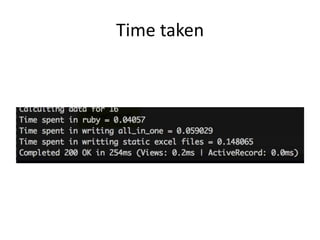
Time taken
What we have done in these
milliseconds
• Parsed the input json
• Applied the business logic to combine the
parameters
• Fetch all the data from redis
• Formatted and sorting the output data
• Generated ruby results to suit the output format.
• Handed over the data to axlsx gem for writing to
excel
• Save the excel file to disk (for record keeping)
Understanding the domain
• Our schema is defined and is very very specific
to our case.
Redis infrastructure
• Redis is hosted locally on each box
Redis infrastructure
• Redis is hosted locally on each box
• So we save few ms in the network call as its
not an external call.
Redis is persistent if you want
• Since our application is read intensive, we are
fine if Redis writes to db every 5 mins.
• It is configurable
• Extensive details at
http://oldblog.antirez.com/post/redis-
persistence-demystified.html
Its smart about writing to disk
• Save after 900 sec if atleast 1 key changed
• Save after 300 sec if atleast 10 keys changed
• Save after 60 sec if atleast 10000 keys changed
Redis crashed!!
• First of all its not all that common
• Secondly, its persistent. When the server
restarts, it will loads the data from the disk.
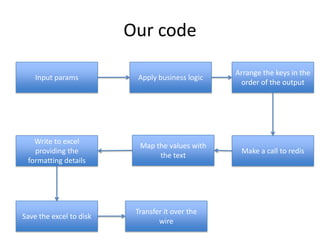
Our code
Input params Apply business logic
Arrange the keys in the
order of the output
Make a call to redis
Map the values with
the text
Write to excel
providing the
formatting details
Save the excel to disk
Transfer it over the
wire
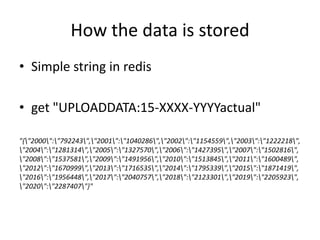
How the data is stored
• Simple string in redis
• get "UPLOADDATA:15-XXXX-YYYYactual"
"{"2000":"792243","2001":"1040286","2002":"1154559","2003":"1222218",
"2004":"1281314","2005":"1327570","2006":"1427395","2007":"1502816",
"2008":"1537581","2009":"1491956","2010":"1513845","2011":"1600489",
"2012":"1670999","2013":"1716535","2014":"1795339","2015":"1871419",
"2016":"1956448","2017":"2040757","2018":"2123301","2019":"2205923",
"2020":"2287407"}"
“Key” to success
• $redis.mget : Gives the output in the input
order
• This enabled us to make just one call to redis
and play with the data in ruby.
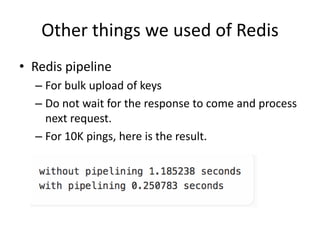
Other things we used of Redis
• Redis pipeline
– For bulk upload of keys
– Do not wait for the response to come and process
next request.
– For 10K pings, here is the result.
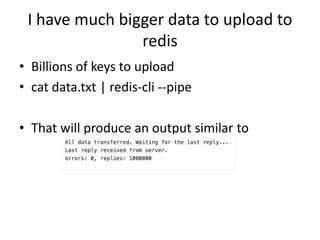
I have much bigger data to upload to
redis
• Billions of keys to upload
• cat data.txt | redis-cli --pipe
• That will produce an output similar to
Future plans
• Sorted sets

Better performance using redis

  • 1.
    Better performance usingRedis and flat schema @singhal_manu @adhasmana
  • 2.
  • 3.
  • 4.
    What we havedone in these milliseconds • Parsed the input json • Applied the business logic to combine the parameters • Fetch all the data from redis • Formatted and sorting the output data • Generated ruby results to suit the output format. • Handed over the data to axlsx gem for writing to excel • Save the excel file to disk (for record keeping)
  • 5.
    Understanding the domain •Our schema is defined and is very very specific to our case.
  • 6.
    Redis infrastructure • Redisis hosted locally on each box
  • 7.
    Redis infrastructure • Redisis hosted locally on each box • So we save few ms in the network call as its not an external call.
  • 8.
    Redis is persistentif you want • Since our application is read intensive, we are fine if Redis writes to db every 5 mins. • It is configurable • Extensive details at http://oldblog.antirez.com/post/redis- persistence-demystified.html
  • 9.
    Its smart aboutwriting to disk • Save after 900 sec if atleast 1 key changed • Save after 300 sec if atleast 10 keys changed • Save after 60 sec if atleast 10000 keys changed
  • 10.
    Redis crashed!! • Firstof all its not all that common • Secondly, its persistent. When the server restarts, it will loads the data from the disk.
  • 11.
    Our code Input paramsApply business logic Arrange the keys in the order of the output Make a call to redis Map the values with the text Write to excel providing the formatting details Save the excel to disk Transfer it over the wire
  • 12.
    How the datais stored • Simple string in redis • get "UPLOADDATA:15-XXXX-YYYYactual" "{"2000":"792243","2001":"1040286","2002":"1154559","2003":"1222218", "2004":"1281314","2005":"1327570","2006":"1427395","2007":"1502816", "2008":"1537581","2009":"1491956","2010":"1513845","2011":"1600489", "2012":"1670999","2013":"1716535","2014":"1795339","2015":"1871419", "2016":"1956448","2017":"2040757","2018":"2123301","2019":"2205923", "2020":"2287407"}"
  • 13.
    “Key” to success •$redis.mget : Gives the output in the input order • This enabled us to make just one call to redis and play with the data in ruby.
  • 14.
    Other things weused of Redis • Redis pipeline – For bulk upload of keys – Do not wait for the response to come and process next request. – For 10K pings, here is the result.
  • 15.
    I have muchbigger data to upload to redis • Billions of keys to upload • cat data.txt | redis-cli --pipe • That will produce an output similar to
  • 16.