







FutureProofing
CHALLENGES IN CO2 REDUCTION
PUBLICATION
NUMBER
42408014 ISSUE 52 | WINTER 2024
Low Carbon Homebuilder Coalition
The Evolution of Home Heating
Embodied Carbon Regulations
The Holistic Home
A Better Place to Call Home
Sealed Tight for Net Zero Ready
www.airmaxtechnologies.com T 905-264-1414
Prioritizing your
comfort while providing
energy savings
Canadian Made
Manufactured by Glow Brand Manufacturing
Models C95 & C140
Condensing Combination Boiler
Glow Brand C95 and C140 instantaneous combination ASME boilers for heating and on-demand
hot water supply. The ultra- efficient compact design combination boiler has an AFUE rating of
95%.These units arefully modulating at 10 to 1 and 2 inch PVC venting up to 100 feet.
Brand
TM
ENDLESS ON-DEMAND
HOT WATER
Models C95 & C140
Glow Brand C95 and C140 instantaneous combination ASME boilers for heating and on-demand
BETTERBUILDER.CA | ISSUE 52 | WINTER 2024
PUBLISHER’S NOTE
2
The Times, They Are
A-Changin’
by John Godden
THE BADA TEST
3
Another New Year
Looking back to look forward
by Lou Bada
INDUSTRY EXPERT
5
Hydro Furnace
The evolution of home heating
by Marc Huminilowycz
INDUSTRY NEWS
9
The Need for Embodied
Carbon Regulations
by Paul De Berardis
INDUSTRY NEWS
13
Panasonic Breathe Well
with Whisper Air Repair
by Alex Newman
BUILDER NEWS
20
The Holistic Home
by Marc Huminilowycz
SITE SPECIFIC
22
Paolo Spinosa:
Problem Solved
by Alex Newman
BUILDER NEWS
24
A Better Place to Call Home
AeroBarrier helps developer
achieve net zero ready
by Marc Huminilowycz
INDUSTRY NEWS
26
Sealed Tight for Net Zero Ready
by Marc Huminilowycz
INDUSTRY EXPERT
28
Flexing the Pex
by John Godden
INDUSTRY EXPERT
30
Comparing Global
Warming Potential
by Tyler Simpson
1
ISSUE 52 | WINTER 2024
Images internally supplied unless otherwise credited.
FEATURE STORY
16
The Low Carbon Homebuilder Coalition
It’s all in the family
by Alex Newman
26
Cover: AscentXmedia,
istockphoto 2166515179
16
30
24
BETTERBUILDER.CA | ISSUE 52 | WINTER 2024
“The Times,
They Are A-Changin’”
“Come gather ’round people, wherever you roam/
And admit that the waters around you have grown”
— Bob Dylan
T
his is the eighth Better Builder issue on future-proofing. Previous issues
have identified low-cost strategies for creating rough-ins for future
installations. The single most impactful feature that we’ve discussed is
combination hybrid heat (CHH), which promotes the wise use of natural gas in
Ontario. CHH can reduce CO2 emissions by up to 50% through fuel switching
with an air source heat pump. In addition, it can save water and reduce
domestic hot water loads substantially. The system is perfect for secondary
suites as it helps to maintain fire separations with one heating plant.
The biggest factor for successful future-proofing may be homeowner
awareness and homebuilder education. On November 26, 2024, the Sustainable
Housing Foundation (SHF) and Enbridge Gas sponsored the annual Low
Carbon Home Builder Coalition (LCHC) dinner and celebrated successful
municipal engagement on local green building standards. The annual dinner
is designed to educate members of the homebuilding industry about their
current choices. Part of this education involves builders building discovery
houses. Five builders, on their discovery homes, received the Hybrid Home
label. This resulted from their participation in Enbridge’s Savings By Design
for Net Zero Energy Ready homes (see photos on page 19). The guest speaker,
Chris Magwood from Builders for Climate Change, educated guests about an
approach to reducing embodied carbon that can account for 49% of carbon
emissions attached to home construction over its life cycle. He shared his
work on the creation of ANSI Standard RESNET/ICC 1550, which will soon be
published by RESNET after public comment.
This issue showcases many simple approaches to future-proofing. Lou
Bada, on page 3, provides an overview of practical strategies, including how to
navigate local green building standards. On page 9, Paul De Berardis discusses
the need for a standardized embodied carbon rating index to calibrate a
baseline for carbon in homes.
Combination heat is an important topic, so we checked in with Phil and Jill
(who we first met in “Aging in Place” in the spring 2024 issue, page 16) to hear
about their experience living with the system for almost a year.
We also welcome Tyler Simpson back in this issue. He provides a valuable
comparison between types of batt insulation and their embodied carbon. He
also explains how the process of environmental product designation works.
In this new year, Better Builder strives to be a forum for discussion about
relevant information for the building industry, now and in the future. As Bob
Dylan sings, “Come writers and critics, who prophesize with your pens/And
keep your eyes wide, the chance won’t come again.” BB
publisher’snote / JOHN GODDEN
2
PUBLISHER
Better Builder Magazine
63 Blair Street
Toronto ON M4B 3N5
416-481-4218 | fax 416-481-4695
sales@betterbuilder.ca
Better Builder Magazine
is a sponsor of
PUBLISHING EDITOR
John B. Godden
MANAGING EDITORS
Crystal Clement
Wendy Shami
editorial@betterbuilder.ca
To advertise, contribute a story,
or join our distribution list, please
contact editorial@betterbuilder.ca
FEATURE WRITERS
Rob Blackstien, Alex Newman,
Marc Huminilowycz
PROOFREADING
Carmen Siu
CREATIVE
Wallflower Design
This magazine brings together
premium product manufacturers
and leading builders to create
better, differentiated homes and
buildings that use less energy,
save water and reduce our
impact on the environment.
PUBLICATION NUMBER
42408014
Copyright by Better Builder
Magazine. Contents may not be
reprinted or reproduced without
written permission. The opinions
expressed herein are exclusively
those of the authors and assumed
to be original work. Better Builder
Magazine cannot be held liable
for any damage as a result of
publishing such works.
TRADEMARK DISCLAIMER
All company and/or product
names may be trade names,
trademarks and/or registered
trademarks of the respective
owners with which they are
associated.
UNDELIVERABLE MAIL
Better Builder Magazine
63 Blair Street
Toronto ON M4B 3N5
Better Builder Magazine is
published four times a year.
BETTERBUILDER.CA | ISSUE 52 | WINTER 2024
build sustainably. We have nothing
to apologize for. We will abide by the
court’s decision and follow the law.
In a nutshell, what we’re looking
for in regulation is consistency that is
rational, predictable and executable
at scale. Standards, not programs.
That’s why the Ontario Building Code
(OBC) was established. Currently,
we can’t build homes with the same
standards on both sides of Steeles
Avenue, in Vaughan and in King City, in
Mississauga and in Oakville, or across
many municipalities. So much for the
federal government’s Housing Design
Catalogue. It’s not just about costs
either; it’s about process. Builders can
and do build to higher energy efficiency
standards and lower carbon homes in a
sensible manner.
It is simply bad public policy and
practice that all 444 of Ontario’s
municipalities can develop often
divergent standards, which impede
homebuilding and add costs to
consumers during a housing supply
crisis. It just doesn’t make sense.
I
’ve always been fascinated at this
time of the year, when the media
reviews last year’s predictions and
then looks forward to what they
believe will happen in the next.
Planning for the future is a necessary
and sometimes fraught exercise. It
reminds me of an old Yiddish saying
(I’m paraphrasing): “If you want to
make God laugh, tell him your plans.”
With this in mind, I’d like to look
back at a few of the past topics written
about in Better Builder.
Nearly every article I’ve written
touches upon municipal so-called
“green building standards.” Recently,
myself and RESCON, the association
that I am a member of (but not author­
ized to speak for), were accused of being
“anti-green” (whatever that means) and
slaves to greedy corporate interests.
Why? Because we went to the courts to
clarify the applicable laws pertaining
to municipal authority on the matter
of green building standards? What if
the Toronto Transit Commission and
the City of Toronto tried changing
the Ontario Highway Traffic Act’s
regulations for all drivers within the
city and began handing out traffic
tickets because councillors decided
it was a good idea? What if every
municipality changed to their own
versions (and changed them often)?
We’ve held extensive, frank and
cordial consultations with various
municipalities expressing our
concerns, with little or no movement
on most municipalities’ part. It was
out of frustration, not avarice, that
we asked for a legal opinion from the
courts (we’re not suing anyone, as
has been alleged). Unfortunately, this
false “anti-green builder” sentiment
has bled into some media outlets and
social media.
Frankly, I don’t believe these accu­
sations even deserve a response. I will
say vilifying us, virtue-signalling and
half-truths don’t do anyone any good.
The American Democratic politician
Daniel P. Moynihan famously said:
“You are entitled to your own opinions,
but not your own facts.”
Private industry builds at least 95%
of all homes in Ontario, and we employ
hundreds of thousands of people. We
3
thebadatest / LOU BADA
BETTERBUILDER.CA | ISSUE 52 | WINTER 2024
Another New Year
Looking Back to Look Forward
In a nutshell, what
we’re looking for
in regulation is
consistency that is
rational, predictable
and executable at
scale. Standards,
not programs.
ISTOCKPHOTO
1136842920
BETTERBUILDER.CA | ISSUE 52 | WINTER 2024
4
with dismal results. The judicious use
of natural gas as a bridge fuel makes a
lot of sense at this time.
So, what will work in the future?
Well, much of what we’ve looked at in
the past.
A rational, predictable and execu­
table system with real cost and benefit
to the environment and homeowners is
a hybrid heating system. It was written
about in the autumn 2023 issue. An
improved building envelope to match
a HERS 46 (or roughly 20% better
than Code), along with a combination
heating system and three-season heat
pump, could reduce CO2 emissions by
up to 50%. Good controls for managing
space heating/cooling systems and
ventilation are very important when
installing a hybrid heating system. If
the OBC develops this way, it would be
a good outcome.
As well, Doug Tarry wrote a wise
article titled “Understanding the
Value of Windows” in the spring 2023
issue. Doug observed that Energy Star
windows with higher solar heat gain
coefficients aren’t always the best choice
for highly insulated and airtight homes.
In my mind, this speaks to the folly of
believing that more is always better.
Also, with less superfluous and
improper regulation, we could concen­
trate on resiliency. For instance, more
attention could be paid to what is
already in the OBC in regard to window
flashing details (see “It’s ‘Plane’ to See”
in the spring 2020 issue). Building more
resilient homes in the face of climate
change is always a winner.
These are only a few thoughts on
future building practices. None of them
are new for the New Year.
We plan because we must. God
laughs because he knows better. BB
Lou Bada is vice-
president of low-rise
construction at Starlane
Home Corporation
and on the board of
directors for the Residential Construction
Council of Ontario (RESCON).
The Net Zero program, or elimin­
ating the use of natural gas in homes,
should not be forced by any municipal
green building standard. Country
Homes benchmarked its hybrid house
against a “net zero” constructed home
BETTERBUILDER.CA | ISSUE 52 | WINTER 2024
industryexpert / MARC HUMINILOW YCZ
Although furnaces have gotten
more capable over the years, they are
still limited by right-sizing to meet
variable outdoor temperatures and
resulting loads. Today’s one-stage
furnaces experience cycling losses,
while their two-stage counterparts
have trouble meeting smaller load
requirements.
Enter a new and innovative
approach to home heating: the hydro
furnace, which integrates modu-
lating burners in tankless hot water
heaters and boilers into furnace tech-
nology. At the forefront of this tech-
nology is Navien, a company founded
in 2006 that for years has been the
industry leader in wall-hung boilers
and gas condensing tankless water
heaters. According to a recent report
from global market intelligence
provider BRG Building Solutions,
Navien is the number one manufac-
turer of all gas tankless water heaters
(condensing and non-condensing) in
North America.
Annual fuel utilization efficiency
(AFUE) is a measure of how effici­
ently a furnace converts fuel to
heat. It is a metric that determines
how much fuel a furnace is actually
turning into heat for the home. A
typical 20-year-old gas furnace
system delivers an AFUE of 70% at
best. The Navien NPF Hydro Furnace
rates 97%, offering maximum effici­
ency plus a full range of modulation
to optimize occupant comfort.
Navien Canada national sales
Hydro Furnace
The Evolution of Home Heating
manager Adam Wills explains: “The
more you modulate, the better the
efficiency and comfort level you
achieve. Conventional furnaces are
most efficient within a range of -10
°C and +10 °C, and their ability to
modulate lower is limited. Utilizing
the same technology as our tankless
hot water heaters, our NPF 60,000
BTU Hydronic Forced Air Furnace
operates from 15% to 100%, with the
ability to go down to 9,000 BTU.
This keeps the thermostat happy
and occupants comfortable on
every level of their home.”
According to Wills, the
ability of a furnace to modulate
to lower BTUs results in a
more consistent run and
the ability to properly size
HVAC equipment, which
equates to cost savings. The
variable capacity operation
of Navien’s hydro furnaces
allows for optimized
furnace performance, more precise
temperature and humidity control,
more consistent comfort and increased
electrical efficiency because it can
match the exact airflow requirements
of the HVAC system.
Here’s how it all works. Navien
condensing stainless steel heat
exchangers recover extra heat that
would be lost in non-condensing
Adam Wills, Navien national sales manager.
“The more you modu­
late, the better the
efficiency and comfort
level you achieve… This
keeps the thermostat
happy and occupants
comfortable on every
level of their home.”
H
ome heating technology has come a long way since the days of building
a house and simply installing a furnace and hot water tank, with little
consideration for efficiency or occupant comfort.
BETTERBUILDER.CA | ISSUE 52 | WINTER 2024
6
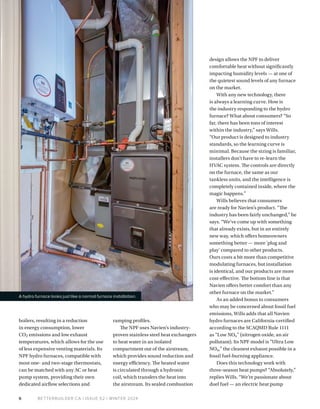
design allows the NPF to deliver
comfortable heat without significantly
impacting humidity levels — at one of
the quietest sound levels of any furnace
on the market.
With any new technology, there
is always a learning curve. How is
the industry responding to the hydro
furnace? What about consumers? “So
far, there has been tons of interest
within the industry,” says Wills.
“Our product is designed to industry
standards, so the learning curve is
minimal. Because the sizing is familiar,
installers don’t have to re-learn the
HVAC system. The controls are directly
on the furnace, the same as our
tankless units, and the intelligence is
completely contained inside, where the
magic happens.”
Wills believes that consumers
are ready for Navien’s product. “The
industry has been fairly unchanged,” he
says. “We’ve come up with something
that already exists, but in an entirely
new way, which offers homeowners
something better — more 'plug and
play' compared to other products.
Ours costs a bit more than competitive
modulating furnaces, but installation
is identical, and our products are more
cost-effective. The bottom line is that
Navien offers better comfort than any
other furnace on the market.”
As an added bonus to consumers
who may be concerned about fossil fuel
emissions, Wills adds that all Navien
hydro furnaces are California-certified
according to the SCAQMD Rule 1111
as “Low NOx” (nitrogen oxide, an air
pollutant). Its NPF model is “Ultra Low
NOx,” the cleanest exhaust possible in a
fossil fuel-burning appliance.
Does this technology work with
three-season heat pumps? “Absolutely,”
replies Wills. “We’re passionate about
duel fuel — an electric heat pump
A hydro furnace looks just like a normal furnace installation.
boilers, resulting in a reduction
in energy consumption, lower
CO2 emissions and low exhaust
temperatures, which allows for the use
of less expensive venting materials. Its
NPF hydro furnaces, compatible with
most one- and two-stage thermostats,
can be matched with any AC or heat
pump system, providing their own
dedicated airflow selections and
ramping profiles.
The NPF uses Navien’s industry-
proven stainless steel heat exchangers
to heat water in an isolated
compartment out of the airstream,
which provides sound reduction and
energy efficiency. The heated water
is circulated through a hydronic
coil, which transfers the heat into
the airstream. Its sealed combustion
BETTERBUILDER.CA | ISSUE 52 | WINTER 2024
combined with a gas product as a
backup system. It’s a fantastic option
for homeowners, and a stepping stone
for complete electrification. With the
temperature swings we experience in
Canada and our abundance of natural
gas, it’s a solid backup option that offers
peace of mind.” BB
Marc Huminilowycz
is a senior writer. He
lives and works in
a low-energy home
built in 2000. As
such, he brings first-hand experience
to his writing on technology and
residential housing and has published
numerous articles on the subject.
7
NPF Horizontal
NPF Upflow
The next level of comfort
in forced-air heating
NEW NPF Hydro-furnace
The NPF Advantage: The NPF heats water
by burning the gas in a sealed combustion
heat exchanger, completely isolated from the
airstream. The heated water is then pumped
through a hydronic heat exchanger that gently
transfers the heat into the air. The fully enclosed
Ultra-Low NOx premix burner provides
extremely quiet operation, highly efficient, and
allows for an industry-leading variable capacity
that can modulate down to 15% for a next-level
comfort experience.
Explore the new NPF at Navieninc.com.
NPF Hydro-furnace Conventional furnace
Our unique hydronic forced-air heating design keeps combustion in a separate, fully enclosed compartment
for safe and quiet comfort.
Durable
stainless steel
combustion
heat exchanger
located out of
the airstream.
A hydronic
coil transfers
heat from the
water into the
conditioned
airstream at a
temperature
up to
150°F
Gas is
burned directly
in the conditioned
airstream —
exposing it to
temperatures up to
1000°F
A hydro furnace uses less energy to provide the same level of comfort (exergy).
BETTERBUILDER.CA | ISSUE 52 | WINTER 2024
However, the constant focus on
operational emissions has skewed our
focus away from other considerations,
such as embodied carbon or product
emissions, which are the largest
contributor to overall emissions and
thereby represent a huge opportunity
to reduce carbon. Considering low-
rise residential construction in the
Greater Toronto and Hamilton Area
(GTHA) contributes nearly one million
tonnes of GHG emissions per year,
which is equivalent to the operation
of almost 200,000 automobiles,
there needs to be more thoughtful
consideration to embodied carbon
implications.
The calculation of embodied
carbon is not currently a regulated
practice. With the 2025 model
National Building Code (NBC)
expected to be released in the first
half of this year, embodied carbon
considerations were not included
in this code. Although there were
discussions, it was determined that
more time was needed, and that the
2030 NBC would be the more realistic
opportunity to begin regulating
embodied carbon. At the provincial
level, the 2024 OBC just recently came
into effect after a harmonization
exercise with the 2020 NBC, so
embodied carbon is a long way out
from being included in national or
provincial building codes.
At the municipal level, certain
jurisdictions are encouraging
homebuilders to conduct and report
on embodied carbon emissions
in the hope that, sometime in the
future, emission intensity targets
can be established and enforced. It’s
encouraging to see that embodied
carbon is on the radar, but there are
limited tools and procedures for
calculating it. One such tool is the
Material Carbon Emissions Estimator
(MCE2), which was developed by
Natural Resources Canada and is
designed for quantifying the embodied
carbon GHG emissions associated with
specific low-rise, residential building
designs. While this free spreadsheet
can be an informative tool to provide
some embodied carbon estimates and
insight, there are several practical
limitations with MCE2.
One other, more advanced tool is
BEAM (Building Emissions Accounting
for Materials), which is another free,
spreadsheet-based embodied carbon
estimator well suited for low- and
mid-rise residential applications.
BEAM was developed by Builders for
9
industrynews / PAUL DE BERARDIS
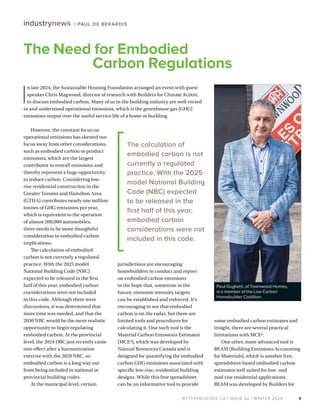
Paul Guglietti, of Townwood Homes,
is a member of the Low Carbon
Homebuilder Coalition.
I
n late 2024, the Sustainable Housing Foundation arranged an event with guest
speaker Chris Magwood, director of research with Builders for Climate Action,
to discuss embodied carbon. Many of us in the building industry are well versed
in and understand operational emissions, which is the greenhouse gas (GHG)
emissions output over the useful service life of a home or building.
The calculation of
embodied carbon is not
currently a regulated
practice. With the 2025
model National Building
Code (NBC) expected
to be released in the
first half of this year,
embodied carbon
considerations were not
included in this code.
The Need for Embodied
Carbon Regulations
BETTERBUILDER.CA | ISSUE 52 | WINTER 2024
10
Climate Action and enables material
selection with varying levels of
carbon intensity. These tools utilize
material quantity user inputs along
with emissions factors derived from
Environmental Product Declarations
(EPDs) to estimate embodied carbon.
For more complex, large, high-rise
buildings, other embodied carbon
analysis methods are available, such
as the Upfront Embodied Emissions
Assessment of the Canada Green
Building Council (CaGBC) Zero Carbon
Building Standard.
As mentioned earlier, since none
of these embodied carbon assessment
tools are based on established
standards or even regulated by
building codes, there is still a lot of
variability in how they calculate and
assess embodied carbon. Furthermore,
while EPDs are increasingly becoming
more commonplace with respect to
building products and materials, there
is still a wide range of uncertainty when
comparing product-specific EPDs to
industry averages. Analogous to any
type of modelling, the accuracy of
the model (in this case, the embodied
carbon analysis) can only be as good
as the precision of the inputs. As
manufacturers and suppliers continue
to offer more EPDs for various building
components, the ability to derive more
precise embodied carbon calculations
will improve.
While embodied carbon calculators
are a work in progress, several builders
across Canada have undertaken
embodied carbon studies on homes
they’ve recently constructed. What has
become apparent is that over 75% of
the embodied carbon can be attributed
to a few key building components,
namely the concrete foundation,
insulation, exterior cladding, interior
surfaces and windows. These are the
systems and products that have the
highest potential for embodied carbon
savings. High-performance homes of
the future will be ones that can balance
low-operational carbon while also
achieving an equal emphasis on low
embodied carbon.
With embodied carbon calculators
and regulations still on the horizon in
Canada, RESNET (Residential Energy
Services Network) in the United
States has released Draft PDS-01
1550, Embodied Carbon, for public
review and comment at the time of
writing this article. This draft standard
provides a consistent methodology
for the calculation and reporting of
the embodied carbon of dwellings
and uses the same modelling data,
processes and reporting employed by
standard ANSI/RESNET/ICC 301. When
complete, this will be the first North
American standard for embodied
carbon analysis. As this RESNET
embodied-carbon standard is finalized,
hopefully future iterations of the NBC
and OBC can adapt some of the lessons
learned from our neighbours.
Until more regulated practices
of embodied carbon analysis are
established in Canada, these analysis
tools can be used by designers and
builders to make educated and
informed decisions when it comes to
building practices. However, we are
still in the early days before embodied
carbon emission intensity targets can
be regulated. BB
Paul De Berardis
is RESCON’s vice
president of building
standards and
engineering. Email
him at deberardis@rescon.com.
This rating is available for
homes built by leading edge
builders who have chosen to
advance beyond current
energy efficiency programs
and have taken the next step
on the path to full sustainability.
BetterThanCode
LowCostCodeCompliancewith
theBetterThanCodePlatform
BetterThanCodeUsestheHERSIndex
to Measure Energy Efficiency
TheLowertheScoretheBetter
Measureable and Marketable
80 60 40 20
This Platform helps Builders with
Municipal Approvals, Subdivision
Agreements and Building Permits.
Navigating the performance path
can be complicated. A code change
happened in 2024 which is causing
some confusion. A new code will be
coming in 2025. How will you
comply with the new requirements?
Let the BTC Platform – including
the HERS Index – help you secure
Municipal Subdivision Approvals
and Building Permits and enhance
your marketing by selling your
homes’ energy efficiency.
betterthancode.ca
Email info@clearsphere.ca
or call 416-481-7517
46
BETTERBUILDER.CA | ISSUE 52 | WINTER 2024 11
™/®
Enercare, Enercare Advantage and the designs are trademarks of Enercare Inc., used under license.
Enercare delivers high-rise building comfort solutions by providing builders with innovative and efficient
mechanical systems without upfront capital costs.
GEOTHERMAL TECHNOLOGY
Enercare, in collaboration with Subterra, offers energy-
efficient heating and cooling technology through
geothermal solutions. By combining this with Enercare’s
heat pump technology, developers can access a greener
alternative to traditional HVAC systems.
What is geothermal and how does it work? The
geothermal exchange process occurs via a series of ground
loops that transfer thermal energy from the ground to heat
pumps that are used to cool or heat your building.
Scan the QR code or visit
enercare.ca/builder/highrise
OUR SUITE OF PRODUCTS
HVAC – Geothermal and Air Source Heat
Pumps, Central Plant, Fan Coils, Air
Handlers and Boilers
Water Heating – Electric Tank and Tankless
Water Heaters
Ventilation – Energy and Heat Recovery
Ventilators
Water Treatment – Reverse Osmosis, Water
Softener, Whole Home Water Filtration
EV Charging – Electric Vehicle Energy
Management System (EVEMS)
WHY CHOOSE THE ENERCARE
ADVANTAGE™ PROGRAM?
Easy to do Business With – On-time deliveries,
with complete commissioning & sourcing on site.
Access to Leading Products – Including state-of-
the-art and energy-efficient equipment designed
to provide year-round comfort.
Complete Service Provider – Single point of
contact for sourcing both in-suite and central
plant equipment from major manufacturers, with
24/7/365 call centre support to assist in booking
a service call.
Take your
builds to new
heights with
Enercare
ECH3697_BetterBuilderAd_Fall_d7.indd 1
ECH3697_BetterBuilderAd_Fall_d7.indd 1 2024-10-15 3:10PM
2024-10-15 3:10PM
BETTERBUILDER.CA | ISSUE 52 | WINTER 2024
As early as 2018, the company
introduced a new energy recovery
ventilator (ERV) line that highlighted
their IAQ products, says John Sneyd,
Ontario regional sales manager for
Panasonic Canada, life and device
division. “We saw the need for
improving IAQ: great energy efficiency
and tighter building envelopes has
meant greater need for mechanical
ventilation,” he explains. “The
pandemic reinforced that need.”
That first ERV was improved on a
few months ago, with the introduc­
tion of the BalancedHome ERV. With
additional cubic feet per minute
(CFM) sizes for increased efficiency
on energy transfer, and air filtration
through replaceable minimum
efficiency reporting value (MERV)
filters, it meets increased Code
demands for more fresh air exchanges.
Plus, its intuitive digital wall control
option allows the homeowner to
immediately see the status of intake
and exhaust, temperature and
humidity, and filter life.
Unique to Panasonic ERVs is the
Swidget control, which has interior
modules that will turn a bathroom
fan off or on based on the room’s
humidity levels.
Also unique to Panasonic is their
nanoe™ X technology, developed
about 20 years ago, which controls
13
Panasonic Breathe Well
with Whisper Air Repair
industrynews / ALEX NEWMAN
A
fter the pandemic, we were left with an acute awareness of all things
related to health. One of those was the importance of improving indoor air
quality (IAQ), since so much of our time was being spent indoors.
Panasonic had been working on this issue even before the pandemic,
introducing products that clean and purify the air circulating in homes under its
Breathe Well banner. For Panasonic, the pandemic was a strong reminder of the
company’s commitment to healthy indoor environments.
Panasonic’s nanoeTM X technology used in Whisper Air Repair.
WHISPER
AIR-
REPAIR
_
F
V-
01VCN1
_
SELL
_
SHEET_
EN
.
PDF
HT
TPS:
//
NA
.
PANASONIC
.C
A
/
INDOOR-
AIR-
QUALIT
Y/
VENTIL
ATION
/AIR-
PURIFIERS/
WHISPER
AIR-
REPAIR
BETTERBUILDER.CA | ISSUE 52 | WINTER 2024
14
a number of their products — air
source heat pumps, fridges, even
hair dryers. nanoe X works by
generating and releasing hydroxyl
radicals (OH radicals) encapsulated
in water molecules, Sneyd says.
“These molecules are able to
neutralize harmful substances in
the air such as odours, allergens and
other contaminants. Not only are
contaminants neutralized in the air,
but also surfaces, such as carpets and
bedding.” See diagram on page 13.
Also part of the BreatheWell
line is the Whisper Air Repair unit,
introduced in 2022. It’s a spot air
purification device that’s effective up
to 200 square feet, making it perfect
for bedrooms and family rooms, and
is especially helpful where pets hang
out. It’s connected and installed like
a pot light, doesn’t need filters and
doesn’t need to be connected to the
ductwork. However, Sneyd adds,
it probably shouldn’t be installed
where there’s a lot of moisture, such
as over the stove or in a bathroom
with a shower.
Like the rest of the BreatheWell
line, the Whisper Air Repair uses
Panasonic’s nanoe X technology. It's a
unit that homeowners can purchase
for less than $200, but it’s something
that builders are putting into new
homes as well, either as a standard
feature or an upgrade, Sneyd says. One
of these units was given away at the
recent Sustainable Housing Foundation
(SHF) event sponsored by Enbridge and
Panasonic; see the photo at the top of
this page.
Panasonic takes a four-fold
approach to improving the indoor
environment, Sneyd says. The first is
to actively exhaust stale air from the
home and replace it with fresh outdoor
air, which is what Panasonic’s ERVs and
exhaust fans do. The next is a little more
passive, to clean the existing indoor
air with products such as Whisper Air
Repair with its nanoe X technology. The
third approach is to properly heat and
cool the air, using technology-based
products such as Panasonic’s air source
heat pumps to prohibit bacteria and
mould growth.
The last part of this holistic
approach is to increase awareness
through education. Panasonic is
doing this through its Breathe Well
marketing program so that builders can
educate homebuyers on their indoor
environment.
He deals directly with builders
and developers. “Many people don’t
realize that about 80% of Panasonic’s
business is commercial, and that many
of our products are sold through a
distribution network,” he says.
IAQ is something that’s occupied
much of Sneyd’s career. After studying
geography and physical education at
Wilfrid Laurier University, he worked
in technology sales for GE, then moved
around to a few companies before
finding his home at Panasonic. He’s
been there for the last 14 years, initially
in the PVX foam division, and then
seconded to the HVAC division four
years ago.
“I really enjoy it,” he says. And he’s
found a like-minded group in the SHF.
“Everyone is committed to improving
customer experience and lifestyle
through sustainability.” BB
Alex Newman is a writer,
editor and researcher at
alexnewmanwriter.com.
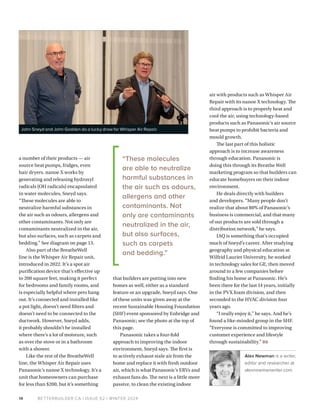
“These molecules
are able to neutralize
harmful substances in
the air such as odours,
allergens and other
contaminants. Not
only are contaminants
neutralized in the air,
but also surfaces,
such as carpets
and bedding.”
John Sneyd and John Godden do a lucky draw for Whisper Air Repair.
BETTERBUILDER.CA | ISSUE 52 | WINTER 2024 15
BETTERBUILDER.CA | ISSUE 52 | WINTER 2024
16
featurestory / ALEX NEWMAN
O
n November 26, the Sustain­
able Housing Foundation
(SHF) held its annual dinner
at Thornhill Golf and Country Club.
Sponsored by the foundation and
Enbridge Gas, the dinner was a
celebration of many milestones.
As master of ceremonies, Clear­
sphere’s CEO, John Godden, outlined
how the green work of committed
builders and manufacturers has
provided much hope for the future of
the planet.
“In 2007, we established the SHF
and, in 2009, we started challenging
builders to build 50% better using
a HERS scale for a typical North
American home,” Godden says.
“In 2012, Enbridge’s Savings by
Design program complemented the
Performance Path in that Building
Code. CRESNET and SHF then
challenged U.S. builders at RESNET,
and the Cross-Border Builder
Challenge was established and kicked
off the ROXUL dinner of champions.
This event was very similar to the
November 26, 2024 event; the only
difference being the inclusion of
embodied carbon and the recognition
of local municipalities for including
choice with their Green Building
Standards at the 2024 event.”
“Since regional variables can make
it challenging to compare homes, a
standardized scale was needed. So, in
2017, Enbridge recognized the HERS
scale as a way to accommodate such
differences by including it in its Savings
by Design workshop program. Using
this measuring makes it possible to
count how much carbon has been
reduced in a year and then relay
that information to Enbridge or the
municipal government. This approach
is responsible for more than 10,000
homes receiving HERS ratings from
2019 to 2024."
Many of the residential home­
builders who attended the SHF dinner
are members of the Low Carbon
Homebuilder Coalition (LCHC),
established in 2022. In the LCHC,
carbon is counted using HERS and
It’s All in the Family
The Low Carbon
Homebuilder Coalition
The Low Carbon
Homebuilder Coalition
BETTERBUILDER.CA | ISSUE 52 | WINTER 2024
Better Than Code ratings. In 2024, this
approach helped 1,936 homes reduce
carbon emissions by 3,125 tonnes.
That collectively saved homeowners
a significant $1.8 million in energy
costs.
All of these milestones have
been documented over the years in
Better Builder magazine, which just
launched its 51st issue. The magazine
continues to provide builders with
the latest information on premium
products, as well as news on ways their
peers are creating low-consumption
homes.
A few of these builders were
awarded Hybrid Home labels at the
dinner, including Country Homes,
Brookfield and Lindvest. Hybrid homes
use both natural gas and electricity for
space heating. For their collaborations
with builders, the municipalities of
Caledon, East Gwillimbury, Richmond
Hill and York Region were given
certificates (see photos on page 18).
Enbridge’s residential manager,
Mark Prociw, talked about the homes
built through their Net Zero energy
workshop program — 20 in 2024
and 28 to be built in 2025. Enbridge
provides builders advice, onsite
training and a $15,000 incentive toward
the pilot home. “The collaboration is
remarkable, demonstrating how we’re
able to work together,” Prociw says.
Through Enbridge’s Savings by
Design program, 565 homes were built
and certified in 2024. Incentives came
to $930,000, which Prociw says “has
really helped builders improve energy
performance, enhance comfort and
air quality, and reduce greenhouse gas
emissions.”
Enbridge also offers the Recognize
Clean home-heating initiative, which
is funded by the Ontario government
to offer $4,500 to participating home­
owners. Prociw says the program’s
17
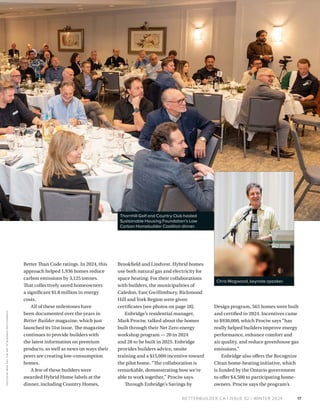
Thornhill Golf and Country Club hosted
Sustainable Housing Foundation’s Low
Carbon Homebuilder Coalition dinner.
PHOTOS
BY
MIKE
DAY,
THE
ART
OF
BUSINESS
PHOTOG
R
APHY
Chris Magwood, keynote speaker.
BETTERBUILDER.CA | ISSUE 52 | WINTER 2024
18
wide popularity sends “a great signal
to the industry that customers are
keenly interested in solutions. And
that paves the way for a clean energy
future. Ontarians want an energy
system that lowers emissions over
time, but they also want a system
that’s safe, reliant, resilient, cost
effective and energy saving, like what
we see in hybrid homes.”
Keynote speaker Chris Magwood
of Builders for Climate Action (see
photo on page 17) spoke about the
SHF’s mandate to engage, educate
and communicate with builders about
energy rating and carbon counting.
To that end, he emphasized the
importance of understanding the
difference between embodied and
operational carbon in construction.
“Everyone in this room has done
their part in reducing emissions,”
Magwood said. “We’re generating a
fraction of the carbon emissions we
once did.”
But there’s still a way to go, he
added. While builders are producing
less emissions, some of the materials
used are being manufactured with high
carbon consumption. To drive the point
home, he said that “materials going into
our homes have the carbon footprint
of the entire economies of Estonia or
Costa Rica. Consider this: a year of
homebuilding in the GTA produces
840,000 tonnes [of carbon], equivalent
to 183,000 cars. That’s most of the cars
on the road.”
All levels of government have
weighed in on this, and the Canada
Green Building Strategies (a 2024
federal mandate) made it clear that
embodied carbon must be calculated.
While that may sound like just one
more thing to worry about when
building a home, Magwood assures
that the tools are simple. “Basic math.
The amount of material going into
building, multiplied by the emissions
factor, equals the embodied carbon of
the building.”
Alireza Hajiyousef of York Region.
Left to right: Susan Lahey of the Town of East Gwillimbury,
Vania Ottoborgo of Averton Homes, and Michael Lio of buildABILITY.
Paul De Berardis of RESCON and
Ferdi Toniolo of the City of Richmond Hill.
Alexandra Service of the Town of Caledon
and Dave Henderson of RESCON.
For their collaborations with builders, the munici­
palities of Caledon, East Gwillimbury, Richmond
Hill and York Region were given certificates.
BETTERBUILDER.CA | ISSUE 52 | WINTER 2024
To make it easier to calculate,
there’s a spreadsheet tool and a
list of materials with data on the
amount of carbon generated in their
manufacture. It doesn’t cover all
materials, since not all manufacturers
have provided their numbers.
However, carbon consumption
differs according to region, as a recent
study comparing four North American
regions found. “Some builders made
a concerted effort to reduce carbon
consumption, while others achieved
great results without really trying,”
Magwood says. “It all depended on the
products used to build.”
This is good news, though, since
it means there’s low-hanging fruit to
be had.
That same study listed the
materials that could garner a builder
the most carbon savings. Concrete, for
example, produces about a third of the
total homebuilding carbon footprint,
so choosing the brand according to
manufacturing methods can save a
lot. Next is insulation, followed by
cladding and, finally, interior surfaces
(flooring, drywall, ceilings). Roofing is
very low on the scale.
The tricky part about embodied
carbon, Magwood explains, is that no
one calculates the same way, resulting
in vastly different answers. That’s why
he has worked with RESNET to develop
a standard for measuring embodied
carbon. A suite of case studies on
their website highlights the various
strategies a builder can use.
The evening ended with a lucky
draw sponsored by Enbridge Gas
Distribution, Panasonic and Better
Builder magazine. John Sneyd
of Panasonic did the draw for a
WhisperAir Repair. The winner was a
lucky builder.
In the 12 years or so since Better
Builder first launched, the progress
made in building better and in
educating the industry has been
incredible, though hardly surprising.
I’ve written for Better Builder for 10
years but have known about John for
19
many more. He’s known not just in
the housing industry but generally in
sustainability as a pioneer of efficiency
strategies, whose technological
knowledge allows him to be the most
persistent person I’ve ever met.
But the real testament to work
well done is having so many builders,
developers and manufacturers under
one roof. John and the Clearsphere
team have created a “family” of
builders and manufacturers with a
shared purpose — to improve the world
by reducing its carbon footprint. BB
Alex Newman is a writer,
editor and researcher at
alexnewmanwriter.com.
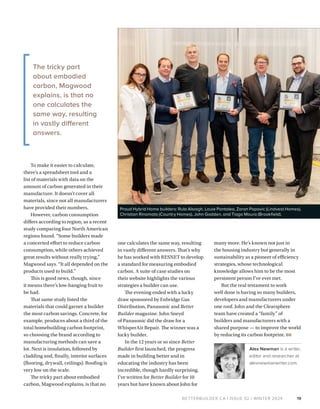
Proud Hybrid Home builders: Rula Alsaigh, Louie Pantaleo, Zoran Popovic (Lindvest Homes),
Christian Rinomato (Country Homes), John Godden, and Tiago Moura (Brookfield).
The tricky part
about embodied
carbon, Magwood
explains, is that no
one calculates the
same way, resulting
in vastly different
answers.
BETTERBUILDER.CA | ISSUE 52 | WINTER 2024
20
buildernews / MARC HUMINILOW YCZ
I
t’s been nine months since Toronto
couple Jill Hamilton and Philip
Wisener moved into their renovated
uptown home — a small, drafty, post-
war townhouse with no bathroom
on the main floor and astronomical
heating and hydro bills that was
updated and retrofitted for comfort,
better accessibility and superior
energy efficiency.
Assisted by their neighbour, John
Godden (a leading home energy
efficiency consultant), Wisener’s
brother-in-law, Richard Lay (a P.Eng.
who has worked on a number of
award-winning LEED buildings)
and architectural designer Deborah
Mesher, the Wisener home was
increased to 1,200 square feet and
completely renovated to Better Than
Code standard.
This included eco-friendly poly­
urethane foam insulation; new, high-
performance Fibertech triple-pane
windows; a combination space heat­
ing system, including an Envirosense
high-efficiency condensing gas hot
water heater feeding an air handler
for even temperatures throughout
the home; an energy-efficient Energy
Star water heater for water and space
heating; a LifeBreath energy recovery
ventilator (ERV) for continuous
ventilation; AIRMAX-zoned high-
velocity heating/cooling controlled
by smart Ecobee thermostats in the
master bedroom and living room; and
a high-efficiency air conditioner to
keep the home cool and remove excess
humidity in the summer.
Better Builder asked the couple
about their experience living in their
retrofitted home, especially with
respect to the performance of the
zoned combination heating system.
“Everything has been working well
— no more drafts, and the ability to
control the temperature and floor
heating from front to back keeps our
home at a nice and steady comfort
level,” says Wisener, adding that the
dual thermostats easily allow them
to keep their master bedroom a bit
cooler (which they prefer) and the
rest of the house warmer.
During the summer, when the
couple were living at their cottage,
they rented out their home via Airbnb
for some extra income. According to
Wisener, seven out of the eight guests
who stayed in the home were pleased
with the home’s overall comfort, with
plenty of hot water available for their
needs. “Only one of the guests had a
complaint — that the house was a bit
too warm for their liking,” he says.
“That’s just a personal preference. Some
The Holistic Home
The Heart of the Holistic Home is Combination Heating
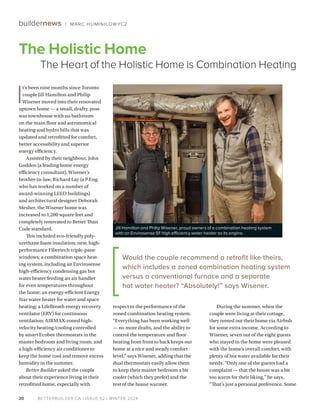
Jill Hamilton and Philip Wisener, proud owners of a combination heating system
with an Envirosense SF high efficiency water heater as its engine.
Would the couple recommend a retrofit like theirs,
which includes a zoned combination heating system
versus a conventional furnace and a separate
hot water heater? “Absolutely!” says Wisener.
BETTERBUILDER.CA | ISSUE 52 | WINTER 2024
people really like to blast their A/C,
which they did, but it takes a while for
the whole home to cool down.” In fact,
most residential air conditioners are
grossly oversized.
Would the couple recommend a
retrofit like theirs, which includes a
zoned combination heating system
versus a conventional furnace
and a separate hot water heater?
“Absolutely!” says Wisener. “Our
daughter recently bought a home in
the U.S. that dates back to the 1920s.
Like ours was before the renovation,
it’s cold and drafty. We strongly
encouraged her to do an HVAC
load calculation to determine the
necessary thermal output capacity
of her home, and then upgrade the
insulation, windows and HVAC
system. If you take a holistic approach
to a renovation and understand how
everything interacts, it makes a huge
difference on the project.” This is the
house-as-a-system approach.
To save some costs on their
renovation, the couple applied for
the federal government’s Greener
Homes Grant. “We had a blower door
test done to get an idea of what we
could get, but because we didn’t go
entirely electric with a heat pump, we
did receive $6,000 out of a potential
$10,000,” explains Wisener.
Based on a usage/cost analysis,
Wisener claims that he’s now
paying less for gas but a bit more for
electricity. “We’re happy with that.
Our old home feels brand new,” he
says. “You walk inside, and it’s so quiet
and comfortable, with lots of natural
light and no drafts. As a lay person,
our retrofit has been an educational
experience for me. I now have a
good understanding of the holistic
approach to home renovation.” BB
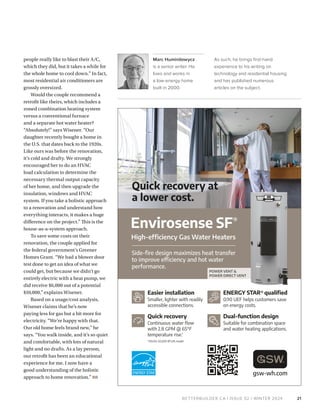
Marc Huminilowycz
is a senior writer. He
lives and works in
a low-energy home
built in 2000.
As such, he brings first-hand
experience to his writing on
technology and residential housing
and has published numerous
articles on the subject.
21
BETTERBUILDER.CA | ISSUE 52 | WINTER 2024
22
sitespecific / ALEX NEWMAN
Spinosa says that’s how he
learned what he knows about HVAC.
While his college degree in business
administration led to a brief career in
retail, he wasn’t challenged enough.
He was soon installing HVAC systems.
“That was my entrée. I learned from
the ground up, starting as a labourer,
doing grunt work in shipping and
receiving. I don’t regret any of it,
because it led me to something better.”
His technical training advanced
even more after becoming involved
with the design of systems and
equipment.
All that technical knowledge has
put him in a better position to meet
the needs of builders. And each
development comes with specific
conditions, since there are regional
and municipal differences, varied
price points and a demographic range.
There are other considerations too,
like whether gas is available, how
green the builder is willing to go and
the price point for homes. Knowing
the answers to these questions will
help determine the type and extent of
the system the homes require.
“Builders come to us needing a
system, whether it’s for one or 100
homes,” Spinosa says. “Mostly the
system is designed by the project
engineer, and our part is to determine
whether they’ll need rentals for the
whole system or just parts of it.”
But sometimes builders don’t have
a clear idea of what they need. In
about heating and AC systems, and are
looking for green alternatives more than
ever. A relatively new, excellent option is
the air source heat pump. It essentially
extracts heat from one area — the air —
and puts it into another system. Even
at zero degrees outside, the air still
contains some heat, and the heat pump
can extract it. A ground source heat
pump does the same, pulling whatever
heat it can from the ground.
“High velocity” is another buzzword
these days. But as Spinosa says, “they’re
not all that different from a regular
furnace, except you’re moving a lot of
air through a smaller pipe.”
How should a builder know what
to choose? “That depends on the
application,” Spinosa says. “If a builder
comes to me with a project of stacked
towns, I automatically think high
velocity that is zoned is the way to go.”
That’s because three or four floors to
heat and cool are going to encounter
temperature variants. If the main floor
is comfortable, the upper floor will be
hot, but if each floor operates as its own
zone, the occupant has more control. A
regular furnace would have to work too
hard to heat all four floors, while trying
to get dense, cold air up those three
levels during air conditioning.
Paolo Spinosa:
Problems Solved
L
earning on the job combines knowledge, skills and experience, and ultimately
brings much more to the table, says Paolo Spinosa, builder markets project
manager for Reliance. “I think it makes you better at understanding what it
takes to solve a problem.”
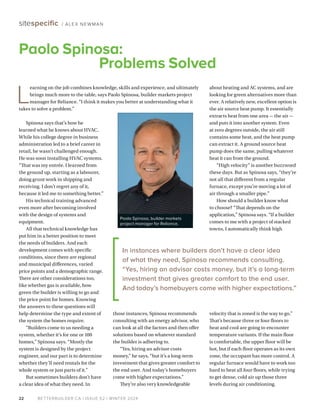
Paolo Spinosa, builder markets
project manager for Reliance.
those instances, Spinosa recommends
consulting with an energy advisor, who
can look at all the factors and then offer
solutions based on whatever standard
the builder is adhering to.
“Yes, hiring an advisor costs
money,” he says, “but it’s a long-term
investment that gives greater comfort to
the end user. And today’s homebuyers
come with higher expectations.”
They’re also very knowledgeable
In instances where builders don’t have a clear idea
of what they need, Spinosa recommends consulting.
“Yes, hiring an advisor costs money, but it’s a long-term
investment that gives greater comfort to the end user.
And today’s homebuyers come with higher expectations.”
BETTERBUILDER.CA | ISSUE 52 | WINTER 2024
High velocity also works when
space is tight. Building ducts into the
walls eats up valuable floor space,
which is in short supply in today’s
smaller homes. High velocity can be
built into bulkheads, so it can easily be
tucked into a coffered ceiling.
Since more builders are
constructing smaller homes and
trying to capitalize on floor space,
they are considering mini-split heat
pumps. These systems are becoming
more popular due to their versatility,
application requirements, effective
performance and footprint.
When asked if he thinks Reliance
is the best company, Spinosa says,
“we do what we do very well, but
there’s always more you can do. What
makes us good is the way we support
our clients. For example, if there’s a
problem with the system, let’s find
out what it is. That’s where I step in;
I always try to work out what the
problem is, whether it’s the product,
the system or the install.”
“Rather than just trying to sell
someone a new unit, we’ll try to
understand what will best meet their
needs. If the problem was ours, we’ll
put in measures to correct that. If it’s
not our problem, then I’ll explain and
direct them to an alternative,” Spinosa
explains.
“The other thing is our service,”
Spinosa says. “Our technicians
are really well informed about the
products they install. For me, it’s
always train, train, train. And when
that’s done, train some more.”
Reliance deals with many different
systems. Because its reputation is
important, the company thoroughly
researches and vets equipment before
approving it. And they’ve had long
working relationships with their
manufacturers and distributors. “Each
product must go through technical
hurdles, marketing and finance before
we’ll include it in our product line.
We’ve developed these relationships
over many years,” Spinosa says. BB
Alex Newman is a writer,
editor and researcher at
alexnewmanwriter.com.
23
Furnaces • Air Conditioners • Water Heaters • Water Shut Off
Water Purification • Smart Home • EV Chargers
866-734-8131
reliancebuilderprogram.com
“Let’s break new ground together”
Jennifer Hurd
Reliance Builder Division
Key Account Manager
PKHBA President
2024 – 2026
BETTERBUILDER.CA | ISSUE 52 | WINTER 2024
24
buildernews / MARC HUMINILOW YCZ
A
s more and more homebuilders
are focusing on airtightness to
keep their homes comfortable
and energy efficient, regional and
municipal governments are putting
pressure on them to build greener
homes as part of their development
standards.
One Ottawa-area builder/devel­
oper, Land Ark Homes, has built 400
homes since its establishment in 1988.
In more recent years, the company has
been going the extra mile to make its
homes as airtight as possible. Every
home in the Watercolour Westport
development, Land Ark’s tenth
community, is utilizing the industry-
leading AeroBarrier system to meet its
airtightness goals.
AeroBarrier technology uses a
sophisticated automated system
that detects and seals uncontrolled
air leakage through walls, ceilings
and exposed floors. As the home is
pressurized and any existing leaks
are amplified, the patented non-toxic
sealant is dispersed as an aerosol mist,
navigating to the leaks propelled by air
pressure and effectively sealing them.
Reducing air leakage does more
than improving a home’s energy
performance and saving money on
heating and cooling bills. When air
leaks into a home building envelope,
it carries moisture. Mould can
form, especially during the winter.
AeroBarrier sealing controls mould,
dust, noise and drafts, resulting in
more comfort and better indoor air
quality in combination with an energy
recovery ventilator (ERV).
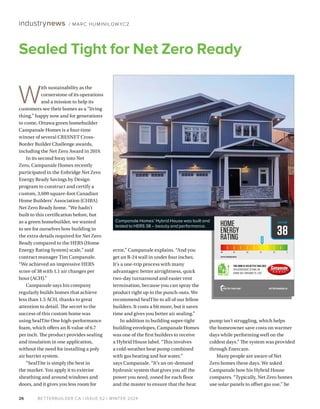
“In Watercolour Westport, we’re
selling variety — bungalows and
two-storey homes — geared for
people who like to have a home in the
country,” says Land Ark founder and
owner Stephen Rolston. “Our guiding
principle in the construction of every
one of our homes is ‘The Three Supers’:
super insulation, super-tight building
envelope and super ventilation. For
each build, we shoot for a tightness of
0.5 air changes per hour (ACH).” Using
the Building Code assumption of 3 ACH
for the average home, an analysis of 43
detached Watercolour Westport homes
following AeroBarrier sealing revealed
a combined carbon savings of roughly
42 tons (see chart below).
A Better Place to Call Home
AeroBarrier Helps Developer Achieve Net Zero Ready
CO2 SAVINGS FROM AEROBARRIER ON 92 HOMES
DETACHED HOUSES (SAMPLE 1)
3 ACH 0.37 ACH REDUCTIONS SAVINGS
ENERGY (kwh/yr) 34946 29722 5224 14.9%
NG* (m3/yr) 2642 2121 521 19.7%
CARBON (kg/yr) 5449 4464 985 18.1%
SAMPLE SIZES
43
detached
houses
521m3 x 43 houses = 22,400 m3 of NG
985kg x 43 houses = 42.3 tons of CO2
*NG = Natural Gas / Modelling was done on REMRate v.16.0.2 using exterior dimensions of home.
BETTERBUILDER.CA | ISSUE 52 | WINTER 2024
“Our approach of keeping the
moisture and air barriers as much
to the outside of the building as
possible before insulation is essential
to the AeroBarrier process,” says
Rolston. “In addition to AeroBarrier
sealing, Watercolour Westport
homes also feature triple-glazed
windows, thermal bridge insulation
— styrofoam above grade, continuing
in the floor joist cavity, down the
concrete wall and below the floor slab
— an ERV and an electric heat pump.”
Using energy-saving products and
techniques, including AeroBarrier,
definitely offers benefits to buyers.
How does Watercolour Westport
communicate these benefits? Rolston
explains: “People are looking for ‘A
better place to call home’ — that’s our
tagline. We’re building custom homes
at a lower cost than production homes,
which offer buyers 20% more value for
20% lower cost because our Net Zero
Ready package is standard for every
home we build. Why would you buy an
obsolete home for more money?”
“Positive comments from visitors to
the Watercolour Westport model home
indicate that buyers are impressed
by the high level of comfort within its
walls,” he adds. According to Rolston,
it’s all about “comfort, comfort,
comfort,” with visitors noticing that
the lower-level living areas in the
home are more comfortable than the
main floor in conventional homes.
“Our model home visits and
physical presence have made a great
impact on our success,” adds Land
Ark marketing advisor Wafa Martin.
“People walk in, stay a while, and share
their enthusiasm about the cleaner
air they’re feeling and breathing! One
visitor who came in suffering from
serious allergies felt better during her
short stay in the model home, where
the air is cleaner and the pollens
stay safely outdoors.” Martin says
that a major portion of the company’s
social media outlets have helped to
reinforce these experiences via videos to
communicate the benefits of its homes.
Foregoing the use of any fossil fuels,
Watercolour Westport prides itself
in being an all-electric community.
“A number of years ago, a friend of
mine from Natural Resources Canada
(NRCan) and I toured a walkable
European village, and it inspired us
to think about how we can make a
positive impact on climate change,”
says Rolston. “The result of this
inspiration was Watercolour Westport,
which offers buyers Net Zero Ready
comfort and walkable living immersed
in nature. It won us an award from
NRCan for building more all-electric
homes than any other builder.”
All-electric aside, Rolston attri­
butes
much of the success of Water­
colour
Westport to the amazing home-sealing
attributes of AeroBarrier. “The future is
now, and we don’t have to build obsolete
homes anymore,” he says. “In fact, some
day governments are going to mandate
this standard of building. It offers every
builder a competitive advantage now.
Everyone can do this.” BB
Marc Huminilowycz
is a senior writer. He
lives and works in
a low-energy home
built in 2000. As
such, he brings first-hand experience
to his writing on technology and
residential housing and has published
numerous articles on the subject.
25
Transform
Your Builds with
Aeroseal Canada –
The Future of
Airtight Efficiency!
Elevate your construction standards and embrace unparalleled efficiency
with Aeroseal Canada, a game-changer in building technology. As industry
leaders, we specialize in revolutionary envelope and duct sealing solutions that
guarantee optimal energy performance and indoor air quality. Experience the
benefits of airtight efficiency and be part of the movement towards smarter,
more sustainable construction.
Embrace the future of building with Aeroseal
Canada and set your projects apart.
Visit our website or contact us today to learn how we
can transform your next project.
BETTERBUILDER.CA | ISSUE 52 | WINTER 2024
26
industrynews / MARC HUMINILOW YCZ
W
ith sustainability as the
cornerstone of its operations
and a mission to help its
customers see their homes as a “living
thing,” happy now and for generations
to come, Ottawa green homebuilder
Campanale Homes is a four-time
winner of several CRESNET Cross-
Border Builder Challenge awards,
including the Net Zero Award in 2019.
In its second foray into Net
Zero, Campanale Homes recently
participated in the Enbridge Net Zero
Energy Ready Savings by Design
program to construct and certify a
custom, 3,600 square-foot Canadian
Home Builders’ Association (CHBA)
Net Zero Ready home. “We hadn’t
built to this certification before, but
as a green homebuilder, we wanted
to see for ourselves how building in
the extra details required for Net Zero
Ready compared to the HERS (Home
Energy Rating System) scale,” said
contract manager Tim Campanale.
“We achieved an impressive HERS
score of 38 with 1.1 air changes per
hour (ACH).”
Campanale says his company
regularly builds homes that achieve
less than 1.5 ACH, thanks to great
attention to detail. The secret to the
success of this custom home was
using SealTite One high-performance
foam, which offers an R-value of 6.7
per inch. The product provides sealing
and insulation in one application,
without the need for installing a poly
air barrier system.
“SealTite is simply the best in
the market. You apply it to exterior
sheathing and around windows and
doors, and it gives you less room for
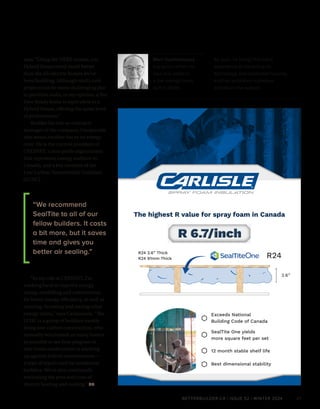
error,” Campanale explains. “And you
get an R-24 wall in under four inches.
It’s a one-trip process with many
advantages: better airtightness, quick
two-day turnaround and easier vent
termination, because you can spray the
product right up to the punch-outs. We
recommend SealTite to all of our fellow
builders. It costs a bit more, but it saves
time and gives you better air sealing.”
In addition to building super-tight
building envelopes, Campanale Homes
was one of the first builders to receive
a Hybrid House label. “This involves
a cold-weather heat pump combined
with gas heating and hot water,”
says Campanale. “It’s an on-demand
hydronic system that gives you all the
power you need, zoned for each floor
and the master to ensure that the heat
pump isn’t struggling, which helps
the homeowner save costs on warmer
days while performing well on the
coldest days.” The system was provided
through Enercare.
Many people are aware of Net
Zero homes these days. We asked
Campanale how his Hybrid House
compares. “Typically, Net Zero homes
use solar panels to offset gas use,” he
Campanale Homes’ Hybrid House was built and
tested to HERS 38 – beauty and performance.
Sealed Tight for Net Zero Ready
38
2017SB-12REFERENCEHERS52
HERSSCORE
BETTERBUILDER.CA | ISSUE 52 | WINTER 2024
says. “Using the HERS system, our
Hybrid House rated much better
than the all-electric homes we’ve
been building. Although multi-unit
projects can be more challenging due
to partition walls, in my opinion, a Net
Zero Ready home is equivalent to a
Hybrid House, offering the same level
of performance.”
Besides his role as contracts
manager in the company, Campanale
also wears another hat as an energy
rater. He is the current president of
CRESNET, a non-profit organization
that represents energy auditors in
Canada, and a key member of the
Low Carbon Homebuilder Coalition
(LCHC).
“In my role at CRESNET, I’m
working hard to improve energy
rating, modelling and construction
for better energy efficiency, as well as
training, licensing and testing other
energy raters,” says Campanale. “The
LCHC is a group of builders mostly
doing low-carbon construction, who
annually benchmark as many homes
as possible to see how progress in
new home construction is stacking
up against federal commitments —
a type of report card for residential
builders. We’re also continually
evaluating the pros and cons of
electric heating and cooling.” BB
Marc Huminilowycz
is a senior writer. He
lives and works in
a low-energy home
built in 2000.
As such, he brings first-hand
experience to his writing on
technology and residential housing
and has published numerous
articles on the subject.
27
Exceeds National
Building Code of Canada
SealTite One yields
more square feet per set
12 month stable shelf life
Best dimensional stability
R24 3.6” Thick
R24 91mm Thick
The highest R value for spray foam in Canada
R 6.7/inch
R 6.7/inch
“We recommend
SealTite to all of our
fellow builders. It costs
a bit more, but it saves
time and gives you
better air sealing.”
BETTERBUILDER.CA | ISSUE 52 | WINTER 2024
28
industryexpert / JOHN GODDEN
A
fter 25 years and numerous
radiant floor installations,
I now realize I have been
following an expensive and labour-
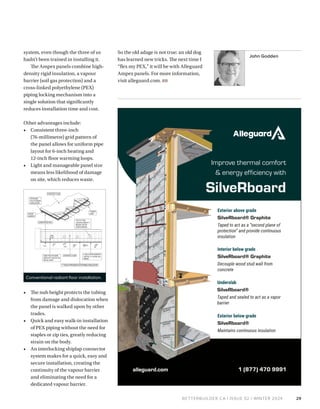
intensive path. (See the old way in
the diagram on page 29.)
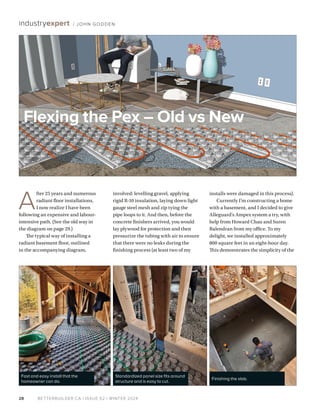
The typical way of installing a
radiant basement floor, outlined
in the accompanying diagram,
involved: levelling gravel, applying
rigid R-10 insulation, laying down light
gauge steel mesh and zip tying the
pipe loops to it. And then, before the
concrete finishers arrived, you would
lay plywood for protection and then
pressurize the tubing with air to ensure
that there were no leaks during the
finishing process (at least two of my
installs were damaged in this process).
Currently I’m constructing a home
with a basement, and I decided to give
Alleguard’s Ampex system a try, with
help from Howard Chau and Suren
Balendran from my office. To my
delight, we installed approximately
800 square feet in an eight-hour day.
This demonstrates the simplicity of the
Flexing the Pex – Old vs New
Standardized panel size fits around
structure and is easy to cut.
Fast and easy install that the
homeowner can do.
Finishing the slab.
BETTERBUILDER.CA | ISSUE 52 | WINTER 2024
John Godden
So the old adage is not true: an old dog
has learned new tricks. The next time I
“flex my PEX,” it will be with Alleguard
Ampex panels. For more information,
visit alleguard.com. BB
system, even though the three of us
hadn’t been trained in installing it.
The Ampex panels combine high-
density rigid insulation, a vapour
barrier (soil gas protection) and a
cross-linked polyethylene (PEX)
piping locking mechanism into a
single solution that significantly
reduces installation time and cost.
Other advantages include:
• Consistent three-inch
(76-millimetre) grid pattern of
the panel allows for uniform pipe
layout for 6-inch heating and
12-inch floor warming loops.
• Light and manageable panel size
means less likelihood of damage
on site, which reduces waste.
• The nub height protects the tubing
from damage and dislocation when
the panel is walked upon by other
trades.
• Quick and easy walk-in installation
of PEX piping without the need for
staples or zip ties, greatly reducing
strain on the body.
• An interlocking shiplap connector
system makes for a quick, easy and
secure installation, creating the
continuity of the vapour barrier
and eliminating the need for a
dedicated vapour barrier.
29
Conventional radiant floor installation.
BETTERBUILDER.CA | ISSUE 52 | WINTER 2024
I
nsulation materials play a pivotal
role in energy efficiency, ensuring
homes and buildings remain
comfortable by slowing down the
rate of heat transfer through the
building enclosure. As the demand
for sustainable building practices
rises, it’s critical to evaluate the
environmental impact of common
insulation materials, particularly
their contribution to global warming
potential (GWP).
Among the most popular insula-
tion options are glass fibre batt insula-
tion and mineral wool batt insulation.
Although these materials are similar
in many ways (including their ability to
improve energy efficiency), their pro-
duction processes and environmental
footprints differ significantly, particu-
larly in terms of GWP.
What is GWP?
Before comparing the two materials,
it’s important to understand what
GWP measures. GWP is a metric
that quantifies the relative impact of
30
industryexpert / TYLER SIMPSON
different greenhouse gases on global
warming, measured over a specific
time frame (usually 100 years). The
higher the GWP, the greater the
material's potential to contribute
to global warming. In the case of
insulation materials, the GWP is
primarily impacted by the energy
required to manufacture them, the
emissions associated with production
and the performance of the materials
over their life cycle (Figure 1).
Comparing
Global Warming Potential
Glass Fibre Batt vs. Mineral Wool Batt Insulation
INGREDIENTS VARY
EMISSIONS INFLUENCED LARGELY
BY SOURCE ENERGY TYPE
©2019 2030 Inc./Architecture 2030. All Rights Reserved
Carbon impacts data source: Builders for Climate Action – 2019 White Paper “Low-Rise Buildings as a Climate Change Solution,” Chris Magwood, 2019
1. MATERIAL EXTRACTION 2. MANUFACTURING 3. TRANSIT 4. USE 5. END OF LIFE
Figure 1: Emission sources during the life
cycle of batt insulation.
BETTERBUILDER.CA | ISSUE 52 | WINTER 2024
Glass fibre batt insulation
Glass fibre batt insulation is made
from a combination of recycled glass
and sand, melted together and spun
into fine fibres (Figure 2). These fibres
are then formed into batt-shaped
pieces that are commonly used in
walls, attics and floors. Glass fibre
insulation is renowned for being
lightweight and fire-resistant, and
for providing excellent thermal
performance.
The production of glass fibre
insulation involves melting the raw
materials at high temperatures, which
consumes a substantial amount of
energy (typically from fossil fuels,
although some manufacturers are
incorporating sustainable energy
sources such as wind or solar). This
results in the release of carbon dioxide
(CO2) and other greenhouse gases,
contributing to the material’s GWP.
However, the relatively low embodied
energy of the material and its long life
expectancy (often lasting for decades)
help to mitigate some of its initial
production emissions.
Mineral wool batt
insulation
Mineral wool batt insulation, often
referred to as “rock wool” or “slag
wool,” is made from molten rock
or industrial slag that is spun into
fine fibres (Figure 3). These fibres are
then formed into batt shapes. Like
glass fibre, mineral wool offers strong
thermal and acoustic properties. It is
also fire-resistant and can withstand
higher temperatures than glass fibre.
However, mineral wool insulation
tends to have a higher GWP than glass
fibre insulation, largely due to the
raw materials used and the energy-
intensive production process. The
creation of mineral wool involves
melting rocks or slag at extremely
high temperatures, which requires
a significant amount of energy. This
results in higher emissions of CO2
and other greenhouse gases during
production. Additionally, mineral wool
is often treated with binding agents that
may contain chemicals that add to the
material's environmental footprint.
While mineral wool insulation
is durable and resistant to moisture
and mould, the energy-intensive
manufacturing process increases its
GWP relative to other materials like
31
Figure 2: Glass fibre batt insulation. Figure 3: Mineral wool batt insulation.
BETTERBUILDER.CA | ISSUE 52 | WINTER 2024
32
glass fibre. However, like glass fibre,
the material’s longevity can help
reduce its overall impact over time, as
it can perform efficiently for decades.
Comparing GWP
To better understand the comparative
environmental impact of glass fibre
and mineral wool batt insulation,
we can examine their respective
GWP values, which are typically
calculated in terms of kilograms of
CO2 equivalent per unit of insulation
produced and found in the products’
environmental product declaration
(EPD). Based on various life cycle
assessments (LCAs), the GWP of
glass fibre batt insulation is generally
around 1 kg CO2 equivalent per square
metre. In contrast, mineral wool batt
insulation typically has a GWP that
ranges from 2 to 5 kg CO2 equivalent
per square metre for the same
thickness.
This difference in GWP arises
from the higher energy consumption
and emissions associated with the
production of mineral wool. However, it
is important to note that both materials
have relatively low environmental
impacts compared to other building
products, such as concrete or steel.
Additionally, the GWP of both
materials is significantly lower when
compared to alternatives such as
foam-based insulations, which tend to
have much higher GWP values due to
the chemicals used in their production
(Figure 4).
Long-term performance
and environmental
considerations
While GWP is a crucial metric in
evaluating the environmental impact
of building materials, it is important to
consider the long-term benefits of using
insulation. Both glass fibre and mineral
wool batt insulations help reduce
energy consumption over the life of a
building by reducing the rate of heat
loss or gain. This, in turn, lowers the
demand for heating and cooling energy,
ultimately reducing a building’s overall
carbon footprint.
Conclusion
In conclusion, while both glass fibre
batt insulation and mineral wool batt
insulation offer excellent thermal
performance, acoustic performance
and fire resistance, mineral wool
generally has a higher GWP than glass
fibre due to its more energy-intensive
production process. Keep in mind,
the differences are relatively small in
the context of building materials as a
whole, and both offer substantial long-
term environmental benefits in terms
of building energy savings.
For those prioritizing sustainability,
glass fibre batt insulation may be
the better choice, especially when
combined with its recycled content
(often upwards of 70%, depending
on the manufacturer). Nevertheless,
both materials can be considered
environmentally responsible options,
especially when compared to alter­
natives that have much higher GWP
values. When making an insulation
choice, it’s essential to weigh both the
immediate environmental impact and
the long-term energy efficiency benefits
for the building to achieve the best
overall performance. BB
Tyler Simpson is a
Certified Passive
House Designer and
founder of TWS Building
Science, offering building
enclosure representation and building
science and enclosure consulting services.
XPS Foam Board R5/inch
Aerogel Batt R9.6/inch
Closed Cell Spray Foam (HFC) R6.6/inch
NGX Foam Board R5/inch
Vacuum Insulated Panel R30/inch
Mineral Wool Board R4.2/inch
Closed Cell Spray Foam (HFO) R6.6/inch
EPS Foam Board (Type II) R4/inch
Polyisocyanurate Foam Board R6.5/inch
Open Cell Spray Foam R4.1/inch
Mineral Wool Batt R4/inch
Wool Batt R4/inch
Fiberglass Blown In R2.6/inch
Fiberglass Batt R3.6/inch
Hemp Fiber Batt R3.7/inch
Cellulose R3.7/inch
Wood Fiber Batt R3.9/inch
Hempcrete R2.1/inch
Wood Fiber Board R3.4/inch
Straw Bale R2.8/inch
-2000 0 2000 4000 6000
kg CO₂e
Each result is an
AVERAGE of a range
and products can vary
by as much as 50%
473
366
288
252
146
115
114
88
59
-70
-202
-218
-554
-663
-753
654
715
1159
1652
4937
Figure 4: Range of insulation emissions comparison for 100 m2 at R-5.
BFC
A
_
PBC-
EMBARC
_
REPORT-WEB.
PDF
ROCKWOOL stone wool insulation is water
resistant and vapor permeable, minimizing
the risk of condensation and mold growth.
Minimizing risk
below-grade
rclass.rockwool.com
Release the natural power of stone wool.
Designing for below-grade assemblies requires choosing materials with unique
performance characteristics to minimize risk and improve occupant comfort.
Whether insulating slab-on-grade, or on the foundation wall, stone wool
insulation provides the required durability, moisture resistance and long term
thermal performance needed for your project.
See how ROCKWOOL stone wool can play an effective role in your strategy to
manage moisture below-grade.
Better Builder Magazine, Issue 52 / Winter 2024

Better Builder Magazine, Issue 52 / Winter 2024

  • 1.
    FutureProofing CHALLENGES IN CO2REDUCTION PUBLICATION NUMBER 42408014 ISSUE 52 | WINTER 2024 Low Carbon Homebuilder Coalition The Evolution of Home Heating Embodied Carbon Regulations The Holistic Home A Better Place to Call Home Sealed Tight for Net Zero Ready
  • 2.
    www.airmaxtechnologies.com T 905-264-1414 Prioritizingyour comfort while providing energy savings Canadian Made Manufactured by Glow Brand Manufacturing Models C95 & C140 Condensing Combination Boiler Glow Brand C95 and C140 instantaneous combination ASME boilers for heating and on-demand hot water supply. The ultra- efficient compact design combination boiler has an AFUE rating of 95%.These units arefully modulating at 10 to 1 and 2 inch PVC venting up to 100 feet. Brand TM ENDLESS ON-DEMAND HOT WATER Models C95 & C140 Glow Brand C95 and C140 instantaneous combination ASME boilers for heating and on-demand
  • 3.
    BETTERBUILDER.CA | ISSUE52 | WINTER 2024 PUBLISHER’S NOTE 2 The Times, They Are A-Changin’ by John Godden THE BADA TEST 3 Another New Year Looking back to look forward by Lou Bada INDUSTRY EXPERT 5 Hydro Furnace The evolution of home heating by Marc Huminilowycz INDUSTRY NEWS 9 The Need for Embodied Carbon Regulations by Paul De Berardis INDUSTRY NEWS 13 Panasonic Breathe Well with Whisper Air Repair by Alex Newman BUILDER NEWS 20 The Holistic Home by Marc Huminilowycz SITE SPECIFIC 22 Paolo Spinosa: Problem Solved by Alex Newman BUILDER NEWS 24 A Better Place to Call Home AeroBarrier helps developer achieve net zero ready by Marc Huminilowycz INDUSTRY NEWS 26 Sealed Tight for Net Zero Ready by Marc Huminilowycz INDUSTRY EXPERT 28 Flexing the Pex by John Godden INDUSTRY EXPERT 30 Comparing Global Warming Potential by Tyler Simpson 1 ISSUE 52 | WINTER 2024 Images internally supplied unless otherwise credited. FEATURE STORY 16 The Low Carbon Homebuilder Coalition It’s all in the family by Alex Newman 26 Cover: AscentXmedia, istockphoto 2166515179 16 30 24
  • 4.
    BETTERBUILDER.CA | ISSUE52 | WINTER 2024 “The Times, They Are A-Changin’” “Come gather ’round people, wherever you roam/ And admit that the waters around you have grown” — Bob Dylan T his is the eighth Better Builder issue on future-proofing. Previous issues have identified low-cost strategies for creating rough-ins for future installations. The single most impactful feature that we’ve discussed is combination hybrid heat (CHH), which promotes the wise use of natural gas in Ontario. CHH can reduce CO2 emissions by up to 50% through fuel switching with an air source heat pump. In addition, it can save water and reduce domestic hot water loads substantially. The system is perfect for secondary suites as it helps to maintain fire separations with one heating plant. The biggest factor for successful future-proofing may be homeowner awareness and homebuilder education. On November 26, 2024, the Sustainable Housing Foundation (SHF) and Enbridge Gas sponsored the annual Low Carbon Home Builder Coalition (LCHC) dinner and celebrated successful municipal engagement on local green building standards. The annual dinner is designed to educate members of the homebuilding industry about their current choices. Part of this education involves builders building discovery houses. Five builders, on their discovery homes, received the Hybrid Home label. This resulted from their participation in Enbridge’s Savings By Design for Net Zero Energy Ready homes (see photos on page 19). The guest speaker, Chris Magwood from Builders for Climate Change, educated guests about an approach to reducing embodied carbon that can account for 49% of carbon emissions attached to home construction over its life cycle. He shared his work on the creation of ANSI Standard RESNET/ICC 1550, which will soon be published by RESNET after public comment. This issue showcases many simple approaches to future-proofing. Lou Bada, on page 3, provides an overview of practical strategies, including how to navigate local green building standards. On page 9, Paul De Berardis discusses the need for a standardized embodied carbon rating index to calibrate a baseline for carbon in homes. Combination heat is an important topic, so we checked in with Phil and Jill (who we first met in “Aging in Place” in the spring 2024 issue, page 16) to hear about their experience living with the system for almost a year. We also welcome Tyler Simpson back in this issue. He provides a valuable comparison between types of batt insulation and their embodied carbon. He also explains how the process of environmental product designation works. In this new year, Better Builder strives to be a forum for discussion about relevant information for the building industry, now and in the future. As Bob Dylan sings, “Come writers and critics, who prophesize with your pens/And keep your eyes wide, the chance won’t come again.” BB publisher’snote / JOHN GODDEN 2 PUBLISHER Better Builder Magazine 63 Blair Street Toronto ON M4B 3N5 416-481-4218 | fax 416-481-4695 sales@betterbuilder.ca Better Builder Magazine is a sponsor of PUBLISHING EDITOR John B. Godden MANAGING EDITORS Crystal Clement Wendy Shami editorial@betterbuilder.ca To advertise, contribute a story, or join our distribution list, please contact editorial@betterbuilder.ca FEATURE WRITERS Rob Blackstien, Alex Newman, Marc Huminilowycz PROOFREADING Carmen Siu CREATIVE Wallflower Design This magazine brings together premium product manufacturers and leading builders to create better, differentiated homes and buildings that use less energy, save water and reduce our impact on the environment. PUBLICATION NUMBER 42408014 Copyright by Better Builder Magazine. Contents may not be reprinted or reproduced without written permission. The opinions expressed herein are exclusively those of the authors and assumed to be original work. Better Builder Magazine cannot be held liable for any damage as a result of publishing such works. TRADEMARK DISCLAIMER All company and/or product names may be trade names, trademarks and/or registered trademarks of the respective owners with which they are associated. UNDELIVERABLE MAIL Better Builder Magazine 63 Blair Street Toronto ON M4B 3N5 Better Builder Magazine is published four times a year.
  • 5.
    BETTERBUILDER.CA | ISSUE52 | WINTER 2024 build sustainably. We have nothing to apologize for. We will abide by the court’s decision and follow the law. In a nutshell, what we’re looking for in regulation is consistency that is rational, predictable and executable at scale. Standards, not programs. That’s why the Ontario Building Code (OBC) was established. Currently, we can’t build homes with the same standards on both sides of Steeles Avenue, in Vaughan and in King City, in Mississauga and in Oakville, or across many municipalities. So much for the federal government’s Housing Design Catalogue. It’s not just about costs either; it’s about process. Builders can and do build to higher energy efficiency standards and lower carbon homes in a sensible manner. It is simply bad public policy and practice that all 444 of Ontario’s municipalities can develop often divergent standards, which impede homebuilding and add costs to consumers during a housing supply crisis. It just doesn’t make sense. I ’ve always been fascinated at this time of the year, when the media reviews last year’s predictions and then looks forward to what they believe will happen in the next. Planning for the future is a necessary and sometimes fraught exercise. It reminds me of an old Yiddish saying (I’m paraphrasing): “If you want to make God laugh, tell him your plans.” With this in mind, I’d like to look back at a few of the past topics written about in Better Builder. Nearly every article I’ve written touches upon municipal so-called “green building standards.” Recently, myself and RESCON, the association that I am a member of (but not author­ ized to speak for), were accused of being “anti-green” (whatever that means) and slaves to greedy corporate interests. Why? Because we went to the courts to clarify the applicable laws pertaining to municipal authority on the matter of green building standards? What if the Toronto Transit Commission and the City of Toronto tried changing the Ontario Highway Traffic Act’s regulations for all drivers within the city and began handing out traffic tickets because councillors decided it was a good idea? What if every municipality changed to their own versions (and changed them often)? We’ve held extensive, frank and cordial consultations with various municipalities expressing our concerns, with little or no movement on most municipalities’ part. It was out of frustration, not avarice, that we asked for a legal opinion from the courts (we’re not suing anyone, as has been alleged). Unfortunately, this false “anti-green builder” sentiment has bled into some media outlets and social media. Frankly, I don’t believe these accu­ sations even deserve a response. I will say vilifying us, virtue-signalling and half-truths don’t do anyone any good. The American Democratic politician Daniel P. Moynihan famously said: “You are entitled to your own opinions, but not your own facts.” Private industry builds at least 95% of all homes in Ontario, and we employ hundreds of thousands of people. We 3 thebadatest / LOU BADA BETTERBUILDER.CA | ISSUE 52 | WINTER 2024 Another New Year Looking Back to Look Forward In a nutshell, what we’re looking for in regulation is consistency that is rational, predictable and executable at scale. Standards, not programs. ISTOCKPHOTO 1136842920
  • 6.
    BETTERBUILDER.CA | ISSUE52 | WINTER 2024 4 with dismal results. The judicious use of natural gas as a bridge fuel makes a lot of sense at this time. So, what will work in the future? Well, much of what we’ve looked at in the past. A rational, predictable and execu­ table system with real cost and benefit to the environment and homeowners is a hybrid heating system. It was written about in the autumn 2023 issue. An improved building envelope to match a HERS 46 (or roughly 20% better than Code), along with a combination heating system and three-season heat pump, could reduce CO2 emissions by up to 50%. Good controls for managing space heating/cooling systems and ventilation are very important when installing a hybrid heating system. If the OBC develops this way, it would be a good outcome. As well, Doug Tarry wrote a wise article titled “Understanding the Value of Windows” in the spring 2023 issue. Doug observed that Energy Star windows with higher solar heat gain coefficients aren’t always the best choice for highly insulated and airtight homes. In my mind, this speaks to the folly of believing that more is always better. Also, with less superfluous and improper regulation, we could concen­ trate on resiliency. For instance, more attention could be paid to what is already in the OBC in regard to window flashing details (see “It’s ‘Plane’ to See” in the spring 2020 issue). Building more resilient homes in the face of climate change is always a winner. These are only a few thoughts on future building practices. None of them are new for the New Year. We plan because we must. God laughs because he knows better. BB Lou Bada is vice- president of low-rise construction at Starlane Home Corporation and on the board of directors for the Residential Construction Council of Ontario (RESCON). The Net Zero program, or elimin­ ating the use of natural gas in homes, should not be forced by any municipal green building standard. Country Homes benchmarked its hybrid house against a “net zero” constructed home
  • 7.
    BETTERBUILDER.CA | ISSUE52 | WINTER 2024 industryexpert / MARC HUMINILOW YCZ Although furnaces have gotten more capable over the years, they are still limited by right-sizing to meet variable outdoor temperatures and resulting loads. Today’s one-stage furnaces experience cycling losses, while their two-stage counterparts have trouble meeting smaller load requirements. Enter a new and innovative approach to home heating: the hydro furnace, which integrates modu- lating burners in tankless hot water heaters and boilers into furnace tech- nology. At the forefront of this tech- nology is Navien, a company founded in 2006 that for years has been the industry leader in wall-hung boilers and gas condensing tankless water heaters. According to a recent report from global market intelligence provider BRG Building Solutions, Navien is the number one manufac- turer of all gas tankless water heaters (condensing and non-condensing) in North America. Annual fuel utilization efficiency (AFUE) is a measure of how effici­ ently a furnace converts fuel to heat. It is a metric that determines how much fuel a furnace is actually turning into heat for the home. A typical 20-year-old gas furnace system delivers an AFUE of 70% at best. The Navien NPF Hydro Furnace rates 97%, offering maximum effici­ ency plus a full range of modulation to optimize occupant comfort. Navien Canada national sales Hydro Furnace The Evolution of Home Heating manager Adam Wills explains: “The more you modulate, the better the efficiency and comfort level you achieve. Conventional furnaces are most efficient within a range of -10 °C and +10 °C, and their ability to modulate lower is limited. Utilizing the same technology as our tankless hot water heaters, our NPF 60,000 BTU Hydronic Forced Air Furnace operates from 15% to 100%, with the ability to go down to 9,000 BTU. This keeps the thermostat happy and occupants comfortable on every level of their home.” According to Wills, the ability of a furnace to modulate to lower BTUs results in a more consistent run and the ability to properly size HVAC equipment, which equates to cost savings. The variable capacity operation of Navien’s hydro furnaces allows for optimized furnace performance, more precise temperature and humidity control, more consistent comfort and increased electrical efficiency because it can match the exact airflow requirements of the HVAC system. Here’s how it all works. Navien condensing stainless steel heat exchangers recover extra heat that would be lost in non-condensing Adam Wills, Navien national sales manager. “The more you modu­ late, the better the efficiency and comfort level you achieve… This keeps the thermostat happy and occupants comfortable on every level of their home.” H ome heating technology has come a long way since the days of building a house and simply installing a furnace and hot water tank, with little consideration for efficiency or occupant comfort.
  • 8.
    BETTERBUILDER.CA | ISSUE52 | WINTER 2024 6 design allows the NPF to deliver comfortable heat without significantly impacting humidity levels — at one of the quietest sound levels of any furnace on the market. With any new technology, there is always a learning curve. How is the industry responding to the hydro furnace? What about consumers? “So far, there has been tons of interest within the industry,” says Wills. “Our product is designed to industry standards, so the learning curve is minimal. Because the sizing is familiar, installers don’t have to re-learn the HVAC system. The controls are directly on the furnace, the same as our tankless units, and the intelligence is completely contained inside, where the magic happens.” Wills believes that consumers are ready for Navien’s product. “The industry has been fairly unchanged,” he says. “We’ve come up with something that already exists, but in an entirely new way, which offers homeowners something better — more 'plug and play' compared to other products. Ours costs a bit more than competitive modulating furnaces, but installation is identical, and our products are more cost-effective. The bottom line is that Navien offers better comfort than any other furnace on the market.” As an added bonus to consumers who may be concerned about fossil fuel emissions, Wills adds that all Navien hydro furnaces are California-certified according to the SCAQMD Rule 1111 as “Low NOx” (nitrogen oxide, an air pollutant). Its NPF model is “Ultra Low NOx,” the cleanest exhaust possible in a fossil fuel-burning appliance. Does this technology work with three-season heat pumps? “Absolutely,” replies Wills. “We’re passionate about duel fuel — an electric heat pump A hydro furnace looks just like a normal furnace installation. boilers, resulting in a reduction in energy consumption, lower CO2 emissions and low exhaust temperatures, which allows for the use of less expensive venting materials. Its NPF hydro furnaces, compatible with most one- and two-stage thermostats, can be matched with any AC or heat pump system, providing their own dedicated airflow selections and ramping profiles. The NPF uses Navien’s industry- proven stainless steel heat exchangers to heat water in an isolated compartment out of the airstream, which provides sound reduction and energy efficiency. The heated water is circulated through a hydronic coil, which transfers the heat into the airstream. Its sealed combustion
  • 9.
    BETTERBUILDER.CA | ISSUE52 | WINTER 2024 combined with a gas product as a backup system. It’s a fantastic option for homeowners, and a stepping stone for complete electrification. With the temperature swings we experience in Canada and our abundance of natural gas, it’s a solid backup option that offers peace of mind.” BB Marc Huminilowycz is a senior writer. He lives and works in a low-energy home built in 2000. As such, he brings first-hand experience to his writing on technology and residential housing and has published numerous articles on the subject. 7 NPF Horizontal NPF Upflow The next level of comfort in forced-air heating NEW NPF Hydro-furnace The NPF Advantage: The NPF heats water by burning the gas in a sealed combustion heat exchanger, completely isolated from the airstream. The heated water is then pumped through a hydronic heat exchanger that gently transfers the heat into the air. The fully enclosed Ultra-Low NOx premix burner provides extremely quiet operation, highly efficient, and allows for an industry-leading variable capacity that can modulate down to 15% for a next-level comfort experience. Explore the new NPF at Navieninc.com. NPF Hydro-furnace Conventional furnace Our unique hydronic forced-air heating design keeps combustion in a separate, fully enclosed compartment for safe and quiet comfort. Durable stainless steel combustion heat exchanger located out of the airstream. A hydronic coil transfers heat from the water into the conditioned airstream at a temperature up to 150°F Gas is burned directly in the conditioned airstream — exposing it to temperatures up to 1000°F A hydro furnace uses less energy to provide the same level of comfort (exergy).
  • 11.
    BETTERBUILDER.CA | ISSUE52 | WINTER 2024 However, the constant focus on operational emissions has skewed our focus away from other considerations, such as embodied carbon or product emissions, which are the largest contributor to overall emissions and thereby represent a huge opportunity to reduce carbon. Considering low- rise residential construction in the Greater Toronto and Hamilton Area (GTHA) contributes nearly one million tonnes of GHG emissions per year, which is equivalent to the operation of almost 200,000 automobiles, there needs to be more thoughtful consideration to embodied carbon implications. The calculation of embodied carbon is not currently a regulated practice. With the 2025 model National Building Code (NBC) expected to be released in the first half of this year, embodied carbon considerations were not included in this code. Although there were discussions, it was determined that more time was needed, and that the 2030 NBC would be the more realistic opportunity to begin regulating embodied carbon. At the provincial level, the 2024 OBC just recently came into effect after a harmonization exercise with the 2020 NBC, so embodied carbon is a long way out from being included in national or provincial building codes. At the municipal level, certain jurisdictions are encouraging homebuilders to conduct and report on embodied carbon emissions in the hope that, sometime in the future, emission intensity targets can be established and enforced. It’s encouraging to see that embodied carbon is on the radar, but there are limited tools and procedures for calculating it. One such tool is the Material Carbon Emissions Estimator (MCE2), which was developed by Natural Resources Canada and is designed for quantifying the embodied carbon GHG emissions associated with specific low-rise, residential building designs. While this free spreadsheet can be an informative tool to provide some embodied carbon estimates and insight, there are several practical limitations with MCE2. One other, more advanced tool is BEAM (Building Emissions Accounting for Materials), which is another free, spreadsheet-based embodied carbon estimator well suited for low- and mid-rise residential applications. BEAM was developed by Builders for 9 industrynews / PAUL DE BERARDIS Paul Guglietti, of Townwood Homes, is a member of the Low Carbon Homebuilder Coalition. I n late 2024, the Sustainable Housing Foundation arranged an event with guest speaker Chris Magwood, director of research with Builders for Climate Action, to discuss embodied carbon. Many of us in the building industry are well versed in and understand operational emissions, which is the greenhouse gas (GHG) emissions output over the useful service life of a home or building. The calculation of embodied carbon is not currently a regulated practice. With the 2025 model National Building Code (NBC) expected to be released in the first half of this year, embodied carbon considerations were not included in this code. The Need for Embodied Carbon Regulations
  • 12.
    BETTERBUILDER.CA | ISSUE52 | WINTER 2024 10 Climate Action and enables material selection with varying levels of carbon intensity. These tools utilize material quantity user inputs along with emissions factors derived from Environmental Product Declarations (EPDs) to estimate embodied carbon. For more complex, large, high-rise buildings, other embodied carbon analysis methods are available, such as the Upfront Embodied Emissions Assessment of the Canada Green Building Council (CaGBC) Zero Carbon Building Standard. As mentioned earlier, since none of these embodied carbon assessment tools are based on established standards or even regulated by building codes, there is still a lot of variability in how they calculate and assess embodied carbon. Furthermore, while EPDs are increasingly becoming more commonplace with respect to building products and materials, there is still a wide range of uncertainty when comparing product-specific EPDs to industry averages. Analogous to any type of modelling, the accuracy of the model (in this case, the embodied carbon analysis) can only be as good as the precision of the inputs. As manufacturers and suppliers continue to offer more EPDs for various building components, the ability to derive more precise embodied carbon calculations will improve. While embodied carbon calculators are a work in progress, several builders across Canada have undertaken embodied carbon studies on homes they’ve recently constructed. What has become apparent is that over 75% of the embodied carbon can be attributed to a few key building components, namely the concrete foundation, insulation, exterior cladding, interior surfaces and windows. These are the systems and products that have the highest potential for embodied carbon savings. High-performance homes of the future will be ones that can balance low-operational carbon while also achieving an equal emphasis on low embodied carbon. With embodied carbon calculators and regulations still on the horizon in Canada, RESNET (Residential Energy Services Network) in the United States has released Draft PDS-01 1550, Embodied Carbon, for public review and comment at the time of writing this article. This draft standard provides a consistent methodology for the calculation and reporting of the embodied carbon of dwellings and uses the same modelling data, processes and reporting employed by standard ANSI/RESNET/ICC 301. When complete, this will be the first North American standard for embodied carbon analysis. As this RESNET embodied-carbon standard is finalized, hopefully future iterations of the NBC and OBC can adapt some of the lessons learned from our neighbours. Until more regulated practices of embodied carbon analysis are established in Canada, these analysis tools can be used by designers and builders to make educated and informed decisions when it comes to building practices. However, we are still in the early days before embodied carbon emission intensity targets can be regulated. BB Paul De Berardis is RESCON’s vice president of building standards and engineering. Email him at deberardis@rescon.com. This rating is available for homes built by leading edge builders who have chosen to advance beyond current energy efficiency programs and have taken the next step on the path to full sustainability. BetterThanCode LowCostCodeCompliancewith theBetterThanCodePlatform BetterThanCodeUsestheHERSIndex to Measure Energy Efficiency TheLowertheScoretheBetter Measureable and Marketable 80 60 40 20 This Platform helps Builders with Municipal Approvals, Subdivision Agreements and Building Permits. Navigating the performance path can be complicated. A code change happened in 2024 which is causing some confusion. A new code will be coming in 2025. How will you comply with the new requirements? Let the BTC Platform – including the HERS Index – help you secure Municipal Subdivision Approvals and Building Permits and enhance your marketing by selling your homes’ energy efficiency. betterthancode.ca Email info@clearsphere.ca or call 416-481-7517 46
  • 13.
    BETTERBUILDER.CA | ISSUE52 | WINTER 2024 11 ™/® Enercare, Enercare Advantage and the designs are trademarks of Enercare Inc., used under license. Enercare delivers high-rise building comfort solutions by providing builders with innovative and efficient mechanical systems without upfront capital costs. GEOTHERMAL TECHNOLOGY Enercare, in collaboration with Subterra, offers energy- efficient heating and cooling technology through geothermal solutions. By combining this with Enercare’s heat pump technology, developers can access a greener alternative to traditional HVAC systems. What is geothermal and how does it work? The geothermal exchange process occurs via a series of ground loops that transfer thermal energy from the ground to heat pumps that are used to cool or heat your building. Scan the QR code or visit enercare.ca/builder/highrise OUR SUITE OF PRODUCTS HVAC – Geothermal and Air Source Heat Pumps, Central Plant, Fan Coils, Air Handlers and Boilers Water Heating – Electric Tank and Tankless Water Heaters Ventilation – Energy and Heat Recovery Ventilators Water Treatment – Reverse Osmosis, Water Softener, Whole Home Water Filtration EV Charging – Electric Vehicle Energy Management System (EVEMS) WHY CHOOSE THE ENERCARE ADVANTAGE™ PROGRAM? Easy to do Business With – On-time deliveries, with complete commissioning & sourcing on site. Access to Leading Products – Including state-of- the-art and energy-efficient equipment designed to provide year-round comfort. Complete Service Provider – Single point of contact for sourcing both in-suite and central plant equipment from major manufacturers, with 24/7/365 call centre support to assist in booking a service call. Take your builds to new heights with Enercare ECH3697_BetterBuilderAd_Fall_d7.indd 1 ECH3697_BetterBuilderAd_Fall_d7.indd 1 2024-10-15 3:10PM 2024-10-15 3:10PM
  • 14.
    BETTERBUILDER.CA | ISSUE52 | WINTER 2024
  • 15.
    BETTERBUILDER.CA | ISSUE52 | WINTER 2024 As early as 2018, the company introduced a new energy recovery ventilator (ERV) line that highlighted their IAQ products, says John Sneyd, Ontario regional sales manager for Panasonic Canada, life and device division. “We saw the need for improving IAQ: great energy efficiency and tighter building envelopes has meant greater need for mechanical ventilation,” he explains. “The pandemic reinforced that need.” That first ERV was improved on a few months ago, with the introduc­ tion of the BalancedHome ERV. With additional cubic feet per minute (CFM) sizes for increased efficiency on energy transfer, and air filtration through replaceable minimum efficiency reporting value (MERV) filters, it meets increased Code demands for more fresh air exchanges. Plus, its intuitive digital wall control option allows the homeowner to immediately see the status of intake and exhaust, temperature and humidity, and filter life. Unique to Panasonic ERVs is the Swidget control, which has interior modules that will turn a bathroom fan off or on based on the room’s humidity levels. Also unique to Panasonic is their nanoe™ X technology, developed about 20 years ago, which controls 13 Panasonic Breathe Well with Whisper Air Repair industrynews / ALEX NEWMAN A fter the pandemic, we were left with an acute awareness of all things related to health. One of those was the importance of improving indoor air quality (IAQ), since so much of our time was being spent indoors. Panasonic had been working on this issue even before the pandemic, introducing products that clean and purify the air circulating in homes under its Breathe Well banner. For Panasonic, the pandemic was a strong reminder of the company’s commitment to healthy indoor environments. Panasonic’s nanoeTM X technology used in Whisper Air Repair. WHISPER AIR- REPAIR _ F V- 01VCN1 _ SELL _ SHEET_ EN . PDF HT TPS: // NA . PANASONIC .C A / INDOOR- AIR- QUALIT Y/ VENTIL ATION /AIR- PURIFIERS/ WHISPER AIR- REPAIR
  • 16.
    BETTERBUILDER.CA | ISSUE52 | WINTER 2024 14 a number of their products — air source heat pumps, fridges, even hair dryers. nanoe X works by generating and releasing hydroxyl radicals (OH radicals) encapsulated in water molecules, Sneyd says. “These molecules are able to neutralize harmful substances in the air such as odours, allergens and other contaminants. Not only are contaminants neutralized in the air, but also surfaces, such as carpets and bedding.” See diagram on page 13. Also part of the BreatheWell line is the Whisper Air Repair unit, introduced in 2022. It’s a spot air purification device that’s effective up to 200 square feet, making it perfect for bedrooms and family rooms, and is especially helpful where pets hang out. It’s connected and installed like a pot light, doesn’t need filters and doesn’t need to be connected to the ductwork. However, Sneyd adds, it probably shouldn’t be installed where there’s a lot of moisture, such as over the stove or in a bathroom with a shower. Like the rest of the BreatheWell line, the Whisper Air Repair uses Panasonic’s nanoe X technology. It's a unit that homeowners can purchase for less than $200, but it’s something that builders are putting into new homes as well, either as a standard feature or an upgrade, Sneyd says. One of these units was given away at the recent Sustainable Housing Foundation (SHF) event sponsored by Enbridge and Panasonic; see the photo at the top of this page. Panasonic takes a four-fold approach to improving the indoor environment, Sneyd says. The first is to actively exhaust stale air from the home and replace it with fresh outdoor air, which is what Panasonic’s ERVs and exhaust fans do. The next is a little more passive, to clean the existing indoor air with products such as Whisper Air Repair with its nanoe X technology. The third approach is to properly heat and cool the air, using technology-based products such as Panasonic’s air source heat pumps to prohibit bacteria and mould growth. The last part of this holistic approach is to increase awareness through education. Panasonic is doing this through its Breathe Well marketing program so that builders can educate homebuyers on their indoor environment. He deals directly with builders and developers. “Many people don’t realize that about 80% of Panasonic’s business is commercial, and that many of our products are sold through a distribution network,” he says. IAQ is something that’s occupied much of Sneyd’s career. After studying geography and physical education at Wilfrid Laurier University, he worked in technology sales for GE, then moved around to a few companies before finding his home at Panasonic. He’s been there for the last 14 years, initially in the PVX foam division, and then seconded to the HVAC division four years ago. “I really enjoy it,” he says. And he’s found a like-minded group in the SHF. “Everyone is committed to improving customer experience and lifestyle through sustainability.” BB Alex Newman is a writer, editor and researcher at alexnewmanwriter.com. “These molecules are able to neutralize harmful substances in the air such as odours, allergens and other contaminants. Not only are contaminants neutralized in the air, but also surfaces, such as carpets and bedding.” John Sneyd and John Godden do a lucky draw for Whisper Air Repair.
  • 17.
    BETTERBUILDER.CA | ISSUE52 | WINTER 2024 15
  • 18.
    BETTERBUILDER.CA | ISSUE52 | WINTER 2024 16 featurestory / ALEX NEWMAN O n November 26, the Sustain­ able Housing Foundation (SHF) held its annual dinner at Thornhill Golf and Country Club. Sponsored by the foundation and Enbridge Gas, the dinner was a celebration of many milestones. As master of ceremonies, Clear­ sphere’s CEO, John Godden, outlined how the green work of committed builders and manufacturers has provided much hope for the future of the planet. “In 2007, we established the SHF and, in 2009, we started challenging builders to build 50% better using a HERS scale for a typical North American home,” Godden says. “In 2012, Enbridge’s Savings by Design program complemented the Performance Path in that Building Code. CRESNET and SHF then challenged U.S. builders at RESNET, and the Cross-Border Builder Challenge was established and kicked off the ROXUL dinner of champions. This event was very similar to the November 26, 2024 event; the only difference being the inclusion of embodied carbon and the recognition of local municipalities for including choice with their Green Building Standards at the 2024 event.” “Since regional variables can make it challenging to compare homes, a standardized scale was needed. So, in 2017, Enbridge recognized the HERS scale as a way to accommodate such differences by including it in its Savings by Design workshop program. Using this measuring makes it possible to count how much carbon has been reduced in a year and then relay that information to Enbridge or the municipal government. This approach is responsible for more than 10,000 homes receiving HERS ratings from 2019 to 2024." Many of the residential home­ builders who attended the SHF dinner are members of the Low Carbon Homebuilder Coalition (LCHC), established in 2022. In the LCHC, carbon is counted using HERS and It’s All in the Family The Low Carbon Homebuilder Coalition The Low Carbon Homebuilder Coalition
  • 19.
    BETTERBUILDER.CA | ISSUE52 | WINTER 2024 Better Than Code ratings. In 2024, this approach helped 1,936 homes reduce carbon emissions by 3,125 tonnes. That collectively saved homeowners a significant $1.8 million in energy costs. All of these milestones have been documented over the years in Better Builder magazine, which just launched its 51st issue. The magazine continues to provide builders with the latest information on premium products, as well as news on ways their peers are creating low-consumption homes. A few of these builders were awarded Hybrid Home labels at the dinner, including Country Homes, Brookfield and Lindvest. Hybrid homes use both natural gas and electricity for space heating. For their collaborations with builders, the municipalities of Caledon, East Gwillimbury, Richmond Hill and York Region were given certificates (see photos on page 18). Enbridge’s residential manager, Mark Prociw, talked about the homes built through their Net Zero energy workshop program — 20 in 2024 and 28 to be built in 2025. Enbridge provides builders advice, onsite training and a $15,000 incentive toward the pilot home. “The collaboration is remarkable, demonstrating how we’re able to work together,” Prociw says. Through Enbridge’s Savings by Design program, 565 homes were built and certified in 2024. Incentives came to $930,000, which Prociw says “has really helped builders improve energy performance, enhance comfort and air quality, and reduce greenhouse gas emissions.” Enbridge also offers the Recognize Clean home-heating initiative, which is funded by the Ontario government to offer $4,500 to participating home­ owners. Prociw says the program’s 17 Thornhill Golf and Country Club hosted Sustainable Housing Foundation’s Low Carbon Homebuilder Coalition dinner. PHOTOS BY MIKE DAY, THE ART OF BUSINESS PHOTOG R APHY Chris Magwood, keynote speaker.
  • 20.
    BETTERBUILDER.CA | ISSUE52 | WINTER 2024 18 wide popularity sends “a great signal to the industry that customers are keenly interested in solutions. And that paves the way for a clean energy future. Ontarians want an energy system that lowers emissions over time, but they also want a system that’s safe, reliant, resilient, cost effective and energy saving, like what we see in hybrid homes.” Keynote speaker Chris Magwood of Builders for Climate Action (see photo on page 17) spoke about the SHF’s mandate to engage, educate and communicate with builders about energy rating and carbon counting. To that end, he emphasized the importance of understanding the difference between embodied and operational carbon in construction. “Everyone in this room has done their part in reducing emissions,” Magwood said. “We’re generating a fraction of the carbon emissions we once did.” But there’s still a way to go, he added. While builders are producing less emissions, some of the materials used are being manufactured with high carbon consumption. To drive the point home, he said that “materials going into our homes have the carbon footprint of the entire economies of Estonia or Costa Rica. Consider this: a year of homebuilding in the GTA produces 840,000 tonnes [of carbon], equivalent to 183,000 cars. That’s most of the cars on the road.” All levels of government have weighed in on this, and the Canada Green Building Strategies (a 2024 federal mandate) made it clear that embodied carbon must be calculated. While that may sound like just one more thing to worry about when building a home, Magwood assures that the tools are simple. “Basic math. The amount of material going into building, multiplied by the emissions factor, equals the embodied carbon of the building.” Alireza Hajiyousef of York Region. Left to right: Susan Lahey of the Town of East Gwillimbury, Vania Ottoborgo of Averton Homes, and Michael Lio of buildABILITY. Paul De Berardis of RESCON and Ferdi Toniolo of the City of Richmond Hill. Alexandra Service of the Town of Caledon and Dave Henderson of RESCON. For their collaborations with builders, the munici­ palities of Caledon, East Gwillimbury, Richmond Hill and York Region were given certificates.
  • 21.
    BETTERBUILDER.CA | ISSUE52 | WINTER 2024 To make it easier to calculate, there’s a spreadsheet tool and a list of materials with data on the amount of carbon generated in their manufacture. It doesn’t cover all materials, since not all manufacturers have provided their numbers. However, carbon consumption differs according to region, as a recent study comparing four North American regions found. “Some builders made a concerted effort to reduce carbon consumption, while others achieved great results without really trying,” Magwood says. “It all depended on the products used to build.” This is good news, though, since it means there’s low-hanging fruit to be had. That same study listed the materials that could garner a builder the most carbon savings. Concrete, for example, produces about a third of the total homebuilding carbon footprint, so choosing the brand according to manufacturing methods can save a lot. Next is insulation, followed by cladding and, finally, interior surfaces (flooring, drywall, ceilings). Roofing is very low on the scale. The tricky part about embodied carbon, Magwood explains, is that no one calculates the same way, resulting in vastly different answers. That’s why he has worked with RESNET to develop a standard for measuring embodied carbon. A suite of case studies on their website highlights the various strategies a builder can use. The evening ended with a lucky draw sponsored by Enbridge Gas Distribution, Panasonic and Better Builder magazine. John Sneyd of Panasonic did the draw for a WhisperAir Repair. The winner was a lucky builder. In the 12 years or so since Better Builder first launched, the progress made in building better and in educating the industry has been incredible, though hardly surprising. I’ve written for Better Builder for 10 years but have known about John for 19 many more. He’s known not just in the housing industry but generally in sustainability as a pioneer of efficiency strategies, whose technological knowledge allows him to be the most persistent person I’ve ever met. But the real testament to work well done is having so many builders, developers and manufacturers under one roof. John and the Clearsphere team have created a “family” of builders and manufacturers with a shared purpose — to improve the world by reducing its carbon footprint. BB Alex Newman is a writer, editor and researcher at alexnewmanwriter.com. Proud Hybrid Home builders: Rula Alsaigh, Louie Pantaleo, Zoran Popovic (Lindvest Homes), Christian Rinomato (Country Homes), John Godden, and Tiago Moura (Brookfield). The tricky part about embodied carbon, Magwood explains, is that no one calculates the same way, resulting in vastly different answers.
  • 22.
    BETTERBUILDER.CA | ISSUE52 | WINTER 2024 20 buildernews / MARC HUMINILOW YCZ I t’s been nine months since Toronto couple Jill Hamilton and Philip Wisener moved into their renovated uptown home — a small, drafty, post- war townhouse with no bathroom on the main floor and astronomical heating and hydro bills that was updated and retrofitted for comfort, better accessibility and superior energy efficiency. Assisted by their neighbour, John Godden (a leading home energy efficiency consultant), Wisener’s brother-in-law, Richard Lay (a P.Eng. who has worked on a number of award-winning LEED buildings) and architectural designer Deborah Mesher, the Wisener home was increased to 1,200 square feet and completely renovated to Better Than Code standard. This included eco-friendly poly­ urethane foam insulation; new, high- performance Fibertech triple-pane windows; a combination space heat­ ing system, including an Envirosense high-efficiency condensing gas hot water heater feeding an air handler for even temperatures throughout the home; an energy-efficient Energy Star water heater for water and space heating; a LifeBreath energy recovery ventilator (ERV) for continuous ventilation; AIRMAX-zoned high- velocity heating/cooling controlled by smart Ecobee thermostats in the master bedroom and living room; and a high-efficiency air conditioner to keep the home cool and remove excess humidity in the summer. Better Builder asked the couple about their experience living in their retrofitted home, especially with respect to the performance of the zoned combination heating system. “Everything has been working well — no more drafts, and the ability to control the temperature and floor heating from front to back keeps our home at a nice and steady comfort level,” says Wisener, adding that the dual thermostats easily allow them to keep their master bedroom a bit cooler (which they prefer) and the rest of the house warmer. During the summer, when the couple were living at their cottage, they rented out their home via Airbnb for some extra income. According to Wisener, seven out of the eight guests who stayed in the home were pleased with the home’s overall comfort, with plenty of hot water available for their needs. “Only one of the guests had a complaint — that the house was a bit too warm for their liking,” he says. “That’s just a personal preference. Some The Holistic Home The Heart of the Holistic Home is Combination Heating Jill Hamilton and Philip Wisener, proud owners of a combination heating system with an Envirosense SF high efficiency water heater as its engine. Would the couple recommend a retrofit like theirs, which includes a zoned combination heating system versus a conventional furnace and a separate hot water heater? “Absolutely!” says Wisener.
  • 23.
    BETTERBUILDER.CA | ISSUE52 | WINTER 2024 people really like to blast their A/C, which they did, but it takes a while for the whole home to cool down.” In fact, most residential air conditioners are grossly oversized. Would the couple recommend a retrofit like theirs, which includes a zoned combination heating system versus a conventional furnace and a separate hot water heater? “Absolutely!” says Wisener. “Our daughter recently bought a home in the U.S. that dates back to the 1920s. Like ours was before the renovation, it’s cold and drafty. We strongly encouraged her to do an HVAC load calculation to determine the necessary thermal output capacity of her home, and then upgrade the insulation, windows and HVAC system. If you take a holistic approach to a renovation and understand how everything interacts, it makes a huge difference on the project.” This is the house-as-a-system approach. To save some costs on their renovation, the couple applied for the federal government’s Greener Homes Grant. “We had a blower door test done to get an idea of what we could get, but because we didn’t go entirely electric with a heat pump, we did receive $6,000 out of a potential $10,000,” explains Wisener. Based on a usage/cost analysis, Wisener claims that he’s now paying less for gas but a bit more for electricity. “We’re happy with that. Our old home feels brand new,” he says. “You walk inside, and it’s so quiet and comfortable, with lots of natural light and no drafts. As a lay person, our retrofit has been an educational experience for me. I now have a good understanding of the holistic approach to home renovation.” BB Marc Huminilowycz is a senior writer. He lives and works in a low-energy home built in 2000. As such, he brings first-hand experience to his writing on technology and residential housing and has published numerous articles on the subject. 21
  • 24.
    BETTERBUILDER.CA | ISSUE52 | WINTER 2024 22 sitespecific / ALEX NEWMAN Spinosa says that’s how he learned what he knows about HVAC. While his college degree in business administration led to a brief career in retail, he wasn’t challenged enough. He was soon installing HVAC systems. “That was my entrée. I learned from the ground up, starting as a labourer, doing grunt work in shipping and receiving. I don’t regret any of it, because it led me to something better.” His technical training advanced even more after becoming involved with the design of systems and equipment. All that technical knowledge has put him in a better position to meet the needs of builders. And each development comes with specific conditions, since there are regional and municipal differences, varied price points and a demographic range. There are other considerations too, like whether gas is available, how green the builder is willing to go and the price point for homes. Knowing the answers to these questions will help determine the type and extent of the system the homes require. “Builders come to us needing a system, whether it’s for one or 100 homes,” Spinosa says. “Mostly the system is designed by the project engineer, and our part is to determine whether they’ll need rentals for the whole system or just parts of it.” But sometimes builders don’t have a clear idea of what they need. In about heating and AC systems, and are looking for green alternatives more than ever. A relatively new, excellent option is the air source heat pump. It essentially extracts heat from one area — the air — and puts it into another system. Even at zero degrees outside, the air still contains some heat, and the heat pump can extract it. A ground source heat pump does the same, pulling whatever heat it can from the ground. “High velocity” is another buzzword these days. But as Spinosa says, “they’re not all that different from a regular furnace, except you’re moving a lot of air through a smaller pipe.” How should a builder know what to choose? “That depends on the application,” Spinosa says. “If a builder comes to me with a project of stacked towns, I automatically think high velocity that is zoned is the way to go.” That’s because three or four floors to heat and cool are going to encounter temperature variants. If the main floor is comfortable, the upper floor will be hot, but if each floor operates as its own zone, the occupant has more control. A regular furnace would have to work too hard to heat all four floors, while trying to get dense, cold air up those three levels during air conditioning. Paolo Spinosa: Problems Solved L earning on the job combines knowledge, skills and experience, and ultimately brings much more to the table, says Paolo Spinosa, builder markets project manager for Reliance. “I think it makes you better at understanding what it takes to solve a problem.” Paolo Spinosa, builder markets project manager for Reliance. those instances, Spinosa recommends consulting with an energy advisor, who can look at all the factors and then offer solutions based on whatever standard the builder is adhering to. “Yes, hiring an advisor costs money,” he says, “but it’s a long-term investment that gives greater comfort to the end user. And today’s homebuyers come with higher expectations.” They’re also very knowledgeable In instances where builders don’t have a clear idea of what they need, Spinosa recommends consulting. “Yes, hiring an advisor costs money, but it’s a long-term investment that gives greater comfort to the end user. And today’s homebuyers come with higher expectations.”
  • 25.
    BETTERBUILDER.CA | ISSUE52 | WINTER 2024 High velocity also works when space is tight. Building ducts into the walls eats up valuable floor space, which is in short supply in today’s smaller homes. High velocity can be built into bulkheads, so it can easily be tucked into a coffered ceiling. Since more builders are constructing smaller homes and trying to capitalize on floor space, they are considering mini-split heat pumps. These systems are becoming more popular due to their versatility, application requirements, effective performance and footprint. When asked if he thinks Reliance is the best company, Spinosa says, “we do what we do very well, but there’s always more you can do. What makes us good is the way we support our clients. For example, if there’s a problem with the system, let’s find out what it is. That’s where I step in; I always try to work out what the problem is, whether it’s the product, the system or the install.” “Rather than just trying to sell someone a new unit, we’ll try to understand what will best meet their needs. If the problem was ours, we’ll put in measures to correct that. If it’s not our problem, then I’ll explain and direct them to an alternative,” Spinosa explains. “The other thing is our service,” Spinosa says. “Our technicians are really well informed about the products they install. For me, it’s always train, train, train. And when that’s done, train some more.” Reliance deals with many different systems. Because its reputation is important, the company thoroughly researches and vets equipment before approving it. And they’ve had long working relationships with their manufacturers and distributors. “Each product must go through technical hurdles, marketing and finance before we’ll include it in our product line. We’ve developed these relationships over many years,” Spinosa says. BB Alex Newman is a writer, editor and researcher at alexnewmanwriter.com. 23 Furnaces • Air Conditioners • Water Heaters • Water Shut Off Water Purification • Smart Home • EV Chargers 866-734-8131 reliancebuilderprogram.com “Let’s break new ground together” Jennifer Hurd Reliance Builder Division Key Account Manager PKHBA President 2024 – 2026
  • 26.
    BETTERBUILDER.CA | ISSUE52 | WINTER 2024 24 buildernews / MARC HUMINILOW YCZ A s more and more homebuilders are focusing on airtightness to keep their homes comfortable and energy efficient, regional and municipal governments are putting pressure on them to build greener homes as part of their development standards. One Ottawa-area builder/devel­ oper, Land Ark Homes, has built 400 homes since its establishment in 1988. In more recent years, the company has been going the extra mile to make its homes as airtight as possible. Every home in the Watercolour Westport development, Land Ark’s tenth community, is utilizing the industry- leading AeroBarrier system to meet its airtightness goals. AeroBarrier technology uses a sophisticated automated system that detects and seals uncontrolled air leakage through walls, ceilings and exposed floors. As the home is pressurized and any existing leaks are amplified, the patented non-toxic sealant is dispersed as an aerosol mist, navigating to the leaks propelled by air pressure and effectively sealing them. Reducing air leakage does more than improving a home’s energy performance and saving money on heating and cooling bills. When air leaks into a home building envelope, it carries moisture. Mould can form, especially during the winter. AeroBarrier sealing controls mould, dust, noise and drafts, resulting in more comfort and better indoor air quality in combination with an energy recovery ventilator (ERV). “In Watercolour Westport, we’re selling variety — bungalows and two-storey homes — geared for people who like to have a home in the country,” says Land Ark founder and owner Stephen Rolston. “Our guiding principle in the construction of every one of our homes is ‘The Three Supers’: super insulation, super-tight building envelope and super ventilation. For each build, we shoot for a tightness of 0.5 air changes per hour (ACH).” Using the Building Code assumption of 3 ACH for the average home, an analysis of 43 detached Watercolour Westport homes following AeroBarrier sealing revealed a combined carbon savings of roughly 42 tons (see chart below). A Better Place to Call Home AeroBarrier Helps Developer Achieve Net Zero Ready CO2 SAVINGS FROM AEROBARRIER ON 92 HOMES DETACHED HOUSES (SAMPLE 1) 3 ACH 0.37 ACH REDUCTIONS SAVINGS ENERGY (kwh/yr) 34946 29722 5224 14.9% NG* (m3/yr) 2642 2121 521 19.7% CARBON (kg/yr) 5449 4464 985 18.1% SAMPLE SIZES 43 detached houses 521m3 x 43 houses = 22,400 m3 of NG 985kg x 43 houses = 42.3 tons of CO2 *NG = Natural Gas / Modelling was done on REMRate v.16.0.2 using exterior dimensions of home.
  • 27.
    BETTERBUILDER.CA | ISSUE52 | WINTER 2024 “Our approach of keeping the moisture and air barriers as much to the outside of the building as possible before insulation is essential to the AeroBarrier process,” says Rolston. “In addition to AeroBarrier sealing, Watercolour Westport homes also feature triple-glazed windows, thermal bridge insulation — styrofoam above grade, continuing in the floor joist cavity, down the concrete wall and below the floor slab — an ERV and an electric heat pump.” Using energy-saving products and techniques, including AeroBarrier, definitely offers benefits to buyers. How does Watercolour Westport communicate these benefits? Rolston explains: “People are looking for ‘A better place to call home’ — that’s our tagline. We’re building custom homes at a lower cost than production homes, which offer buyers 20% more value for 20% lower cost because our Net Zero Ready package is standard for every home we build. Why would you buy an obsolete home for more money?” “Positive comments from visitors to the Watercolour Westport model home indicate that buyers are impressed by the high level of comfort within its walls,” he adds. According to Rolston, it’s all about “comfort, comfort, comfort,” with visitors noticing that the lower-level living areas in the home are more comfortable than the main floor in conventional homes. “Our model home visits and physical presence have made a great impact on our success,” adds Land Ark marketing advisor Wafa Martin. “People walk in, stay a while, and share their enthusiasm about the cleaner air they’re feeling and breathing! One visitor who came in suffering from serious allergies felt better during her short stay in the model home, where the air is cleaner and the pollens stay safely outdoors.” Martin says that a major portion of the company’s social media outlets have helped to reinforce these experiences via videos to communicate the benefits of its homes. Foregoing the use of any fossil fuels, Watercolour Westport prides itself in being an all-electric community. “A number of years ago, a friend of mine from Natural Resources Canada (NRCan) and I toured a walkable European village, and it inspired us to think about how we can make a positive impact on climate change,” says Rolston. “The result of this inspiration was Watercolour Westport, which offers buyers Net Zero Ready comfort and walkable living immersed in nature. It won us an award from NRCan for building more all-electric homes than any other builder.” All-electric aside, Rolston attri­ butes much of the success of Water­ colour Westport to the amazing home-sealing attributes of AeroBarrier. “The future is now, and we don’t have to build obsolete homes anymore,” he says. “In fact, some day governments are going to mandate this standard of building. It offers every builder a competitive advantage now. Everyone can do this.” BB Marc Huminilowycz is a senior writer. He lives and works in a low-energy home built in 2000. As such, he brings first-hand experience to his writing on technology and residential housing and has published numerous articles on the subject. 25 Transform Your Builds with Aeroseal Canada – The Future of Airtight Efficiency! Elevate your construction standards and embrace unparalleled efficiency with Aeroseal Canada, a game-changer in building technology. As industry leaders, we specialize in revolutionary envelope and duct sealing solutions that guarantee optimal energy performance and indoor air quality. Experience the benefits of airtight efficiency and be part of the movement towards smarter, more sustainable construction. Embrace the future of building with Aeroseal Canada and set your projects apart. Visit our website or contact us today to learn how we can transform your next project.
  • 28.
    BETTERBUILDER.CA | ISSUE52 | WINTER 2024 26 industrynews / MARC HUMINILOW YCZ W ith sustainability as the cornerstone of its operations and a mission to help its customers see their homes as a “living thing,” happy now and for generations to come, Ottawa green homebuilder Campanale Homes is a four-time winner of several CRESNET Cross- Border Builder Challenge awards, including the Net Zero Award in 2019. In its second foray into Net Zero, Campanale Homes recently participated in the Enbridge Net Zero Energy Ready Savings by Design program to construct and certify a custom, 3,600 square-foot Canadian Home Builders’ Association (CHBA) Net Zero Ready home. “We hadn’t built to this certification before, but as a green homebuilder, we wanted to see for ourselves how building in the extra details required for Net Zero Ready compared to the HERS (Home Energy Rating System) scale,” said contract manager Tim Campanale. “We achieved an impressive HERS score of 38 with 1.1 air changes per hour (ACH).” Campanale says his company regularly builds homes that achieve less than 1.5 ACH, thanks to great attention to detail. The secret to the success of this custom home was using SealTite One high-performance foam, which offers an R-value of 6.7 per inch. The product provides sealing and insulation in one application, without the need for installing a poly air barrier system. “SealTite is simply the best in the market. You apply it to exterior sheathing and around windows and doors, and it gives you less room for error,” Campanale explains. “And you get an R-24 wall in under four inches. It’s a one-trip process with many advantages: better airtightness, quick two-day turnaround and easier vent termination, because you can spray the product right up to the punch-outs. We recommend SealTite to all of our fellow builders. It costs a bit more, but it saves time and gives you better air sealing.” In addition to building super-tight building envelopes, Campanale Homes was one of the first builders to receive a Hybrid House label. “This involves a cold-weather heat pump combined with gas heating and hot water,” says Campanale. “It’s an on-demand hydronic system that gives you all the power you need, zoned for each floor and the master to ensure that the heat pump isn’t struggling, which helps the homeowner save costs on warmer days while performing well on the coldest days.” The system was provided through Enercare. Many people are aware of Net Zero homes these days. We asked Campanale how his Hybrid House compares. “Typically, Net Zero homes use solar panels to offset gas use,” he Campanale Homes’ Hybrid House was built and tested to HERS 38 – beauty and performance. Sealed Tight for Net Zero Ready 38 2017SB-12REFERENCEHERS52 HERSSCORE
  • 29.
    BETTERBUILDER.CA | ISSUE52 | WINTER 2024 says. “Using the HERS system, our Hybrid House rated much better than the all-electric homes we’ve been building. Although multi-unit projects can be more challenging due to partition walls, in my opinion, a Net Zero Ready home is equivalent to a Hybrid House, offering the same level of performance.” Besides his role as contracts manager in the company, Campanale also wears another hat as an energy rater. He is the current president of CRESNET, a non-profit organization that represents energy auditors in Canada, and a key member of the Low Carbon Homebuilder Coalition (LCHC). “In my role at CRESNET, I’m working hard to improve energy rating, modelling and construction for better energy efficiency, as well as training, licensing and testing other energy raters,” says Campanale. “The LCHC is a group of builders mostly doing low-carbon construction, who annually benchmark as many homes as possible to see how progress in new home construction is stacking up against federal commitments — a type of report card for residential builders. We’re also continually evaluating the pros and cons of electric heating and cooling.” BB Marc Huminilowycz is a senior writer. He lives and works in a low-energy home built in 2000. As such, he brings first-hand experience to his writing on technology and residential housing and has published numerous articles on the subject. 27 Exceeds National Building Code of Canada SealTite One yields more square feet per set 12 month stable shelf life Best dimensional stability R24 3.6” Thick R24 91mm Thick The highest R value for spray foam in Canada R 6.7/inch R 6.7/inch “We recommend SealTite to all of our fellow builders. It costs a bit more, but it saves time and gives you better air sealing.”
  • 30.
    BETTERBUILDER.CA | ISSUE52 | WINTER 2024 28 industryexpert / JOHN GODDEN A fter 25 years and numerous radiant floor installations, I now realize I have been following an expensive and labour- intensive path. (See the old way in the diagram on page 29.) The typical way of installing a radiant basement floor, outlined in the accompanying diagram, involved: levelling gravel, applying rigid R-10 insulation, laying down light gauge steel mesh and zip tying the pipe loops to it. And then, before the concrete finishers arrived, you would lay plywood for protection and then pressurize the tubing with air to ensure that there were no leaks during the finishing process (at least two of my installs were damaged in this process). Currently I’m constructing a home with a basement, and I decided to give Alleguard’s Ampex system a try, with help from Howard Chau and Suren Balendran from my office. To my delight, we installed approximately 800 square feet in an eight-hour day. This demonstrates the simplicity of the Flexing the Pex – Old vs New Standardized panel size fits around structure and is easy to cut. Fast and easy install that the homeowner can do. Finishing the slab.
  • 31.
    BETTERBUILDER.CA | ISSUE52 | WINTER 2024 John Godden So the old adage is not true: an old dog has learned new tricks. The next time I “flex my PEX,” it will be with Alleguard Ampex panels. For more information, visit alleguard.com. BB system, even though the three of us hadn’t been trained in installing it. The Ampex panels combine high- density rigid insulation, a vapour barrier (soil gas protection) and a cross-linked polyethylene (PEX) piping locking mechanism into a single solution that significantly reduces installation time and cost. Other advantages include: • Consistent three-inch (76-millimetre) grid pattern of the panel allows for uniform pipe layout for 6-inch heating and 12-inch floor warming loops. • Light and manageable panel size means less likelihood of damage on site, which reduces waste. • The nub height protects the tubing from damage and dislocation when the panel is walked upon by other trades. • Quick and easy walk-in installation of PEX piping without the need for staples or zip ties, greatly reducing strain on the body. • An interlocking shiplap connector system makes for a quick, easy and secure installation, creating the continuity of the vapour barrier and eliminating the need for a dedicated vapour barrier. 29 Conventional radiant floor installation.
  • 32.
    BETTERBUILDER.CA | ISSUE52 | WINTER 2024 I nsulation materials play a pivotal role in energy efficiency, ensuring homes and buildings remain comfortable by slowing down the rate of heat transfer through the building enclosure. As the demand for sustainable building practices rises, it’s critical to evaluate the environmental impact of common insulation materials, particularly their contribution to global warming potential (GWP). Among the most popular insula- tion options are glass fibre batt insula- tion and mineral wool batt insulation. Although these materials are similar in many ways (including their ability to improve energy efficiency), their pro- duction processes and environmental footprints differ significantly, particu- larly in terms of GWP. What is GWP? Before comparing the two materials, it’s important to understand what GWP measures. GWP is a metric that quantifies the relative impact of 30 industryexpert / TYLER SIMPSON different greenhouse gases on global warming, measured over a specific time frame (usually 100 years). The higher the GWP, the greater the material's potential to contribute to global warming. In the case of insulation materials, the GWP is primarily impacted by the energy required to manufacture them, the emissions associated with production and the performance of the materials over their life cycle (Figure 1). Comparing Global Warming Potential Glass Fibre Batt vs. Mineral Wool Batt Insulation INGREDIENTS VARY EMISSIONS INFLUENCED LARGELY BY SOURCE ENERGY TYPE ©2019 2030 Inc./Architecture 2030. All Rights Reserved Carbon impacts data source: Builders for Climate Action – 2019 White Paper “Low-Rise Buildings as a Climate Change Solution,” Chris Magwood, 2019 1. MATERIAL EXTRACTION 2. MANUFACTURING 3. TRANSIT 4. USE 5. END OF LIFE Figure 1: Emission sources during the life cycle of batt insulation.
  • 33.
    BETTERBUILDER.CA | ISSUE52 | WINTER 2024 Glass fibre batt insulation Glass fibre batt insulation is made from a combination of recycled glass and sand, melted together and spun into fine fibres (Figure 2). These fibres are then formed into batt-shaped pieces that are commonly used in walls, attics and floors. Glass fibre insulation is renowned for being lightweight and fire-resistant, and for providing excellent thermal performance. The production of glass fibre insulation involves melting the raw materials at high temperatures, which consumes a substantial amount of energy (typically from fossil fuels, although some manufacturers are incorporating sustainable energy sources such as wind or solar). This results in the release of carbon dioxide (CO2) and other greenhouse gases, contributing to the material’s GWP. However, the relatively low embodied energy of the material and its long life expectancy (often lasting for decades) help to mitigate some of its initial production emissions. Mineral wool batt insulation Mineral wool batt insulation, often referred to as “rock wool” or “slag wool,” is made from molten rock or industrial slag that is spun into fine fibres (Figure 3). These fibres are then formed into batt shapes. Like glass fibre, mineral wool offers strong thermal and acoustic properties. It is also fire-resistant and can withstand higher temperatures than glass fibre. However, mineral wool insulation tends to have a higher GWP than glass fibre insulation, largely due to the raw materials used and the energy- intensive production process. The creation of mineral wool involves melting rocks or slag at extremely high temperatures, which requires a significant amount of energy. This results in higher emissions of CO2 and other greenhouse gases during production. Additionally, mineral wool is often treated with binding agents that may contain chemicals that add to the material's environmental footprint. While mineral wool insulation is durable and resistant to moisture and mould, the energy-intensive manufacturing process increases its GWP relative to other materials like 31 Figure 2: Glass fibre batt insulation. Figure 3: Mineral wool batt insulation.
  • 34.
    BETTERBUILDER.CA | ISSUE52 | WINTER 2024 32 glass fibre. However, like glass fibre, the material’s longevity can help reduce its overall impact over time, as it can perform efficiently for decades. Comparing GWP To better understand the comparative environmental impact of glass fibre and mineral wool batt insulation, we can examine their respective GWP values, which are typically calculated in terms of kilograms of CO2 equivalent per unit of insulation produced and found in the products’ environmental product declaration (EPD). Based on various life cycle assessments (LCAs), the GWP of glass fibre batt insulation is generally around 1 kg CO2 equivalent per square metre. In contrast, mineral wool batt insulation typically has a GWP that ranges from 2 to 5 kg CO2 equivalent per square metre for the same thickness. This difference in GWP arises from the higher energy consumption and emissions associated with the production of mineral wool. However, it is important to note that both materials have relatively low environmental impacts compared to other building products, such as concrete or steel. Additionally, the GWP of both materials is significantly lower when compared to alternatives such as foam-based insulations, which tend to have much higher GWP values due to the chemicals used in their production (Figure 4). Long-term performance and environmental considerations While GWP is a crucial metric in evaluating the environmental impact of building materials, it is important to consider the long-term benefits of using insulation. Both glass fibre and mineral wool batt insulations help reduce energy consumption over the life of a building by reducing the rate of heat loss or gain. This, in turn, lowers the demand for heating and cooling energy, ultimately reducing a building’s overall carbon footprint. Conclusion In conclusion, while both glass fibre batt insulation and mineral wool batt insulation offer excellent thermal performance, acoustic performance and fire resistance, mineral wool generally has a higher GWP than glass fibre due to its more energy-intensive production process. Keep in mind, the differences are relatively small in the context of building materials as a whole, and both offer substantial long- term environmental benefits in terms of building energy savings. For those prioritizing sustainability, glass fibre batt insulation may be the better choice, especially when combined with its recycled content (often upwards of 70%, depending on the manufacturer). Nevertheless, both materials can be considered environmentally responsible options, especially when compared to alter­ natives that have much higher GWP values. When making an insulation choice, it’s essential to weigh both the immediate environmental impact and the long-term energy efficiency benefits for the building to achieve the best overall performance. BB Tyler Simpson is a Certified Passive House Designer and founder of TWS Building Science, offering building enclosure representation and building science and enclosure consulting services. XPS Foam Board R5/inch Aerogel Batt R9.6/inch Closed Cell Spray Foam (HFC) R6.6/inch NGX Foam Board R5/inch Vacuum Insulated Panel R30/inch Mineral Wool Board R4.2/inch Closed Cell Spray Foam (HFO) R6.6/inch EPS Foam Board (Type II) R4/inch Polyisocyanurate Foam Board R6.5/inch Open Cell Spray Foam R4.1/inch Mineral Wool Batt R4/inch Wool Batt R4/inch Fiberglass Blown In R2.6/inch Fiberglass Batt R3.6/inch Hemp Fiber Batt R3.7/inch Cellulose R3.7/inch Wood Fiber Batt R3.9/inch Hempcrete R2.1/inch Wood Fiber Board R3.4/inch Straw Bale R2.8/inch -2000 0 2000 4000 6000 kg CO₂e Each result is an AVERAGE of a range and products can vary by as much as 50% 473 366 288 252 146 115 114 88 59 -70 -202 -218 -554 -663 -753 654 715 1159 1652 4937 Figure 4: Range of insulation emissions comparison for 100 m2 at R-5. BFC A _ PBC- EMBARC _ REPORT-WEB. PDF
  • 35.
    ROCKWOOL stone woolinsulation is water resistant and vapor permeable, minimizing the risk of condensation and mold growth. Minimizing risk below-grade rclass.rockwool.com Release the natural power of stone wool. Designing for below-grade assemblies requires choosing materials with unique performance characteristics to minimize risk and improve occupant comfort. Whether insulating slab-on-grade, or on the foundation wall, stone wool insulation provides the required durability, moisture resistance and long term thermal performance needed for your project. See how ROCKWOOL stone wool can play an effective role in your strategy to manage moisture below-grade.