PUBLICATION
NUMBER
42408014 ISSUE 54 | SUMMER 2025
Bill 17 and Municipal Collaboration
Historic Efficiency at Beazer Homes
Minto Moves the HERS Bar
Cost-Effective Comfort & Quality
Campanale Leading Innovation
Empire: Low Carbon Champions
THE 2025
CROSS BORDER CHALLENGE
CELEBRATING
THE WINNERS
www.airmaxtechnologies.com T 905-264-1414
Prioritizing your
comfort while providing
energy savings
Canadian Made
Manufactured by Glow Brand Manufacturing
Models C95 & C140
Condensing Combination Boiler
Glow Brand C95 and C140 instantaneous combination ASME boilers for heating and on-demand
hot water supply. The ultra- efficient compact design combination boiler has an AFUE rating of
95%.These units arefully modulating at 10 to 1 and 2 inch PVC venting up to 100 feet.
Brand
TM
ENDLESS ON-DEMAND
HOT WATER
Models C95 & C140
Glow Brand C95 and C140 instantaneous combination ASME boilers for heating and on-demand
BETTERBUILDER.CA | ISSUE 54 | SUMMER 2025
20
PUBLISHER’S NOTE
2
With HERS, Less Means More
by John Godden
THE BADA TEST
3
Less of M.O.R.E.
by Lou Bada
INDUSTRY EXPERT
5
Bill 17, Or the Carrot and the Stick
by Paul De Berardis
BUILDER NEWS
8
Minto Moves the HERS Bar
by Marc Huminilowycz
9
Comfort and Quality
by Marc Huminilowycz
12
Royal Pine Hy-Quality
Performance
by Better Builder Staff
20
Rosehaven: Demonstrating
Leadership
by Alex Newman
SITE SPECIFIC
22
Working through Bill 17 Means
Municipal Collaboration
by Alex Newman
BUILDER NEWS
24
Campanale Leading the
Charge for Innovation
by Alex Newman
26
Lindvest Does It Differently
by Marc Huminilowycz
28
Heathwood is Building
on Greatness
by Marc Huminilowycz
29
Going to Town in Caledon
with Townwood
by Alex Newman
30
Dietrich Does It Again
by Marc Huminilowycz
31
Empire Homes:
Low-Carbon Champions
by Marc Huminilowycz
1
ISSUE 54 | SUMMER 2025
Images internally supplied unless otherwise credited.
22
Cover: iStock, 2196915561 (humanmade) and 531075619 (Tammy Fulham)
16
5
The 2025 Cross Border
Builder Challenge
FEATURE STORY
16
Historic Efficiency
A centuries-old builder proves its adaptability.
by Rob Blackstien
BETTERBUILDER.CA | ISSUE 54 | SUMMER 2025
With HERS,
Less Means More
A
dapting and innovating is important for managing uncertainty. At the
same time, rules and regulations create order and fairness, guiding
us towards shared goals. Our current economic challenges stem from
politics and policy. (As Ross Perot once said, “War has rules. Mud wrestling
has rules. Politics has no rules.”) One only has to look at Trump’s illegal use of
tariffs to see how unpredictability and mistrust wreak havoc on otherwise well-
functioning and highly integrated systems.
The Ontario government’s Bill 17 re-establishes the Building Code as the
law of the land, limiting the spread and expansion of local green building
guidelines. (I used the word “guidelines” instead of “standards” because these
documents are not the product of a transparent standards process.)
We delve into the challenges of these guidelines, and the opportunities
available under Bill 17, in three articles in this issue:
• On page 3, Lou Bada argues that we need to create a fair, stable and
predictable road map if we are to make housing accessible to more
Canadians.
• On page 5, Paul De Berardis examines how builders and municipalities can
work together to encourage voluntary participation in providing low-carbon
and resilient housing. (Ironically, the Ontario Building Code has the formula
within it — namely, performance compliance through energy modelling and
voluntary labelling, using a rating system.)
• The City of Pickering has always led the way in a progressive and
choice-based approach. In “Working through Bill 17 Means Municipal
Collaboration” on page 22, Pickering’s team explains how they treat builders
as partners.
In this issue, we also feature 10 Canadian builders, all winners of the 13th
annual RESNET Cross Border Builder Challenge and graduates of Savings by
Design. Most have moved on to build hybrid homes as members of the Low
Carbon Homebuilder Coalition (LCHC). These Better Than Code builders use
the Home Energy Rating System (HERS) to compare their energy performance
to their American counterparts, enhance their brand with homebuyers, and
track and aggregate their CO2 emissions reductions.
The rules of engagement are simple: the lowest HERS/energy rating wins.
HERS is a standard-based system, based on ANSI/RESNET/ICC 301-2022,
which has been used to rate over four million homes in the U.S. The winners are
celebrated at the annual RESNET conference.
In golf, as in green building, less is more. More effort does not mean the ball
goes further. A nice, smooth swing is key. With a HERS score, less also means
more — less energy consumption and less CO2 emissions. As more builders
understand more about HERS ratings, we can count on less climate change
moving forward. BB
publisher’snote / JOHN GODDEN
2
PUBLISHER
Better Builder Magazine
63 Blair Street
Toronto ON M4B 3N5
416-481-4218 | fax 416-481-4695
sales@betterbuilder.ca
Better Builder Magazine
is a sponsor of
PUBLISHING EDITOR
John B. Godden
MANAGING EDITORS
Crystal Clement
Wendy Shami
editorial@betterbuilder.ca
To advertise, contribute a story,
or join our distribution list, please
contact editorial@betterbuilder.ca
FEATURE WRITERS
Rob Blackstien, Alex Newman,
Marc Huminilowycz
PROOFREADING
Carmen Siu
CREATIVE
Wallflower Design
This magazine brings together
premium product manufacturers
and leading builders to create
better, differentiated homes and
buildings that use less energy,
save water and reduce our
impact on the environment.
PUBLICATION NUMBER
42408014
Copyright by Better Builder
Magazine. Contents may not be
reprinted or reproduced without
written permission. The opinions
expressed herein are exclusively
those of the authors and assumed
to be original work. Better Builder
Magazine cannot be held liable
for any damage as a result of
publishing such works.
TRADEMARK DISCLAIMER
All company and/or product
names may be trade names,
trademarks and/or registered
trademarks of the respective
owners with which they are
associated.
UNDELIVERABLE MAIL
Better Builder Magazine
63 Blair Street
Toronto ON M4B 3N5
Better Builder Magazine is
published four times a year.
BETTERBUILDER.CA | ISSUE 54 | SUMMER 2025
within some high-rise buildings (yes,
that’s what builders have had to install
in Toronto, in some cases) or require
“recycling stations” inside low-rise
garages of homes. These are just a few
of the very many dumb ideas I’ve seen.
The OBC already has some of the high-
est mandated levels of energy efficiency
in North America, achieved through
careful consideration.
Builders will build to what their
addressable market requires and
values. We’d love nothing more than
to build affordable and sustainable
homes that we could sell. If we don’t
sell them, they don’t get built. If we
don’t sell houses, jobs aren’t created,
a myriad of taxes are not collected,
essential government services are
financially strained, and the economy
and (mostly younger) people suffer.
This will amount to billions of
dollars of lost revenue for all levels of
government. I’m not quite sure why the
construction industry, which last year
employed almost 600,000 people, is so
derided and is taxed like alcohol and
tobacco. Imagine that you taxed food
as you do housing. The Greater Toronto
Area is at risk of being hollowed out by
unaffordable housing costs.
My arguments are about a rational
and uniform process that eliminates
unnecessary costs and poorly thought-
out programs. It’s not a reluctance to
build more sustainable homes.
I’ve been asked about ways to
incentivize builders to build higher-
efficiency homes. I was asked if lower
development charges and/or faster
permitting or development processes
would inspire us to build more
sustainable houses. In my opinion, this
“What a fool believes, he sees.”
— The Doobie Brothers
G
roucho Marx once said: “It is
impossible to make anything
that is foolproof because fools
are so ingenious.”
The ink hadn’t yet dried on the
provincial government’s legislation
to rationalize the building approvals
process through Bill 17 when Toronto
city council’s executive received a
staff report stating that they could
continue imposing the Toronto Green
Building Standard to building and
development applications as usual.
Council seemingly laughed-off the law
and made some derogatory remarks
about the legislation and the duly
elected Ontario Government. On
June 19, the Housing Minister’s office
issued a letter to municipalities that
they cannot impose any requirements
regarding the construction or
demolition of housing outside of the
Ontario Building Code (OBC) on
builders and developers.
However, at the time of this
writing, builders are still being asked
by municipalities to go further than
the OBC in regard to the construction
of homes. So, what gives?
When we challenged some
municipal officials on their green
building programs, they pleaded
that builders and developers agreed
to these provisions in previous
agreements (which were illegal then
as well) and that they are still bound
to them (which is not correct). They
continue to slow us down by telling
us they have to investigate the matter
further or change their bylaws.
Hogwash. Municipal bylaws do not
supersede provincial law. This is either
sheer incompetence, negligence or bad
faith. You pick. It is further evidence
that many municipal governments
are out of their depth when it comes to
regulating homebuilders.
Legally, rationally and politically,
those municipalities taking this
intransigent course are delusional.
I recently read a well written article
by Dave Henderson of RESCON
(rescon.com/media/newsletters).
Dave argues that public policy should
follow innovation and not the other
way around. If public policy tries to
drive innovation, outcomes become
irrational and wasteful. This is
something our industry shouldn’t deal
with in a housing affordability crisis (or
ever). Yet, I see it every day.
Builders are free to build anything
they believe is better than the OBC
through the OBC’s Performance Path
compliance method for Part 9 build-
ings. Thankfully, that doesn’t include
an outrageous number of bicycle
storage spaces and repair facilities
3
thebadatest / LOU BADA
BETTERBUILDER.CA | ISSUE 54 | SUMMER 2025
Less of M.O.R.E.
(Municipal Over-Reach Everywhere)
Cutting nonsensical
regulations; reducing
taxes, fees and levies;
and speeding the
approvals process
will make sustainable
housing more affordable
and boost the economy.
BETTERBUILDER.CA | ISSUE 54 | SUMMER 2025
4
incentive to allow you to build the
shelter that they themselves need.
Taxes, fees and levies already make
up about 36% of the sale price of a new
home, and we are near the bottom of
the list of developed countries in the
speed of building and development
approvals. Incentives can also come
and go. We need permanent solutions.
Our new home sales are catastrophic.
Unemployment in our industry is
skyrocketing. Valuable skilled workers
are leaving the industry or province or
are retiring. Small- and medium-sized
builders will falter. This is a recipe for a
future disaster, if things ever improve.
There are ways through the
Performance Path in the OBC
and Better Than Code third-party
verification to make some good choices,
build a more sustainable product at a
reasonable cost and give us a marketing
advantage. The “hybrid house” is a
good example I’ve mentioned before.
However, municipalities have to better
accommodate builders and not slow
them down because they are taking a
non-prescriptive path. This has been
improving with some hard work that’s
been done, but we are not where we
should be.
The supply of housing, development
land, infrastructure and approvals
need to drastically improve, especially
if demand returns. We need to have
free and fair competition. Cutting
nonsensical regulations; reducing
taxes, fees and levies; and speeding
the approvals process will make
sustainable housing more affordable
and boost the economy. These things
shouldn’t be an incentive given to
us; it is what governments need
to do to improve our well-being.
Ensuring competition and supply
will inspire better and sustainable
buildings. M.O.R.E. won’t give us
more; it will give us less. BB
Lou Bada is vice-
president of low-rise
construction at Starlane
Home Corporation
and on the board of
directors for the Residential Construction
Council of Ontario (RESCON).
thinking is all wrong. Rationalizing
the process and lowering taxes, fees
and levies is something that should’ve
already happened. This is a crisis and
should be treated as one.
It’s like asking someone to stop
punching you in the face as an
What We Offer:
404 McDonald St., Regina, SK S4N 6E1 1-855-742-3626
Spray Polyurethane Foams
2 lb, closed cell spray foam
SealTite One
SealTite Pro HFO
3 lb closed cell spray foam
Henry PremiR+ 70 Evo
Polyurea/Polyurethanes
Waterproofing/Truck Bed
Intellathane 550
Intellathane 517
Intellathane 6190
Roofing
Intellathane SL50
Aluminized 7625
Transferable Warranty
$50,000
2 Year
Labour & Material
Equipment
IS30 & IS40 Proportioners
ST1 Spray Guns
QuickHeat Hose
BETTERBUILDER.CA | ISSUE 54 | SUMMER 2025
Builders have adjusted new home
prices where possible and also tweaked
product offerings to entice prospective
homebuyers, but this has done little to
stimulate new home sales activity. In
this market, considering land prices,
the planning process timeframe and
construction costs, the math on a
proforma no longer works to deliver
homes people can afford.
Consumers have spoken. They are
unwilling and financially unable to pay
these prices for new housing. Bill 17
aims to tackle the systemic regulatory
challenges noted above, primarily
by lowering development charges to
reduce financial barriers as well as
streamline and standardize municipal
approval processes to help increase
housing supply. The Province has made
it clear that reducing obstacles to new
housing development is a top priority in
recent legislative rounds and seeks to
strip away regulatory hurdles that slow
projects.
As part of the streamlining and
standardization initiative under Bill 17,
the Province has clarified municipal
jurisdiction over construction stand­
ards. The Building Code Act always
contained a “paramountcy” provision,
which enforced that the Ontario
Building Code (OBC) supersede all
municipal bylaws respecting the
construction of buildings, consistent
with the intention that the Code
establish a uniform provincial regime
for the regulation of construction.
from just a few thousand dollars
per unit in the early 2000s to nearly
$200,000 in certain Greater Toronto
Area (GTA) municipalities today. While
home prices have increased during this
period, development charges increased
by magnitudes more.
To add insult to injury, HST is then
charged on top of the full cost of a new
home, including on the development
charge itself, and then land transfer
tax is levied on that total. Municipal,
provincial and federal taxes, fees and
levies now make up 36% of the cost of
a new home.
The labyrinth of municipal
planning processes, exorbitant taxes
and fees on new housing, as well as
higher interest rates (for builders and
consumers alike) has made it nearly
impossible for prospective homebuyers
to afford new home product offerings.
This has been made abundantly clear
as the GTA’s housing starts have fallen
off a cliff, with new home sales down
90% since the 2021 peak of the market.
T
he Government of Ontario
introduced Bill 17, the
Protect Ontario by Building
Faster and Smarter Act, which
received royal assent in June 2025.
This bill is aimed at speeding up
the construction of homes and
supporting infrastructure for new
housing, with the overarch­
ing goal of
driving economic and job growth.
Certain councillors, mayors and
municipal officials have been critical
of Bill 17 and apprehensive of the
proposed impacts it may have, citing
that the provincial government is
interfering in municipal jurisdiction
and that municipalities are best
equipped to deal with these matters.
However, let’s take a quick look at the
current state of the industry and see if
provincial intervention is warranted
to get more housing built.
Let’s start with the development
approval process. It doesn’t matter
where you are in Ontario or what
you are building, whether it be a
greenfield low-rise subdivision or an
infill high-rise tower — the process
takes years to navigate.
As if approval timelines were
not bad enough, then come the
astronomical development charges.
Over the last two decades, when
the housing market was thriving,
municipalities realized they could
quietly add nearly anything and
everything imaginable into develop­
ment charges. These charges soared
Municipal, provincial
and federal taxes,
fees and levies now
make up 36% of the
cost of a new home.
5
industryexpert / PAUL DE BERARDIS
Bill 17, Or the Carrot and the Stick
ISTOCKPHOTO
171555782
BETTERBUILDER.CA | ISSUE 54 | SUMMER 2025
6
developers and builders. As a result
of this, there’s a great opportunity
for municipalities to work with the
building industry to create a new
landscape for green buildings. As
mentioned, many homebuilders are
still committed to delivering high-
performance homes despite the
absence of municipal requirements.
However, if a municipality wants to
further drive greater uptake of green
building practices, they are still able
to do so on a voluntary basis through
various enticements.
Over the last few weeks, several
fulsome discussions with various
GTA municipalities have transpired
and presented many opportunities
for collaboration in offering voluntary
green building programs. Mayors and
municipal councils who are serious
about advancing green building
practices can come to the table with a
suite of incentives.
Developers and builders understand
that municipal finances may not
permit monetary incentives in all
jurisdictions, but other options exist,
such as expedited development
approvals, density bonusing and
fast-tracked building permits.
Should a municipality wish to pursue
monetary incentives, examples
include development charge rebates,
planning or permitting application
fee reductions, and adjusted
community benefits charge (CBC)
rates. Municipalities must understand
that for sustainability measures to
work, they must first be financially
sustainable for builders to implement
and sell to homebuyers. BB
Paul De Berardis
is RESCON’s vice
president of building
standards and
engineering. Email
him at deberardis@rescon.com.
Municipalities may have had
their own interpretation, but Bill
17 now takes this a step further by
clarifying that municipalities’ broad
authority and spheres of jurisdiction
do not authorize them to pass bylaws
respecting the construction of
buildings. A letter from the Ministry
of Municipal Affairs and Housing
informed Ontario municipalities
that “Bill 17 now provides greater
clarification that municipalities do
not have, and have never had, the
authority to pass bylaws that establish
construction or demolition standards.”
This measure is aimed at enhancing
consistency across the province,
reducing costs for builders and
standardizing construction practices
across all Ontario municipalities.
Environmental advocates have
claimed that Bill 17 is an attack on
climate policy, yet that is simply
untrue. It is intended to ensure
predictability and consistency for
designers and builders across the
province and to avoid duplication and
differences between municipal bylaws
and provincial regulations. The
outcome is that it will avoid the need
for builders to redesign their products
for use in different jurisdictions, as
local green building standards vary
across Ontario municipalities and are
perpetually updated at differing times.
Despite uninformed critics saying that
the OBC is a bare minimum or does
not go far enough in terms of energy
efficiency, the fact of the matter is that
the current OBC is essentially aligned
with Tier 3 of the 2025 National
Building Code (NBC) when it comes
to building homes. While most other
Canadian provinces are building to
Tier 1 of the NBC, Ontario has been
building to this higher standard of
construction for nearly a decade.
Despite what some environmental
groups may believe, high-performance
homebuilding will still exist in Ontario.
Many homebuilders take pride in
and voluntarily incorporate building
practices that reduce operational
emissions, improve energy efficiency
or reduce embodied carbon as a core
function of their business values,
and this will not change. Under the
performance path option in the
OBC, builders have the flexibility to
incorporate endless permutations
of sustainability measures into new
home designs. Now under Bill 17,
homebuilders can cater to and address
what their prospective homebuyers
desire and value, whereas up until
now these green building standards
have been driven by municipal staff
and their sustainability consultants,
who are often too far removed from
understanding what homebuyers
actually want in their new homes.
Until now, green building standards
were used as a regulatory tool to
obligate homebuilders to meet certain
municipal metrics to obtain planning
approvals for their projects. Under
Bill 17, it has been clarified that the
municipalities never had the regulatory
mechanisms they thought they did,
so they will have to adopt the carrot
and stick approach in dealing with
As a result of this,
there’s a great
opportunity
for municipalities
to work with the
building industry
to create a new
landscape for
green buildings.
BETTERBUILDER.CA | ISSUE 54 | SUMMER 2025 7
Where SUSTAINABILITY
meets SUPERIORITY.
DISCOVER BP CANADA’S WOOD FIBRE INSUL-SHEATHING PANELS
High performance
Bio-based building materials
Recycled wood fibre sourced from post industrial and post consumer origin
PERFORMANCE
and STRENGTH
BP Canada’s R-5 XP exterior sheathing
panel provides R-5 of continuous
insulation using Dupont’s low GHG
STYROFOAM™ Extruded Polystyrene,
laminated to a ½" high performance
wood fiber panel. The overall panel
assembly provides a water vapour
permeance rating of 2 perms, ensuring
an optimal performance of your overall
building envelope.
B P C A N . C O M
REDUCE MATERIAL
and LABOUR COSTS
BP Canada’s Excel exterior sheathing
panel provides R-1.5 of continuous
insulation while providing superior
structural strength, weather resistive
and air barrier properties, ensuring
that your walls remain warm and dry,
mitigating moisture entrapment in
the wall cavity.
PERFECT
COMBINATION
BP Canada’s R-1.5 exterior sheathing
panel provides structural strength,
noise reduction, superior water
vapour permeance at 37 perms, and
a remarkably low carbon footprint,
at a value-based pricing.
R-1.5 continuous superior water vapour
permeance – a perfect combination
for our Canadian climate.
BETTERBUILDER.CA | ISSUE 54 | SUMMER 2025
8
buildernews / MARC HUMINILOW YCZ
R
enowned for its innovation and
commitment to sustainability,
Minto Communities in Ottawa
has been building its homes to R-2000
and Energy Star since the early 1990s.
A forward-thinking company, Minto
continues to adopt new building
techniques and technologies to offer a
high-end product to its customers.
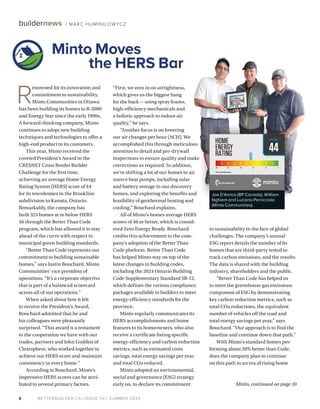
This year, Minto received the
coveted President’s Award in the
CRESNET Cross Border Builder
Challenge for the first time,
achieving an average Home Energy
Rating System (HERS) score of 44
for its townhomes in the Brookline
subdivision in Kanata, Ontario.
Remarkably, the company has
built 323 homes at or below HERS
46 through the Better Than Code
program, which has allowed it to stay
ahead of the curve with respect to
municipal green building standards.
“Better Than Code represents our
commitment to building sustainable
homes,” says Justin Bouchard, Minto
Communities’ vice president of
operations. “It’s a corporate objective
that is part of a balanced scorecard
across all of our operations.”
When asked about how it felt
to receive the President’s Award,
Bouchard admitted that he and
his colleagues were pleasantly
surprised. “This award is a testament
to the cooperation we have with our
trades, partners and John Godden of
Clearsphere, who worked together to
achieve our HERS score and maintain
consistency in every home.”
According to Bouchard, Minto’s
impressive HERS scores can be attri­
buted to several primary factors.
“First, we zero in on airtightness,
which gives us the biggest bang
for the buck — using spray foams,
high-efficiency mechanicals and
a holistic approach to indoor air
quality,” he says.
“Another focus is on lowering
our air changes per hour (ACH). We
accomplished this through meticulous
attention to detail and pre-drywall
inspections to ensure quality and make
corrections as required. In addition,
we’re shifting a lot of our homes to air
source heat pumps, including solar
and battery storage in our discovery
homes, and exploring the benefits and
feasibility of geothermal heating and
cooling,” Bouchard explains.
All of Minto’s homes average HERS
scores of 46 or better, which is consid­
ered Zero Energy Ready. Bouchard
credits this achievement to the com­
pany’s adoption of the Better Than
Code platform. Better Than Code
has helped Minto stay on top of the
latest changes in building codes,
including the 2024 Ontario Building
Code Supplementary Standard SB-12,
which defines the various compliance
packages available to builders to meet
energy-efficiency standards for the
province.
Minto regularly communicates its
HERS accomplishments and home
features to its homeowners, who also
receive a certificate listing specific
energy-efficiency and carbon reduction
metrics, such as estimated costs
savings, total energy savings per year
and total CO2 reduced.
Minto adopted an environmental,
social and governance (ESG) strategy
early on, to declare its commitment
to sustainability in the face of global
challenges. The company’s annual
ESG report details the number of its
homes that are third-party tested to
track carbon emissions, and the results.
The data is shared with the building
industry, shareholders and the public.
“Better Than Code has helped us
to meet the greenhouse gas emissions
component of ESG by demonstrating
key carbon reduction metrics, such as
total CO2 reductions, the equivalent
number of vehicles off the road and
total energy savings per year,” says
Bouchard. “Our approach is to find the
baseline and continue down that path.”
With Minto’s standard homes per­
forming about 20% better than Code,
does the company plan to continue
on this path in an era of rising home
Minto Moves
the HERS Bar
44
2017 SB-12 REFERENCE HERS 57
HERSSCORE
Joe D’Amico (BP Canada), William
Nghiem and Luciano Perricciolo
(Minto Communities).
Minto, continued on page 10
BETTERBUILDER.CA | ISSUE 54 | SUMMER 2025
I
nnovation and quality have been
the hallmarks of Canadian builder
Brookfield Residential for more
than 65 years. With many of its
homes in the Greater Toronto Area
built through the Better Than Code
platform, the company completed
143 homes achieving a Home Energy
Rating System (HERS) score of 47 or
better in 2024, resulting in carbon
reductions equivalent to removing
47 vehicles off the road.
Brookfield is a leading builder
in the Low Carbon Homebuilder
Coalition. In 2017, the company won
a CRESNET Cross Border Builder
Challenge award for its discovery
home in Tottenham, Ontario, which
achieved an impressive HERS rating
of 33. This year, through the Enbridge
Net Zero Energy Ready program,
Brookfield took home the Lowest
HERS Score Canadian Production
Builder award for its hybrid house in
the Heartland subdivision near Baxter,
Ontario, which scored HERS 38.
“We pride ourselves on building
better, using new technology and
practical, economical techniques
to get to Net Zero,” says Brookfield
architectural project manager Keith
Beresford. “In both the Tottenham and
Baxter projects, we achieved our low
HERS scores in a number of key ways:
two-inch continuous rigid insulation
on the cold side of the framing, a two-
inch under-slab insulation, in-floor
heating, triple-glazed windows, a heat
pump, 24-inch spaces between studs
to slow down heat loss, and a thinner
concrete foundation wall to reduce
our embodied carbon footprint.”
Beresford noted that these
techniques — combined with
other enhancements, such as
high-performance HVAC systems,
energy recovery ventilators (ERVs)
and hybrid heating — have served
his company well in its quest for
energy-efficiency and carbon
savings. Many Brookfield homes
are also solar-ready, with trusses to
carry extra weight and a conduit to
the roof. Added to these features, a
smart-home electrical panel with an
electric vehicle charger and a home
management system give occupants
the opportunity to see the energy
they are using and educates them on
how they could do better.
With building codes continually
changing their energy performance
requirements, it is a challenge for
builders to stay on top of what may be
required down the road. “It’s really all
guesswork,” says Beresford. “Ontario
is a leader in energy efficiency and
building envelopes. There haven’t been
many changes for a few Code cycles,
and the Code system really leans on
industry professionals, but we’re not
too concerned about what’s coming.
We’ve been continually building to a
level higher than the standard Code.”
Brookfield’s record of building
better, more efficient homes is a
commendable achievement, but how
does the company convey its efforts to
the consumer? “Customer experiences
are our biggest priority,” replies
Amanda Thackway, building studio
manager. “The benefits of airtightness,
ERVs vs. heat recovery ventilators
(HRVs), the Better Than Code label and
HERS performance graphics — these
are some of the advanced attributes of
our homes that we focus on to get the
message across to customers that a
Brookfield home is more comfortable
and energy-saving than its Code-built
counterparts.”
9
Cost-effective Comfort
and Quality
buildernews / MARC HUMINILOW YCZ
38
2017 SB-12 REFERENCE HERS 57
HERSSCORE
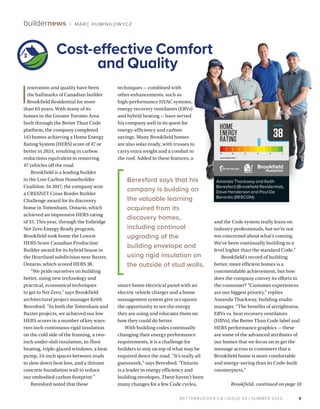
Amanda Thackway and Keith
Beresford (Brookfield Residential),
Dave Henderson and Paul De
Berardis (RESCON).
Brookfield, continued on page 10
Beresford says that his
company is building on
the valuable learning
acquired from its
discovery homes,
including continual
upgrading of the
building envelope and
using rigid insulation on
the outside of stud walls.
BETTERBUILDER.CA | ISSUE 54 | SUMMER 2025
10
costs? “100%,” declares Bouchard.
“Yes, there is pressure on costs these
days, but this is ingrained in the
homebuilding industry as a whole. We
pledge to continue building our homes
to exceed Code. As a progressive
builder, this is something that we take
great pride in. It is, and will continue
to be, one of our primary corporate
objectives into the future.” BB
Marc Huminilowycz is a writer who lives
and works in a low-energy home, bringing
first-hand experience to his writing on
technology and residential housing.
But according to Beresford, energy
efficiency is not as high on the radar,
and not in the average consumer’s
budget, as it was two years ago. “We
have to focus on purchase price,”
responds Thackway. “People are still
looking for energy savings, but the cost
has to be affordable. The energy-saving
return on investment can be a longer-
term investment than some people are
comfortable with.”
Going forward, Beresford says that
his company is building on the valuable
learning acquired from its discovery
homes, including continual upgrading
of the building envelope, using rigid
insulation on the outside of stud walls
and reducing heat loss through wood
studs. “We’re extremely pleased with
what we achieved and proud of our team
for their role in the process,” he says.
“After 68 years, Brookfield Residential is
committed more than ever to building
better homes that people will enjoy for
many years to come.” BB
Marc Huminilowycz is a writer who lives
and works in a low-energy home, bringing
first-hand experience to his writing on
technology and residential housing.
Minto, continued from page 8 Brookfield, continued from page 9
BETTERBUILDER.CA | ISSUE 54 | SUMMER 2025
Introducing our most
versatile and efficient
single-family ERV Series
with BalancedHome™
Panasonic’s BalancedHome™ Energy Recovery
Ventilators are engineered to deliver advanced
ventilation, ensuring balanced airflow and superior
indoor air quality in homes across Canada. Whether
it’s a new build or retrofit, this system is designed to
meet the needs of modern, high-performance homes.
Build healthier
homes today.
Scan to learn more
or connect with a
distributor near you.
Panasonic ERVs are Holmes Approved and part of Breathe Well,
The Only Complete Air Quality Solution™.
• Top-rated Sensible Recovery Efficiency of 82% at 0 °C for Elite Plus 160
CFM models.
• Optional low voltage timer provides easy, push-button operation to set
boost time (10/20/40/60 minutes).
• Built-in SmartFlow® technology provides balanced ventilation regardless
of a complicated duct run, saving the contractor time on installation.
• Panasonic’s hygroscopic core balances humidity between the indoor and
outdoor airflows.
• Embedded frost prevention strategies automatically activate to prevent
the core from freezing.
• Choose the perfect solution for any home. Unmatched flexibility with 8
models and 4 maximum adjustable CFM ranges (130/140/150/160 CFM).
• Available in top-port or side-port ERV configurations to fit any home layout.
• All models are equipped with a standard power cord and include a
hardwire adapter in the box.
• MERV 13 filter is standard for Elite Plus models (130/160 CFM). MERV 8
filter is standard for Elite models (120/150 CFM). Washable MERV 6 filters
are also available. All filters can be used in all models.
Optional Accessories:
Low Voltage
Timer
Touchscreen
Wall Control
BETTERBUILDER.CA | ISSUE 54 | SUMMER 2025
12
buildernews / BETTER BUILDER STAFF
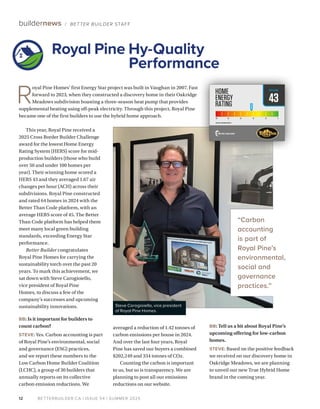
This year, Royal Pine received a
2025 Cross Border Builder Challenge
award for the lowest Home Energy
Rating System (HERS) score for mid-
production builders (those who build
over 50 and under 100 homes per
year). Their winning home scored a
HERS 43 and they averaged 1.67 air
changes per hour (ACH) across their
subdivisions. Royal Pine constructed
and rated 64 homes in 2024 with the
Better Than Code platform, with an
average HERS score of 45. The Better
Than Code platform has helped them
meet many local green building
standards, exceeding Energy Star
performance.
Better Builder congratulates
Royal Pine Homes for carrying the
sustainability torch over the past 20
years. To mark this achievement, we
sat down with Steve Carogioiello,
vice president of Royal Pine
Homes, to discuss a few of the
company’s successes and upcoming
sustainability innovations.
BB: Is it important for builders to
count carbon?
STEVE: Yes. Carbon accounting is part
of Royal Pine’s environmental, social
and governance (ESG) practices,
and we report these numbers to the
Low Carbon Home Builder Coalition
(LCHC), a group of 30 builders that
annually reports on its collective
carbon emission reductions. We
averaged a reduction of 1.42 tonnes of
carbon emissions per house in 2024.
And over the last four years, Royal
Pine has saved our buyers a combined
$202,249 and 334 tonnes of CO2.
Counting the carbon is important
to us, but so is transparency. We are
planning to post all our emissions
reductions on our website.
BB: Tell us a bit about Royal Pine’s
upcoming offering for low-carbon
homes.
STEVE: Based on the positive feedback
we received on our discovery home in
Oakridge Meadows, we are planning
to unveil our new True Hybrid Home
brand in the coming year.
R
oyal Pine Homes’ first Energy Star project was built in Vaughan in 2007. Fast
forward to 2023, when they constructed a discovery home in their Oakridge
Meadows subdivision boasting a three-season heat pump that provides
supplemental heating using off-peak electricity. Through this project, Royal Pine
became one of the first builders to use the hybrid home approach.
Royal Pine Hy-Quality
Performance
Steve Carogioiello, vice president
of Royal Pine Homes.
43
2017 SB-12 REFERENCE HERS 57
HERSSCORE
“Carbon
accounting
is part of
Royal Pine’s
environmental,
social and
governance
practices.”
BETTERBUILDER.CA | ISSUE 54 | SUMMER 2025 13
*Terms and conditions and certain exceptions apply. See rental agreement for details. ®
Enercare, Enercare Advantage and the designs
are registered trademarks of Enercare Inc., used under license.
Enercare delivers high-rise building comfort solutions by providing builders with innovative and efficient
mechanical systems without upfront capital costs.*
Scan the QR code or visit enercare.ca/builder/highrise
OUR SUITE OF PRODUCTS
WHY CHOOSE THE ENERCARE
ADVANTAGE®
PROGRAM?
Easy to do Business With – On-time deliveries with
complete commissioning.
Access to Leading Products – Including state-of-
the-art and energy-efficient equipment designed to
provide year-round comfort.
Complete Service Provider – Single point of contact
for sourcing both in-suite and central plant equipment
from major manufacturers, with 24/7/365 call centre
support to assist in booking a service call.
Innovative
Solutions for
Every Build
HVAC – Geothermal and Air Source Heat Pumps,
Central Plant, Fan Coils, Air Handlers and Boilers
Water Heating – Electric Tank and Tankless
Water Heaters
Ventilation – Energy and Heat Recovery
Ventilators
Water Treatment – Reverse Osmosis, Water
Softener, Whole Home Water Filtration
EV Charging – Electric Vehicle Energy
Management System (EVEMS)
ELECTRIC VEHICLE ENERGY
MANAGEMENT SYSTEM (EVEMS)
Enercare is leading urban transformation
with cost-effective EVEMS solutions.
By seamlessly integrating EV charging
infrastructure with our suppliers Eaton
and Tesla, Enercare prepares buildings
for future needs and enhances project
viability. Discover how Enercare is shaping
the future of urban development.
ECH3757_BuilderMagAd_EVEMS_FIN.indd 1
ECH3757_BuilderMagAd_EVEMS_FIN.indd 1 2025-06-13 10:33AM
2025-06-13 10:33AM
BETTERBUILDER.CA | ISSUE 54 | SUMMER 2025
14
BB: What do you think about combin­
ation hybrid heat (a combination
heating system with a three-season
heat pump)?
STEVE: We definitely think it’s a big
step in the right direction. We’re proud
to include right-sized, three-season
heat pumps in our new True Hybrid
Homes, because we think they’re that
integral to sustainable homebuilding.
BB: How does combination hybrid
heat work?
STEVE: It promotes the wise use
of natural gas while reducing CO2
emissions. Lab research and field
studies reveal that, when compared to
a separate furnace and hot water tank,
combination heating systems reduce
gas consumption by 20%. And using
a three-season heat pump to provide
supplemental heating with off-peak
electricity can reduce gas usage by a
further 30%.
BB: How are HERS and Better Than
Code helping you with your marketing
strategy?
STEVE: They help us differentiate
ourselves from brands such as Energy
Star, because we build to a level that
exceeds Code performance by 20%.
BB: The Cross Border Builder
Challenge is a friendly competition
between American and Canadian
homebuilders. How do you feel about
being a Canadian builder right now?
STEVE: As a Canadian builder, it is
very important to us that we keep
jobs in Canada and support other
Canadian businesses. This is why we
like to promote all the Canadian-made
products we use to build our houses —
including steel, concrete, mechanical
systems, and more. BB
MEET PERFORMANCE GOALS
SAVE THE MONEY
SEAL THE LEAKS
Used by
4 of the top 5
home builders
The World’s Largest Automated
Air Sealing Technology Provider
Aeroseal’s advanced AeroBarrier
technologies make meeting ACH
requirements and efficiency standards
like Energy Star 3.2 a seamless
process that saves time, labor, and
money – with instantly verified and
guaranteed results.
BETTERBUILDER.CA | ISSUE 54 | SUMMER 2025
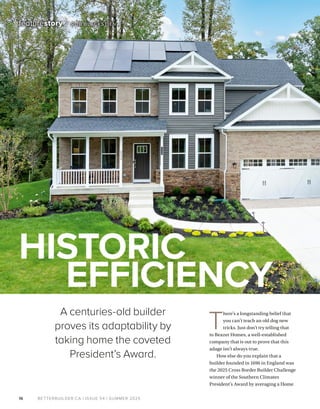
T
here’s a longstanding belief that
you can’t teach an old dog new
tricks. Just don’t try telling that
to Beazer Homes, a well-established
company that is out to prove that this
adage isn’t always true.
How else do you explain that a
builder founded in 1696 in England was
the 2025 Cross Border Builder Challenge
winner of the Southern Climates
President’s Award by averaging a Home
16
featurestory / ROB BLACKSTIEN
HISTORIC
EFFICIENCY
A centuries-old builder
proves its adaptability by
taking home the coveted
President’s Award.
BETTERBUILDER.CA | ISSUE 54 | SUMMER 2025 17
DAVID
KEITH
PHOTOG
R
APHY
Energy Rating System (HERS) score of
32 across its housing fleet?
Now that’s some serious historic
efficiency.
The Atlanta-based builder — which
set up shop in the U.S. in 1986 — comes
across its greenbuilding tendencies
honestly. Megan Cordes, director of
sustainability and building science,
says this mindset dates back to the
company’s origins.
She explains that founder George
Beazer despised waste, and it’s a trait
that was inherited by many of the nine
generations of this family that worked
within the business. For instance, Cyril
Beazer, who lived from the early 20th
century until just before the move to
North America, wrote a self-published
book in 1981 which detailed his hatred
of job-site waste.
“If he went to a job site and there was
a bucket of nails spilled, he would pick
up every single one,” Cordes says. “So it
is interesting that this thread has carried
forward throughout the company’s
history. Those principles kind of made
the move from the U.K. to the U.S., and
it’s something we’re very proud of.”
The builder went public in 1994
and has been led by Allan Merrill as
CEO since 2011. But the Beazer family’s
involvement continued officially until
2018, when Brian (now 90) stepped
down as chairman of the board.
Unofficially, Brian is still very involved
with the company.
More recently, Beazer has developed
an association with RESNET and the
HERS method of energy rating. “Our
path kind of aligns with how RESNET
has gone,” Cordes explains. All new staff
training includes a discussion about the
Beazer approach, its history of efficiency
and sustainability, and how it all fits
together in a broader context, she says.
Part of that involves showing new
employees a chart detailing Interna-
tional Code Council (ICC) standards
since 2006 and how this illustrates
Beazer’s continuously improved rating
over time, dovetailing the company’s
enhancements in terms of efficiency.
Beazer built its first Energy Star
home nearly three decades ago, in 1998.
By 2011, 100 per cent of Beazer’s homes
were recognized by Energy Star.
Five years ago, Cordes says, the
builder committed to being 100 per cent
Zero Energy Ready with a HERS score of
under 45 across all their homes by the
end of 2025. They’re right on track, with
fewer than 100 non-Zero Energy Ready
housing starts on tap for the remainder
of the year.
Cordes lists the challenges of build­
ing Zero Energy Ready as follows:
1) learning how to do it;
2) getting their trades and partners on
board in terms of understanding it
and doing it efficiently; and
3) the costs involved, much of which
relates to the learning curve.
She believes the company’s ties with
RESNET — including Beazer’s manager
of governmental affairs, Brian Shanks,
serving on the board — have really helped.
Cordes says this collaboration has
“been a really beneficial relationship
both ways. I think we can provide feed­
back on what’s working and what’s not
working as we put our goals into effect.”
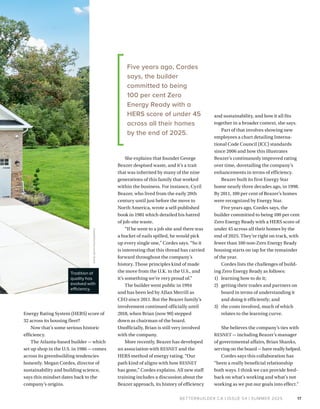
Tradition of
quality has
evolved with
efficiency.
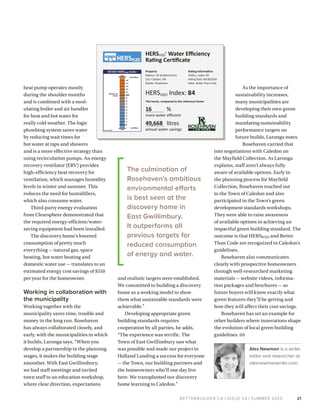
Five years ago, Cordes
says, the builder
committed to being
100 per cent Zero
Energy Ready with a
HERS score of under 45
across all their homes
by the end of 2025.
BETTERBUILDER.CA | ISSUE 54 | SUMMER 2025
In terms of building Zero Energy
Ready homes, Beazer specifically
follows the Department of Energy’s
program, which is designed to achieve
at least 40 to 50 per cent greater energy
efficiency than typical new houses.
While winning the President’s
Award was certainly a nice feather
in its cap, accolades such as this are
not Beazer’s main motivator. Rather,
earning this honour is more a product
of what they’re going to do regardless.
She says the real reward for Beazer’s
staff “is knowing that they built a
house that somebody will live in and
say, ‘Wow! This is so different than any
other house that I’ve lived in.’”
While this award was for the Southern
Climates (based on all their homes in
climate zones 0 through 3), Beazer also
makes homes in the southwest (as far
north as Sacramento), along the eastern
seaboard (as far north as Maryland)
and has a community in the Midwest
(Indianapolis), so calling it merely a
southern builder is a bit unfair.
Wherever they build, Beazer does
a great job communicating their
value differentiator to homebuyers.
Cordes says in virtually every model
home, there is what’s known as “the
surprising performance room,”
which illustrates how they build,
from the materials to their practices
and partners, providing potential
buyers a peek behind the curtain.
Included in this are boards showing
the monthly energy savings of Beazer
homes compared to those that are
non-Zero Energy Ready or on the resale
market. She believes this helps tackle
“the challenge of telling the story of
that value.”
The HERS scores tell a similar tale.
As long ago as 2007, Beazer posted
a HERS 85, which was only slightly
lower than what an average new home
was. 14 years later their average was
18
Megan Cordes, director of sustainability
and building science, Beazer Homes. Surprising performance: Inverter with battery system and car charger.
Surprising performance: High tech kitchen and appliances.
Surprising performance: Foam insulation on
roof deck and insulation in exterior walls.
BE
A
ZER
HOMES
BETTERBUILDER.CA | ISSUE 54 | SUMMER 2025
73 — well below a resale home (130).
An average Beazer home by 2021?
Try 56, a number which has been
dramatically improved upon since.
The builder is also a big believer in
third-party verification. Cordes says
anyone can simply make the claim that
they’re building better. But having that
backed up by a 32-point checklist adds
a major element of assurance.
“We really do want to make sure
that we’ve got the best verification that
we can, and making sure that it’s all as
legitimate as it can be.”
Tantamount to the goals of any good
builder that’s focused on sustainability
is how to be part of the climate change
solution, and Beazer is no different.
“I think the most important thing
that we can do is continue to evolve,”
says Cordes. This was part of her
messaging in a recent training session
for one of the company’s top divisions.
While Cordes told them how wonderful
it was that they’ve been efficient while
being both budget conscious and
sophisticated in their approach, she
also stressed the importance of not
sitting on their laurels.
“We’re not stopping [here],” she
says. “There’s no one specific thing
that we can do to fix climate change, so
what we can do is continue to build a
better home, just continue to evolve our
building practices.”
Now that Beazer has pretty much
nailed the whole Zero Energy Ready
thing, it’s been adding renewables and
storage.
In terms of their next innovation,
she says that solar with storage is a
substantial initiative for the company,
one that she currently spends a good
chunk of her time working on.
“I think that’s the very near future
for us,” Cordes says. “Ultimately, I
think that we are pretty nimble in
terms of how we approach the different
technologies that we use because we’re
constantly trying to do better and
pulling data from the divisions that
are doing all of these new things and
understanding what could be next.” BB
Rob Blackstien is a
Toronto-based freelance
writer. Pen-Ultimate.ca
19
Innovative and user-friendly form for
sustainable and resilient design.
Embedded
cross-ties
Two diagonal cross
ties which virtually
eliminate the chance
of blow out.
FormLock™
interlock
Patented interlock
with moisure drain
system
No tying required
Built-in rebar holders
eliminate tying
Multiple block
types available
Including straight, 90°
corner, 45° corner, taper
top, brickledge, t-block,
and radius blocks
AmvicTM
Insulated
Concrete Forms
6” & 8” CORE
also available in R22
with core sizes of
4”, 6”, 8”, 10” & 12”
R30
alleguard.com
1 (877) 470 9991
Insulated Concrete Forms
TM
C
M
Y
CM
MY
CY
CMY
K
Better Builder Island Ad 4.875x7.375 Spring 2024.pdf 1 2/21/2024 10:33:23 AM
BETTERBUILDER.CA | ISSUE 54 | SUMMER 2025
20
buildernews / ALEX NEWMAN
R
osehaven Homes has always
been keen on green. Ever
since incorporating in 1992,
the company has built high-quality,
energy-saving homes. Rosehaven’s
sustainable building journey began
with the first EnerGuide community,
Riverstone Golf & Country Club in
Brampton, in 2005. Today, the builder
has achieved the first HERS and
HERSH2O ratings in every home in
their most recent project, the Mayfield
Collection in Caledon.
The company is committed to
building better than Code, despite
Ontario’s new Bill 17, which restricts
local green building requirements.
The bill’s aim is to make building more
affordable by eliminating the wide
fluctuations in green codes from region
to region. But it allows builders the
freedom to go better than Code using
whatever rating method they prefer.
Rosehaven has always gone above
and beyond, by using both Energy
Star and HERS Better Than Code.
The Mayfield Collection was built
in partnership with Townwood Homes
and boasts homes that use on average
16% less water. That translates to an
annual reduction of 3.9 million litres
over the project’s 47 homes, which
not only saves homeowners money
but reduces municipal infrastructure
costs. This water reduction also
translates directly into 16% less
sanitary outflow.
“Respecting the environment is
very important to us, and everyone
needs to do their part to reduce
carbon footprint,” says Joe Laronga,
Rosehaven’s manager of architecture
and engineering.
Those innovations have won the
builder bragging rights. And plenty of
awards.
In 2018, they received an award
for greywater recycling in their East
Gwillimbury project, where they built
a hybrid house seven years before
anyone else.
In 2016, Rosehaven won the Cross
Border Builder Challenge President’s
Award for the lowest average HERS score
of 46. And this year, they won the Cross
Border Builder Challenge HERSH2O
Award for reduced water consumption
at the Mayfield Collection.
The culmination of Rosehaven’s
ambitious environmental efforts is
best seen at the discovery home in
East Gwillimbury. It outperforms
all previous targets for reduced
consumption of energy and water.
Featuring the Total Water Solution, a
hybrid system that results in a carbon
footprint that is 23% less than current
Code homes, water use is monitored
with the Phyn flow monitor. In addi­
tion, the drain water heat recovery
feature takes the heat from shower
water to preheat domestic hot water.
The shower water is then captured and
treated through greywater recycling
before being reused for toilet flushing.
Heat is generated by a combination
hybrid heating system: a three-season
Rosehaven:
Demonstrating Leadership
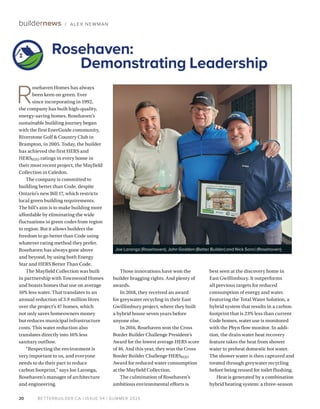
Joe Laronga (Rosehaven), John Godden (Better Builder) and Nick Sanci (Rosehaven).
BETTERBUILDER.CA | ISSUE 54 | SUMMER 2025
heat pump operates mostly
during the shoulder months
and is combined with a mod­
ulating boiler and air handler
for heat and hot water for
really cold weather. The logic
plumbing system saves water
by reducing wait times for
hot water at taps and showers
and is a more effective strategy than
using recirculation pumps. An energy
recovery ventilator (ERV) provides
high-efficiency heat recovery for
ventilation, which manages humidity
levels in winter and summer. This
reduces the need for humidifiers,
which also consume water.
Third-party energy evaluation
from Clearsphere demonstrated that
the required energy-efficient/water-
saving equipment had been installed.
The discovery home’s lowered
consumption of pretty much
everything — natural gas, space
heating, hot water heating and
domestic water use — translates to an
estimated energy cost savings of $510
per year for the homeowner.
Working in collaboration with
the municipality
Working together with the
municipality saves time, trouble and
money in the long run. Rosehaven
has always collaborated closely, and
early, with the municipalities in which
it builds, Laronga says. “When you
develop a partnership in the planning
stages, it makes the building stage
smoother. With East Gwillimbury,
we had staff meetings and invited
town staff to an education workshop,
where clear direction, expectations
and realistic targets were established.
We committed to building a discovery
home as a working model to show
them what sustainable standards were
achievable.”
Developing appropriate green
building standards requires
cooperation by all parties, he adds.
“The experience was terrific. The
Town of East Gwillimbury saw what
was possible and made our project in
Holland Landing a success for everyone
— the Town, our building partners and
the homeowners who’ll one day live
here. We transplanted our discovery
home learning to Caledon.”
As the importance of
sustainability increases,
many municipalities are
developing their own green
building standards and
mandating sustainability
performance targets on
future builds, Laronga notes.
Rosehaven carried that
into negotiations with Caledon on
the Mayfield Collection. As Laronga
explains, staff aren’t always fully
aware of available options. Early in
the planning process for Mayfield
Collection, Rosehaven reached out
to the Town of Caledon and also
participated in the Town’s green
development standards workshops.
They were able to raise awareness
of available options in achieving an
impactful green building standard. The
outcome is that HERSH2O and Better
Than Code are recognized in Caledon’s
guidelines.
Rosehaven also communicates
clearly with prospective homeowners
through well-researched marketing
materials — website videos, informa­
tion packages and brochures — so
future buyers will know exactly what
green features they’ll be getting and
how they will affect their cost savings.
Rosehaven has set an example for
other builders where innovations shape
the evolution of local green building
guidelines. BB
Alex Newman is a writer,
editor and researcher at
alexnewmanwriter.com.
21
HERSH2O® Water Efficiency
Rating Certificate
Property
Address: 59 Stratford Drive
City: Caledon, ON
Builder: Rosehaven
Rating Information
HERSH2O Index: 84
Rating Date: 04/30/2024
Rater: Better Than Code
HERSH2O Index: 84
This home, compared to the reference home:
16 %
more water efficient
49,668 litres
annual water savings
The culmination of
Rosehaven’s ambitious
environmental efforts
is best seen at the
discovery home in
East Gwillimbury.
It outperforms all
previous targets for
reduced consumption
of energy and water.
BETTERBUILDER.CA | ISSUE 54 | SUMMER 2025
22
sitespecific / ALEX NEWMAN
T
he recent announcement of
Bill 17 has generated a number
of questions about local green
building standards. In essence, the
bill proposes that municipalities
cannot create and enforce local
bylaws requiring construction
standards to exceed the Ontario
Building Code (OBC). Some view the
bill as a step forward in creating more
affordable housing by eliminating
costly extra planning steps; others
worry it means a step backward
for green building by reducing
incentives to go better than Code.
While the City of Pickering
acknowledges the Province’s authority
to set legislation, staff are waiting
for provincial regulations under
Bill 17 to understand how it applies
to the City’s Integrated Sustainable
Design Standards (ISDS) program.
But this doesn’t alter the approach
Pickering has always taken, which is
to collaborate with the development
community. Pickering’s plan has
been developed over the past several
years using a performance-based,
tiered system. But many sustainability
practices have been in place since
2007, before the ISDS.
Pickering is understandably
proud of the strides it has made in
sustainable building and especially
of the ISDS. “We shaped these
standards with a lot of input from the
development community and various
stakeholders, including residents
and city council,” says Kyle Bentley,
director of city development and chief
building official.
While Bill 17 will not permit any
municipality to enforce practices
that exceed the Code, Pickering’s ISDS
provides a framework for builders
to go beyond minimum Code and
consider design strategies that improve
efficiency and reduce environmental
impact. “We recognize builders have
constraints, financial and otherwise, so
we wanted to come up with something
everyone understood, by setting up
goals from the beginning,” Bentley says.
The ISDS is built around seven key
principles that go beyond a home’s
energy efficiency, Bentley explains.
These principles include:
• educating future homeowners about
sustainable practices;
• designing homes for energy
efficiency and climate resilience;
• creating safe, accessible and
inclusive neighbourhoods;
• managing land use to protect and
enhance the natural environment;
• supporting active and low-carbon
transportation options;
• implementing waste management
with effective onsite recycling and
diversion; and
• promoting water-efficient systems
alongside sustainable stormwater
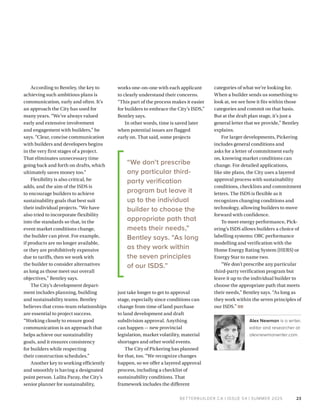
management.
Working through Bill 17
Means Municipal Collaboration
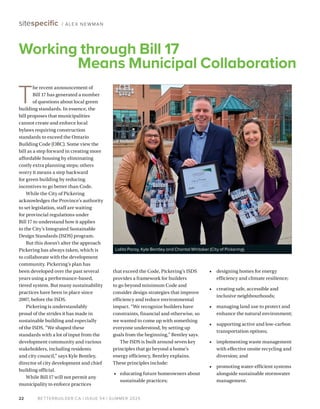
Lalita Paray, Kyle Bentley and Chantal Whitaker (City of Pickering).
BETTERBUILDER.CA | ISSUE 54 | SUMMER 2025
According to Bentley, the key to
achieving such ambitious plans is
communication, early and often. It’s
an approach the City has used for
many years. “We’ve always valued
early and extensive involvement
and engagement with builders,” he
says. “Clear, concise communication
with builders and developers begins
in the very first stages of a project.
That eliminates unnecessary time
going back and forth on drafts, which
ultimately saves money too.”
Flexibility is also critical, he
adds, and the aim of the ISDS is
to encourage builders to achieve
sustainability goals that best suit
their individual projects. “We have
also tried to incorporate flexibility
into the standards so that, in the
event market conditions change,
the builder can pivot. For example,
if products are no longer available,
or they are prohibitively expensive
due to tariffs, then we work with
the builder to consider alternatives
as long as those meet our overall
objectives,” Bentley says.
The City’s development depart­
ment includes planning, building
and sustainability teams. Bentley
believes that cross-team relationships
are essential to project success.
“Working closely to ensure good
communication is an approach that
helps achieve our sustainability
goals, and it ensures consistency
for builders while respecting
their construction schedules.”
Another key to working efficiently
and smoothly is having a designated
point person. Lalita Paray, the City’s
senior planner for sustainability,
works one-on-one with each applicant
to clearly understand their concerns.
“This part of the process makes it easier
for builders to embrace the City’s ISDS,”
Bentley says.
In other words, time is saved later
when potential issues are flagged
early on. That said, some projects
just take longer to get to approval
stage, especially since conditions can
change from time of land purchase
to land development and draft
subdivision approval. Anything
can happen — new provincial
legislation, market volatility, material
shortages and other world events.
The City of Pickering has planned
for that, too. “We recognize changes
happen, so we offer a layered approval
process, including a checklist of
sustainability conditions. That
framework includes the different
categories of what we’re looking for.
When a builder sends us something to
look at, we see how it fits within those
categories and commit on that basis.
But at the draft plan stage, it’s just a
general letter that we provide,” Bentley
explains.
For larger developments, Pickering
includes general conditions and
asks for a letter of commitment early
on, knowing market conditions can
change. For detailed applications,
like site plans, the City uses a layered
approval process with sustainability
conditions, checklists and commitment
letters. The ISDS is flexible as it
recognizes changing conditions and
technology, allowing builders to move
forward with confidence.
To meet energy performance, Pick­
ering’s ISDS allows builders a choice of
labelling systems: OBC performance
modelling and verification with the
Home Energy Rating System (HERS) or
Energy Star to name two.
“We don’t prescribe any particular
third-party verification program but
leave it up to the individual builder to
choose the appropriate path that meets
their needs,” Bentley says. “As long as
they work within the seven principles of
our ISDS.” BB
Alex Newman is a writer,
editor and researcher at
alexnewmanwriter.com.
23
“We don’t prescribe
any particular third-
party verification
program but leave it
up to the individual
builder to choose the
appropriate path that
meets their needs,”
Bentley says. “As long
as they work within
the seven principles
of our ISDS.”
BETTERBUILDER.CA | ISSUE 54 | SUMMER 2025
24
buildernews / ALEX NEWMAN
T
he Campanale family has
been building quality homes
for almost 50 years and has
garnered a reputation for being
ahead of the green curve. They were
early adopters of energy-efficient
construction, working closely with
Clearsphere on testing, energy
modelling and adopting the Home
Energy Rating System (HERS) Index.
The company has twice won CRES­
NET’s Cross Border Builder Challenge
for lowest HERS score, and Tim
Campanale, the company’s director of
construction operations, served on the
CRESNET board for two years before
becoming its president in 2024.
Hybrid home
A hybrid house, recently built in
Campanale’s Ottawa Westboro
project, won the company its second
CRESNET Enbridge Innovation
Award. The home is dual-labelled,
says Campanale. “It was a hybrid, net
zero-ready house labelled with HERS
ratings for low carbon.”
The house has a plethora of green
features: triple-pane, low solar heat
gain windows; spray foam exterior
walls; hybrid heating system with a
modulating tankless hot water heater;
zoned air handler; Panasonic high-
efficiency energy recovery ventilator;
R-10 under-slab insulation; solar-ready
trusses for future panel install; and an
electric car charger. It’s certified Net
Zero Ready and HERS 38.
Net zero-ready homes are certified
by EnerGuide, whereas a zero energy-
ready hybrid house can be certified by
HERS 46 or below.
The specific innovation with the
hybrid home, Campanale says, is the
three-season heat pump (appropriate
for spring, summer and fall, but
struggles to heat during extremely cold
Ottawa winters). This electric heat
pump provides supplemental heat for a
gas-fired combination heating system.
“The heat pump is supposed to work
to –30 °C, but they become less efficient
after –10 °C,” Campanale says. But
instead of putting in backup electric
heat, you can use a hot water heater and
an air handler combination for deep
winter. With fluctuating temperatures,
especially in January and February,
the homeowner can switch over to a
primary source of heat provided by
natural gas. Campanale is currently
building his own family home using the
same systems and materials.
Who loves the sun?
Some homes get fitted with solar
panels, but Campanale points out that
solar is one of the costlier items you can
use to reduce your load — especially in
much of Canada, since the panels are
covered in snow for most of the winter.
While the company has retrofitted
for solar on some homes, they did a
significant install on one apartment
complex: Urban Terraces in Barrhaven.
That project garnered the Greater
Ottawa Home Builders’ Association’s
2023 Green Building of the Year award
because it was completely HERS rated
with solar.
Future space is allocated on the roof
so solar panels can be installed later,
but right now, he says, it doesn’t make
sense: “In my opinion, everything
should be done within reason.”
Legislative updates and the
threat of tariffs
When asked whether builders should
be concerned about provincial
Bill 17, which is intended to speed
up and increase housing supply,
Campanale replies, “Not at all — the
bill is actually making it easier for
builders to construct more affordable
Campanale Leading the
Charge for Innovation
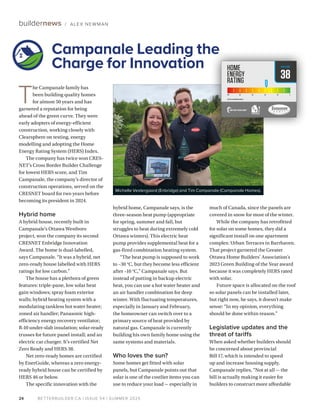
Michelle Vestergaard (Enbridge) and Tim Campanale (Campanale Homes).
38
2017 SB-12 REFERENCE HERS 52
HERSSCORE
BETTERBUILDER.CA | ISSUE 54 | SUMMER 2025
housing because it’s attempting to
prevent municipalities from using the
Planning Act to force builders to build
above Code without incentives.”
With the inconsistent green build­
ing requirements from region to
region, efficiency is lost by having to
adjust construction each time. That
creates price discrepancies, which in
turn disrupts the market. However, the
bill doesn’t restrict a builder wanting
to build better than Code voluntarily.
And you can incorporate any energy-
efficiency features you wish.
But builders are also facing the
threat of tariffs from the U.S. “It’s a
tough market and the tariffs don’t
help, so you adapt however you can.
And then it changes. So it’s hard to
make a plan when nobody knows
what’s going to be introduced next,”
Campanale admits.
He says suppliers are not changing
prices yet because the rules keep
changing. It isn’t feasible to pivot when
you don’t know what’s going on and
everyone is on hold. Most suppliers are
putting a disclaimer on their goods that
they may end up having to charge extra
due to tariffs.
At the same time, a lot of suppliers
are relabelling products, whether that’s a
raw product or manufactured — they’re
doing what they can to keep costs down.
“Builders are buyers of goods, so you
make decisions on what to buy and, if
a product is superior for what your goal
is, what will it matter if it’s an extra 10%?
And there’s the issue of trust. Flooring,
for example, is a choice between U.S.
goods or Italian. It was a thing before to
buy U.S. because it’s trusted, but that’s
not so much the case now.”
With the uncertainty of tariffs
and changes to code standards, the
industry needs good leadership.
In his role as CRESNET president,
Campanale’s mandate of strengthening
relationships, combined with being
an innovative builder, couldn’t
come at a better time. BB
Alex Newman is a writer,
editor and researcher at
alexnewmanwriter.com.
25
hotwatercanada.ca
No hard water exclusions on X3™ models
15-year limited warranty on the heat exchanger**
Adapt™
& Go Tankless!
X3
TM
Scale Prevention
Technology
Standard Condensing Tankless Premium Condensing Tankless
Eliminates regular descaling service
Extends the life of the unit up to three times*
* Compared to other tankless models without X3™ Technology
** In residential applications
Expanded
Line-up
BETTERBUILDER.CA | ISSUE 54 | SUMMER 2025
T
rue to its motto, “Do It
Differ­ently,” Lindvest
Communities has built
thousands of homes across
Ontario over the years, earn­
ing
a reputation for excellence in its
planning, progressive designs
and high construction standards.
According to the company’s
website, this achievement includes
ensuring that its customers are
“more inspired, more informed and
more included from start to finish.”
This year, Lindvest has won another
major prize in the CRESNET Cross
Border Builder Challenge — the Zero
Energy Ready Award — for its hybrid
discovery home in Vaughan’s The Klein
community. Boasting an impressive
Home Energy Rating System (HERS)
score of 38, the home features an
improved building envelope, zoned
HVAC from front to rear, a hybrid
gas furnace system with electric cold
climate air source heat pump, triple-
glazed windows, solar/EV-ready
infrastructure, 11-kWh battery storage
and the Panasonic Breathe Well system
for optimum indoor air quality.
Prior to this accolade, Lindvest
took home the prestigious President’s
Award two years in a row — for an
average HERS score of 45 across its
homes in 2024, and 46 in 2023. An
early adopter of the Enbridge Savings
by Design program, Lindvest has
been using HERS to monitor its site
performance and target low levels
of airtightness in all of its homes,
achieving an average 2.5 air changes
per hour (ACH).
“We are truly honoured to have
received these awards, which
after much discussion about har­
monization and energy perform­
ance tiers. We were pleasantly
surprised that the Ministry of
Muni­
cipal Affairs and Housing
didn’t pursue any dramatic
changes at the time, when
Ontario’s homebuilding industry
was reeling from lacklustre new home
sales. Our adoption of the Net Zero
Energy Ready program was intended
to be an exercise in how to meet the
improvement tiers if they applied.”
“Zero Energy Ready homes are
optimized to generate as much energy
as an average family uses in a year.
They take energy efficiency to the
next level, exceeding Energy Star,
which many builders follow,” Popovic
explains. “So, building to Zero Energy
Ready instead of Energy Star was a
natural progression for us from an
energy perspective. Zero Energy Ready
homes also enhance occupant comfort
and indoor air quality while reducing
greenhouse gas emissions.”
Enbridge’s Net Zero Ready Program
consists of six steps, including a one-
day integrated design process (IDP)
workshop and three half-days of
on-site training for trades and sales.
Sustainable Building Canada (SBC) was
Enbridge’s authorized delivery agent
for this process. “The charette format
was most valuable to the Lindvest
team, bringing everyone into the
room and getting real-time feedback.
Closing big holes and weatherproofing
windows was an important part of this
training,” recalls Popovic.
According to Popovic, the Net Zero
Ready Program has been instrumental
in preparing his company to meet and
acknowledge and validate our efforts
to build better, more efficient homes,”
says Lindvest product development
manager Zoran Popovic. “The
President’s Award is given to a builder
who constructs over 100 homes in a
year with the lowest average HERS
score. Our scores in 2023 and 2024 were
at or below Zero Energy Ready.
“We believe that the hybrid combi
heating/cooling approach we use to
help achieve our low HERS scores will
be important for many years to come.”
According to Popovic, building
a discovery home and trying new
approaches can be challenging
and rewarding at the same time for
builders. He details the why and the
how of his company’s decision to build
its Zero Energy Ready Award-winning
hybrid home in The Klein.
“Lindvest signed on to the Savings
by Design Net Zero Energy Ready
program back in March 2023,” says
Popovic. “The next year, the 2024
Ontario Building Code was introduced
26
buildernews / MARC HUMINILOW YCZ
Lindvest Does It Differently
38
2017 SB-12 REFERENCE HERS 57
HERSSCORE
Jackie Manitaros (Panasonic), Rula
Alsaigh (Lindvest), John Sneyd
(Panasonic), Mario Cirelli (Lindvest).
BETTERBUILDER.CA | ISSUE 54 | SUMMER 2025
exceed municipal green building stan­
dards. Currently, Lindvest is building
sustainable homes in Markham (Sus­
tainability Metrics Program) and King
Township (ThinKING Green). “Our
company is part of the Low Carbon
Homebuilder Coalition (LCHC), which
helps builders meet these standards,
such as those of the City of Pickering,
which supports HERS energy ratings
and HERSH2O labels,” he says.
Low HERS scores are impressive,
but how can builders achieve them
while still making their homes
affordable? “One of the best applica­
tions of optimum value engineering
(OVE) that we use is finding the sweet
spot for the highest performance for
the lowest cost,” explains Popovic.
“Using custom computer modelling,
construction costs can not only be
reduced, but builders have a choice to
build the way they want.”
“The housing crisis in Canada is
severe and demands creative solu­
tions to address both affordability
and supply,” Popovic adds. “In the
Greater Toronto Area, we face 30%+ in
government taxes, fees and levies on
the price of new homes, compounded
by regulations that add time and cost.
Energy efficiency and savings need
to be reflected in home appraisal
values as it is in some U.S. states.
This has to change here. At the same
time, homeowners should
be incentivized for the extra
steps and costs they incur
in reducing their carbon
footprint.” BB
Marc Huminilowycz is a writer
who lives and works in a low-
energy home, bringing first-hand
experience to his writing on
technology and residential housing.
27
“We believe that the
hybrid combi heating/
cooling approach we
use to help achieve
our low HERS scores
will be important for
many years to come.”
BETTERBUILDER.CA | ISSUE 54 | SUMMER 2025
28
buildernews / MARC HUMINILOW YCZ
B
ack in 2007, pioneering Ontario
builder Rodeo Fine Homes,
founded by Vince Naccarato, was
the first to use the Home Energy Rating
System (HERS) on its subdivision in
Newmarket, Ontario, achieving an
impressive score of 43 for its 34 homes.
In Naccarato’s spirit, Heathwood
Homes has received the Vince Naccarato
Memorial Award in the CRESNET
Cross Border Builder Challenge, recog­
nizing its high standards for building
performance in achieving an average
HERS score of 46 for all of its homes.
Since 2018, Heathwood Homes has
completed more than 448 homes with a
HERS score of 46 or better, resulting in
carbon emission reductions equivalent
to removing 123 vehicles off the road.
How important is this number? HERS 46
is 30% better than the Ontario Building
Code, meets ASHRAE 90.2 (a globally
recognized benchmark for energy
efficiency in buildings) and exceeds
the U.S. Department of Energy’s Zero
Energy Ready Home thresholds.
“We’re very honoured to win the
Vince Naccarato Award this year,”
says Matthew Solomon, Heathwood’s
director of operations. “It validates all
of our hard work and achievements in
home energy efficiency, which would
not have been possible without the
guidance and support of John Godden
of Clearsphere. Over the years, we have
worked on many projects, overcoming
numerous concerns and challenges
along the way to build better homes.”
As a recent example, Solomon
describes one recent project that he is
particularly proud of — a purpose-built
rental building that was built to Canada
Mortgage and Housing Corporation
(CMHC) 40% Better Than Code standard
through MLI Select, a new multi-unit
mortgage loan insurance product
focused on affordability, accessibility
and climate compatibility, which
offers reduced premiums and longer
amortization periods.
“It was a challenging project,” recalls
Solomon, whose company was an early
adopter of the program. “Because we
were not able to use spray foam on the
exterior walls, we did early testing before
drywall and applied batt insulation to
achieve a comparable result. To make the
units as tight as possible, we used Hilti
fire-rated caulking and ROCKWOOL
product to fill holes outside and inside,
including party walls. We went through
each and every unit, pressurizing
adjacent units, conducting guarded
door tests and applying Aeroseal duct-
sealing technology to achieve the CMHC
requirement. HERS allowed us to verify
the building’s performance.”
When asked about the specifics of how
Heathwood Homes are consistently built
to Better Than Code, Solomon outlines
some of the basic techniques, materials
and technologies his company employs:
rigid insulation on exterior walls, triple-
glazed windows, adherence to Energy
Star-compliant insulation standards,
heat pumps, hybrid heating systems and
the HERSH2O index for water efficiency.
To complement and promote its
energy-efficient practices, Heathwood
Homes communicates the benefits
of the Better Than Code approach
to its homebuyers via its TOTAL
HOME+ program, which educates
them on the advanced features of their
homes, including water and energy
conservation, the environment, smart
home and energy savings, listing
the specific details and benefits of
each. At the same time, Heathwood is
continually lobbying municipalities and
mortgage lenders to accept Better Than
Code and HERS as a more effective,
performance-based (vs. prescriptive)
approach to energy-efficient building.
As one example, Solomon describes
letters written to RBC regarding its Green
Mortgage, which offers buyers a 35-year
amortization if their home is built
strictly to Energy Star specifications.
“We are encouraging RBC to consider
the Better Than Code approach to green
building as one that offers different ways
of achieving the same overall result — it’s
more current, it’s more relative and it’s at
the forefront of technology,” he explains.
“We thank Vince Naccarato for
inspiring us to build better homes using
Better Than Code and the HERS rating
system,” Solomon adds. “And we are
continually grateful to our homebuyers
for believing in what we’re doing — now
and into the future.” BB
Marc Huminilowycz is a writer who lives
and works in a low-energy home, bringing
first-hand experience to his writing on
technology and residential housing.
Building
on Greatness
40
2017 SB-12 REFERENCE HERS 57
HERSSCORE
Matthew Solomon (Heathwood
Homes) and Tim Campanale,
president of CRESNET.
BETTERBUILDER.CA | ISSUE 54 | SUMMER 2025
Going to Town
in Caledon
T
he Town of Caledon has con­
sistently ranked high among
Canadian municipalities for its
green building and energy-efficient
practices and standards. In 2023,
Caledon was named the Greenest Town
in Ontario.
An early adopter of Caledon’s
mission, Townwood Homes completed
the EnerGuide rated development at
Riverstone Golf and Country Club in
Brampton in 2006.
Two decades later, working with
Rosehaven Homes, Townwood has
released the Mayfield Collection in
Caledon. The community has achieved
a combined water reduction of two
million litres and a carbon emission
reduction of 64 tons of CO2. This
accomplishment secured Townwood
its recent win at the Cross Border
Builder Challenge for its low Home
Energy Rating System (HERS) score of
42 (with an average 1.59 air changes per
hour [ACH] on the first eight homes).
This score outperforms a Zero Energy
Ready designation.
A zero energy-ready home is one
that can be transitioned towards net
zero, producing as much energy as
it consumes, explains Townwood’s
project manager, Marc Bozzo.
Although Bozzo is unsure that
net zero is a realistic goal in southern
Ontario for a variety of reasons, Zero
Energy Ready is. And it’s a valuable
selling point, he says, because
“homeowners are definitely interested
in future-proofing a home that can be
easily retrofitted.”
For example, in Townwood’s King
City and Aurora townhome projects,
homes are future-fitted with conduits
for solar panels running from basement
to rooftop, as well as designated spaces
for battery storage units.
Reducing energy consumption and
emissions can be costly, so why make
the effort? Bozzo can list a few reasons
why: “There are long-term utility savings
and there’s increased comfort. And a
higher-efficiency home with hot water
tanks and an energy recovery ventilator
(ERV) is going to save money long term.
Plus, offering a home that’s better than
Code is a way to distinguish ourselves as
quality builders in a saturated market.”
With real estate costs what they are
these days, more people are staying put
longer and moving less. This makes
future-proofing even more important,
“hence the net zero energy-ready features
in the Mayfield Collection,” Bozzo says.
Developed and constructed
in collaboration with Rosehaven,
Mayfield’s substantial sustainability
checklist is impressive: low-flow
faucets, showerheads and 3.5-litre
toilets to conserve water; low solar
heat gain glass in windows that are
filled with low-e argon (which allows
heat into the house in winter and
keeps heat out in summer); ERVs; and
drain water heat recovery systems.
Homes are tested to be airtight beyond
Code, while bumped-up insulation
keeps temperatures steady. Each new
home also factors in comfort with a
zoned HVAC system with separate,
programmable wifi thermostats on the
ground level and second floor for more
consistent comfort.
As well, homes have 100% LED
lighting, structural insulated wall
sheathing and cellulose attic insulation
to reduce carbon footprint. All together,
this contributes to the 20% better-than-
Code package in terms of performance.
Awards are wonderful for a company’s
reputation and are added right away into
marketing materials. But the recognition
has another benefit, Bozzo says.
“I see the biggest win as the recog­
nition for our trades. It’s a reward for
a job well done for the people on-site
who do the work. Our trades do it all —
airtightness, sealing, insulation, framing
— all going toward making a home that’s
airtight. They take huge pride in their
work and that’s recognition that their
work is highly regarded.” BB
Alex Newman is a writer, editor and
researcher at alexnewmanwriter.com.
29
buildernews / ALEX NEWMAN
42
2017 SB-12 REFERENCE HERS 57
HERSSCORE
Paul Guglietti (Townwood Homes),
Trudy Puls (ROCKWOOL) and Marc
Bozzo (Townwood Homes).
“Homeowners are
definitely interested
in future-proofing a
home that can be
easily retrofitted.”
BETTERBUILDER.CA | ISSUE 54 | SUMMER 2025
30
buildernews / MARC HUMINILOW YCZ
H
ot on the heels of its Enbridge
Innovation Award from last
year’s Cross Border Builder
Challenge, Peterborough, Ontario
home builder Dietrich Homes has
taken home the Low Volume Builder
(over 10 and under 50 houses built)
category HERS Score Award in 2025.
Dietrich Homes has been a leader
in energy-efficient housing, using the
Energy Star approach for many years.
As a graduate of Savings by Design,
each of its homes is targeted to achieve
at least 20% better than Code. Today,
the company labels all of its homes
under the Better Than Code program,
averaging HERS 44 across their
production in the Trails of Lily Lake
community, with an impressive score
of 40 for its net zero hybrid house.
“It’s fantastic to be recognized by
industry leaders for all our team efforts,
and the educational and informative
process along the way,” says Dietrich’s
owner/builder, Paul Dietrich, of his
company’s CRESNET award. “We’re
currently building homes in our Lily
Lake subdivision under the Savings
by Design program, where we’re
averaging to date a HERS score of 43,
with air changes per hour (ACH) of
less than two. Our customers, vendors
and industry colleagues recognize our
efforts towards building better homes.
They’re also contributing in kind to
the building process and helping us
deliver a healthy, comfortable and safe
environment within our homes.”
The key to Dietrich’s impressive
HERS scores and home comfort
is its attention to detail, including
airtightness. “Airtightness is critical to
maximizing the comfort of occupants
of each home, while simultaneously
utilizing the mechanical systems to
their highest and best potential,”
Dietrich explains. “We initiate our
home designs with energy efficiency
first, maximizing the efficient use of
every square foot while eliminating
any potential design flaws that could
present energy leak points, such
as excessive outside corners and
penetrations. At the same time, we’re
paying attention to industry warrantable
issues that may occur post-construction
and eliminating their root causes.”
According to Dietrich, the Better
Than Code program has not only
prepared his company for future code
changes, but also helped communicate
the benefits of an energy-efficient home
to customers. “The program has assisted
our build team tremendously, as well
as our vendors and trades, allowing us
to substantially improve our building
science while taking the time to clarify
and explain each step of the improved
process,” he says. “For our homeowners,
we communicate the benefits of
building science while showcasing our
homes. Our customers in turn broadcast
these benefits to others, which helps
build brand awareness and loyalty.”
Dietrich Homes is known as a
trailblazer in sustainable housing. To
communicate this reputation in its
marketing, the company partnered
with Better Than Code to develop a
Sustainability Checklist — an excellent
“go to” reference tool for home buyers
when selecting their builder of choice.
It helps buyers understand why one
builder’s price point may be different
from another, giving them confidence in
their builder selection.
“We also promote de-carbonization
initiatives as they pertain to our
business model, product selections and
energy effectiveness,” Dietrich adds.
“Another feature we can include in
our home designs is a secondary suite
option, which provides an opportunity
for both rental income and extra space
for family members to live in, with
some degree of independence. We take
care of the plans, building department
approvals, structural requirements and
even the installation of a second hydro
meter in advance, if required.”
Dietrich Homes is leading the way
in other areas of its operations, always
learning and growing to offer a better
product to its customers. “Our HERS
and HERSH2O ratings give us excellent
tools to help buyers and homeowners
understand the importance of energy
and water conservation in the home­
building industry,” says Dietrich. BB
Marc Huminilowycz is a writer who lives
and works in a low-energy home, bringing
first-hand experience to his writing on
technology and residential housing.
Dietrich
Does It Again
40
2017 SB-12 REFERENCE HERS 52
HERSSCORE
Shelly Palmer and Aaron Palmer
(Dietrich Homes), JR Newell and
Howard Cohen (Alleguard).
BETTERBUILDER.CA | ISSUE 54 | SUMMER 2025
C
RESNET’s Cross Border
Builder Challenge recog­
nizes companies’ efforts to
raise the bar in the comfort, energy
efficiency and carbon reduction of
their homes. Winning an award in
the competition is an honour for any
builder. This year, a new prize was
added to the awards roll: the Low
Carbon Award. And the winner was
Ontario builder Empire Homes.
For more than 32 years, Empire
Homes has been committed to
building high-quality, energy-
efficient homes. Today, the company
consistently delivers homes that
perform at least 20% better than
Ontario Building Code (OBC)
requirements. Notably, the home that
won Empire the Low Carbon Award
achieved a Home Energy Rating
System (HERS) Index score of 40.
The company leverages its Better
Than Code platform to track and
quantify carbon emission reductions.
In 2024 alone, Empire evaluated
353 homes, achieving an average
HERS score of 45. This level of
performance translates to a carbon
reduction impact equivalent to
removing 139 vehicles from the road.
This was the strongest perform­
ance among all members of the Low
Carbon Home Builder Coalition, an
industry organization that bench­
marks the energy performance of
as many homes as possible over a
rolling four-year period. The initiative
serves as a progress report for
residential builders, measuring how
the sector is advancing in relation
to federal climate commitments.
Over the past five years, Empire
Homes has constructed 2,689 homes
with HERS scores of 46 or lower,
aligning with ASHRAE 90.2 standards
and demonstrating consistent
leadership in high-performance
homebuilding.
Empire Homes was among the first
builders in Ontario to adopt the Energy
Star program, which currently delivers
homes that perform approximately 15%
better than Code. Empire has since
advanced beyond that benchmark,
with average HERS scores reflecting
performance that is approximately 25%
better than Code.
Andrew Guido, vice president
of sustainability and innovation at
Willowdale Asset Management (Empire
31
buildernews / MARC HUMINILOW YCZ
Empire Homes
Low-Carbon Champions
Andrew Guido, vice president of
sustainability and innovation at Willowdale
Asset Management (Empire Homes).
40
2017 SB-12 REFERENCE HERS 57
HERSSCORE
In 2024 alone, Empire evaluated 353 homes,
achieving an average HERS score of 45 … a level of
performance translating to a carbon reduction impact
equivalent to removing 139 vehicles from the road.
BETTERBUILDER.CA | ISSUE 54 | SUMMER 2025
32
Homes’s parent company), describes
the company’s evolution from early
Energy Star participation to the
development of its Better Than Code
platform — a strategic approach aimed
at driving continual improvement
in energy performance and carbon
reduction across its portfolio.
“Empire’s legacy of innovation
stretches across its 32 years in busi-
ness, distinguishing the company as
a pioneer in both vision and practice,”
he says. “Recognizing early on the tre-
mendous growth potential beyond the
confines of the Greater Toronto Area,
Empire has built more homes in south-
ern Ontario than any other builder,
helping to shape vibrant new communi-
ties. When Energy Star for New Homes
was first introduced to Canada in 2005,
we were quick to see its value.”
By 2006, the company debuted
its very first Energy Star home in the
Riverland master-planned community
in Breslau, Ontario, where Empire has
an active presence to this day. This
bold move positioned Empire as one of
Canada’s first builders to offer Energy
Star-qualified homes as standard,
solidifying its reputation for forging
unique paths toward sustainable,
energy-efficient housing.
“This established a new baseline
for energy efficiency in the province
and proved that higher performance
standards could be achieved at scale
in residential construction,” says
Guido. “Our approach has always gone
beyond simply meeting Energy Star
requirements — we’ve consistently
piloted advanced technologies and
construction methods that exceed both
Energy Star and the OBC.”
As an example, Guido notes Empire’s
discovery home pilot program, which
incorporates advanced insulation,
solar battery storage and water-saving
systems, serving as a research and
development platform for future
building practices.
Guido believes today’s challenging
housing market reveals the true
character of an organization. “At
Empire, we see these conditions not as
obstacles, but as catalysts for growth,
innovation and improvement. Our
focus remains on discovering how we
can build better, faster and more cost-
effectively while upholding the high
standards of quality our homeowners
have come to expect.” BB
Marc Huminilowycz is
a writer who lives and
works in a low-energy
home, bringing first-hand
experience to his writing
on technology and residential housing.
• Auto-Reversible: 1 unit = 4 models
• Suits single and multi-family homes
• 75%+ SRE: Meets OBC requirements
• Solves tight installations with ease
• Mounts in any orientation with no drain
• EC fans right-size to
air flow requirement
• 140 cfm @ 0.3
• Only 22 lbs
SE135E Low Profile ERV
Cost effective product design.
Quality build. Delivered on time.
nu-airventilation.com
We are your one-source source partner with our complete line of residential and
light commercial H/ERVs 40-4000 cfm. Proudly made in Windsor NS since 1992.
SIMPLIFY INSTALLATION WITH THE ONLY
AUTO-REVERSIBLE ERV ON THE MARKET
“This established
a new baseline for
energy efficiency
in the province and
proved that higher
performance standards
could be achieved at
scale in residential
construction.”
F I R E S A F E | M O I S T U R E R E S I S T A N T | S O U N D A B S O R B E N T
Fortify your foundation.
ROCKWOOL Comfortboard stone wool insulation demonstrates
exceptional versatility across a wide range of applications, including
below-grade exterior- and interior-insulated foundation walls and
slab-on-grade assemblies. Engineered for durability, Comfortboard
improves energy efficiency, enhances comfort, and helps mitigate
condensation risk in properly designed basements and other
below-grade spaces, supporting a healthier indoor environment.
Better Builder Magazine, Issue 54 / Summer 2025

Better Builder Magazine, Issue 54 / Summer 2025

  • 1.
    PUBLICATION NUMBER 42408014 ISSUE 54| SUMMER 2025 Bill 17 and Municipal Collaboration Historic Efficiency at Beazer Homes Minto Moves the HERS Bar Cost-Effective Comfort & Quality Campanale Leading Innovation Empire: Low Carbon Champions THE 2025 CROSS BORDER CHALLENGE CELEBRATING THE WINNERS
  • 2.
    www.airmaxtechnologies.com T 905-264-1414 Prioritizingyour comfort while providing energy savings Canadian Made Manufactured by Glow Brand Manufacturing Models C95 & C140 Condensing Combination Boiler Glow Brand C95 and C140 instantaneous combination ASME boilers for heating and on-demand hot water supply. The ultra- efficient compact design combination boiler has an AFUE rating of 95%.These units arefully modulating at 10 to 1 and 2 inch PVC venting up to 100 feet. Brand TM ENDLESS ON-DEMAND HOT WATER Models C95 & C140 Glow Brand C95 and C140 instantaneous combination ASME boilers for heating and on-demand
  • 3.
    BETTERBUILDER.CA | ISSUE54 | SUMMER 2025 20 PUBLISHER’S NOTE 2 With HERS, Less Means More by John Godden THE BADA TEST 3 Less of M.O.R.E. by Lou Bada INDUSTRY EXPERT 5 Bill 17, Or the Carrot and the Stick by Paul De Berardis BUILDER NEWS 8 Minto Moves the HERS Bar by Marc Huminilowycz 9 Comfort and Quality by Marc Huminilowycz 12 Royal Pine Hy-Quality Performance by Better Builder Staff 20 Rosehaven: Demonstrating Leadership by Alex Newman SITE SPECIFIC 22 Working through Bill 17 Means Municipal Collaboration by Alex Newman BUILDER NEWS 24 Campanale Leading the Charge for Innovation by Alex Newman 26 Lindvest Does It Differently by Marc Huminilowycz 28 Heathwood is Building on Greatness by Marc Huminilowycz 29 Going to Town in Caledon with Townwood by Alex Newman 30 Dietrich Does It Again by Marc Huminilowycz 31 Empire Homes: Low-Carbon Champions by Marc Huminilowycz 1 ISSUE 54 | SUMMER 2025 Images internally supplied unless otherwise credited. 22 Cover: iStock, 2196915561 (humanmade) and 531075619 (Tammy Fulham) 16 5 The 2025 Cross Border Builder Challenge FEATURE STORY 16 Historic Efficiency A centuries-old builder proves its adaptability. by Rob Blackstien
  • 4.
    BETTERBUILDER.CA | ISSUE54 | SUMMER 2025 With HERS, Less Means More A dapting and innovating is important for managing uncertainty. At the same time, rules and regulations create order and fairness, guiding us towards shared goals. Our current economic challenges stem from politics and policy. (As Ross Perot once said, “War has rules. Mud wrestling has rules. Politics has no rules.”) One only has to look at Trump’s illegal use of tariffs to see how unpredictability and mistrust wreak havoc on otherwise well- functioning and highly integrated systems. The Ontario government’s Bill 17 re-establishes the Building Code as the law of the land, limiting the spread and expansion of local green building guidelines. (I used the word “guidelines” instead of “standards” because these documents are not the product of a transparent standards process.) We delve into the challenges of these guidelines, and the opportunities available under Bill 17, in three articles in this issue: • On page 3, Lou Bada argues that we need to create a fair, stable and predictable road map if we are to make housing accessible to more Canadians. • On page 5, Paul De Berardis examines how builders and municipalities can work together to encourage voluntary participation in providing low-carbon and resilient housing. (Ironically, the Ontario Building Code has the formula within it — namely, performance compliance through energy modelling and voluntary labelling, using a rating system.) • The City of Pickering has always led the way in a progressive and choice-based approach. In “Working through Bill 17 Means Municipal Collaboration” on page 22, Pickering’s team explains how they treat builders as partners. In this issue, we also feature 10 Canadian builders, all winners of the 13th annual RESNET Cross Border Builder Challenge and graduates of Savings by Design. Most have moved on to build hybrid homes as members of the Low Carbon Homebuilder Coalition (LCHC). These Better Than Code builders use the Home Energy Rating System (HERS) to compare their energy performance to their American counterparts, enhance their brand with homebuyers, and track and aggregate their CO2 emissions reductions. The rules of engagement are simple: the lowest HERS/energy rating wins. HERS is a standard-based system, based on ANSI/RESNET/ICC 301-2022, which has been used to rate over four million homes in the U.S. The winners are celebrated at the annual RESNET conference. In golf, as in green building, less is more. More effort does not mean the ball goes further. A nice, smooth swing is key. With a HERS score, less also means more — less energy consumption and less CO2 emissions. As more builders understand more about HERS ratings, we can count on less climate change moving forward. BB publisher’snote / JOHN GODDEN 2 PUBLISHER Better Builder Magazine 63 Blair Street Toronto ON M4B 3N5 416-481-4218 | fax 416-481-4695 sales@betterbuilder.ca Better Builder Magazine is a sponsor of PUBLISHING EDITOR John B. Godden MANAGING EDITORS Crystal Clement Wendy Shami editorial@betterbuilder.ca To advertise, contribute a story, or join our distribution list, please contact editorial@betterbuilder.ca FEATURE WRITERS Rob Blackstien, Alex Newman, Marc Huminilowycz PROOFREADING Carmen Siu CREATIVE Wallflower Design This magazine brings together premium product manufacturers and leading builders to create better, differentiated homes and buildings that use less energy, save water and reduce our impact on the environment. PUBLICATION NUMBER 42408014 Copyright by Better Builder Magazine. Contents may not be reprinted or reproduced without written permission. The opinions expressed herein are exclusively those of the authors and assumed to be original work. Better Builder Magazine cannot be held liable for any damage as a result of publishing such works. TRADEMARK DISCLAIMER All company and/or product names may be trade names, trademarks and/or registered trademarks of the respective owners with which they are associated. UNDELIVERABLE MAIL Better Builder Magazine 63 Blair Street Toronto ON M4B 3N5 Better Builder Magazine is published four times a year.
  • 5.
    BETTERBUILDER.CA | ISSUE54 | SUMMER 2025 within some high-rise buildings (yes, that’s what builders have had to install in Toronto, in some cases) or require “recycling stations” inside low-rise garages of homes. These are just a few of the very many dumb ideas I’ve seen. The OBC already has some of the high- est mandated levels of energy efficiency in North America, achieved through careful consideration. Builders will build to what their addressable market requires and values. We’d love nothing more than to build affordable and sustainable homes that we could sell. If we don’t sell them, they don’t get built. If we don’t sell houses, jobs aren’t created, a myriad of taxes are not collected, essential government services are financially strained, and the economy and (mostly younger) people suffer. This will amount to billions of dollars of lost revenue for all levels of government. I’m not quite sure why the construction industry, which last year employed almost 600,000 people, is so derided and is taxed like alcohol and tobacco. Imagine that you taxed food as you do housing. The Greater Toronto Area is at risk of being hollowed out by unaffordable housing costs. My arguments are about a rational and uniform process that eliminates unnecessary costs and poorly thought- out programs. It’s not a reluctance to build more sustainable homes. I’ve been asked about ways to incentivize builders to build higher- efficiency homes. I was asked if lower development charges and/or faster permitting or development processes would inspire us to build more sustainable houses. In my opinion, this “What a fool believes, he sees.” — The Doobie Brothers G roucho Marx once said: “It is impossible to make anything that is foolproof because fools are so ingenious.” The ink hadn’t yet dried on the provincial government’s legislation to rationalize the building approvals process through Bill 17 when Toronto city council’s executive received a staff report stating that they could continue imposing the Toronto Green Building Standard to building and development applications as usual. Council seemingly laughed-off the law and made some derogatory remarks about the legislation and the duly elected Ontario Government. On June 19, the Housing Minister’s office issued a letter to municipalities that they cannot impose any requirements regarding the construction or demolition of housing outside of the Ontario Building Code (OBC) on builders and developers. However, at the time of this writing, builders are still being asked by municipalities to go further than the OBC in regard to the construction of homes. So, what gives? When we challenged some municipal officials on their green building programs, they pleaded that builders and developers agreed to these provisions in previous agreements (which were illegal then as well) and that they are still bound to them (which is not correct). They continue to slow us down by telling us they have to investigate the matter further or change their bylaws. Hogwash. Municipal bylaws do not supersede provincial law. This is either sheer incompetence, negligence or bad faith. You pick. It is further evidence that many municipal governments are out of their depth when it comes to regulating homebuilders. Legally, rationally and politically, those municipalities taking this intransigent course are delusional. I recently read a well written article by Dave Henderson of RESCON (rescon.com/media/newsletters). Dave argues that public policy should follow innovation and not the other way around. If public policy tries to drive innovation, outcomes become irrational and wasteful. This is something our industry shouldn’t deal with in a housing affordability crisis (or ever). Yet, I see it every day. Builders are free to build anything they believe is better than the OBC through the OBC’s Performance Path compliance method for Part 9 build- ings. Thankfully, that doesn’t include an outrageous number of bicycle storage spaces and repair facilities 3 thebadatest / LOU BADA BETTERBUILDER.CA | ISSUE 54 | SUMMER 2025 Less of M.O.R.E. (Municipal Over-Reach Everywhere) Cutting nonsensical regulations; reducing taxes, fees and levies; and speeding the approvals process will make sustainable housing more affordable and boost the economy.
  • 6.
    BETTERBUILDER.CA | ISSUE54 | SUMMER 2025 4 incentive to allow you to build the shelter that they themselves need. Taxes, fees and levies already make up about 36% of the sale price of a new home, and we are near the bottom of the list of developed countries in the speed of building and development approvals. Incentives can also come and go. We need permanent solutions. Our new home sales are catastrophic. Unemployment in our industry is skyrocketing. Valuable skilled workers are leaving the industry or province or are retiring. Small- and medium-sized builders will falter. This is a recipe for a future disaster, if things ever improve. There are ways through the Performance Path in the OBC and Better Than Code third-party verification to make some good choices, build a more sustainable product at a reasonable cost and give us a marketing advantage. The “hybrid house” is a good example I’ve mentioned before. However, municipalities have to better accommodate builders and not slow them down because they are taking a non-prescriptive path. This has been improving with some hard work that’s been done, but we are not where we should be. The supply of housing, development land, infrastructure and approvals need to drastically improve, especially if demand returns. We need to have free and fair competition. Cutting nonsensical regulations; reducing taxes, fees and levies; and speeding the approvals process will make sustainable housing more affordable and boost the economy. These things shouldn’t be an incentive given to us; it is what governments need to do to improve our well-being. Ensuring competition and supply will inspire better and sustainable buildings. M.O.R.E. won’t give us more; it will give us less. BB Lou Bada is vice- president of low-rise construction at Starlane Home Corporation and on the board of directors for the Residential Construction Council of Ontario (RESCON). thinking is all wrong. Rationalizing the process and lowering taxes, fees and levies is something that should’ve already happened. This is a crisis and should be treated as one. It’s like asking someone to stop punching you in the face as an What We Offer: 404 McDonald St., Regina, SK S4N 6E1 1-855-742-3626 Spray Polyurethane Foams 2 lb, closed cell spray foam SealTite One SealTite Pro HFO 3 lb closed cell spray foam Henry PremiR+ 70 Evo Polyurea/Polyurethanes Waterproofing/Truck Bed Intellathane 550 Intellathane 517 Intellathane 6190 Roofing Intellathane SL50 Aluminized 7625 Transferable Warranty $50,000 2 Year Labour & Material Equipment IS30 & IS40 Proportioners ST1 Spray Guns QuickHeat Hose
  • 7.
    BETTERBUILDER.CA | ISSUE54 | SUMMER 2025 Builders have adjusted new home prices where possible and also tweaked product offerings to entice prospective homebuyers, but this has done little to stimulate new home sales activity. In this market, considering land prices, the planning process timeframe and construction costs, the math on a proforma no longer works to deliver homes people can afford. Consumers have spoken. They are unwilling and financially unable to pay these prices for new housing. Bill 17 aims to tackle the systemic regulatory challenges noted above, primarily by lowering development charges to reduce financial barriers as well as streamline and standardize municipal approval processes to help increase housing supply. The Province has made it clear that reducing obstacles to new housing development is a top priority in recent legislative rounds and seeks to strip away regulatory hurdles that slow projects. As part of the streamlining and standardization initiative under Bill 17, the Province has clarified municipal jurisdiction over construction stand­ ards. The Building Code Act always contained a “paramountcy” provision, which enforced that the Ontario Building Code (OBC) supersede all municipal bylaws respecting the construction of buildings, consistent with the intention that the Code establish a uniform provincial regime for the regulation of construction. from just a few thousand dollars per unit in the early 2000s to nearly $200,000 in certain Greater Toronto Area (GTA) municipalities today. While home prices have increased during this period, development charges increased by magnitudes more. To add insult to injury, HST is then charged on top of the full cost of a new home, including on the development charge itself, and then land transfer tax is levied on that total. Municipal, provincial and federal taxes, fees and levies now make up 36% of the cost of a new home. The labyrinth of municipal planning processes, exorbitant taxes and fees on new housing, as well as higher interest rates (for builders and consumers alike) has made it nearly impossible for prospective homebuyers to afford new home product offerings. This has been made abundantly clear as the GTA’s housing starts have fallen off a cliff, with new home sales down 90% since the 2021 peak of the market. T he Government of Ontario introduced Bill 17, the Protect Ontario by Building Faster and Smarter Act, which received royal assent in June 2025. This bill is aimed at speeding up the construction of homes and supporting infrastructure for new housing, with the overarch­ ing goal of driving economic and job growth. Certain councillors, mayors and municipal officials have been critical of Bill 17 and apprehensive of the proposed impacts it may have, citing that the provincial government is interfering in municipal jurisdiction and that municipalities are best equipped to deal with these matters. However, let’s take a quick look at the current state of the industry and see if provincial intervention is warranted to get more housing built. Let’s start with the development approval process. It doesn’t matter where you are in Ontario or what you are building, whether it be a greenfield low-rise subdivision or an infill high-rise tower — the process takes years to navigate. As if approval timelines were not bad enough, then come the astronomical development charges. Over the last two decades, when the housing market was thriving, municipalities realized they could quietly add nearly anything and everything imaginable into develop­ ment charges. These charges soared Municipal, provincial and federal taxes, fees and levies now make up 36% of the cost of a new home. 5 industryexpert / PAUL DE BERARDIS Bill 17, Or the Carrot and the Stick ISTOCKPHOTO 171555782
  • 8.
    BETTERBUILDER.CA | ISSUE54 | SUMMER 2025 6 developers and builders. As a result of this, there’s a great opportunity for municipalities to work with the building industry to create a new landscape for green buildings. As mentioned, many homebuilders are still committed to delivering high- performance homes despite the absence of municipal requirements. However, if a municipality wants to further drive greater uptake of green building practices, they are still able to do so on a voluntary basis through various enticements. Over the last few weeks, several fulsome discussions with various GTA municipalities have transpired and presented many opportunities for collaboration in offering voluntary green building programs. Mayors and municipal councils who are serious about advancing green building practices can come to the table with a suite of incentives. Developers and builders understand that municipal finances may not permit monetary incentives in all jurisdictions, but other options exist, such as expedited development approvals, density bonusing and fast-tracked building permits. Should a municipality wish to pursue monetary incentives, examples include development charge rebates, planning or permitting application fee reductions, and adjusted community benefits charge (CBC) rates. Municipalities must understand that for sustainability measures to work, they must first be financially sustainable for builders to implement and sell to homebuyers. BB Paul De Berardis is RESCON’s vice president of building standards and engineering. Email him at deberardis@rescon.com. Municipalities may have had their own interpretation, but Bill 17 now takes this a step further by clarifying that municipalities’ broad authority and spheres of jurisdiction do not authorize them to pass bylaws respecting the construction of buildings. A letter from the Ministry of Municipal Affairs and Housing informed Ontario municipalities that “Bill 17 now provides greater clarification that municipalities do not have, and have never had, the authority to pass bylaws that establish construction or demolition standards.” This measure is aimed at enhancing consistency across the province, reducing costs for builders and standardizing construction practices across all Ontario municipalities. Environmental advocates have claimed that Bill 17 is an attack on climate policy, yet that is simply untrue. It is intended to ensure predictability and consistency for designers and builders across the province and to avoid duplication and differences between municipal bylaws and provincial regulations. The outcome is that it will avoid the need for builders to redesign their products for use in different jurisdictions, as local green building standards vary across Ontario municipalities and are perpetually updated at differing times. Despite uninformed critics saying that the OBC is a bare minimum or does not go far enough in terms of energy efficiency, the fact of the matter is that the current OBC is essentially aligned with Tier 3 of the 2025 National Building Code (NBC) when it comes to building homes. While most other Canadian provinces are building to Tier 1 of the NBC, Ontario has been building to this higher standard of construction for nearly a decade. Despite what some environmental groups may believe, high-performance homebuilding will still exist in Ontario. Many homebuilders take pride in and voluntarily incorporate building practices that reduce operational emissions, improve energy efficiency or reduce embodied carbon as a core function of their business values, and this will not change. Under the performance path option in the OBC, builders have the flexibility to incorporate endless permutations of sustainability measures into new home designs. Now under Bill 17, homebuilders can cater to and address what their prospective homebuyers desire and value, whereas up until now these green building standards have been driven by municipal staff and their sustainability consultants, who are often too far removed from understanding what homebuyers actually want in their new homes. Until now, green building standards were used as a regulatory tool to obligate homebuilders to meet certain municipal metrics to obtain planning approvals for their projects. Under Bill 17, it has been clarified that the municipalities never had the regulatory mechanisms they thought they did, so they will have to adopt the carrot and stick approach in dealing with As a result of this, there’s a great opportunity for municipalities to work with the building industry to create a new landscape for green buildings.
  • 9.
    BETTERBUILDER.CA | ISSUE54 | SUMMER 2025 7 Where SUSTAINABILITY meets SUPERIORITY. DISCOVER BP CANADA’S WOOD FIBRE INSUL-SHEATHING PANELS High performance Bio-based building materials Recycled wood fibre sourced from post industrial and post consumer origin PERFORMANCE and STRENGTH BP Canada’s R-5 XP exterior sheathing panel provides R-5 of continuous insulation using Dupont’s low GHG STYROFOAM™ Extruded Polystyrene, laminated to a ½" high performance wood fiber panel. The overall panel assembly provides a water vapour permeance rating of 2 perms, ensuring an optimal performance of your overall building envelope. B P C A N . C O M REDUCE MATERIAL and LABOUR COSTS BP Canada’s Excel exterior sheathing panel provides R-1.5 of continuous insulation while providing superior structural strength, weather resistive and air barrier properties, ensuring that your walls remain warm and dry, mitigating moisture entrapment in the wall cavity. PERFECT COMBINATION BP Canada’s R-1.5 exterior sheathing panel provides structural strength, noise reduction, superior water vapour permeance at 37 perms, and a remarkably low carbon footprint, at a value-based pricing. R-1.5 continuous superior water vapour permeance – a perfect combination for our Canadian climate.
  • 10.
    BETTERBUILDER.CA | ISSUE54 | SUMMER 2025 8 buildernews / MARC HUMINILOW YCZ R enowned for its innovation and commitment to sustainability, Minto Communities in Ottawa has been building its homes to R-2000 and Energy Star since the early 1990s. A forward-thinking company, Minto continues to adopt new building techniques and technologies to offer a high-end product to its customers. This year, Minto received the coveted President’s Award in the CRESNET Cross Border Builder Challenge for the first time, achieving an average Home Energy Rating System (HERS) score of 44 for its townhomes in the Brookline subdivision in Kanata, Ontario. Remarkably, the company has built 323 homes at or below HERS 46 through the Better Than Code program, which has allowed it to stay ahead of the curve with respect to municipal green building standards. “Better Than Code represents our commitment to building sustainable homes,” says Justin Bouchard, Minto Communities’ vice president of operations. “It’s a corporate objective that is part of a balanced scorecard across all of our operations.” When asked about how it felt to receive the President’s Award, Bouchard admitted that he and his colleagues were pleasantly surprised. “This award is a testament to the cooperation we have with our trades, partners and John Godden of Clearsphere, who worked together to achieve our HERS score and maintain consistency in every home.” According to Bouchard, Minto’s impressive HERS scores can be attri­ buted to several primary factors. “First, we zero in on airtightness, which gives us the biggest bang for the buck — using spray foams, high-efficiency mechanicals and a holistic approach to indoor air quality,” he says. “Another focus is on lowering our air changes per hour (ACH). We accomplished this through meticulous attention to detail and pre-drywall inspections to ensure quality and make corrections as required. In addition, we’re shifting a lot of our homes to air source heat pumps, including solar and battery storage in our discovery homes, and exploring the benefits and feasibility of geothermal heating and cooling,” Bouchard explains. All of Minto’s homes average HERS scores of 46 or better, which is consid­ ered Zero Energy Ready. Bouchard credits this achievement to the com­ pany’s adoption of the Better Than Code platform. Better Than Code has helped Minto stay on top of the latest changes in building codes, including the 2024 Ontario Building Code Supplementary Standard SB-12, which defines the various compliance packages available to builders to meet energy-efficiency standards for the province. Minto regularly communicates its HERS accomplishments and home features to its homeowners, who also receive a certificate listing specific energy-efficiency and carbon reduction metrics, such as estimated costs savings, total energy savings per year and total CO2 reduced. Minto adopted an environmental, social and governance (ESG) strategy early on, to declare its commitment to sustainability in the face of global challenges. The company’s annual ESG report details the number of its homes that are third-party tested to track carbon emissions, and the results. The data is shared with the building industry, shareholders and the public. “Better Than Code has helped us to meet the greenhouse gas emissions component of ESG by demonstrating key carbon reduction metrics, such as total CO2 reductions, the equivalent number of vehicles off the road and total energy savings per year,” says Bouchard. “Our approach is to find the baseline and continue down that path.” With Minto’s standard homes per­ forming about 20% better than Code, does the company plan to continue on this path in an era of rising home Minto Moves the HERS Bar 44 2017 SB-12 REFERENCE HERS 57 HERSSCORE Joe D’Amico (BP Canada), William Nghiem and Luciano Perricciolo (Minto Communities). Minto, continued on page 10
  • 11.
    BETTERBUILDER.CA | ISSUE54 | SUMMER 2025 I nnovation and quality have been the hallmarks of Canadian builder Brookfield Residential for more than 65 years. With many of its homes in the Greater Toronto Area built through the Better Than Code platform, the company completed 143 homes achieving a Home Energy Rating System (HERS) score of 47 or better in 2024, resulting in carbon reductions equivalent to removing 47 vehicles off the road. Brookfield is a leading builder in the Low Carbon Homebuilder Coalition. In 2017, the company won a CRESNET Cross Border Builder Challenge award for its discovery home in Tottenham, Ontario, which achieved an impressive HERS rating of 33. This year, through the Enbridge Net Zero Energy Ready program, Brookfield took home the Lowest HERS Score Canadian Production Builder award for its hybrid house in the Heartland subdivision near Baxter, Ontario, which scored HERS 38. “We pride ourselves on building better, using new technology and practical, economical techniques to get to Net Zero,” says Brookfield architectural project manager Keith Beresford. “In both the Tottenham and Baxter projects, we achieved our low HERS scores in a number of key ways: two-inch continuous rigid insulation on the cold side of the framing, a two- inch under-slab insulation, in-floor heating, triple-glazed windows, a heat pump, 24-inch spaces between studs to slow down heat loss, and a thinner concrete foundation wall to reduce our embodied carbon footprint.” Beresford noted that these techniques — combined with other enhancements, such as high-performance HVAC systems, energy recovery ventilators (ERVs) and hybrid heating — have served his company well in its quest for energy-efficiency and carbon savings. Many Brookfield homes are also solar-ready, with trusses to carry extra weight and a conduit to the roof. Added to these features, a smart-home electrical panel with an electric vehicle charger and a home management system give occupants the opportunity to see the energy they are using and educates them on how they could do better. With building codes continually changing their energy performance requirements, it is a challenge for builders to stay on top of what may be required down the road. “It’s really all guesswork,” says Beresford. “Ontario is a leader in energy efficiency and building envelopes. There haven’t been many changes for a few Code cycles, and the Code system really leans on industry professionals, but we’re not too concerned about what’s coming. We’ve been continually building to a level higher than the standard Code.” Brookfield’s record of building better, more efficient homes is a commendable achievement, but how does the company convey its efforts to the consumer? “Customer experiences are our biggest priority,” replies Amanda Thackway, building studio manager. “The benefits of airtightness, ERVs vs. heat recovery ventilators (HRVs), the Better Than Code label and HERS performance graphics — these are some of the advanced attributes of our homes that we focus on to get the message across to customers that a Brookfield home is more comfortable and energy-saving than its Code-built counterparts.” 9 Cost-effective Comfort and Quality buildernews / MARC HUMINILOW YCZ 38 2017 SB-12 REFERENCE HERS 57 HERSSCORE Amanda Thackway and Keith Beresford (Brookfield Residential), Dave Henderson and Paul De Berardis (RESCON). Brookfield, continued on page 10 Beresford says that his company is building on the valuable learning acquired from its discovery homes, including continual upgrading of the building envelope and using rigid insulation on the outside of stud walls.
  • 12.
    BETTERBUILDER.CA | ISSUE54 | SUMMER 2025 10 costs? “100%,” declares Bouchard. “Yes, there is pressure on costs these days, but this is ingrained in the homebuilding industry as a whole. We pledge to continue building our homes to exceed Code. As a progressive builder, this is something that we take great pride in. It is, and will continue to be, one of our primary corporate objectives into the future.” BB Marc Huminilowycz is a writer who lives and works in a low-energy home, bringing first-hand experience to his writing on technology and residential housing. But according to Beresford, energy efficiency is not as high on the radar, and not in the average consumer’s budget, as it was two years ago. “We have to focus on purchase price,” responds Thackway. “People are still looking for energy savings, but the cost has to be affordable. The energy-saving return on investment can be a longer- term investment than some people are comfortable with.” Going forward, Beresford says that his company is building on the valuable learning acquired from its discovery homes, including continual upgrading of the building envelope, using rigid insulation on the outside of stud walls and reducing heat loss through wood studs. “We’re extremely pleased with what we achieved and proud of our team for their role in the process,” he says. “After 68 years, Brookfield Residential is committed more than ever to building better homes that people will enjoy for many years to come.” BB Marc Huminilowycz is a writer who lives and works in a low-energy home, bringing first-hand experience to his writing on technology and residential housing. Minto, continued from page 8 Brookfield, continued from page 9
  • 13.
    BETTERBUILDER.CA | ISSUE54 | SUMMER 2025 Introducing our most versatile and efficient single-family ERV Series with BalancedHome™ Panasonic’s BalancedHome™ Energy Recovery Ventilators are engineered to deliver advanced ventilation, ensuring balanced airflow and superior indoor air quality in homes across Canada. Whether it’s a new build or retrofit, this system is designed to meet the needs of modern, high-performance homes. Build healthier homes today. Scan to learn more or connect with a distributor near you. Panasonic ERVs are Holmes Approved and part of Breathe Well, The Only Complete Air Quality Solution™. • Top-rated Sensible Recovery Efficiency of 82% at 0 °C for Elite Plus 160 CFM models. • Optional low voltage timer provides easy, push-button operation to set boost time (10/20/40/60 minutes). • Built-in SmartFlow® technology provides balanced ventilation regardless of a complicated duct run, saving the contractor time on installation. • Panasonic’s hygroscopic core balances humidity between the indoor and outdoor airflows. • Embedded frost prevention strategies automatically activate to prevent the core from freezing. • Choose the perfect solution for any home. Unmatched flexibility with 8 models and 4 maximum adjustable CFM ranges (130/140/150/160 CFM). • Available in top-port or side-port ERV configurations to fit any home layout. • All models are equipped with a standard power cord and include a hardwire adapter in the box. • MERV 13 filter is standard for Elite Plus models (130/160 CFM). MERV 8 filter is standard for Elite models (120/150 CFM). Washable MERV 6 filters are also available. All filters can be used in all models. Optional Accessories: Low Voltage Timer Touchscreen Wall Control
  • 14.
    BETTERBUILDER.CA | ISSUE54 | SUMMER 2025 12 buildernews / BETTER BUILDER STAFF This year, Royal Pine received a 2025 Cross Border Builder Challenge award for the lowest Home Energy Rating System (HERS) score for mid- production builders (those who build over 50 and under 100 homes per year). Their winning home scored a HERS 43 and they averaged 1.67 air changes per hour (ACH) across their subdivisions. Royal Pine constructed and rated 64 homes in 2024 with the Better Than Code platform, with an average HERS score of 45. The Better Than Code platform has helped them meet many local green building standards, exceeding Energy Star performance. Better Builder congratulates Royal Pine Homes for carrying the sustainability torch over the past 20 years. To mark this achievement, we sat down with Steve Carogioiello, vice president of Royal Pine Homes, to discuss a few of the company’s successes and upcoming sustainability innovations. BB: Is it important for builders to count carbon? STEVE: Yes. Carbon accounting is part of Royal Pine’s environmental, social and governance (ESG) practices, and we report these numbers to the Low Carbon Home Builder Coalition (LCHC), a group of 30 builders that annually reports on its collective carbon emission reductions. We averaged a reduction of 1.42 tonnes of carbon emissions per house in 2024. And over the last four years, Royal Pine has saved our buyers a combined $202,249 and 334 tonnes of CO2. Counting the carbon is important to us, but so is transparency. We are planning to post all our emissions reductions on our website. BB: Tell us a bit about Royal Pine’s upcoming offering for low-carbon homes. STEVE: Based on the positive feedback we received on our discovery home in Oakridge Meadows, we are planning to unveil our new True Hybrid Home brand in the coming year. R oyal Pine Homes’ first Energy Star project was built in Vaughan in 2007. Fast forward to 2023, when they constructed a discovery home in their Oakridge Meadows subdivision boasting a three-season heat pump that provides supplemental heating using off-peak electricity. Through this project, Royal Pine became one of the first builders to use the hybrid home approach. Royal Pine Hy-Quality Performance Steve Carogioiello, vice president of Royal Pine Homes. 43 2017 SB-12 REFERENCE HERS 57 HERSSCORE “Carbon accounting is part of Royal Pine’s environmental, social and governance practices.”
  • 15.
    BETTERBUILDER.CA | ISSUE54 | SUMMER 2025 13 *Terms and conditions and certain exceptions apply. See rental agreement for details. ® Enercare, Enercare Advantage and the designs are registered trademarks of Enercare Inc., used under license. Enercare delivers high-rise building comfort solutions by providing builders with innovative and efficient mechanical systems without upfront capital costs.* Scan the QR code or visit enercare.ca/builder/highrise OUR SUITE OF PRODUCTS WHY CHOOSE THE ENERCARE ADVANTAGE® PROGRAM? Easy to do Business With – On-time deliveries with complete commissioning. Access to Leading Products – Including state-of- the-art and energy-efficient equipment designed to provide year-round comfort. Complete Service Provider – Single point of contact for sourcing both in-suite and central plant equipment from major manufacturers, with 24/7/365 call centre support to assist in booking a service call. Innovative Solutions for Every Build HVAC – Geothermal and Air Source Heat Pumps, Central Plant, Fan Coils, Air Handlers and Boilers Water Heating – Electric Tank and Tankless Water Heaters Ventilation – Energy and Heat Recovery Ventilators Water Treatment – Reverse Osmosis, Water Softener, Whole Home Water Filtration EV Charging – Electric Vehicle Energy Management System (EVEMS) ELECTRIC VEHICLE ENERGY MANAGEMENT SYSTEM (EVEMS) Enercare is leading urban transformation with cost-effective EVEMS solutions. By seamlessly integrating EV charging infrastructure with our suppliers Eaton and Tesla, Enercare prepares buildings for future needs and enhances project viability. Discover how Enercare is shaping the future of urban development. ECH3757_BuilderMagAd_EVEMS_FIN.indd 1 ECH3757_BuilderMagAd_EVEMS_FIN.indd 1 2025-06-13 10:33AM 2025-06-13 10:33AM
  • 16.
    BETTERBUILDER.CA | ISSUE54 | SUMMER 2025 14 BB: What do you think about combin­ ation hybrid heat (a combination heating system with a three-season heat pump)? STEVE: We definitely think it’s a big step in the right direction. We’re proud to include right-sized, three-season heat pumps in our new True Hybrid Homes, because we think they’re that integral to sustainable homebuilding. BB: How does combination hybrid heat work? STEVE: It promotes the wise use of natural gas while reducing CO2 emissions. Lab research and field studies reveal that, when compared to a separate furnace and hot water tank, combination heating systems reduce gas consumption by 20%. And using a three-season heat pump to provide supplemental heating with off-peak electricity can reduce gas usage by a further 30%. BB: How are HERS and Better Than Code helping you with your marketing strategy? STEVE: They help us differentiate ourselves from brands such as Energy Star, because we build to a level that exceeds Code performance by 20%. BB: The Cross Border Builder Challenge is a friendly competition between American and Canadian homebuilders. How do you feel about being a Canadian builder right now? STEVE: As a Canadian builder, it is very important to us that we keep jobs in Canada and support other Canadian businesses. This is why we like to promote all the Canadian-made products we use to build our houses — including steel, concrete, mechanical systems, and more. BB MEET PERFORMANCE GOALS SAVE THE MONEY SEAL THE LEAKS Used by 4 of the top 5 home builders The World’s Largest Automated Air Sealing Technology Provider Aeroseal’s advanced AeroBarrier technologies make meeting ACH requirements and efficiency standards like Energy Star 3.2 a seamless process that saves time, labor, and money – with instantly verified and guaranteed results.
  • 17.
    BETTERBUILDER.CA | ISSUE54 | SUMMER 2025
  • 18.
    BETTERBUILDER.CA | ISSUE54 | SUMMER 2025 T here’s a longstanding belief that you can’t teach an old dog new tricks. Just don’t try telling that to Beazer Homes, a well-established company that is out to prove that this adage isn’t always true. How else do you explain that a builder founded in 1696 in England was the 2025 Cross Border Builder Challenge winner of the Southern Climates President’s Award by averaging a Home 16 featurestory / ROB BLACKSTIEN HISTORIC EFFICIENCY A centuries-old builder proves its adaptability by taking home the coveted President’s Award.
  • 19.
    BETTERBUILDER.CA | ISSUE54 | SUMMER 2025 17 DAVID KEITH PHOTOG R APHY Energy Rating System (HERS) score of 32 across its housing fleet? Now that’s some serious historic efficiency. The Atlanta-based builder — which set up shop in the U.S. in 1986 — comes across its greenbuilding tendencies honestly. Megan Cordes, director of sustainability and building science, says this mindset dates back to the company’s origins. She explains that founder George Beazer despised waste, and it’s a trait that was inherited by many of the nine generations of this family that worked within the business. For instance, Cyril Beazer, who lived from the early 20th century until just before the move to North America, wrote a self-published book in 1981 which detailed his hatred of job-site waste. “If he went to a job site and there was a bucket of nails spilled, he would pick up every single one,” Cordes says. “So it is interesting that this thread has carried forward throughout the company’s history. Those principles kind of made the move from the U.K. to the U.S., and it’s something we’re very proud of.” The builder went public in 1994 and has been led by Allan Merrill as CEO since 2011. But the Beazer family’s involvement continued officially until 2018, when Brian (now 90) stepped down as chairman of the board. Unofficially, Brian is still very involved with the company. More recently, Beazer has developed an association with RESNET and the HERS method of energy rating. “Our path kind of aligns with how RESNET has gone,” Cordes explains. All new staff training includes a discussion about the Beazer approach, its history of efficiency and sustainability, and how it all fits together in a broader context, she says. Part of that involves showing new employees a chart detailing Interna- tional Code Council (ICC) standards since 2006 and how this illustrates Beazer’s continuously improved rating over time, dovetailing the company’s enhancements in terms of efficiency. Beazer built its first Energy Star home nearly three decades ago, in 1998. By 2011, 100 per cent of Beazer’s homes were recognized by Energy Star. Five years ago, Cordes says, the builder committed to being 100 per cent Zero Energy Ready with a HERS score of under 45 across all their homes by the end of 2025. They’re right on track, with fewer than 100 non-Zero Energy Ready housing starts on tap for the remainder of the year. Cordes lists the challenges of build­ ing Zero Energy Ready as follows: 1) learning how to do it; 2) getting their trades and partners on board in terms of understanding it and doing it efficiently; and 3) the costs involved, much of which relates to the learning curve. She believes the company’s ties with RESNET — including Beazer’s manager of governmental affairs, Brian Shanks, serving on the board — have really helped. Cordes says this collaboration has “been a really beneficial relationship both ways. I think we can provide feed­ back on what’s working and what’s not working as we put our goals into effect.” Tradition of quality has evolved with efficiency. Five years ago, Cordes says, the builder committed to being 100 per cent Zero Energy Ready with a HERS score of under 45 across all their homes by the end of 2025.
  • 20.
    BETTERBUILDER.CA | ISSUE54 | SUMMER 2025 In terms of building Zero Energy Ready homes, Beazer specifically follows the Department of Energy’s program, which is designed to achieve at least 40 to 50 per cent greater energy efficiency than typical new houses. While winning the President’s Award was certainly a nice feather in its cap, accolades such as this are not Beazer’s main motivator. Rather, earning this honour is more a product of what they’re going to do regardless. She says the real reward for Beazer’s staff “is knowing that they built a house that somebody will live in and say, ‘Wow! This is so different than any other house that I’ve lived in.’” While this award was for the Southern Climates (based on all their homes in climate zones 0 through 3), Beazer also makes homes in the southwest (as far north as Sacramento), along the eastern seaboard (as far north as Maryland) and has a community in the Midwest (Indianapolis), so calling it merely a southern builder is a bit unfair. Wherever they build, Beazer does a great job communicating their value differentiator to homebuyers. Cordes says in virtually every model home, there is what’s known as “the surprising performance room,” which illustrates how they build, from the materials to their practices and partners, providing potential buyers a peek behind the curtain. Included in this are boards showing the monthly energy savings of Beazer homes compared to those that are non-Zero Energy Ready or on the resale market. She believes this helps tackle “the challenge of telling the story of that value.” The HERS scores tell a similar tale. As long ago as 2007, Beazer posted a HERS 85, which was only slightly lower than what an average new home was. 14 years later their average was 18 Megan Cordes, director of sustainability and building science, Beazer Homes. Surprising performance: Inverter with battery system and car charger. Surprising performance: High tech kitchen and appliances. Surprising performance: Foam insulation on roof deck and insulation in exterior walls. BE A ZER HOMES
  • 21.
    BETTERBUILDER.CA | ISSUE54 | SUMMER 2025 73 — well below a resale home (130). An average Beazer home by 2021? Try 56, a number which has been dramatically improved upon since. The builder is also a big believer in third-party verification. Cordes says anyone can simply make the claim that they’re building better. But having that backed up by a 32-point checklist adds a major element of assurance. “We really do want to make sure that we’ve got the best verification that we can, and making sure that it’s all as legitimate as it can be.” Tantamount to the goals of any good builder that’s focused on sustainability is how to be part of the climate change solution, and Beazer is no different. “I think the most important thing that we can do is continue to evolve,” says Cordes. This was part of her messaging in a recent training session for one of the company’s top divisions. While Cordes told them how wonderful it was that they’ve been efficient while being both budget conscious and sophisticated in their approach, she also stressed the importance of not sitting on their laurels. “We’re not stopping [here],” she says. “There’s no one specific thing that we can do to fix climate change, so what we can do is continue to build a better home, just continue to evolve our building practices.” Now that Beazer has pretty much nailed the whole Zero Energy Ready thing, it’s been adding renewables and storage. In terms of their next innovation, she says that solar with storage is a substantial initiative for the company, one that she currently spends a good chunk of her time working on. “I think that’s the very near future for us,” Cordes says. “Ultimately, I think that we are pretty nimble in terms of how we approach the different technologies that we use because we’re constantly trying to do better and pulling data from the divisions that are doing all of these new things and understanding what could be next.” BB Rob Blackstien is a Toronto-based freelance writer. Pen-Ultimate.ca 19 Innovative and user-friendly form for sustainable and resilient design. Embedded cross-ties Two diagonal cross ties which virtually eliminate the chance of blow out. FormLock™ interlock Patented interlock with moisure drain system No tying required Built-in rebar holders eliminate tying Multiple block types available Including straight, 90° corner, 45° corner, taper top, brickledge, t-block, and radius blocks AmvicTM Insulated Concrete Forms 6” & 8” CORE also available in R22 with core sizes of 4”, 6”, 8”, 10” & 12” R30 alleguard.com 1 (877) 470 9991 Insulated Concrete Forms TM C M Y CM MY CY CMY K Better Builder Island Ad 4.875x7.375 Spring 2024.pdf 1 2/21/2024 10:33:23 AM
  • 22.
    BETTERBUILDER.CA | ISSUE54 | SUMMER 2025 20 buildernews / ALEX NEWMAN R osehaven Homes has always been keen on green. Ever since incorporating in 1992, the company has built high-quality, energy-saving homes. Rosehaven’s sustainable building journey began with the first EnerGuide community, Riverstone Golf & Country Club in Brampton, in 2005. Today, the builder has achieved the first HERS and HERSH2O ratings in every home in their most recent project, the Mayfield Collection in Caledon. The company is committed to building better than Code, despite Ontario’s new Bill 17, which restricts local green building requirements. The bill’s aim is to make building more affordable by eliminating the wide fluctuations in green codes from region to region. But it allows builders the freedom to go better than Code using whatever rating method they prefer. Rosehaven has always gone above and beyond, by using both Energy Star and HERS Better Than Code. The Mayfield Collection was built in partnership with Townwood Homes and boasts homes that use on average 16% less water. That translates to an annual reduction of 3.9 million litres over the project’s 47 homes, which not only saves homeowners money but reduces municipal infrastructure costs. This water reduction also translates directly into 16% less sanitary outflow. “Respecting the environment is very important to us, and everyone needs to do their part to reduce carbon footprint,” says Joe Laronga, Rosehaven’s manager of architecture and engineering. Those innovations have won the builder bragging rights. And plenty of awards. In 2018, they received an award for greywater recycling in their East Gwillimbury project, where they built a hybrid house seven years before anyone else. In 2016, Rosehaven won the Cross Border Builder Challenge President’s Award for the lowest average HERS score of 46. And this year, they won the Cross Border Builder Challenge HERSH2O Award for reduced water consumption at the Mayfield Collection. The culmination of Rosehaven’s ambitious environmental efforts is best seen at the discovery home in East Gwillimbury. It outperforms all previous targets for reduced consumption of energy and water. Featuring the Total Water Solution, a hybrid system that results in a carbon footprint that is 23% less than current Code homes, water use is monitored with the Phyn flow monitor. In addi­ tion, the drain water heat recovery feature takes the heat from shower water to preheat domestic hot water. The shower water is then captured and treated through greywater recycling before being reused for toilet flushing. Heat is generated by a combination hybrid heating system: a three-season Rosehaven: Demonstrating Leadership Joe Laronga (Rosehaven), John Godden (Better Builder) and Nick Sanci (Rosehaven).
  • 23.
    BETTERBUILDER.CA | ISSUE54 | SUMMER 2025 heat pump operates mostly during the shoulder months and is combined with a mod­ ulating boiler and air handler for heat and hot water for really cold weather. The logic plumbing system saves water by reducing wait times for hot water at taps and showers and is a more effective strategy than using recirculation pumps. An energy recovery ventilator (ERV) provides high-efficiency heat recovery for ventilation, which manages humidity levels in winter and summer. This reduces the need for humidifiers, which also consume water. Third-party energy evaluation from Clearsphere demonstrated that the required energy-efficient/water- saving equipment had been installed. The discovery home’s lowered consumption of pretty much everything — natural gas, space heating, hot water heating and domestic water use — translates to an estimated energy cost savings of $510 per year for the homeowner. Working in collaboration with the municipality Working together with the municipality saves time, trouble and money in the long run. Rosehaven has always collaborated closely, and early, with the municipalities in which it builds, Laronga says. “When you develop a partnership in the planning stages, it makes the building stage smoother. With East Gwillimbury, we had staff meetings and invited town staff to an education workshop, where clear direction, expectations and realistic targets were established. We committed to building a discovery home as a working model to show them what sustainable standards were achievable.” Developing appropriate green building standards requires cooperation by all parties, he adds. “The experience was terrific. The Town of East Gwillimbury saw what was possible and made our project in Holland Landing a success for everyone — the Town, our building partners and the homeowners who’ll one day live here. We transplanted our discovery home learning to Caledon.” As the importance of sustainability increases, many municipalities are developing their own green building standards and mandating sustainability performance targets on future builds, Laronga notes. Rosehaven carried that into negotiations with Caledon on the Mayfield Collection. As Laronga explains, staff aren’t always fully aware of available options. Early in the planning process for Mayfield Collection, Rosehaven reached out to the Town of Caledon and also participated in the Town’s green development standards workshops. They were able to raise awareness of available options in achieving an impactful green building standard. The outcome is that HERSH2O and Better Than Code are recognized in Caledon’s guidelines. Rosehaven also communicates clearly with prospective homeowners through well-researched marketing materials — website videos, informa­ tion packages and brochures — so future buyers will know exactly what green features they’ll be getting and how they will affect their cost savings. Rosehaven has set an example for other builders where innovations shape the evolution of local green building guidelines. BB Alex Newman is a writer, editor and researcher at alexnewmanwriter.com. 21 HERSH2O® Water Efficiency Rating Certificate Property Address: 59 Stratford Drive City: Caledon, ON Builder: Rosehaven Rating Information HERSH2O Index: 84 Rating Date: 04/30/2024 Rater: Better Than Code HERSH2O Index: 84 This home, compared to the reference home: 16 % more water efficient 49,668 litres annual water savings The culmination of Rosehaven’s ambitious environmental efforts is best seen at the discovery home in East Gwillimbury. It outperforms all previous targets for reduced consumption of energy and water.
  • 24.
    BETTERBUILDER.CA | ISSUE54 | SUMMER 2025 22 sitespecific / ALEX NEWMAN T he recent announcement of Bill 17 has generated a number of questions about local green building standards. In essence, the bill proposes that municipalities cannot create and enforce local bylaws requiring construction standards to exceed the Ontario Building Code (OBC). Some view the bill as a step forward in creating more affordable housing by eliminating costly extra planning steps; others worry it means a step backward for green building by reducing incentives to go better than Code. While the City of Pickering acknowledges the Province’s authority to set legislation, staff are waiting for provincial regulations under Bill 17 to understand how it applies to the City’s Integrated Sustainable Design Standards (ISDS) program. But this doesn’t alter the approach Pickering has always taken, which is to collaborate with the development community. Pickering’s plan has been developed over the past several years using a performance-based, tiered system. But many sustainability practices have been in place since 2007, before the ISDS. Pickering is understandably proud of the strides it has made in sustainable building and especially of the ISDS. “We shaped these standards with a lot of input from the development community and various stakeholders, including residents and city council,” says Kyle Bentley, director of city development and chief building official. While Bill 17 will not permit any municipality to enforce practices that exceed the Code, Pickering’s ISDS provides a framework for builders to go beyond minimum Code and consider design strategies that improve efficiency and reduce environmental impact. “We recognize builders have constraints, financial and otherwise, so we wanted to come up with something everyone understood, by setting up goals from the beginning,” Bentley says. The ISDS is built around seven key principles that go beyond a home’s energy efficiency, Bentley explains. These principles include: • educating future homeowners about sustainable practices; • designing homes for energy efficiency and climate resilience; • creating safe, accessible and inclusive neighbourhoods; • managing land use to protect and enhance the natural environment; • supporting active and low-carbon transportation options; • implementing waste management with effective onsite recycling and diversion; and • promoting water-efficient systems alongside sustainable stormwater management. Working through Bill 17 Means Municipal Collaboration Lalita Paray, Kyle Bentley and Chantal Whitaker (City of Pickering).
  • 25.
    BETTERBUILDER.CA | ISSUE54 | SUMMER 2025 According to Bentley, the key to achieving such ambitious plans is communication, early and often. It’s an approach the City has used for many years. “We’ve always valued early and extensive involvement and engagement with builders,” he says. “Clear, concise communication with builders and developers begins in the very first stages of a project. That eliminates unnecessary time going back and forth on drafts, which ultimately saves money too.” Flexibility is also critical, he adds, and the aim of the ISDS is to encourage builders to achieve sustainability goals that best suit their individual projects. “We have also tried to incorporate flexibility into the standards so that, in the event market conditions change, the builder can pivot. For example, if products are no longer available, or they are prohibitively expensive due to tariffs, then we work with the builder to consider alternatives as long as those meet our overall objectives,” Bentley says. The City’s development depart­ ment includes planning, building and sustainability teams. Bentley believes that cross-team relationships are essential to project success. “Working closely to ensure good communication is an approach that helps achieve our sustainability goals, and it ensures consistency for builders while respecting their construction schedules.” Another key to working efficiently and smoothly is having a designated point person. Lalita Paray, the City’s senior planner for sustainability, works one-on-one with each applicant to clearly understand their concerns. “This part of the process makes it easier for builders to embrace the City’s ISDS,” Bentley says. In other words, time is saved later when potential issues are flagged early on. That said, some projects just take longer to get to approval stage, especially since conditions can change from time of land purchase to land development and draft subdivision approval. Anything can happen — new provincial legislation, market volatility, material shortages and other world events. The City of Pickering has planned for that, too. “We recognize changes happen, so we offer a layered approval process, including a checklist of sustainability conditions. That framework includes the different categories of what we’re looking for. When a builder sends us something to look at, we see how it fits within those categories and commit on that basis. But at the draft plan stage, it’s just a general letter that we provide,” Bentley explains. For larger developments, Pickering includes general conditions and asks for a letter of commitment early on, knowing market conditions can change. For detailed applications, like site plans, the City uses a layered approval process with sustainability conditions, checklists and commitment letters. The ISDS is flexible as it recognizes changing conditions and technology, allowing builders to move forward with confidence. To meet energy performance, Pick­ ering’s ISDS allows builders a choice of labelling systems: OBC performance modelling and verification with the Home Energy Rating System (HERS) or Energy Star to name two. “We don’t prescribe any particular third-party verification program but leave it up to the individual builder to choose the appropriate path that meets their needs,” Bentley says. “As long as they work within the seven principles of our ISDS.” BB Alex Newman is a writer, editor and researcher at alexnewmanwriter.com. 23 “We don’t prescribe any particular third- party verification program but leave it up to the individual builder to choose the appropriate path that meets their needs,” Bentley says. “As long as they work within the seven principles of our ISDS.”
  • 26.
    BETTERBUILDER.CA | ISSUE54 | SUMMER 2025 24 buildernews / ALEX NEWMAN T he Campanale family has been building quality homes for almost 50 years and has garnered a reputation for being ahead of the green curve. They were early adopters of energy-efficient construction, working closely with Clearsphere on testing, energy modelling and adopting the Home Energy Rating System (HERS) Index. The company has twice won CRES­ NET’s Cross Border Builder Challenge for lowest HERS score, and Tim Campanale, the company’s director of construction operations, served on the CRESNET board for two years before becoming its president in 2024. Hybrid home A hybrid house, recently built in Campanale’s Ottawa Westboro project, won the company its second CRESNET Enbridge Innovation Award. The home is dual-labelled, says Campanale. “It was a hybrid, net zero-ready house labelled with HERS ratings for low carbon.” The house has a plethora of green features: triple-pane, low solar heat gain windows; spray foam exterior walls; hybrid heating system with a modulating tankless hot water heater; zoned air handler; Panasonic high- efficiency energy recovery ventilator; R-10 under-slab insulation; solar-ready trusses for future panel install; and an electric car charger. It’s certified Net Zero Ready and HERS 38. Net zero-ready homes are certified by EnerGuide, whereas a zero energy- ready hybrid house can be certified by HERS 46 or below. The specific innovation with the hybrid home, Campanale says, is the three-season heat pump (appropriate for spring, summer and fall, but struggles to heat during extremely cold Ottawa winters). This electric heat pump provides supplemental heat for a gas-fired combination heating system. “The heat pump is supposed to work to –30 °C, but they become less efficient after –10 °C,” Campanale says. But instead of putting in backup electric heat, you can use a hot water heater and an air handler combination for deep winter. With fluctuating temperatures, especially in January and February, the homeowner can switch over to a primary source of heat provided by natural gas. Campanale is currently building his own family home using the same systems and materials. Who loves the sun? Some homes get fitted with solar panels, but Campanale points out that solar is one of the costlier items you can use to reduce your load — especially in much of Canada, since the panels are covered in snow for most of the winter. While the company has retrofitted for solar on some homes, they did a significant install on one apartment complex: Urban Terraces in Barrhaven. That project garnered the Greater Ottawa Home Builders’ Association’s 2023 Green Building of the Year award because it was completely HERS rated with solar. Future space is allocated on the roof so solar panels can be installed later, but right now, he says, it doesn’t make sense: “In my opinion, everything should be done within reason.” Legislative updates and the threat of tariffs When asked whether builders should be concerned about provincial Bill 17, which is intended to speed up and increase housing supply, Campanale replies, “Not at all — the bill is actually making it easier for builders to construct more affordable Campanale Leading the Charge for Innovation Michelle Vestergaard (Enbridge) and Tim Campanale (Campanale Homes). 38 2017 SB-12 REFERENCE HERS 52 HERSSCORE
  • 27.
    BETTERBUILDER.CA | ISSUE54 | SUMMER 2025 housing because it’s attempting to prevent municipalities from using the Planning Act to force builders to build above Code without incentives.” With the inconsistent green build­ ing requirements from region to region, efficiency is lost by having to adjust construction each time. That creates price discrepancies, which in turn disrupts the market. However, the bill doesn’t restrict a builder wanting to build better than Code voluntarily. And you can incorporate any energy- efficiency features you wish. But builders are also facing the threat of tariffs from the U.S. “It’s a tough market and the tariffs don’t help, so you adapt however you can. And then it changes. So it’s hard to make a plan when nobody knows what’s going to be introduced next,” Campanale admits. He says suppliers are not changing prices yet because the rules keep changing. It isn’t feasible to pivot when you don’t know what’s going on and everyone is on hold. Most suppliers are putting a disclaimer on their goods that they may end up having to charge extra due to tariffs. At the same time, a lot of suppliers are relabelling products, whether that’s a raw product or manufactured — they’re doing what they can to keep costs down. “Builders are buyers of goods, so you make decisions on what to buy and, if a product is superior for what your goal is, what will it matter if it’s an extra 10%? And there’s the issue of trust. Flooring, for example, is a choice between U.S. goods or Italian. It was a thing before to buy U.S. because it’s trusted, but that’s not so much the case now.” With the uncertainty of tariffs and changes to code standards, the industry needs good leadership. In his role as CRESNET president, Campanale’s mandate of strengthening relationships, combined with being an innovative builder, couldn’t come at a better time. BB Alex Newman is a writer, editor and researcher at alexnewmanwriter.com. 25 hotwatercanada.ca No hard water exclusions on X3™ models 15-year limited warranty on the heat exchanger** Adapt™ & Go Tankless! X3 TM Scale Prevention Technology Standard Condensing Tankless Premium Condensing Tankless Eliminates regular descaling service Extends the life of the unit up to three times* * Compared to other tankless models without X3™ Technology ** In residential applications Expanded Line-up
  • 28.
    BETTERBUILDER.CA | ISSUE54 | SUMMER 2025 T rue to its motto, “Do It Differ­ently,” Lindvest Communities has built thousands of homes across Ontario over the years, earn­ ing a reputation for excellence in its planning, progressive designs and high construction standards. According to the company’s website, this achievement includes ensuring that its customers are “more inspired, more informed and more included from start to finish.” This year, Lindvest has won another major prize in the CRESNET Cross Border Builder Challenge — the Zero Energy Ready Award — for its hybrid discovery home in Vaughan’s The Klein community. Boasting an impressive Home Energy Rating System (HERS) score of 38, the home features an improved building envelope, zoned HVAC from front to rear, a hybrid gas furnace system with electric cold climate air source heat pump, triple- glazed windows, solar/EV-ready infrastructure, 11-kWh battery storage and the Panasonic Breathe Well system for optimum indoor air quality. Prior to this accolade, Lindvest took home the prestigious President’s Award two years in a row — for an average HERS score of 45 across its homes in 2024, and 46 in 2023. An early adopter of the Enbridge Savings by Design program, Lindvest has been using HERS to monitor its site performance and target low levels of airtightness in all of its homes, achieving an average 2.5 air changes per hour (ACH). “We are truly honoured to have received these awards, which after much discussion about har­ monization and energy perform­ ance tiers. We were pleasantly surprised that the Ministry of Muni­ cipal Affairs and Housing didn’t pursue any dramatic changes at the time, when Ontario’s homebuilding industry was reeling from lacklustre new home sales. Our adoption of the Net Zero Energy Ready program was intended to be an exercise in how to meet the improvement tiers if they applied.” “Zero Energy Ready homes are optimized to generate as much energy as an average family uses in a year. They take energy efficiency to the next level, exceeding Energy Star, which many builders follow,” Popovic explains. “So, building to Zero Energy Ready instead of Energy Star was a natural progression for us from an energy perspective. Zero Energy Ready homes also enhance occupant comfort and indoor air quality while reducing greenhouse gas emissions.” Enbridge’s Net Zero Ready Program consists of six steps, including a one- day integrated design process (IDP) workshop and three half-days of on-site training for trades and sales. Sustainable Building Canada (SBC) was Enbridge’s authorized delivery agent for this process. “The charette format was most valuable to the Lindvest team, bringing everyone into the room and getting real-time feedback. Closing big holes and weatherproofing windows was an important part of this training,” recalls Popovic. According to Popovic, the Net Zero Ready Program has been instrumental in preparing his company to meet and acknowledge and validate our efforts to build better, more efficient homes,” says Lindvest product development manager Zoran Popovic. “The President’s Award is given to a builder who constructs over 100 homes in a year with the lowest average HERS score. Our scores in 2023 and 2024 were at or below Zero Energy Ready. “We believe that the hybrid combi heating/cooling approach we use to help achieve our low HERS scores will be important for many years to come.” According to Popovic, building a discovery home and trying new approaches can be challenging and rewarding at the same time for builders. He details the why and the how of his company’s decision to build its Zero Energy Ready Award-winning hybrid home in The Klein. “Lindvest signed on to the Savings by Design Net Zero Energy Ready program back in March 2023,” says Popovic. “The next year, the 2024 Ontario Building Code was introduced 26 buildernews / MARC HUMINILOW YCZ Lindvest Does It Differently 38 2017 SB-12 REFERENCE HERS 57 HERSSCORE Jackie Manitaros (Panasonic), Rula Alsaigh (Lindvest), John Sneyd (Panasonic), Mario Cirelli (Lindvest).
  • 29.
    BETTERBUILDER.CA | ISSUE54 | SUMMER 2025 exceed municipal green building stan­ dards. Currently, Lindvest is building sustainable homes in Markham (Sus­ tainability Metrics Program) and King Township (ThinKING Green). “Our company is part of the Low Carbon Homebuilder Coalition (LCHC), which helps builders meet these standards, such as those of the City of Pickering, which supports HERS energy ratings and HERSH2O labels,” he says. Low HERS scores are impressive, but how can builders achieve them while still making their homes affordable? “One of the best applica­ tions of optimum value engineering (OVE) that we use is finding the sweet spot for the highest performance for the lowest cost,” explains Popovic. “Using custom computer modelling, construction costs can not only be reduced, but builders have a choice to build the way they want.” “The housing crisis in Canada is severe and demands creative solu­ tions to address both affordability and supply,” Popovic adds. “In the Greater Toronto Area, we face 30%+ in government taxes, fees and levies on the price of new homes, compounded by regulations that add time and cost. Energy efficiency and savings need to be reflected in home appraisal values as it is in some U.S. states. This has to change here. At the same time, homeowners should be incentivized for the extra steps and costs they incur in reducing their carbon footprint.” BB Marc Huminilowycz is a writer who lives and works in a low- energy home, bringing first-hand experience to his writing on technology and residential housing. 27 “We believe that the hybrid combi heating/ cooling approach we use to help achieve our low HERS scores will be important for many years to come.”
  • 30.
    BETTERBUILDER.CA | ISSUE54 | SUMMER 2025 28 buildernews / MARC HUMINILOW YCZ B ack in 2007, pioneering Ontario builder Rodeo Fine Homes, founded by Vince Naccarato, was the first to use the Home Energy Rating System (HERS) on its subdivision in Newmarket, Ontario, achieving an impressive score of 43 for its 34 homes. In Naccarato’s spirit, Heathwood Homes has received the Vince Naccarato Memorial Award in the CRESNET Cross Border Builder Challenge, recog­ nizing its high standards for building performance in achieving an average HERS score of 46 for all of its homes. Since 2018, Heathwood Homes has completed more than 448 homes with a HERS score of 46 or better, resulting in carbon emission reductions equivalent to removing 123 vehicles off the road. How important is this number? HERS 46 is 30% better than the Ontario Building Code, meets ASHRAE 90.2 (a globally recognized benchmark for energy efficiency in buildings) and exceeds the U.S. Department of Energy’s Zero Energy Ready Home thresholds. “We’re very honoured to win the Vince Naccarato Award this year,” says Matthew Solomon, Heathwood’s director of operations. “It validates all of our hard work and achievements in home energy efficiency, which would not have been possible without the guidance and support of John Godden of Clearsphere. Over the years, we have worked on many projects, overcoming numerous concerns and challenges along the way to build better homes.” As a recent example, Solomon describes one recent project that he is particularly proud of — a purpose-built rental building that was built to Canada Mortgage and Housing Corporation (CMHC) 40% Better Than Code standard through MLI Select, a new multi-unit mortgage loan insurance product focused on affordability, accessibility and climate compatibility, which offers reduced premiums and longer amortization periods. “It was a challenging project,” recalls Solomon, whose company was an early adopter of the program. “Because we were not able to use spray foam on the exterior walls, we did early testing before drywall and applied batt insulation to achieve a comparable result. To make the units as tight as possible, we used Hilti fire-rated caulking and ROCKWOOL product to fill holes outside and inside, including party walls. We went through each and every unit, pressurizing adjacent units, conducting guarded door tests and applying Aeroseal duct- sealing technology to achieve the CMHC requirement. HERS allowed us to verify the building’s performance.” When asked about the specifics of how Heathwood Homes are consistently built to Better Than Code, Solomon outlines some of the basic techniques, materials and technologies his company employs: rigid insulation on exterior walls, triple- glazed windows, adherence to Energy Star-compliant insulation standards, heat pumps, hybrid heating systems and the HERSH2O index for water efficiency. To complement and promote its energy-efficient practices, Heathwood Homes communicates the benefits of the Better Than Code approach to its homebuyers via its TOTAL HOME+ program, which educates them on the advanced features of their homes, including water and energy conservation, the environment, smart home and energy savings, listing the specific details and benefits of each. At the same time, Heathwood is continually lobbying municipalities and mortgage lenders to accept Better Than Code and HERS as a more effective, performance-based (vs. prescriptive) approach to energy-efficient building. As one example, Solomon describes letters written to RBC regarding its Green Mortgage, which offers buyers a 35-year amortization if their home is built strictly to Energy Star specifications. “We are encouraging RBC to consider the Better Than Code approach to green building as one that offers different ways of achieving the same overall result — it’s more current, it’s more relative and it’s at the forefront of technology,” he explains. “We thank Vince Naccarato for inspiring us to build better homes using Better Than Code and the HERS rating system,” Solomon adds. “And we are continually grateful to our homebuyers for believing in what we’re doing — now and into the future.” BB Marc Huminilowycz is a writer who lives and works in a low-energy home, bringing first-hand experience to his writing on technology and residential housing. Building on Greatness 40 2017 SB-12 REFERENCE HERS 57 HERSSCORE Matthew Solomon (Heathwood Homes) and Tim Campanale, president of CRESNET.
  • 31.
    BETTERBUILDER.CA | ISSUE54 | SUMMER 2025 Going to Town in Caledon T he Town of Caledon has con­ sistently ranked high among Canadian municipalities for its green building and energy-efficient practices and standards. In 2023, Caledon was named the Greenest Town in Ontario. An early adopter of Caledon’s mission, Townwood Homes completed the EnerGuide rated development at Riverstone Golf and Country Club in Brampton in 2006. Two decades later, working with Rosehaven Homes, Townwood has released the Mayfield Collection in Caledon. The community has achieved a combined water reduction of two million litres and a carbon emission reduction of 64 tons of CO2. This accomplishment secured Townwood its recent win at the Cross Border Builder Challenge for its low Home Energy Rating System (HERS) score of 42 (with an average 1.59 air changes per hour [ACH] on the first eight homes). This score outperforms a Zero Energy Ready designation. A zero energy-ready home is one that can be transitioned towards net zero, producing as much energy as it consumes, explains Townwood’s project manager, Marc Bozzo. Although Bozzo is unsure that net zero is a realistic goal in southern Ontario for a variety of reasons, Zero Energy Ready is. And it’s a valuable selling point, he says, because “homeowners are definitely interested in future-proofing a home that can be easily retrofitted.” For example, in Townwood’s King City and Aurora townhome projects, homes are future-fitted with conduits for solar panels running from basement to rooftop, as well as designated spaces for battery storage units. Reducing energy consumption and emissions can be costly, so why make the effort? Bozzo can list a few reasons why: “There are long-term utility savings and there’s increased comfort. And a higher-efficiency home with hot water tanks and an energy recovery ventilator (ERV) is going to save money long term. Plus, offering a home that’s better than Code is a way to distinguish ourselves as quality builders in a saturated market.” With real estate costs what they are these days, more people are staying put longer and moving less. This makes future-proofing even more important, “hence the net zero energy-ready features in the Mayfield Collection,” Bozzo says. Developed and constructed in collaboration with Rosehaven, Mayfield’s substantial sustainability checklist is impressive: low-flow faucets, showerheads and 3.5-litre toilets to conserve water; low solar heat gain glass in windows that are filled with low-e argon (which allows heat into the house in winter and keeps heat out in summer); ERVs; and drain water heat recovery systems. Homes are tested to be airtight beyond Code, while bumped-up insulation keeps temperatures steady. Each new home also factors in comfort with a zoned HVAC system with separate, programmable wifi thermostats on the ground level and second floor for more consistent comfort. As well, homes have 100% LED lighting, structural insulated wall sheathing and cellulose attic insulation to reduce carbon footprint. All together, this contributes to the 20% better-than- Code package in terms of performance. Awards are wonderful for a company’s reputation and are added right away into marketing materials. But the recognition has another benefit, Bozzo says. “I see the biggest win as the recog­ nition for our trades. It’s a reward for a job well done for the people on-site who do the work. Our trades do it all — airtightness, sealing, insulation, framing — all going toward making a home that’s airtight. They take huge pride in their work and that’s recognition that their work is highly regarded.” BB Alex Newman is a writer, editor and researcher at alexnewmanwriter.com. 29 buildernews / ALEX NEWMAN 42 2017 SB-12 REFERENCE HERS 57 HERSSCORE Paul Guglietti (Townwood Homes), Trudy Puls (ROCKWOOL) and Marc Bozzo (Townwood Homes). “Homeowners are definitely interested in future-proofing a home that can be easily retrofitted.”
  • 32.
    BETTERBUILDER.CA | ISSUE54 | SUMMER 2025 30 buildernews / MARC HUMINILOW YCZ H ot on the heels of its Enbridge Innovation Award from last year’s Cross Border Builder Challenge, Peterborough, Ontario home builder Dietrich Homes has taken home the Low Volume Builder (over 10 and under 50 houses built) category HERS Score Award in 2025. Dietrich Homes has been a leader in energy-efficient housing, using the Energy Star approach for many years. As a graduate of Savings by Design, each of its homes is targeted to achieve at least 20% better than Code. Today, the company labels all of its homes under the Better Than Code program, averaging HERS 44 across their production in the Trails of Lily Lake community, with an impressive score of 40 for its net zero hybrid house. “It’s fantastic to be recognized by industry leaders for all our team efforts, and the educational and informative process along the way,” says Dietrich’s owner/builder, Paul Dietrich, of his company’s CRESNET award. “We’re currently building homes in our Lily Lake subdivision under the Savings by Design program, where we’re averaging to date a HERS score of 43, with air changes per hour (ACH) of less than two. Our customers, vendors and industry colleagues recognize our efforts towards building better homes. They’re also contributing in kind to the building process and helping us deliver a healthy, comfortable and safe environment within our homes.” The key to Dietrich’s impressive HERS scores and home comfort is its attention to detail, including airtightness. “Airtightness is critical to maximizing the comfort of occupants of each home, while simultaneously utilizing the mechanical systems to their highest and best potential,” Dietrich explains. “We initiate our home designs with energy efficiency first, maximizing the efficient use of every square foot while eliminating any potential design flaws that could present energy leak points, such as excessive outside corners and penetrations. At the same time, we’re paying attention to industry warrantable issues that may occur post-construction and eliminating their root causes.” According to Dietrich, the Better Than Code program has not only prepared his company for future code changes, but also helped communicate the benefits of an energy-efficient home to customers. “The program has assisted our build team tremendously, as well as our vendors and trades, allowing us to substantially improve our building science while taking the time to clarify and explain each step of the improved process,” he says. “For our homeowners, we communicate the benefits of building science while showcasing our homes. Our customers in turn broadcast these benefits to others, which helps build brand awareness and loyalty.” Dietrich Homes is known as a trailblazer in sustainable housing. To communicate this reputation in its marketing, the company partnered with Better Than Code to develop a Sustainability Checklist — an excellent “go to” reference tool for home buyers when selecting their builder of choice. It helps buyers understand why one builder’s price point may be different from another, giving them confidence in their builder selection. “We also promote de-carbonization initiatives as they pertain to our business model, product selections and energy effectiveness,” Dietrich adds. “Another feature we can include in our home designs is a secondary suite option, which provides an opportunity for both rental income and extra space for family members to live in, with some degree of independence. We take care of the plans, building department approvals, structural requirements and even the installation of a second hydro meter in advance, if required.” Dietrich Homes is leading the way in other areas of its operations, always learning and growing to offer a better product to its customers. “Our HERS and HERSH2O ratings give us excellent tools to help buyers and homeowners understand the importance of energy and water conservation in the home­ building industry,” says Dietrich. BB Marc Huminilowycz is a writer who lives and works in a low-energy home, bringing first-hand experience to his writing on technology and residential housing. Dietrich Does It Again 40 2017 SB-12 REFERENCE HERS 52 HERSSCORE Shelly Palmer and Aaron Palmer (Dietrich Homes), JR Newell and Howard Cohen (Alleguard).
  • 33.
    BETTERBUILDER.CA | ISSUE54 | SUMMER 2025 C RESNET’s Cross Border Builder Challenge recog­ nizes companies’ efforts to raise the bar in the comfort, energy efficiency and carbon reduction of their homes. Winning an award in the competition is an honour for any builder. This year, a new prize was added to the awards roll: the Low Carbon Award. And the winner was Ontario builder Empire Homes. For more than 32 years, Empire Homes has been committed to building high-quality, energy- efficient homes. Today, the company consistently delivers homes that perform at least 20% better than Ontario Building Code (OBC) requirements. Notably, the home that won Empire the Low Carbon Award achieved a Home Energy Rating System (HERS) Index score of 40. The company leverages its Better Than Code platform to track and quantify carbon emission reductions. In 2024 alone, Empire evaluated 353 homes, achieving an average HERS score of 45. This level of performance translates to a carbon reduction impact equivalent to removing 139 vehicles from the road. This was the strongest perform­ ance among all members of the Low Carbon Home Builder Coalition, an industry organization that bench­ marks the energy performance of as many homes as possible over a rolling four-year period. The initiative serves as a progress report for residential builders, measuring how the sector is advancing in relation to federal climate commitments. Over the past five years, Empire Homes has constructed 2,689 homes with HERS scores of 46 or lower, aligning with ASHRAE 90.2 standards and demonstrating consistent leadership in high-performance homebuilding. Empire Homes was among the first builders in Ontario to adopt the Energy Star program, which currently delivers homes that perform approximately 15% better than Code. Empire has since advanced beyond that benchmark, with average HERS scores reflecting performance that is approximately 25% better than Code. Andrew Guido, vice president of sustainability and innovation at Willowdale Asset Management (Empire 31 buildernews / MARC HUMINILOW YCZ Empire Homes Low-Carbon Champions Andrew Guido, vice president of sustainability and innovation at Willowdale Asset Management (Empire Homes). 40 2017 SB-12 REFERENCE HERS 57 HERSSCORE In 2024 alone, Empire evaluated 353 homes, achieving an average HERS score of 45 … a level of performance translating to a carbon reduction impact equivalent to removing 139 vehicles from the road.
  • 34.
    BETTERBUILDER.CA | ISSUE54 | SUMMER 2025 32 Homes’s parent company), describes the company’s evolution from early Energy Star participation to the development of its Better Than Code platform — a strategic approach aimed at driving continual improvement in energy performance and carbon reduction across its portfolio. “Empire’s legacy of innovation stretches across its 32 years in busi- ness, distinguishing the company as a pioneer in both vision and practice,” he says. “Recognizing early on the tre- mendous growth potential beyond the confines of the Greater Toronto Area, Empire has built more homes in south- ern Ontario than any other builder, helping to shape vibrant new communi- ties. When Energy Star for New Homes was first introduced to Canada in 2005, we were quick to see its value.” By 2006, the company debuted its very first Energy Star home in the Riverland master-planned community in Breslau, Ontario, where Empire has an active presence to this day. This bold move positioned Empire as one of Canada’s first builders to offer Energy Star-qualified homes as standard, solidifying its reputation for forging unique paths toward sustainable, energy-efficient housing. “This established a new baseline for energy efficiency in the province and proved that higher performance standards could be achieved at scale in residential construction,” says Guido. “Our approach has always gone beyond simply meeting Energy Star requirements — we’ve consistently piloted advanced technologies and construction methods that exceed both Energy Star and the OBC.” As an example, Guido notes Empire’s discovery home pilot program, which incorporates advanced insulation, solar battery storage and water-saving systems, serving as a research and development platform for future building practices. Guido believes today’s challenging housing market reveals the true character of an organization. “At Empire, we see these conditions not as obstacles, but as catalysts for growth, innovation and improvement. Our focus remains on discovering how we can build better, faster and more cost- effectively while upholding the high standards of quality our homeowners have come to expect.” BB Marc Huminilowycz is a writer who lives and works in a low-energy home, bringing first-hand experience to his writing on technology and residential housing. • Auto-Reversible: 1 unit = 4 models • Suits single and multi-family homes • 75%+ SRE: Meets OBC requirements • Solves tight installations with ease • Mounts in any orientation with no drain • EC fans right-size to air flow requirement • 140 cfm @ 0.3 • Only 22 lbs SE135E Low Profile ERV Cost effective product design. Quality build. Delivered on time. nu-airventilation.com We are your one-source source partner with our complete line of residential and light commercial H/ERVs 40-4000 cfm. Proudly made in Windsor NS since 1992. SIMPLIFY INSTALLATION WITH THE ONLY AUTO-REVERSIBLE ERV ON THE MARKET “This established a new baseline for energy efficiency in the province and proved that higher performance standards could be achieved at scale in residential construction.”
  • 35.
    F I RE S A F E | M O I S T U R E R E S I S T A N T | S O U N D A B S O R B E N T Fortify your foundation. ROCKWOOL Comfortboard stone wool insulation demonstrates exceptional versatility across a wide range of applications, including below-grade exterior- and interior-insulated foundation walls and slab-on-grade assemblies. Engineered for durability, Comfortboard improves energy efficiency, enhances comfort, and helps mitigate condensation risk in properly designed basements and other below-grade spaces, supporting a healthier indoor environment.