Shahar Evron | Zend Technologies
Best Practices in
PHP Deployment
Agenda
●
The PHP Application Lifecycle
●
What problem are we trying to solve?
●
What are the current ways to solve it?
●
A little bit of what Zend is working on
●
Hopefully more discussion than talk
●
This is what I've learned
●
Maybe you know better
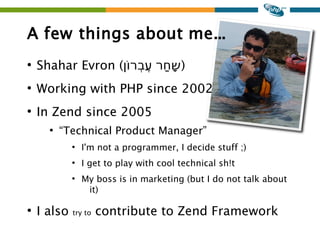
A few things about me...
●
Shahar Evron (‫ֹן‬‫ו‬‫ְר‬‫ב‬ֶ‫ע‬ ‫ַר‬‫ח‬ָ‫ש‬)
●
Working with PHP since 2002
●
In Zend since 2005
●
“Technical Product Manager”
●
I'm not a programmer, I decide stuff ;)
●
I get to play with cool technical sh!t
●
My boss is in marketing (but I do not talk about
it)
●
I also try to contribute to Zend Framework
Part I: Broken Cycles
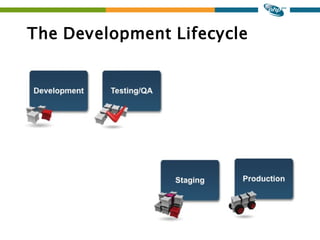
The Development Lifecycle
Development
●
Purpose
●
Provide developers with an environment to
work in efficiently
●
Characteristics
●
Should be similar to production, though it
usually isn’t
●
Often more open security
●
Error reporting and debugging enabled
●
Local or semi-local to the developer
Testing
●
Purpose
●
Provide a stable environment to test
functionality on
●
Characteristics
●
Continuous Integration could be included
●
Environment closer to production setup
●
Stable - no development occurs, only testing
●
Test a specific code snapshot / tag
●
Developers should not do the testing
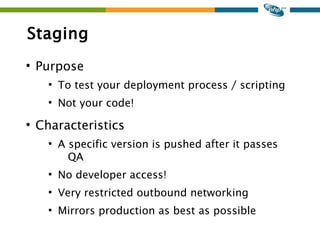
Staging
●
Purpose
●
To test your deployment process / scripting
●
Not your code!
●
Characteristics
●
A specific version is pushed after it passes
QA
●
No developer access!
●
Very restricted outbound networking
●
Mirrors production as best as possible
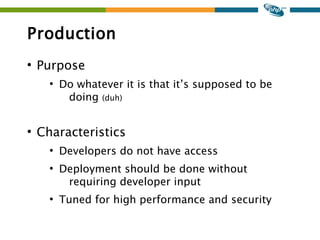
Production
●
Purpose
●
Do whatever it is that it’s supposed to be
doing (duh)
●
Characteristics
●
Developers do not have access
●
Deployment should be done without
requiring developer input
●
Tuned for high performance and security
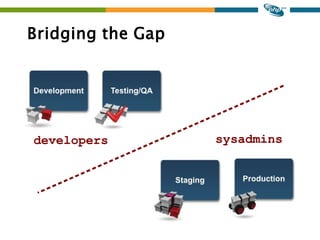
Bridging the Gap
developers sysadmins
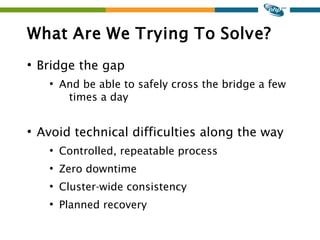
What Are We Trying To Solve?
●
Bridge the gap
●
And be able to safely cross the bridge a few
times a day
●
Avoid technical difficulties along the way
●
Controlled, repeatable process
●
Zero downtime
●
Cluster-wide consistency
●
Planned recovery
Application Considerations
●
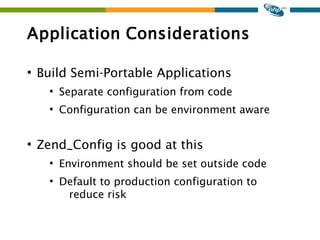
Build Semi-Portable Applications
●
Separate configuration from code
●
Configuration can be environment aware
●
Zend_Config is good at this
●
Environment should be set outside code
●
Default to production configuration to
reduce risk
A Quick ZF Example: config.ini
[production]
log.verbosity = WARN
php.display_errors = off
php.error_reporting = E_ALL & ~E_NOTICE
db.adapter = PDO_MYSQL
db.hostname = myhugedbcluster.myapp.lan
db.dbname = productiondb
[testing:production]
log.verbosity = NOTICE
php.error_reporting = E_ALL | E_STRICT
db.hostname = mytestdb.myapp.lan
db.dbname = testingdb
[development:testing]
log.verbosity = DEBUG
php.display_errors = on
db.adapter = PDO_SQLITE
db.dbname = localdev.sq3
A Quick ZF Example: index.php
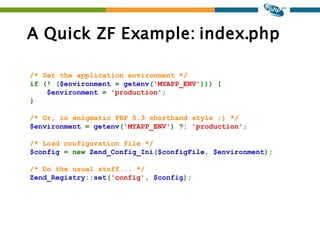
/* Set the application environment */
if (! ($environment = getenv('MYAPP_ENV'))) {
$environment = 'production';
}
/* Or, in enigmatic PHP 5.3 shorthand style ;) */
$environment = getenv('MYAPP_ENV') ?: 'production';
/* Load configuration file */
$config = new Zend_Config_Ini($configFile, $environment);
/* Do the usual stuff... */
Zend_Registry::set('config', $config);
A Quick ZF Example: httpd.conf
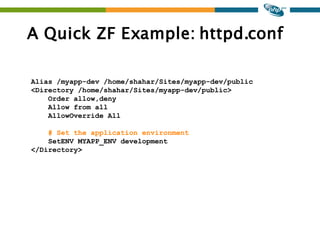
Alias /myapp-dev /home/shahar/Sites/myapp-dev/public
<Directory /home/shahar/Sites/myapp-dev/public>
Order allow,deny
Allow from all
AllowOverride All
# Set the application environment
SetENV MYAPP_ENV development
</Directory>
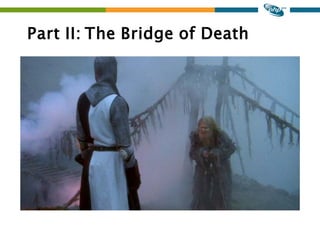
Part II: The Bridge of Death
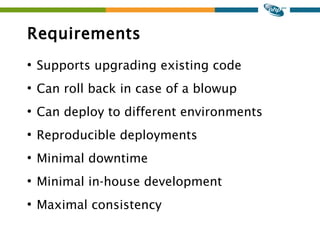
Requirements
●
Supports upgrading existing code
●
Can roll back in case of a blowup
●
Can deploy to different environments
●
Reproducible deployments
●
Minimal downtime
●
Minimal in-house development
●
Maximal consistency
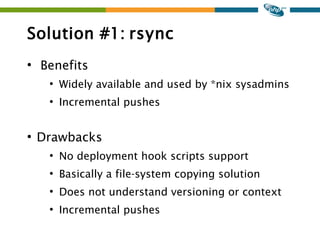
Solution #1: rsync
●
Benefits
●
Widely available and used by *nix sysadmins
●
Incremental pushes
●
Drawbacks
●
No deployment hook scripts support
●
Basically a file-system copying solution
●
Does not understand versioning or context
●
Incremental pushes
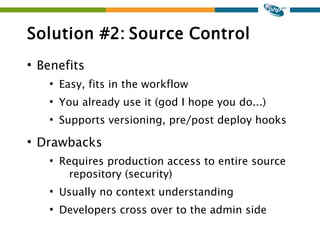
Solution #2: Source Control
●
Benefits
●
Easy, fits in the workflow
●
You already use it (god I hope you do...)
●
Supports versioning, pre/post deploy hooks
●
Drawbacks
●
Requires production access to entire source
repository (security)
●
Usually no context understanding
●
Developers cross over to the admin side
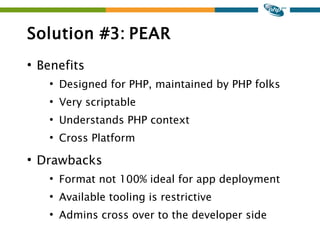
Solution #3: PEAR
●
Benefits
●
Designed for PHP, maintained by PHP folks
●
Very scriptable
●
Understands PHP context
●
Cross Platform
●
Drawbacks
●
Format not 100% ideal for app deployment
●
Available tooling is restrictive
●
Admins cross over to the developer side
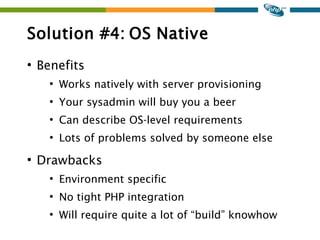
Solution #4: OS Native
●
Benefits
●
Works natively with server provisioning
●
Your sysadmin will buy you a beer
●
Can describe OS-level requirements
●
Lots of problems solved by someone else
●
Drawbacks
●
Environment specific
●
No tight PHP integration
●
Will require quite a lot of “build” knowhow
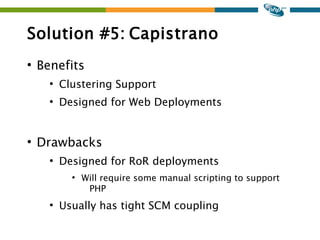
Solution #5: Capistrano
●
Benefits
●
Clustering Support
●
Designed for Web Deployments
●
Drawbacks
●
Designed for RoR deployments
●
Will require some manual scripting to support
PHP
●
Usually has tight SCM coupling
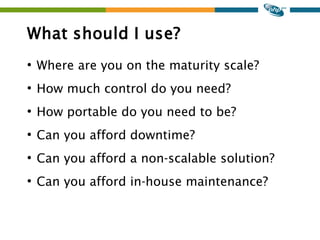
What should I use?
●
Where are you on the maturity scale?
●
How much control do you need?
●
How portable do you need to be?
●
Can you afford downtime?
●
Can you afford a non-scalable solution?
●
Can you afford in-house maintenance?
Part III: Deliberate Ambiguity
So what's up with Zend Server?
●
Zend is working on a deployment solution
●
You have seen some of it in today's keynote
●
IT'S NOT READY YET!
●
I cannot say when it's going to be ready
●
It's a prototype, lots of things may change
●
I want your feedback!
Zend Server Deployment
●
Based on an open, simple package format
●
Basically a zip/tarball with an XML
descriptor
●
You can create it using common tools
●
Package includes and defines:
●
Code, hook scripts
●
Configuration, dependancies
●
Required and optional parameters
Zend Server Deployment
●
Synchronized cluster deployments
●
Two-step stage / activate workflow
●
Apache / IIS integration
●
Will define vhost / alias as needed
●
Upgrades
●
Rollbacks
●
A simple switch-back to the previous version
which is already staged
Questions? Feedback?
●
Find me at the Zend booth
●
Email me: shahar.e@zend.com
●
IRC: #zftalk, #zendserver @ FreeNode
Thank You!

Best Practices in PHP Application Deployment

  • 1.
    Shahar Evron |Zend Technologies Best Practices in PHP Deployment
  • 2.
    Agenda ● The PHP ApplicationLifecycle ● What problem are we trying to solve? ● What are the current ways to solve it? ● A little bit of what Zend is working on ● Hopefully more discussion than talk ● This is what I've learned ● Maybe you know better
  • 3.
    A few thingsabout me... ● Shahar Evron (‫ֹן‬‫ו‬‫ְר‬‫ב‬ֶ‫ע‬ ‫ַר‬‫ח‬ָ‫ש‬) ● Working with PHP since 2002 ● In Zend since 2005 ● “Technical Product Manager” ● I'm not a programmer, I decide stuff ;) ● I get to play with cool technical sh!t ● My boss is in marketing (but I do not talk about it) ● I also try to contribute to Zend Framework
  • 4.
  • 5.
  • 6.
    Development ● Purpose ● Provide developers withan environment to work in efficiently ● Characteristics ● Should be similar to production, though it usually isn’t ● Often more open security ● Error reporting and debugging enabled ● Local or semi-local to the developer
  • 7.
    Testing ● Purpose ● Provide a stableenvironment to test functionality on ● Characteristics ● Continuous Integration could be included ● Environment closer to production setup ● Stable - no development occurs, only testing ● Test a specific code snapshot / tag ● Developers should not do the testing
  • 8.
    Staging ● Purpose ● To test yourdeployment process / scripting ● Not your code! ● Characteristics ● A specific version is pushed after it passes QA ● No developer access! ● Very restricted outbound networking ● Mirrors production as best as possible
  • 9.
    Production ● Purpose ● Do whatever itis that it’s supposed to be doing (duh) ● Characteristics ● Developers do not have access ● Deployment should be done without requiring developer input ● Tuned for high performance and security
  • 10.
  • 11.
    What Are WeTrying To Solve? ● Bridge the gap ● And be able to safely cross the bridge a few times a day ● Avoid technical difficulties along the way ● Controlled, repeatable process ● Zero downtime ● Cluster-wide consistency ● Planned recovery
  • 12.
    Application Considerations ● Build Semi-PortableApplications ● Separate configuration from code ● Configuration can be environment aware ● Zend_Config is good at this ● Environment should be set outside code ● Default to production configuration to reduce risk
  • 13.
    A Quick ZFExample: config.ini [production] log.verbosity = WARN php.display_errors = off php.error_reporting = E_ALL & ~E_NOTICE db.adapter = PDO_MYSQL db.hostname = myhugedbcluster.myapp.lan db.dbname = productiondb [testing:production] log.verbosity = NOTICE php.error_reporting = E_ALL | E_STRICT db.hostname = mytestdb.myapp.lan db.dbname = testingdb [development:testing] log.verbosity = DEBUG php.display_errors = on db.adapter = PDO_SQLITE db.dbname = localdev.sq3
  • 14.
    A Quick ZFExample: index.php /* Set the application environment */ if (! ($environment = getenv('MYAPP_ENV'))) { $environment = 'production'; } /* Or, in enigmatic PHP 5.3 shorthand style ;) */ $environment = getenv('MYAPP_ENV') ?: 'production'; /* Load configuration file */ $config = new Zend_Config_Ini($configFile, $environment); /* Do the usual stuff... */ Zend_Registry::set('config', $config);
  • 15.
    A Quick ZFExample: httpd.conf Alias /myapp-dev /home/shahar/Sites/myapp-dev/public <Directory /home/shahar/Sites/myapp-dev/public> Order allow,deny Allow from all AllowOverride All # Set the application environment SetENV MYAPP_ENV development </Directory>
  • 16.
    Part II: TheBridge of Death
  • 17.
    Requirements ● Supports upgrading existingcode ● Can roll back in case of a blowup ● Can deploy to different environments ● Reproducible deployments ● Minimal downtime ● Minimal in-house development ● Maximal consistency
  • 18.
    Solution #1: rsync ● Benefits ● Widelyavailable and used by *nix sysadmins ● Incremental pushes ● Drawbacks ● No deployment hook scripts support ● Basically a file-system copying solution ● Does not understand versioning or context ● Incremental pushes
  • 19.
    Solution #2: SourceControl ● Benefits ● Easy, fits in the workflow ● You already use it (god I hope you do...) ● Supports versioning, pre/post deploy hooks ● Drawbacks ● Requires production access to entire source repository (security) ● Usually no context understanding ● Developers cross over to the admin side
  • 20.
    Solution #3: PEAR ● Benefits ● Designedfor PHP, maintained by PHP folks ● Very scriptable ● Understands PHP context ● Cross Platform ● Drawbacks ● Format not 100% ideal for app deployment ● Available tooling is restrictive ● Admins cross over to the developer side
  • 21.
    Solution #4: OSNative ● Benefits ● Works natively with server provisioning ● Your sysadmin will buy you a beer ● Can describe OS-level requirements ● Lots of problems solved by someone else ● Drawbacks ● Environment specific ● No tight PHP integration ● Will require quite a lot of “build” knowhow
  • 22.
    Solution #5: Capistrano ● Benefits ● ClusteringSupport ● Designed for Web Deployments ● Drawbacks ● Designed for RoR deployments ● Will require some manual scripting to support PHP ● Usually has tight SCM coupling
  • 23.
    What should Iuse? ● Where are you on the maturity scale? ● How much control do you need? ● How portable do you need to be? ● Can you afford downtime? ● Can you afford a non-scalable solution? ● Can you afford in-house maintenance?
  • 24.
  • 25.
    So what's upwith Zend Server? ● Zend is working on a deployment solution ● You have seen some of it in today's keynote ● IT'S NOT READY YET! ● I cannot say when it's going to be ready ● It's a prototype, lots of things may change ● I want your feedback!
  • 26.
    Zend Server Deployment ● Basedon an open, simple package format ● Basically a zip/tarball with an XML descriptor ● You can create it using common tools ● Package includes and defines: ● Code, hook scripts ● Configuration, dependancies ● Required and optional parameters
  • 27.
    Zend Server Deployment ● Synchronizedcluster deployments ● Two-step stage / activate workflow ● Apache / IIS integration ● Will define vhost / alias as needed ● Upgrades ● Rollbacks ● A simple switch-back to the previous version which is already staged
  • 28.
    Questions? Feedback? ● Find meat the Zend booth ● Email me: shahar.e@zend.com ● IRC: #zftalk, #zendserver @ FreeNode
  • 29.