FOUNDATION
OFTHE
PRINCIPLES OF
BUSINESS
ETHICS
ANCIENT PHILOSOPHIES ANDTHEIR
IMPLICATIONSTO BUSINESS
2
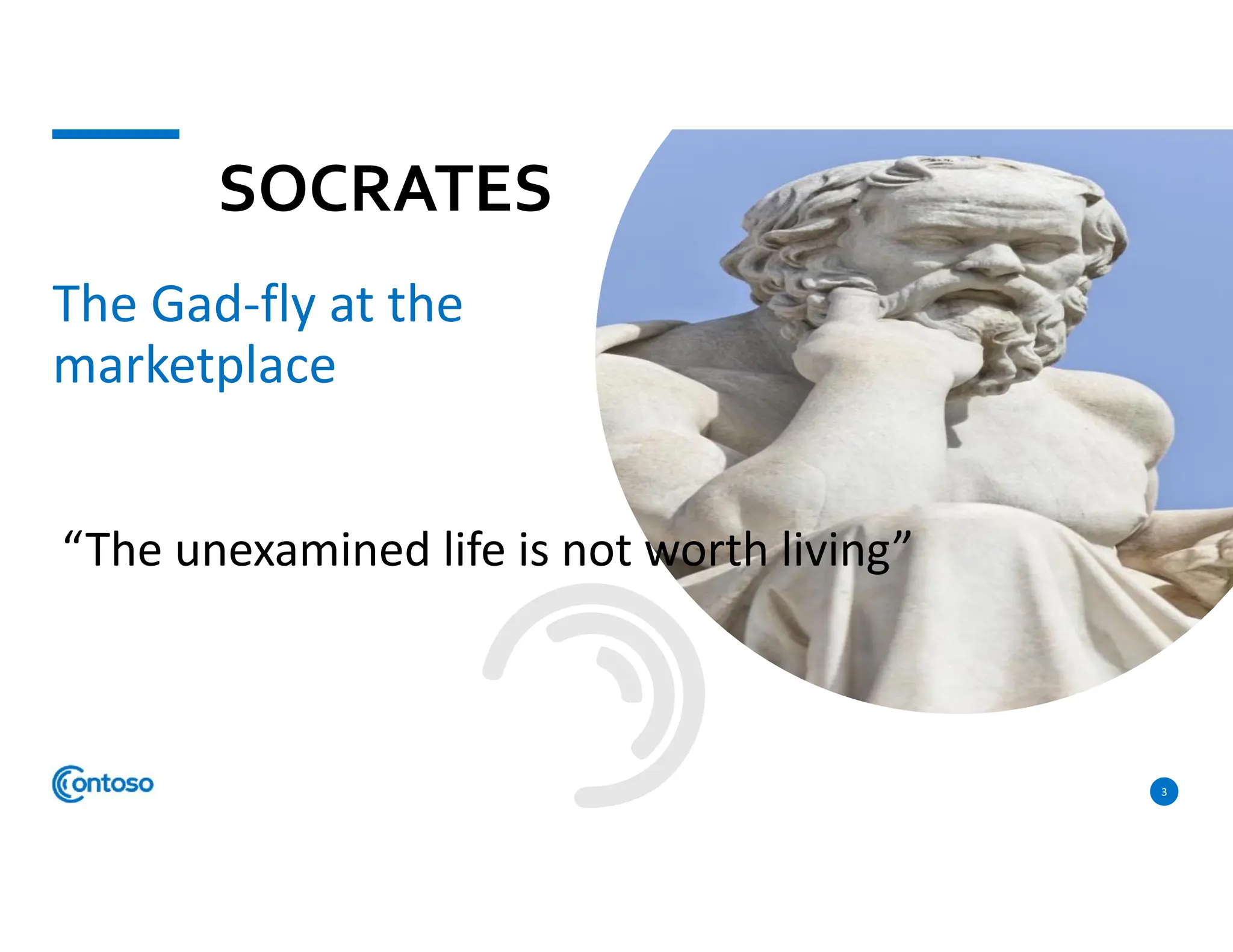
SOCRATES
The Gad-fly at the
marketplace
3
“The unexamined life is not worth living”
4
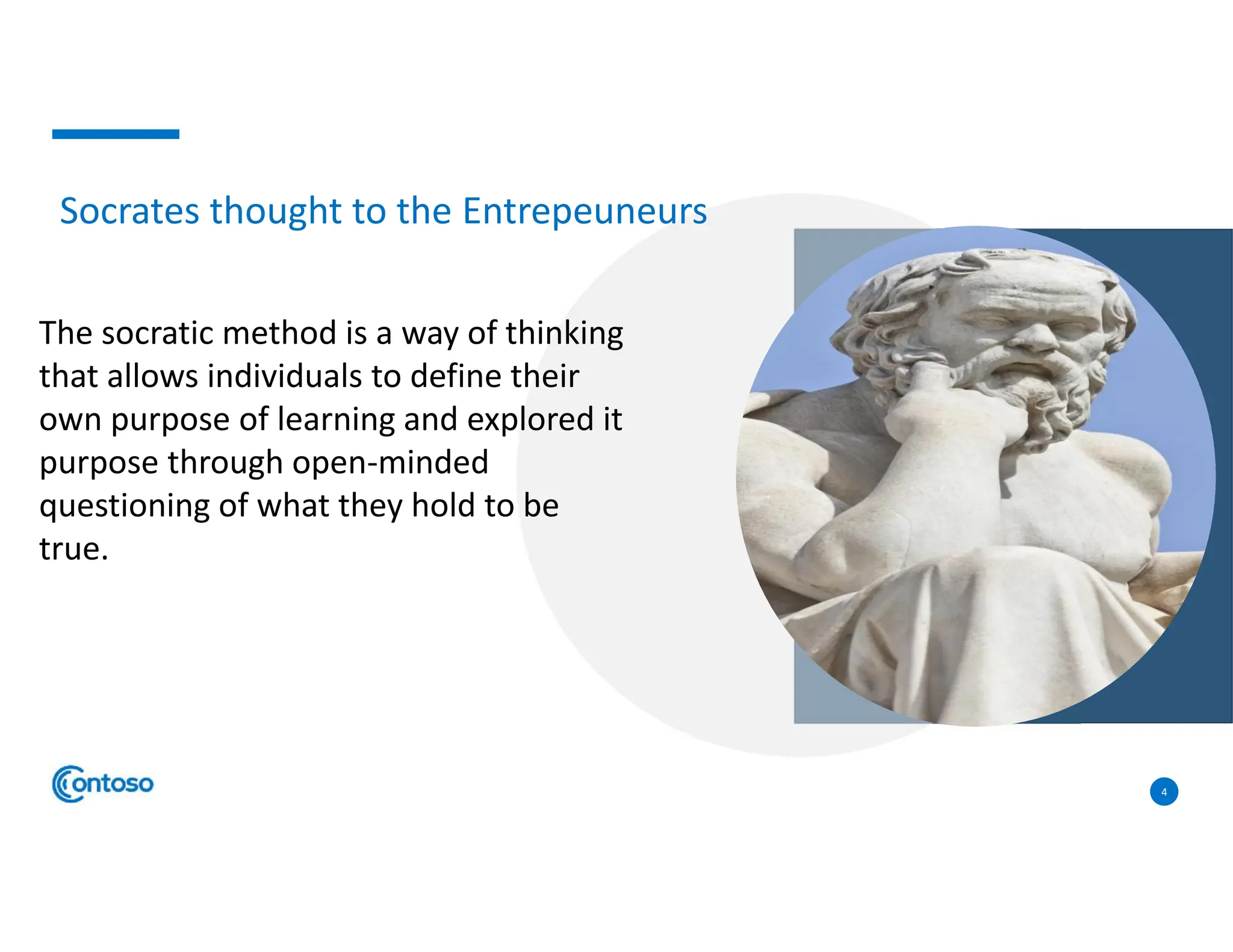
The socratic method is a way of thinking
that allows individuals to define their
own purpose of learning and explored it
purpose through open-minded
questioning of what they hold to be
true.
Socrates thought to the Entrepeuneurs
5
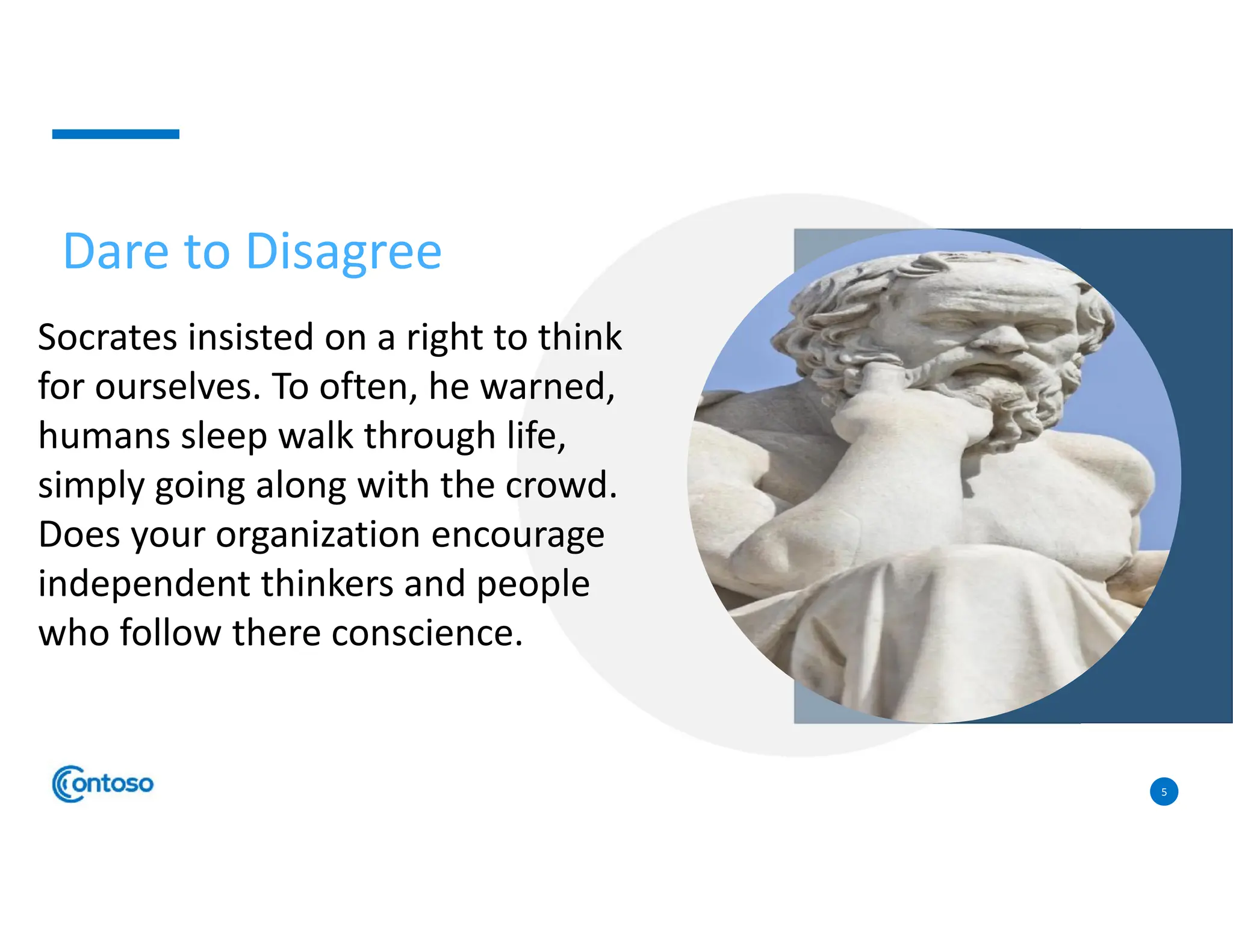
Socrates insisted on a right to think
for ourselves. To often, he warned,
humans sleep walk through life,
simply going along with the crowd.
Does your organization encourage
independent thinkers and people
who follow there conscience.
Dare to Disagree
6
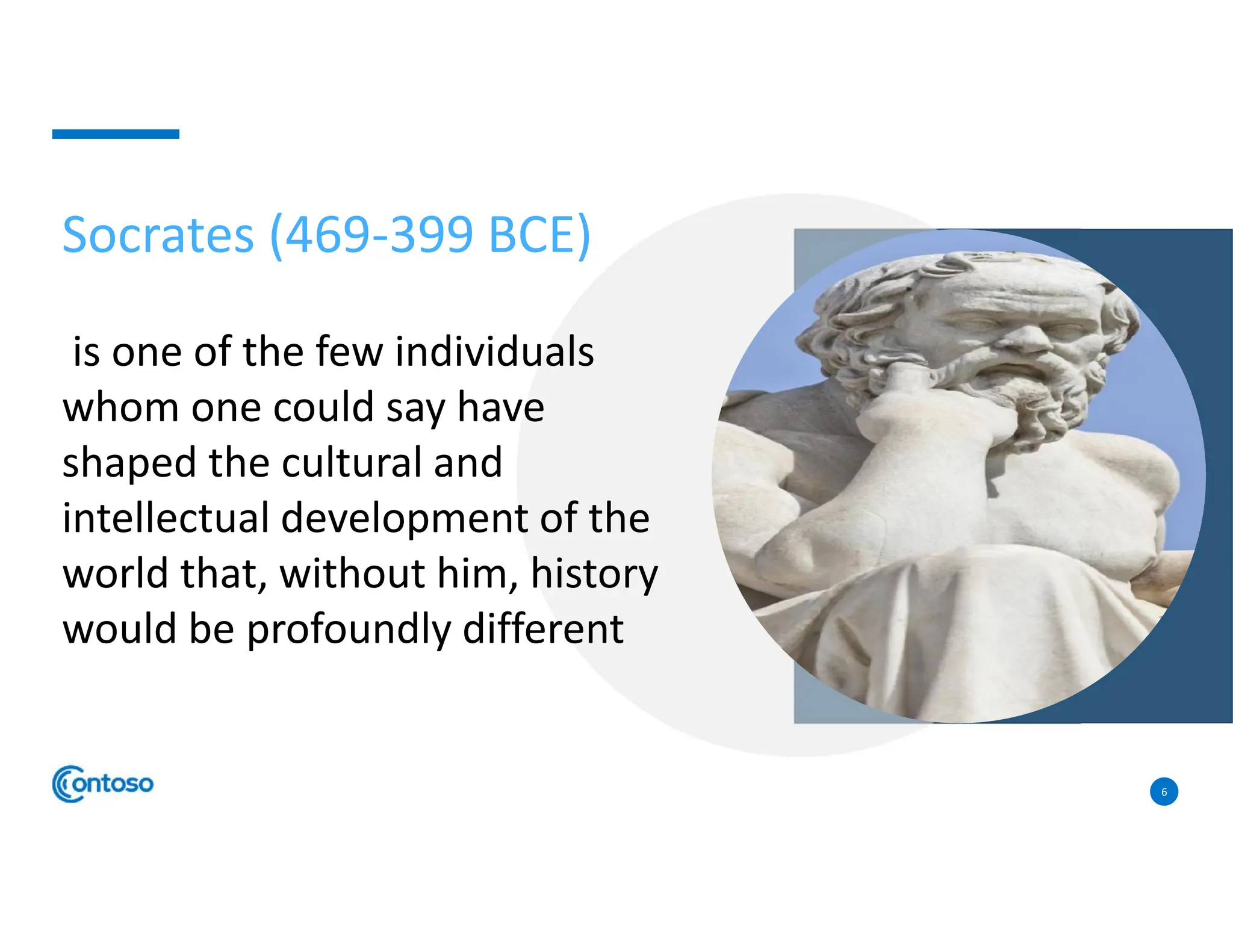
Socrates (469-399 BCE)
is one of the few individuals
whom one could say have
shaped the cultural and
intellectual development of the
world that, without him, history
would be profoundly different
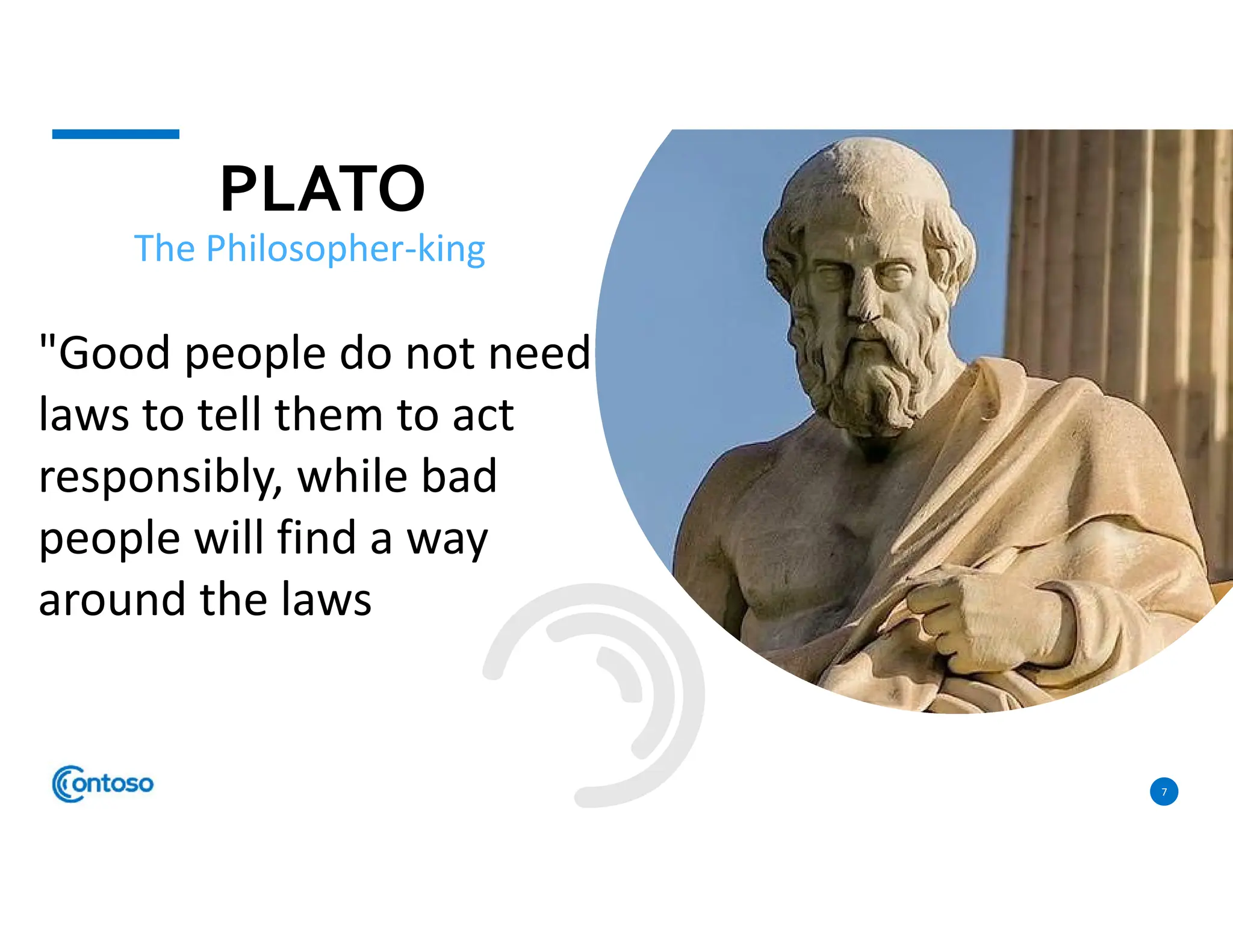
PLATO
7
The Philosopher-king
"Good people do not need
laws to tell them to act
responsibly, while bad
people will find a way
around the laws
8
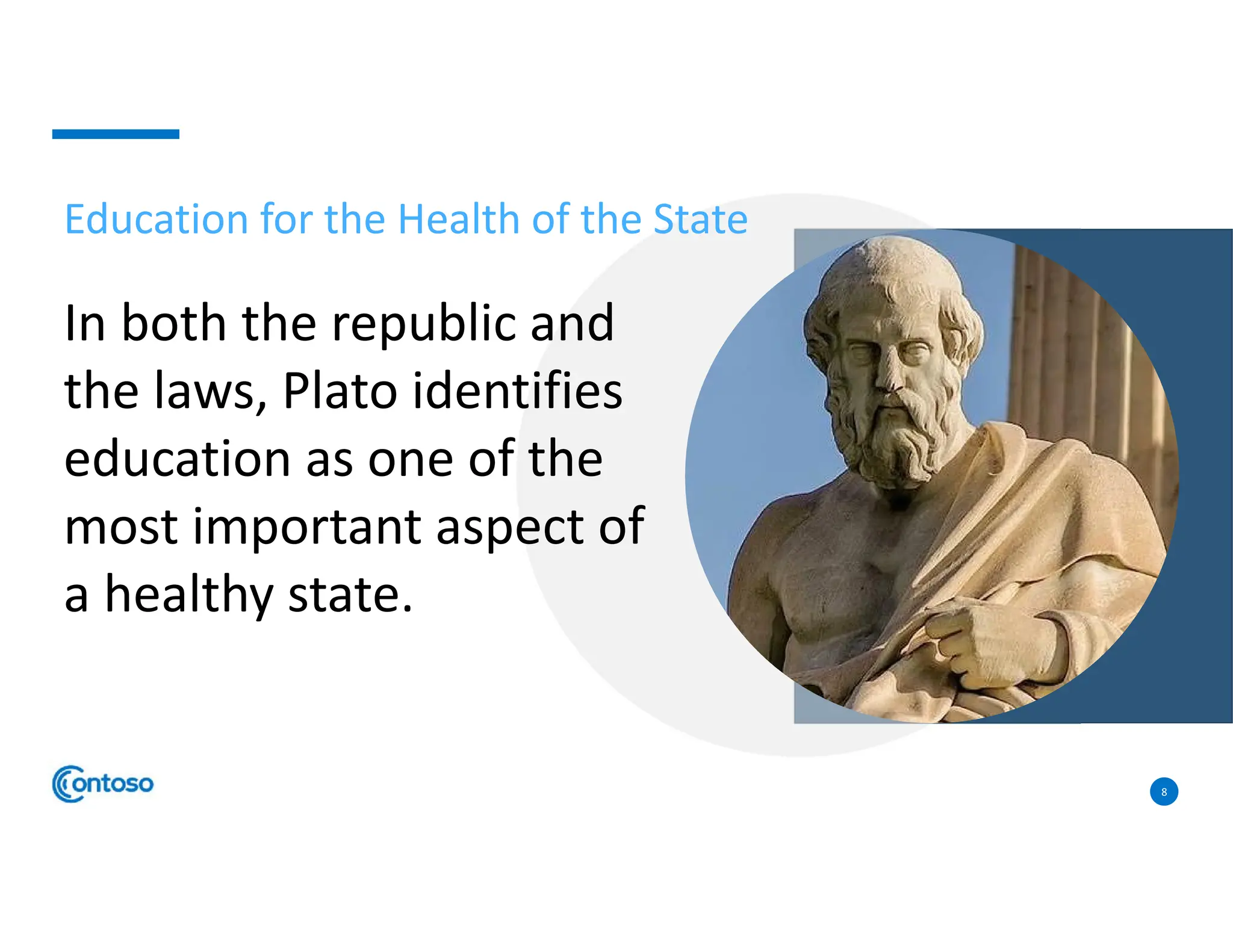
Education for the Health of the State
In both the republic and
the laws, Plato identifies
education as one of the
most important aspect of
a healthy state.
9
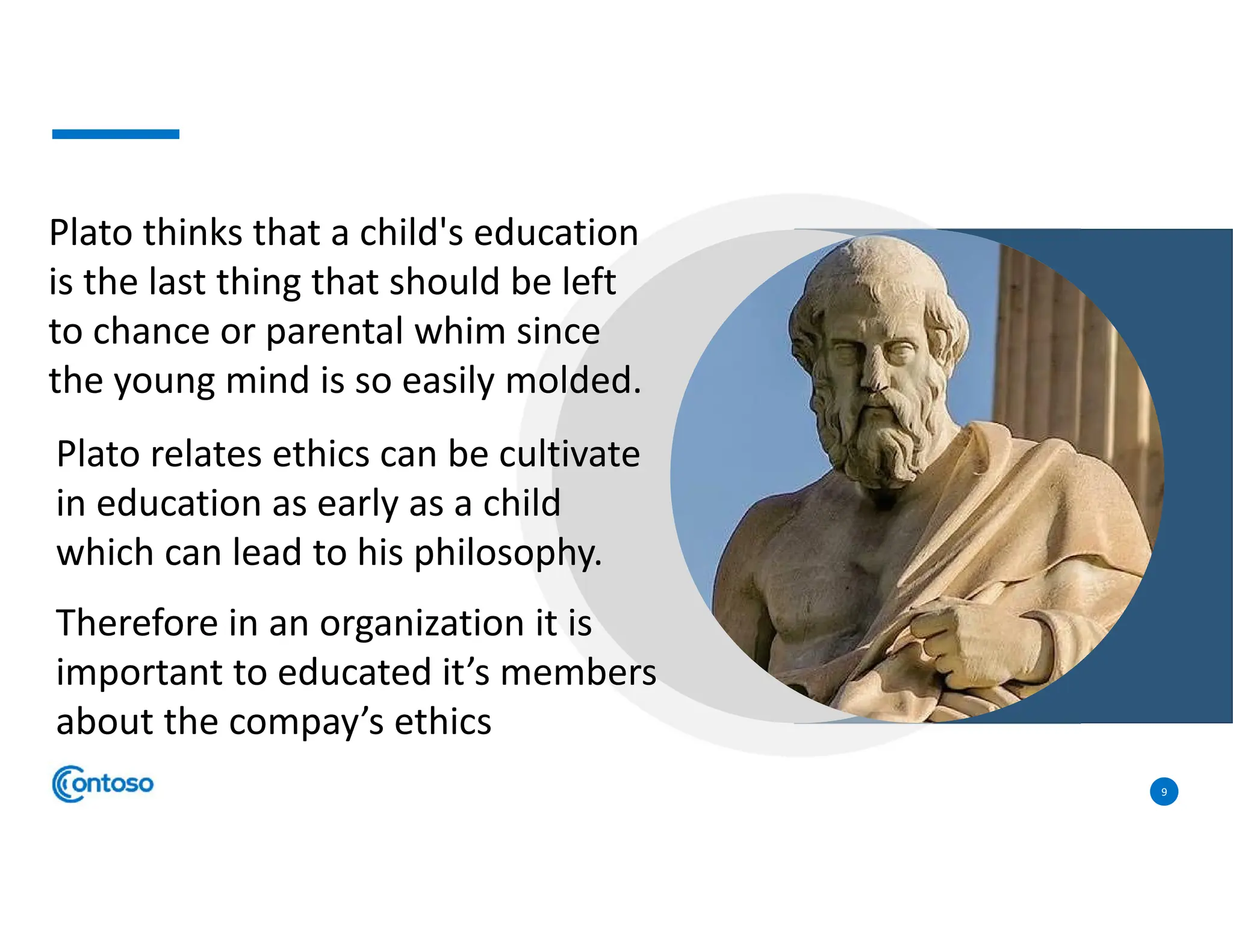
Plato thinks that a child's education
is the last thing that should be left
to chance or parental whim since
the young mind is so easily molded.
Plato relates ethics can be cultivate
in education as early as a child
which can lead to his philosophy.
Therefore in an organization it is
important to educated it’s members
about the compay’s ethics
10
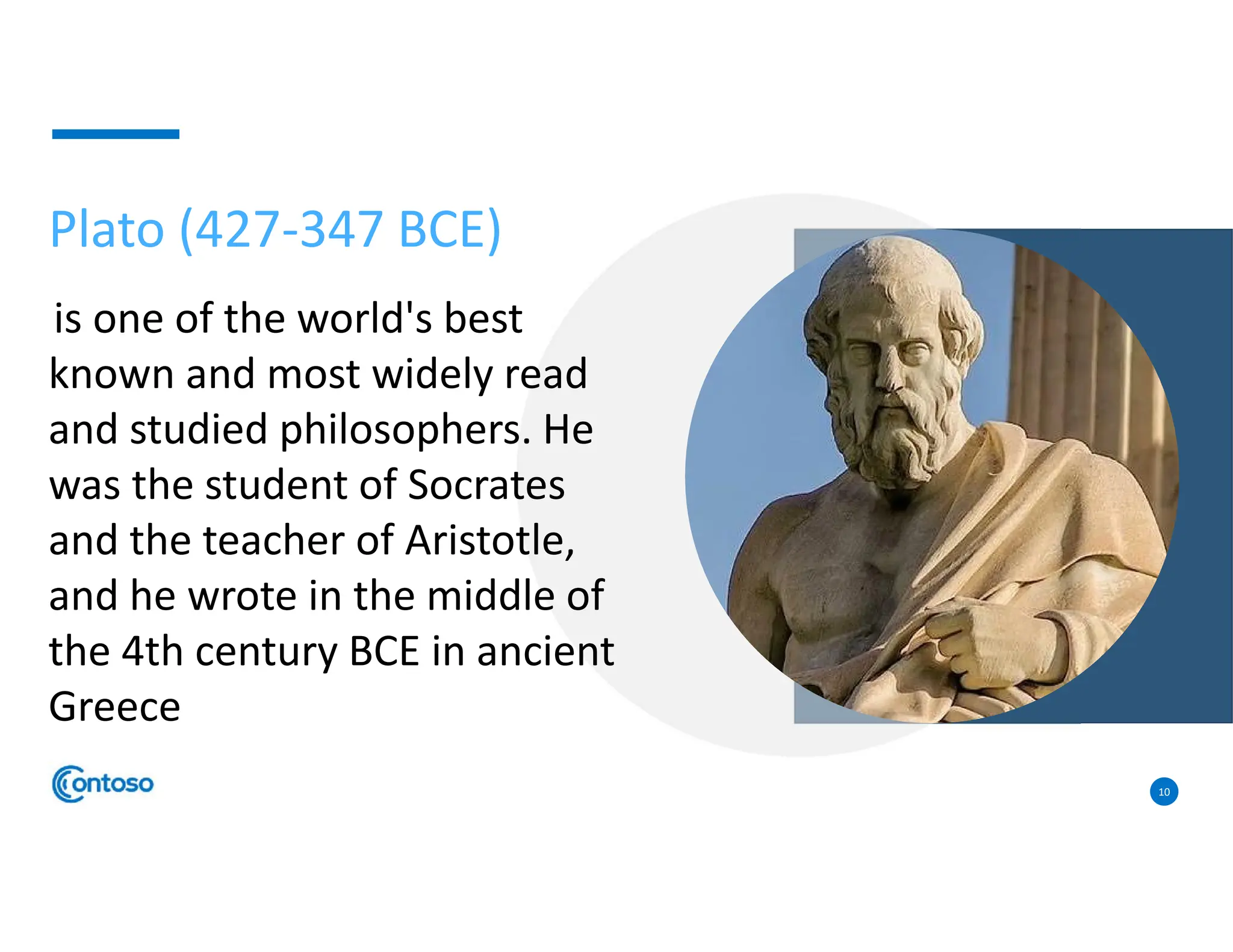
Plato (427-347 BCE)
is one of the world's best
known and most widely read
and studied philosophers. He
was the student of Socrates
and the teacher of Aristotle,
and he wrote in the middle of
the 4th century BCE in ancient
Greece
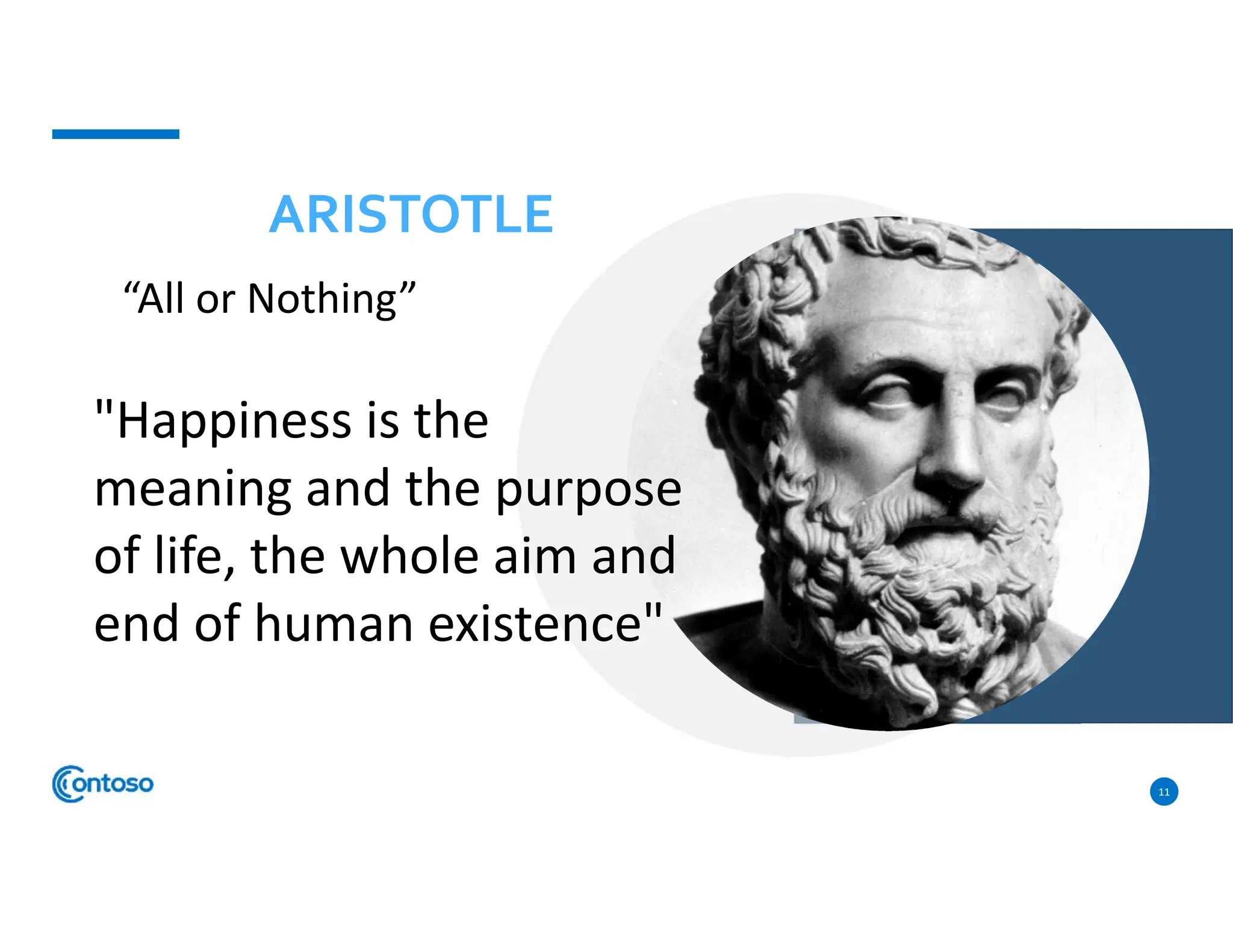
ARISTOTLE
11
“All or Nothing”
"Happiness is the
meaning and the purpose
of life, the whole aim and
end of human existence"
12
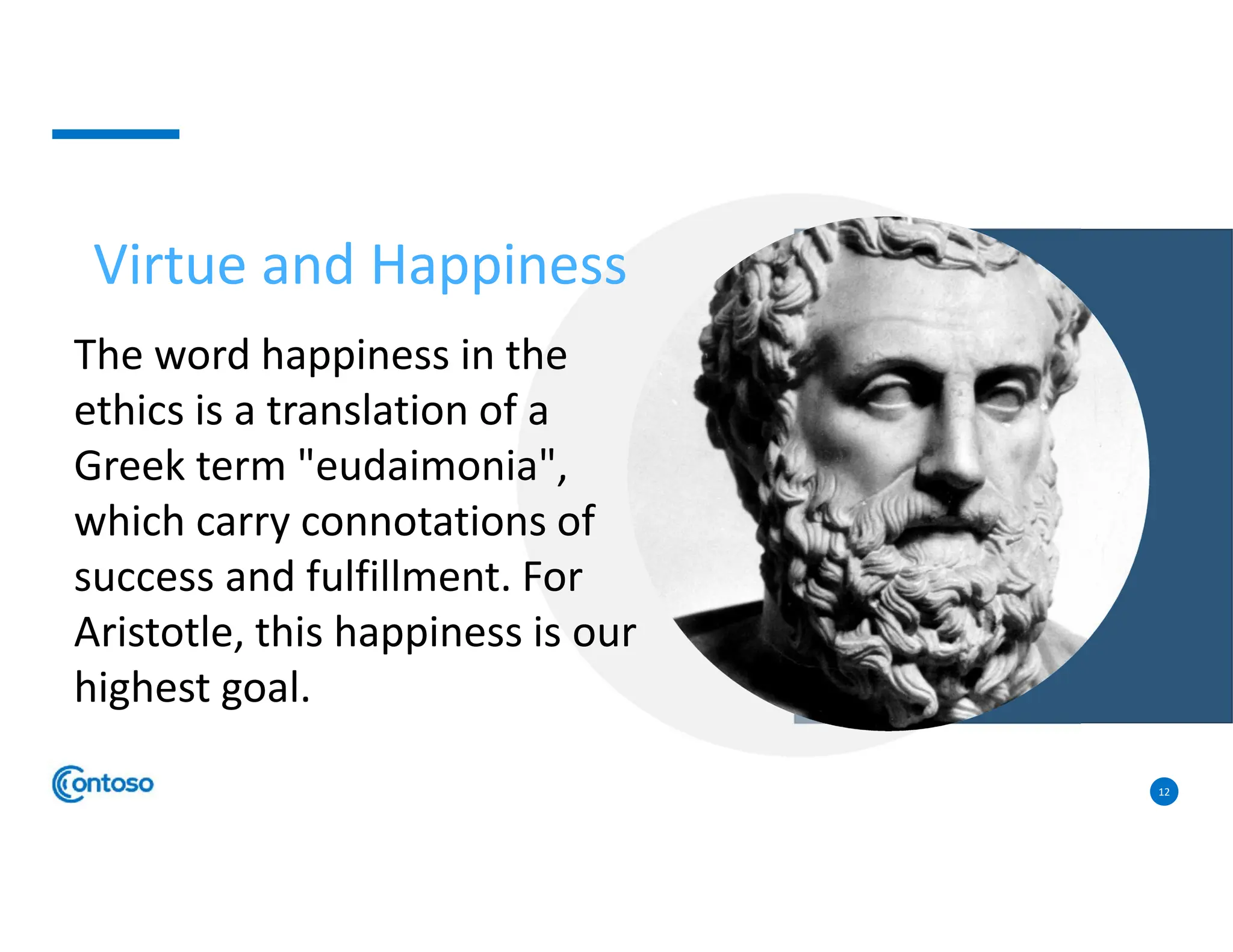
Virtue and Happiness
The word happiness in the
ethics is a translation of a
Greek term "eudaimonia",
which carry connotations of
success and fulfillment. For
Aristotle, this happiness is our
highest goal.
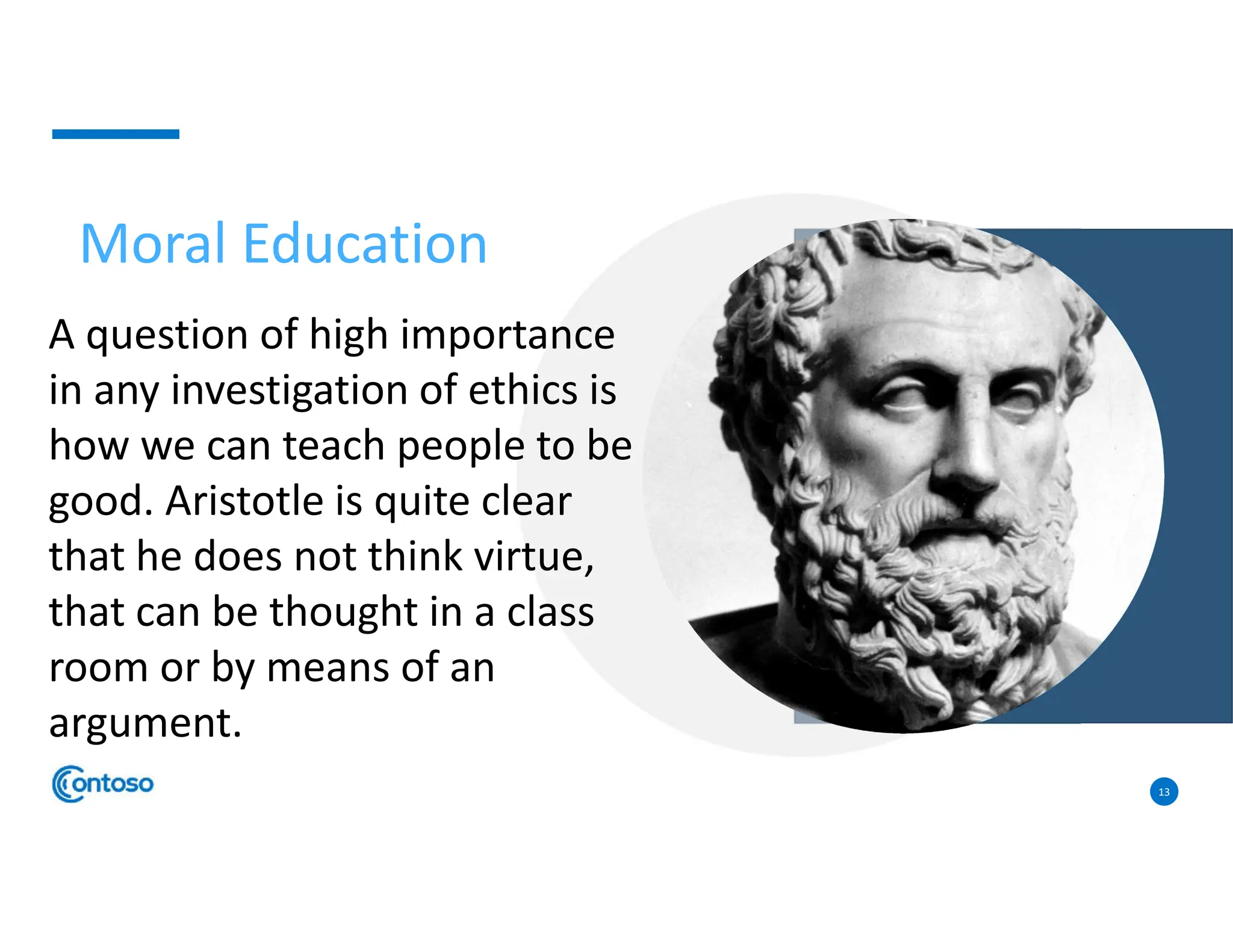
13
A question of high importance
in any investigation of ethics is
how we can teach people to be
good. Aristotle is quite clear
that he does not think virtue,
that can be thought in a class
room or by means of an
argument.
Moral Education
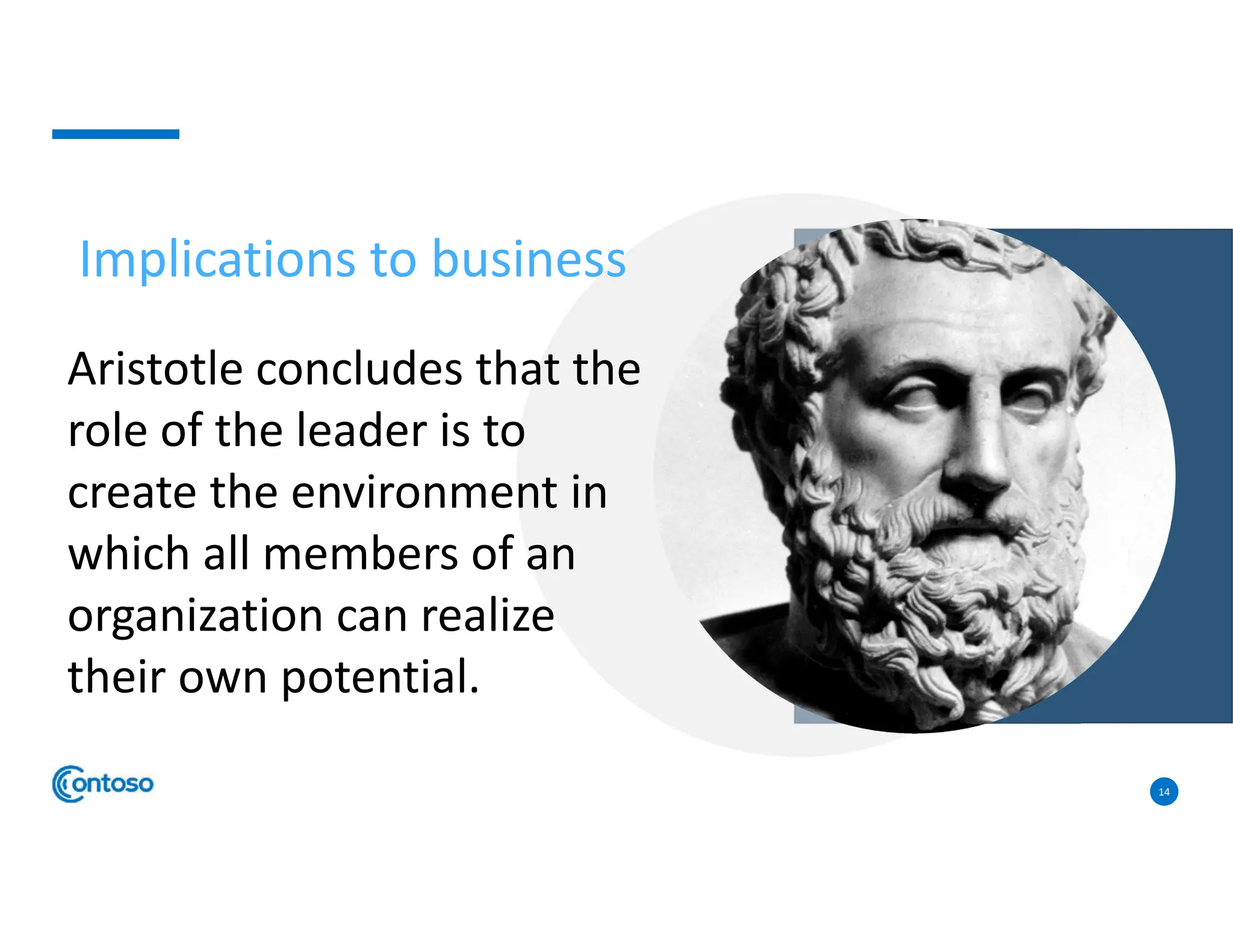
14
Aristotle concludes that the
role of the leader is to
create the environment in
which all members of an
organization can realize
their own potential.
Implications to business
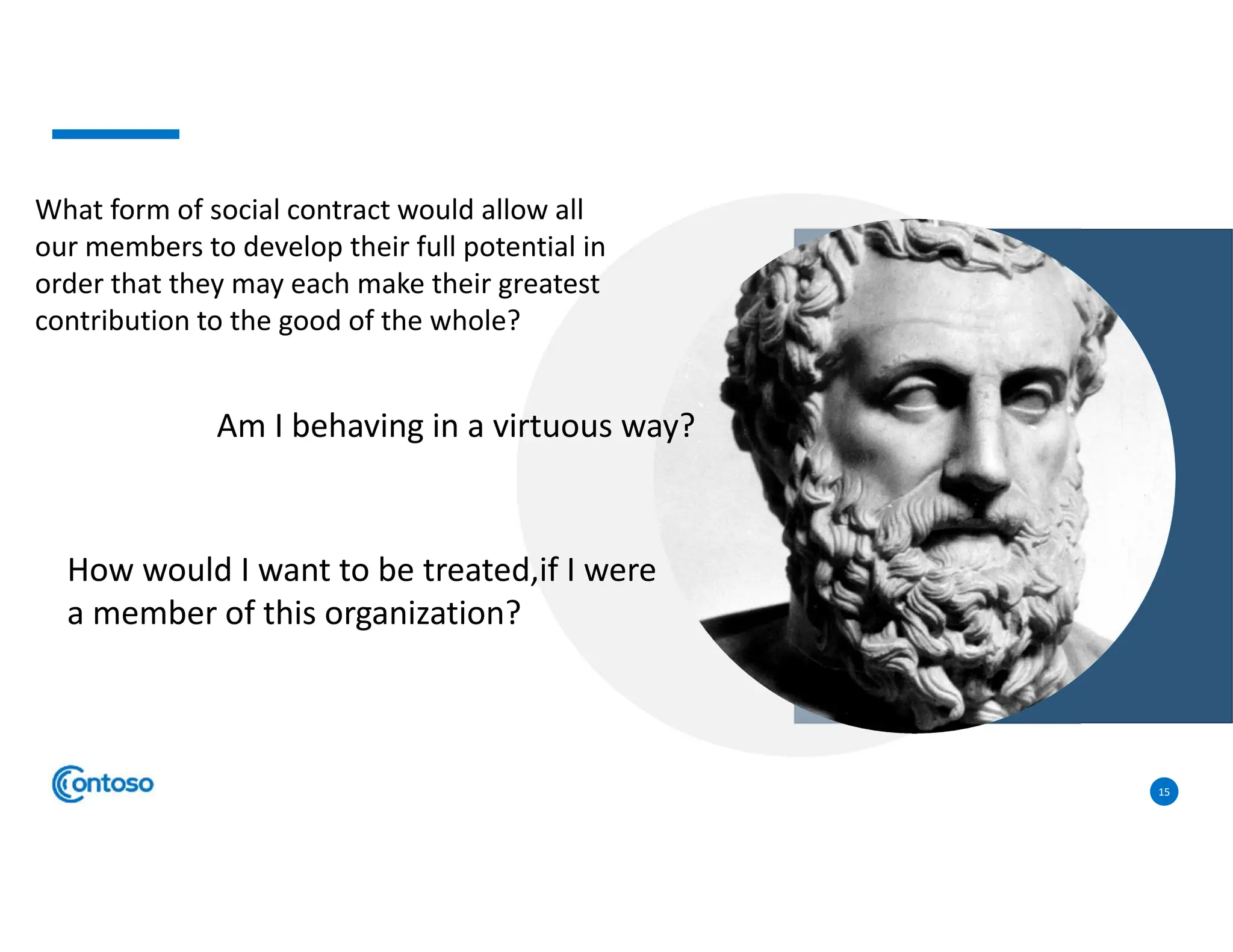
15
What form of social contract would allow all
our members to develop their full potential in
order that they may each make their greatest
contribution to the good of the whole?
Am I behaving in a virtuous way?
How would I want to be treated,if I were
a member of this organization?
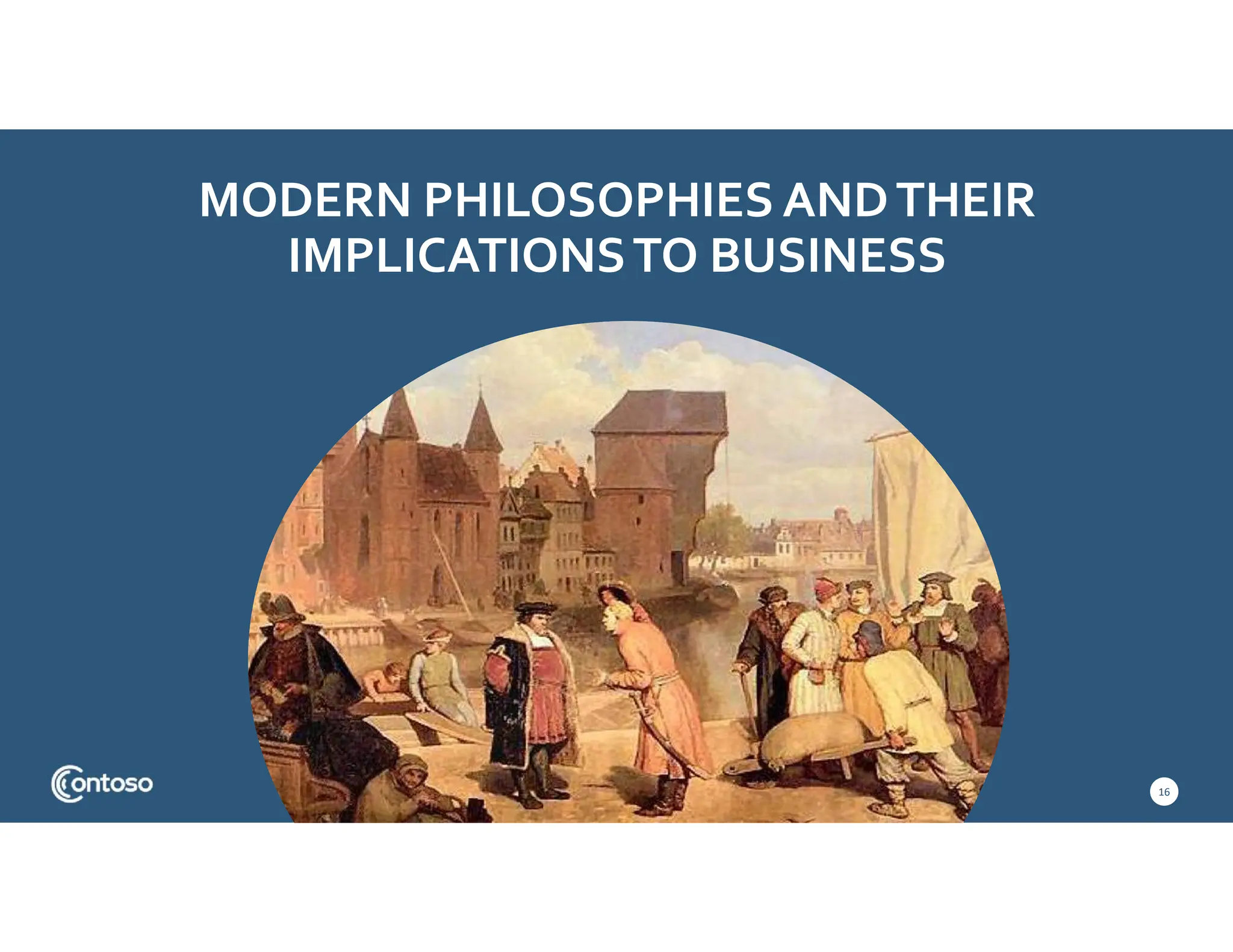
MODERN PHILOSOPHIES ANDTHEIR
IMPLICATIONSTO BUSINESS
16
17
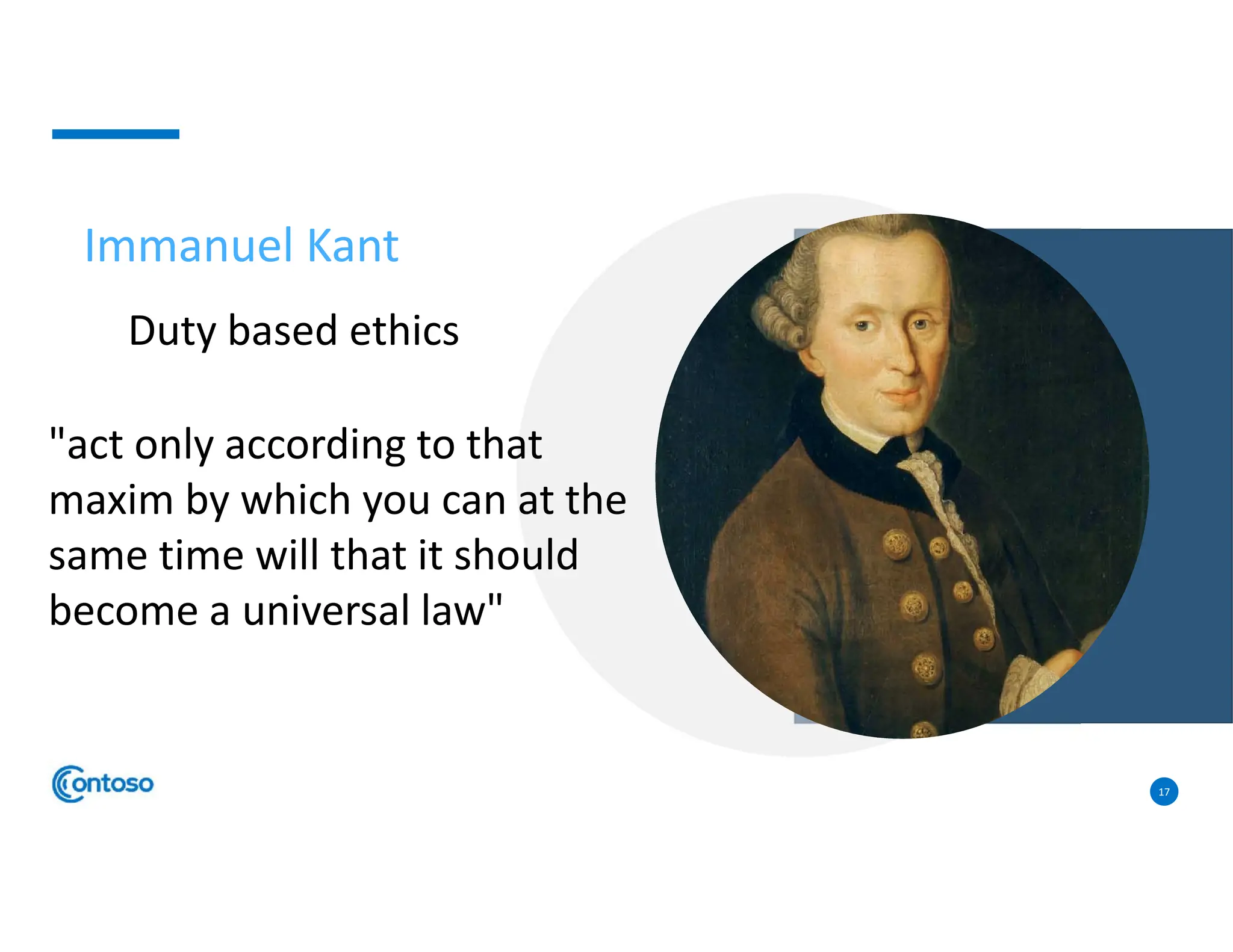
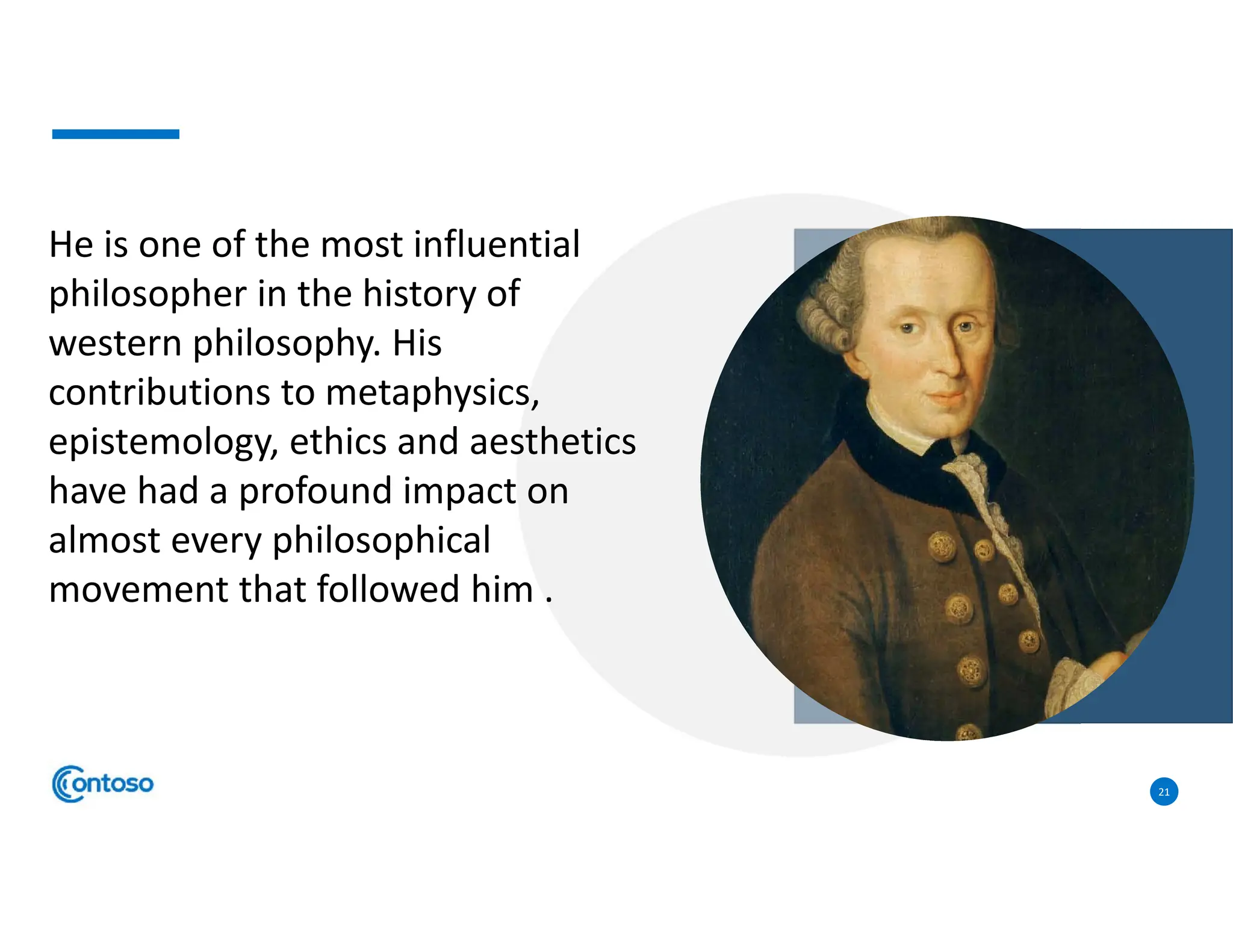
Immanuel Kant
Duty based ethics
"act only according to that
maxim by which you can at the
same time will that it should
become a universal law"
18
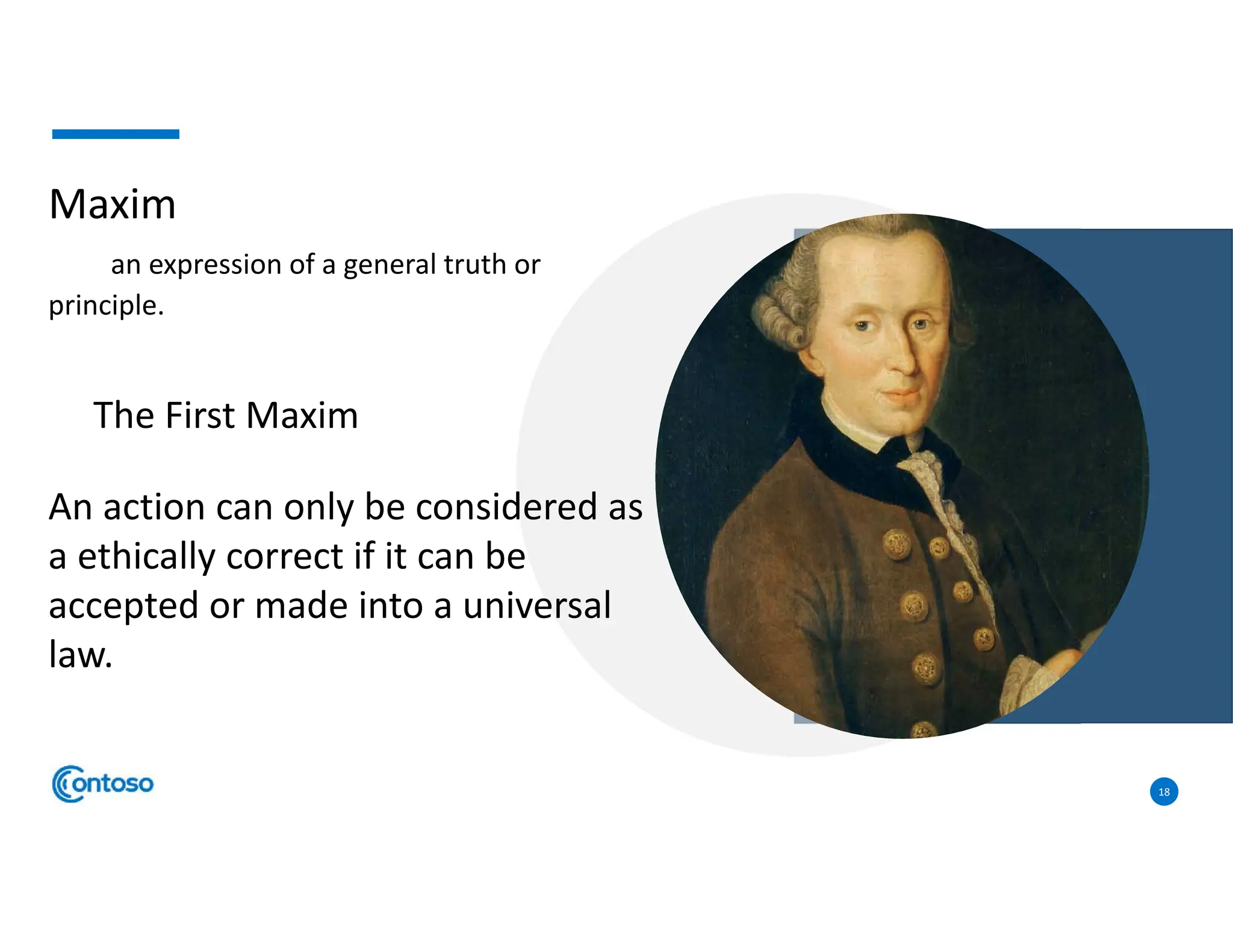
Maxim
an expression of a general truth or
principle.
An action can only be considered as
a ethically correct if it can be
accepted or made into a universal
law.
The First Maxim
19
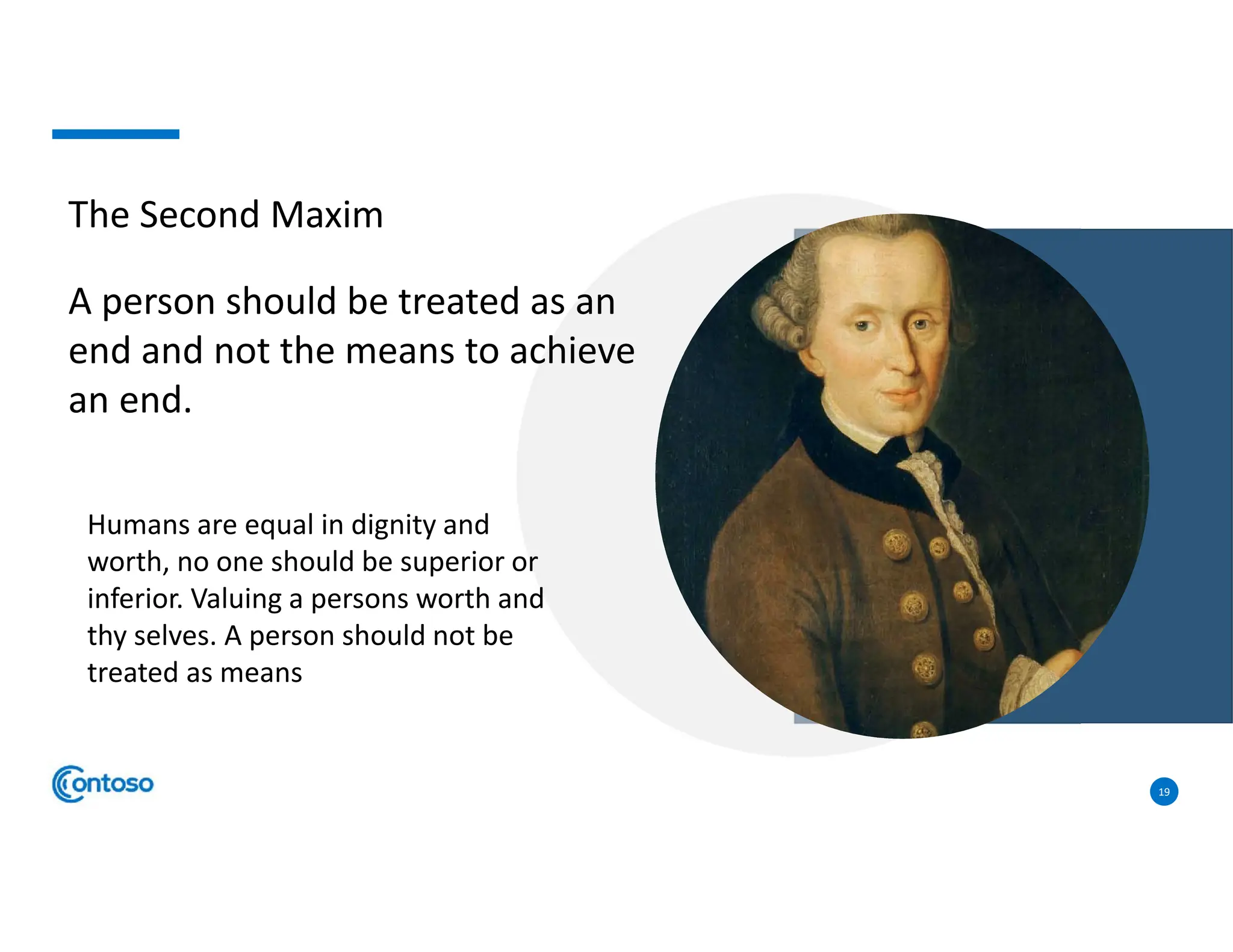
The Second Maxim
A person should be treated as an
end and not the means to achieve
an end.
Humans are equal in dignity and
worth, no one should be superior or
inferior. Valuing a persons worth and
thy selves. A person should not be
treated as means
20
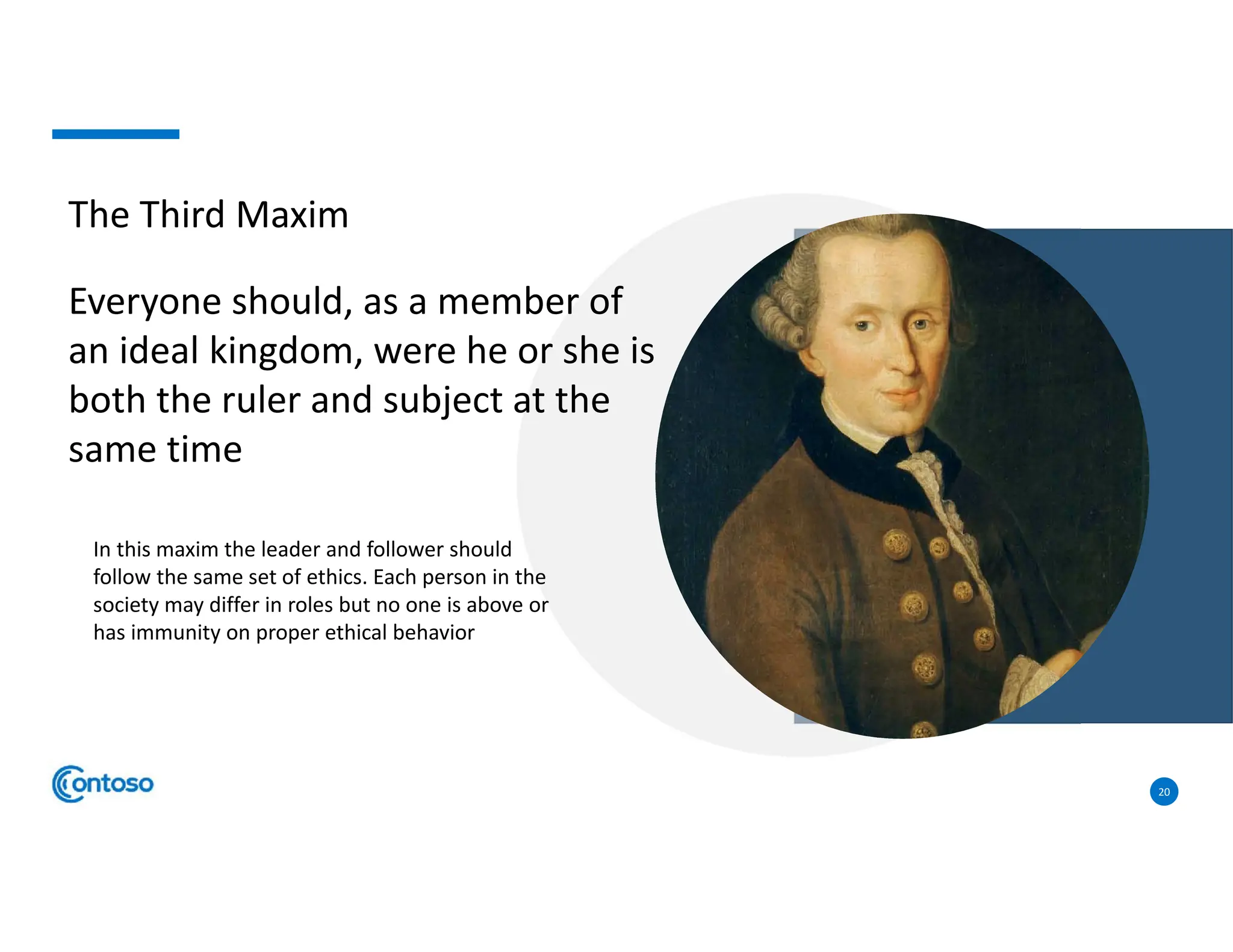
The Third Maxim
Everyone should, as a member of
an ideal kingdom, were he or she is
both the ruler and subject at the
same time
In this maxim the leader and follower should
follow the same set of ethics. Each person in the
society may differ in roles but no one is above or
has immunity on proper ethical behavior
21
He is one of the most influential
philosopher in the history of
western philosophy. His
contributions to metaphysics,
epistemology, ethics and aesthetics
have had a profound impact on
almost every philosophical
movement that followed him .
22
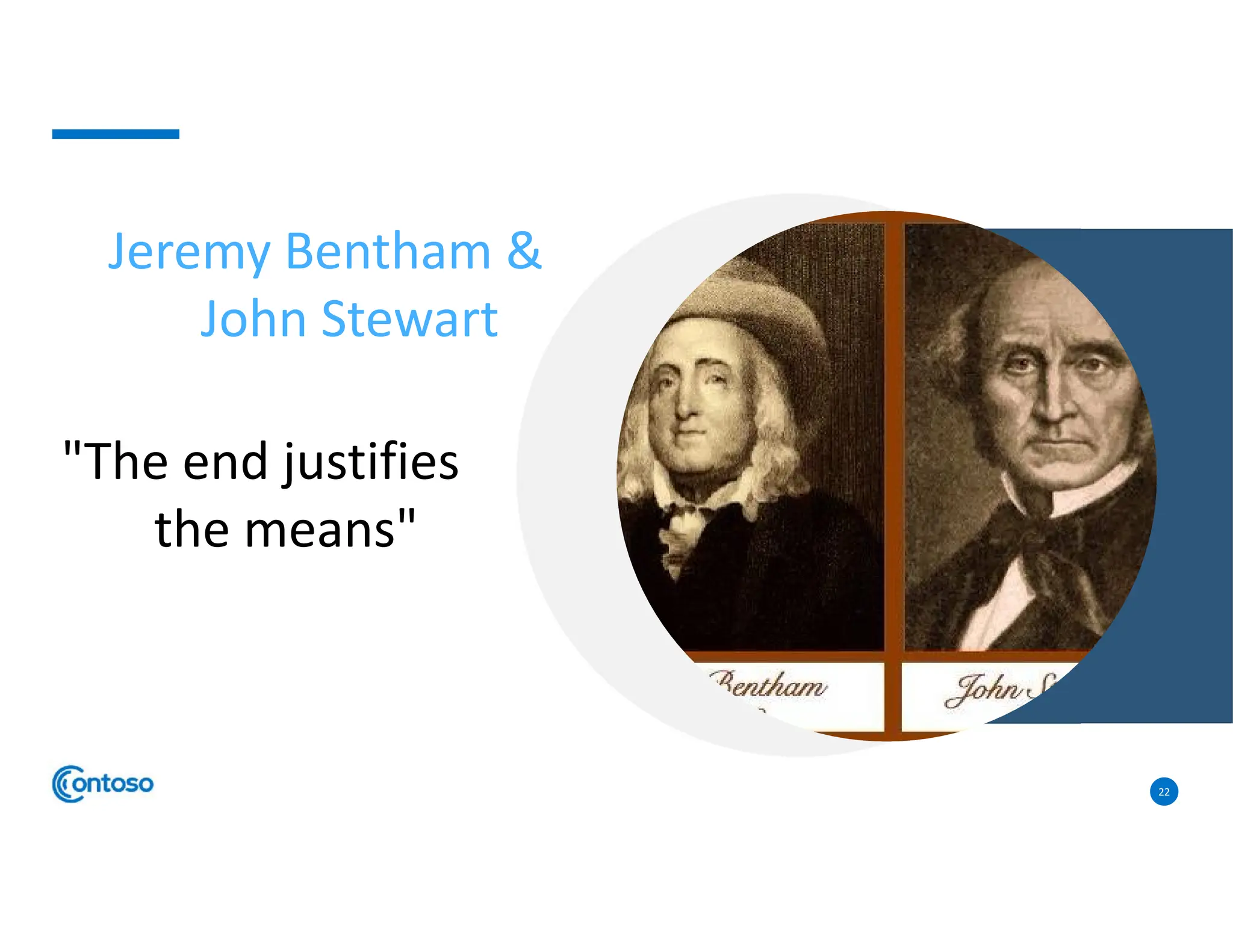
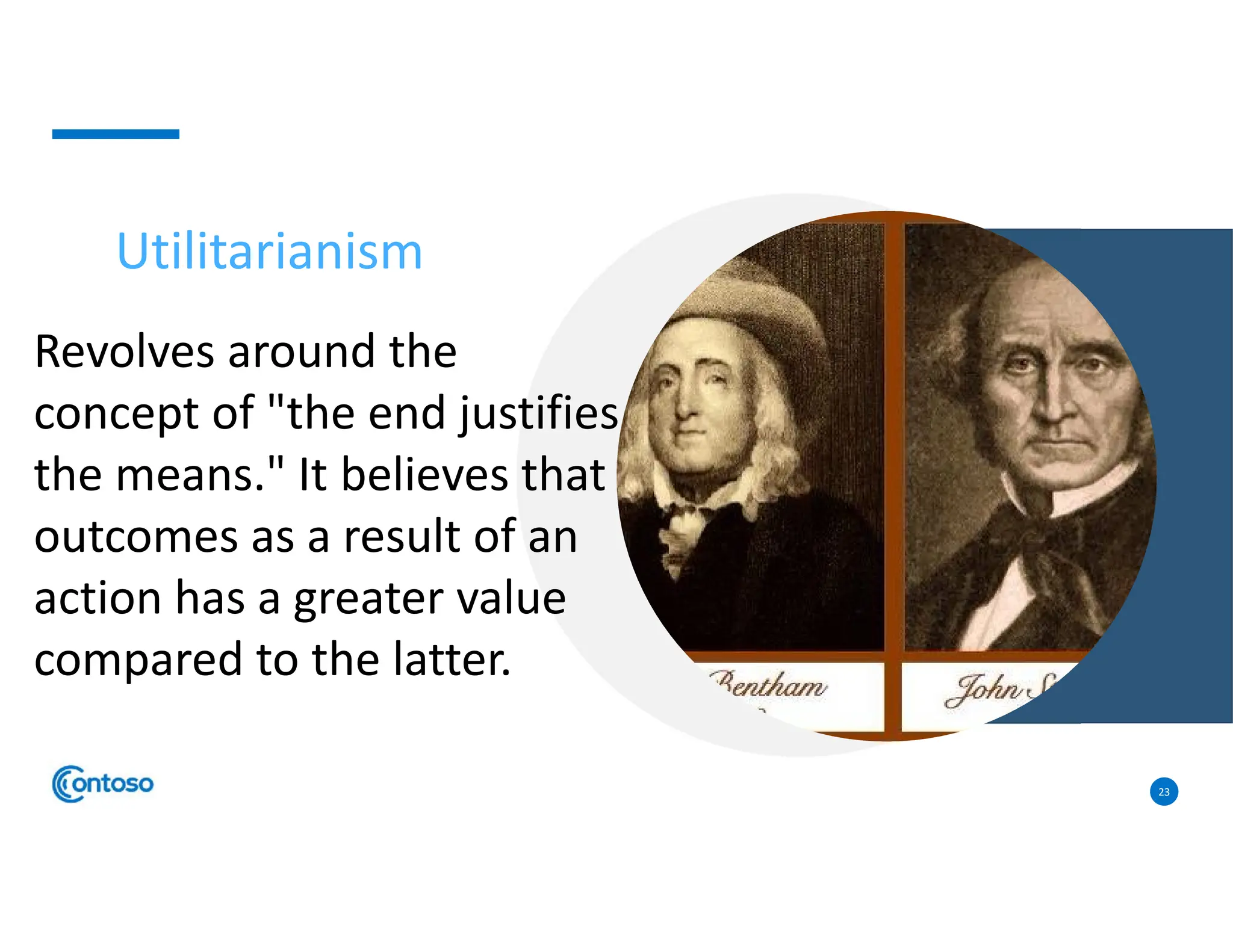
Jeremy Bentham &
John Stewart
"The end justifies
the means"
23
Utilitarianism
Revolves around the
concept of "the end justifies
the means." It believes that
outcomes as a result of an
action has a greater value
compared to the latter.
NEWTON'STHIRD
LAW OF MOTION
for every action
(force) in nature
there is an equal and
opposite reaction.
24
25
IMPACT OF BELIEF SYSTEMS IN BUSINESSES
In an organization the diversity of its
members other than ethnicity, regional
cultures and gender, there is also
differences in belief system. In the
Philippines there are three major
belief system which is Christianity,
Islam and Buddhism. Each religious
system have different teachings and
perspective about morality.
26
In Christianity……….
Christ as center of this faith. Jesus was born Jew by a virgin named Mary and died
to redeem humanity. It is believed that Jesus was a descendent of Abraham.
Known Traditions
Christmas, Holy Week and Easter.
Catholics do fasting during Lent season which includes abstinence to meat like
pork, beef and fowl.
27
In Islam……..
Prophet Muhammad received a message from God through the angel Jibriel(Gabriel).
It is the completion and universal version of a primordial faith that was revealed
many times before through prophets including Adam, Abraham, Moses and Jesus.
Known Traditions
Haj, Eid il Ftir, Eid il Hada,Salah
Pork is unclean and forbid to eat. They do fasting during the month of Ramadan.
28
In Buddhism……..
Buddhism is a faith that was founded by Siddhartha Gautama (“the Buddha”)
more than 2,500 years ago in India
Dharma
Buddha’s teachings are known as “dharma.” He taught that wisdom, kindness,
patience, generosity and compassion were important virtues.
Followers of Buddhism don’t acknowledge a supreme god or deity. They instead
focus on achieving enlightenment—a state of inner peace and wisdom. When
followers reach this spiritual echelon, they’re said to have experienced nirvana.
The religion’s founder, Buddha, is considered an extraordinary man, but not a god.
The word Buddha means “enlightened.”
29
Take away…
• The differences in belief system should not be a hindrance but a faculty of
common grounds
• One belief system should not be favored as morally right and morally wrong
• Organization can give faculties for traditions and occasions but it should not be
enforcing individual to participate
• Organizations decision should not be impaired due to differences of moral
perspective
• The commonality of morals of each belief system are looked on how they are
aligned to the company’s ethics
30
The Filipino Value System
Utang Na Loob (Reciprocity)
• Obligation and responsibility are often viewed in terms of reciprocity ( utang na loob),
comprised of debts ( utang), and inner-selffree will ( na-loob). The process begins with an
unsolicited gift and continues going often into to the next generation. The essence of utang
na loob is an obligation to appropriately repay a person who has done one a favor.
In business:
Utang na Loob may be good or bad for business depending on a lot of considerations,
but it affects the way business is conducted especially when the business person is
confronted with ethical issue.
31
Filial Piety
• Filial piety is a virtue of respect for one’s parents, elders, and ancestors
• Filial piety is an important concept in Filipino culture. It is understood as essential to
maintain the collective face of the family and to avoid experiencing hiya
In business:
The Filipino family is so intact that it is common for members of the same family work
for the same company.
Padrino System (Palakasan, Patronage)
• Padrino System, or patronage in the Filipino culture and politics is the value system where
one gains favor, promotion, or political appointment through family affiliation (nepotism) or
friendship (cronyism), as opposed to one's merit
32
In business:
Nepotism is the practice of hiring family members regardless of their qualifications. In some
cases, a relative of a company executive may be qualified to perform the job for which she is
hired. The fact that she is an executive's relative gives her an advantage over the other
applicants. But when the employee is not qualified to perform the job, then nepotism
becomes counter-productive. Your executive staff begins hiring family members because
they need jobs, But the family members' lack of qualifications and ability can affect your
company's profitability.
Cronyism is the other side of nepotism. It is the act of hiring friends regardless of
qualifications. One of the main problems with cronyism, which you also find in nepotism, is
the feeling of entitlement that employees hired under these circumstances feel. Because
they know or are related to an executive with the company, they feel they deserve raises and
promotions that should be reserved for more qualified staff members. This creates conflict in
the workplace and can result in losing qualified personnel.
33
Suki System
• “Suki” is a Filipino term which means “loyal customers.”
• “Suki” is a distinct Filipino value system which is rooted primarily in personal alliance systems
based on commercial relationships
In business:
Though a suki relationship usually takes time and many business transactions to be solidified,
suggesting a suki like relationship and backing it up with concessions could be used as a
measure to build trust and at the very least hasten the development of a suki like arrangement.
34
Bahala Na
• The word Bahala is actually a derivative of the word Bathala, which refers to the ancient Supreme
Being worshiped by Filipinos during the pre-Spanish Period. It can be said that the proper use of this
phrase should be in the context of leaving things in the hands of the Divine Being. Simply put, “Bahala
na” can be the equivalent of the Islamic term Inshallah, which means “God willing” or “if Allah wills.”
• Bahala Na has been loosely translated as “come what may.” Hence, it is referred to as the Filipino
version of fatalism, that is, leaving everything in the hands of fate
• Bahala Na is an attitidue of just letting things happen instead of doing something to make things
happen is not a genuine “Bahala Na” value
• Bahala Na is a distinct Filipino value system which is rooted primarily in personal alliance
systems based on religion
35
• The use of the phrase “Bahala na” in the second context somewhat manifests the tendency of Filipinos
to humbly submit everything to the Higher Being during tough times
• Filipinos usually say “Bahala na” when they are unable to decide their next course of action or when
they have no idea what will happen next. They say this phrase as if all they want is to go with the flow,
not minding what the outcome might be
Mañana Habit (Procrastination)
• Mañana Habit comes from the Spanish word "Mañana" which literally means "tomorrow” or "an
unspecified future time." Hence, Mañana Habit, refers to procrastination, or putting off for tomorrow
what can be done today
• The ‘Mañana habit,’ synonymous to the Filipino expression “Mamaya na,” is just another term for
procrastination
36
In business:
• Reduced efficiency
• Damaged reputation – if it gets to the point where the effects of procrastination affects what and when
you deliver to customers you are obviously in trouble and it may cause a reputation for tardiness
• Missed opportunities – if you’re on top of your workload you’ll also be a much better position to take
advantage of new opportunities
• Roadblocks/Bottlenecks – When you start avoiding things it can interrupt the workflow in your business.
Then, an accumulation of things that haven’t been done leads stress for you and frustration for other team
members
Amor Propio
• Amor propio best translates as “self-love.”
• “Amor propio” is a Spanish word which means self –love; a sense of self-esteem or self-respect
that prevents a person from swallowing his pride
37
• Amor propio is part of the Filipino culture. The Filipino people are super sensitive to the
emotional imperatives that guide asal or conduct (behavior). "Delicadeza and Amor Propio” are
the two damdamin (emotional) norms which govern our sense of propriety and self-esteem
• Extra sensitivity or “Balat Sibuyas”
In business:
Filipinos are not overly fond of saying “no” and therefore a “yes” you received earlier in the
day might not actually pan out
THANKYOU
HTTP://WWW.CONTOSO.COM/
CUSTOMIZETHISTEMPLATE
Template Editing
Instructions and Feedback
39

BESR-Lesson 2 -Foundation of the principles of business ethics.pdf

  • 1.
  • 2.
  • 3.
    SOCRATES The Gad-fly atthe marketplace 3 “The unexamined life is not worth living”
  • 4.
    4 The socratic methodis a way of thinking that allows individuals to define their own purpose of learning and explored it purpose through open-minded questioning of what they hold to be true. Socrates thought to the Entrepeuneurs
  • 5.
    5 Socrates insisted ona right to think for ourselves. To often, he warned, humans sleep walk through life, simply going along with the crowd. Does your organization encourage independent thinkers and people who follow there conscience. Dare to Disagree
  • 6.
    6 Socrates (469-399 BCE) isone of the few individuals whom one could say have shaped the cultural and intellectual development of the world that, without him, history would be profoundly different
  • 7.
    PLATO 7 The Philosopher-king "Good peopledo not need laws to tell them to act responsibly, while bad people will find a way around the laws
  • 8.
    8 Education for theHealth of the State In both the republic and the laws, Plato identifies education as one of the most important aspect of a healthy state.
  • 9.
    9 Plato thinks thata child's education is the last thing that should be left to chance or parental whim since the young mind is so easily molded. Plato relates ethics can be cultivate in education as early as a child which can lead to his philosophy. Therefore in an organization it is important to educated it’s members about the compay’s ethics
  • 10.
    10 Plato (427-347 BCE) isone of the world's best known and most widely read and studied philosophers. He was the student of Socrates and the teacher of Aristotle, and he wrote in the middle of the 4th century BCE in ancient Greece

  • 11.

    ARISTOTLE 11 “All or Nothing” "Happinessis the meaning and the purpose of life, the whole aim and end of human existence"
  • 12.
    12 Virtue and Happiness Theword happiness in the ethics is a translation of a Greek term "eudaimonia", which carry connotations of success and fulfillment. For Aristotle, this happiness is our highest goal.
  • 13.
    13 A question ofhigh importance in any investigation of ethics is how we can teach people to be good. Aristotle is quite clear that he does not think virtue, that can be thought in a class room or by means of an argument. Moral Education
  • 14.
    14 Aristotle concludes thatthe role of the leader is to create the environment in which all members of an organization can realize their own potential. Implications to business
  • 15.
    15 What form ofsocial contract would allow all our members to develop their full potential in order that they may each make their greatest contribution to the good of the whole? Am I behaving in a virtuous way? How would I want to be treated,if I were a member of this organization?
  • 16.
  • 17.
    17 Immanuel Kant Duty basedethics "act only according to that maxim by which you can at the same time will that it should become a universal law"
  • 18.
    18 Maxim an expression ofa general truth or principle. An action can only be considered as a ethically correct if it can be accepted or made into a universal law. The First Maxim
  • 19.
    19 The Second Maxim Aperson should be treated as an end and not the means to achieve an end. Humans are equal in dignity and worth, no one should be superior or inferior. Valuing a persons worth and thy selves. A person should not be treated as means
  • 20.
    20 The Third Maxim Everyoneshould, as a member of an ideal kingdom, were he or she is both the ruler and subject at the same time In this maxim the leader and follower should follow the same set of ethics. Each person in the society may differ in roles but no one is above or has immunity on proper ethical behavior
  • 21.
    21 He is oneof the most influential philosopher in the history of western philosophy. His contributions to metaphysics, epistemology, ethics and aesthetics have had a profound impact on almost every philosophical movement that followed him .
  • 22.
    22 Jeremy Bentham & JohnStewart "The end justifies the means"
  • 23.
    23 Utilitarianism Revolves around the conceptof "the end justifies the means." It believes that outcomes as a result of an action has a greater value compared to the latter.
  • 24.
    NEWTON'STHIRD LAW OF MOTION forevery action (force) in nature there is an equal and opposite reaction. 24
  • 25.
    25 IMPACT OF BELIEFSYSTEMS IN BUSINESSES In an organization the diversity of its members other than ethnicity, regional cultures and gender, there is also differences in belief system. In the Philippines there are three major belief system which is Christianity, Islam and Buddhism. Each religious system have different teachings and perspective about morality.
  • 26.
    26 In Christianity………. Christ ascenter of this faith. Jesus was born Jew by a virgin named Mary and died to redeem humanity. It is believed that Jesus was a descendent of Abraham. Known Traditions Christmas, Holy Week and Easter. Catholics do fasting during Lent season which includes abstinence to meat like pork, beef and fowl.
  • 27.
    27 In Islam…….. Prophet Muhammadreceived a message from God through the angel Jibriel(Gabriel). It is the completion and universal version of a primordial faith that was revealed many times before through prophets including Adam, Abraham, Moses and Jesus. Known Traditions Haj, Eid il Ftir, Eid il Hada,Salah Pork is unclean and forbid to eat. They do fasting during the month of Ramadan.
  • 28.
    28 In Buddhism…….. Buddhism isa faith that was founded by Siddhartha Gautama (“the Buddha”) more than 2,500 years ago in India Dharma Buddha’s teachings are known as “dharma.” He taught that wisdom, kindness, patience, generosity and compassion were important virtues. Followers of Buddhism don’t acknowledge a supreme god or deity. They instead focus on achieving enlightenment—a state of inner peace and wisdom. When followers reach this spiritual echelon, they’re said to have experienced nirvana. The religion’s founder, Buddha, is considered an extraordinary man, but not a god. The word Buddha means “enlightened.”
  • 29.
    29 Take away… • Thedifferences in belief system should not be a hindrance but a faculty of common grounds • One belief system should not be favored as morally right and morally wrong • Organization can give faculties for traditions and occasions but it should not be enforcing individual to participate • Organizations decision should not be impaired due to differences of moral perspective • The commonality of morals of each belief system are looked on how they are aligned to the company’s ethics
  • 30.
    30 The Filipino ValueSystem Utang Na Loob (Reciprocity) • Obligation and responsibility are often viewed in terms of reciprocity ( utang na loob), comprised of debts ( utang), and inner-selffree will ( na-loob). The process begins with an unsolicited gift and continues going often into to the next generation. The essence of utang na loob is an obligation to appropriately repay a person who has done one a favor. In business: Utang na Loob may be good or bad for business depending on a lot of considerations, but it affects the way business is conducted especially when the business person is confronted with ethical issue.
  • 31.
    31 Filial Piety • Filialpiety is a virtue of respect for one’s parents, elders, and ancestors • Filial piety is an important concept in Filipino culture. It is understood as essential to maintain the collective face of the family and to avoid experiencing hiya In business: The Filipino family is so intact that it is common for members of the same family work for the same company. Padrino System (Palakasan, Patronage) • Padrino System, or patronage in the Filipino culture and politics is the value system where one gains favor, promotion, or political appointment through family affiliation (nepotism) or friendship (cronyism), as opposed to one's merit
  • 32.
    32 In business: Nepotism isthe practice of hiring family members regardless of their qualifications. In some cases, a relative of a company executive may be qualified to perform the job for which she is hired. The fact that she is an executive's relative gives her an advantage over the other applicants. But when the employee is not qualified to perform the job, then nepotism becomes counter-productive. Your executive staff begins hiring family members because they need jobs, But the family members' lack of qualifications and ability can affect your company's profitability. Cronyism is the other side of nepotism. It is the act of hiring friends regardless of qualifications. One of the main problems with cronyism, which you also find in nepotism, is the feeling of entitlement that employees hired under these circumstances feel. Because they know or are related to an executive with the company, they feel they deserve raises and promotions that should be reserved for more qualified staff members. This creates conflict in the workplace and can result in losing qualified personnel.
  • 33.
    33 Suki System • “Suki”is a Filipino term which means “loyal customers.” • “Suki” is a distinct Filipino value system which is rooted primarily in personal alliance systems based on commercial relationships In business: Though a suki relationship usually takes time and many business transactions to be solidified, suggesting a suki like relationship and backing it up with concessions could be used as a measure to build trust and at the very least hasten the development of a suki like arrangement.
  • 34.
    34 Bahala Na • Theword Bahala is actually a derivative of the word Bathala, which refers to the ancient Supreme Being worshiped by Filipinos during the pre-Spanish Period. It can be said that the proper use of this phrase should be in the context of leaving things in the hands of the Divine Being. Simply put, “Bahala na” can be the equivalent of the Islamic term Inshallah, which means “God willing” or “if Allah wills.” • Bahala Na has been loosely translated as “come what may.” Hence, it is referred to as the Filipino version of fatalism, that is, leaving everything in the hands of fate • Bahala Na is an attitidue of just letting things happen instead of doing something to make things happen is not a genuine “Bahala Na” value • Bahala Na is a distinct Filipino value system which is rooted primarily in personal alliance systems based on religion
  • 35.
    35 • The useof the phrase “Bahala na” in the second context somewhat manifests the tendency of Filipinos to humbly submit everything to the Higher Being during tough times • Filipinos usually say “Bahala na” when they are unable to decide their next course of action or when they have no idea what will happen next. They say this phrase as if all they want is to go with the flow, not minding what the outcome might be Mañana Habit (Procrastination) • Mañana Habit comes from the Spanish word "Mañana" which literally means "tomorrow” or "an unspecified future time." Hence, Mañana Habit, refers to procrastination, or putting off for tomorrow what can be done today • The ‘Mañana habit,’ synonymous to the Filipino expression “Mamaya na,” is just another term for procrastination
  • 36.
    36 In business: • Reducedefficiency • Damaged reputation – if it gets to the point where the effects of procrastination affects what and when you deliver to customers you are obviously in trouble and it may cause a reputation for tardiness • Missed opportunities – if you’re on top of your workload you’ll also be a much better position to take advantage of new opportunities • Roadblocks/Bottlenecks – When you start avoiding things it can interrupt the workflow in your business. Then, an accumulation of things that haven’t been done leads stress for you and frustration for other team members Amor Propio • Amor propio best translates as “self-love.” • “Amor propio” is a Spanish word which means self –love; a sense of self-esteem or self-respect that prevents a person from swallowing his pride
  • 37.
    37 • Amor propiois part of the Filipino culture. The Filipino people are super sensitive to the emotional imperatives that guide asal or conduct (behavior). "Delicadeza and Amor Propio” are the two damdamin (emotional) norms which govern our sense of propriety and self-esteem • Extra sensitivity or “Balat Sibuyas” In business: Filipinos are not overly fond of saying “no” and therefore a “yes” you received earlier in the day might not actually pan out
  • 38.
  • 39.