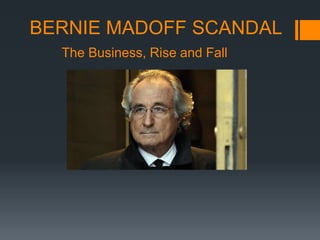
BERNIE MADOFF SCANDAL
The Business, Rise and Fall
WHO IS BERNIE
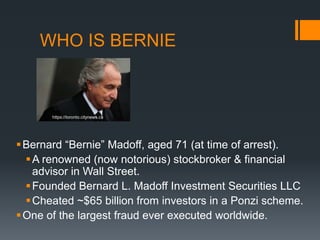
Bernard “Bernie” Madoff, aged 71 (at time of arrest).
A renowned (now notorious) stockbroker & financial
advisor in Wall Street.
Founded Bernard L. Madoff Investment Securities LLC
Cheated ~$65 billion from investors in a Ponzi scheme.
One of the largest fraud ever executed worldwide.
https://toronto.citynews.ca
 Bernard Madoff’s positions (financial):
 Chairman of NASDAQ, National Association of Securities Dealers
(NASD) & Securities Industry and Financial Markets Association
(SIFMA) trading committee.
 Founding board member of International Securities Clearing
Corporation.
 Bernard Madoff’s positions (non-financial)
 Founder of Madoff Family Foundation.
 Chairman of Systems School of Business, Yeshiva University.
 Board of New York City Center.
 Executive council of UJA Foundation of New York Wall Street
division.
GOVERNMENT TIES
Gains access the leading securities industry trade group.
 Securities Industry and Financial Markets Association
 Madoff’s brother and niece both were active n this group.
OVERVIEW
 Madoff started his firm in 1960 as a penny stock trader with $5,000 earned from working as a lifeguard and
sprinkler installer.
 His fledgling business began to grow with the assistance of his father-in-law, accountant Saul Alpern, who
referred a circle of friends and their families.
 Initially, the firm made markets quoted bid and ask prices via the National’s Quotation Bureau.
 To compete with firms that were members of the New York Stock trading on the stock exchange's floor, his firm
began using innovative computer information technology to disseminate quotes
 After a trial run, the technology that the firm helped develop became the NASDAQ. At one point, Madoff
Securities was the largest buying-and-selling “market maker" at the NASDAQ.
 Despite claiming to generate large, steady returns through an investing strategy called "split-strike conversion,"
which is an actual trading strategy, Madoff simply deposited client funds into a single bank account that he used
to pay existing clients who wanted to cash out. He funded redemptions by attracting new investors and their
capital, but was unable to maintain the fraud when the market turned sharply lower in late 2008.
 In 2009, at age 71, Madoff pleaded guilty to 11 federal felony counts, including securities fraud, wire fraud, mail
fraud, perjury and money laundering.
 Peter has since been sentenced to 10 years in prison, and Mark committed suicide by hanging exactly
two years after his father's arrest.
THE BUSINESS
 He started his company, Bernard L. Madoff Investment
Securities LLC, in 1960, at age 22.
 At first, he traded penny stocks with $5,000 (worth around
$41,000 in 2017) he had earned installing sprinklers and
working as a lifeguard.
 He further secured a loan of $50,000 from his father-in-law
which he also used to set up Bernard L. Madoff Investment
Securities LLC
 His business grew with the assistance of his father-in-law,
accountant Saul Alpern, who referred a circle of friends and their
families.
 Several family members worked for him.
 His younger brother Peter, was senior managing director and
chief compliance officer.
 Peter's daughter Shana Madoff, was the compliance attorney.
 Madoff's sons, Mark and Andrew, worked in the trading
section, along with Charles Weiner, Madoff's nephew.
THE RISE
 By 2000, Madoff Securities, one of the top traders of US
securities held approximately $300 million in assets.
 In order to compete with firms that were members of the New
York Stocks Exchange trading on the stock exchange's floor, his
firm began using innovative computer information technology to
disseminate its quotes
 After a trial run, the technology that the firm helped to develop
became the NASDAQ.
 Investors believed the 10% was put into their account and
spread the word that Madoff was reliable and he became
more and more popular each year.
 Since people believed the 10 % added each year , they had
no reason to take out their money out and hold it for a long
time.
 If they did take the money out, Madoff would pay them with
other peoples money.
 He was secretive about the firm's business and kept
his financial statements closely guarded.
 Madoff continued doing this until October of 2008.
 The scheme began to unravel in the fall of 2008.
 Due to the economy, everyone started taking their money out
and Madoff could not pay them back.
 Madoff only survived by moving money from his broker-dealer's
account into his Ponzi scheme account.
 The Chase account, which at one point in 2008 had well over $5
billion, was down to only $234 million.
 On December 10, 2008, Madoff's sons told authorities that their
father had confessed to them that the asset management unit of
his firm was a massive Ponzi scheme, and quoted him as
saying that it was "one big lie".
THE FALL
 On March 12, 2009, Madoff pleaded guilty to 11 federal
felonies and admitted to turning his wealth management
business into a massive Ponzi scheme.
 Madoff committed the biggest scam by a human being,
scamming close to 65 billion dollars
 Affected thousands of investors
 Court papers indicate that Madoff's firm had about 4,800
investment client accounts as of November 30, 2008 and
issued statements for that month reporting that client
accounts held a total balance of about $65 billion but actually
"held only a small fraction" of that balance for clients.
 Madoff was arrested by the Federal Bureau of Investigation
(FBI) on December 11, 2008 on a criminal
charge of securities fraud.
Remains in jail until hearing
Madoff plead guilty to charges of fraud
On June 29, Judge Chin sentenced Madoff to 150
years in prison.
 Madoff apologized to his victims at the sentencing saying
 "I have left a legacy of shame, as some of my victims
have pointed out, to my family and my grandchildren.
This is something I will live in for the rest of my life.
I'm sorry. ... I know that doesn't help you.
Timeline:
 1960 - Bernard L. Madoff Investment Securities is founded.
 December 10, 2008 - Bernard Madoff allegedly confesses to employees of his company that the asset
management portion of his firm is actually a large Ponzi scheme. Madoff says the business had lost about
$50 billion and that he plans to turn himself in to authorities in a week.
 December 11, 2008 - Madoff is arrested on one count of securities fraud for allegedly operating a multi
billion dollar Ponzi scheme from his investment advisory business. He is released on $10 million bail.
 December 12, 2008 - A federal court in Manhattan issues a temporary order freezing Madoff's assets and
appointing a receiver over him and his firm.
 December 17, 2008 - Madoff is placed on house arrest. Several bids by prosecutors to jail Madoff are
denied by the court.
 February 9, 2009 - The SEC and Madoff reach a partial settlement agreement. Under the terms of the
deal, Madoff will keep a previously reached agreement to freeze his assets and not to violate any other
securities laws. This is separate from the criminal charge Madoff faces.
 March 12, 2009 - Madoff pleads guilty to eleven felony charges including: money laundering, perjury, false
filings with the SEC and fraud. There is no deal with the government associated with the guilty
plea. Madoff pleaded guilty to 11 federal crimes and admitted to operating the largest private Ponzi
scheme in history.
 March 20, 2009 - An appeals court rules that Madoff will remain in jail until sentencing.
 April 1, 2009 - Federal marshals seize Madoff's yacht, a smaller boat, and one of his homes in Florida as
court-ordered seizures of the financier's assets begin.
 June 29, 2009 -Madoff is sentenced to 150 years in prison.
 July 14, 2009 - Madoff arrives at Butner Federal Correction Complex in North Carolina to begin serving his
sentence.
 October 2, 2009 - A $199 million lawsuit is filed against Madoff's sons, his brother Peter Madoff and his
niece Shana Madoff, who all worked at Madoff's firm.
 December 11, 2010 -Mark Madoff, 46 commits suicide in his Manhattan apartment.
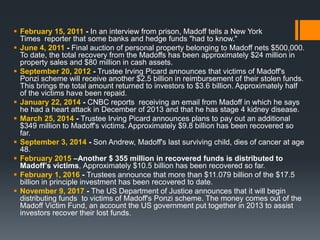
 February 15, 2011 - In an interview from prison, Madoff tells a New York
Times reporter that some banks and hedge funds "had to know."
 June 4, 2011 - Final auction of personal property belonging to Madoff nets $500,000.
To date, the total recovery from the Madoffs has been approximately $24 million in
property sales and $80 million in cash assets.
 September 20, 2012 - Trustee Irving Picard announces that victims of Madoff's
Ponzi scheme will receive another $2.5 billion in reimbursement of their stolen funds.
This brings the total amount returned to investors to $3.6 billion. Approximately half
of the victims have been repaid.
 January 22, 2014 - CNBC reports receiving an email from Madoff in which he says
he had a heart attack in December of 2013 and that he has stage 4 kidney disease.
 March 25, 2014 - Trustee Irving Picard announces plans to pay out an additional
$349 million to Madoff's victims. Approximately $9.8 billion has been recovered so
far.
 September 3, 2014 - Son Andrew, Madoff's last surviving child, dies of cancer at age
48.
 February 2015 –Another $ 355 million in recovered funds is distributed to
Madoff’s victims, Approximately $10.5 billion has been recovered so far.
 February 1, 2016 - Trustees announce that more than $11.079 billion of the $17.5
billion in principle investment has been recovered to date.
 November 9, 2017 - The US Department of Justice announces that it will begin
distributing funds to victims of Madoff's Ponzi scheme. The money comes out of the
Madoff Victim Fund, an account the US government put together in 2013 to assist
investors recover their lost funds.
REFERENCES:
 “Biggest Fraud in History $50 billion Madoff Ponzi Scheme”. December 13,
2008.
 David Glovin (February 11, 2009). ”Madoff Prosecutors Get 30 More Days fr
Indictment ‘’. Bloomberg LP Retrieved February 11, 2009.
 “The Madoff Case: A Timeline” .The Wall Street Journal. March 6, 2009.
Retrieved March 6, 2009.
 Madoff Investment Scandal By Ashton Leyens, David Lerman, and Jordan
Cohen
 https://edition.cnn.com/2013/03/11/us/bernard-madoff-fast-facts/index.html
 https://en.wikipedia.org/wiki/Madoff_investment_scandal

BERNIE MADOFF SCANDAL.pptx

  • 1.
    BERNIE MADOFF SCANDAL TheBusiness, Rise and Fall
  • 2.
    WHO IS BERNIE Bernard“Bernie” Madoff, aged 71 (at time of arrest). A renowned (now notorious) stockbroker & financial advisor in Wall Street. Founded Bernard L. Madoff Investment Securities LLC Cheated ~$65 billion from investors in a Ponzi scheme. One of the largest fraud ever executed worldwide. https://toronto.citynews.ca
  • 3.
     Bernard Madoff’spositions (financial):  Chairman of NASDAQ, National Association of Securities Dealers (NASD) & Securities Industry and Financial Markets Association (SIFMA) trading committee.  Founding board member of International Securities Clearing Corporation.  Bernard Madoff’s positions (non-financial)  Founder of Madoff Family Foundation.  Chairman of Systems School of Business, Yeshiva University.  Board of New York City Center.  Executive council of UJA Foundation of New York Wall Street division.
  • 4.
    GOVERNMENT TIES Gains accessthe leading securities industry trade group.  Securities Industry and Financial Markets Association  Madoff’s brother and niece both were active n this group.
  • 5.
    OVERVIEW  Madoff startedhis firm in 1960 as a penny stock trader with $5,000 earned from working as a lifeguard and sprinkler installer.  His fledgling business began to grow with the assistance of his father-in-law, accountant Saul Alpern, who referred a circle of friends and their families.  Initially, the firm made markets quoted bid and ask prices via the National’s Quotation Bureau.  To compete with firms that were members of the New York Stock trading on the stock exchange's floor, his firm began using innovative computer information technology to disseminate quotes  After a trial run, the technology that the firm helped develop became the NASDAQ. At one point, Madoff Securities was the largest buying-and-selling “market maker" at the NASDAQ.  Despite claiming to generate large, steady returns through an investing strategy called "split-strike conversion," which is an actual trading strategy, Madoff simply deposited client funds into a single bank account that he used to pay existing clients who wanted to cash out. He funded redemptions by attracting new investors and their capital, but was unable to maintain the fraud when the market turned sharply lower in late 2008.  In 2009, at age 71, Madoff pleaded guilty to 11 federal felony counts, including securities fraud, wire fraud, mail fraud, perjury and money laundering.  Peter has since been sentenced to 10 years in prison, and Mark committed suicide by hanging exactly two years after his father's arrest.
  • 6.
    THE BUSINESS  Hestarted his company, Bernard L. Madoff Investment Securities LLC, in 1960, at age 22.  At first, he traded penny stocks with $5,000 (worth around $41,000 in 2017) he had earned installing sprinklers and working as a lifeguard.  He further secured a loan of $50,000 from his father-in-law which he also used to set up Bernard L. Madoff Investment Securities LLC
  • 7.
     His businessgrew with the assistance of his father-in-law, accountant Saul Alpern, who referred a circle of friends and their families.  Several family members worked for him.  His younger brother Peter, was senior managing director and chief compliance officer.  Peter's daughter Shana Madoff, was the compliance attorney.  Madoff's sons, Mark and Andrew, worked in the trading section, along with Charles Weiner, Madoff's nephew. THE RISE
  • 8.
     By 2000,Madoff Securities, one of the top traders of US securities held approximately $300 million in assets.  In order to compete with firms that were members of the New York Stocks Exchange trading on the stock exchange's floor, his firm began using innovative computer information technology to disseminate its quotes  After a trial run, the technology that the firm helped to develop became the NASDAQ.
  • 9.
     Investors believedthe 10% was put into their account and spread the word that Madoff was reliable and he became more and more popular each year.  Since people believed the 10 % added each year , they had no reason to take out their money out and hold it for a long time.  If they did take the money out, Madoff would pay them with other peoples money.
  • 10.
     He wassecretive about the firm's business and kept his financial statements closely guarded.  Madoff continued doing this until October of 2008.  The scheme began to unravel in the fall of 2008.
  • 11.
     Due tothe economy, everyone started taking their money out and Madoff could not pay them back.  Madoff only survived by moving money from his broker-dealer's account into his Ponzi scheme account.  The Chase account, which at one point in 2008 had well over $5 billion, was down to only $234 million.  On December 10, 2008, Madoff's sons told authorities that their father had confessed to them that the asset management unit of his firm was a massive Ponzi scheme, and quoted him as saying that it was "one big lie". THE FALL
  • 12.
     On March12, 2009, Madoff pleaded guilty to 11 federal felonies and admitted to turning his wealth management business into a massive Ponzi scheme.  Madoff committed the biggest scam by a human being, scamming close to 65 billion dollars  Affected thousands of investors
  • 13.
     Court papersindicate that Madoff's firm had about 4,800 investment client accounts as of November 30, 2008 and issued statements for that month reporting that client accounts held a total balance of about $65 billion but actually "held only a small fraction" of that balance for clients.  Madoff was arrested by the Federal Bureau of Investigation (FBI) on December 11, 2008 on a criminal charge of securities fraud.
  • 14.
    Remains in jailuntil hearing Madoff plead guilty to charges of fraud On June 29, Judge Chin sentenced Madoff to 150 years in prison.
  • 15.
     Madoff apologizedto his victims at the sentencing saying  "I have left a legacy of shame, as some of my victims have pointed out, to my family and my grandchildren. This is something I will live in for the rest of my life. I'm sorry. ... I know that doesn't help you.
  • 16.
    Timeline:  1960 -Bernard L. Madoff Investment Securities is founded.  December 10, 2008 - Bernard Madoff allegedly confesses to employees of his company that the asset management portion of his firm is actually a large Ponzi scheme. Madoff says the business had lost about $50 billion and that he plans to turn himself in to authorities in a week.  December 11, 2008 - Madoff is arrested on one count of securities fraud for allegedly operating a multi billion dollar Ponzi scheme from his investment advisory business. He is released on $10 million bail.  December 12, 2008 - A federal court in Manhattan issues a temporary order freezing Madoff's assets and appointing a receiver over him and his firm.  December 17, 2008 - Madoff is placed on house arrest. Several bids by prosecutors to jail Madoff are denied by the court.  February 9, 2009 - The SEC and Madoff reach a partial settlement agreement. Under the terms of the deal, Madoff will keep a previously reached agreement to freeze his assets and not to violate any other securities laws. This is separate from the criminal charge Madoff faces.  March 12, 2009 - Madoff pleads guilty to eleven felony charges including: money laundering, perjury, false filings with the SEC and fraud. There is no deal with the government associated with the guilty plea. Madoff pleaded guilty to 11 federal crimes and admitted to operating the largest private Ponzi scheme in history.  March 20, 2009 - An appeals court rules that Madoff will remain in jail until sentencing.  April 1, 2009 - Federal marshals seize Madoff's yacht, a smaller boat, and one of his homes in Florida as court-ordered seizures of the financier's assets begin.  June 29, 2009 -Madoff is sentenced to 150 years in prison.  July 14, 2009 - Madoff arrives at Butner Federal Correction Complex in North Carolina to begin serving his sentence.  October 2, 2009 - A $199 million lawsuit is filed against Madoff's sons, his brother Peter Madoff and his niece Shana Madoff, who all worked at Madoff's firm.  December 11, 2010 -Mark Madoff, 46 commits suicide in his Manhattan apartment.
  • 17.
     February 15,2011 - In an interview from prison, Madoff tells a New York Times reporter that some banks and hedge funds "had to know."  June 4, 2011 - Final auction of personal property belonging to Madoff nets $500,000. To date, the total recovery from the Madoffs has been approximately $24 million in property sales and $80 million in cash assets.  September 20, 2012 - Trustee Irving Picard announces that victims of Madoff's Ponzi scheme will receive another $2.5 billion in reimbursement of their stolen funds. This brings the total amount returned to investors to $3.6 billion. Approximately half of the victims have been repaid.  January 22, 2014 - CNBC reports receiving an email from Madoff in which he says he had a heart attack in December of 2013 and that he has stage 4 kidney disease.  March 25, 2014 - Trustee Irving Picard announces plans to pay out an additional $349 million to Madoff's victims. Approximately $9.8 billion has been recovered so far.  September 3, 2014 - Son Andrew, Madoff's last surviving child, dies of cancer at age 48.  February 2015 –Another $ 355 million in recovered funds is distributed to Madoff’s victims, Approximately $10.5 billion has been recovered so far.  February 1, 2016 - Trustees announce that more than $11.079 billion of the $17.5 billion in principle investment has been recovered to date.  November 9, 2017 - The US Department of Justice announces that it will begin distributing funds to victims of Madoff's Ponzi scheme. The money comes out of the Madoff Victim Fund, an account the US government put together in 2013 to assist investors recover their lost funds.
  • 18.
    REFERENCES:  “Biggest Fraudin History $50 billion Madoff Ponzi Scheme”. December 13, 2008.  David Glovin (February 11, 2009). ”Madoff Prosecutors Get 30 More Days fr Indictment ‘’. Bloomberg LP Retrieved February 11, 2009.  “The Madoff Case: A Timeline” .The Wall Street Journal. March 6, 2009. Retrieved March 6, 2009.  Madoff Investment Scandal By Ashton Leyens, David Lerman, and Jordan Cohen  https://edition.cnn.com/2013/03/11/us/bernard-madoff-fast-facts/index.html  https://en.wikipedia.org/wiki/Madoff_investment_scandal