Scriptures, science and mythology:
An ancient Indian astronomical interplay
Rajesh Kochhar
Vice-President IAU Commission 41: History of Astronomy
Indian Institute of Science Education and Research, Mohali, Punjab
rkochhar2000@yahoo.com
Belfast 16 November 2011
Human beings are born astronomers.
Ever since they learnt to walk
upright, they have looked at the sky
and wondered. The sky has remained
the same but its meaning has been
changing.
We can distinguish between three
phases in humankind’s astronomical
pursuits: Propitiatory Phase,
Negotiatory Phase, and the Galilean
Phase. In the current Galilean phase,
celestial bodies are mere objects of
study and the sky is a laboratory for
testing our scientific theories.
Although we are a part of the
Universe, we now tend to look at it
as if from the outside.
In an earlier era however astronomy
was sacred. Human perception of the
cosmic environment was an essential
input for determining the
humankind’s place in the divine
scheme of things.
The Propitiatory and Negotiatory
phases were coeval rather than
sequential. The Sun and the Moon
are part of human evolution. Other
planets would also have been noticed
very early.
Since the world was anthropo-
centric, the Creator would surely
keep a watch on the Earthians. His
messages would be carried by the
moving deities in the sky.
It was therefore important to monitor
these objects. The tapestry of the
night sky represented the mysterious
immutable part of the cosmos, and
served as a convenient backdrop for
movements in the sky.
Ancient Indian perception of the
dynamic cosmic environment was
bipolar. Orbits of the seven
geocentric planets (graha) by virtue
of their predictability represented
cosmic order,
while phenomena like meteors,
comets and eclipses which did not fit
into any pattern were classified as
utpata, portent or calamity.
The beginnings of astronomy are
related to the requirements of the
ritual in early cultures. Ritual was a
means of securing divine approval
and support for terrestrial actions. To
be effective,
the ritual had to be elaborate and
well-timed, so that a careful
distinction could be made between
auspicious and inauspicious times.
Since planetary motions provided a
natural means of time keeping ,
their refined study became
important. Early astronomical
knowledge went into the making of
sacred literature and mythology.
Even when astronomy developed as
a scientific
discipline in its own right, it
continued to be seen as revealed
knowledge rather than deduced. It
could not, would not, jettison its
historical baggage.
Before proceeding further, it will be
instructive to take note of the nature
and limitations of the source material
available.
Source material
Oral intellectual tradition. Secondary
role for script when used. Perishable
writing material.
Vedic corpus: no addition, no deletion.
Mechanisms to prevent distortion.
Puranas and epics : addition but no
deletion.
Scientific texts ( astronomy and health
care) have undergone deletions,
additions and alterations.
.
In my book The Vedic People
(2000), I have assigned the bracket
1700-900 BCE to the actual
composition of the Rgveda. Its
oldest portions may however carry
memories of still older times.
Mahabharata, “the Encyclopedia
Brahminica” is believed to have
largely acquired “its present
volume, content and character”
by the fourth century CE.
Although there are minor
additions/ alterations in various
recensions/ editions of Mbh after
date,
astronomical content of MBh
was NOT touched. MBh is thus a
valuable source for the
astronomical knowledge as it
stood c. 4th
cent. CE.
An important feature of ancient
Indic textual tradition should be
noted. These texts are valuable for
the statements they explicitly make.
But no conclusions should be
drawn from absence of mention..
If the dog barked, we know the dog
was not there. But if the dog did not
bark, we do not know whether only
the bark was missing or the dog
itself was absent.
In addition to the Hindu sacred texts,
we have Buddhist and Jain sources:
written, dated, and very valuable.
Historiography and geography
The colonial period British historians
denied great antiquity or originality to
Indian science. The backlash has
produced a school of thought which
tries to push chronology backwards and
deny all outside influences.
This is like discovering great
therapeutic value in distilled water.
History is a child of geography. The
Himalayas protect India, but do not
isolate it. India’s entire intellectual
tradition has been fashioned by a
combination of antiquity, continuity
and interaction with
the outside world, especially through
the northwest. Before the colonial
period, these interactions were
unselfconscious and mutual. People
and ideas both travelled and were
absorbed.
Foreign words are accepted in a
language. Once absorbed they obey
rules of the host language. Similarly,
self-confident cultures are open to
influences from all over. Ideas once
received are assimilated
and developed further in the context
of the host culture.
This give-and-take is visible in
sacred and mathematical astronomy
in India, as also elsewhere.
There are a few stray astronomical
references in the Rgveda, but for our
purposes the more useful is the
Yajurveda. This is understandable
because Yajurveda is a manual for
actual performance of the ritual.
There is a solitary Vedic text,
Vedanga Jyotisha, devoted
exclusively to astronomy. Its oldest
portions could be as old as 1400
BCE. As a scientific text, it soon
became obsolete. Still, it was
.
preserved because it had Vedic
sanctity. No wonder then that it has
been the least understood of the
whole corpus.
Zodiacal signs and week days are
not mentioned in Vedic astronomy.
They were introduced into Indian
mainstream by the end of 5th
cent.
from the northwest
Siddhantic astronomy
An important date in Indian astronomy is
499 CE when Aryabhata ( b. 476 CE)
composed his influential text simply
called Aryabhatiyam.
Aryabhata incorporated Greco-
Babylonian elements into his work,
integrated zodiacal signs and weekdays
into Indian astronomical tradition, and in
addition gave, for the first time in the
Indian context, the mathematical theory
of eclipses.
For a thousand years, from sixth century
CE till Kepler’s time, Indian astronomers
were probably the only ones in the world
who could calculate eclipses with any
reasonable accuracy. The tradition was
alive till early nineteenth century.
Since the astro-mathematical texts
were called Siddhantas (“proven in
the end”), we may call Indian
mathematical astronomy Siddhantic
astronomy (a term preferable to, say,
Hindu astronomy).
While astronomical text books were
known by the name of their authors,
their elements were used to upgrade old
texts which were claimed to be divine
in origin.
In imitation of the Rgveda, astronomical
texts were composed in metrical verse,
so that an astronomer had to be a poet
first. (Unlike the Vedic corpus, no steps
were taken to preserve the text in its
original form.)
Cosmic order and human ethics
There is a beautiful concept linking
the divine with the human that goes
back to the joint Indo-Iranian times.
Called rta in the Rgveda and arta
(or asa) in the Avesta, it refers to the
cosmic order, not in the sense of
impersonal laws of nature as
ascertained from the outside, but as an
example of righteous cosmic conduct
which the humans should emulate.
The laws regulating the behaviour of
the planetary divinities are inbuilt
into the system. But similar
regulation of human conduct can
come only from an explicit
prescription
of a code of ethical conduct.
Emphasis on rta / arta is far more
pronounced in the Avesta than
Rgveda (Varuna vs Indra). This
much is well known.
What follows is my own speculation.
To bring the terrestrial and the
celestial closer together, the Vedic
people assigned the attributes of one
to the other. Planets return to their
place in the sky; so do seasons on
the earth. But human beings are born
and die. In analogy with the planets,
human beings should also have
continuity. To achieve this, the
concept of reincarnation was
introduced. But in a certain sense
planets are condemned to a life of
incessant motion. An endless cycle of
birth and death would be a punishment
rather than a boon. Therefore the
concept of what we may call truncated
eternity was introduced,
under the name moksha or nirvana,
whereby a soul is liberated from the
constraints of future birth.
At the moment, we are far more
interested in the reverse process,
namely, the human attributes
assigned to the gods.
The cyclic time
The concept of age, birth and death
was introduced for the cosmos as a
whole, and a cosmic chronology in the
form of the yuga system
was constructed by suitably scaling up
the human calendar. The eternity of
the planetary orbits was generalized to
set up an oscillating universe without
beginning or end.
Manusmrti (as also Mahabharata and
other texts) constructs an elaborate
chronological scheme where large
numbers are defined. I have discussed it
at length in a paper, which is available
on the Net. Here is a very brief
summary.
For those in a hurry, the recipe is this:
Multiply 360 by 12 and add zeroes.
In the Vedic times, a year comprised 12
months and 360 days. A human year was
set equal to a day of the gods, so that a
divine year (Dyr) would consist of 360
human years (yr).The divine year in turn
was used to construct an elaborate
chronology.
A mahayuga or chaturyuga (great age or
four-age) was postulated as made up of
four sub-ages or yugas: kali, dvapara,
treta and krta, with duration (and virtue)
in the ratio 1:2:3:4. Kaliyuga was set
equal to 1200 Dyr so that a mahayuga
comprised 12000 Dyr. In human years,
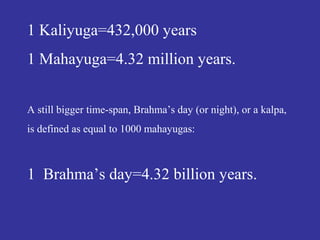
1 Kaliyuga=432,000 years
1 Mahayuga=4.32 million years.
A still bigger time-span, Brahma’s day (or night), or a kalpa,
is defined as equal to 1000 mahayugas:
1 Brahma’s day=4.32 billion years.
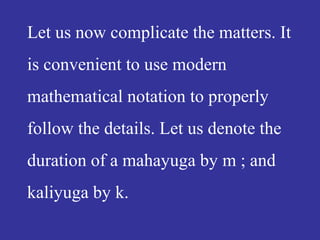
Let us now complicate the matters. It
is convenient to use modern
mathematical notation to properly
follow the details. Let us denote the
duration of a mahayuga by m ; and
kaliyuga by k.
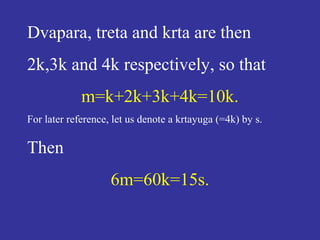
Dvapara, treta and krta are then
2k,3k and 4k respectively, so that
m=k+2k+3k+4k=10k.
For later reference, let us denote a krtayuga (=4k) by s.
Then
6m=60k=15s.
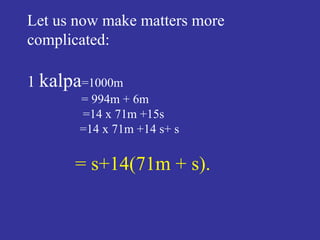
Let us now make matters more
complicated:
1 kalpa=1000m
= 994m + 6m
=14 x 71m +15s
=14 x 71m +14 s+ s
= s+14(71m + s).
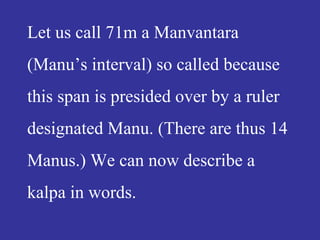
Let us call 71m a Manvantara
(Manu’s interval) so called because
this span is presided over by a ruler
designated Manu. (There are thus 14
Manus.) We can now describe a
kalpa in words.
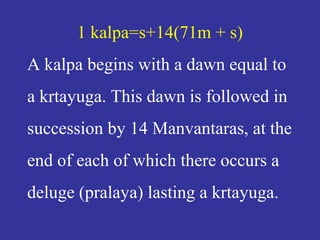
1 kalpa=s+14(71m + s)
A kalpa begins with a dawn equal to
a krtayuga. This dawn is followed in
succession by 14 Manvantaras, at the
end of each of which there occurs a
deluge (pralaya) lasting a krtayuga.
This complex scheme has perplexed
many modern-day commentators.
Thus, Rev. Ebenezer Burgess in his
famous 1860 annotated translation of
the Surya Siddhanta wondered:
“Why the factors fourteen and seventy
- one were thus used in making up the
Aeon [kalpa] is not obvious” (Burgess
1860:11). I think this scheme was
constructed working backwards from
the neat round figure of 1000.
It is noteworthy that though the
scheme is cosmological, it brings in
political rulers ( Manu), thus
combining the celestial with the
human.
The yuga nomenclature was
borrowed by the Puranas in the
context of political history. A total
of about 94 past royal generations
were split into the three yugas: krta
(or satya), treta, and dvapara.
The Puranic kaliyuga began with the
Mahabharata war.(the date of the
text is independent of the date of the
event.)
Note that the yuga scheme is
inherently optimistic. Kaliyuga is
the worst period but mercifully it is
the shortest. And satyayuga is round
the corner.
This “fact” was invoked to arouse
feelings against the British rule.
There was however one significant
difference. Earlier, time had flowed
at its own pace.
Now people were exhorted to hasten
it the end of kaliyuga under the
British and usher in the satyayuga.
(Has not worked out quite that way, but that is
a separate mater.)
For the sake of continuity with the
scriptures, the yuga scheme
was borrowed by the astronomers.
Instead of conveniently expressing
planetary revolutions in a million or
a billion years,
an astronomer would say that there
are 146,568 revolutions of Saturn in
a mahayuga, implying an orbital
period of 29.4743 years.
The mix-up between cosmological
yuga and the Puranic yuga has
produced great confusion.
Timescales of hundred thousands of
years have been assigned to kings
and events.
Unwittingly or otherwise, Aryabhata
has added to the confusion in a very
influential way. He uses the yuga
system all right, and for his own
reasons fixes the beginning of his
kaliyuga at 3102 BC.
While referring to the beginning of
his kaliyuga, he explicitly but
unnecessarily refers to the
Mahabharata battle. The result is that
the hypothetical astronomical epoch
of
3102 BCE has been erroneously
taken to be the date of the historical
Mahabharata battle.
The most interesting interplay of
scriptures, scientific knowledge and
mythology is provided by the
treatment of eclipses.
Vedic Rahu and Ketu
Rgveda (5.40.5-9) tells us that
Svarbhanu, son of an asura, pierced
the sun “through and through with
darkness”.
The Sun himself appealed to Atri
(the poet who wrote this): “Let not
the oppressor with this dread,
through anger, swallow me up, for I
am thine, O Atri”. Responding
quickly,
Atri caused Svarbhanu’s magic arts
to vanish. (Griffith 1896, p. 255) .
What the Atri probably did was to
chant mantras while the eclipse
lasted.
The Rgvedic description is
significant. An eclipse was seen as
the demon’s work in disrupting the
cosmic order. Propitiation was
needed to restore that order.
Subsequently, the name of the demon
was changed to Rahu, who appears
for the first time in Atharvaveda (19,
9-10).
The Rahu legend was adopted by the
Buddhists to add to Buddha’s glory.
The Pali Buddhist sources refer
to the Moon and the Sun freeing
themselves from the clutches of
Rahu by invoking Buddha’s name.
(Chandima Sutta, Samyutta-nikaya 2.9; Suriya Sutta,
Samyutta-nikaya 2.10).
Atharvaveda (13.16-24) employs ketu
to mean ray of light. Typically ketu
meant combination of fire and smoke. At
one place ketu means either a comet or
smoke from a funeral pyre. But
generally, ketu denoted comets and
meteors.
Puranic Rahu and Ketu
Interestingly, critical questions were
asked within the mythological
framework also. If the demon Rahu
devours the Sun or the Moon to
cause an eclipse,
how do they become visible again?
The answer is provided by the well -
known story of samudramanthana
(churning of ocean), described in
Mahabharata, Vishnupurana and
elsewhere. In this elaborate story,
the demon Rahu’s head is chopped
off, which survives. It is the Rahu
head which causes an eclipse. Since
the rest of the body is missing, there
is an escape route for the Sun and
the Moon.
Note that the name Rahu now
belonged to the body-less head. The
head-less body was placed in the
mortuary for later use.
Mathematical theory of eclipses
According to this theory, solar and
lunar eclipses occur when the Moon
is at either of its orbital nodes. These
theoretical points move in a direction
opposite to that of the
planets and complete an orbit in the
rather short period of 18.6 years. At
this stage, astronomers could have
declared: We understand how
eclipses take place. We can even
predict them.
We do not need eclipse demon any
more. But, no body was ready for a
break with the past.
The two nodes were classified as
planets, implying that they were now
amenable to mathematics. Since they
were hypothetical, they were dubbed
shadow planets.
And since they were planets, they
had to be named . It was decided to
call them Rahu and Ketu .
Since the two nodes are 180 degrees
apart, naming one would have been
sufficient. Both were listed no doubt
to bring the planetary number up to
nine which was considered sacred
and magical.
If brand new names had been used,
matter would have rested there. Both
Rahu and Ketu are terms of Vedic
vintage. The term Rahu had
previously been used
in connection with eclipse so that its
deployment represents an attempt at
integrating new scientific
developments with ancient tradition.
Rahu now ceased to be an utpata; its
predictability however did not
remove the fear associated with it.
Thanks to mathematical astronomy,
Rahu was now a demon who came
by appointment.
Another demon was needed for the
other node.
Mythology was accordingly
expanded to take note of the new
scientific developments.
The torso which had been lying
lifeless after the detachment of the
Rahu head was now resurrected and
for some reason named Ketu.
At the same time, Ketu continued to
be used in the older sense (comets,
etc.) also, creating great confusion.
Brhatsammhita (5:1-3) also refers to
a prevalent alternative belief that
Rahu is of a serpentine form with
only the head and the tail. This was
an Iranian myth. We do not know
whether it had received arrived into
India or whether the author
Varahamihira was placing on record
a myth which was already known.
So, here we have an example of
commonality or migration of myths.
I have argued that inclusion of the
demon Rahu in the list of
mathematically tractable planets
took place after 499 CE. Support for
this conclusion comes from
iconographic data.
Puranic Rahu occurs in a relief of the
‘Churning of the Ocean’ carved over
the façade of the doorway of cave-
temple number nineteen at Udayagiri
in the Vidisha district of
Madhya Pradesh, which can be dated
to ca. 430-450 CE. Earliest known
representations of Rahu as a member
of the planetary deities are those on
two stone lintels, 100cm by 20cm,
originally
from the villages of Nachna and
Kuthara in the Panna district in the
Bundelkhand region of Madhya
Pradesh.
They were most likely sculpted
during the reign of the Uchchakalpa
king Jayanatha (r. ca. 490-510 CE)
( Markel 1990, pp. 11-13).
If the assigned dates are correct, it is
remarkable that Rahu’s planetization
occurred within a decade of
Aryabhata’s theory.
Ketu as a planetary deity had to wait.
He appears in about 600 CE or a
little later, in Uttar Pradesh.
In the eastern state of Orissa, Ketu
was not counted in until the tenth
century, which thus had only eight
grahas till then (Markel 1990, p. 21).
One wonders whether it was from
Orissa that Rahu as Yahu travelled
to Burma as one of the eight nats
(spirits).
Astronomical literature employs the
term Rahu in connection with
eclipse, in a number of ways.
Aryabhata does not use either Rahu
or Ketu; he and following him many
others refer to a node as pata.
Otherwise brilliant Brahmagupta (b.
598CE) took time to reconcile
tradition with science. Fortunately he
lived long enough to be able to do
so.
In his earlier work
Brahmasphutasiddhanta ( 628 CE),
he expresses his faith in the demon
Rahu as the cause of eclipse. Al
Biruni noted this (Sachau 1888, Vol. 2, p. 110).
In his later text, Khandakhadyaka
(665 CE), however, Brahmagupta
calculates eclipses in a
matter-of-fact way. He now
uses the technical term pata and does
not name Rahu or Ketu (Chatterjee 1970, pp.
80-85). The later, secondary, texts
however do use the term Rahu.
The 689 CE astronomical handbook
Karanaratna by Devacharya (Shukla
1979) uses Rahu to denote the
eclipse shadow (2.2) as well as the
ascending node (e.g. 1.15).
Significantly, at one place (1.13)
the ascending node is called
Rahumukha (Rahu head). A tersely
written basic astronomical text will
have no reason to mention Ketu. As
comet, meteor or the like, Ketu lay
outside the scope of theory while
as descending node it would be
redundant once the ascending node
Rahu or pata was mentioned.
In later Iranian and Arabic
mythology Rahu and Ketu become
the head and the tail of the dragon
Al-Djawzahr. Ketu as comet is
remembered as al-Kayd (Hartner 1965).
Rahu and Ketu as part of
mathematical astronomy were
introduced into China during the
Tang dynasty (618-907 CE), but
with modified meaning.
While Rahu was retained in the
sense of the lunar ascending node,
Ketu was used as a designation for
lunar apogee (Niu 1995) .
The imagery and iconography of
Rahu and Ketu have evolved over
time, with the Ketu having been
more difficult to conceptualize.
While Rahu has been well-defined
since the days of the
samudramanthana story, Ketu had in
the sixth century CE the eclipse role
thrust upon him in addition to the
cometary ( and not the other way
round as Neugebauer (1957, p. 211)
suggests).
Spin of the earth
Aryabhata believed in the spin of the
earth and said so in his work. This
however never became a part of the
mainstream.
He was severally criticized for this
by his “adversaries”.
Even later astronomers belonging to
his own school felt so embarrassed
that they tried to change a word here
and there in his work to convey the
impression that the great master
like everybody else took the earth to
be non-spinning. And yet the
Skanda Purana (1.1.31.71)
describes the earth as revolving like
a bhramarika (spinning top).
Here we have an example of a
“religious” text subscribing to a
scientific view even though the
scientists did not.
Quite obviously, there was a time
when mythology was open in the
sense it would take note of the
developments in science and in fact
could even take sides.
It is a most remarkable fact that no
religious book or revealed text has
ever contradicted the scientific
knowledge that prevailed at the time
of its composition.
At some stage, religious tradition
gets frozen, while science marches
on.
When and how did scriptures and
mythology on one hand and science
on the other became antagonistic?
I would like to close on a
contemporary note.
In India and among Non Resident
Indians there is a flourishing
industry which discovers all modern
“Western” scientific developments
in ancient texts.
On the face of it, it looks laughable,
but it serves an important purpose. It
enables the majority community in
India to accept modern scientific
developments without feeling
culturally threatened.
Contrast it with the situation with
some extremist Muslim groups
which treat modern science as part of
Western civilization package.
As part of the globalization-era
boom, the number of malls and
multiplexes has drastically increased
in India in recent times. This has
been noticed.
An even more striking phenomenon
however has gone un-noticed. The
number of temples dedicated to the
malignant planet Saturn (Shani) have
multiplied even more.
This is because of the insecurities in
the new economy. The malignant
planet Saturn (Shani) is now
represented by your private sector
manager.
You did not need to appease Saturn
if you had a government job.
Rise of individualism now demands
pseudo-mythology. In the era of
classical mythology, eclipse was
supposed to exercise a class effect.
(Bad for pregnant women; bad for
people of such and such region, etc.).
But this is an era of individual
ambitions, rivalries and jealousies.
People are now demanding of the
astrologers that an eclipse have a
differential effect , related, e. g., to
an individual’s zodiacal sign.
Emergence of pseudo-mythology is
an entirely new phenomenon, worthy
of detailed study. I anticipate new
developments in pseudo-mythology
to cope with current financial
developments.
Thank you.
Concluding remarks
I now return to the main thesis of the
paper,
Mathematical astronomy could
never sever its links with sacred
astronomy. (yuga theory, Rahu as
lunar node).
Mythology returned the
compliment by taking into account
scientific developments ( two
eclipse demons in place of one.)
THANK YOU
References
Bhat, M. Ramakrishna (1981) Varahamihira’s
Brihat Samhita (Delhi: Motilal Banarasidass).
Burgess, Ebenezer (1860) The Surya
Siddhanta (reprint; Delhi: Motilal
Banarsidass, 2005)
Chatterjee, Bina (1970) The Khandakhadyaka
of Brahmagupta with the commentary of
Bhattotpla, Vol. I. ( Delhi: Motilal
Banarasidass).
Dikshit, Sankar Balakrishna (1896) History of
Indian Astronomy (English translation by
R.V. Vaidya), Pt I, 1968; Pt II, 1981. (New
Delhi: India Meteorological Department).
Griffith, Ralph T. H. (1896 ) The Hymns of
the Rgveda ( Reprint, Delhi : Motilal
Banarasidass, 1973).
Hartner, W. (1965) “ Al-Djawzahar”. In
:Encyclopedia of Islam,Vol.2 ( Leiden: Brill),
pp.501-502.
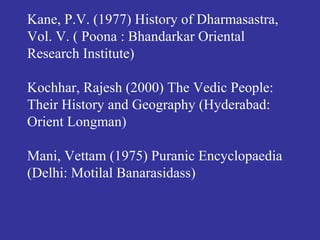
Kane, P.V. (1977) History of Dharmasastra,
Vol. V. ( Poona : Bhandarkar Oriental
Research Institute)
Kochhar, Rajesh (2000) The Vedic People:
Their History and Geography (Hyderabad:
Orient Longman)
Mani, Vettam (1975) Puranic Encyclopaedia
(Delhi: Motilal Banarasidass)
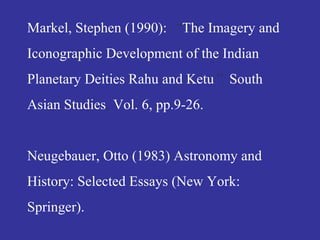
Markel, Stephen (1990): “The Imagery and
Iconographic Development of the Indian
Planetary Deities Rahu and Ketu”. South
Asian Studies, Vol. 6, pp.9-26.
Neugebauer, Otto (1983) Astronomy and
History: Selected Essays (New York:
Springer).
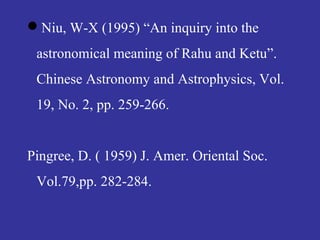
Niu, W-X (1995) “An inquiry into the
astronomical meaning of Rahu and Ketu”.
Chinese Astronomy and Astrophysics, Vol.
19, No. 2, pp. 259-266.
Pingree, D. ( 1959) J. Amer. Oriental Soc.
Vol.79,pp. 282-284.
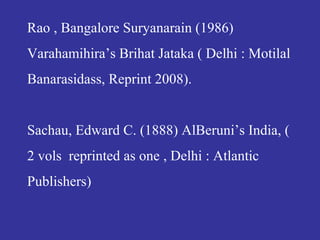
Rao , Bangalore Suryanarain (1986)
Varahamihira’s Brihat Jataka ( Delhi : Motilal
Banarasidass, Reprint 2008).
Sachau, Edward C. (1888) AlBeruni’s India, (
2 vols reprinted as one , Delhi : Atlantic
Publishers)
Shukla, Kripa Shankar (1979) Karana-Ratna
of Devacarya ( Lucknow : Lucknow
University).
Vaidya, P. L. (ed.) (1999 )Divyavadanam
Darbhanga : Mithila Institute).
Whitney, William Dwight (1905) Atharva-
veda-samhita, 2 vols. (Cambridge, USA:
Harvard University).

Scriptures, science and mythology: An ancient Indian astronomical interplay

  • 1.
    Scriptures, science andmythology: An ancient Indian astronomical interplay Rajesh Kochhar Vice-President IAU Commission 41: History of Astronomy Indian Institute of Science Education and Research, Mohali, Punjab rkochhar2000@yahoo.com Belfast 16 November 2011
  • 2.
    Human beings areborn astronomers. Ever since they learnt to walk upright, they have looked at the sky and wondered. The sky has remained the same but its meaning has been changing.
  • 3.
    We can distinguishbetween three phases in humankind’s astronomical pursuits: Propitiatory Phase, Negotiatory Phase, and the Galilean Phase. In the current Galilean phase,
  • 4.
    celestial bodies aremere objects of study and the sky is a laboratory for testing our scientific theories. Although we are a part of the Universe, we now tend to look at it as if from the outside.
  • 5.
    In an earlierera however astronomy was sacred. Human perception of the cosmic environment was an essential input for determining the humankind’s place in the divine scheme of things.
  • 6.
    The Propitiatory andNegotiatory phases were coeval rather than sequential. The Sun and the Moon are part of human evolution. Other planets would also have been noticed very early.
  • 7.
    Since the worldwas anthropo- centric, the Creator would surely keep a watch on the Earthians. His messages would be carried by the moving deities in the sky.
  • 8.
    It was thereforeimportant to monitor these objects. The tapestry of the night sky represented the mysterious immutable part of the cosmos, and served as a convenient backdrop for movements in the sky.
  • 9.
    Ancient Indian perceptionof the dynamic cosmic environment was bipolar. Orbits of the seven geocentric planets (graha) by virtue of their predictability represented cosmic order,
  • 10.
    while phenomena likemeteors, comets and eclipses which did not fit into any pattern were classified as utpata, portent or calamity.
  • 11.
    The beginnings ofastronomy are related to the requirements of the ritual in early cultures. Ritual was a means of securing divine approval and support for terrestrial actions. To be effective,
  • 12.
    the ritual hadto be elaborate and well-timed, so that a careful distinction could be made between auspicious and inauspicious times. Since planetary motions provided a natural means of time keeping ,
  • 13.
    their refined studybecame important. Early astronomical knowledge went into the making of sacred literature and mythology. Even when astronomy developed as a scientific
  • 14.
    discipline in itsown right, it continued to be seen as revealed knowledge rather than deduced. It could not, would not, jettison its historical baggage.
  • 15.
    Before proceeding further,it will be instructive to take note of the nature and limitations of the source material available.
  • 16.
    Source material Oral intellectualtradition. Secondary role for script when used. Perishable writing material. Vedic corpus: no addition, no deletion. Mechanisms to prevent distortion.
  • 17.
    Puranas and epics: addition but no deletion. Scientific texts ( astronomy and health care) have undergone deletions, additions and alterations. .
  • 18.
    In my bookThe Vedic People (2000), I have assigned the bracket 1700-900 BCE to the actual composition of the Rgveda. Its oldest portions may however carry memories of still older times.
  • 19.
    Mahabharata, “the Encyclopedia Brahminica”is believed to have largely acquired “its present
  • 20.
    volume, content andcharacter” by the fourth century CE. Although there are minor additions/ alterations in various recensions/ editions of Mbh after date,
  • 21.
    astronomical content ofMBh was NOT touched. MBh is thus a valuable source for the astronomical knowledge as it stood c. 4th cent. CE.
  • 22.
    An important featureof ancient Indic textual tradition should be noted. These texts are valuable for the statements they explicitly make. But no conclusions should be drawn from absence of mention..
  • 23.
    If the dogbarked, we know the dog was not there. But if the dog did not bark, we do not know whether only the bark was missing or the dog itself was absent.
  • 24.
    In addition tothe Hindu sacred texts, we have Buddhist and Jain sources: written, dated, and very valuable.
  • 25.
    Historiography and geography Thecolonial period British historians denied great antiquity or originality to Indian science. The backlash has produced a school of thought which
  • 26.
    tries to pushchronology backwards and deny all outside influences. This is like discovering great therapeutic value in distilled water.
  • 27.
    History is achild of geography. The Himalayas protect India, but do not isolate it. India’s entire intellectual tradition has been fashioned by a combination of antiquity, continuity and interaction with
  • 28.
    the outside world,especially through the northwest. Before the colonial period, these interactions were unselfconscious and mutual. People and ideas both travelled and were absorbed.
  • 29.
    Foreign words areaccepted in a language. Once absorbed they obey rules of the host language. Similarly, self-confident cultures are open to influences from all over. Ideas once received are assimilated
  • 30.
    and developed furtherin the context of the host culture. This give-and-take is visible in sacred and mathematical astronomy in India, as also elsewhere.
  • 31.
    There are afew stray astronomical references in the Rgveda, but for our purposes the more useful is the Yajurveda. This is understandable because Yajurveda is a manual for actual performance of the ritual.
  • 32.
    There is asolitary Vedic text, Vedanga Jyotisha, devoted exclusively to astronomy. Its oldest portions could be as old as 1400 BCE. As a scientific text, it soon became obsolete. Still, it was .
  • 33.
    preserved because ithad Vedic sanctity. No wonder then that it has been the least understood of the whole corpus.
  • 34.
    Zodiacal signs andweek days are not mentioned in Vedic astronomy. They were introduced into Indian mainstream by the end of 5th cent. from the northwest
  • 35.
    Siddhantic astronomy An importantdate in Indian astronomy is 499 CE when Aryabhata ( b. 476 CE) composed his influential text simply called Aryabhatiyam.
  • 36.
    Aryabhata incorporated Greco- Babylonianelements into his work, integrated zodiacal signs and weekdays into Indian astronomical tradition, and in addition gave, for the first time in the Indian context, the mathematical theory of eclipses.
  • 37.
    For a thousandyears, from sixth century CE till Kepler’s time, Indian astronomers were probably the only ones in the world who could calculate eclipses with any reasonable accuracy. The tradition was alive till early nineteenth century.
  • 38.
    Since the astro-mathematicaltexts were called Siddhantas (“proven in the end”), we may call Indian mathematical astronomy Siddhantic astronomy (a term preferable to, say, Hindu astronomy).
  • 39.
    While astronomical textbooks were known by the name of their authors, their elements were used to upgrade old texts which were claimed to be divine in origin.
  • 40.
    In imitation ofthe Rgveda, astronomical texts were composed in metrical verse, so that an astronomer had to be a poet first. (Unlike the Vedic corpus, no steps were taken to preserve the text in its original form.)
  • 41.
    Cosmic order andhuman ethics There is a beautiful concept linking the divine with the human that goes back to the joint Indo-Iranian times. Called rta in the Rgveda and arta
  • 42.
    (or asa) inthe Avesta, it refers to the cosmic order, not in the sense of impersonal laws of nature as ascertained from the outside, but as an example of righteous cosmic conduct which the humans should emulate.
  • 43.
    The laws regulatingthe behaviour of the planetary divinities are inbuilt into the system. But similar regulation of human conduct can come only from an explicit prescription
  • 44.
    of a codeof ethical conduct. Emphasis on rta / arta is far more pronounced in the Avesta than Rgveda (Varuna vs Indra). This much is well known.
  • 45.
    What follows ismy own speculation. To bring the terrestrial and the celestial closer together, the Vedic people assigned the attributes of one to the other. Planets return to their place in the sky; so do seasons on
  • 46.
    the earth. Buthuman beings are born and die. In analogy with the planets, human beings should also have continuity. To achieve this, the concept of reincarnation was introduced. But in a certain sense
  • 47.
    planets are condemnedto a life of incessant motion. An endless cycle of birth and death would be a punishment rather than a boon. Therefore the concept of what we may call truncated eternity was introduced,
  • 48.
    under the namemoksha or nirvana, whereby a soul is liberated from the constraints of future birth.
  • 49.
    At the moment,we are far more interested in the reverse process, namely, the human attributes assigned to the gods.
  • 50.
    The cyclic time Theconcept of age, birth and death was introduced for the cosmos as a whole, and a cosmic chronology in the form of the yuga system
  • 51.
    was constructed bysuitably scaling up the human calendar. The eternity of the planetary orbits was generalized to set up an oscillating universe without beginning or end.
  • 52.
    Manusmrti (as alsoMahabharata and other texts) constructs an elaborate chronological scheme where large numbers are defined. I have discussed it at length in a paper, which is available on the Net. Here is a very brief summary.
  • 53.
    For those ina hurry, the recipe is this: Multiply 360 by 12 and add zeroes.
  • 54.
    In the Vedictimes, a year comprised 12 months and 360 days. A human year was set equal to a day of the gods, so that a divine year (Dyr) would consist of 360 human years (yr).The divine year in turn was used to construct an elaborate chronology.
  • 55.
    A mahayuga orchaturyuga (great age or four-age) was postulated as made up of four sub-ages or yugas: kali, dvapara, treta and krta, with duration (and virtue) in the ratio 1:2:3:4. Kaliyuga was set equal to 1200 Dyr so that a mahayuga comprised 12000 Dyr. In human years,
  • 56.
    1 Kaliyuga=432,000 years 1Mahayuga=4.32 million years. A still bigger time-span, Brahma’s day (or night), or a kalpa, is defined as equal to 1000 mahayugas: 1 Brahma’s day=4.32 billion years.
  • 57.
    Let us nowcomplicate the matters. It is convenient to use modern mathematical notation to properly follow the details. Let us denote the duration of a mahayuga by m ; and kaliyuga by k.
  • 58.
    Dvapara, treta andkrta are then 2k,3k and 4k respectively, so that m=k+2k+3k+4k=10k. For later reference, let us denote a krtayuga (=4k) by s. Then 6m=60k=15s.
  • 59.
    Let us nowmake matters more complicated: 1 kalpa=1000m = 994m + 6m =14 x 71m +15s =14 x 71m +14 s+ s = s+14(71m + s).
  • 60.
    Let us call71m a Manvantara (Manu’s interval) so called because this span is presided over by a ruler designated Manu. (There are thus 14 Manus.) We can now describe a kalpa in words.
  • 61.
    1 kalpa=s+14(71m +s) A kalpa begins with a dawn equal to a krtayuga. This dawn is followed in succession by 14 Manvantaras, at the end of each of which there occurs a deluge (pralaya) lasting a krtayuga.
  • 62.
    This complex schemehas perplexed many modern-day commentators. Thus, Rev. Ebenezer Burgess in his famous 1860 annotated translation of the Surya Siddhanta wondered:
  • 63.
    “Why the factorsfourteen and seventy - one were thus used in making up the Aeon [kalpa] is not obvious” (Burgess 1860:11). I think this scheme was constructed working backwards from the neat round figure of 1000.
  • 64.
    It is noteworthythat though the scheme is cosmological, it brings in political rulers ( Manu), thus combining the celestial with the human.
  • 65.
    The yuga nomenclaturewas borrowed by the Puranas in the context of political history. A total of about 94 past royal generations were split into the three yugas: krta (or satya), treta, and dvapara.
  • 66.
    The Puranic kaliyugabegan with the Mahabharata war.(the date of the text is independent of the date of the event.)
  • 67.
    Note that theyuga scheme is inherently optimistic. Kaliyuga is the worst period but mercifully it is the shortest. And satyayuga is round the corner.
  • 68.
    This “fact” wasinvoked to arouse feelings against the British rule. There was however one significant difference. Earlier, time had flowed at its own pace.
  • 69.
    Now people wereexhorted to hasten it the end of kaliyuga under the British and usher in the satyayuga. (Has not worked out quite that way, but that is a separate mater.)
  • 70.
    For the sakeof continuity with the scriptures, the yuga scheme was borrowed by the astronomers. Instead of conveniently expressing planetary revolutions in a million or a billion years,
  • 71.
    an astronomer wouldsay that there are 146,568 revolutions of Saturn in a mahayuga, implying an orbital period of 29.4743 years.
  • 72.
    The mix-up betweencosmological yuga and the Puranic yuga has produced great confusion. Timescales of hundred thousands of years have been assigned to kings and events.
  • 73.
    Unwittingly or otherwise,Aryabhata has added to the confusion in a very influential way. He uses the yuga system all right, and for his own reasons fixes the beginning of his kaliyuga at 3102 BC.
  • 74.
    While referring tothe beginning of his kaliyuga, he explicitly but unnecessarily refers to the Mahabharata battle. The result is that the hypothetical astronomical epoch of
  • 75.
    3102 BCE hasbeen erroneously taken to be the date of the historical Mahabharata battle.
  • 76.
    The most interestinginterplay of scriptures, scientific knowledge and mythology is provided by the treatment of eclipses.
  • 77.
    Vedic Rahu andKetu Rgveda (5.40.5-9) tells us that Svarbhanu, son of an asura, pierced the sun “through and through with darkness”.
  • 78.
    The Sun himselfappealed to Atri (the poet who wrote this): “Let not the oppressor with this dread, through anger, swallow me up, for I am thine, O Atri”. Responding quickly,
  • 79.
    Atri caused Svarbhanu’smagic arts to vanish. (Griffith 1896, p. 255) . What the Atri probably did was to chant mantras while the eclipse lasted.
  • 80.
    The Rgvedic descriptionis significant. An eclipse was seen as the demon’s work in disrupting the cosmic order. Propitiation was needed to restore that order.
  • 81.
    Subsequently, the nameof the demon was changed to Rahu, who appears for the first time in Atharvaveda (19, 9-10).
  • 82.
    The Rahu legendwas adopted by the Buddhists to add to Buddha’s glory. The Pali Buddhist sources refer
  • 83.
    to the Moonand the Sun freeing themselves from the clutches of Rahu by invoking Buddha’s name. (Chandima Sutta, Samyutta-nikaya 2.9; Suriya Sutta, Samyutta-nikaya 2.10).
  • 84.
    Atharvaveda (13.16-24) employsketu to mean ray of light. Typically ketu meant combination of fire and smoke. At one place ketu means either a comet or smoke from a funeral pyre. But generally, ketu denoted comets and meteors.
  • 85.
    Puranic Rahu andKetu Interestingly, critical questions were asked within the mythological framework also. If the demon Rahu devours the Sun or the Moon to cause an eclipse,
  • 86.
    how do theybecome visible again? The answer is provided by the well - known story of samudramanthana (churning of ocean), described in Mahabharata, Vishnupurana and elsewhere. In this elaborate story,
  • 87.
    the demon Rahu’shead is chopped off, which survives. It is the Rahu head which causes an eclipse. Since the rest of the body is missing, there is an escape route for the Sun and the Moon.
  • 88.
    Note that thename Rahu now belonged to the body-less head. The head-less body was placed in the mortuary for later use.
  • 89.
    Mathematical theory ofeclipses According to this theory, solar and lunar eclipses occur when the Moon is at either of its orbital nodes. These theoretical points move in a direction opposite to that of the
  • 90.
    planets and completean orbit in the rather short period of 18.6 years. At this stage, astronomers could have declared: We understand how eclipses take place. We can even predict them.
  • 91.
    We do notneed eclipse demon any more. But, no body was ready for a break with the past.
  • 92.
    The two nodeswere classified as planets, implying that they were now amenable to mathematics. Since they were hypothetical, they were dubbed shadow planets.
  • 93.
    And since theywere planets, they had to be named . It was decided to call them Rahu and Ketu .
  • 94.
    Since the twonodes are 180 degrees apart, naming one would have been sufficient. Both were listed no doubt to bring the planetary number up to nine which was considered sacred and magical.
  • 95.
    If brand newnames had been used, matter would have rested there. Both Rahu and Ketu are terms of Vedic vintage. The term Rahu had previously been used
  • 96.
    in connection witheclipse so that its deployment represents an attempt at integrating new scientific developments with ancient tradition.
  • 97.
    Rahu now ceasedto be an utpata; its predictability however did not remove the fear associated with it. Thanks to mathematical astronomy, Rahu was now a demon who came by appointment.
  • 98.
    Another demon wasneeded for the other node. Mythology was accordingly expanded to take note of the new scientific developments.
  • 99.
    The torso whichhad been lying lifeless after the detachment of the Rahu head was now resurrected and for some reason named Ketu.
  • 100.
    At the sametime, Ketu continued to be used in the older sense (comets, etc.) also, creating great confusion.
  • 101.
    Brhatsammhita (5:1-3) alsorefers to a prevalent alternative belief that Rahu is of a serpentine form with only the head and the tail. This was an Iranian myth. We do not know
  • 102.
    whether it hadreceived arrived into India or whether the author Varahamihira was placing on record a myth which was already known. So, here we have an example of commonality or migration of myths.
  • 103.
    I have arguedthat inclusion of the demon Rahu in the list of mathematically tractable planets took place after 499 CE. Support for this conclusion comes from iconographic data.
  • 104.
    Puranic Rahu occursin a relief of the ‘Churning of the Ocean’ carved over the façade of the doorway of cave- temple number nineteen at Udayagiri in the Vidisha district of
  • 105.
    Madhya Pradesh, whichcan be dated to ca. 430-450 CE. Earliest known representations of Rahu as a member of the planetary deities are those on two stone lintels, 100cm by 20cm, originally
  • 106.
    from the villagesof Nachna and Kuthara in the Panna district in the Bundelkhand region of Madhya Pradesh.
  • 107.
    They were mostlikely sculpted during the reign of the Uchchakalpa king Jayanatha (r. ca. 490-510 CE) ( Markel 1990, pp. 11-13).
  • 108.
    If the assigneddates are correct, it is remarkable that Rahu’s planetization occurred within a decade of Aryabhata’s theory.
  • 109.
    Ketu as aplanetary deity had to wait. He appears in about 600 CE or a little later, in Uttar Pradesh.
  • 110.
    In the easternstate of Orissa, Ketu was not counted in until the tenth century, which thus had only eight grahas till then (Markel 1990, p. 21).
  • 111.
    One wonders whetherit was from Orissa that Rahu as Yahu travelled to Burma as one of the eight nats (spirits).
  • 112.
    Astronomical literature employsthe term Rahu in connection with eclipse, in a number of ways. Aryabhata does not use either Rahu or Ketu; he and following him many others refer to a node as pata.
  • 113.
    Otherwise brilliant Brahmagupta(b. 598CE) took time to reconcile tradition with science. Fortunately he lived long enough to be able to do so.
  • 114.
    In his earlierwork Brahmasphutasiddhanta ( 628 CE), he expresses his faith in the demon Rahu as the cause of eclipse. Al Biruni noted this (Sachau 1888, Vol. 2, p. 110).
  • 115.
    In his latertext, Khandakhadyaka (665 CE), however, Brahmagupta calculates eclipses in a matter-of-fact way. He now
  • 116.
    uses the technicalterm pata and does not name Rahu or Ketu (Chatterjee 1970, pp. 80-85). The later, secondary, texts however do use the term Rahu.
  • 117.
    The 689 CEastronomical handbook Karanaratna by Devacharya (Shukla 1979) uses Rahu to denote the eclipse shadow (2.2) as well as the ascending node (e.g. 1.15). Significantly, at one place (1.13)
  • 118.
    the ascending nodeis called Rahumukha (Rahu head). A tersely written basic astronomical text will have no reason to mention Ketu. As comet, meteor or the like, Ketu lay outside the scope of theory while
  • 119.
    as descending nodeit would be redundant once the ascending node Rahu or pata was mentioned.
  • 120.
    In later Iranianand Arabic mythology Rahu and Ketu become the head and the tail of the dragon Al-Djawzahr. Ketu as comet is remembered as al-Kayd (Hartner 1965).
  • 121.
    Rahu and Ketuas part of mathematical astronomy were introduced into China during the Tang dynasty (618-907 CE), but with modified meaning.
  • 122.
    While Rahu wasretained in the sense of the lunar ascending node, Ketu was used as a designation for lunar apogee (Niu 1995) .
  • 123.
    The imagery andiconography of Rahu and Ketu have evolved over time, with the Ketu having been more difficult to conceptualize. While Rahu has been well-defined since the days of the
  • 124.
    samudramanthana story, Ketuhad in the sixth century CE the eclipse role thrust upon him in addition to the cometary ( and not the other way round as Neugebauer (1957, p. 211) suggests).
  • 125.
    Spin of theearth Aryabhata believed in the spin of the earth and said so in his work. This however never became a part of the mainstream.
  • 126.
    He was severallycriticized for this by his “adversaries”.
  • 127.
    Even later astronomersbelonging to his own school felt so embarrassed that they tried to change a word here and there in his work to convey the impression that the great master
  • 128.
    like everybody elsetook the earth to be non-spinning. And yet the Skanda Purana (1.1.31.71) describes the earth as revolving like a bhramarika (spinning top).
  • 129.
    Here we havean example of a “religious” text subscribing to a scientific view even though the scientists did not.
  • 130.
    Quite obviously, therewas a time when mythology was open in the sense it would take note of the developments in science and in fact could even take sides.
  • 131.
    It is amost remarkable fact that no religious book or revealed text has ever contradicted the scientific knowledge that prevailed at the time of its composition.
  • 132.
    At some stage,religious tradition gets frozen, while science marches on. When and how did scriptures and mythology on one hand and science on the other became antagonistic?
  • 133.
    I would liketo close on a contemporary note.
  • 134.
    In India andamong Non Resident Indians there is a flourishing industry which discovers all modern “Western” scientific developments in ancient texts.
  • 135.
    On the faceof it, it looks laughable, but it serves an important purpose. It enables the majority community in India to accept modern scientific developments without feeling culturally threatened.
  • 136.
    Contrast it withthe situation with some extremist Muslim groups which treat modern science as part of Western civilization package.
  • 137.
    As part ofthe globalization-era boom, the number of malls and multiplexes has drastically increased in India in recent times. This has been noticed.
  • 138.
    An even morestriking phenomenon however has gone un-noticed. The number of temples dedicated to the malignant planet Saturn (Shani) have multiplied even more.
  • 139.
    This is becauseof the insecurities in the new economy. The malignant planet Saturn (Shani) is now represented by your private sector manager.
  • 140.
    You did notneed to appease Saturn if you had a government job.
  • 141.
    Rise of individualismnow demands pseudo-mythology. In the era of classical mythology, eclipse was supposed to exercise a class effect.
  • 142.
    (Bad for pregnantwomen; bad for people of such and such region, etc.). But this is an era of individual ambitions, rivalries and jealousies.
  • 143.
    People are nowdemanding of the astrologers that an eclipse have a differential effect , related, e. g., to an individual’s zodiacal sign.
  • 144.
    Emergence of pseudo-mythologyis an entirely new phenomenon, worthy of detailed study. I anticipate new developments in pseudo-mythology to cope with current financial developments.
  • 145.
  • 146.
    Concluding remarks I nowreturn to the main thesis of the paper,
  • 147.
    Mathematical astronomy could neversever its links with sacred astronomy. (yuga theory, Rahu as lunar node).
  • 148.
    Mythology returned the complimentby taking into account scientific developments ( two eclipse demons in place of one.)
  • 149.
  • 150.
    References Bhat, M. Ramakrishna(1981) Varahamihira’s Brihat Samhita (Delhi: Motilal Banarasidass). Burgess, Ebenezer (1860) The Surya Siddhanta (reprint; Delhi: Motilal Banarsidass, 2005)
  • 151.
    Chatterjee, Bina (1970)The Khandakhadyaka of Brahmagupta with the commentary of Bhattotpla, Vol. I. ( Delhi: Motilal Banarasidass). Dikshit, Sankar Balakrishna (1896) History of Indian Astronomy (English translation by R.V. Vaidya), Pt I, 1968; Pt II, 1981. (New Delhi: India Meteorological Department).
  • 152.
    Griffith, Ralph T.H. (1896 ) The Hymns of the Rgveda ( Reprint, Delhi : Motilal Banarasidass, 1973). Hartner, W. (1965) “ Al-Djawzahar”. In :Encyclopedia of Islam,Vol.2 ( Leiden: Brill), pp.501-502.
  • 153.
    Kane, P.V. (1977)History of Dharmasastra, Vol. V. ( Poona : Bhandarkar Oriental Research Institute) Kochhar, Rajesh (2000) The Vedic People: Their History and Geography (Hyderabad: Orient Longman) Mani, Vettam (1975) Puranic Encyclopaedia (Delhi: Motilal Banarasidass)
  • 154.
    Markel, Stephen (1990):“The Imagery and Iconographic Development of the Indian Planetary Deities Rahu and Ketu”. South Asian Studies, Vol. 6, pp.9-26. Neugebauer, Otto (1983) Astronomy and History: Selected Essays (New York: Springer).
  • 155.
    Niu, W-X (1995)“An inquiry into the astronomical meaning of Rahu and Ketu”. Chinese Astronomy and Astrophysics, Vol. 19, No. 2, pp. 259-266. Pingree, D. ( 1959) J. Amer. Oriental Soc. Vol.79,pp. 282-284.
  • 156.
    Rao , BangaloreSuryanarain (1986) Varahamihira’s Brihat Jataka ( Delhi : Motilal Banarasidass, Reprint 2008). Sachau, Edward C. (1888) AlBeruni’s India, ( 2 vols reprinted as one , Delhi : Atlantic Publishers)
  • 157.
    Shukla, Kripa Shankar(1979) Karana-Ratna of Devacarya ( Lucknow : Lucknow University). Vaidya, P. L. (ed.) (1999 )Divyavadanam Darbhanga : Mithila Institute). Whitney, William Dwight (1905) Atharva- veda-samhita, 2 vols. (Cambridge, USA: Harvard University).